Melchizedek and Jerusalem
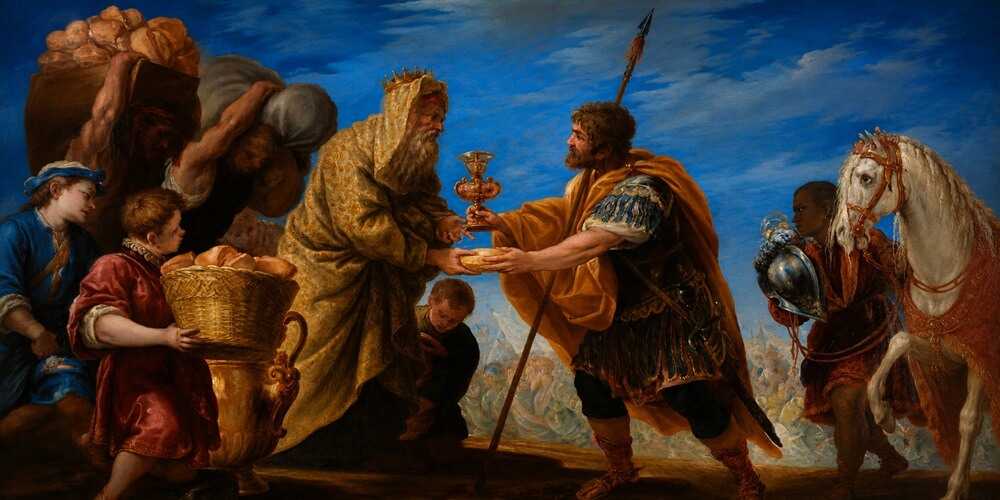
The first legendary figure associated with Jerusalem is Melchizedek, king of Salem. After Abraham’s battle with four Canaanite kings, during which he rescues Lot, his nephew, and after meeting the king of Sodom in the “Valley of the Plain, which is the King’s Valley,” Abraham receives Melchizedek’s blessing. As it is written:
“Then Melchizedek king of Salem brought out bread and wine. He was priest of God Most High, and he blessed Abram, saying, “Blessed be Abram by God Most High, Creator of heaven and earth. And praise be to God Most High.” (Genesis 14:18–20)
If we consider Canaanite language and mythology for a moment, “Yeru” means city, and thus Jerusalem is the city of Shalem—the Canaanite god of sunset, the afterlife, health, and protection. In addition to Shalem, Jerusalem was identified with the Canaanite father of the gods, called “El Elyon” or simply “El.”
Melchizedek, king of Salem, was a priest of the Supreme God and was therefore probably the king of Jerusalem, since kings were also high priests. The name of the king of Jerusalem may have been traditionally associated with a local god or concept called “Zedek,” since Joshua also fought against “Adoni-Zedek,” king of Jerusalem, who was one of the five kings that allied against the Hebrew invasion[1].
Melchizedek blesses Abraham with wine and bread—an act that naturally reminds us of the Christian Eucharist. But if Melchizedek, King of Salem, was a priest of the Supreme God, then there must have been a temple in Jerusalem where he worshiped. Every priest must have a temple in which to perform his duties—especially a high priest serving the head of the Canaanite pantheon, “El” (a name the Jews inherited from the Canaanites).
The relationship to the Gods and the Sacred also forms the basis for the construction of cities, which, according to the Sumerians, were models of the heavens given to humans by the gods. However, due to the extensive construction in later periods, it is difficult to believe such a temple could ever be found.
In Psalm 110:4, there is another reference to Melchizedek: “The Lord has sworn and will not change his mind: “You are a priest forever, in the order of Melchizedek”.
Philo of Alexandria identified Melchizedek with the Logos, and one of the Qumran scrolls is called the Melchizedek Scroll, in which he appears as a divine figure who hastens redemption.
In Paul’s Epistle to the Hebrews, Jesus is identified with Melchizedek. As it says in chapter 7:1-3 “This Melchizedek was king of Salem and priest of God Most High. He met Abraham returning from the defeat of the kings and blessed him, and Abraham gave him a tenth of everything. First, the name Melchizedek means “king of righteousness”; then also, “king of Salem” means “king of peace.” Without father or mother, without genealogy, without beginning of days or end of life, resembling the Son of God, he remains a priest forever.”
The Slavonic Book of Enoch also glorifies Melchizedek and turns him into a mythical figure similar to Enoch or Jesus.
In other words, Melchizedek becomes a larger-than-life figure—one of the enlightened teachers and priests who have guided humanity since ancient times. He is similar to other mythical figures such as Enoch and Elijah.
In someof the ancient Gnostic scrolls found at Nag Hammadi (Gospel of Philip, The Book of Melchizedek), Melchizedek is presented as an enlightened teacher belonging to the sons of Light, and even today, Melchizedek remains a popular figure in New Age teachings and spiritual schools. His name is associated with the Chariot (Merkavah), enlightened extra-planetary beings, and more.
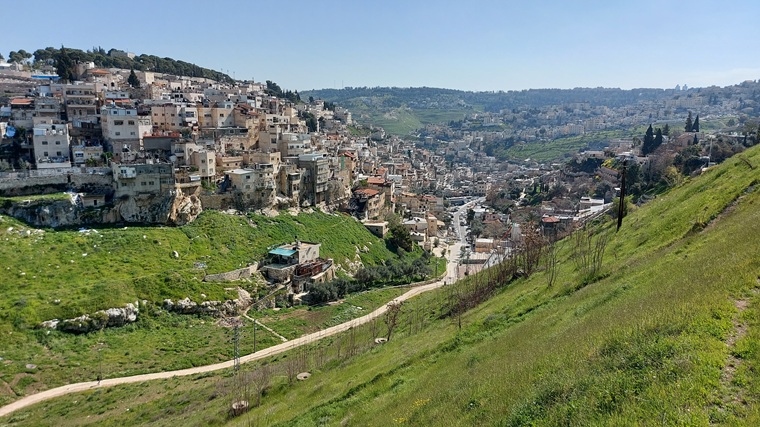
The Kidron Valley and the Village of Shiloah Jerusalem
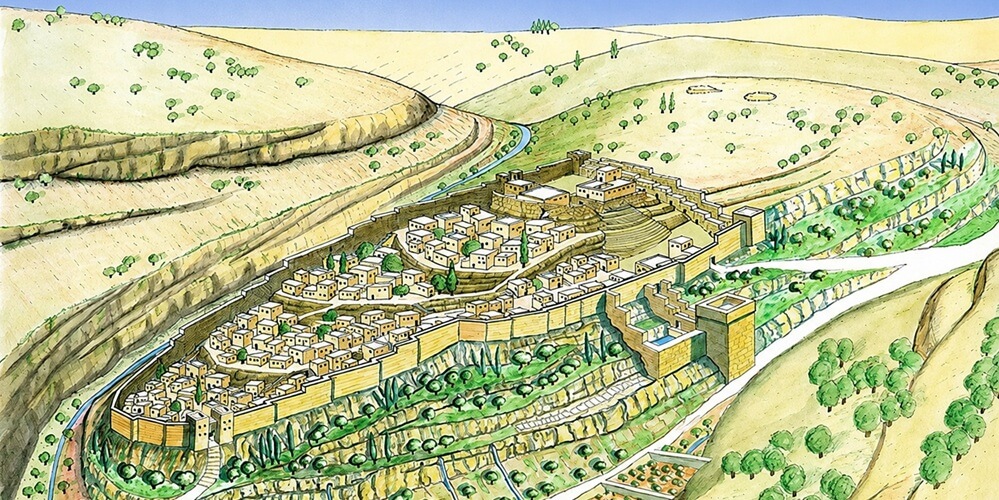
Jebusite Jerusalem
If the meeting between Abraham and Melchizedek did indeed take place, it should be dated to the period when the Hyksos ruled Jerusalem—or perhaps even earlier, during the Middle Egyptian period (17th–18th centuries BCE). Between the time of Abraham and the reign of Akhenaten (14th century BCE), Indo-European settlers—specifically Hurrians from the kingdom of Mitanni (in northern Iraq)—arrived in Jerusalem and founded a new city there. They may have been craftsmen and were therefore summoned to the city, which was a regional center of craftsmanship and religious worship. In ancient times, craftsmanship was considered sacred, performed with divine blessing and closely associated with temples.
The name of the king of Jerusalem in the 14th century BCE, as recorded in the Amarna Letters (Akhenaten), is Abdi-Heba. “Heba” was the mother goddess of the Hurrians, and her name means “Lady of the Sky.” Hence, the name Abdi-Heba likely means “servant of the goddess Heba,” implying that Jerusalem was a center of worship for the Hurrian sky goddess.
Furthermore, the name Zion may derive from a Hurrian deity known as The Illuminator, suggesting that the Citadel of Zion means Citadel of the Luminous Sky. The man who sold the Temple Mount area to King David was Araunah the Jebusite. In ancient Hurrian, “Araunah” (or Arnon) can mean “lord.” Even in Egyptian texts, Canaan is described as “the land of the Hurrians.”[2]
Some scholars identify the Hurrians with the Jebusites, one of the seven nations of Canaan, based on linguistic similarities. They also note that the Hittites, another Canaanite nation, were of Indo-European origin and may have arrived during or before Egyptian rule. It is even possible that the Jebusites and the Hittites were closely related, as evidenced by Uriah the Hittite, a resident of Jerusalem.
The Hittites established an empire in much of modern-day Turkey and competed with Egypt for dominance during the Late Bronze Age. They eventually conquered the Hurrian kingdom of Mitanni, and a mixing of populations may have occurred.
Joshua ben Nun fought five Canaanite kings, including Adoni-Zedek, king of Jerusalem, and defeated them. The Book of Judges tells us that the tribe of Judah set fire to Jerusalem, yet the Bible explicitly states that the Israelites were unable to expel the Jebusites, who remained in their stronghold in Jerusalem (Joshua 15:63). Some claim that the Jebusites arrived in the city only after the Israelite tribes had settled the land, replacing the previous inhabitants.
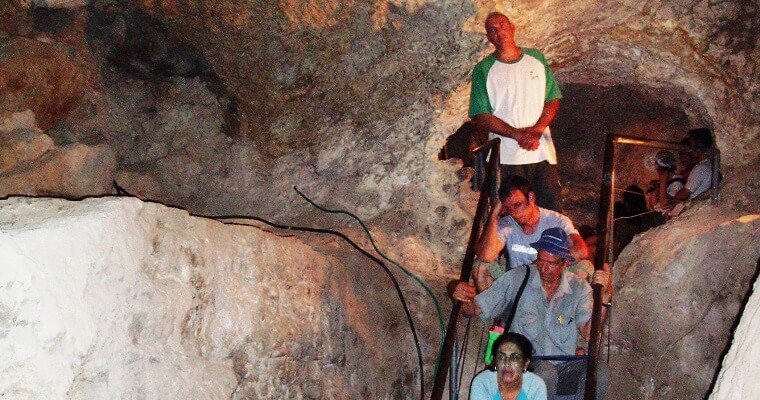
In 2005, archaeologist Eilat Mazar discovered a large stone structure in the upper part of the City of David [3]. She claimed it was the remains of King David’s palace. However, other archaeologists, including Amihai Mazar, suggested that the structure was actually part of the ancient Jebusite fortress that the Israelites conquered during David’s time—only after discovering a secret water shaft leading into the city, known today as the Warren Shaft. The remains of this large structure, along with the shaft and the Stepped Stone Structure supporting it (in Area G), can be visited today in the City of David Archaeological Park.
Finally, a theory known as the “Jebusite Integration Theory” [4] proposes that after King David’s conquest of Jerusalem, the Jebusites were not exterminated but rather assimilated into the Israelite population. This theory is supported by the absence of any biblical account of mass killing after the conquest and by the fact that several prominent figures in David’s court were of Jebusite origin. These include Bathsheba, Nathan the prophet, and most notably, Zadok the priest. In this view, the Jebusite high priesthood was absorbed into Israelite religion and Zadok became the head of the new priestly line in the Jerusalem Temple.
The theory is reinforced by the linguistic similarity between “Zadok” and “Zedek”—the name or title of the Jebusite priests of Jerusalem (as in Melchizedek). The Zadokite priesthood appears only after the conquest of Jerusalem, replacing the previous priestly family of the House of Eli, and goes on to become the dominant priestly family in the First Temple period.
The New Iron Age
The Exodus probably took place at the end of the reign of King Ramesses II, in the 13th century BCE. The events of the Exodus, the settlement of the Israelite tribes in the Land of Israel, and the establishment of the Kingdom of Israel occurred during a time of global historical change—a major crisis and collapse of civilizations known as the Late Bronze Age Crisis—which paved the way for the transition from the Bronze Age to the beginning of the Iron Age.
History begins with the emergence of city-states in Mesopotamia and the unification of Egypt, which is accompanied by the invention of bronze and is therefore considered the beginning of the Bronze Age. The historical development of the Egyptian and Mesopotamian cultures reaches its peak in the 16th–13th centuries BCE, along with the emergence of large and developed kingdoms in Turkey and Greece and city-states in the Levant. The New Kingdom of Egypt, the Hittite Kingdom, the Mycenaean kingdoms, the city-states of Syria, and the Babylonians come to a division of power and spheres of influence among themselves and enjoy a period of cooperation and prosperity, a flourishing of international trade and creativity. However, an unexplained crisis occurs that leads to the collapse of the Hittite and Mycenaean kingdoms, the destruction of the independent Syrian cities, the weakening of Egypt, and the temporary disappearance of the Babylonians—a crisis known as the “collapse of the Late Bronze Age.”
A combination of climatic changes, droughts, earthquakes, and social and material transformations led to the migration of warring peoples who left their homelands in the steppes and elsewhere and invaded the civilized world. This caused destruction, devastation, a severe setback in international trade, and a dramatic decline in material culture and writing. The Sea Peoples, of whom the Philistines were a part, arrived in our region, probably from the Greek islands and regions of Greece and Italy—warring peoples who first tried to conquer Egypt and eventually settled on the southern coast of the Land of Israel. On their way, they destroyed the Hittite kingdom; the Dorians arrived in Greece, the Arameans and Chaldeans in Mesopotamia, and so on. Mostly, it was Indo-European peoples arriving from the north and Semitic peoples from the south.
However, in every chaotic and destructive time there is also the possibility of a new beginning. The Exodus of the tribes of Israel from Egypt, their settlement in the land, and the establishment of the Israelite kingdom were made possible within the framework of these changes.
It is possible that the crisis at the end of the Bronze Age was due to a prosaic reason: a severe shortage of tin, which was necessary to create bronze, the foundation of ancient civilizations. Tin was brought from distant places such as England, its quantities were limited, and it is possible that its resources were exhausted.
Be that as it may, it became necessary to find a replacement for the metal used to make tools, and this was found in the form of iron. The problem with iron is that its melting temperature is higher and its production processes are more complex, but developments in metallurgy meant that in the first millennium BCE, iron could be produced relatively cheaply and easily. This led to improvements in tools and agriculture, enabled more intensive settlement by invading peoples, and allowed for the production of stronger weapons that facilitated conquest, as well as the later use of iron in construction.
If we accept the spiritual assumption found in various religions and traditions—that there are hidden threads connecting events (synchronicity), and that there is causality and purpose in historical development – some kind of guiding hand sent from the future—then the transition from the Bronze Age to the Iron Age has meaning. The question is, what is that meaning? Why did it happen, and where did it lead?
We can begin to look at the issue through the properties of bronze versus iron. The production of bronze is a combination of two metals—an alchemical process that transforms both. It requires the use of tin, imported from afar, and was therefore a monopoly of rulers. Iron, on the other hand, is more common, and its production became more democratic. The development of methods for producing iron made agricultural and mechanical tools more accessible to small communities. Stronger tools enabled the cultivation of hard lands that could not be farmed before. Thus, the Israelites could settle in the mountainous regions, cut down trees, build terraces, and plow the hard soil. The transition to iron allowed for the establishment of tribal kingdoms instead of large empires.
Spiritually and energetically, iron is associated with war and the planet Mars. Therefore, the use of iron and iron tools was prohibited in the construction of the Temple. Copper, on the other hand, is associated with Venus, and tin with Jupiter—two of the brightest celestial bodies in the sky—and bronze is made from both of them. Bronze takes on a bluish-green hue, whereas iron rusts to red.
Hesiod, in his book Works and Days, describes five generations of people, each associated with a metal, with each generation declining in quality over time. First comes a golden generation, then silver, then bronze, then a generation of heroes, and finally the iron generation.
The Iron Age symbolizes the beginning of the era of wars in the world. But as Heraclitus said, war is the mother of all things. Struggle leads to development, innovation, and the fulfillment of human potential. The transition from the harmonious stillness of the late Bronze Age to the chaos of the early Iron Age led to cultural growth and the breaking of the religious-magical monopoly of the great temples. This allowed for the emergence of new ideas such as monotheism. The mixing of ideas and cultures made the world universal for the first time. The new Iron Age kingdoms introduced new concepts to the world, breaking existing frameworks and generating change—for better or for worse.
It seems that 3,200 years ago, the ancient world “ran out of steam.” Its spiritual sources of nourishment were cut off, and everything that had once seemed important suddenly lost meaning. The Golden and Silver Ages ended, as did the harmonious Bronze Age, as Hesiod describes, and the Iron Age began—an age of difficulty, struggle, and disharmony. Physical power came to dominate, but at the same time the distinction between the physical and the spiritual was sharpened. In the midst of all this, a small people introduced universal values to the world—values that were ahead of their time—and managed to interpret the strange course of history as a divine revelation.
Footnotes
[1] The other four kings were of Lachish, Eglon – probably the ruins of Beit Mirsim, Jarmuth – near Beit Shemesh, and Hebron.
[2] The Hurrians were culturally and ethnically close to the Hittites; in the list of the seven nations of Canaan that should be inherited, the Jebusites appear after the Hittites, and some have claimed that they are the same people.
[3] Mazar, E. (2009). Armon ha-Melekh David: ha-ḥafirot be-rosh Giv‘at ‘Ir David: Pirsum rishoni shel onot 2005–2007 [The palace of King David: Excavations at the summit of the City of David, first publication of the 2005–2007 seasons]. Shoham Academic Research and Publication. (in Hebrew)
[4] Rowley, H. H. (1950). Melchizedek and Zadok. In Festschrift Alfred Bertholet (pp. 461–472). Tübingen: Mohr Siebeck.