
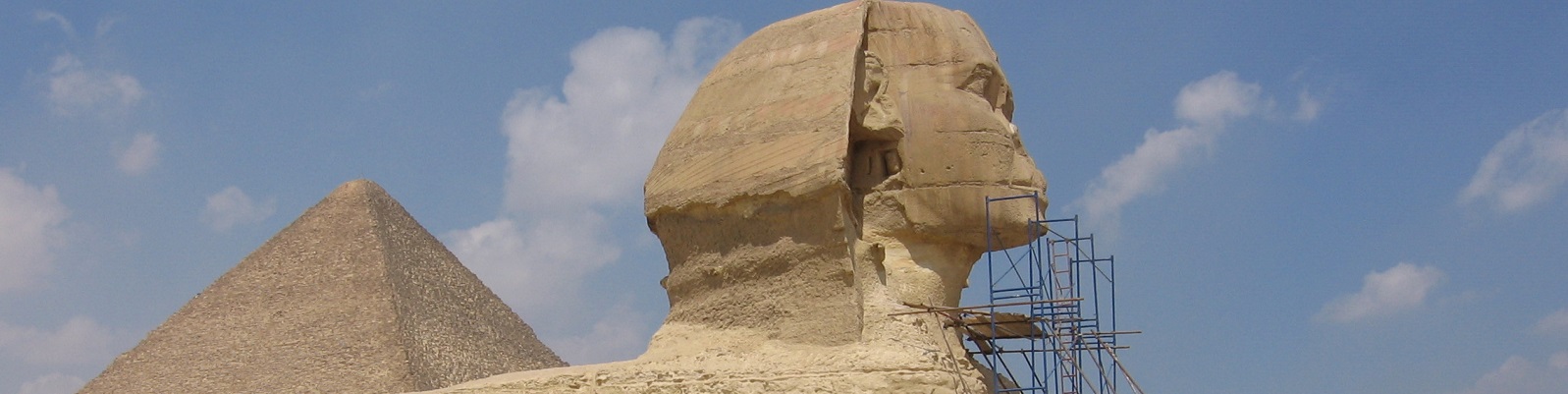
Egyptian Spirituality in Jerusalem
With the establishment of the kingdoms of Egypt and Sumer, and the first cities throughout the Fertile Crescent, including the Land of Israel 5,500 years ago, a religious revolution occurred in which people began to believe in gods who came from the sky and possessed superhuman powers. This revolution led to the construction of temples and the appointment of kings and priests, whose role was to mediate between humans and the gods. The first cities developed around the temples, becoming the nucleus of the new kingdoms, which represented a more advanced form of social organization [1].
The significance of God’s presence on earth was enormous. This brought about the fertility of the fields, moderated the weather, enabled a connection to the muses and wisdom in humans, and provided magical protection for the land and the nation, provided that the divine laws were observed. As long as God was in the sky, he only observed what was happening and did not intervene, but when he had a house to dwell in, he could be visited, to receive blessings, energy, inspiration, healing, guidance and comfort – both collectively and individually. Therefore, humans built temples to the gods, sometimes combined with huge structures called ziggurats in Sumer or mastabas in Egypt.
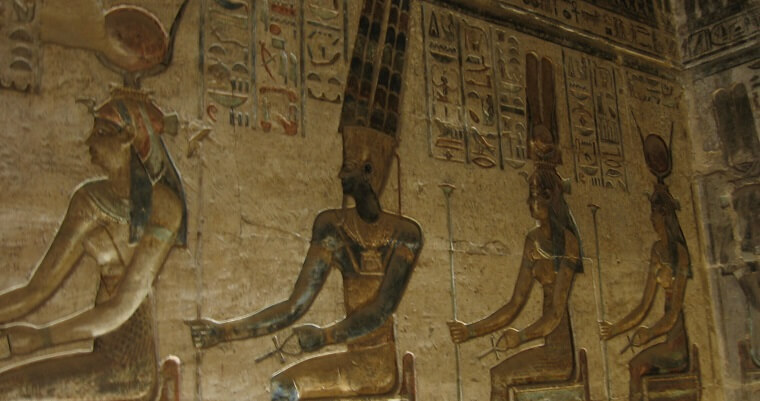
Contrary to popular belief, cities were not established for security reasons, and temples were not built after cities had already been founded—the process was the other way around. First, temples were constructed, with a priestly class serving the new gods who came from the sky, and only then were cities built around them. As a result of the construction of these large temples, writing, laws, and a new form of organization developed, which required a ruling class of priests and kings. At least, that is what historian and archaeologist Gordon Childe, who coined the term “urban revolution”, argued [2].
The establishment of the first kingdoms was accompanied by enormous building projects, the main reason for which was religious. The new culture and way of life sought to prove their power, and this was expressed in large engineering projects, both for economic well-being, such as digging irrigation canals, and for the gods in the form of temples, ziggurats, and pyramids. The gods taught humans writing, medicine, law, religion, a form of social organization, construction and engineering, and the science of magic, which served as a tool to communicate with them and summon their powers.
Today we are educated to think that no matter where we are, what is important are the feelings we have in our heart and the thoughts we have in our mind. A person can connect with God anywhere, depending on what is inside them. Without entering into any judgment, this is a type of thought and expression of a culture that I call “mystical culture,” which was introduced to the world by Moses at Mount Sinai, and the religion that spread it is Judaism. The Torah says, “You shall love the Lord your God with all your heart, with all your soul, and with all your might; and these words which I command you today shall be on your heart” (Deuteronomy 6:6-7). The “commandments” are the Ten Commandments, and they are engraved on the heart and are kept by the power of love. Judaism imparted to the world the moral and mystical concept, and this is one of the two foundations on which Western culture and way of thinking were built (the other foundation is the logical-scientific thought and art of the Greeks).
In the ancient cultures of Egypt and Sumer, it was not enough to love the gods in one’s heart (although this was very important), but one had to take certain actions in order to approach them, actions that stemmed from the science of magic. What a person thought and felt was largely determined by the shape of the building in which he was staying, the color of the walls, the clothes and jewelry he wore, and so on, as well as by rituals of purification and affirmation, spells and other magical actions. A person’s thoughts and feelings were largely determined by what existed outside of him, from the arrangement of the stars in the sky to the materials with which he came into contact with. This is a magical way of thinking that has deteriorated over the years into superstitious beliefs in amulets and the evil eye, and is therefore considered by us to be primitive and inferior.
The ancients believed wholeheartedly in the existence of parallel spiritual worlds and that they were the decisive factor in our lives. Those worlds were ruled by the gods, and were connected to the energetic parts of the human body, such as the mind and the soul. The source of all things is found in the spiritual worlds, where the laws that governs the world of phenomena exist. This appears in the Egyptian religious way of thinking, as well as in the Mesopotamian, and is expressed in belief in a variety of subjects, from astrology and numerology to fields bordering on the mystical on the one hand and the logical on the other, such as music, architecture and art [3].
With the beginning of history, developed and complex magical systems of thought appeared in the Egyptian and Sumerian cultures that related to humans and their environment, centered on the gods, supreme representations of humans and animals in their simplistic sense, and manifestations of cosmic forces and principles in their deeper sense. These new religious systems of thought are the reason and explanation for the formation of cities, which were a new type of human settlement, and for the development of schools, writing, mythology, music, poetry, and especially a new type of religion and spirituality that is expressed in the establishment of temples, religious worship, and priesthood.
The most advanced culture at the beginning of history was the ancient Egyptian culture, which believed in the existence of energetic worlds outside of man, spiritual parts within him, life after death, and developed the theme of architecture and sacred art as a way to summon divine powers [4]. In Egypt, what determined was the spell you said, the amulet you wore, and the temple you visited, but all this was only in addition to a moral life and the observance of the principles of “Ma’at” (truth), the sacred order of creation, both personal and collective. The Egyptian symbol of truth was a feather, which was placed on the scales on which a person’s heart was weighed after death
The role of humans and the ruler at their head (pharaoh) was to maintain and preserve this order. Therefore, in a magical culture such as that of Egypt, great importance was attached to the layout of cities, buildings, the shape of houses and temples, the orientation, proportions and dimensions, arrangement, interrelationships, and so on. In addition, the temples and cities represented the universal order, were a mirror image of the sky, and were located in special places upon the earth [5].
Magical Spirituality in Jerusalem
Jerusalem is one of the first cities in the world. Although no remains from the earliest historical period have been found there, as they have in other places in the country, such as Tel Yerach, the Liviah complex, Megiddo, and Arad, they may have disappeared over time. However, a little over 4,000 years ago we begin to find massive construction in Jerusalem, in the City of David area near the spring, including towers, a pool, supporting structures, and more. The first archaeological remains date to about 3,800 years ago, near the Gihon spring, where urns decorated with geometric shapes such as squares, grids, lines, and tassels were found, as well as burial caves carved into the rock.
These ancient remains can be interpreted in light of the principles of magic and Egyptian sacred architecture, and not only from a practical point of view. At the beginning of the second millennium BC, people believed in magic. The decorations on the urns and their form (one of the urns was double, like Siamese twins) point in this direction, as does the burial near the spring.
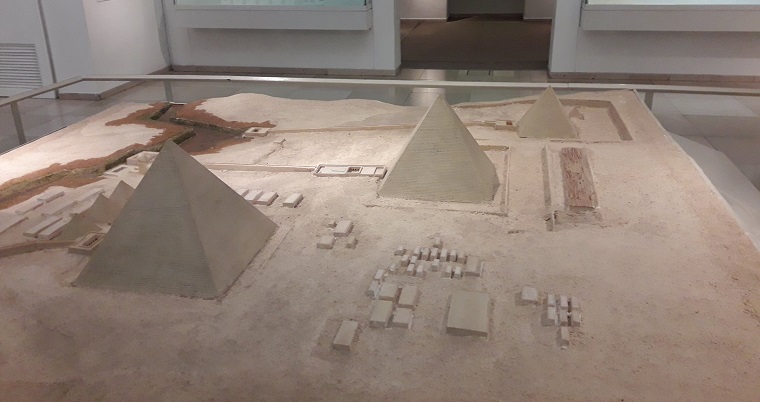
In magical culture, the layout of cities, the buildings, the shape of houses and temples, their orientation, and the resonance between them were of great importance. The first law of magic was: “As above, so below.” Therefore, in order to attract the energy of the Orion constellation in the sky, the pyramids at Giza were built to reflect Orion’s Belt, thereby channeling celestial energies onto the earth’s surface [6]. Seven hundred years later, the first sacred layout of Jerusalem was built. My argument is that the principles underlying it were similar.
According to Isaac Maitlis [7], in the Middle Bronze Age II, that is, about 3,800 years ago, there was a settlement in Jerusalem that was the largest of its kind in the mountain region, and around it was a ring of other settlements such as Minchat, Emek Refaim, Binyaney Ha’uma, Khirbet Alina, French Hill (Giv’at Shapira), A-Za’im and more. An examination of the location of these settlements reveals that they form an almost complete circle around the city, meaning that their distance from Jerusalem is equal. The circle is a magical shape that summons energies, hence Jerusalem was sacred at that time, and therefore a circle of settlements was established around it.
It is interesting to note that north of Jerusalem, on the French Hill, a fortress from the Iron Age (Israelite period) was found, built entirely of huge flint stones that were probably brought there from the Judean Desert. According to Maitlis, the settlements in the Iron Age were established on the basis of settlements from the ancient period, and if so, it is possible that the flints in the fortress were connected to an older system. According to the magical concept, different stones have energetic properties, and flint is associated with the elements of fire and light. The different directions also have spiritual magical significance, and the north is considered the place of eternity and enlightenment.
Thus, even if it happened unconsciously, the existence of a large flint structure in the exact north direction of Jerusalem enhances its energy. In addition, each circle needs an opening through which the energy can enter. In ancient stone circles in England, one different stone can be found, usually in a special orientation, and sometimes there is a flint stone as part of a circle of limestone stones, and this is exactly the case in Jerusalem.
In the Canaanite city itself, a huge structure was erected from giant stones, rising to a height of at least 8 meters and a width of at least 24 meters. According to the director of the excavation, archaeologist Roni Reich, the structure is a fortification that descends from some fortress that existed on the hill above the spring. However, according to Yitzhak Maitlis, the settlements from that period were not fortified, but were built at the foot of the hills and not on their tops, which indicates that there were no wars.
Therefore, he writes: “In light of the location of the settlements, it is clear that the issue of security was not a significant factor,” and therefore it is possible that the impressive structure also had some kind of magico-religious function, especially when it is related to water (it is located above the spring). In this case, the structure, and perhaps also the fortress above it, were the heart of the magical sacred architecture layout of Jerusalem, which was expressed in the establishment of a circle of settlements around the city.
Roni Reich and Shukron describe two massive towers around a pool into which water was channeled from the Gihon spring in a canal [8]. An arrangement of two towers appears in magical contexts in ancient Egypt. At the entrance to the temples there are two tower structures – pylons that symbolize the double horizon and constitute magical protection of the temple, sometimes there are also two obelisks or two statues. This may have been the reason for the construction of the two towers in Jerusalem as well. I am not claiming that the towers were not used for physical protection, but that in addition they had magical and energetic meanings. Magic was a central tool in protection.
In addition to the towers, there was also a pool into which the water of the Gihon spring was channelled. In Egyptian culture, pools had magical functions in temples, and they symbolized the waters of the abyss from which the world was created. It is possible that in the case of Jerusalem, beyond its practical function, the pool also had a spiritual-magical significance, as we see in other periods, and even in the case of the “sea” in the Temple.
The reference to Egyptian magic is relevant, because in the 18th century BCE, the rule over northern Egypt and the Land of Israel was in the hands of the same people, the Hyksos, immigrants of Semitic and Indo-European origin (including from the Canaanite cities of Israel) who settled in the Delta and adopted Egyptian culture and religion. This is reflected in the biblical stories about Joseph and his brothers. At that time, large cities were established in the Land of Israel that were characterized by magical planning, an important part of which were huge earthen ramparts that were mistakenly called fortifications. They may have been used for defense, but their main function was magical protection, and the proof of this is the temples that were found in them (Hazor).
One of the fascinating settlements from this period is Tel Batesh near Beit Shemesh, which was built as a huge square complex the exact size of the base of the Great Pyramid in Egypt. The dimensions and square shape of Tel Batesh, together with the orientation of it (to the four cardinal directions), imitate the structure of the Great Pyramid, and in my opinion this is not coincidental, but rather indicates the existence of a magical principles and in the design of cities. This suggestion is strengthened by the similarity of Tel Batesh to Tel el-Yehudiyya – the capital of the Hyksos in Egypt at that time.
We know that during the Old Kingdom of Egypt there were schools of sacred and magical architecture, led by wonderful architects and human gods like the Imhotep, the designer of Zjoser Step Pyramid. It is assumed that they continued to exist during the Hyksos period and it is possible that they advised the builders of the first sacred complex of Jerusalem and the settlements around it. It should be understood that in ancient times public construction, especially of cities, was associated with magic and gods and suoervised by priests.
After 200 years of Hyksos rule, the Egyptians succeeded in defeating the Hyksos and re-establishing their kingdom. They conquered the Land of Israel and ruled it for nearly 400 years. During this time, there is a strong influence of the ideas and principles of Egyptian magical science in the building of the city of Jerusalem.
In the 14th century BCE, the population of Jerusalem changed from Canaanite to Indo-European, Jebusite/Hurrians. But the ancient magical spiritual tradition was preserved. During this period, we find in Area G in the City of David a system of seven retaining walls supporting a platform that was probably above the hill of the City of David of today.
The number seven was a magical number in ancient times, and it is possible that these retaining walls, whose function and time of construction are disputed, are related to a magical architectural complex built at that time at the top of the hill, even though no archaeological remains were found of it. The ziggurat in Mesopotamia also had seven steps, symbolizing the seven stars visible in the sky, the seven colors in the rainbow, and the seven notes in the musical scale. The retaining walls can be seen in the excavations of the City of David. I am not necessarily claiming that this was a magical structure, but rather suggesting the possibility based on the importance of the number seven.
In addition to what has been discovered in the City of David, there is a claim by archaeologist Gabriel Barkai that there was an ancient temple to the Egyptian god Osiris in Jerusalem in the 1st century BCE. The 13th BC.
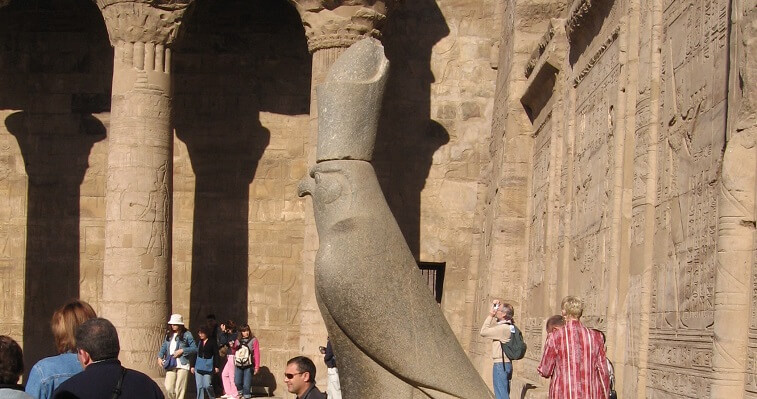
Temple of Osiris in Jerusalem
The Egyptians ruled the Land of Israel directly for 400 years, from the 16th to the 12th centuries BC, and in addition greatly influenced the local culture and religion before and after this period. Egypt was the most advanced and spiritual civilization in the ancient world, leaving behind the most impressive remains and existing continuously for more than 3000 years. Egypt has always been considered the source of the world’s knowledge, especially the magical sciences. At a distance of two weeks walking, or three days sailing, Egypt is closer to the Land of Israel than any other great civilization.
According to archaeologist Gabriel Barkai, [9] ancient remains found in the Saint-Etienne complex north of the Old City suggest that there was an Egyptian temple in Jerusalem during the Egyptian-Canaanite period (13th century BCE). A small stele was found in the complex with the inscription “First of the Westerners”, which is the nickname for Osiris. In addition, an Egyptian offering table was found that served as an altar of offerings as part of the cult of the dead, an Egyptian-style alabaster jar, similar to vessels found in the tomb of Tutankhamun, and the lower part of a figurine made of Egyptian greenish serpentine stone of a seated man, probably the god Amun (or Ptah).
According to Barkai, witnesses to excavations at the site in the late 19th century recount the discovery of an Egyptian column capital resembling a palm tree from the 19th Dynasty, and indeed such a capital is found in the nearby tomb garden. It is different in type from other column capitals in Jerusalem. Conrad Schick reported that the stone of the capital was a red stone, perhaps porphyry, drum-shaped, and if so, then it is the same type of stone as the stele. In addition to the mention of Osiris, the stele contains an appearance of the god Seth, and therefore it is dated to the 19th Dynasty and specifically to the reign of Pharaoh Merneptah. The 19th Dynasty is the first to sanctify Seth in addition to Osiris, and therefore its founder is called Seti the First.
Barkai claims that the findings at Saint-Etienne indicate that there was an Egyptian temple nearby. We know of Egyptian temples in Jaffa to the goddess Sekhmet, in Ashkelon to the god Ptah, temples that belonged to the main Egyptian temple system, and there was even a school of writing (Hieroglyphs) in Rosh Ha-Ayin, and why wouldn’t there be an Egyptian temple in Jerusalem? Perhaps to the god Osiris, the god of the dead, or Seth, the Gof of the desert and chaos, or to the Amon the hidden god. This does not contradict the existence of a Canaanite king, temples, and other cult traditions.
And on this occasion, it is worth mentioning that the greatest researcher of ancient Egypt and the father of archaeology, Flinders Petrie, who also excavated in the Land of Israel, is buried on Mount Zion and on his tomb is the Egyptian symbol of life – the ankh, and that the museum of the Pontifical Institute of the Bible has an original mummy from Egypt. The Egyptians were concerned with life after death, and it is possible that Jerusalem was already for them a place of resurrection, and therefore they built a temple there to Osiris, the god of the dead.
The god Osiris brought culture to humans, taught them agriculture, irrigation, construction, literacy, making bread, wine and beer, but most important of all – he founded the Ma’at, the cosmic order, the individual and collective truth by which the world operates. He managed the order of the earth, from the star systems to the irrigation systems. Consequently, human society flourished. After bringing culture to Egypt, Osiris set out, accompanied by musicians and minor gods, to teach the ways of culture to the rest of the world, and certainly on his way he passed through Jerusalem.
We know that great pharaohs of the 18th and 19th dynasties such as Thutmose or Ramesses II came to the land of Israel during military campaigns, and in this context they spent some time there, they did not come alone but with a large part of their court which included priests, and these needed temples in which to hold their worship, and perhaps this explains the temple to Osiris in Jerusalem. Jerusalem may have been a small and unimportant town far from the main road, but it is a fact that correspondence from the 14th century with the king of Jerusalem Abdehiba appears in the Tell el Amarna letters.
The influence of the great temples of Egypt and the priesthood increased during the New Kingdom, and they controlled many estates in Egypt, and apparently there were lands and villages in the Land of Israel that were associated with the temples of Karnak, Amun, Mot, and others. The Egyptians treated the land as an organism and built the temple system of Egypt according to the legend of Osiris [10], with each temple corresponding to a part of his body, and therefore it can be assumed that they also treated the Land of Israel as an organic body whose energy needed to be strengthened and revived with the help of an array of temples, and within the sacred geographical array of the land, Jerusalem played an important role, if only because of its location in the middle of the land.
Egypt was the most religious culture the world has ever known, centered on the afterlife, spiritual worlds, temple worship, and connection with the gods. It had various advanced spiritual schools that taught about the energetic parts of man, the structure of the unseen worlds, and the ways of personal development and the activation of dormant Faculties in man. Many of the world’s existing spiritual traditions drew their inspiration from Egypt. Jerusalem’s connection to Egypt existed not only during the period of direct Egyptian rule, but continued afterwards as well, but more on that later.
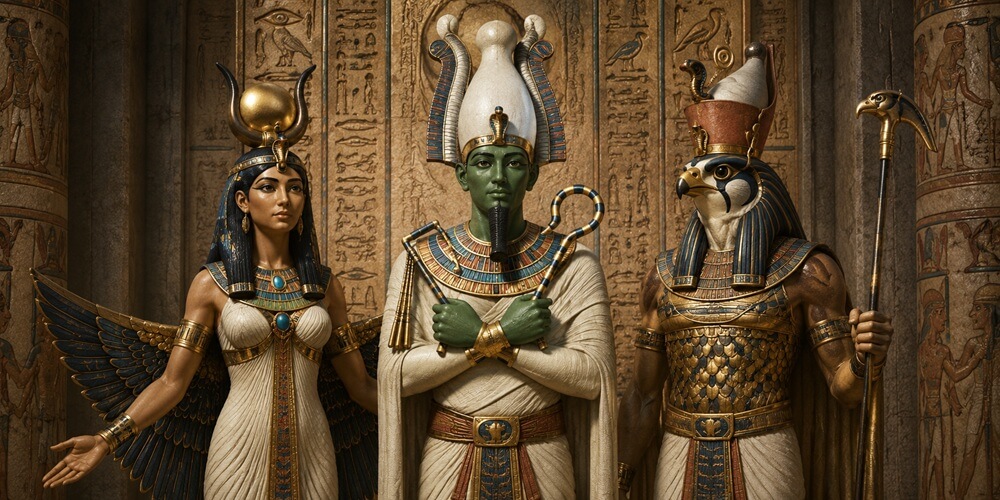
Osiris, Isis and Horus
Life after death
The issue of life after death has always concerned man, the fact is that Neanderthal man buried his dead, and even more so with the appearance of the Homo sapiens, and this indicates belief in existence after death. The fact that man passes into another state at night, dreams and experiences another reality, led to the belief in the existence of other worlds to which one reaches after death. Trance rituals and ecstatic states of shamans also indicated the existence of worlds beyond.
With the beginning of history 5500 years ago, a culture developed in Egypt that emphasized life after death. The Egyptian Book of the Dead describes the journeys of the soul after death into other worlds, a journey that resembles the journey of the sun at night, made with the help of the gods, and ultimately leads to resurrection in the world beyond. The Egyptians were busy their entire lives preparing for this transition, building tombs, decorating and preparing them, learning the secret formulas that had to be told to the guardians of the various parts of the underworld, and living a moral life with the concept that at the end of life a person’s deeds are weighed on the scales, and according to the result he moves to a kind of paradise, or is devoured by a monster [11].
There are other cultures in the world that emphasize life after death, such as Tibetan culture, in all cases this is accompanied by very deep religious and moral values. For the Egyptians, belief in life after death did not necessarily lead to indifference or despair, because life after death was seen as a continuation of the good life in this world. It can be likened to a movie in which a person sees all the events of his life over and over again, he lives the moments that happened to him in his life forever and with full force, and this requires caution on the one hand and a full and happy life on the other, because every moment has meaning, and it should be emphasized in this regard that a person does not relive the pleasure, but the meaning. This belief is expressed in the commemoration of the various events that happened to a person in his life on the walls of his tomb, and the placing of objects in the tomb that will help him in the new life in the world beyond.
Other ancient cultures also believed in life after death, although for some of them, such as the Sumerian culture in Mesopotamia, or the Greek culture, life after death was a continuation of existence in various regions of the underworld, and not necessarily reaching an ideal state. The basic question is what is man, and this has led to the different perceptions of what happens after his death. The Egyptians believed that man has several spiritual bodies. One of them, namely the spirit – “Akh”, follows the way of Ra and sails across the ancient watery regions, like the sun when it is below the horizon, until it is reborn as a spirit, connecting to the sun in the sky, to the sparkling stars, where it is granted eternal life. The other, which is the soul, follows the way of Osiris and is reborn within the spiritual worlds of this world. It knows how to leave the grave and, like a bird, wander during the day, but must return to its body and grave, because they are a kind of anchor for it. Therefore, it is important to cultivate the grave to be a suitable home for “Ba” – the soul.
One of the things that characterizes Jerusalem is the abundance of tombs in and around it, a natural product of thousands of years of human habitation, and different cultures that believed in life after death. Jerusalem is actually one large cemetery, and there are a large number of tombs that are ancient. Through them we can learn about the beliefs of the locals and their spirituality.
With the beginning of history (the Early Bronze Age 5,000 years ago), burials in Israel were carried out in underground chambers to which a shaft leads, and inside them were urns that were supposed to provide the deceased with support on their journey to the world beyond. After death, a person expected a journey, a process, a test, and a threshold that he had to pass in order to be accepted into the world of the dead.
Because of the perception of the earth (and Israel geographical unit) as an organism, there were places to which bodies were brought for burial, and perhaps for secondary burial in urns, as was discovered in the southern Dead Sea [12]. A shaft-shaped tomb from the Early Bronze Age was discovered on Mount Scopus, and it was perhaps a part of such burial area.
With the arrival of the Canaanites in the land of Israel at the end of the third millennium BC, burial traditions changed. Near the Church of Dominus Flavius on the Mount of Olives, a 4,000-year-old burial cave was found that had been used for burial for a thousand years. Inside, thousands of potsherds , alabaster, metal, jewelry, and an impressive collection of scarabs were found. The scarab was an Egyptian symbol of life after death. It is a dung beetle that emerges as a caterpillar from a ball of dung, transforms into a cocoon and becomes a beetle capable of flying.
Like the butterfly, the beetle symbolizes the stages of transition to another life after death. The dead person in the burial shroud is the cocoon, from which emerges a new and different creature capable of flying, namely the soul. Dozens of burial scarabs have been found in the country, and they have special local decoration. In Egypt, verses from the Book of the Dead were sometimes written on them.
The journey of the soul was both in this world and in the worlds beyond, reflected in the cosmic drama of sunset and sunrise, winter and summer and the movement of the sun and stars across the sky. It was possible to communicate with the dead on certain days of the yea, as there was a synchronization between the macrocosm and the microcosm. The directions of sunrise and sunset were important, with the west being the land of the setting sun associated with Osiris the god of the dead.
Egypt’s necropolises, mortuary temples, and royal tombs were generally located on the west bank of the Nile. However, there are exceptions to this, and one of the most notable is the burial tradition at Tell el Amarna during the time of Akhenaten. The revolutionary Egyptian pharaoh attempted to promote a monotheistic sun cult of the sun god Aten in the 14th century BC. The god Aten was associated with the sunrise and the life-giving power of the sun, life itself, and not necessarily with the afterlife. His worship was associated with receiving the sun at sunrise. Thus, the location of Tell el Amarna was determined by the sunrise at the mouth of a wadi east of the Sacred Valley, and the pharaoh’s tomb was excavated in this wadi [13].
Jerusalem has mountains around it and tombs around it, but the most important location of the tombs is in the east, in the Mount of Olives, Mount Scopus, and the village of Siloam. Since the Bronze Age and perhaps even earlier, we find burials east of the City of David and the Temple Mount. And this tradition is adopted by Judaism, and subsequently by Christianity and Islam. More on this later

Footnotes
[1] Ben-Arie, Z. (2021). Ha-elim ba’im: Tekhilat ha-historia be-Yisrael [The gods are coming: The beginning of history in Israel] (1st ed.). Jerusalem: Prague Publishing. (in Hebrew)
[2] Childe, V. G. (1950). The urban revolution. Town planning review, 21(1), 3.
[3] Lamy, Lucie. Egyptian Mysteries: New Light on Ancient Knowledge. Thames & Hudson Ltd, London, 1989.
[4] Ben-Arie, Z. (2020). Ha-fele ha-shevi‘i: Tiyulei tarbut ve-ruaḥ be-Mitzrayim u-Petra [The seventh wonder: Cultural and spiritual journeys in Egypt and Petra]. Jerusalem: Prague Publishing. (in Hebrew)
[5] Anthony West, John. Serpent in the Sky: The High Wisdom of Ancient Egypt. Quest Books, 1993.
[6] Gilbert, Adrian and Duval Robert. The Orion Mystery: Unlocking the Secrets of the Pyramids. Broadway Books, 1995.
[7] Maitlis, Y. (2004). Svivot Yerushalayim bi-Tkufat ha-Bronza ha-Tikhona B u-vi-Tkufat ha-Barzel: Meḥkar mashveh [The environs of Jerusalem in Middle Bronze II and Iron Age II: A comparative study]. Judea and Samaria Research Studies, 13, 27–34. (in Hebrew)
[8] Reich, R., & Shukron, E. (2009). Sheridei bitzur mi-Tkufat ha-Bronza ha-Tikhona B shenikhsefu le’acharona be-‘Ir David, Yerushalayim [Fortification remains from Middle Bronze II recently uncovered in the City of David, Jerusalem]. In Proceedings of the 10th Conference of the City of David and Ancient Jerusalem Studies. Jerusalem: Megalim Institute, The Higher Institute for Jerusalem Studies. (in Hebrew)
[9] Barkay, G. (1996). A Late Bronze Age Egyptian Temple in Jerusalem?. Israel Exploration Journal, 23-43.
[10] Belmonte, J. A., Shaltout, M., & Fekri, M. (2009). Astronomy, landscape and symbolism: a study of the orientation of ancient Egyptian temples. In search of cosmic order, selected essays on Egyptian archaeoastronomy, 211-82.
[11] Lamy, Lucie. Egyptian Mysteries: New Light on Ancient Knowledge. Thames & Hudson Ltd, London, 1989.
[12] Lapp, P. W. (1968). Bab edh-Dhra’Tomb A 76 and Early Bronze I in Palestine. Bulletin of the American Schools of Oriental Research, 189(1), 12-41.
[13] Stevens, A. (2016). Tell el-Amarna. UCLA Encyclopedia of Egyptology, 1(1).1
