
The Greeks Are Coming
According to Max Dimont[1], Judaism knew how to change throughout history in response to external challenges, showing vitality and inner strength. Until the end of the Persian period, the Jews dealt with the pagan culture with its magical characteristics, but with the arrival of the Greeks, Judaism and the Jews were forced to confront advanced Greek thought. The Greeks brought with them philosophy, science, medicine, mathematics, astronomy, the gymnasium, theater, politics, and democracy, and as a result, an ideological struggle developed between Jewish culture and Hellenic culture—between hedonism and morality, and even more, between Greek philosophical ideas and the teaching of Moses and the principles of religious monotheism.
In response to philosophy, the Jews developed the Midrash (whose beginnings already existed earlier), in response to Greek science, the study of the Torah, in response to Epicureanism and hedonism, faith, and in response to the political and military power of the Greeks, the expectation of a messianic redeemer. It can be said that in response to the Hellenic conquest, the Oral Torah developed, as well as mystical and apocalyptic literature. Thus, the various Midrashim in which dialogues between rabbis appear, the logical arguments within these dialogues such as “nevertheless” or “go and learn,” were influenced by Greek philosophy, adopting its techniques but providing an answer on another level—not that of logic but of faith.
In Greece, for example, there was the custom of the symposium, in which after a meal they reclined, drank wine, and discussed questions of life inspired by the wisdom of Dionysus, the god of wine, Judaism offers the telling of the Exodus from Egypt, meditating on the divine miracle while drinking wine (four cups). However, there is a difference: Judaism places divinity and holiness above man, while Greek culture places man at the center.
The Greeks excelled in architecture and art, building the most beautiful temples in history such as the Parthenon, and the Jews also had a temple, but the approach of the two peoples to holiness and temples was different. The Greek temple was a central element in the life of the polis and the urban social order. It glorified and magnified the city in which it was built and served as a place of identification and fulfillment of civic duties, and not necessarily the dwelling place of the god, who indeed was present but appeared like an ordinary man, only a little bigger and more powerful. The temple was a cultural creation of society, which defined it. The Jewish temple was the dwelling place of the Shekhinah, a mystical cloud, a supreme power.
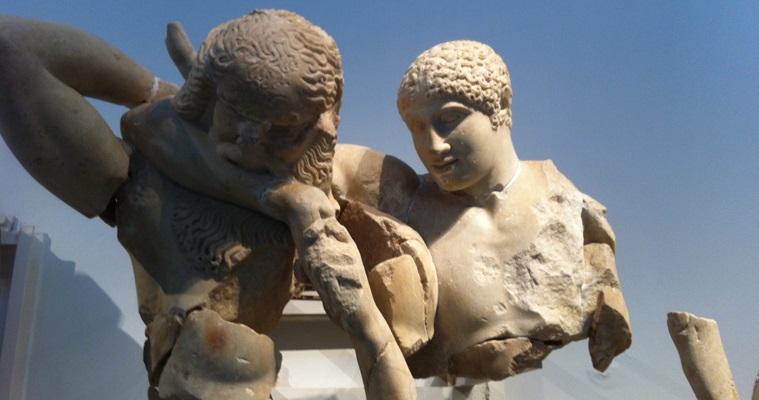
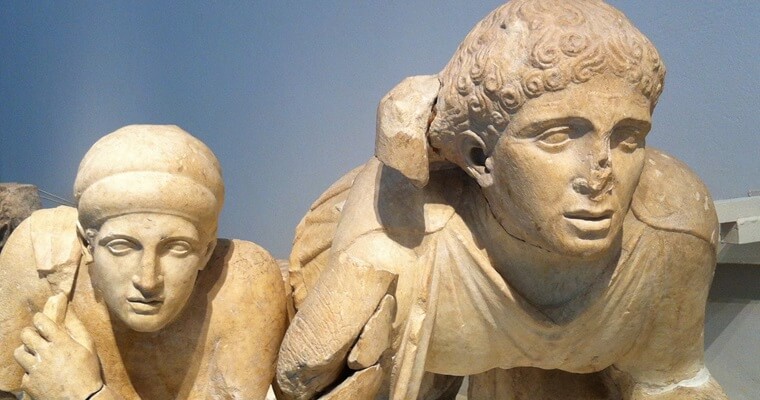
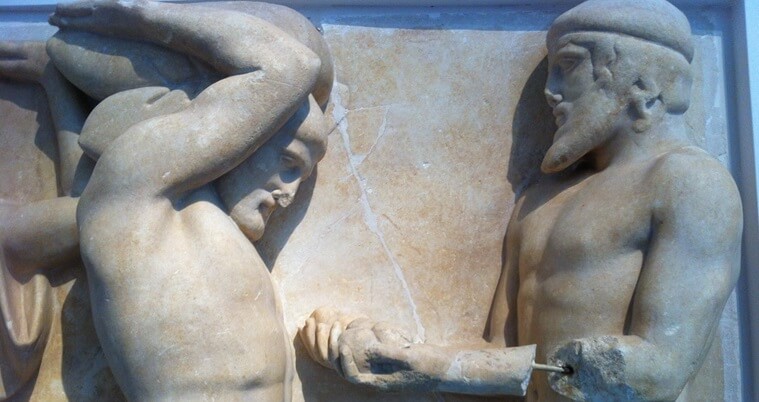
In addition to their public role, Greek temples were works of art intended to expand human consciousness and bring about aesthetic experience, with sculptures playing an especially important role. The purpose of the Greek temple was to influence the visitor, to awaken in him an awareness of the landscape, the land, the heavens, the society he was part of, and also of himself. Through the sculptures, the visitor absorbed mythology and reached a connection with himself and with the gods. The temple was meant to awaken in man a new awareness, refined emotions, and a new feeling—the muse, which was supposed to move him in his life. In Judaism, the temple was meant to awaken religious feeling, to cause an experience of holiness.
The Greek temple tradition led part of the Jewish people, including some priestly circles who adopted Greek culture (the Hellenizers), to want to make changes in the Jewish Temple. They wanted to turn it into a Hellenic temple, serving the new Hellenic culture, the polis beginning to take shape in Jerusalem, and consequently to change the worship and place statues within it (contrary to the explicit commandment in the Torah). The Hellenizers seized the senior priestly positions, including that of the High Priest (Menelaus), and with the encouragement of Antiochus, established in Jerusalem a civic council—a polis and civil institutions, including a gymnasium, where their children held athletic competitions naked in the Greek style (the stadium was probably in the area of the Temple Mount but has not yet been found).
With the rise to power of Antiochus IV, and the power struggles over Jerusalem between Hellenizers and their opponents, an active attempt began to impose the values, religion, and way of Hellenism on the entire population of Judea. Religious decrees were imposed for the first time. This led to a clash with traditional Jews, which sparked the Hasmonean revolt led by the Maccabees. It is important to remember that Judaism at that time was not yet consolidated and included groups that interpreted the Torah allegorically in the spirit of Greek philosophy, and priestly groups that adopted Greek culture. Therefore, the struggle between the Hellenizers and the Hasmoneans was, to some extent, a civil war between two different worldviews.
With the arrival of the Greeks in our region, the land experienced development and economic prosperity resulting from the trade network the Greeks maintained and developed, from the growing markets of the new cities, from technological inventions, and from a more efficient form of social organization. The population grew, and so did Jerusalem, which expanded to the western hill, Mount Zion, and the Jewish and Armenian quarters. In the area of the Jewish Quarter, a huge fortress with many towers was built, called the Acra, which was the stronghold of the Hellenizers—those Jews who adopted Greek culture.
Greek Philosophy
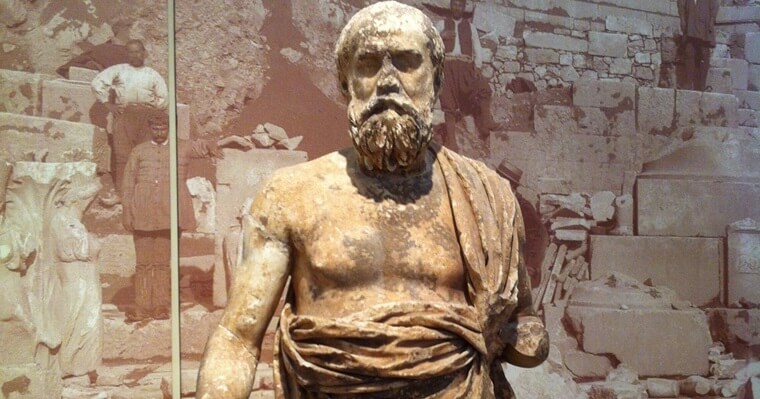
The influences of Hellenism on the Jewish religion probably began already in the 6th century BCE, with the appearance of Greek philosophy and the spread of Greek colonies throughout the world. The sages of Greece taught a universal doctrine that spread across the Mediterranean and beyond. One can see a parallel in the 5th century BCE between the emergence of Greek philosophy and the activity of Ezra the Scribe in formulating the Pentateuch, and afterward Hellenistic influences can be seen in Wisdom Literature and the Writings.
According to Edith Hamilton[2], the Greeks separated themselves from magical and mystical belief and began to base their lives on reason and the human intellect. They tried to find order in the world and to live according to it. The ancient world was ruled by unpredictable, unknown forces on whose mercy humankind depended. And yet, in everything concerning human society, people had the possibility of creating any type of organization thanks to the city-founding heroes who were half-god, half-man, and this organization was based on thought rather than faith. Top of Form
The Greek was directed to use his intellect. The Eastern priest argued that there are boundaries to thought, but in Greece there were no boundaries, and therefore the priests filled only a marginal role of ritual and social sacrifice, nothing more. Prometheus, as the one who brings culture to humankind, is called “Forethought,” and this is precisely what characterized the Greeks: the use of reason as the measure of life. As a result, philosophy and logic developed, the Greek motto being: “All things were in chaos until thought arose and imposed order upon them.”
The Greeks of the classical period replaced religious superstition with philosophy that searched for the causes and origin of all things. Greek philosophy arrived at the conclusion that the true god is not similar to man. It critiqued the conception of the divine held by the ancients and offered in its place another concept of gods as allegories for cosmic principles, among them morality and justice. The gods thus became abstract principles. According to Rudolf Steiner and Jungian psychology, the Greek gods are psychic forces which we perceive externally, and from this arose books like Goddess in Every Woman or God in Every Man.
And so, in the 6th century BCE, a group of philosophers and sophists began to criticize Homeric morality. Xenophanes of Colophon (570–470 BCE) writes: “They attribute to the gods everything that brings disgrace and shame among mortals.” He also says: “Mortals suppose that the gods are born like themselves, that they are clothed like humans, that their voice is human and their form human. The Ethiopians say that their gods are black and snub-nosed, while the Thracians say that their gods have blue eyes and red hair.” Xenophanes concludes: “There exists one god, greatest among gods and men, who is not like mortals in body nor in thought. Entirely he sees, entirely he thinks, entirely he hears. Without toil he moves all things by the power of his mind.”
With the development of philosophy, religion acquired another dimension. The way in which the religious feeling found expression among Socrates, Plato, and their companions was in the search for excellence—or in another word, “arete.” Their quest was more than the wish to excel; it was the highest perfection that they sought, that a human being could attain. At the same time, it must be remembered that Greek philosophy is an aspiration to wisdom, not final or perfect knowledge—which is impossible for mortals. Simonides writes: “Excellence does not appear in physical presence before the eyes of men, except for the one who, through supreme effort, with dripping sweat, attains the heights of manly virtue.”
There are many paths to excel, among them art and poetry. The imitation of the human body is a true instrument of thought and spirit. Thus, for example, the sculptor Phidias created statues such that whoever beheld them immediately began to reflect on the heavenly; whoever looked at them was drawn away from himself. Dio Chrysostom writes: “I think that if a man with a heavy heart, whose life was hard, were to stand before the statue, he would no longer remember his troubles. Phidias is the healer of grief, the bringer of forgetfulness of all cares.”
In the 4th century BCE Greek philosophy reached its peak through two spiritual giants—Plato and Aristotle. The private pupil of Aristotle was Alexander the Great, the man destined to conquer the world and inaugurate a new era. Alexander wished to unite all humankind in a universal culture that blended East and West, and he viewed all people as children of one father. His ambition was to unite Greeks, Persians, Egyptians, and Phoenicians, to bring peace to the world, and to spread culture and learning. Thus Hellenism was born—a syncretic blend of beliefs and traditions that took root and developed within the framework of a new urban society. The soldiers of Alexander’s army, together with local elites who were inclined to adopt Hellenistic ideas (especially the upper classes), founded new cities across the world according to the Greek polis model—including in the Land of Israel, and probably even in Jerusalem. The city was not necessarily a place but rather the fellowship of its citizens.
The Hellenistic civic societies built theaters and temples in both new and old cities, established gymnasia where education was acquired, and constructed markets and bathhouses. Greek philosophical schools served as guides for life, ranging between two extremes: on the one hand Stoicism, with its emphasis on moral duty, and on the other Epicureanism, which emphasized pleasure and living as if there were no tomorrow. Within Stoicism a conception of the “citizen of the world” began to develop, in which all people were members of the city of the cosmos, under one divine law, based on love and voluntary agreement. This law was rooted in divine reason—that is, the Logos—sparks of which could appear within the intellect of the individual. The universe itself was understood as a living being full of wisdom.
Wisdom
In Jerusalem of the Second Temple period there emerged a literary corpus called “Wisdom Literature,” which includes Proverbs, Ecclesiastes, parts of Psalms and Job, as well as apocryphal books such as Baruch and Ben Sira. Ben Sira was a man who lived in Jerusalem in the 2nd century BCE. The Book of Baruch was ascribed to Baruch son of Neriah, Jeremiah’s scribe during the exile (though in fact it was likely composed in the 2nd century BCE). Proverbs and Ecclesiastes were attributed to King Solomon, and Psalms to David.
Wisdom Literature echoes the Hellenistic concept of Wisdom as an independent entity. In this period, wisdom replaced prophecy as the guiding force of Israel, as something to be pursued. Within wisdom were embedded virtue and interpretation of the Torah—elements that would later appear in rabbinic literature. The Temple itself radiated wisdom upon the Sanhedrin convened there, upon the sages and rabbis, and upon the pilgrims who came to it.
Wisdom is presented as God’s representative in the world, parallel to the Greek Sophia. In various biblical and apocryphal sources her qualities are described. One of the most important passages is Proverbs 8, dedicated entirely to portraying the attributes of this abstract being: wisdom possesses counsel and resourcefulness, is linked to truth and justice, and its beginning is the fear of the Lord. She existed from the dawn of time and played a role in creation. One must heed her, for she shows the way to God, especially to rulers. The fruits of walking in her paths are many, but one must guard oneself and persist in her ways. Ben Sira 1 likewise contains a description of wisdom.
At the beginning, wisdom dwelt with God, inaccessible (Job 28), but God found her and gave her to Israel (Baruch 3). Therefore, she can manifest on earth. Wisdom is feminine, and as such she addresses humankind (Proverbs 1), but she requires understanding that derives from faith and spiritual connection; in order for wisdom to convey God’s word, she needs binah (understanding). Thus, in the Tree of Life, we find two sefirot—Chokhmah (Wisdom) and Binah (Understanding). The nations are incapable of comprehending wisdom, despite their efforts, because they lack the connection to God. Wisdom dwells among Israel, and especially in the Temple and in Jerusalem.
The pillars of wisdom are seven (Proverbs 9:1). Wisdom possesses a spirit of holiness and purity, an influence flowing from God: “the breath of the power of God and a pure emanation of the glory of the Almighty… the brightness of the everlasting light, the unspotted mirror of the power of God” (Wisdom of Solomon 7:26). She renews the world, and in every generation is embodied through holy souls and prophets. The best example of a man who embodied wisdom in his being is, of course, King Solomon, who loved her and sought her from his youth (Wisdom of Solomon 2). Wisdom “is the worker of all things and the discerner of all things” (Wisdom of Solomon 8:4). The book Wisdom of Solomon was written in Alexandria in the 1st century BCE and was influenced by Neoplatonic concepts of wisdom.
The Library of Alexandria
One of the most important institutions in the Greek polis was the academy, similar to the one in Athens—a center of study and education that was also a library. It is possible that such a library also existed in Jerusalem, which might explain the tremendous literary activity that took place there in the 2nd–3rd centuries BCE. This is only an unproven hypothesis, but it is thought-provoking. In any case, the most famous and important library in the world was that of Alexandria, the capital of the Ptolemaic kingdom, which ruled over the Land of Israel from the time of Alexander the Great until 200 BCE, for a period of 120 years.
Ptolemaic Egypt was one of the three Hellenistic kingdoms that emerged after the breakup of Alexander the Great’s empire. The kingdom was founded by Ptolemy I, one of Alexander’s closest associates, who was one of the Diadochi—his successors. The uniqueness of the Ptolemies lay in their adoption of Egyptian culture, a fusion of Greek philosophy with Egyptian religious feeling and magic. The dynasty lasted for 300 years, until the time of Cleopatra, and in some ways, the culture that developed within it continued during the years of Roman rule. The Ptolemies ruled Jerusalem for 120 years.
Ptolemy I ruled Egypt and the empire he founded between 323–285 BCE. He was one of Alexander the Great’s closest friends, his general and bodyguard, and, according to rumor, his half-brother from Philip. Ptolemy participated in Alexander’s expedition to the oracle of Amun at Siwa, where Alexander was proclaimed pharaoh, and remained as governor of Egypt after its conquest. After Alexander’s death, he proposed the division of the empire, while also ensuring that Alexander’s body was brought to Egypt and buried in Memphis, the ancient Egyptian capital. He was a skilled diplomat and during his lifetime fought wars with the other Diadochi over Rhodes, Cyprus, and Libya. In some wars he lost, but he won a decisive battle at Gaza in 312 BCE—a victory that secured his rule over Egypt, as well as the Land of Israel, Lebanon, Crete, Cyprus, Libya, parts of Asia Minor, and more. Ptolemy was also a writer, who composed a history of Alexander’s campaigns. After conquering Jerusalem, he brought many Jews to live in Alexandria, thereby creating an important and influential Jewish community there.
The Ptolemaic fusion of cultures was expressed in the founding of the cult of Serapis, a new divine figure that combined the gods of Greece and Egypt—Zeus and Osiris. Serapis was a new influence that entered the world, represented by the Greek rulers of Egypt. He was associated with the death and resurrection of Alexander the Great, with his spirit wandering the world. Ptolemy himself dreamed of a statue found in Sinope, Turkey, and brought it from there. Serapis was associated with dreams and visions, and he appeared to Emperor Vespasian after the destruction of the Temple, on his way from Jerusalem to Rome, before he became emperor. The god Serapis appeared in human form but also in the form of the sacred Apis bull, conceived from a ray of light, and as the son of the sky goddess Hathor. In this way, Greek and Egyptian religious thought were merged.
As a result of the encounter between the Hellenic world and the East, the concept of the Messiah, the Soter—a savior of the world, a larger-than-life figure who would redeem humanity, but first and foremost guide and enlighten it—developed. The image of the teacher-savior was connected with the figure of the perfect and spiritual man that appeared in Judaism at that time (Merkhava)—one who ascended the spiritual ladder and reached the heavenly spheres, such as Enoch or Melchizedek. It was also connected with figures like Zoroaster the Persian or the Egyptian pharaoh. The kings of the Ptolemaic dynasty, especially Ptolemy I, called themselves Soter, meaning “saviors,” and identified themselves with gods. Their aim was to bring the Logos, the Nous, to humanity.
After Ptolemy I, his successor Ptolemy II Philadelphus came to power, ruling between 285–246 BCE. He was the one who established the great Library of Alexandria, and within this framework gathered knowledge from all over the world, including from Jerusalem. The Ptolemies brought scholars from across the Greek world to Alexandria and decided to translate into Greek all religious, moral, and scientific important works from Egypt, Persia, Babylon, and elsewhere. The library was a temple to the Muses, a museum, and it was built in an area where a large Jewish, Egyptian, and Greek population lived.
As part of this endeavor, an envoy (Aristeas) was sent to the Sanhedrin in Jerusalem to obtain the Jewish sacred writings, first and foremost the Bible. This was likely a stimulus for the great Jewish literary enterprise that centered in Jerusalem, during which the apocryphal books were written, such as the Book of Jubilees, Enoch, and the Wisdom of Ben Sira, and the process of the canonization of the Bible began. It seems that the Bible was finalized during this period, since the Maccabean Revolt, which occurred after the Ptolemies left the land and it was conquered by the Seleucids, is not included in it. After receiving approval from the Jewish leadership, the Ptolemies began the extraordinary project of translating the Bible into Greek by seventy sages, in what became known as the Septuagint.
The first five Ptolemaic kings supported the enrichment and expansion of the library, each contributing his own unique part in his field of expertise. The first chief librarian was Demetrius of Phalerum, a historian, polymath, and governor of Athens, who was a student of Aristotle. The second librarian was Apollonius of Rhodes, who wrote the Argonautica (Jason and the Golden Fleece). The third librarian was Eratosthenes of Cyrene, a student of Zeno of Citium, founder of the Stoic school. He was the first to measure the circumference of the earth.
The Letter of Aristeas
The first mention of the Library of Alexandria appears in a book from the 2nd century BCE, which describes a senior Greek official, a courtier of Ptolemy II named Aristeas, who was sent by the king to Jerusalem to the High Priest Eleazar, to request his assistance in the project of translating the Bible into Greek. Aristeas visited the Temple in Jerusalem, conversed with the High Priest, and was deeply impressed by the wisdom and depth of Judaism. He described Jerusalem and the customs of the Jews, praising them and their wisdom. This continued the respectful attitude some Greek philosophers had toward Judaism.
According to Josephus in Antiquities of the Jews, the ancient Greeks, including Aristotle, admired the Jews and Judaism. The first to mention the Jews and describe Jerusalem was Aristotle’s student, Hecataeus of Abdera, who wrote an important book on Egypt.
The philosopher who founded the Library of Alexandria was Demetrius of Phalerum, also a student of Aristotle. It seems there was a connection between Demetrius and Hecataeus; perhaps both belonged to the same school that moved from Greece to Alexandria and were associated with the Peripatetic school of Aristotle. A hundred years later, their path was continued by a Jewish-Hellenistic philosopher named Aristobulus of Alexandria. Aristobulus argued that the source of Greek philosophy and metaphysics was Jewish. According to him, the ancient poets such as Homer, Hesiod, and Orpheus, and the great philosophers such as Plato, acquired their wisdom from Jewish writings and sages, with the greatest sage of all being Moses. Continuing this line of thought on the connection between Greek culture and Israel was Philo of Alexandria. The Christian scholar Clement of Alexandria in the 3rd century CE also said: “What is Plato if not Moses speaking Attic (Greek)?”[3]
In the formation of early Greek culture, Phoenician influence was considerable, especially in everything connected with writing and the ancient mysteries (such as those of the Kabiri in Samothrace). Writing was brought to Greece by Cadmus, a Phoenician prince from Tyre, and there is similarity between Phoenician and Greek letters, and therefore also between Hebrew and Greek letters. This had great importance in preserving the original meaning of a religious text such as the Bible after its translation. God created the world with words, but He spoke Hebrew. Translation into Greek altered the meaning of the text, but due to the connection between the two cultures and their alphabet, much of the meaning was preserved, and at times new meaning, previously hidden in the text, was revealed.
It is possible that the Jewish philosophers in Alexandria confused the Phoenician-Babylonian influence on Greek sages with a Jewish influence. It is clear that if there was influence between the cultures, it was mostly from Greek culture upon Judaism, and not the other way around—Moses did not speak Attic Greek. However, Philo of Alexandria developed an interpretation of the Bible in the spirit of Greek philosophy and allegory, as did others of his time in Alexandria, and also in Jerusalem. There is no doubt that the high culture brought by the Greeks to the ancient world, including to Egypt and Judea, challenged Judaism, but Judaism knew how to respond to this challenge with the development of its own spiritual and cultural creativity.
The mission of Aristeas ended successfully. Seventy-two sages of the Sanhedrin returned with him and were housed by Ptolemy II in comfortable conditions on the island of Pharos near the harbor, where they were given separate rooms and engaged in the translation of the Five Books of Moses. Remarkably, all of their translations came out identical, and it is known to this day as the Septuagint.
A Literary Project in Jerusalem
Jerusalem was under the rule of the Ptolemaic kingdom for 120 years, until 200 BCE, and afterward under the rule of the Seleucid kingdom for more than 30 quiet years, until the beginning of religious persecutions and the Hasmonean rebellion. During this long period of more than 150 years, an immense cultural and literary project took place: the committing to writing of some of the biblical books such as Job, Ecclesiastes, and Song of Songs, the editing and canonization of the rest of the biblical books, and the writing of some of the apocryphal works, including wisdom literature and apocalyptic writings.
The meaning of this great book-creation enterprise is that there were educational and public institutions of learning in Jerusalem at that time. Just as Plato committed his dialogues to writing within the framework of Athenian society and the Platonic academy, so too did the sages of Jerusalem commit to writing the books of the Bible and the apocryphal books. In some of these books, Greek influence can be discerned. However, unlike Greek literature, the biblical books are books of God, the Word by which the world was created, somewhat similar to the sacred texts of the Egyptians, and they are often based on much older sources.
In Greece too, there was a tradition of books written in the spirit of God, especially in the mystery cults such as the Orphic school. Yet the Bible has a uniqueness of its own, a kind of divine spirit resting within it. Where was the literary institution that produced such an impressive creation? Who were its members? What were the philosophical outlooks of those members? What was written under divine inspiration and how did the writers connect to it? And what was transmitted from previous generations? The answer to all these questions lies in the history of Jerusalem.
The books of the Torah had already been sealed and sanctified in the 5th century by Ezra the Scribe, who began the tradition of their public reading. This served as a unifying and governing tool. In a similar manner, one may suggest that the other biblical books were sealed and sanctified by the next leaders of the people, the Hasmoneans, as a tool for unifying and governing the people. But we have no record of a public reading of the entire Bible, nor do we have a king or leader boasting of such an event. Therefore, it is possible that some of the biblical books were first read in closed circles. This served the Pharisees as a tool for study, sanctification, and the development of Jewish national identity. But above all (and under the influence of Greek culture), it was a tool to connect to the Logos, the human spirituality of the Nous, a tool for invoking wisdom.
Much has been written about different codes that exist in the Bible—hidden meanings revealed by skipping letters in certain intervals across words (for example, every 5 letters or every 7). According to Michael Drosnin in his book The Bible Code, everything that has happened and everything that will happen is found in the Bible, including the names of important people of our times and influential events[4]. This claim is based on mathematical probability and supported by some professors of mathematics, while many others dismiss it. A different kind of code was discovered by the Bulgarian mystic Peter Deunov, who, while reading the Bible, suddenly experienced synesthesia, a confusion of the senses in which sounds can be seen, and so forth. Deunov saw the verses of the Bible taking on colors according to a code of five colors: white, red, blue, yellow, and green. He claimed that five frequencies are hidden within the Bible. The number five appears in the five books of the Torah and was also connected to the symbol of the kings of David and the Hasmoneans—the pentagram.
Footnotes
[1] Dimont, M. I. (1994). Jews, God, and history. New York, NY: Mentor Books
[2] Hamilton, E. (1993). The Greek way (Vol. 230). New York, NY: W. W. Norton & Company.
[3] Clement of Alexandria. (1885). The Stromata, or Miscellanies (W. Wilson, Trans.). In A. Roberts & J. Donaldson (Eds.), Ante-Nicene Fathers (Vol. 2, pp. 299–567). Buffalo, NY: Christian Literature Publishing Co. (Original work published ca. 200 CE).
[4] Drosnin, M. (1998). The Bible Code. New York, NY: Atria Books.