The Mysteries of the Hellenic World
The Greeks believed that the soul descended into the underworld after death, where it remained without possibility of redemption, dwelling in the eternal fields at best. They did not seek life after death but rather focused on glory in this world. However, there was an exception to this among the spiritual schools that spread throughout the Hellenic world and drew their inspiration from spiritual traditions of the East. These schools were called the “Mysteries.” They were conducted in special places, and within their framework, anyone who desired and was willing to pay the price could undergo an initiation, at the end of which he or she attained eternal life.
The spiritual schools of Pythagoras and Orphism were widespread in the Greek world. Their aim was the salvation of the individual, and they were open to all. Hellenism connected the Mysteries with the spiritual schools of Egypt (Osiris), Persia (Mithras), Mesopotamia, and perhaps even India and Central Asia. The Hellenistic period was saturated with a spiritual search for meaning, for the secret of eternal life, and for the attainment of enlightenment. The journey of Alexander the Great to the East was perceived not only as a campaign of conquest, but also as a quest for the Fountain of Youth, similar to Gilgamesh’s quest thousands of years earlier. Many sought to imitate this journey. With the Greek conquest of Jerusalem, the Mystery schools took root there, and the greatest Mystery of all occurred 366 years after the Hellenic conquest: the death and resurrection of Jesus.
The Mysteries sought to answer the fundamental questions related to human existence: What happens after death? Why do we live? Is there a purpose to life? —and to connect man with the spiritual element within him. These were spiritual paths that offered processes of initiation leading man to the attainment of eternal life and enlightenment. They included rites of purification, ceremonies of consecration, and connection to the spiritual light.
It is possible to distinguish several main streams of Mysteries in the Hellenic world, each with its own rites and ceremonies, exemplary figures, and patron gods. They took place in centers of worship and initiation, sacred places with temples, and pilgrimage traditions. Despite the differences, the goal was the same: connection to the spiritual part within man and making man godlike, and through this, attaining enlightenment and eternal life.
These are the main streams of Hellenic Mysteries:
- The Orphic Mysteries – a path of purification, enlightenment, and ascent on the mystical ladder from the material to the spiritual. It developed in connection with the cult of Orpheus and Apollo, appeared in Plato’s doctrines, and its ancient origins were the cults of Amun-Ra in Egypt, and perhaps Knossos in Crete. Its centers were in Samothrace and in spiritual communities around the Hellenic world. Its purpose was to live in the spiritual worlds of light (see later chapter on the Orphic Mysteries).
- The Mysteries of Demeter and Persephone – centered at Eleusis near Athens, this path was linked to the cycles of nature of autumn, winter, and spring, attuning to the natural rhythm of man in relation to his environment. Its origins were in the Egyptian cult of Isis and Osiris, and it was associated with the myth of Demeter and Persephone. Its purpose was the attainment of eternal life (see chapters on resurrection and redemption on the Mount of Olives).
- The Mysteries of the Great Gods – they celebrated the sacred marriages between gods and human beings, the union of opposites within and outside of us, which brings about a new creation. They were connected to magic and the feminine divinity. The origin of this spiritual path was in the Levant, and it was brought to Greece by Cadmus, prince of Tyre. They were practiced in the sacred center on the island of Samothrace and in Thebes. Their purpose was connecting the human and the divine (see the chapter on the cult of Asherah and Astarte).
- The Cult of the Sibyl – this path was represented by Helen of Troy, developed in Ephesus in Asia Minor, and appeared in the figure of the Phrygian Sibyl and the goddess Diana. Its goal was connection to the feminine element, to intuition and wisdom. It was linked to the intelligence of the creative feminine divinity and appeared already in prehistory. Its purpose was to connect to the spirit of prophecy (see chapters on ancient goddess spirituality and on wisdom).
- The Mysteries of Dionysus and Pan – sometimes, in order to connect to the spiritual within man, there is a need to descend low, to mingle with the world of matter, and to give free rein to instincts, thereby finding the divine element and the life force—Eros. This was the way of Dionysus, expressed in tragedies, ecstasy, and intoxication, and of Pan, expressed in the grotesque and the frightening, but ultimately leading to the universal. The outcome of this path was compassion.
It is important to emphasize that these Mysteries were connected to Hellenic culture, that their places of worship and traditions were located within the sphere of Hellenic influence, and that in addition to them there were other spiritual teachings and additional paths of initiation which later spread across the world, such as those of Isis from Egypt or Mithras from Persia. Every culture had its own spirituality. For example, the Celtic and Gallic inhabitants of Europe had an original spirituality preserved by the Druid priests, which included nature worship. One had to undergo many years of initiation in order to become a Celtic bard (poet), and twenty years of study and practice were required to become a Druid.
From this it can be understood that different cultures possessed advanced knowledge regarding the spiritual aspects of the human being, the structure of the energetic world, and the possibilities of human development. Similarities can be found between the different spiritual traditions, since they relate to the same reality and because of mutual influences, but each path had its own unique character. The spiritual world of antiquity was much more pluralistic, diverse, and accepting than the Christian world of the Middle Ages, and this also influenced Judea and Judaism in different ways.
The Hellenic Mysteries proposed that within the human being there exists not only a physical part but also divine spiritual elements. The philosophers also referred to this, but refrained from delving too deeply—the most striking example being Socrates: when asked if he believed in life after death, he answered that he did not have time to occupy himself with that, since he was busy trying to understand whether he was a Typhon-like serpent or a refined being (in the dialogue Phaedrus). At the same time, his student Plato spoke of the world of ideas and transmitted part of the Orphic teaching in his writings. The Mysteries were intended to fill the void left by advanced Greek culture, which was based on reason and humanity, and to reveal the higher and religious dimension within man—that which, according to the spiritual teachings they advanced, would remain after death.
All who underwent the Mysteries swore an oath of secrecy, and therefore today we lack complete information about their course. However, what is clear is that during the initiation the initiate died to his old self and was reborn as a spiritual person. It is known that the Mysteries included a process of purification, aroused a deep sense of awe and wonder, and promised immortality. Plutarch, who had undergone the Mysteries, wrote to his wife[1]: “By virtue of those sacred promises given in the Mysteries… we know that the soul is eternal and incorruptible.” Cicero, who also underwent the Mysteries, wrote: “There is nothing higher than those Mysteries… they not only showed us how to live with joy, but also taught us how to die with better hope.”
Today, the Mysteries tend to be viewed as a kind of religion, different from the ordinary religion of the classical world. According to Professor Gedaliahu Stroumsa, within the framework of the Mystery religions of the ancient world, new characteristics of religion emerged, which later appeared in Jewish-Christian culture: emphasis on the individual, interpretation of sacred texts, avoidance of blood sacrifice, and emphasis on religious community life instead of civic religion. The Mystery was private and personal, and the experience of the participants was ecstatic and emotional, very different from public communal worship. Anyone could participate in the Mysteries, including women and slaves. There were no exclusions, and there were only two conditions for acceptance: being free from blood-guilt and not being a barbarian (a speaker of a non-Greek tongue).
The rituals of the Mysteries were usually accompanied by a story or a founding myth that served as an object of identification. The story was usually about a divine figure undergoing a journey of suffering, trials, and loss. When the initiates reenacted this journey and experienced the god’s suffering, it was essential for them to reach catharsis at the end of the process and thereby illumination and redemption. Anyone who experienced the god’s path of suffering became divine himself. And this, of course, reminds us of the story of Jesus—but more on that later.
The Orphic Mysteries
One of the Hellenic spiritual schools that had a foothold in Jerusalem was the Orphic school, which spread throughout the world and, according to Professor Stroumsa, influenced the development of Judaism[2]. A mosaic discovered north of the Old City hints at this, as we shall see later.
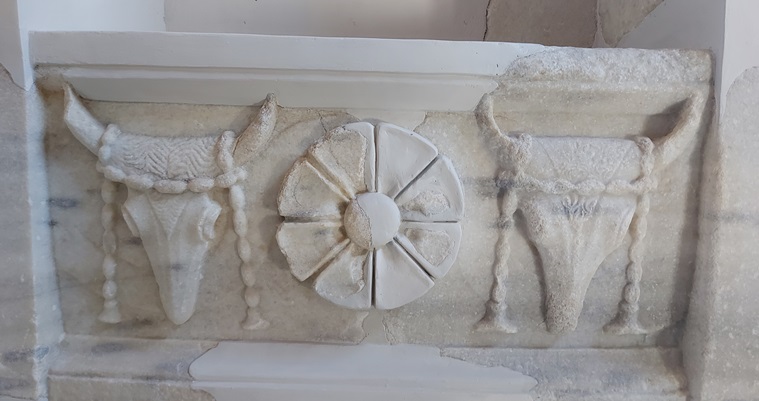
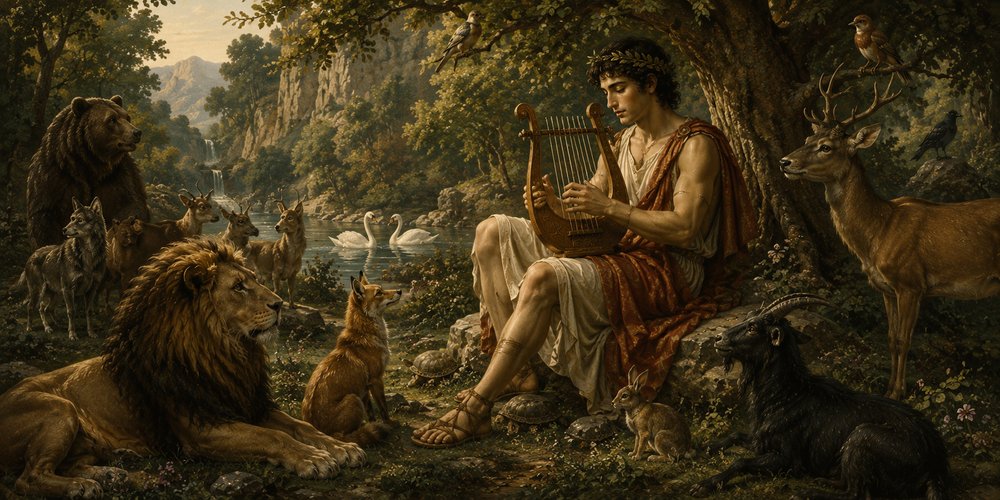
Orpheus is a divine musician who received a lyre from Apollo, accompanied the Argonauts on their journey, and became famous for his descent into the underworld in order to rescue his beloved Eurydice. According to the classical mythological version, Orpheus succeeded in reaching the underworld and obtained permission to bring his beloved out from there, but ultimately failed in his mission and lost his loved one and his sanity, eventually being torn apart by the Maenads, priestesses of Dionysus. However, there were groups in the ancient world that claimed that during his journey into the underworld, and especially after the tragedy that befell him, Orpheus discovered the secret of eternal life, and that he did not die but rather became an enlightened teacher who taught, through music, the structure of the invisible worlds and how one could attain eternal life for many years, founding a spiritual school called the Orphic school.
Even if Orpheus himself did not found a spiritual school, in the classical world there were spiritual teachings that rested on the Orphic myth. According to the founding myth of these teachings, the creation of the world begins with air—aether, darkness, and chaos issuing from the loins of Uranus. From these was born the cosmic egg, out of which a winged androgynous deity with golden wings called Phanes Ericapaeus was born, also known as Eros or Nyx. With the life force—Eros—Uranus engendered generative deities, monstrous giants called Titans, and one of them, Kronos, fathered Zeus and the other Olympian gods.
To Zeus was born a divine son named Dionysus Zagreus (the elder, in distinction from the younger Dionysus). The Titans, jealous of Dionysus Zagreus, tore him to pieces and devoured his limbs, but the goddess Athena managed to save his heart and bring it to his father Zeus. Zeus swallowed the heart and gave birth to the second Dionysus, the god of wine. Zeus then fought the Titans and burned them; from their ashes humankind was created. Therefore, the human being is both Dionysian-divine and Titanic-monstrous, since the Titans’ ashes also contained the body of Dionysus Zagreus the divine. Through purification, initiatory rites, and adherence to the Orphic way of life, it was possible to cast off the Titanic element and become Bacchus—that is, to attain a Dionysian divine state.
The Orphic doctrine was based on sacred writings. According to Socrates, as recorded in Plato’s Republic and Phaedo, there were secret books connected to the Orphic teaching in the hands of itinerant priests, which contained instructions for a life of vegetarianism and purity.
Franz Cumont (a world expert on religions of the classical period) described Orphism as a religion of salvation based on books[3]. Indeed, the oldest text in Europe, preserved in the Thessaloniki Museum, is the Derveni Papyrus, dated to the end of the 5th century BCE. In this scroll, the author takes one of the Orphic hymns and explains that in fact everything is an allegory, hinted at already in the first verse: “You, initiate, close the door.” The author draws upon the theories of the pre-Socratic philosopher Anaxagoras, who claimed that the stories of the gods represent natural forces and the act of creation.
According to Eliade[4]: “The Derveni Papyrus reveals a new Orphic theogony centered on Zeus. In Orphism there is a dualism of body and soul akin to the Platonic dualism, and at the same time a series of myths, beliefs, rules of conduct, and initiatory practices that guarantee the separation of the ‘Orphic’ from the rest of humanity, which leads to the separation of the soul from the cosmos.”
Aeschylus, the Greek tragedian, wrote a lost play called Bassarids, in which he described the Orphic cult, just as the Greek playwright Euripides described the Dionysian cult in his play The Bacchae. According to that play, Orpheus would ascend every morning to a mountain called Pangaios to worship the Sun. The essence of Orphism is refinement and spiritual development, which were achieved, among other means, through music, dance, poetry, healing, interpretation, communal life, and prophecy. The playing of Orpheus calms the passions and allows for the attainment of pure thought. It exerts influence on stones, trees, and animals, and is connected to the Muses and to the divine Dionysus.
According to Professor Bremmer[5], Orpheus, who participates in the quest for the Golden Fleece, sets the rhythm for the rowers on the ship of the Argonauts. Musicians stand outside the regular social order, since they have a special connection with the Muses. Orpheus was associated with initiation, especially of young people, with secret societies; he was the founder of a Mystery tradition, a poet, and a prophet. Homer and Hesiod are his descendants, physically or spiritually, and Orpheus is the first and most ancient of poets. Orpheus is not mentioned by Homer or Hesiod, but Pindar mentions him and calls him the father of poetry, the composer of sacred hymns.
Orphic life and societies
Orphism spread throughout the classical world. According to Eliade, those who were initiated in the way of Orpheus (the Orphics) adhered strictly to vegetarianism. The religious meaning of vegetarianism was the avoidance of blood sacrifices. Eating meat was linked in antiquity to the myths about the gods, to the act of Prometheus, and to the religious life of the Greek city. The eating of meat was part of the covenant renewed between gods and human beings, a religious rite. The vegetarianism of the Orphic believers distinguished them from Greek urban culture and its mythology. The meaning of vegetarianism was liberation from Greek human karma. In addition, “the turn to vegetarianism signifies both the decision to atone for the original sin and the hope to return, at least partially, to the state of primordial bliss.”
Orphic life was a life of purification, asceticism, observance of special rules, and salvation that could be attained through initiation—that is, according to cosmological and theosophical revelations. It seems that Orphic initiation included the repetition of prayers, mantras, fasting, purification rituals, the enactment of a drama of death and rebirth, and perhaps also libations and a ritual meal. Ultimately, initiation led to the reception of grace and constituted a way to be freed from the cycle of life—the endless cycle of rebirths—whose purpose was to lead a person through the suffering of birth and life in order to purify the Titanic element within him.
According to Eliade[6], several hints in Plato allow us to grasp the main Orphic idea regarding immortality and the transmigration of souls. Because of the original sin, “the soul is imprisoned in the body (soma) as in a tomb (sema).” Hence, physical existence is more akin to death, and the death of the body is therefore the beginning of life. However, this “true life” is not attained automatically, but only through effort, a life of purity, and initiation. The soul is judged according to its achievements and failures, and after some time it reincarnates. Similar to the Indian Upanishads, the Orphic view believes in the indestructible existence of the soul, which causes it to be reborn again and again until its final redemption.
Many people studied in the Orphic school. One of the most famous was Pythagoras, who later founded his own spiritual school and community in southern Italy. According to Professor Guy Stroumsa of the Hebrew University[7], the Orphic doctrine was also acknowledged by the Jews of Alexandria, who valued it. Aristobulus, a Jewish philosopher of the 2nd century BCE, claimed that Orpheus learned from Moses.
Stroumsa argues that Orphism represents the first appearance of a modern-type religion that promoted personal salvation, social life, and morality instead of cultic ritual, and it greatly influenced the later development of Judaism and Christianity. According to Stroumsa, the term “Yordei Merkavah” (descenders of the chariot) is related to katabasis—a descent into the underworld, which is identified with Orpheus. This term appears in the Hekhalot literature, which represents the first stage of Jewish mysticism, and it refers to the vision of the chariot in Ezekiel.
According to Jewish Alexandrian sources, Moses, identified with Hermes, taught Orpheus the ancient wisdom, and he brought it to the West. Orpheus is the sage of the pagans, the most enlightened among the nations. According to Josephus Flavius, the Essenes were a kind of Jewish Orphism, and some say the Therapeutae in Alexandria as well.
Living in communities outside the city, the allegorical interpretation of sacred texts, the emphasis on purification, and the connection with angels are shared features of the Essenes, the Therapeutae, and the Orphic societies. The Essenes had a community neighborhood in Jerusalem. In archaeological excavations carried out in the city, a mosaic was discovered that points to the existence of an Orphic community during Roman rule, but it is possible that there were also groups with a similar ideology and way of life in earlier periods.
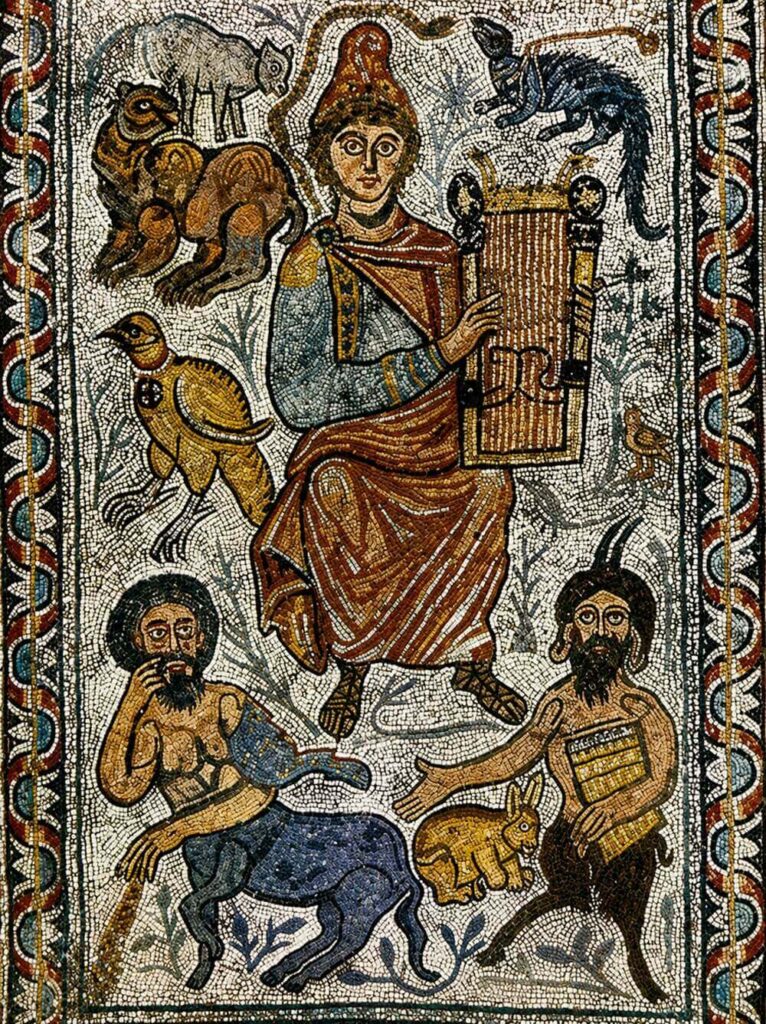
Orpheus Mosaic Jerusalem)
The Orpheus Mosaic in Jerusalem
Asher Ovadiah and Sonia Mucznik argued that a mosaic discovered inside a room of a 4th-century house in the Nisan Bey neighborhood, north of the Old City, was part of a pagan Orphic cult center—perhaps a place of initiation—and not, as had previously been identified, a decoration of a Christian burial site[8].
At the center of the mosaic appears the figure of Orpheus with large eyes gazing spiritually into the distance. He wears a Phrygian cap, a sign of initiation. Orpheus is dressed in a golden-red robe and holds in his hand a kithara with 11 strings. Above his head a salamander and a serpent struggle, but Orpheus manages to calm the animals with his music and resolve the conflict. Beneath the figure of Orpheus are a centaur and Pan: the centaur appears to listen to the music in wonder, while Pan holds his panpipes but does not play. Lotus flowers and acanthus leaves frame two outer borders, with the acanthus leaves forming medallions containing large faces at the corners, a woman’s face at the center of one side, and animals and fruits in other medallions.
Below the central image are two women in robes standing on either side of a column, each with a halo: one holds a dove, the other a flower. Their names are inscribed as Theodosia and Georgia. Beneath the women is another panel depicting two nude hunters and two hunting animals.
According to Ovadiah and Mucznik, the mosaic is pagan and therefore faces west rather than east. The two women represent abstract qualities, not specific individuals. The word Georgia means “the fruits of the earth” or agriculture, while Theodosia means “a gift of the divinity.” Orpheus is seen as the tamer of passions and the human soul—the wild elements within man. One of the factors that contribute to humanity’s animalistic nature is the eating of animal flesh, and thus Orpheus teaches humans agriculture. The meaning of agriculture is food that restrains passions: the human soul is liberated through vegetarianism from animal instincts and desires. The fruits of the earth are divine gifts intended to elevate humankind.
The halo surrounding the women is a pagan motif that appears in Roman and Greek mosaics before Christianity, not a Christian symbol of sainthood. Around the neck of an eagle depicted in the mosaic hangs an amulet resembling those worn by Orphic initiates, inscribed with instructions for conduct in the afterlife. Thus, the eagle symbolizes the transmigration of the soul, a fundamental Orphic belief.
Centaurs are teachers of wisdom and appear in the retinue of Dionysus returning from the East. Pan, too, is a companion of Dionysus on this journey. Both the centaur and Pan combine human and animal, the Titanic and the divine elements in man, and therefore they mirror the human soul, which contains a struggle between opposing forces. They are symbols of Orphic-Dionysian initiation. The centaur and Pan represent chthonic divinity (of the earth), tied to the transformation of man’s animal instincts into universal tranquility, which is why they appear in the mosaic.
According to Ovadiah and Mucznik, early Christianity identified Orpheus with the Logos—the one who tames passion and desire, brings peace to the world, and acknowledges a supreme God. The mosaic was initially part of a room in a pagan household used for Orphic worship and rites, and should be dated to the late 4th century CE. At that time, the Roman Empire, including Israel, had officially become Christian, but pagan worship survived underground, as this mosaic demonstrates. In a later phase, probably in the mid-to-late 5th century CE, with the construction of Christian institutions nearby, especially the Eudocia complex, the house was purchased by a Christian family, and in front of the Orpheus mosaic they added an apse with another, much cruder, mosaic depicting a cross.
The founder of the French École Biblique in Jerusalem, Marie-Joseph Lagrange, wrote introductory books on the New Testament. In his fourth volume he devoted an entire study to Orphism in relation to the mosaic discovered in Jerusalem[9]. In contrast to Professor Stroumsa, he rejected the view that Christianity was a combination of Jewish messianic beliefs with the Mystery cult traditions of a savior god. According to him, the essential difference between Christianity and Orphism lay in the body: Christians longed for the resurrection of the body, whereas the Orphics sought liberation from it.
It is worth recalling that in the late 3rd and early 4th centuries CE, major Neoplatonic thinkers were active in the Syrian region: Porphyry in Tyre and Iamblichus in Apamea (near Hama). Iamblichus wrote the biography of Pythagoras, who had been a disciple of Orpheus. Porphyry recorded the teachings of Plotinus, emphasized vegetarianism, and wrote on ancient philosophy, including Pythagoras. In this context it should be noted that the meaning of Orphism was vegetarianism. As far as is known, neither of these figures visited Jerusalem, but Porphyry expressed sympathy toward Judaism and especially the Essenes. It is reasonable to assume that students of Neoplatonic philosophy and adherents of classical salvation cults, including Orphism, lived throughout the Levant, and likely also in Aelia Capitolina, the Roman pagan city.
Julian the Apostate was a devotee of Neoplatonic philosophy and of Iamblichus’ theurgy, which drew upon Egyptian and Chaldean magic. He regarded Jewish religion and worship positively (Moses was considered the teacher of Orpheus and Pythagoras). Perhaps for this reason he wished to rebuild the Temple in Jerusalem. Eastern Neoplatonic philosophy was grounded in the myth of Orpheus, and it is possible that the Orpheus mosaic was installed during Julian’s reign by a Neoplatonic Orphic group living in the city. This would fit well with the dating of the mosaic.
Footnotes
[1] Burkert, Walter. Ancient Mystery Cults. Harvard University Press, 1987
[2] Stroumsa, G. G. (2012). The Afterlife of Orphism: Jewish, Gnostic and Christian Perspectives. Historia religionum: an international Journal: 4, 2012, 139-158
[3] Cumont, F. (1912). Astrology and Religion among the Greeks and Romans (Vol. 581). GP Putnam’s sons
[4] Eliade, M. (1978). A History of Religious Ideas, Volume 1: From the Stone Age to the Eleusinian Mysteries (W. R. Trask, Trans.). University of Chicago Press.
[5] Bremmer, J. N. (2014). Initiation into the Mysteries of the Ancient World. In Initiation into the Mysteries of the Ancient World. de Gruyter.
[6] Eliade, M. (1978). A History of Religious Ideas, Volume 1: From the Stone Age to the Eleusinian Mysteries (W. R. Trask, Trans.). University of Chicago Press.
[7] Stroumsa, G. G. (2012). The Afterlife of Orphism: Jewish, Gnostic and Christian Perspectives. Historia religionum: an international Journal: 4, 2012, 139-158
[8] Ovadiah, A., & Mucznik, S. (2004). Orpheus from Jerusalem-Pagan Or Christian Image
[9] Lagrange, M.-J. (1937). Introduction à l’étude du Nouveau Testament, IV: Critique historique. Les mystères: l’orphisme. Paris: Gabalda. (Études bibliques)