Saint Nino and the Holy Robe
Saint Nino (296–340) is the founder of Georgian Christianity. This is a unique case of a national religion being founded by a woman. She is the patron saint of the Georgians, and her story is connected to Jerusalem. The sources for the story of Saint Nino are the Church History of Rufinus from the 4th century[1], the book “The Conversion of Kartli” from the 7th century, and the book “The Life of Nino” from the 9th century[2].
She was born in Cappadocia and was from the family of the original Saint George. Her mother was the sister of the Bishop of Jerusalem (likely Armanus), and her father was a general in the Roman army. At the age of 12, the family moved to Jerusalem. Her father became a monk, left the family, and went to live in the Jordan desert. Her mother was ordained as a deaconess and also left, and so the young Nino was raised by an old woman named Sarah Niaphor in a Christian atmosphere. Sarah told her stories about Jesus, among them a story about Jesus’s robe that miraculously reached a pagan country called Georgia.
The stories told about two people from Mtskheta, Georgia, among them a man named Eliaz, who were present at the crucifixion. They bought Jesus’s robe from a soldier who was guarding Golgotha and brought it to Mtskheta. Sidonia, Eliaz’s sister, went to meet them on their return and died of grief when she saw the robe. The Georgians buried the robe with the holy woman, and a cedar tree grew in the place where they were buried.
As a result of hearing these wonderful stories, Nino prayed devoutly to the Mother of God (Theotokos), asking for her blessing and help in traveling to Georgia to worship the sacred robe she had woven for her son. The Virgin heard her prayers and appeared to Nino in a dream. She told her: “Go to my land and spread the gospel, and I will protect and bless you.”
Nino asked: “How can I, a weak woman, perform such a great mission, and how will I know that the vision is true?”
The Virgin presented Nino with a cross made of grapevine branches and said: “Take this cross as a shield from visible and invisible enemies.”
When Nino woke up, she found the cross in her hands. Tears of joy flowed from her eyes, and she tied the cross to her body with ropes made from her hair (some say it was Mary’s hair). She told her uncle, Bishop Armanus of Jerusalem, about the vision that had been revealed to her and her intention to spread the gospel in Georgia. He took her into an inner room, laid his hands on her, and blessed her. After that, she travelled to Rome, and from there, together with a princess named Rispine and 40 other virgins, she reached Georgia and converted it to Christianity, establishing a church in the place where the holy robe is buried[3].
After the conversion Georgian Christianity developed and flourished, from the Byzantine period until after the Crusader period, the Georgians had several sites of their own in Jerusalem, including the Monastery of the Cross, which we will discuss later. However, with the destruction of the Georgian kingdom by Genghis Khan and their conquest by the Ottomans, their power waned and the places were sold to others or abandoned. But still, the Georgian heritage is intimately connected to Jerusalem, and in these days of renewed independence, we may see a new Georgian religious foothold in the city.
According to the legends, the Georgian King Mirian visited Jerusalem as early as the 4th century and received the Valley of the Cross as a gift from Emperor Constantine the Great. There he built a church that later became a monastery and an important Georgian center of study and pilgrimage, which was fostered by Peter the Iberian (see article)
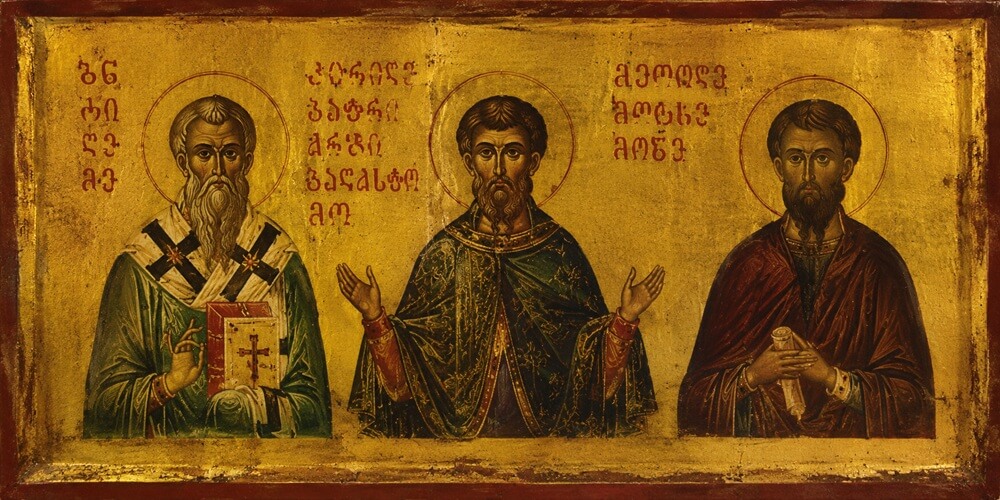
Georgian Golden Saints Petrus the Iberian and Hilarion
The Armenian Church
The Armenian people are an ancient people who claim descent from Noah’s Ark, which rested on Mount Ararat[4]. In the high lands of Armenia, ancient kingdoms existed from the beginning of history, and at the end of the Second Temple period, the Armenian Empire almost conquered the Land of Israel, with many Armenians settling throughout the Middle East. The religion of the Armenians was Mazdaism (Zoroastrianism), and they were caught between the Parthian hammer and the Roman anvil, maintaining a unique identity of their own. At the beginning of the 3rd century, the Armenians were the first people to convert to Christianity thanks to Gregory the Illuminator (257–321) and King Trdat.
Gregory and king Trdat established the holy city of Echmiadzin. The story goes like this: one day he had a vision in which he saw the heavens open, a ray of light bursting forth, and divine figures, headed by a tall, thin man, who was Jesus, descending on it. The figure descended to the ground and struck the ground several times in three places with a hammer. Where it struck, a circle of gold was created, and from it, a pillar of fire rose, wrapped in a cross of light. The instructions were clear: in these three places, churches must be built with a circle in the center that rises to the heavens, located within a cross pattern. Gregory and the people of Armenia were to build Heavenly Jerusalem in Armenia with earthly hammers and chisels—to create a ladder through which God could descend to the earth and people could ascend to heaven, namely, Echmiadzin. And so the Armenian holy city was created, and the pattern of Armenian churches was established: a cross with a cone on it.
With the acceptance of Christianity, many Armenian pilgrims began to arrive in the Israel (a distance of 700–1,000 kilometers). The Roman roads and public order made this possible. Many of them stayed in the country and joined monasteries in Jerusalem, the Judean Desert, and other places. According to legend, king Trdat had already established the Monastery of Saint James in Jerusalem as an Armenian center, and so we find an Armenian presence in more than 70 churches and monasteries in the country already in the 4th – 5th Century. The Armenians were one of the most important factors in Byzantine Jerusalem; the Jerusalemite monasticism and that of the Judean Desert are largely a Greek-Armenian collaboration.
The Armenians have always been a significant factor in the demographic and ethnic composition of the Middle East, and therefore every conqueror of the Land of Israel had to take them into account. They were widespread throughout the Transcaucasus and eastern Turkey, and were in fact the leading Christian element in the sphere of influence of the Persian Sassanian Empire, which was the significant rival power to the Byzantine Empire. In addition, there were large Armenian populations within the Byzantine Empire. Armenian advisors and merchants played an important role everywhere, as did military personnel. The prominent trait of the Armenians was honesty and loyalty. Also, Armenian women were considered the most beautiful in the world and married into Christian (especially Crusader) and Muslim royal dynasties.
In the 5th century, the Catholicos Isaac the Great initiated a project to develop an Armenian alphabet and translate the holy books, and this is no small matter, since God created the world with a word, and in translation, the exact meaning is sometimes lost. Moreover, in Armenia, and also in other branches of Christianity, the letters are considered sacred, constituting a kind of divine code, like in the Kabbalah.
The partner of Isaac the Great in translation work and other important tasks during that period was Saint Mesrop, the man who invented the Armenian letters and developed the script. He was a theologian, poet, cleric, and scholar. According to legend, he also invented the Georgian and Albanian (in the Caucasus) scripts. Mesrop was born into a noble family and received an excellent education in several languages, including Greek, Persian, and probably Hebrew and Aramaic as well. At a young age, he retired to a monastery, where he prepared for his life’s mission. These were days of trouble, and he was called to duty to go and teach Christianity throughout the kingdom. He then realized that one of the major problems was the lack of holy books in the local Armenian language from which to teach the masses, and he resolved to solve this matter.
After inventing the 36-letter script, the first verse he translated was the opening verse of Proverbs: “To know wisdom and instruction; to understand words of insight.” The invention of the Armenian script quickly transformed the Armenians from an ignorant people into an educated one. It made them a people who love books—adding a trait to the national character that had not existed before. Just as the Armenians adopted Christianity with one heart, so too did they become lovers of books with one heart—and this characteristic remains to this day.
In the Armenian Church, there is a title for a particularly learned person, a kind of Doctor of the Church, called Vardapet. In the collections of ancient Armenian books known as the Matenadaran—the largest of which is in Yerevan—one can find writings by Zeno the Stoic, Aristotle, Hermes Trismegistus, Porphyry of Tyre (a student of Plotinus), and others. Besides becoming people of letters, Many Armenians turned to the exact sciences and especially to mathematics, which was a great help in the development of architecture.
However, it wasn’t all rosy. In the middle of the 5th century, Armenia was ruled by forces larger and stronger than itself. The Byzantines tried to subject the Armenians to Orthodox Christianity and dismantled the noble families and the local feudal structure, while the Persians entered into a religious struggle with the Armenians and tried to force them to abandon their faith and convert to Mazdeism. The Persian king, Sassanid Yazdegerd II, was a great zealot for the Mazdean religion. In 449, he issued a decree requiring the entire population of Transcaucasia—Armenia, Georgia, and Caucasian Albania—to adopt the Mazdean religion.
The Armenians refused the conversion, and many of them were executed and became saints. A rebellion broke out, led by Prince Vardan Mamikonian, the grandson of Catholicos Isaac the Great. He visited Jerusalem and received encouragement from Euthymius the Great for the Armenians’ national religious struggle against all odds. And so, an army of 66,000 Armenians under his command met the Persian army of 220,000 men in the Battle of Avarayr, which took place in 451. Despite the heroic loss in the battle, the Armenians gained religious and cultural autonomy. The Armenian connection to Jerusalem was strengthened, and the Church of St. James in the Armenian Quarter was probably established at this stage.
With the Muslim conquest of Jerusalem, and especially during the Crusades, the presence of the Armenians in Jerusalem was strengthened and became more and more central. In the Middle Ages, there was an Armenian cultural and political renaissance. The most important center of education was the Seminary of Syunik. The small Armenian kingdom of Cilicia was founded, and there was cooperation with the Crusaders, some of whose kings married Armenian princesses (see the chapter on Melisende).
Armenian institutions and monasteries were established throughout Jerusalem and its environment (Judean Desert). The Armenian cultural renaissance was accompanied by the establishment of religious and educational institutions, and later a central seminary for priests in Jerusalem called the Brotherhood of St. James. From that period until today, we have a respectable and even disproportionate presence of Armenians in Jerusalem, not only physically but also in terms of theological and spiritual influence.
Even during the Mamluk and Ottoman periods, the Armenians had a position of primacy in the city as the ones responsible for all the Monophysite communities. The Armenians served as a counterweight to the Orthodox and played a central role in the administration of the empires and in the economy. In addition, the National Church Council in Sis recognized Jerusalem as an independent patriarchate.
The Church of St. Gregory the Illuminator
The Armenians are one of the three most important communities in the Church of the Holy Sepulchre, alongside the Greek Orthodox and the Latins, and as such, there are days when they have the key to the church. Significant parts of the church belong to them. In the past, they owned the Golgotha, but they were pushed out of it, and today they have an area in front of the Golgotha with the Chapel of the Women. The Stone of Unction is partially owned by them (two lamps), and even the tomb itself is partially owned by them. In addition, they own the Chapel of the Division of Jesus’s Garments, seven columns in the rotunda, the burial cave of Joseph of Arimathea (part of which they transferred to the Syrians), and most importantly: the Cave/Crypt of St. Helena and the Chapel of the Finding of the True Cross.
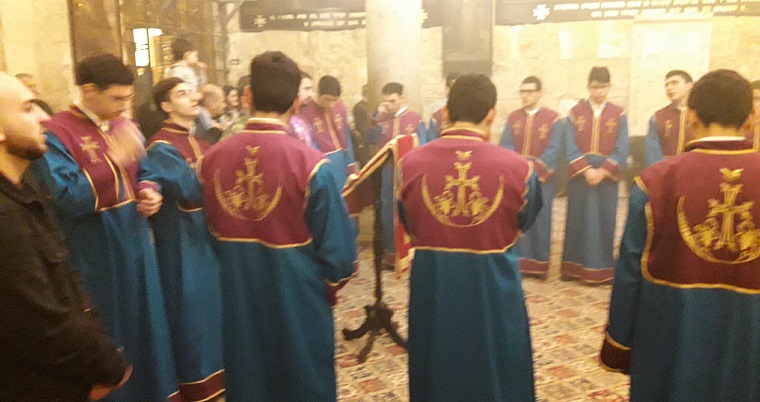
In the Cave/Crypt of St. Helena, there is the Church of St. Gregory the Illuminator, who brought Christianity to Armenia in 301. Following him, the Armenians were the first people to adopt Christianity. On the walls of the church, the most important events in the history of Armenian Christianity are depicted: the miraculous rescue of Gregory from a pit where he was imprisoned after his arrival as the herald of Christianity to Armenia, the baptism of the king and the nobles to Christianity, the establishment of the holy city of Echmiadzin following a vision of Jesus descending to the earth and striking it with a hammer, the return of the True Cross by Heraclius, the invention of the Armenian script by the monk Mesrop, and more.
On the floor of the church, there is a mosaic showing the church buildings of Armenian communities that were annihilated in the genocide, as well as Noah’s Ark and the rainbow, symbolizing the antiquity of the Armenian people and their legendary descent from Noah and his sons. The church is largely a memorial to the Armenian Genocide and has an altar with a perpetually burning lamp. In the side apse of the church, another altar is dedicated to the thousands of Armenian soldiers who sacrificed themselves in the Battle of Avarayr, the decisive battle for the preservation of the Christian faith against the Zoroastrian Persians in 451, which was led by Prince Vardan after he received divine support for his rebellion from Euthymius on his pilgrimage to Jerusalem. The church contains all of Armenian history, and it also has a miniature example of the unique architecture of this wonderful people with a canopy over the altars in the shape of a cone above four columns and an altar below it.
On the northern side of the church, an entrance leads to a closed part of the underground spaces located under the Church of the Holy Sepulchre. In this closed part/cave, there is a painting of a ship accompanied by a quote from Psalms: “Let us go up to the house of the Lord.” The painting is probably from the beginning of the fourth century and possibly before, and proves that the site was sacred even before the Church of the Holy Sepulchre was built. According to several legends, Gregory the Illuminator came here to seclude himself before going on his mission to Armenia.
On the southeastern side of the church, there is a wide opening leading to another, deeper carved cave space that was part of the underground quarry from the Second Temple period and later used as a cistern. This is where Empress Helena found the remains of the True Cross.
The Armenian Quarter
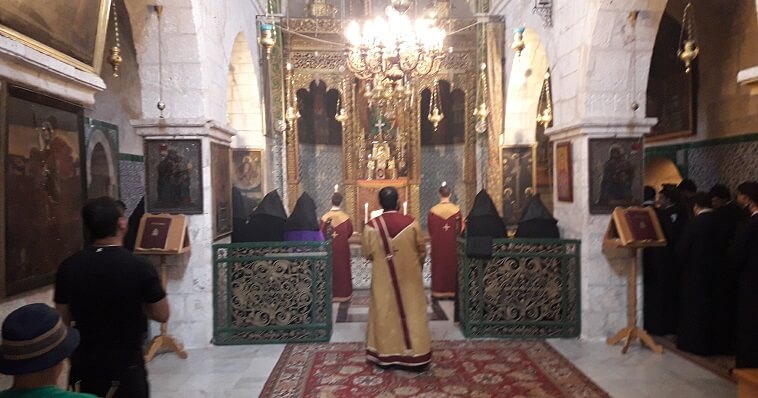
The Armenian Quarter occupies one-sixth of the area of the Old City. It is a city in its own right, with a library, a theological center, a school, a monastery, churches, residences, a bakery, a printing press, and more. It developed around the Cathedral and Monastery of St. James. The quarter has only one official entrance, and opposite it is their most important theological seminary, whose students come from all over the world and are called the Brotherhood of St. James.
According to legends[5], the wife of King Abgar (the legendary king of Edessa who lived in Jesus’s time and whom the Armenians claim as their own) built a chapel for Armenian monks in the Armenian Quarter as early as the first century CE. Another legend says that the Armenian King Trdat, who was converted to Christianity by St. Gregory, built a church in honor of the two James in the area of the Church of St. James as early as the 4th century.
The Greater James is James, son of Zebedee, who was killed by the men of Herod Antipas, and the later James the Less is Jesus’s half-brother and the leader of the first Christian community. Both of them are buried in the church. However, the body of the Greater James made its way to Santiago, and only his head remained. He was one of Jesus’s three closest disciples. His body rests in Santiago de Compostela in Spain, but his head is buried in a chapel in the left—northern—wall of the church, and that is what matters! The burial place of his body in Santiago de Compostela developed into the most important pilgrimage center in Europe as early as the Middle Ages.
It is likely that the original Church of St. James was built in the 5th-6th centuries CE. However, in 614, it was destroyed by the Persians and rebuilt immediately afterward. Gradually, Armenian monks began to settle around the site, creating a monastery that also served as a guesthouse for pilgrims.
On the side of the main hall, there is an opening to a prayer room called Echmiadzin, named after the holy city of Armenia (the meaning of the name is “the descent of the embodiment”), where God appeared to Gregory the Illuminator and showed him the pattern of Heavenly Jerusalem, commanding him to build it in Armenia. Near the altar in this room are three stones, one from the Jordan, one from Mount Tabor, and one from Mount Sinai. The Cathedral of St. James is one of the most beautiful and well-preserved Crusader buildings in the city (see chapter in the second book on sacred Armenian architecture).
The Armenians cooperated with the Crusaders during the Crusades and received permission to establish a kind of quarter of their own in Jerusalem. When the Mamluks and Ayyubids conquered Jerusalem from the Crusaders, they allowed the Armenians to continue to live in their quarter and confirmed their rights to the holy places. At the entrance to the Armenian Quarter, there is a document of rights granted to the Armenians by the Mamluk ruler of the country in the 14th century. The Ottomans preserved the rights of the Armenians, and with the awakening of Jerusalem in the 19th century, the Armenian Quarter also awakened and developed, with the monastery and church of St. James at its center.
Significant growth of the Armenian Quarter and a change in its character occurred during World War I. The Armenians suffered persecution and massacres by the Turks, and refugees came to Israel, which was already under British rule. These refugees were settled in the monastery area, which included vast plots of land and buildings around the main church. The quarter became more secular. Until that period, there were open courtyards used by pilgrims according to their place of origin. From that time, the areas outside the cathedral were built up, and secular populations settled in the houses. Since then, the Armenian Quarter has been a combination of monastery and civilian neighborhood.
In recent years, a museum on the history of the community and the quarter has opened in the Quarter, with important finds from excavations and church treasures. In addition to the Church of St. James, there are other churches in the Armenian Quarter, as well as the building of the Patriarchate, the Patriarch’s palace, and the building of the first printing press in Jerusalem from the 19th century.
The Meaning of the Cross
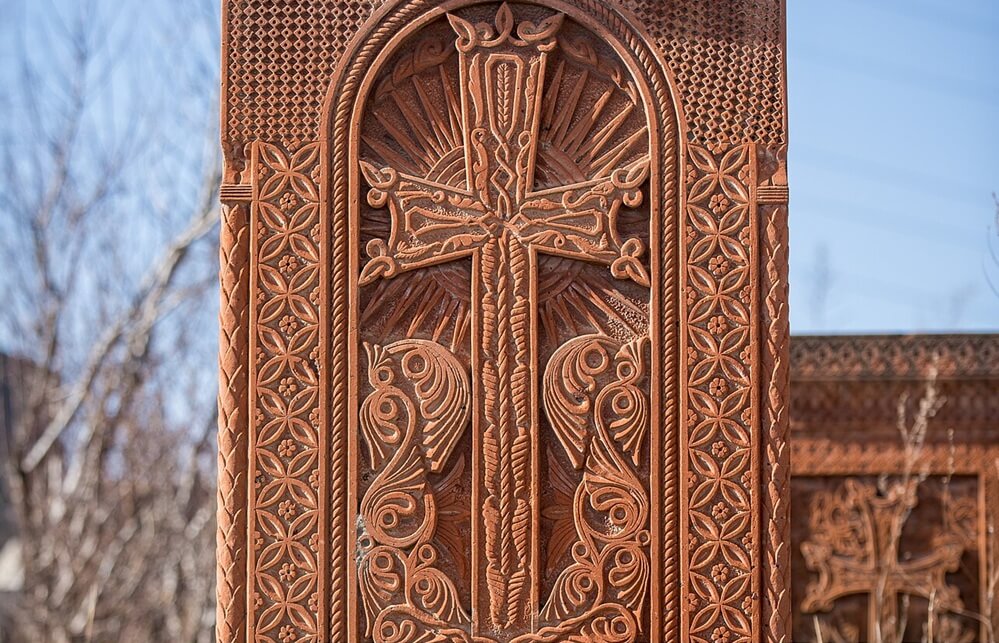
In Armenian churches, there is no iconostasis, but sometimes a curtain is used to separate the holy from the profane. There are also no regular icons; the role of the icons is replaced by the khachkar, a cross carved in stone or wood with a special deign. On the wall of the courtyard of the Armenian Church of St. James, there are twenty-two Armenian crosses—khachkars of various sizes. The crosses were carved to mark various events: the establishment of a church, a historical event. The oldest khachkar is located above the entrance and is from 956.
The khachkar symbolizes the tree of life. No two khachkars are alike, because this is the characteristic of life—diversity and change. They are full of geometric shapes, repeating motifs—a kind of arabesque. In the center of many of them, there is a circle, and they somewhat resemble the Irish Celtic crosses. According to the mystical allegorical interpretation, the cross has a meaning and symbolism beyond being the object on which Jesus was crucified and died. The cross succeeds in destroying death, conquering it, and it is a symbol of unity, cosmology, and life (the tree of life). Gregory of Narek talks about the cross as uniting the elements. Jesus is a man who unites the opposites within him, water and fire, earth and air. He is the four letters that make up the name of YHWH, which correspond to the four arms of the cross.
Saint Grigor Tatevatsi, the head of the university at the Tatev Monastery from the 14th century (see chapter in the second book), says that the cross unites the four qualities: love at the top, humility at the bottom, obedience on the right side, and patience on the left side. The top is heaven, the bottom is hell, the left side is forgiveness of sins, and the right side is giving grace—like the Tree of Life of the Kabbalah[6].
Gregory the Illuminator, in his “Book of Instruction,” links the meaning of the cross to the tradition of sacred Persian Mazdean architecture that preceded Christianity, and in doing so, he establishes guiding principles for the architecture of the new churches in the future. According to Gregory, the cross is a theology of redemption. It draws all people back to God. It is the lamp that spreads light around. The base fixed in the ground shows that God trod upon the earth and that he founded the church on a solid foundation. The upper part points to the heavens and shows the nature of the one who was crucified. The right arm shows the power of God’s arm and the future of joy and reward for the righteous, while the left arm shows the suffering of the sinners. The four corners of the cross are the four corners of the altar that receives the sacrifice of the body of God, which was offered by the Father, and they are also the four corners of the earth, symbolizing the human race rejoicing in the victory over death.
notes
[1] Amidon, P. R. (1997). Rufinus of Aquileia: History of the church. Washington, DC: Catholic University of America Press.
[2] Rapp Jr, Stephen H. “Georgian Christianity.” The Blackwell Companion to Eastern Christianity 31 (2010): 137.
[3] Alasania, Giuli. “Twenty Centuries of Christianity in Georgia.” IBSU Scientific Journal 1.1 (2006): 117-129
[4] Redgate, A. E., & Redgate, A. (1998). The Armenians. Blackwell Publishers
[5] Ormanian, Malachia. “The Church of Armenia.” (Trans. G. Margar Gregory), London: Mowbray (1955).
[6] Tsaghikyan, Diana. Grigor Tatevatsi and the Sacraments of Initiation. (2015).