Monophysite Churches
Monophysite means “one nature” (mono = one, physis = nature). The Monophysite movement includes all those who believe in the single nature of Jesus, in contrast to the Orthodox and Catholics, who believe in his dual nature. The Monophysite churches include the national churches of Egypt, Ethiopia, Armenia, and Syria. These churches split from the rest of the Christian world in the 5th century CE.
The ancient peoples who first adopted Christianity, such as the Copts and the Syriac Aramaeans, claimed that Jesus had only one nature and that his humanity was merely an illusion. These were mainly the Semitic peoples of the Middle East, among whom monotheistic religion was deeply rooted, making it difficult for them to accept the Hellenistic-style duality.
Monotheism is related to the Semitic genius, while among the Indo-European peoples—especially in Greek and Roman culture—there was a concept of physical and spiritual duality, as expressed in the mysteries of the ancient world and in Plato’s theory of ideas. In addition, the Byzantine Empire was divided into two: the Greek-speaking peoples, who felt they were part of it, and the peoples of the Middle East, who spoke other languages and sought independence from the central government, which exploited the provinces and favored the Greek-speaking regions of Turkey and Greece.
In 451 CE, an ecumenical council was held in Chalcedon, Turkey, which condemned the Monophysite belief. This led to a final and irreconcilable split between the churches that accepted the Dyophysite Orthodox tradition and the churches of the ancient peoples in the East, who emphasized the oneness of Jesus and were therefore called Monophysites. These Eastern churches did not accept the authority or rule of the emperors, nor the dogmas decided upon at the church councils.
The split also manifested in the Land of Israel and within the Jerusalem Church itself. On one side, the Christian establishment, headed by Juvenal, Patriarch of Jerusalem, supported the Dyophysite concept, along with Euthymius, the father of Judean Desert monasticism. On the other side, the majority of the monks, including Peter the Iberian, actively supported the Monophysite belief. In the end, the Dyophysites prevailed in the Land of Israel, but in the neighboring countries, separate Monophysite churches were established. Although persecuted at first, over the years they became national churches: the Coptic Church in Egypt, the Syriac Church, the Ethiopian Church, and the Armenian Church.
The Council of Chalcedon imposed restrictions on the Middle Eastern monastic movement, which led to the persecution of monks—especially those of the ecstatic type, many of whom were inclined toward the Monophysite doctrine. As a result, they found refuge in remote places such as Ethiopia, the deserts of Syria, and the Armenian highlands.
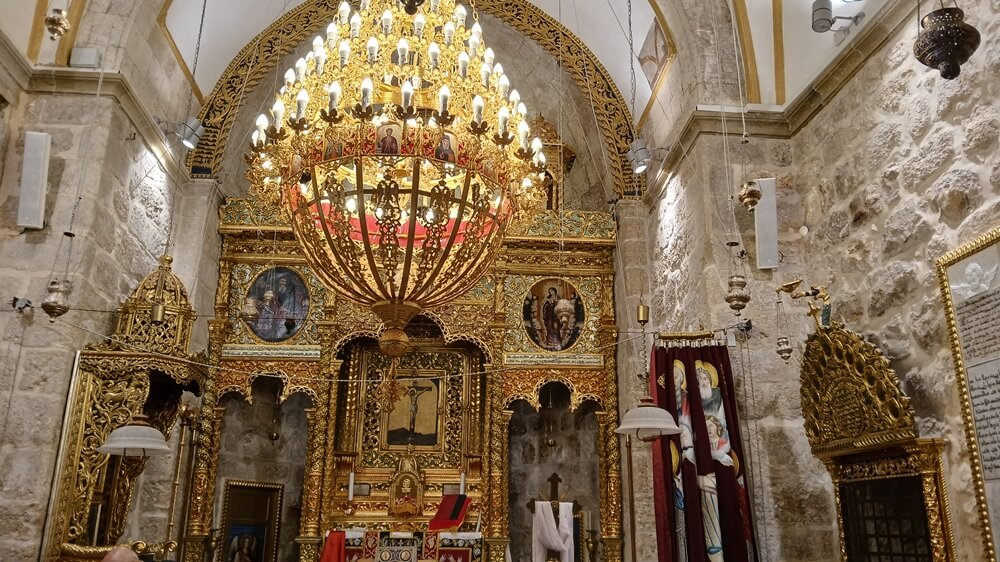
Syrian St Mark Church Jerusalem
The Earliest Church in the World – Syrians
The Syriac Orthodox Church, also called the Jacobite Church, claims direct continuity from Jesus and regards itself as the first and earliest Christian church in the world. The Syrians still use Aramaic (the language of Jesus) as a living language in some of their villages and as a sacred language in worship. They have their own ancient translation of the Old and New Testaments, called the Peshitta, as well as their own holy books, poetry, unique forms of worship, and a fascinating monastic tradition.
According to the Syrian Church, in the time of Jesus there lived a king named Abgar, who ruled over Edessa and its surroundings (today Urfa in southeastern Turkey). This king heard about Jesus and wrote him a letter, asking for help to heal him from a disease he was suffering from. The correspondence between Abgar and Jesus (a similar tradition also appears among the Armenians) reads as follows: “Abgar Ukomo, the ruler, to Jesus, the good Savior who has appeared in the district of Jerusalem, greetings. I have heard about you and your healings—how you heal without medicine or herbs… And when I heard about all these things concerning you, I concluded that it must be one of two things: either you are God and have come down from heaven to do these things, or you are the Son of God because you do these things. For this reason, I am writing to beg you to come to me quickly and heal me of the sufferings I endure.”
Jesus’s answer, conveyed through Hananiah: “Blessed are you who believe in me without seeing me… As for what you wrote to me, asking me to come to you—I must first complete all that I was sent here to do. After I complete this, I will be taken up to the One who sent me. And when I am taken up, I will send you one of my disciples to heal your suffering and to give life to you and to those with you.”
After the death of Jesus, one of his disciples came to Edessa and healed Abgar. As a result, Abgar and his entire kingdom became Christians, forming the first Christian community in Syria. The Syrians preserve a canonical book that recounts this story and others, and they believe in the great antiquity of their community. The message is that their church had a direct connection with Jesus and with the people around him, and that their worship today is a living continuation of that connection.
Another story that is common among the Syrians is about Ignatius, a small boy whom Jesus pointed to as an example for the disciples when they were arguing among themselves. The Gospel of Mark records: “And they came to Capernaum. When he was in the house, he asked them, ‘What were you arguing about on the way?’ But they were silent, because on the way they had been arguing among themselves about who was the greatest. Jesus sat down, called the twelve disciples to him, and said to them, ‘Whoever wants to be first must be last of all and servant of all.’ He took a child, placed him among them, embraced him, and said, ‘Whoever receives one such child in my name receives me, and whoever receives me does not receive me but the one who sent me.'” (Mark 9:33–37)
The thing with children is that they usually grow up, and this was also the case with Ignatius. The boy grew up and became the second patriarch of Antioch (after Peter). He wrote letters that were not included in the New Testament but are important for understanding early Christianity.
According to the Syrians, they began as a Christian community in the days of the Apostle Paul and were consolidated as a community by him. As it is written: “Then Barnabas went to Tarsus to look for Saul, and when he found him, he brought him to Antioch. And for a whole year they met with the church and taught a large crowd, and in Antioch the disciples were for the first time called ‘Christians’” (Acts 11:25–26). According to Eusebius, Peter established the first holy see in Antioch around the year 37 CE, four years after Jesus’s ascension to heaven, and after he moved to Rome, Ignatius succeeded him.
Antioch was the capital of Syria and of the East during the Roman period, a huge city of close to half a million people. The Patriarch of Antioch was one of the four main patriarchs of the universal church and competed for primacy in the Christian world. Until the year 518, the Orthodox Patriarch of Antioch ruled over the entire East, and the Syrians were under his authority. Afterward, they split from the Greek Orthodox Church over the Monophysite belief and established their own patriarchate, with Saint Jacob Baradaeus as the key figure in the founding of the independent Christian denomination.
Saint Jacob Baradaeus is the true founder of the Syrian Church. He received the support of Empress Theodora (Justinian’s wife) and the local population. He moved from place to place in hiding, ordained clergy, and organized an independent church, and therefore they are called Jacobites. During the early Muslim rule in Syria, the Syriac Church flourished, but later they went through difficult periods, the climax of which was a genocide that paralleled the Armenian Genocide in World War I. Today, there are about 1,500 Syriac Christians in Israel, most of them in Bethlehem, but a few dozen or a few hundred in Jerusalem, where they have a center, an ancient church, and a monastery in the house of Saint Mark, believed to be the original house of the Last Supper (see below).
Syriac Christianity played an important role in preserving human culture. They copied the writings of the Greek philosophers, which later passed to the Arabs, and they also preserved the tradition of sacred music and the singing of the Levites in the Temple. Syriac Christianity has its own saints and literature. It is interesting to note that one of the literary genres that developed in Syriac Christianity is the Thomistic literature, which focuses on the figure of Thomas—the twin of Jesus—who becomes like him and shows the way to others by bringing forth the true and hidden teaching of Jesus[1].
Syriac monasticism began very early and developed unique characteristics. It played a crucial role in preserving the Christian faith. According to some scholars, the roots of Syriac Christian spirituality can be traced to Essene groups, such as the community in Damascus (the Damascus Scroll), who waged a holy war against the material world and emphasized modesty and poverty, abstinence from wine and meat, fasting, sleep deprivation, and renunciation. These were the Bnai Qyama (Qyama in Aramaic means “covenant,” hence “sons of the covenant”). According to Arthur Võõbus, refugees from Israel came to Syria and brought their spirituality with them. At some point, the Bnai Qyama community was baptized, and their traditions were absorbed into Syriac Christianity and monasticism[2].
Syriac Asceticism and Monasticism
Syriac monasticism was different from that of Egypt. While in Egypt the model was Antony the Great, in Syria the model was Jesus himself. The idea was to give up one’s earthly life in order to gain eternal life, and the path was through asceticism, renunciation, and ascending the spiritual ladder. It began with groups of Bnai Qyama, or “sons of the covenant,” people who took vows of renunciation and purity upon themselves while still living within the earthly world, and later developed into hermits who withdrew into the desert.
In the 3rd–4th centuries, the phenomenon of asceticism spread, and various forms of Syriac monasticism appeared[3]. Some of them were reminiscent of the fakirs of the East: there were monks who stood day and night until they sometimes became fixed in their position. They would sleep leaning on a staff and could not care for their own needs, so they had assistants who helped them use the bathroom and move from place to place. Others alternated between standing and kneeling. Some wandered constantly and even slept while walking or standing. Other monks lived in trees. They were called Dendrites and existed until the 13th century. A famous example was a monk named John who lived in a cypress tree. By the grace of God, he survived falling out of it several times, until he devised a plan to tie himself with an iron chain to the tree so that if he fell, he would remain hanging between heaven and earth, dependent on the mercy of passers-by to return him to his place. Still others lived in enclosed spaces, whether a small cave or a hut. But the most famous and eccentric were the pillar monks, such as Simeon Stylites (see below).
The monks sought asceticism as a way to experience and share in the suffering of Jesus. However, some were not satisfied with physical asceticism and also sought emotional suffering. They pretended to be insane during the day (while at night they would pray and purify themselves) so that people would despise them, and in this way they shared the fate of the ridiculed and rejected Jesus. The idea was to combat self-pride. The most famous of them was another Simeon, known as Simeon the Fool, from the 7th century.
He lived until the age of 39 as a monk in the Arnon Stream in Jordan, but when his fame spread, he decided to take drastic action. He filled his pockets with pits and walnut shells and went to the nearest city church. When he arrived, he showered the candles with shells and pits in the middle of the prayer, until he managed to extinguish them all, to the horror of the believers. But that was not enough. He climbed the preacher’s platform and continued to hurl his shells from there, aiming at the women. Only one man in the crowd refused to be impressed by the outrageous act and assumed that he was just a monk pretending to be insane. This man invited Simeon to his house. Simeon, fearing he might still fall into the sin of pride, decided to act again. At night, he sneaked into the bed of his host’s wife, making sure to be caught at the right time. Simeon was thrown out of the house to his satisfaction, and the man who had invited him swore that there was no greater villain than him.
The Syriac monks believed that within each person there is a spiritual mirror, a sacred organ meant to reflect the divine reality. Yet because of human desires and passions, this mirror is hidden, veiled, and in need of cleansing and renewal. This organ is called the heart, a concept reminiscent of Sufi mysticism. In parallel, they envisioned a spiritual realm in heaven called the House of Treasures, with which they aspired to connect[4].
Thomas of Marga, the 9th-century historian of Syriac monasticism and a bishop, writes about the Syriac monks as follows: “Some of the fathers wrote in their books that within the heart there exists a wonderful and intellectual mirror, which the Creator of natures formed from all the spiritual and visible elements of creation for the great glory of his image, and as a means to reveal his invisibility. He made it a bond, a connection, and a completion of all natures. The fathers call it the ‘beauty of their person,’ Saint Paul calls it ‘the house of peace,’ the wise call it ‘the house of good,’ and others call it ‘the house of joy.’ Within it resides the spirit of conformity which we have received from the Holy Spirit, and upon it shines the light of grace.
He who has cleansed this mirror of its impurities—of passions and sins—and renewed it to the original state of its created nature can, by the light of its wonderful rays, perceive all manner of spiritual realities, whether near or far. And he who, by the secret power of the Holy Spirit, is able to behold them clearly, as though they were all set in order before his eyes without obstruction, recognizes the work of God reflected in the faces of holy people. Then this gift of the Holy Spirit is found upon them and dwells within them, turning them into beings of eternal life and joy.”
Original Icon of Lukas St Mark Church Jerusalem
Aphrahat and Ephrem
Two of the most important figures in the early Syriac Church are Aphrahat and Ephrem, who were active on both sides of the border between the Roman and Parthian Empires. Aphrahat (280–345), known as the “Persian Sage,” lived and worked in the early 4th century in the Persian Sassanian Empire, at the same time that the Romans were adopting Christianity. He was a contemporary of Ephrem the Syrian (306–373), who was active in the regions under Roman control.
Aphrahat’s importance lies in the sermons he composed, which explain the principles of the Christian faith as understood by the Syriac Aramaeans. These are twenty-three sermons, called Homilies, on topics such as prayer, renunciation, love, modesty, monasticism, the war of Gog and Magog, the prophecies of the Messiah, the genealogy of Jesus, and more. They are still used in the Syriac Church today[5].
Aphrahat explains the Trinity in the following way: God is the sun, Jesus is the action of the sun on the earth—the illumination and warmth—and the rays are the Holy Spirit. According to S. Brock[6], Aphrahat is the first Christian to write an essay on prayer, and he offers an interesting interpretation of Jesus’s words: “Enter your room and pray to your Father in secret” (Matthew 6:6). For Aphrahat, this means that one should pray in the depths of the heart, in the hidden chambers of the soul.
From his words: “Every man knows that the sun is fixed in the heavens, and yet its rays spread over the earth, and light from it enters through many windows and doors. Wherever the sun’s radiation falls, it is called the sun. And although it illuminates in many places, it is still called the sun, but the true sun is in the heavens. Likewise, the water in the sea is infinite, and when you take one cup of it, it is called water. Even if you divide it into a thousand vessels, it is still called water. So also God, although he is one, is in many, and nothing diminishes from his essence when he is in many, just as the sun is not diminished when it is in the heavens while it radiates over the earth. Much greater is the power of God, for by the power of God the sun exists.”
Ephrem the Syrian, a contemporary of Aphrahat, founded churches in Nisibis and Edessa in the Roman Empire and established a school that developed Syriac Christian theology. Ephrem wrote many hymns and composed melodies that are still used in prayer today, and therefore he is called “the Sun of the Syrians,” “the Harp of the Holy Spirit,” and more. The Syrians pray seven times a day but combine the prayers into three services (similar to Judaism). Prayer is combined with singing in Aramaic. Music has an important role in the Syriac Church, and many of the holy figures wrote hymns and composed melodies inspired by the singing of the Levites in the Temple—or, if you will, the angels in the seventh heaven who praise God. In addition to hymns, Ephrem also wrote commentaries on the Bible and taught Christian theology.
He was born in Nisibis, on the border of Turkey and Syria. Six years earlier, the city had been conquered by the Romans from the Persians, symbolizing the victory of Christianity over the faith of Zoroaster—the official religion of the Persian Empire at that time. When he was young, he received a Christian education from the bishop of Nisibis and became a “Bar Qyama.” This is a term that exists only in Syriac Orthodox Christianity and refers to a man or woman who has taken vows of renunciation and lives within the community like a monk, but among the general population. The Bnai Qyama (“sons of the covenant”) saw themselves as standing at the beginning of a spiritual ladder that they had to climb, and so did Ephrem.
Throughout his life, he served the community as a deacon, teacher, and missionary, but he refused to be appointed bishop, claiming he was unworthy. In 350 CE, Ephrem, together with a group of monks, founded the University of Nisibis, considered the first Christian institution of its kind in the world. It had three departments—medicine, philosophy, and theology—and became a center for the development of Syriac Christianity.
In 363, Nisibis fell to the Persians, and the entire Christian population was exiled. Ephrem moved to Edessa—an important historical Christian center—where he reestablished the university as the theological hub of Syriac Christianity. At that time, Edessa was a vibrant multicultural city with representatives of many different Christian and heretical movements: Manichaeans, Marcionites, Arians, and various Gnostic sects. The Christians who followed the Nicene Creed formed only a small community. In the midst of this theological turmoil and marketplace of ideas, Ephrem emerged as a leading figure. He wrote books, composed poems, invited women’s choirs to sing them in the city square, composed prayers, promoted and defended the faith of Nicaea, and became its chief advocate. In his poems and interpretations, Ephrem blended Jewish rabbinic techniques, Greek philosophy, and Persian mystical symbolism.
Ephrem had direct connections with Basil the Great, the Egyptian Desert Fathers, and other important religious figures of the emerging Christian world. After ten years of fruitful activity in Edessa, he died in 373.
According to the book The Cave of Treasures[7], Ephrem wrote in Aramaic, but his works were translated into Greek, including some of his hymns and commentaries on Genesis and Exodus. Among his best-known writings are the Hymns of Paradise, the Hymns on the Faith, and a collection of hymns on the pearl, which contains Gnostic elements. This collection likely influenced the inclusion of the pearl motif in the Ethiopian book The Glory of Kings. The Cave of Treasures explains: “The symbolic potential of the pearl is enriched by the common belief at the time that pearls are created when lightning strikes a shell in the sea. From the union of the opposing elements of fire and water, the pearl is born, and from this arises the comparison to the birth of Jesus from Mary and the Holy Spirit.”
Ephrem developed a method of “symbolic theology,” woven from parallels, typology, names, and symbols, at the heart of which lie the concepts of symbol and mystery found throughout creation. These symbols and mysteries arise from the harmony between God and the world and point to God’s existence and His creative activity. Among the symbols and mysteries most beloved by Ephrem are the mirror, the oil, the olive tree, and the pearl. In his writings, one can see the influence of Jewish interpretive and mystical traditions, and it is possible that his knowledge of Aramaic helped him to be familiar with them.
One of the hallmarks of the spirituality he embodied was renunciation of the world, expressed through weeping. Of him it was written: “Just as breathing is a natural function that does not cease in all people, so for Ephrem it was natural to weep. There was no day, no night, no hour, no moment—even the briefest one—in which his eyes were not open and full of tears, whether he reflected on the shortcomings and mistakes of his own life, or on those of the human race.”
In the Syriac Church, the title given to an ascetic was “weeper.” Isaac of Nineveh writes about the value of tears: when the seeker begins to leave the physicality of this world and enters a realm beyond visible nature, he immediately attains the grace of tears. These tears begin to flow, leading him to the fullness of love for God. It is interesting to note that one of the earliest names for the Sufis was “the weepers.” About weeping it is said: “When the heart weeps for what it has lost, the spirit rejoices in what it has found.” Another saying declares: “Brothers, should we not weep with a desire for God? Will he who weeps in longing for his master be denied the vision of his master?”
Ephrem writes in one of his poems: “All my many responsibilities will plead together until they find release. Together they will raise sounds of weeping and shed tears like water, and our hearts will break with sighs, until forgiveness is granted.”
According to Ephrem, man was created in the image of God and was meant to be His dwelling place: “The soul is ready to look upon God and reflect His image within itself. God is within us: ‘His kingdom is within your soul, if you are ready. Enter, leaving behind the confusion of pleasures and the corruption of desires, the errors of lust and wealth, and the things that harm you. Enter and find yourself within the pure depths of your thoughts, and seek the kingdom there. Enter and find yourself within your heart, for there is God. For it is not He who departs from you, but you who depart from Him.’”
There is a dormant spiritual organ within us called “the heart,” meant to reflect the divine worlds that exist within and around us. Yet this does not happen because the mirror of the heart is covered with dirt caused by worldly involvement: “Here the mirror is to blame if its clarity is dulled because of stains upon it, for the dirt becomes a covering for those who look into it. If our mirror is dulled, it brings pleasure to the haters, for their sins are not revealed. But if it is polished and clean, it becomes the adornment of our freedom. Blessed is he who polishes our mirror.”
He also writes: “Your mirror is clean and wholly turned toward you. Your clarity compels the impure to cleanse themselves by it, for no impurity can join you unless it has first been cleansed of the dirt that clung to it.”
We will return to this theme when we discuss the practices of the Sufi orders.
It is not clear whether Ephrem and Aphrahat ever came to Jerusalem. It is, however, a reasonable possibility, since they lived not far away and those were days of security and prosperity that allowed for relatively easy travel along the roads. What is certain is that they exerted great influence on the development of the monastic movement in Jerusalem, both directly and indirectly, as can be seen in the case of Theodosius.
Lower Hall St Mark Church Jerusalem
Theodosius and Simeon Stylites
Saint Theodosius (423–529) began his life as an ordinary monk, later became an ascetic in the Syriac style, and ended his life as one of the most important Desert Fathers. He was active in parallel with Euthymius, served as overseer of all the communal monasteries in the land, and was head of a large monastery near Jerusalem—Theodosius Monastery—which housed 400 monks. He lived to the remarkable age of 105[8].
Theodosius was a Greek from Cappadocia by origin, but his source of inspiration was one of the most important Syriac ascetics—Simeon Stylites. As a young man, he set out on a journey from Cappadocia to Jerusalem, inspired by the command given to Abraham: “Go forth.” On the way, he stopped to visit Simeon Stylites, who, in an unusual gesture, invited him to climb up the pillar and blessed him, prophesying that he would achieve greatness.
Simeon Stylites was the most famous ascetic in the Christian world to this day and one of the most influential figures of the 5th century. Although he spent most of his life atop a high pillar in the Syrian wilderness, he maintained contact with Eudocia, Juvenal, and Theodosius, and was also known to Euthymius. Simeon was born in 388 to a shepherd in the Adana region of Turkey. He became a devout Christian at the age of 13 after reading the Beatitudes from the Sermon on the Mount, and at 16 he entered a monastery. However, his views and practices were so extreme and ascetic that the other monks no longer wanted him in their community and expelled him.
After being expelled, Simeon went to live in a hut in northern Syria near Aleppo, where he practiced extreme asceticism. During the forty days before Easter, he neither ate nor drank, so his very survival seemed miraculous to others. He would stand for hours and even days until his legs could no longer carry him. After a year and a half in the hut, he moved to a small cave on the slopes of a high mountain, seeking to live as a hermit.
However, his reputation as a holy man had already spread widely, and many people began to seek him out for advice, blessings, and healing. The poor Simeon was heartbroken: he had chosen the path of solitude and asceticism, yet he had become a pilgrimage site. He no longer had time for his prayers, his practices, or his solitude with God.
Determined to act, Simeon turned to the ruins of a nearby Roman city, where one of the great pillars of a temple or public building still stood. He built a platform at its top and climbed up with the firm intention of never coming down again. If he could not escape the world horizontally, he would escape it vertically. And so it was. Children from the nearby village brought him small amounts of food from time to time.
At first, Simeon lived atop a pillar three meters high, but over time he improved his dwelling, and by the end of his life he had spent thirty years on a pillar fifteen meters high. On top of the pillar was a platform of just one square meter, and this was his entire world.
The reputation of the strange monk spread far and wide, and if he had been an attraction before, he was all the more so now. Every afternoon Simeon received the many visitors who flocked to him. He did not rest on the pillar but prayed without ceasing in unusual positions—prostrating himself, or standing with arms outstretched like the crucified one. He was, in a sense, crucified anew each day in the heat of the sun and the cold of the night. His body was reduced almost to nothing, but his spirit grew great.
People would climb a ladder to speak with him. He also wrote letters, instructed disciples, and even delivered sermons from the top of his pillar (some of his letters survive to this day). In time, a church was built on the site, the Church of Simeon Stylites, which later inspired Antonio Barluzzi in his design for the Church of the Transfiguration on Mount Tabor.
After receiving the unexpected blessing from Simeon Stylites, Theodosius continued on his way to Jerusalem, where he was accepted as a monk in the Kathisma Monastery (its remains lie along the Bethlehem road, near the Mar Elias Monastery). There he served as a cantor and became so popular that the community wished to appoint him head of the monastery.
According to tradition, it was at this monastery that the Virgin Mary, while pregnant, rested on her way to Bethlehem to give birth. Nearby, at the Mar Elias Monastery, Elijah is said to have rested while fleeing from Jezebel to Beersheba. Yet Theodosius himself found no rest there. Longing for a deeper experience of the sacred, he withdrew to the edge of the desert and settled on a desolate hilltop, in a cave where the three Magi were believed to have stayed after visiting Jesus in Bethlehem. This was an ideal place for extreme ascetic practice. Theodosius remained there for several years, spending nights standing and tying himself with a rope, eating very little, and refraining from sleep.
Many disciples gathered around Theodosius, and in time he was persuaded to establish a monastery that eventually housed 400 monks at its peak. From focusing on his own path to enlightenment, Theodosius turned to works of charity. He directed the monks to care for the sick and to provide food for the poor. His monastery became a center for the care of the needy, and he was ultimately appointed head of all the cenobitic monasteries in the Land of Israel.
Theodosius’s colleague in advancing the monastic movement in the Judean Desert was Saint Sabas, a disciple of Euthymius and founder of the Mar Saba Monastery. He was appointed overseer of the hermit monasteries, known as the laurae. The two men cooperated closely with the patriarchs of Jerusalem, especially Patriarch Elias, who himself came from a monastic background. Together they secured the final victory of the Dyophysite doctrine (the belief in the dual nature of Jesus) in the Land of Israel over the Monophysite view. Both Theodosius and Sabas lived to a ripe old age.
It may be said that Theodosius’s extreme asceticism, inspired by Syriac models, was a kind of daily crucifixion that atoned for the sins of the land and purified it spiritually. After his death and “crucifixion,” he was regarded as resurrected in spirit—a new man who taught and helped others.
Theodosius is buried in the crypt of his monastery together with his mother; with Saint Sophia, the mother of Saint Sabas, his partner in Christian leadership in the Land of Israel; and with Johannes Moschus, the author of The Spiritual Meadow (see article). Although the monastery was abandoned over the centuries, it was renewed by the Greek Orthodox Patriarchate in 1872.
Saint Mark’s Syriac Church
The center of the Syrians in the Old City is the Monastery of Saint Mark, located near Mount Zion on the border of the Armenian Quarter. Inside it is one of the most special churches in Jerusalem and probably the oldest among them. The true place of the Last Supper, the true home of Saint Mark.
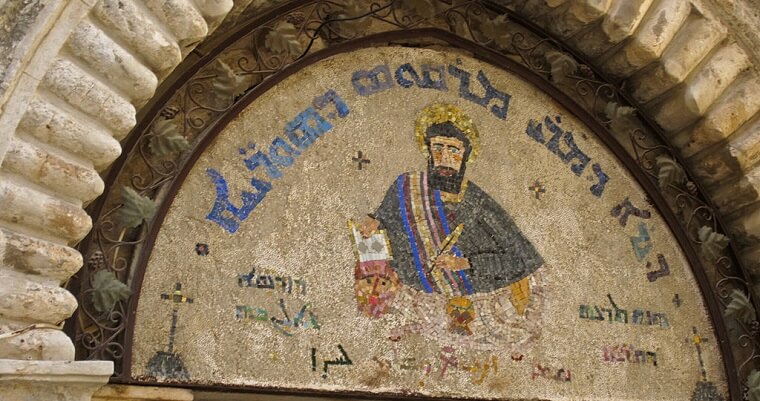
At the entrance gate to the monastery is a Crusader arch and a mosaic of Saint Mark with an inscription in Aramaic around it. The Syrians use a dialect of ancient Aramaic that is close to the language spoken in Israel two thousand years ago. They see themselves as the true Christians, the direct successors of Jesus and the apostles. The entrance leads to a courtyard surrounded by a complex of buildings, some of which are used for residences.
Opposite the entrance is the ancient church, where, according to the Syrians, the room of the Last Supper was located. Where Jesus and the disciples held their Last Supper, after the crucifixion the disciples returned to that same house, and there they established the first Christian community and received the descent of the Holy Spirit on Pentecost.
The house belonged to a man carrying a water jar on his head, who was Mark, later the writer of the Gospel of Mark. His house was later called Mary’s house. The mystery of the sacraments first appeared in this house. And so the important Syriac saint Ephrem writes: “In the house of Mark, Jesus abolished the ancient sacrifices and on that same night prevented the knife from the animals. There he wrote the new beliefs and abolished the false beliefs.”
he Syriac theologian Iaoannis (860 CE) tells us that the apostles performed the sacrament of the holy anointing oil for the first time in the history of the Church in this house. They also administered the sacrament of entering the Christian covenant (baptism) for the first time in this house, during which even the Virgin Mary was baptized. The first seven deacons (assistants) were also chosen in this house. And so on and so forth.
Most Christians identify Mark’s house as the room of the Last Supper on Mount Zion, but the Syrians claim that this identification is mistaken and that the true place is in their church, and they are probably right. At the entrance to the house, on the right side, an inscription in Aramaic was found indicating that the house was renovated in the first century and that it is indeed Mark’s house. It says: “This is the house of Mary, the mother of John, who is called Mark, which the holy apostles commemorated as a church in the name of the Mother of God, Mary, after the ascension of our Lord Jesus Christ to heaven. The church was rebuilt in 73 CE, after Emperor Titus destroyed Jerusalem.”
The lower parts of the church are ancient and probably date to the end of the Second Temple period, but the structure, which was a Syriac monastery, was renovated during the time of the Byzantine Emperor Justinian (6th century) and again during the Crusader period (12th century), after it was destroyed by Al-Hakim at the beginning of the 11th century. Most of the upper parts of the church today are Crusader. In the 18th century, renovations were carried out, and the sink, the bishop’s chair, the bookcase, and the treasure chest were installed. Many of the pictures are from this period.
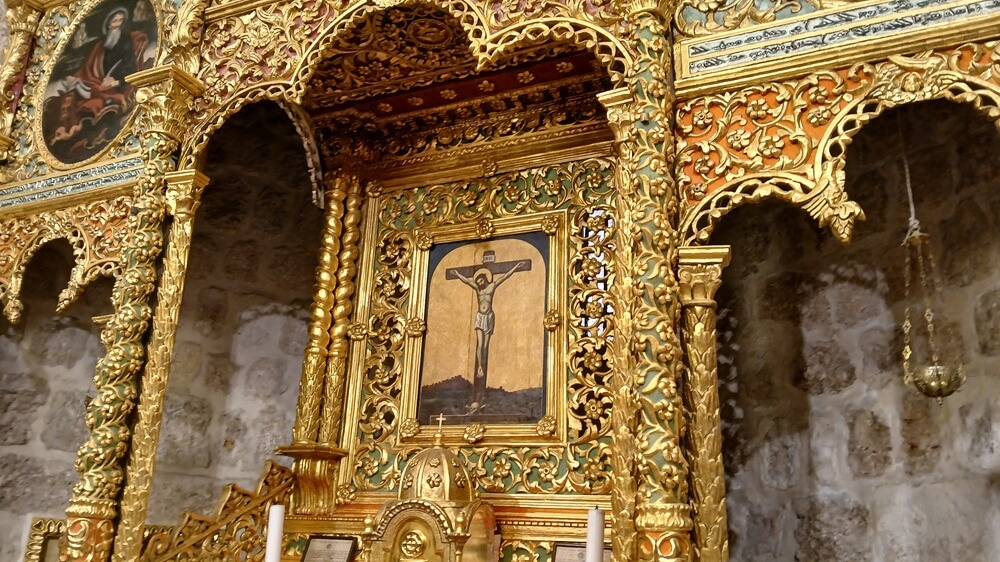
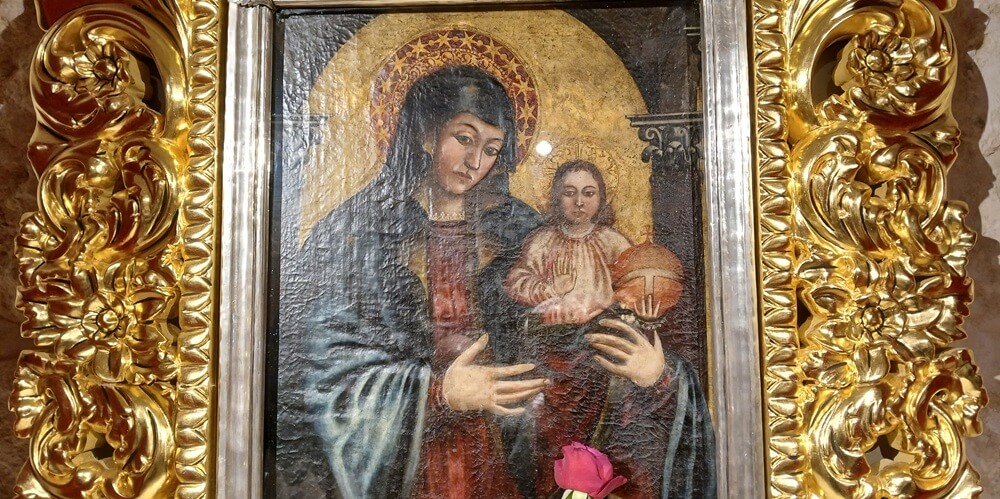
Opposite the entrance, there is a stand with a particularly holy icon. It is a picture of Mary holding Jesus in her arms, painted in real time by Luke, the author of the third Gospel, who was also a doctor and painter. This means that he painted the picture while Mary was still alive and he saw her, and therefore it shows the true figures of Jesus and Mary. Indeed, the infant Jesus looks like an adult. The icon is attributed to various miraculous deeds and serves as an object of adoration and prayer.
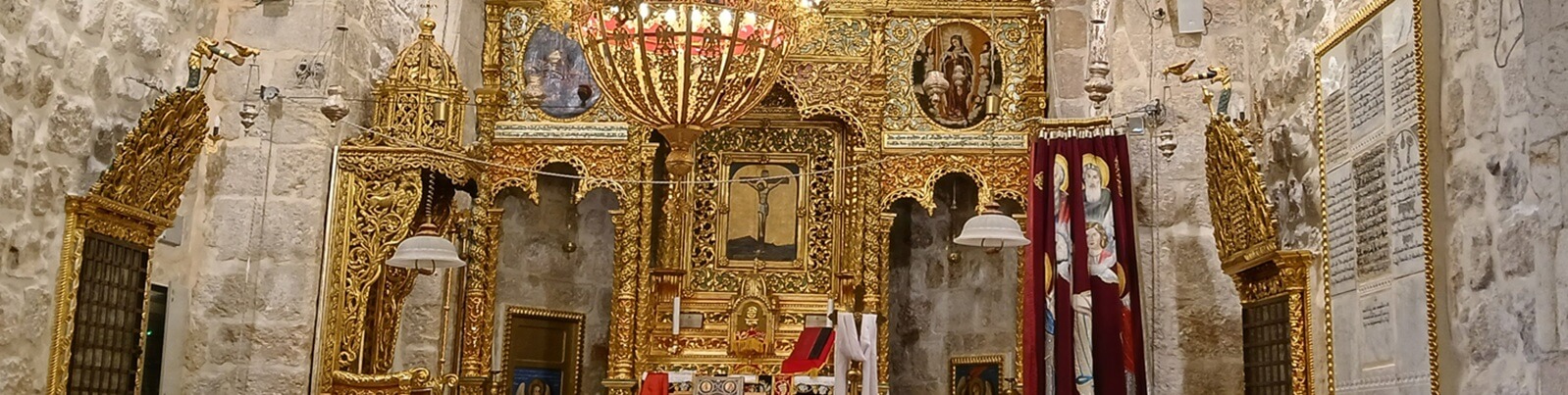
The altar area—the Holy of Holies—in a Syriac church is separated from the profane by a colorful curtain that can be moved aside at the request of visitors, revealing a beautiful wooden screen with three domes on it. On the left side of the altar, there is a magnificent chair. This is the chair of Jacob, the brother of Jesus, who led the first Christian community in Jerusalem and lived in this house, and also the chair of the Syriac bishops of Jerusalem who continue his path.
Above Jacob’s chair, on the side wall of the church, there is a statue of a dragon from which a hand emerges holding a dove. The dove is a symbol of the Holy Spirit that entered the body of Mary, symbolized by the hand, and purified her from within. According to the belief of the Syrians, at the time of the Annunciation an angel of God descended upon Mary and cleansed her insides, making her pure, and only then could the second principle of the Godhead (the Son of God) be embodied within her. According to the Syrians, Mary is a Theotokos in whom the divine and human natures are united. These beliefs are important because they are contrary to the beliefs of Nestorian Christianity, which was the ideological—and sometimes also physical—rival of the Syrians in that region in ancient times. The Nestorians opposed the worship of Mary and her title as the Mother of God.
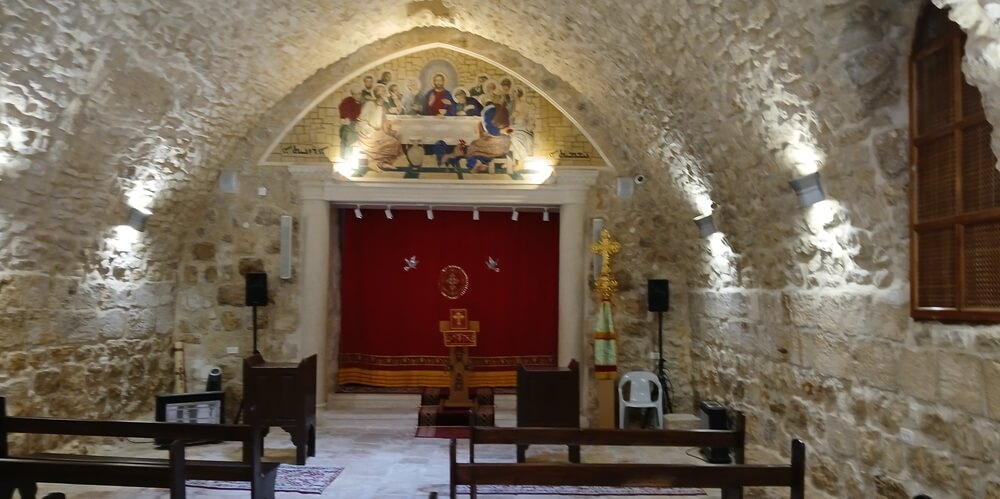
The visit to the church is completed by descending to the crypt below it. It is a long hall, half of which is blocked by a wall, so one can only enter half of it. According to tradition, this is where the room of the Last Supper was. In the past, the street level was much lower, as proven by excavations carried out in the area, and at that time the room was on the upper floor, as written in the New Testament. On the wall, there is a painting of the Last Supper in a Syriac version. On the other side of the wall, there is a space where the bodies of the bishops of Jerusalem are laid. Every bishop who dies is placed with his ceremonial robes on a chair beyond the wall, with the shepherd’s staff in his hands. According to legend, the bodies remain seated in their places, intact, until the death of the next bishop. This is done to confuse and deter the spirits of demons, as was also the case with King Solomon.
References
[1] Blinitzky, B., & Rotman, Y. (Eds.). (2018). The Cave of Treasures: An Anthology of Syriac Literature from Late Antiquity in Hebrew Translation. Tel Aviv: Tel Aviv University Press.
[2] Vööbus, A. (1958–1988). History of asceticism in the Syrian Orient: A contribution to the history of culture in the Near East (Vols. 1–3). Louvain: Secrétariat du CorpusSCO.
[3] Peña, I., & Sullivan, J. (1992). The amazing life of the Syrian monks: in the 4th-6th centuries. Franciscan printing press. Milano.
[4] Kopsky, A., & Rozer, S. (2018). Early Christian Faith: Challenges, Changes, Controversies. Tel Aviv: Adra Press. (Hebrew)
[5] Kopsky, A., & Rozer, S. (2018). Early Christian Faith: Challenges, Changes, Controversies. Tel Aviv: Adra Press. (Hebrew)
[6] Brock, S. P. (1987). Aphrahat Demonstration IV, On Prayer. In The Syriac Fathers on Prayer and the Spiritual Life (pp. 1–28). Kalamazoo: Cistercian Publications.
[7] Blinitzky, B., & Rotman, Y. (Eds.). (2018). The Cave of Treasures: An Anthology of Syriac Literature from Late Antiquity in Hebrew Translation. Tel Aviv: Tel Aviv University Press. (Hebrew)
[8] Ashkenazi, Y. (Central Editor Meshulam, S.). (2009). Mother of All Churches: The Church of Jerusalem from its Beginning to the Muslim Conquest. Jerusalem: Yad Izhak Ben-Zvi.