Kabbalah in the Jewish Quarter
Kabbalah appeared in southern France and Spain in the 13th century with the publication of the Zohar, and swiftly conquered the Jewish center in Spain. Following the unification of Spain under Ferdinand and Isabella in 1492, the Jews were expelled, and the glorious joint Jewish, Christian, and Muslim civilization came to an end. A large part of the Jews arrived in the Ottoman Empire.
Bayezid II, who needed human capital to maintain and develop his expanding empire, seized the opportunity. It is written that: “Sultan Bayezid, King of Turkey, heard of all the evil that the King of Spain had done to the Jews, and that they sought rest for the soles of their feet, and his eye pitied them, and he sent men before him and a voice went throughout his kingdom, and also by letter, saying that no man of his city governors should be permitted to oppress or expel the Jew, but all should receive them with a cheerful countenance.”
Bayezid thus said: “Is it possible to call such a king wise or intelligent? He impoverishes his own country and enriches my kingdom.”
The Turkish Sultan proactively sent ships to Spain and Portugal to bring the Jews into his domain. More than 150,000 people found refuge in the Ottoman Empire, settling first in Thessaloniki and Istanbul, and in cities along the Balkan trade routes. To attract them to his kingdom, Bayezid granted them economic rights, such as a license to supply clothing to the Ottoman army.
Gershom Scholem argues that the expulsion from Spain fueled Jewish mysticism and messianism [1]. The trauma of the Spanish expulsion remained imprinted on the collective memory, a kind of lost paradise. Further disasters also influenced a pessimistic outlook. Christianity was perceived as the enemy, a force of evil, and for this reason, the Ottoman Empire was seen as the force of Good, which opened the door to messianic visions.
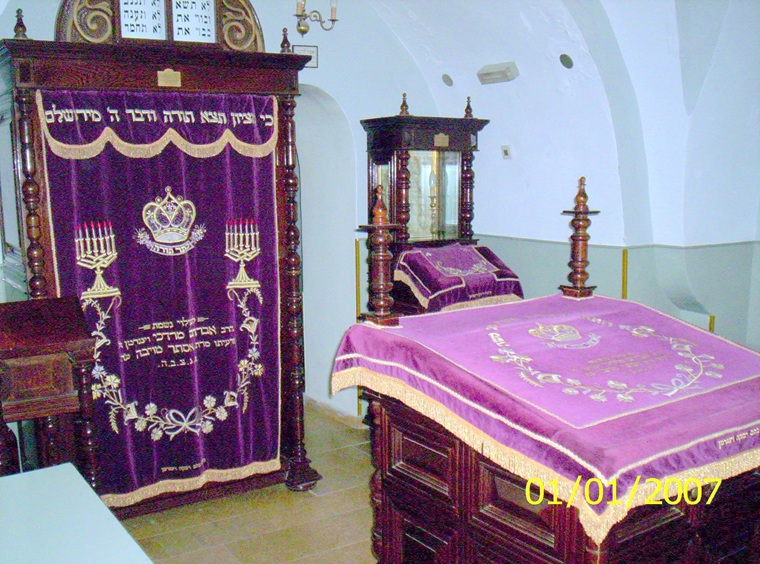
At the time of the Spanish expulsion, Jerusalem was under Mamluk rule, and the Ottomans had not yet gained a foothold in the Middle East. In the mid-15th century, the Jewish settlement in Jerusalem began to awaken with the arrival of Rabbi Ovadia of Bertinoro. By the end of the 15th century, some of the exiles from Spain arrived in Jerusalem, and it is possible that the Yochanan ben Zakkai Synagogue was established at that time. With the conquest of the city by the Ottomans in 1517, the trickle of immigrants turned into a flood. Those who arrived in the Holy Land were people from the second generation of exiles and those who were still strong in body and mind. Many arrived in Safed and Tiberias, but there were also those who came to Jerusalem and Hebron. The Jewish community in Jerusalem multiplied and became predominantly Sephardic.
Jerusalem has always been an object of longing for the Jews. There is an inextricable link between the place (Jerusalem), a dynasty (the House of David, from which the Messiah will come), the people, and the religion (Judaism). God dwells in Jerusalem even after the destruction of the Temple, and therefore Jews have always wanted to reach it, live and be buried there, and also study the Torah and the esoteric tradition there. The Ottoman conquest was an opportunity to fulfill a long-standing dream.
In addition, many of the Spanish Jews embraced the tradition of Kabbalah. According to Zeev Vilnay [2], the Kabbalists attached special importance to prayer in Jerusalem because, according to their belief, the Gate of Heaven is located there. The world is enveloped in klipot (shells/husks) that appear in Ezekiel’s vision, such as a stormy wind, a great cloud, a blazing fire, and a radiance, or as described in the Book of Genesis—an abyss, darkness, water, and chaos. Only in Jerusalem is there a kind of gate, a corridor, an opening through the klipot. Therefore, prayer in Jerusalem ascends directly to the heavens; it is good to study Kabbalah there, and even better to die and be buried there, because the resurrection of the dead will happen in Jerusalem.
immigration of Spanish Jews to Israel in the 16th century led to a Jewish cultural renaissance that took place mainly in Safed but also had branches in Jerusalem, and there were great rabbis in Jerusalem such as the Ralbach (Rabbi Levi ben Habib, 1480–1541), who opposed the primacy of the center in Safed. Many of the immigrants were sons and daughters of Thessaloniki Jews and were supported by them. This was the time of Rabbi Moses Cordovero, who wrote the Shulchan Aruch, and of the Ha’ari, who developed Kabbalah practice and learning. In Spain, the sages had been dispersed, and now they were all gathered together, and this had tremendous power and influence. Libraries and yeshivas were established, books and halakhot were written. Thus, the final stage in the consolidation of Halakhic and spiritual Judaism emerged. The relative wealth allowed philanthropists to support students and writers, and groups of students gathered around charismatic teachers.
One of the families that settled in Jerusalem was the Luria family, of Ashkenazi descent, descendants of King David and Rashi. The father of the family, Shlomo Luria, married a Sephardic woman from the Francis family, and in 1534 the prophet Elijah appeared before him and announced that the son about to be born would be great in Torah, and so it happened. The baby born was the “Ha’ari” (the acronym for HaElohi Rabbi Isaac Luria), the only person in Judaism referred to as “the Divine.” He grew up in Jerusalem and presumably ran around the city’s alleyways until the age of eight. One can visit his birthplace, where a synagogue was later established, which is today part of the Old Yishuv Court Museum, 6 Or HaChaim Street.
The Ha’ari was orphaned from his father at the age of eight, and the family moved to Egypt to live with his mother’s brother, who was a wealthy man. He studied Torah under Rabbi Bezalel Ashkenazi, who was originally from Jerusalem and was destined to become the head of the community in Egypt, the successor of the Radbaz — Rabbi David Ben Zimra — and later the head of the Jewish community in Jerusalem. Rabbi Bezalel Ashkenazi introduced the Ha’ari to the Radbaz and possibly also to the Zohar. In any case, at the age of fifteen, he was accepted into the Great Study Hall of Cairo, where the Radbaz, one of the greatest halakhic discourses of the generation, who was also from Jerusalem, taught.
The Radbaz was one of the original refugees from Spain and was expelled at the age of 13. He arrived with his family in Morocco, and from there they immigrated to Safed and Jerusalem. He left Jerusalem in 1513 at the age of 34 and moved to Egypt, where he taught for 40 years and was the head of a yeshiva and the leader of Egyptian Jewry. After 40 years, he returned to Jerusalem and Safed and died at an advanced age. The Ha’ari was a child born in Jerusalem 21 years after he left the city, who came to him when he had already been teaching for 36 years in Egypt, and studied the secrets of the Torah from him.
The Ha’ari spent seven years in the Cairo yeshiva, becoming part of the inner circle of the Radbaz and later of his successor, Bezalel Ashkenazi. During those years, he married his cousin, and two years later, a Kabbalistic book fell into his hands, prompting him to delve into the esoteric tradition. He left the yeshiva and the city and moved to a small island in the Nile that belonged to the family, where he spent fifteen years, much of that time in extreme physical and mental states, meditating on the Zohar.
In 1570, at the age of 36, a Heavenly Voice was revealed to him and commanded him to immigrate to the Land of Israel. He likely arrived first in Jerusalem and then moved to Safed, where he began to disseminate his esoteric doctrine. In the two years he spent in Safed until his relatively early death, he introduced a new dimension to the study of Kabbalah and the understanding of the unseen worlds. Concepts such as Tzimtzum (Contraction), Chalal Panuy (Empty Space), Shevirat HaKelim (Shattering of the Vessels), Mitah HaMelachim (Death of the Kings), and Tikkun (Rectification) transformed Kabbalah from a theoretical understanding of the divine worlds into a dynamic conception of life and of the role of man in the world.
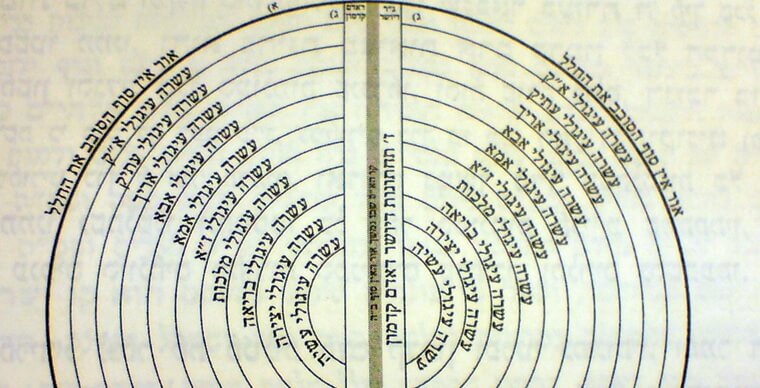
The Topography of Jerusalem in the Light of Kabbalah
According to the Kabbalistic world of imagery (found in the Ha’ari’s doctrine), when God wished to create the world, He first needed to contract Himself (Tzimtzum). So He evacuated a circular space called Tohū (or Tohu), into which a primordial ray of light penetrated and became Adam Kadmon (Primordial Man), the archetype of man built according to the principle of the Sefirot. From this Man, lights emanate from the eyes (even though they are closed), and also from the ears, the nostrils, and the mouth.
The light emanating from the eyes is a light shared by both eyes; the light emanating from the ears is separated lights that relate to each other; the light emanating from the nostrils is separated but touches each other; and only the light emanating from the mouth has two stages: thought and speech. From this light, the world of the Sefirot is created. This happens primarily through a beard created from the mouth down to the navel [3].
The Tohiru (the circular space) is actually divided into ten concentric circles, and against this backdrop stands Adam Kadmon, who contains the Ten Sefirot in the following arrangement: Keter (Crown) is above the head; Chochmah (Wisdom) and Binah (Understanding) are the two sides of the brain; Chesed (Lovingkindness) and Din (Judgment) are the right and left hands; Tiferet (Beauty) is the heart; Netzach (Eternity) and Hod (Splendor) are the two legs; Yesod (Foundation) is the male sexual organ; and Malchut (Kingship) is the inverted female figure.
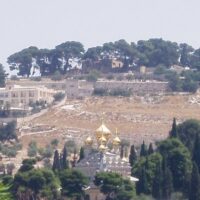
The topographical structure of Jerusalem symbolizes the cosmic drama of creation according to Kabbalah. Jerusalem is built inside a round valley, a kind of crater—“Jerusalem, mountains surrounding her”—with the place of the Temple in the middle, surrounded by mountain peaks that create a perfect circle around it. Furthermore, the point where their intersecting lines meet is precisely at the Temple itself. Into this circle, a sunray penetrates from the east—from the highest peak of the Mount of Olives—and illuminates the Temple, which is built on an east–west axis, facing the Mount of Olives. In other words, the highest mountain in Jerusalem—the Mount of Olives—is located exactly to the east of the entrance to the Temple, which, as mentioned, is set within a circle, thus connecting the circle and the straight line.
Temple service was related to the sunrise above the Mount of Olives, which signaled the beginning of the daily worship and sacrifice. The straight line of the sun’s ray at sunrise penetrates the circle of Jerusalem at the site of the Temple, thus creating the image of Adam Kadmon, which is expressed in the structure of the Temple itself [4]:
- The Holy of Holies is the Head – the Chochmah and Binah Sefirot are the two Cherubs on the Ark, Abba and Imma, and the Crown is the Glory of God between them.
• The Sanctuary (Heichal) is the Body – the Chesed, Din, and Tiferet Sefirot.
o Chesed is represented by the Menorah; its light is the divine abundance.
o Din is the Showbread (Lechem HaPanim), the world of matter of Tzimtzum.
o Tiferet is the Incense (Ketoret), which, like the prayers of Israel, ascends directly from the earth to the heavens.
• The two columns before the Hall – Boaz and Jachin – correspond to the two Sefirot Netzach and Hod. Netzach is the right column, and Hod is the left column.
• The opening between them is the Yesod and Malchut Sefirot, dependent on the entry and exit of the priests into the Sanctuary and the action they perform.
The Kabbalists see the pair of words Zion and Jerusalem as a pair with mystical meaning: the Yesod Sefirah is Zion, and it is masculine, while the Shechinah Sefirah is Jerusalem, and it is feminine. Zion is the spiritual Jerusalem, and Jerusalem is the physical Jerusalem. The connection of the sun ray with the Temple—the topographical circle of Jerusalem—occurs simultaneously with the connection between the worlds, the spiritual and the earthly, and this brings about the flow of abundance into the world.
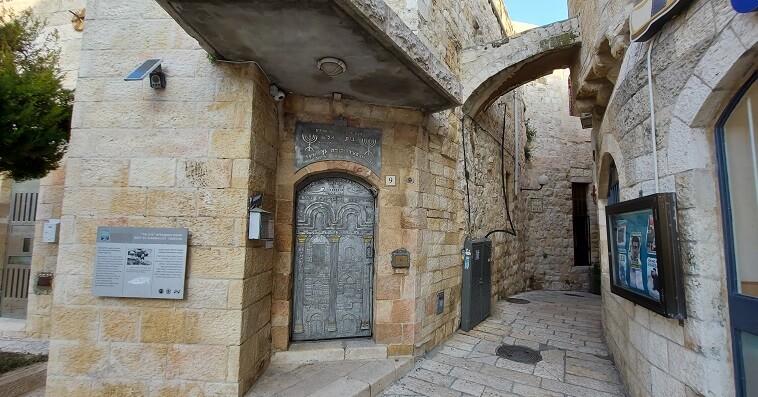
The Beit El Kabbalistic Yeshiva
The Beit El Kabbalistic Yeshiva was founded by Gedaliah Hayon in 1737. Towards the middle of the 18th century, eight yeshivas were founded in Jerusalem, parallel to the religious-messianic wave and the growth of the Jewish community. Before that, there was only one yeshiva, Beit Yaakov, founded in the 17th century. In the 16th century, there were several study institutions and yeshivas, but the Jewish community underwent a severe crisis at the beginning of the 17th century, and these study institutions, some of them earlier, closed down.
The Beit El Yeshiva held three shifts of study: the first, from midnight, included Tikkun Chatzot (Midnight Lament), dirges, and the study of the Ha’ari’s Kabbalah; the second, after the morning prayer (Shacharit), included the study of the Ha’ari’s Kabbalah; and the third began sometime in the afternoon and initially dealt with the study of the Mishnah with Bertinoro’s commentary, and after the evening prayer (Ma’ariv), the study of the Gemara with the Tosafot commentary and the Halakhic decisors. The prayer was also according to the Ha’ari’s kavannot (intentions) [5].
In the years after the death of the Rashash (see below), the Beit El Yeshiva served as the only Kabbalah study center of its kind, where the Kabbalistic way of life was practiced. The crisis at the end of the 18th century led to a decline in the Jewish settlement and the closure of study institutions, but the Beit El Yeshiva continued to exist. At the end of the 19th century, additional Kabbalistic yeshivas opened in Jerusalem: Yeshivat HaChaim VeHaShalom, Nahar HaShalom, Rechovot HaNahar.
With the fall of the Jewish Quarter in 1948, the Yeshiva ceased to exist. Ten years later, Rabbi Daya re-established the Yeshiva on Rashi Street in the New City of Jerusalem. After the Six-Day War, Rabbi Getz – who was also the Rabbi of the Western Wall and a well-known public figure – re-established the Yeshiva in the Jewish Quarter and served as its head. The Yeshiva returned to its historic location in the Old City. At its entrance is a special silver door with seven gates of Jerusalem, including the Double Gate and the Gate of Mercy (Sha’ar HaRachamim). The numbers and the colors silver and gold on the door are symbolic and relate to the structure of the Tree of Life (the Sefirot).
The Rashash
The Ha’ari renewed the doctrine of Kabbalah but died young and did not have enough time in the two years he taught to fully develop his system. Therefore, the root of his soul needed to be reincarnated in another figure to complete the work that had been prematurely interrupted. This figure was a man who lived and worked in Jerusalem in the 18th century.
Rabbi Shalom Sharabi (Rashash) (1720–1777) was born in Yemen and decided to immigrate to Israel in his youth. He passed through Bombay, Baghdad, Aleppo, and finally reached the Holy Land. Initially, he worked as a sexton at the Beit El Kabbalistic Yeshiva under its head, Rabbi Hayon, but he was discovered to be a genius in Torah, and the Rabbi married him to his daughter and appointed him as the head in his place. The Rashash led the Beit El Kabbalistic Yeshiva from 1750–1777 and made it the most important Kabbalistic Yeshiva in the world. As a result, Jerusalem became the most important center of Kabbalah and of Kabbalists in the world.
The Rashash headed a group of famous Rabbis called “Chevrat Ahavat Shalom“ (Society of Love of Peace). He ruled, among other things, that the Kabbalists should perform Tikkun Chatzot at the Western Wall. The Rashash would descend to the Western Wall at midnight and lament and roar like a lion over the destruction of the Temple for two whole hours every day.
According to the Ha’ari’s Kabbalah, a person’s decision to cleave to God is the climax of the rectification process (Tikkun). The soul is rectified through the study of the secrets of the Torah, meaning Kabbalah itself.
The Rashash developed the way of life led by the Ha’ari and his disciples, seeing it as a guide for the Kabbalist’s life—a pattern of religious life that is stricter than the Halakhic pattern. He saw the Ha’ari’s doctrine as a recipe for daily life intended for the select few—those who take on an especially ascetic way of life, beyond the letter of the law, and in return gain special holiness, and with it, influence over the divine worlds and forces. His prayer book (Siddur), which includes the Ha’ari’s kavvanot, became a tool for Kabbalists all over the world.
The Ha’ari’s writings are given a status identical to that of the Talmud by the Rashash. The Kabbalist spends his days in subtle and meticulous study of the Ha’ari’s writings and in prayer using the Ha’ari’s kavannot, which can sometimes last for many hours.
Some of the rectifications introduced by the Rashash involve lengthening the prayer by repeating combinations of letters. The letters are a vessel that carries the soul—a chariot (Merkavah). One must neutralize all feelings and reach absolute clarity. The combination of letters and syllables, such as “A-H-A-H-A-Y-H,” while performing commandments and intentions, makes the rectification process possible. While contemplating the letters, the intention must be focused and sacred.
Attempts to Hasten the Redemption
In 1752, the Rashash gathered 12 students around him, forming a Kabbalistic mystical group modeled after the Ha’ari’s cubs, with the desire to create a harmonious microcosm of the people of Israel.
In 1753, there was an attempt by the Rashash, the Chida (Rabbi Chaim Joseph David Azulai), and Rabbi Chaim De La Rosa to hasten the Redemption. They purified and prepared themselves for weeks and gathered together to call upon the Holy Names that would compel the Messiah to arrive. But then a Heavenly Voice was heard saying that it was a desecration of the holy to hasten the end, and because of this, one of them must leave Jerusalem. The three of them together could arouse energies that could not be controlled, and this could lead to the destruction of the world. And so, the Chida was forced to leave Jerusalem.
Chaim Joseph David Azulai—the Chida (1724–1806) was born in Jerusalem, studied under Chaim Ben Attar, and was a student and member of the Rashash’s group. He symbolizes the transition to the Modern Era and a Jewish religious renaissance that set a narrative for future generations. He is famous for his work on the great figures of Judaism up to his time, called Shem HaGedolim. He traveled around the Jewish world as an emissary (Shadar) of Jerusalem and wrote a book about it called B’Ma’agal Tov (In the Good Circuit). The phrase “All delay is for the good” is attributed to him.
Rabbi Chaim De La Rosa (died 1876) was one of the Rashash’s students, an ascetic who used to fast for three days and roll in the snow.
The Development of Christian Kabbalah
The engagement with Kabbalah within Christianity began with Pico della Mirandola, the successor of Ficino at the Neo-Platonic Academy in Florence. Christian Kabbalah was later developed by figures such as the Franciscan monk Francesco Giorgi (1466–1540) and Johannes Reuchlin (1455–1522).
Giorgi studied Hebrew and Greek, Pythagoreanism, Neo-Platonism, and Kabbalah. He wrote the book De harmonia mundi (The Harmonies of the World) [7], which was influenced by Kabbalah in explaining sacred architecture, and he applied this knowledge in the building of churches in Italy, especially the Church of San Francesco della Vigna in Venice, which is based on the model of the universe or the Jewish Temple. He was an advisor to the English King Henry VIII.
Reuchlin was one of the leaders of humanism and the Reformation, one of the founders of the study of Hebrew and Kabbalah. He wrote the book De arte cabalistica (On the Art of the Kabbalah) [8], in which he argues that Kabbalah is the source of the wisdom of Pythagoreanism and part of an ancient classical wisdom whose continuation is Christian spirituality.
The engagement with Kabbalah and the study of the Jewish language led to journeys to the Holy Land in general, and to Jerusalem and Safed in particular, by some of these scholars and others influenced by them.
Hasidism
With the spread of the belief in Kabbalah, the custom of directing intentions (kavannot) and the use of letters and symbols became widespread. But then Hasidism came and said otherwise. The Baal Shem Tov taught that the intention should be the simple intention. Rabbi Nachman said that he lowered the intentions and even forbade the combinations of letters.
Hasidism took the intentions and transformed them into unifications (yichudim). The Baal Shem Tov said that the Messiah would arrive if the masses could perform unifications. He taught three Holy Names and three virtues through which one could attain holiness. One of the virtues is joy.
Hasidism emphasizes divine immanence (“There is no place void of Him” [Leit Atar Panuy Minei]). The Shattering is explained by the parable of a tailor who cuts fabric into pieces only to stitch a suitable garment. The Hasidic doctrine of Tzimtzum assumes that the divine desire is to reveal itself specifically in the lower worlds. Everything exists in the depths of a person’s soul. Man can encounter the divine by descending into the depths of himself. Hasidism strives for the redemption of the individual. The answer to personal redemption is found in the self’s complete annulment, which leads to cleaving to God (Deveikut).
Hasidism appeared in the world in the 18th century, but it did not manage to take root in Jerusalem. The Jewish community in Jerusalem was mainly Sephardic, and many were Kabbalists. Only in the late 18th century do we find the beginnings of a Hasidic presence in the city.
Rabbi Gershon of Kitov
Many Jews expected the coming of the Messiah in 1740, but when this did not happen, some Kabbalists calculated that he would come in 1748. This led to a wave of immigration to Jerusalem, including Rabbi Gershon of Kitov. A year earlier, the Baal Shem Tov performed the ritual of the Ascent of the Soul (Aliyat Neshamah), after failing in his attempt to immigrate to the Holy Land.
He asked the Or HaChaim (Rabbi Chaim Ben Attar) whether he would be able to arrive. The Or HaChaim said that if the Baal Shem Tov saw only his feet during the Ascent of the Soul, it was a sign that he was forbidden to come. And so it was. A few months later, the Baal Shem Tov announced: “The western candle has been extinguished,” meaning that the Or HaChaim had died.
Rabbi Gershon of Kitov settled in Hebron and later moved to Jerusalem, and was accepted as a student of the Rashash at the Beit El Yeshiva. He was in the Holy Land from 1747–1761, died in Jerusalem, and was buried on the Mount of Olives.
At the end of the 18th century, there was a social, economic, and nutritional crisis in Jerusalem. The Jewish population dropped to about 2,000 Jews (out of a population of 10,000). But this marked the transition to a new period, in which the Jewish settlement would grow to a majority of tens of thousands of people by the end of the 19th century.
See a lecture on the development of Kabbalah in the Jewish Quarter:
Footnotes
[1] Scholem, G. (2016). Major Trends in Jewish Mysticism (S. C. Scully, Trans.). Tel Aviv: Miskal – Yedioth Books.
[2] Vilnay, Z. (1960). Jerusalem (Vol. 1-2). Achiever.
[3] Shatil, Sharon, The Ha’ari: The Story and Thought of the Kabbalistic Revolution in Safed, Tel Aviv: Miskal, 2008.
[4] Machover, Menachem, The Light of the Temple: The World of Thought of the Temple, 2 Vols., Jerusalem: The Temple Institute, 2003-2005.
[5] Morgenstern, A. (1999). Mysticism and Messianism: From the Ascent of the Ramchal to the Vilna Gaon. Maor. p. 94.
[6] Ibid, p. 104.
[7] Gill, D. J. (Trans. & Ed.). (2012). Francesco Giorgio’s De harmonia mundi. Lewiston, NY: Edwin Mellen Press.
[8] Reuchlin, J. (1993). On the art of the Kabbalah (De arte cabalistica) (M. Goodman, Trans.). Lincoln, NE: University of Nebraska Press.