The Yeshiva of the Land of Israel
Shortly after the Muslim conquest of Jerusalem, Jews were permitted to return and live in the city. The Jews viewed the Muslim conquest and the construction of the Dome of the Rock as the “beginning of the Redemption” (Atchalta de-Geula). The most important Jewish center in the Land of Israel at that time was in Tiberias, which was a Shi’ite city relatively close to Damascus, where the Yeshiva of the Land of Israel was located. However, in the mid-10th century, the status of the Jews in the Land of Israel rose due to their cooperation with the Ikhshidid and later the Fatimid dynasties, and the senior positions they held in their kingdoms. Consequently, a greater Jewish presence became possible in Jerusalem, and the Yeshiva of the Land of Israel moved from Tiberias to Jerusalem.
The Yeshiva of the Land of Israel, also called Gaon Yaakov (“Pride of Jacob”), was one of the most important Jewish study institutions during the early Muslim period, from the 7th century CE until the end of the 11th century. It was responsible for all the communities that had previously been under Byzantine rule (the Jews of Lebanon, Syria, the Land of Israel, and Egypt), and after its move to Jerusalem, it was responsible for all Jews in the Fatimid Empire, including the Jews of North Africa.
The Yeshiva saw itself as the successor of the Sanhedrin, and the person who headed it was called the “Gaon.” One of the most famous Geonim was Daniel ben Azariah, after whom the Ben Ezra Synagogue—known for the Cairo Genizah—is named. He was a descendant of the House of David and served in his position from 1052–1062. It is said that the ordination (semikha) in Israel ceased after him. A little later, at the end of the 11th century, the central government weakened, and with the Seljuk conquest of Jerusalem in 1073, the Yeshiva of the Land of Israel moved to Tyre. However, the Jewish settlement in Jerusalem continued to exist and played a crucial role in defending the city against the Crusaders. After the Crusader conquest, the Yeshiva moved to Damascus and Egypt, and it was eventually replaced in the leadership of the Jews by the Rambam (Maimonides).
The members of the Yeshiva of the Land of Israel participated in Sukkot ceremonies in Jerusalem, especially in the annual ceremony on the Mount of Olives on Hoshana Rabbah (the seventh day of Sukkot). During that period, the Jewish Quarter was probably located south of the Temple Mount, in the area of the Umayyad Palaces, the City of David, the Cheesemakers’ Valley, and down to the slopes of Mount Zion. Some believe that Jews also lived in the Muslim Quarter north of the Temple Mount. Many Jewish pilgrims came to the city, and the site where the destruction of the Temple was commemorated was the Eastern Wall rather than the Western Wall as it is today. The Eastern Wall of the Temple Mount plaza featured the Gate of Mercy and faced the Mount of Olives, from where the Messiah is believed to come.

The Annual Ceremony on the Mount of Olives
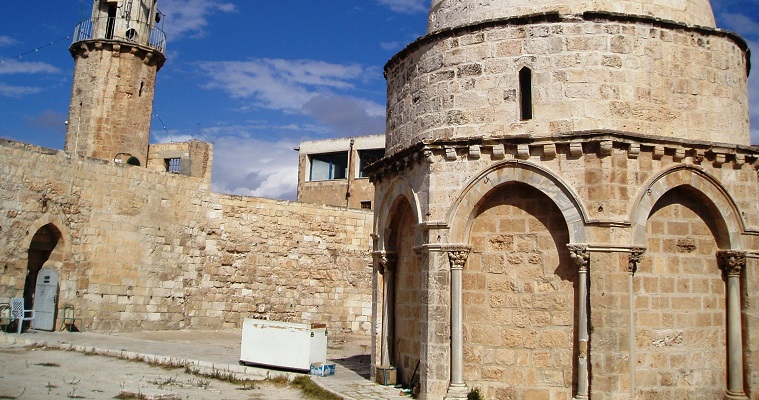
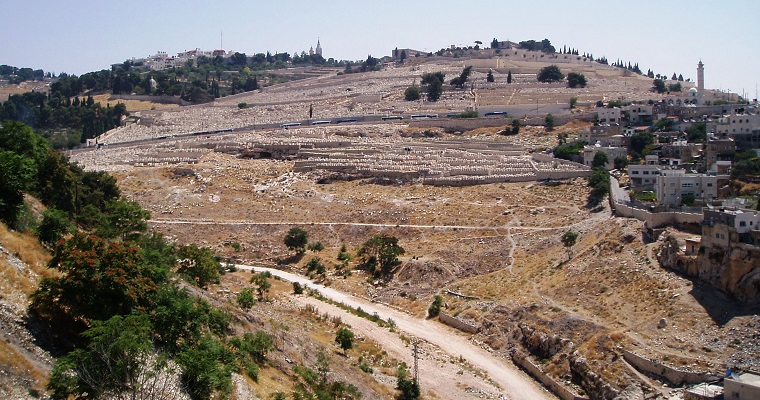
The Mount of Olives was considered a place of the Divine Presence (Shechinah), called “the footstool of our God” or “the place of His mighty presence and the footstool of His feet.” Beginning in the 9th–10th centuries CE, we have descriptions of Jews ascending the mountain on Hoshana Rabbah and circumambulating the peak seven times, accompanied by prayers and psalms. The priests walked at the head of the procession, dressed in silk garments, followed by the masses of Israel. According to Zev Vilnay, during the processions it was customary to distribute titles of honor to distinguished Torah scholars, and special liturgical poems (piyyutim) were sung, some of which were found in the Cairo Genizah. The Karaites also ascended the mountain. The center of the celebrations was probably near the site of Jesus’ ascension to heaven, with the two traditions complementing one another.
According to Eyal Davidson, the Mount of Olives connects the traditions of destruction and redemption, past and present, and therefore constitutes an axis mundi linking the temporal and the eternal, the earthly and the divine. Davidson suggests that the circumambulations on Hoshana Rabbah took place at the Christian Ascension site itself, which was abandoned during the Fatimid period [1]. Even if they did not take place exactly at the location Davidson proposes, there is an overlap between the traditions of redemption and resurrection in the three religions, particularly in relation to the Mount of Olives. Thus, Jerusalem, as a microcosm of the human religious quest in Western culture, shows that certain archetypes—such as that of redemption—speak to humanity universally and are subconsciously connected to specific geographical features, such as a high mountain peak.
According to tradition, there was a stone on the Mount of Olives called the “Chair of the Cantors,” where the Shechinah stood for three and a half years after its exile, and where it intends to return: “Then the glory of the Lord went up from the midst of the city and stood on the mountain which is on the east side of the city” (Ezekiel 11:23).
Karaites
An important presence in Jerusalem during the early Muslim period was that of the Karaites. The movement began during the time of the Abbasid Caliph al-Mansur, when Anan ben David, the Exilarch, was deposed from his position. Anan rejected the Oral Torah as sacred and proposed an alternative halakha, and he was therefore rejected by the wider Jewish community. However, for some who became his followers, he was considered a prophet and sage of the generation from the House of David, destined to lead the Jewish people and restore them to the true Torah, and they became the “Karaites.” According to Karaite tradition, after the polemics in Babylon, his imprisonment and miraculous release, he wrote the Sefer ha-Mitzvot (“Book of Commandments”), and then immigrated to Jerusalem and established the Karaite synagogue that exists in the Jewish Quarter to this day.
The Karaites emphasized self-study and investigation of the Torah, personal responsibility in the interpretation and observance of the commandments, as well as an interpretation that was partly esoteric. They did not oppose the interpretation of the Torah, but argued that the Mishnah and the Talmud held no sanctity, and that anyone could interpret differently, provided the interpretation was based on an organized method of inference (they had seven such inferences).
Their perception rested on the verses in Deuteronomy 30:11–14: “Now what I am commanding you today is not too difficult for you or beyond your reach. It is not up in heaven, so that you have to ask, “Who will ascend into heaven to get it and proclaim it to us so we may obey it?” Nor is it beyond the sea, so that you have to ask, “Who will cross the sea to get it and proclaim it to us so we may obey it?” No, the word is very near you; it is in your mouth and in your heart so you may obey it.”
It is the duty and right of every person to approach the commandments on their own merit. The Muslims, who sanctified the written word in the Quran, identified with the Jewish-Karaite view, and many of them saw it as a correct form of Judaism.
Another aspect of the Karaites that also appealed to the Muslims was their mourning and ascetic customs. They ostensibly mourned the destruction of the Temple, but their mourning was deeper and touched upon the state of human sin in the face of the Day of Judgment, somewhat similar to the early Muslim “Weepers.” They kept fasts, refrained from meat and wine, and engaged in physical and spiritual asceticism, somewhat akin to the early Sufis. According to Eli Malki [2], the Karaites were familiar with ancient Essene literature, and evidence of this is the discovery of a copy of the Damascus Document in the Cairo Genizah. Their sources also contain a story about scrolls that came from the Land of Israel to Babylon at the beginning of the 9th century CE. Kirkisani (an important Karaite scholar of the 10th century) tells of a Jewish sect called the Sect of the Caves—perhaps the Essenes.
The Karaites called their righteous individuals “Shoshanim” (Roses/Lilies), flowers whose appearance symbolizes the end of winter, and whose beauty is emphasized by their background—“as the lily among thorns,” the thorns being interpretative Judaism. They encouraged immigration to and settlement in Jerusalem. From the moment rule over the Land of Israel passed from the Abbasids to the Tulunids in 868, and subsequently to the Ikhshidids, the Karaites experienced a period of revitalization. Their leader in Jerusalem was Daniel ben Moses al-Qumisi, who wrote: “From the beginning of the exile, the Rabbanites were princes and judges… and the seekers of the Torah could not open their mouths to the commandments of the Lord for fear of the Rabbanites… until the coming of the kingdom of Ishmael, for they always help the Karaites to observe the Torah of Moses, and we must bless them.”
In the Fatimid Empire, there was an important Jewish family of advisors called the Tustaris. They were Karaites who came from Iraq and served the court for several generations until the mid-11th century. In addition, there was a wealthy and influential Karaite community in Cairo, Egypt, that supported the Jerusalem community. Therefore, the Golden Age of the Karaites continued with the Fatimid conquest in 970 and lasted until their decline about a hundred years later.
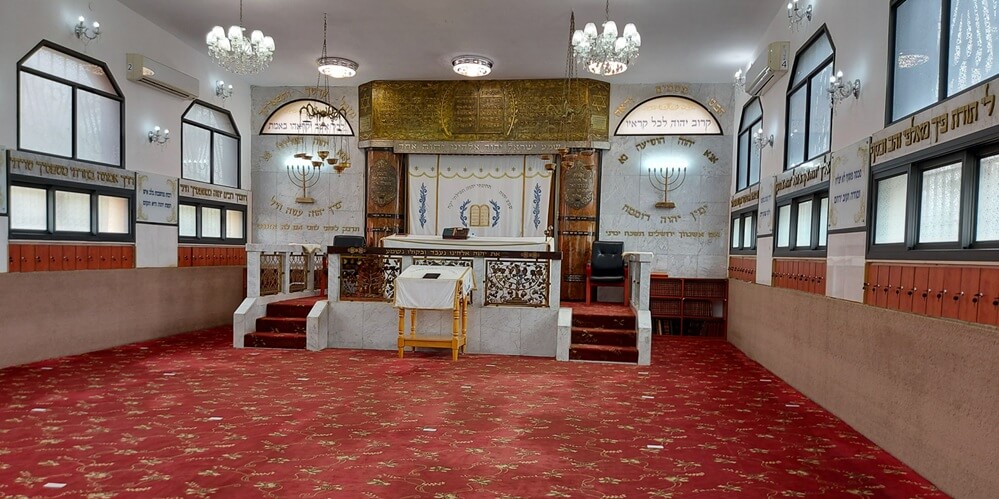
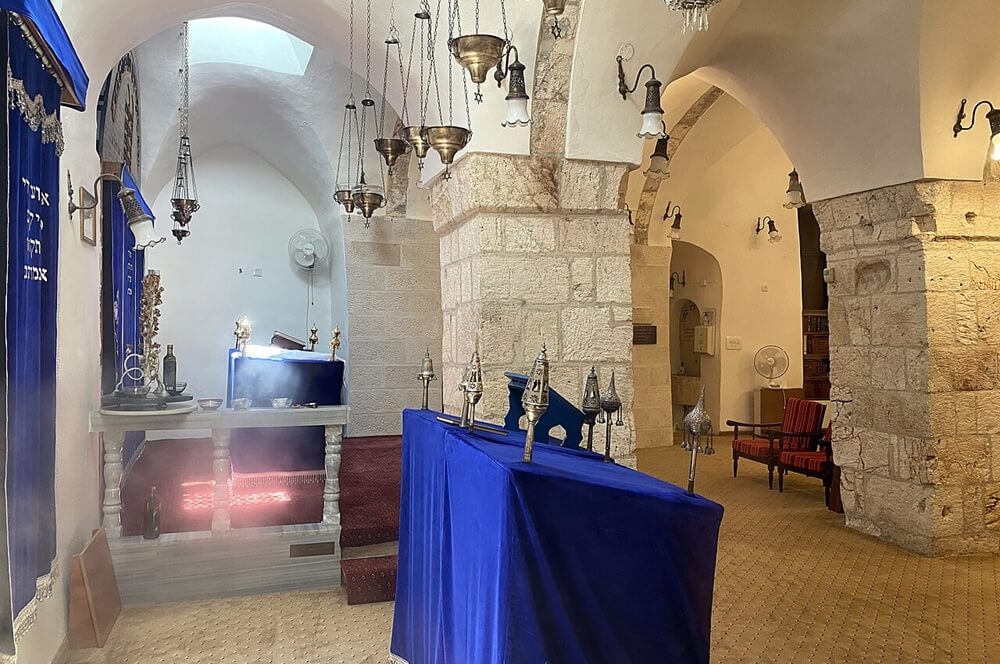
The Karaite synagogue in Jerusalem is located near the Nissan Bak Synagogue in the Jewish Quarter. According to Karaite tradition, continuous prayer has been held there since the 8th century BCE, which would make it the oldest active synagogue in the world. In general, a Karaite synagogue is somewhat similar to a mosque: the floor is covered with carpets, shoes are forbidden, and during prayer there are prostrations and bowing. Adjacent to the synagogue, there is a visitors’ and heritage center that tells the story of this unique community, which currently numbers about 25,000 people throughout Israel.
The Ramban and the Establishment of the Jewish Quarter
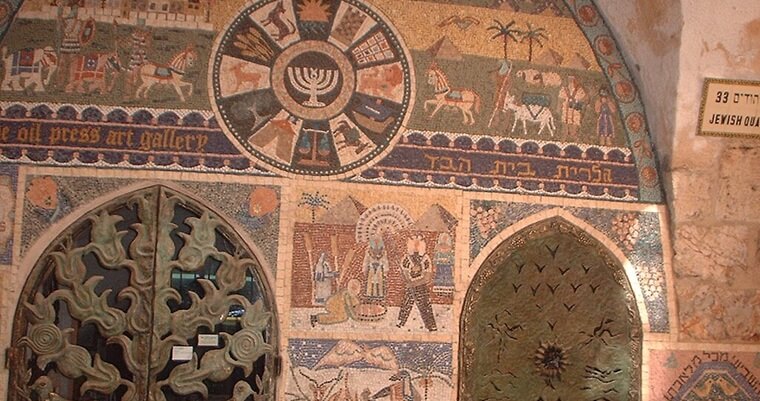
The Jewish neighborhood in Jerusalem was not always in its current location. Before the Crusades, the Jewish Quarter was situated south of the Temple Mount. The person who probably established the Jewish Quarter in its current location was the Ramban (Nachmanides), who arrived in the Holy Land during the Mamluk period and founded a synagogue named after him in the area of the Jewish Quarter that is active to this day.
The Ramban—Rabbi Moses ben Nachman (1194–1270)—was a well-known figure both in the Jewish world and in the world of Kabbalah, and he essentially gave the stamp of legitimacy, by virtue of his Halakhic authority, to the Kabbalah that developed in Spain and southern France during that period. He became famous for characterizing the interpretation of the Torah according to four levels, and was the first to explicitly use the term Pardes: Pshat (simple meaning), Derash (homiletic meaning), Remez (allusion), and Sod (secret/mystical meaning).
The Ramban was zealous about preserving the secrecy of Kabbalistic knowledge. Therefore, we do not have large-scale textual units in which he details his Kabbalistic doctrine. However, he concealed the secrets of Kabbalah within his commentary on the Torah. In the introduction to his commentary, the Ramban writes that the meaning of his subtle allusions to Kabbalistic matters, which he wove into his commentary, is inaccessible to the average observer. Only a master of the Kabbalistic tradition would be able to grasp the depth of his allusions.
The Ramban’s love for the Land of Israel knew no bounds. He wrote poems and essays about the Land of Israel, and in his Torah commentary he frequently praises it. The opportunity for his immigration to the Land of Israel arose following a public disputation he had with the Christians, after which he was forced to leave Spain under pressure from Pope Clement IV. He arrived in the Land of Israel in the month of Elul in 1267 and described the desolate state of Jerusalem.
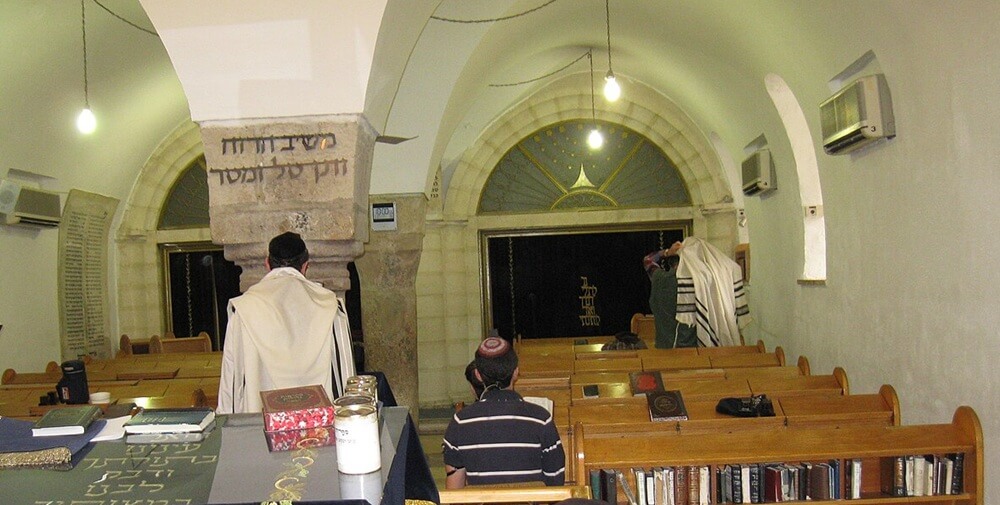
The Ramban Synagogue is a relatively small synagogue, sunken below ground. According to those responsible for the site, there are remnants there from the Ramban’s period (13th century). Some argue that the Jewish community resided on Mount Zion and that the Ramban settled and established a synagogue there rather than in the Jewish Quarter. In any case, by the 15th century (one hundred and fifty years after the Ramban’s arrival in the Holy Land), we already have evidence of Jews living in the Jewish Quarter in Jerusalem, and the Ramban Synagogue apparently moved with them from Mount Zion to its current location.
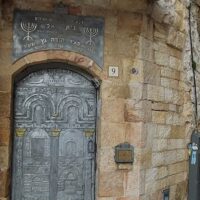
At the entrance to the synagogue, there is an inscription containing his letter to his son, which includes the famous verse: “Hear, my son, your father’s moral instruction, and do not forsake your mother’s teaching” (Proverbs 1:8). If we apply the concepts of Pardes, then the mother is the Binah sefirah in Kabbalah, and the father is the Chochmah sefirah. According to the Sefer Yetzirah (Book of Creation), one must use these two forms of thought: “Understand with Wisdom and be wise with Understanding,” meaning the activation of both hemispheres of the brain. The external Torah is not enough; inner morality (musar) is also needed. Thus, the verse has both an explicit and a hidden meaning.
At the end of his life, the Ramban returned to Acre, and from there it is unknown where he continued or where he died and was buried. Various traditions attribute his burial to Jerusalem (near the village of Silwan), Haifa, Acre, Hebron, or Tiberias.
Footnotes
[1] Davidson, A. (2022). “And as they were ascending the Mount of Olives: A Proposal for Identifying the Site of the ‘Ascension of the Shechinah’ in Jewish Traditions of the Middle Ages.” B’Ma’abeh HaHar, 12, 83–114.
[2] Eli Malki, The Spiritual Path of the Essenes – From Qumran to Kundalini. 2015.