Shabbatai Zevi
In the late 17th century, interest in Kabbalah intensified, and the Zohar became increasingly popular. Refugees from Russia (persecutions of 1648–1649) arrived in the Ottoman Empire. Against this backdrop, another wave of messianism grew, reaching its peak with the appearance of Shabbatai Zevi, who lived and was active in Jerusalem [1]. In this context, it is worth mentioning Rabbi Azulai, a famous Kabbalist from the 17th century who spent several years in Jerusalem and was known for his work Ḥesed le-Avraham. In his book, he presents a diagram of the klipot (shells/husks) and claims that there is a breach above Jerusalem through which one can reach heaven. He died in 1663, around the time the designated “Messiah,” Shabbatai Zevi, arrived in Jerusalem (and Hebron, his first residence).
In 1662, a charismatic and eccentric young man named Shabbatai Zevi arrived in Jerusalem. He stayed in the Jewish Quarter for two years, performing spiritual intentions (kavvanot), reaching spiritual heights, and slowly becoming convinced that he was the awaited Messiah. At that time, 200–300 Jewish families lived in Jerusalem, many of whom were engaged in Kabbalah. The only functioning yeshiva in the city was Beit Yaakov, founded in 1658 by Rabbi Israel Yaakov Ḥagiz with the support of Jews from Livorno, Italy. The leaders of the yeshiva later became the most ardent opponents of Sabbateanism and Shabbatai Zevi, but one of its students—Nathan of Gaza—became his most important supporter.
Shabbatai adopted ascetic customs, secluded himself in a room, and even traveled to the Judean Hills and the Judean Desert, hearing Divine voices (Bat Kol) and communing with God. In 1664, he became a shadar (emissary of the rabbis) of the Jewish community in Jerusalem and set out on its behalf to Egypt. During this journey, he met Nathan of Gaza, whom he may have known previously, and Nathan convinced him definitively that he was the Messiah.
The first person in Judaism to be called the Messiah was actually Cyrus, King of Persia. Messiah was initially considered someone who had a political and practical role in bringing political independence to Israel. With the development of Christianity and the messianic teaching of Jesus, the concept of the Messiah also developed in Judaism. The Messiah is initially a king who is anointed (mashiach). Over time, the concept came to represent a legendary king who would come at the end of days, redeem Israel, and establish the Kingdom of Heaven on earth, causing the glory of God to descend to the earth and fulfilling the prophecies of the prophets.
However, the Kabbalah of the Ha’ari gives the Messiah a deeper dimension: the reason for the exile of Israel is a cosmic accident during which the vessels shattered, and the sparks of light of the image of Adam Kadmon (Primordial Man) were scattered among the klipot that created the world. The light that was in the form of Adam Kadmon was imprisoned within the klipot that constitute the world. The role of the Jewish people is to gather the sparks of light from the various lands and peoples in order to recreate the image of Man—Adam Kadmon—this time through merit and not through grace. Thus, the role of the Messiah is to create the Kingdom of Heaven on earth, based on justice and peace, in the spirit of the prophets’ vision, with its center in Jerusalem, and to serve the entire world. The Messiah is a legendary figure who will convince the nations and lead the entire world toward redemption.
The appearance of the Kabbalah of the Ha’ari, the concepts of Tzimtzum (Contraction), Shevirah (Shattering), and Tikkun (Rectification), the description of the Sefirot (Emanations) in the form of Adam Kadmon, and the general messianic climate—all these prepared the ground for claims of a divine messianic revelation in a person, and the one who rode this wave was Shabbatai Zevi.
Shabbatai Zevi introduced a new dimension to the concept of the Messiah: the Messiah must suffer for the sake of Israel. The process of Tikkun will be carried out through him and his figure, and not through others under his leadership. He must set a personal example and descend to the Klipot at their lowest level. Only from the lowest place can the Divine Names be known in their fullness, which is the purpose of man in creation. From a place of evil one can know the good; from a place of ugliness one can know the beauty. Only by descending into the Klipot can the light within them be extracted, and the good within the evil, and the beauty within the ugliness, be revealed—so that the whole world may be united with God, making everything one, which is the role of man.
It can be said that in Christianity, Jesus also descends to the Klipot; the Son of God appears in this world to suffer for our sake, but he is not an active partner in the attributes of the Klipot. He brings light to the places of darkness and does not become darkness himself. The understanding of Shabbatai Zevi’s divinity and his messianism holds the view that the Messiah must participate in the Klipot in order to elevate the darkness to light, and not, as Jesus did, to bring the Kingdom of Heaven to Earth—even for a short time. Jesus does not extract the sparks of light from the shells of darkness but ignores them. He brings a Gnostic perspective of two worlds existing simultaneously and fighting each other. In Judaism, the tendency is to refer to the physical world as part of the divine world, to everything as one.
In the prophecies of destruction, Jerusalem is described as a maiden wallowing in the dust, and she is called to shake off her ashes and rise and awaken. The prophecies speak of the poor state of the maiden Jerusalem and the renewal of her days as of old—and even more magnificently.
In later times, Jerusalem or Zion was identified with the Shekhinah (Divine Presence), who is in a state of mourning, wallowing in the dust, distant from the King. But when the day comes, she will awaken and return to her status as Queen, conveying the Divine Light through her. Shabbatai Zevi identified himself with the Shekhinah; he is her appearance in the world. This is the meaning of the Messiah according to his method.
We see that Shabbatai Zevi mixed several Kabbalistic concepts that began to take deep root among the people during his time and attributed them to himself, and hence his power. The concepts are: Shekhinah, Messiah, Adam Kadmon, and the dialectical process of Shattering and Rectification. Another tool that Shabbatai Zevi used brilliantly is the esoteric interpretation of the Torah.
According to the Kabbalah, the Torah has four levels of understanding: Pshat (Simple), Derash (Homiletical), Remez (Allusion), and Sod (Secret). Within the Secret lies the entire dialectical process of Creation, Shattering, and Rectification. A correct interpretation of the Torah extracts the sparks of light from the Klipot and can lead to the creation of a spiritual body, Tzelem (Image), in man and in the world.
Shabbatai Zevi engaged extensively in the study of the hidden interpretation of the Torah and saw himself as an expert and leader in this field, to the extent that a new Torah appeared in him, just as a Torah had been given to Moses. He himself became the Torah, because the Torah was given to reveal the secrets of Creation to human beings and as part of the process of Tikkun, and he himself embodies the secrets of Creation and the process of Tikkun, so he is permitted to transgress its prohibitions. The identification of himself with the Torah was not understood literally by most of the people, but the understanding was that he had the keys to the hidden side of the Torah, to the secret teaching within it. To demonstrate this, he held a mystical marriage ceremony between himself and a Torah scroll in Thessaloniki.
We see that the mixing of concepts, names, and their interpretation through the figure of Shabbatai Zevi is characteristic of Sabbateanism. This is a kind of New Age movement in which names and terms like Redemption, Messiah, Secrets of the Torah, Adam Kadmon, and more are freely used. These are names that were heavily charged by the collective subconscious of the Jewish community, and it was enough to use them to create a strong emotional effect among the masses. It was a kind of demagoguery that plays on emotions aroused by archetypal concepts. This explains the success of Sabbateanism, but there is a deeper dimension here: Sabbateanism succeeded in connecting all these forces—all the charged vectors of the expectation of redemption, the search for the spiritual in man, the attempt to understand the secrets of the Torah—into an interrelated system of concepts revolving around the figure of Shabbatai Zevi.
The figure of the Messiah became an accessible physical anchor for all those theoretical Kabbalistic terms — a point of their actualization and a possibility for practical reference. As a result, Sabbateanism succeeded in arousing dormant psychological forces among the believers, and this was a genuine phenomenon that had value in itself, as Gershom Scholem notes. In the end, when the moment of truth arrived, Shabbatai converted to Islam under the Sultan’s pressure, and this was a very great crisis. A Messiah can die, but he cannot deny his religion. However, Sabbateanism and Shabbatai himself had an explanation for this, and this time it was not merely the excuse of the descent into the Klipot, but something that touched a deeper layer.
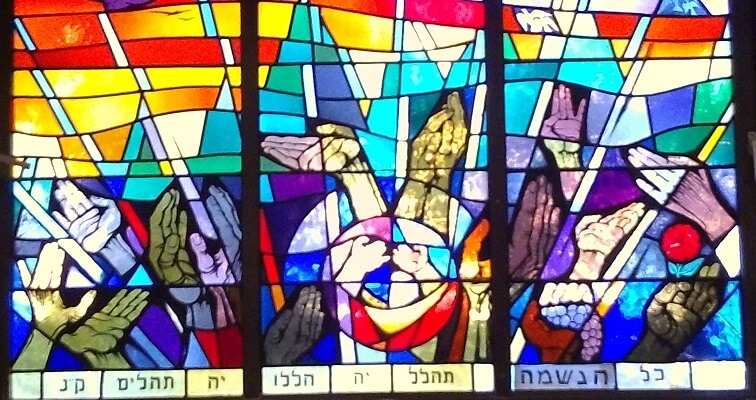
The Teaching of Truth and Grace
Shabbatai Zevi is known in Jewish sources as a false messiah, one who promised and disappointed. One could dismiss the entire Sabbatean phenomenon and its claims as madness and nothing more. But with a deeper look, one can see (if one wishes) how he nevertheless managed to touch upon a certain truth, even though he himself did not see it during his lifetime, nor did his followers, and only in the perspective of time can this be discovered.
This is related to the phrase that became the motto of the Sabbatean movement, “Your Torah is Truth and Grace.” Shabbatai Zevi’s interpretation of the two attributes, after his conversion, was that Truth is Judaism and Grace is Islam. According to this view, Judaism and Islam do not essentially contradict each other, but are two aspects of the same thing. The true religion is a combination of both, as it is written: “Love and faithfulness meet together; righteousness and peace kiss each other” (Psalm 85:10). Shabbatai Zevi says: “You already know that the Torah of Ishmael is called the Torah of Grace, and our Holy Torah is Truth.”
purpose of Shabbatai Zevi’s messianism was, in retrospect, the connection between Judaism and Islam and the transcendence above both to a personal, spiritual religion that breaks out of the framework of the ordinary and ossified religion of the time and can provide answers to human life. Shabbatai elaborates on the reason for this appellation and the dual existence of the Messiah in both religions: “Because the Ishmaelites have only what their fathers passed down to them, and therefore their Torah is called Grace, and to this he said in Psalms 26:3, ‘For Your Grace is before my eyes, and I walked in Your truth.’
He was reciting and chanting the Torah of Grace, which is the Qur’an of the Ishmaelite nation, and this is, ‘She opens her mouth with wisdom, and the law of kindness [Torat Ḥesed] is on her tongue’” [2].
Islam brings the spirit and grace; Judaism brings morality, devotion, and truth. Man needs both in life to draw close to God. Truth is not enough, because it is dry. Grace is also not enough, because it lacks knowledge, a framework, moral codes, and reasons. The body cannot exist without the spirit, but the spirit also cannot exist without the body. Islam gives the spirit; Judaism lost the spirit but holds the body.
To be a true Messiah, Shabbatai Zevi had to unite both within his personality, and he tried: in 1666, the Sultan forced him to convert to Islam or die, and he chose to convert. With the same enthusiasm with which he convinced the masses that he was the Messiah, and with the same outbursts of ecstasy so characteristic of Muslim dervishes, he tried to convince the Jews to follow him. Most of them adhered to the tradition of their fathers, some were convinced, and some wavered between the two.
Shabbatai Zevi would read the Qur’an and be filled with spirit, and at the same time he did not abandon the Jewish tradition—the laying of tefillin, the tzitzit (fringes), or his destiny as the Messiah of the Jews. Whenever he could and the time was right, he continued to observe commandments whose reasons he understood, and he continued to see himself as a Jew.
Shabbatai Zevi began to identify himself with the figure of Adam Kadmon of the Kabbalah, and at the same time with the figure of the Light of Muhammad, the Perfect Man of mystical Islam. He succeeded in connecting within himself the concepts of the Spiritual Man in both religions. Thus, he signed one of his letters: “The saying of your brother from the Truth of God’s Faith to the Truth—this is the Gate by which the righteous shall enter.” That is: Muḥammad—which is me-emet (“from truth”) in Turkish, as a pun—is Shabbatai Zevi; he is the gate to God, who verifies the true faith.
In his final years as a Muslim, Shabbatai Zevi connected with a Sufi mystic named Niyāzī al-Miṣrī (1618–1694), a Shaykh of the Khilwatī Order. Niyāzī al-Miṣrī was a poet and teacher whose antinomian and non-orthodox teachings led to his persecution by the authorities. The special connection he had with Shabbatai Zevi, whom he met personally, is understood against the backdrop of this Sufi tradition of transcending external religious law. Niyāzī’s songs, which advocate the disappearance of duality and the arrival of Unity through love and spiritual intoxication, echo the core tenets of Sabbateanism.
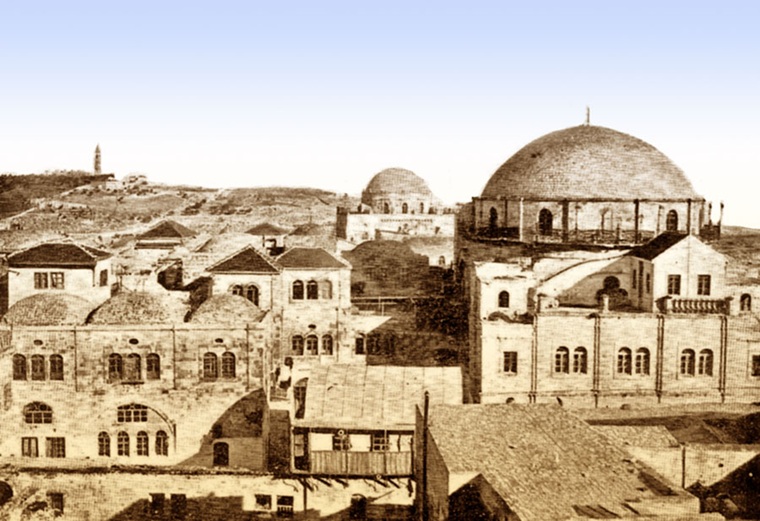
Rabbi Yehuda HeChasid
Shabbatai Zevi’s stay in Jerusalem, the most important Yeshiva was Beit Yaakov, led by Rabbi Israel Yaakov Ḥagiz. He was a prominent opponent of Shabbatai Zevi, perhaps because he encountered him in Jerusalem, and as is said: there is no prophet in his own town. But after Shabbatai Zevi’s death, a group of Sabbateans arrived who were part of the aliyah (immigration) of Rabbi Yehuda HeChasid (Judah the Pious) to the city.
In 1697, a man named Rabbi Yehuda HeChasid (Judah the Pious), influenced by Sabbatean ideas, established a messianic movement aimed at immigrating to Israel and hastening the coming of the Messiah. At 41, he traveled across Europe for three years, recruiting many people for his convoy, gaining local support, and in the year 1700 the group, numbering a thousand people, immigrated to Jerusalem. However, unexpectedly, Rabbi Yehuda died within a few days. It seems as if the hand of fate intervened. Consequently, the group dispersed, and only a plot of land they had purchased with a loan they could not repay remained, and it has been called Hurvat Rabbi Yehuda HeChasid (“the Ruin of Judah the Pious”) ever since. The plot of land, by the way, is the place where the Holy Shelah from Prague settled a hundred years earlier, and where the main Ashkenazi synagogue would be built more than a hundred and fifty years later by the disciples of the Vilna Gaon — the Hurva Synagogue.
Among the immigrants were Sabbateans who expected Shabbatai Zevi to reappear in Jerusalem in 1706, forty years after his conversion to Islam. Ḥaim Malakh, an important Kabbalist, was one of them, having reached this conclusion through studying the Zohar and the Scriptures. He became central to the community after Yehuda HeChasid’s death, but his influence waned after the prophecy was not fulfilled. Some say that Yehuda HeChasid himself was a Sabbatean or considered himself the Messiah. In any case, he was known as a pious man, and something occurred between the righteous person and the Holy Land that may have been his undoing.
When the righteous person meets the Holy Land, something very powerful can happen, and it works both ways. That is why there is a connection in Jerusalem between a righteous person—King David—and a place—Jerusalem. That is why the Lubavitcher Rebbe did not visit the land; the founder of Chabad tried to travel to Israel three times and did not succeed; and the founder of Hasidism, the Baal Shem Tov, did not come to Israel even though he wished to, as he was told through visions that the time had not yet arrived.
Rabbi Yehuda HeChasid apparently did not heed the warnings, and the result was tragic. After the group dispersed, there was no one to repay the loans they had taken to establish a synagogue and a neighborhood. The Muslims destroyed the synagogue (which has been called “The Hurva” or “The Ruin” ever since) and did not allow Ashkenazi Jews to enter the city gates until the money was repaid. The debt was eventually paid off in the early 19th century.
Following the immigration of Rabbi Yehuda HeChasid, there were subsequent immigrations, and in 1702 the Kabbalist Abraham Rovigo from Italy immigrated to the Land of Israel and established a Kabbalistic yeshiva in Jerusalem, which the remaining members of Rabbi Yehuda HeChasid’s entourage joined.
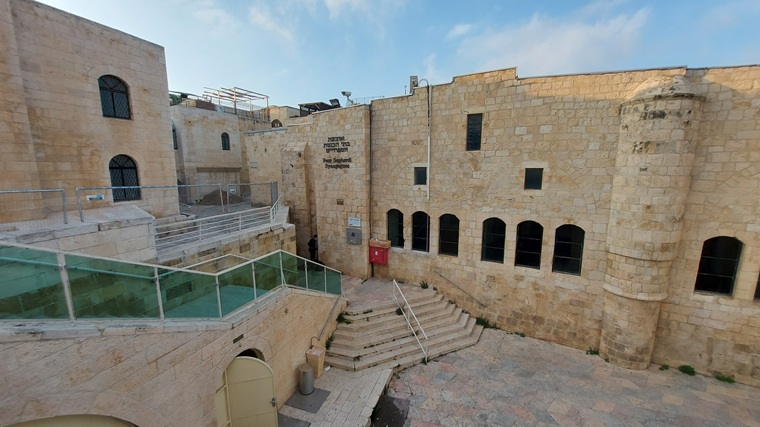
Mysticism and Messianism in the 18th Century
In the 18th century, the Jewish Quarter in Jerusalem experienced growth and development. Important educational institutions were established, and some of the most important figures in the Jewish world arrived there. Toward 1740 (the Hebrew year 5500), there was a messianic expectation that led to the immigration of Ramchal (Rabbi Moshe Chaim Luzzatto), the author of Mesillat Yesharim; Rabbi Chaim Abulafia (who renewed the Jewish settlement in Tiberias); Chaim ben Attar; Rabbi Shalom Sharabi; and many other great figures.
The failure of Shabbatai Zevi and the Sabbatean movement, the messianic aspiration did not die out but took on other forms. One of the ideas, for example, was to establish groups of Kabbalists among whom the principle of “Love your neighbor as yourself” would prevail, as a way of hastening the Redemption. The idea of a group that thinks and becomes sanctified as one is the next stage in human evolution toward a collective mind, as they say in Damanhur—an overman. This Unity will bring about the Tikkun of the whole—the Tikkun of the Shekhinah.
The goal of those striving for holiness was to observe commandments and prayers with the intentions (kavvanot) of the Ha’ari, and it was preferable to do so in the Land of Israel. The sanctity of the land and the effort involved in arriving and staying there amplified the spiritual-magical action. Only in the Land of Israel is it possible to deeply understand the secrets of Kabbalah and to achieve divine inspiration and the ascent of the soul through visits and prostrations at the graves of the Ha’ari and Rabbi Shimon bar Yoḥai.
At the end of the 17th century, Rabbi Raphael Mordechai Malachi was active in Jerusalem. He was also a physician and worked in the city for 30 years until 1702. Malachi concluded that what was needed to hasten the Redemption was the establishment of a spiritual and Torah center in Jerusalem, because it is written: “For out of Zion shall go forth the law, and the word of the Lord from Jerusalem.” Therefore, a Sanhedrin needed to be established in Jerusalem, and only then would the Messiah come. The way was to establish a Yeshiva with at least 70 students, as studying in fellowship also helps hasten the End of Days.
The Kabbalist Emmanuel Ḥai Ricci (1688–1743) calculated that the beginning of the process of the End of Days would arrive in the year 1740 (5500 in the Hebrew calendar), which led to a renewed religious-messianic awakening. Ricci, who was born in Italy, first immigrated to Safed for a few years, then wrote and worked in Italy, and finally immigrated to Jerusalem in 1737. His teaching held that reincarnation is the rectification of a soul, and that the Redemption is a 41-year historical process that would begin in 1740.
The early views of Malachi, Ricci, and others were adopted, according to Aryeh Morgenstern [3], by three great spiritual leaders of the mid-18th century: Ramchal, Rabbi Chaim Abulafia, and Rabbi Chaim ben Attar. This led to a wave of immigration to Jerusalem that brought the Jewish community there to a peak of 5,000–10,000 people. The immigration was partly aided by the improvement of physical conditions and security in the land and by the establishment of the Committee of Officials for Jerusalem by the Jews of Istanbul.
In the 1630s, the Committee of Officials of Jerusalem in Istanbul was established, which helped to consolidate the Jewish community in Jerusalem. The Jewish community numbered 2,000 people but grew rapidly to several thousand. This led to the establishment of the Istanbuli and Emtzai Synagogues, in addition to the Yochanan ben Zakai and Eliyahu HaNavi Synagogues established at the beginning of the century in the Spanish Synagogues complex, and the establishment of eight Yeshivas instead of the one that had existed until then.
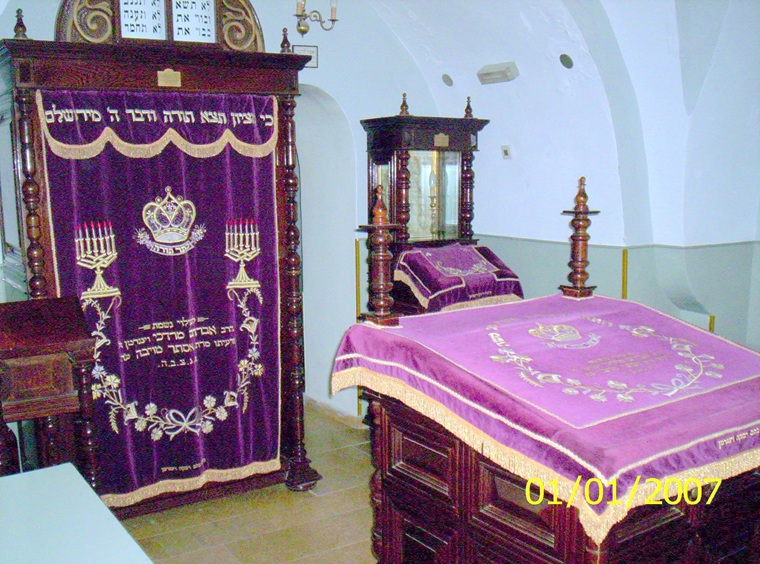
The Or ha-Ḥayyim
Rabbi Chaim ben Attar (1696–1743) was born in Morocco to a family of rabbis originally from Spain. He immigrated to Italy in 1741 after a life full of struggle and hardship in his homeland. After receiving support from the Jews of Livorno, Italy, he immigrated to the Land of Israel, influenced by messianic calculations and following the example of Chaim Abulafia. He stayed in the Galilee for a year, visited many graves of righteous people, and finally moved to Jerusalem and established his study hall there. He was a Torah commentator who combined Midrash and Kabbalah and wrote the book Or ha-Ḥayyim (Light of Life), hence his appellation “Or ha-Ḥayyim.” He is highly regarded by the Hasidim, who see him as a kind of Messiah and the Baal Shem Tov as a kind of successor to his path.
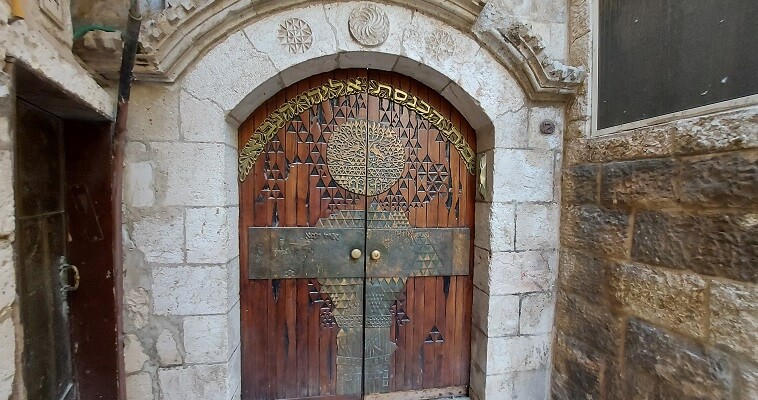
In the part of the Jewish Quarter adjacent to the Armenian Quarter, there is the Old Yishuv Court Museum, a cluster of ancient rooms that includes two important places related to Kabbalistic lore: one is the room and house where the Ha’ari was born, and the second is the Or ha-Ḥayyim Synagogue, which was the center of the Yeshiva founded by Rabbi and Kabbalist Chaim ben Attar.
The Or ha-Ḥayyim is called the “Western Lamp” in Hasidism, and people customarily visit his grave on the Mount of Olives. The synagogue he established was abandoned, and later the Ashkenazi Perushim (disciples of the Vilna Gaon) who returned to Jerusalem purchased it.
The Sephardic Synagogues
The growth of the Jewish population in Jerusalem in the 16th century led to the need to establish more synagogues, and thus the Sephardic Synagogues were founded, the first being the Yochanan ben Zakai Synagogue and the Eliyahu HaNavi Synagogue.
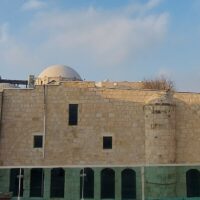
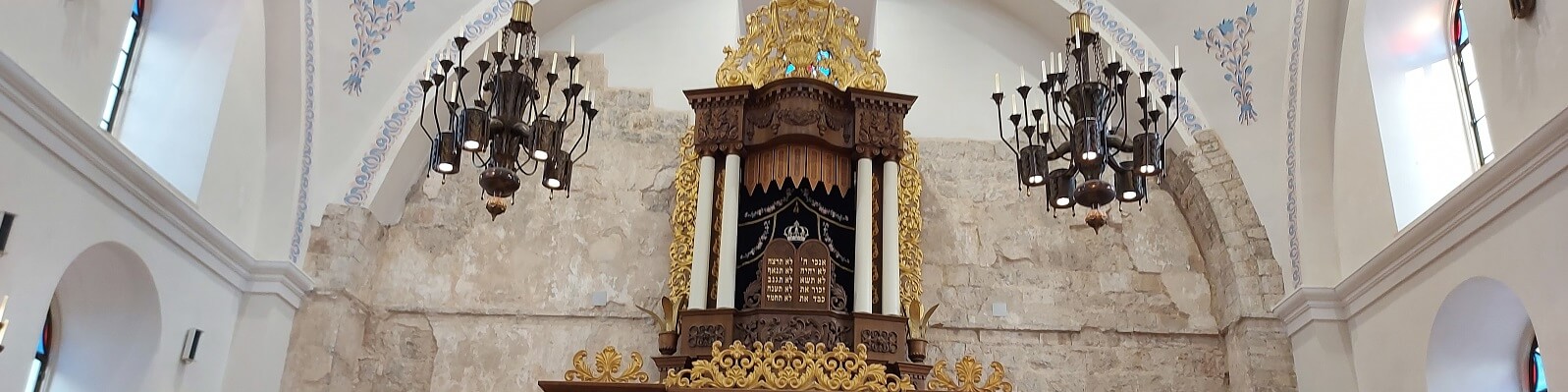
The Yochanan ben Zakai Synagogue was built in the Moorish-Spanish style, on the site where Rabbi Yochanan ben Zakai’s study hall was traditionally located. Unusually, and similar to the Ramban Synagogue, it has two Holy Arks, and at its center stands a platform with beautiful copper carvings. On an upper shelf in the synagogue, there is a shofar and a flask of oil that are traditionally considered to be from the Second Temple period and are intended for use by the coming Messiah. The Sephardic Chief Rabbi is crowned in this synagogue.
The Eliyahu HaNavi Synagogue is adjacent to the Yochanan ben Zakai Synagogue and got its name from a miracle that occurred there. One day, a prayer service was held in the study hall (the Eliyahu HaNavi Synagogue), and one person was missing for the quorum (minyan). Suddenly, a man arrived from nowhere, who was later identified as the Prophet Elijah. Therefore, when the Yochanan ben Zakai Synagogue could no longer accommodate all the worshipers and there was a need to establish an additional synagogue, it was named after the Prophet Elijah.
The chair on which this mysterious man sat was consecrated and is currently in a side niche, and sitting on it is believed to bring a blessing, especially to barren women.
pressing need for another synagogue. Thus, the area between the two older synagogues was prepared and called the Emtzai (Middle) Synagogue. Twenty years later, the Istanbuli Synagogue was established, intended for Ottoman Jews and built by the Committee of Officials of Jerusalem in Istanbul in the Ottoman style.
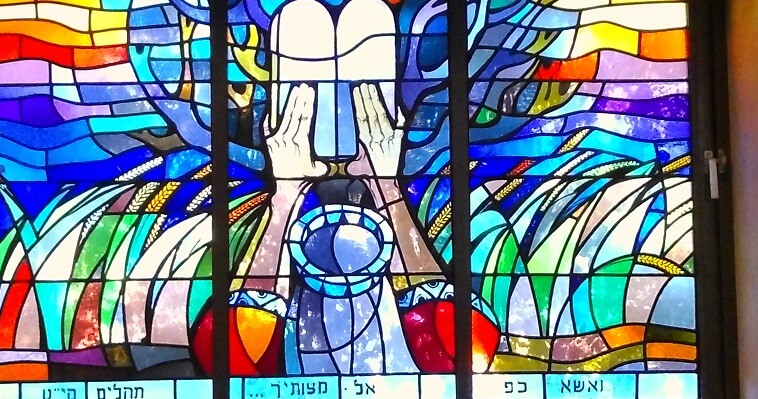
The unique feature of this synagogue is that the Bimah (reader’s platform) is located on the opposite wall—far from the wall of the Holy Ark—with the congregation’s benches between them. This creates a bipolar tension between the two sides of the synagogue, emphasized by the entrance being on the east side, adjacent to the Holy Ark. This architecture, along with the colored windows and the four impressive marble pillars of the platform, gives the synagogue a special atmosphere, which the designers likely intended.
as there are churches into which archetypes of holiness have been consciously or unconsciously introduced, so there are such synagogues too, especially in Jerusalem. There is a connection between place and person, and there are places that help to arouse the sense of holiness in a person through the generators of holiness they possess. Such was the Temple in Jerusalem, and so too are some of the synagogues in the city, such as the Sephardic Synagogues, and in this context, we should mention the Great Synagogue on King George Street and the Hurva Synagogue, which will be discussed in the third book.
Footnotes:
[1] Scholem, G. (1967). Shabbetai Zevi and the Sabbatean Movement During His Lifetime (Vols. 1–2). Tel Aviv / Jerusalem: Am Oved / Schocken.
[2] Ibid.
[3] Morgenstern, A. (2006). Mysticism and Messianism from the Ascent of the Ramchal to the Vilna Gaon. Jerusalem: Shalem Press.