Russians and the Orthodox world
The Slavic peoples of Eastern Europe number more than 300 million people, more than all the peoples of Western Europe combined, and the leader of the Orthodox and Slavic world in the 19th century was the Russian Empire.
The Russian Orthodox Church (in translation, Pravoslavnaya) is currently the largest Orthodox Church in the world, numbering nearly 150 million people. It has its own saints, unique tradition, special monasteries, and pilgrimage sites, and although it is part of the Orthodox world, the Russians believe that Moscow is the Third Rome and that they should lead the Christian world. From the time of Russia’s rise in the 15th century, the Russian Church developed a special sentiment for Jerusalem, and because it is a national church, and for other reasons, the Russian connection to the city deepened and intensified, especially in the 19th century.
According to legends, the first to bring Christianity to Russia was the Apostle Andrew, who was active in the Black Sea and Greek regions and is considered the bringer of Christianity to Romania as well, but Russia remained essentially pagan. The Christianization of the Slavic Russians occurred during the time of Prince Vladimir the Great (958–1015). First, his grandmother Olga converted, and he himself converted in 988 after marrying the sister of Emperor Basil II. In addition to the political and military circumstances explained earlier, it is likely that Bulgarian Slavic scholars from the Christian centers in Ohrid and Pliska arrived in Russia following the Russian conquest of Eastern Bulgaria twenty years earlier, bringing with them a new concept of Slavic Christianity.
When the Russian ruler Vladimir converted to Christianity in 988, he destroyed the pagan temples he himself had erected a few years earlier and built two churches in Kyiv: one named after Basil the Great (the most important Orthodox Church Father of the 4th century), and the second named after the Dormition (also called the Church of the Tithe, because Vladimir dedicated a tenth of his income to its construction). He underwent a solemn baptism ceremony in a former Byzantine colony he had conquered in the Crimea, called Chersonesus.
After his conversion, Vladimir attempted to create a just christian kingdom. He chose 12 of his sons to rule the different parts of the land, founded a legendary fortress city called Belgorod, and tried to personally implement the Christian ideal of charitable deeds. It is possible that Vladimir was influenced by his wife, Anna; it is possible that his conversion before the year 1000 was perceived by him as a divine act related to the millenium and the Second Coming of Jesus. Either way, he adopted a 12-tribe structure, with Kyiv as the New Jerusalem. Vladimir died in 1015, not before Christianity and the Slavic script imported from Bulgaria became a unifying factor for the Russian people scattered across vast territories. From then until the Communist Revolution, the history of Russia was linked to the Russian Church.
In 1240, the Prince of Novgorod, Alexander Nevsky, succeeded in halting the Swedish Catholic invasion from the north and uniting the Russians. With the help of the Metropolitan of Kyiv, Cyril, the position of the Metropolitan of Kyiv made him the head of an independent Russian Church. In the 14th century, Metropolitan Peter built a cathedral in honor of Archangel Michael in Moscow, and was buried there; his successor moved the religious center from Kyiv to Moscow, followed by the governmental center. Three churches were erected in the Kremlin: the Dormition Cathedral (or the Assumption of Mary), which is the Mother Church of Russia (the church in the Russian Compound in Jerusalem resembles it); the Annunciation Cathedral, which is the church of the Tsars (the Church of Mary Magdalene in Jerusalem resembles it); and the Archangel Michael Cathedral, which marks Russian victories in wars.
The fall of Constantinople in 1453 led to a process that ended with the recognition of the Russian Church as a separate Patriarchate and the rise of its importance. Prince Ivan III married the Byzantine Princess Sophia Palaiologina, niece of the last Byzantine Emperor, and adopted the Byzantine symbol. From this time forward, Moscow saw itself as the Third Rome, after the original Rome and Byzantium. The fall of Constantinople, and before that of the Serbian and Bulgarian kingdoms, led to the arrival of Slavic scholars in Russia, bringing with them Orthodox Christian mysticism. This is expressed in the appearance of books such as the Dove Book [1]. The Christian mystical perception had existed earlier, even since Russia converted, but in the 14th–15th centuries it developed a theology, literature, techniques of Christian meditation, and a doctrine of reaching enlightenment, called Hesychasm.
From that period, and even more so in the 18th and 19th centuries, the concept of the Startsy (meaning “elder”) appeared in Russia. This is a charismatic holy man identified by the masses due to his powers, possessing supernatural abilities of telepathy and clairvoyance. He sees into the heart of the initiate and helps correct it; heals and sometimes knows the future. The Startsy resided in monasteries that became pilgrimage sites, especially the Optina Monastery, which was the center of the movement. In the 18th century, Saint Paisius Velichkovsky translated the Philokalia—the collection of mystical writings of the Desert Fathers [2], a kind of Christian Zohar—into Church Slavonic, and sent emissaries throughout Russia with the old-new spiritual teaching.
In the late 18th century, the standing and importance of Russia rose, and it was recognized as the representative of Christians in the Ottoman Empire. Besides being a great power, Russia at the time was the only independent country where Orthodox Christianity was the state religion. The Russian slogan was: God, the Tsar, and the People (Nation). With the weakening of the Ottoman Empire in the 19th century, the Russians gained a foothold in Jerusalem. The Russian presence in the city began as early as 1840 during the time of Tsar Nicholas I. He obtained permission for the construction of two Russian monasteries, one for women and one for men; these were built within the Greek Orthodox complexes.
In 1847, the monk Theophan the Recluse arrived in Jerusalem, a classic Startsy figure, who collaborated with Archimandrite Porphyrius Uspensky to discover the ancient spiritual tradition of the Desert Fathers by finding lost ancient manuscripts in the desert monasteries and the Old City. He translated the Philokalia into Russian. Initial copies of parts of the mystical writings already existed in Russia, but this was not the full ancient Christian-mystical heritage.
Nicholas I sought to expand the borders of the Russian Empire and gain influence in Constantinople and Jerusalem, and therefore, in 1852, he demanded precedence for Orthodox rights in the Church of the Holy Sepulchre (as well as an alliance of protégés) from the Ottoman Sultan. When his demands were rejected, he attacked the Ottomans in what became the Crimean War. The war lasted for three years and ended in a Russian defeat because of French and English intervention, but from that time on, it was clear that the Russian bear must also be appeased to maintain peace, and this included rights in Jerusalem.
In 1859, Grand Duke Konstantin Nikolaevich, the brother of the new Tsar Alexander II, arrived in the Holy Land. He headed the Russian Christian Society for the Holy Land, which became the patron of Russians in the Holy Land in general and Jerusalem in particular. This was the beginning of an increased Russian presence in the city, occurring simultaneously with the increase in the flow of pilgrims. He acquired the area of the Russian Compound and began planning it.
Alexander II initiated reforms in post-war Russia. He freed the serfs in 1861, and they began to go on pilgrimage to the Holy Land. Tens of thousands of pilgrims arrived in Jerusalem every year (more than any other community), aided by the developing railway and steamship transport. They spent all their life savings on the special journey, but once embarking on it, the Russian government, through its aid institutes, cared for them, and there was arranged transport all the way to the Russian Compound in Jerusalem, from where they could walk around the city.
In 1865, Father Antonin Kapustin arrived in Jerusalem, leading the Russian community for nearly 30 years. He acquired large plots of land in various places in the city, built the Church of the Ascension on the Mount of Olives, and was involved in the construction of the other churches and the Russian Compound complex. He established contact with Orthodox Christian Arabs, and ultimately led to the establishment of the Imperial Orthodox Palestine Society in 1882, which replaced the previous Russian Society for the Holy Land. It supported the pilgrims but also encouraged research, Orientalism, and engaged in humanitarian activities among the residents of the land. Father Kapustin continued the work of Uspensky and Theophan, engaging in and encouraging Orthodox mysticism.
In 1882, the conservative Tsar Alexander III ascended to power in Russia. He encouraged Russian Orthodoxy, including pilgrimage and the establishment of institutions in Jerusalem. He appointed his brother, Prince Sergei Alexandrovich, as President of the Imperial Orthodox Palestine Society. Sergei came to Jerusalem with his wife, Ella (Grand Duchess Elizabeth Feodorovna), and initiated the construction of more Russian institutions and churches in the city: he built the Church of Mary Magdalene on the Mount of Olives, the Alexander Nevsky Church in the Old City, and Sergei’s House in the Russian Compound. But the dynamic figure in the Palestine Society was his wife, Princess Elizabeth (Ella), and she became the head of the Society after her husband’s assassination by revolutionaries in 1905.
Elizabeth, who was German Protestant by birth, became Russian Orthodox after a pilgrimage to Jerusalem in 1891. Perhaps because she had no children, she tended towards spirituality and found herself in the Hesychasm tradition of the Russian Church. This tradition also existed in the Romanian, Serbian, Bulgarian, and Greek Orthodox Churches. Indeed, she became a nun and abbess in her later years. This did not prevent the Bolsheviks from executing her, and thus she became a saint after her death, and her remains were later transferred for burial in the Church of Mary Magdalene.
New Russian Spirituality
As in the rest of Europe, Russian spirituality in the modern era is divided into two streams: one that developed within the Church framework and one that was secular. However, in the case of Russia, both streams are connected to the Orthodox mystical-religious tradition. Thus, people like Dostoevsky and Tolstoy visited monasteries where the holy Startsy resided and incorporated components of the Christian Theosis concept into their thought.
Starting from the 1880s, a wave of spirituality swept across Russia, combining mystical Christianity, spiritual doctrines, and modern occultism, expressed in poetry, literature, and art—a Symbolist movement influenced by both Western thought and sparks from the East appeared [3]. A prominent figure considered largely the founder of the movement is Vladimir Solovyov (1853–1900), nicknamed “righteous of the Nations” by Rabbi Kook. He saw physical Jerusalem as a universal symbol for the possible unity of religions.
According to Solovyov, spirituality is a fundamental and universal human phenomenon and is related to the next step in the development of man and humanity, which will adopt a universal and loving Christianity as its religion. He developed a kind of religious syncretism based on Christian esoteric sources. Solovyov was a friend of Dostoevsky. Early in his career, he delved into Eastern religions and later studied Kabbalah and the secrets of Eastern Christianity. He experienced personal encounters with a divine entity called Sophia (Wisdom), influenced perhaps by Gnostic perceptions, and developed the concept of the existence of a divine feminine entity parallel to the Shekhinah (Divine Presence) that operates in addition to the Holy Trinity. Sergei Bulgakov (1877–1944) continued his path.
Bulgakov and Solovyov saw themselves as new Christians and attempted to bridge the gap between the traditional Russian Church and universal concepts. The motto of the movement to which they belonged was the free and universal search for God, and they assumed the existence of two worlds—physical and Noetic (spiritual). There is a way to reach the Noetic world connected to intuition, and it is open to every person. Leo Tolstoy (1828–1910) was also partially connected to and influenced by this movement.
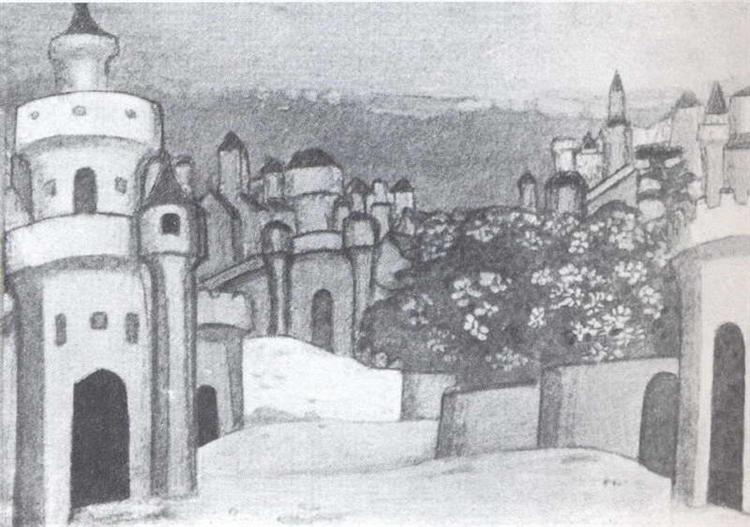
In 1904–5, the most important Russian landscape painter and mystic Nicholas Roerich (1874–1947) traveled among the various Orthodox monasteries of Russia, collecting sparks of the light of ancient spiritual knowledge existing within them. Following this, he painted a picture called “Jerusalem,” a fantastic presentation of a city with exaggerated architectural forms—towers and domes—in the middle of which is a beautiful garden. Roerich depicts heavenly Jerusalem in the spirit of a book that became popular at the time called The Way of a Pilgrim. Even though he visited many places in the world and led expeditions to Tibet (discovering Tibetan Buddhism), he never visited physical Jerusalem.
Theophan the Recluse
The Philokalia is a collection of Christian mystical writings, compositions, and commentaries by the Desert Fathers, mystics, and theologians on subjects such as inner prayer, watchfulness, spiritual light, and more. Some of the writings were indeed translated by Paisius Velichkovsky into Church Slavonic in the 18th century, but these were not available to the masses. The translation of the writings into Russian in the 19th century brought about a wave of Christian mystical religious revival, adding a dimension of depth to the faith that suited the modern era. This important translation project began in Jerusalem and is linked to the figure of a spiritual man and scholar named the Theophan the Recluse, who lived and worked in the city for seven years.
Theophan the Recluse (1815–1894) was one of the most prominent scholars of the Russian Church, teaching in the most important seminaries, yet his soul yearned for the solitude that enables a connection with God. From a young age, he engaged in spiritual practices and was exposed to mystical writings. In 1847, he requested to be transferred and posted to the Holy Land, both because of the mystical connection he felt with the land and the anticipation that something would happen to him there, and because he wished to distance himself from the cultural centers and activism of Russia. His wish was granted, and here he had the opportunity to deepen both his internal and external journey. He learned icon painting, as well as the Greek, Arabic, Hebrew, and French languages. He toured Jerusalem and its surroundings, including visits and stays in ancient monasteries, and was exposed to the mystical tradition of Eastern Christianity. During his research expeditions, he rediscovered the writings of early Christian mystics, the Desert Fathers, and Church Fathers (whom we expanded upon in the first book); he collected ancient scrolls and expanded his library and education.
During the seven years he stayed in the land, he collaborated with the Russian Archimandrite Bishop Porphyrius Uspensky (1804–1885), who also possessed a broad education and knowledge of languages. They were part of the Russian Orthodox Ecclesiastical Mission in Jerusalem and toured monasteries in Sinai, Jerusalem, and the Judean Desert together. They collected ancient manuscripts in Greek, finding both unknown codices [4] and ancient icons from before the Iconoclasm, which are kept in St. Petersburg. Special emphasis was placed on the archives of the Mar Saba and Saint Catherine monasteries.
The two great scholars, Theophan the Recluse and Bishop Porphyrius, left Israel with the outbreak of the Crimean War in 1854 and embarked on a journey to Western Europe, where they met, among others, Pope Pius IX.
Theophan returned to Russia and served in senior positions in the Ecclesiastical Academy, while simultaneously dedicating his time to his life’s work: publishing the writings of the Philokalia in an expanded edition and in language accessible to all. He retired into seclusion in 1872 to concentrate on the work of writing and reading, and in 1877, the first of five volumes of the Dobrotolyubie—the complete Russian translation of the Philokalia—was published. He never returned to Jerusalem; his place in the city’s landscape was taken by a Russian Orthodox scholar of his own age, no less great or important, named Antonin Kapustin.
Russian Orthodox Spirituality
The stay of great Russian scholars in Israel—the monk Theophan, Uspensky, and Father Kapustin—led to the rediscovery of the collection of mystical Christian writings called the Philokalia. The translation of these writings into Russian, along with other factors, brought about a wave of Orthodox mystical revival. In 1884, the book The Way of a Pilgrim was published in Russia, causing a wave of spiritual enthusiasm. The author is unclear, and there are versions that it was mysteriously discovered on Mount Athos or in one of the monasteries in Russia.
The plot tells of a man who reads the verse from Paul’s Letter to the Thessalonians (5:17), that one must pray without ceasing—meaning to pray constantly—and he seeks how to do this. His wanderings bring him to a spiritual father (a Starets) who teaches him how to pray incessantly (the Jesus Prayer). This is done through the practice of infinite repetition of the prayer phrase: “Lord Jesus Christ, Son of God, have mercy on me, a sinner”—initially 3,000 times a day, then 6,000, and later 12,000—until the prayer becomes part of the person and he says it automatically in his heart. But this is only the beginning of the process. Afterward, one must imagine the heart as a spiritual organ and bring the thought into it, and then there are further stages where the words of the prayer are synchronized with the breath and the rhythm of the heartbeat.
The practice of the Prayer of the Heart allows for the opening of the spiritual eyes and senses, seeing things happening at a distance, healing, and other miraculous phenomena; it warms the heart, makes the person happy, connected to higher powers, and “drunk without wine.”
To delve deeper into the practice and its higher levels, the pilgrim aims to study passages from the Philokalia (the Christian Zohar); he receives instructions on which chapters to study and in what order, and this is the key to the wonders. The Philokalia contains writings from 25 saints who teach the secrets of unceasing prayer. The first instruction is physical: to sit alone and quietly, bow the head, close the eyes, and breathe gently, contemplate the heart with the imagination, bring the thought from the head to the heart, and say while breathing: “Jesus Christ, have mercy on me.” This is the abbreviated version of the phrase; one can say it or the longer version.
Instructions for reading the Philokalia are: first read the second part of the writings of Nikephoros the Monastic. Then all the writings of Gregory of Sinai, except for a few short chapters. Then Symeon the New Theologian on three types of prayer and a word on faith, and then the book of Callistus and Ignatius. These books contain the entire doctrine. The Philokalia is the introduction to the Scriptures; they are higher, but one cannot reach them directly.
The rise of Orthodox mysticism in Russia occurred concurrently with the great pilgrimages to Jerusalem and the increased Russian influence in the Middle East. It is likely that some of the Russian pilgrims to Jerusalem at the end of the 19th century carried copies of the Philokalia and perhaps The Way of a Pilgrim with them, and that they practiced the Jesus Prayer during their journey and while they stayed in Jerusalem.
The Russian Compound
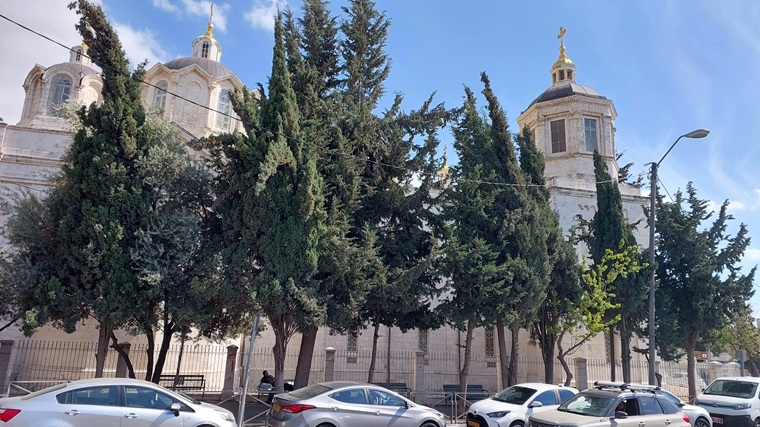
The construction of the Russian Compound began in 1860; it was one of the first complexes outside the Old City, and in addition, it was close to the wall. The main building is the Holy Trinity Church, which resembles the Dormition Cathedral in the Moscow Kremlin. The church in Moscow is the Mother Church of Russia, the place where the Tsars were anointed. It was first built in the 14th century with the rise of Moscow to greatness but was rebuilt in the 15th century, combining Renaissance and Byzantine styles, at the time Russia replaced Constantinople as the leader of the Orthodox world—the Third Rome—and to mark this event.
The architect of the church in Jerusalem was Martin Ivanovich Eppinger. He studied church architectural styles on Mount Athos, arrived in the Holy Land in 1859, and collaborated with the French architect Christophe-Édouard Mauss (builder of St. Anne) in the renovation of the Church of the Holy Sepulchre and in the design of the Nisan Bak Synagogue. The Holy Trinity Church was inaugurated in 1872 by Grand Duke Konstantin Nikolaevich, the brother of Alexander II.
Antonin Kapustin
One of the most important figures in Jerusalem at the end of the 19th century was Father Kapustin (1817–1894). He was active in the city for nearly 30 years (1865–1894), served as the head of the Russian Mission, and was involved in purchasing numerous lands and establishing churches.
He was born into a family of respected clergy and studied at the Kiev Theological Academy during the same years as Theophan the Recluse; presumably, given their shared interests, they knew one another. Kapustin was fluent in Greek, Latin, and Hebrew (and at an older age, also French, German, and possibly Arabic). He became a teacher at the academy and a monk holding a senior position in the Russian Church. Between 1850 and 1865, he served in Greece, Athens, and Istanbul, participating in two expeditions to Mount Athos[5] in 1859 and 1863. Kapustin engaged in research of the Byzantine era, both ancient and modern—the Palaeologan Renaissance. He knew Greek thoroughly, spent several years studying the writings of the Church Fathers, excavated early churches in Athens, and even wrote an archaeology book on the subject. He also acquired ancient Hebrew writings from the Cairo Genizah and was in contact with scholars worldwide. Kapustin was also an amateur astronomer and numismatist.
In 1865, he was appointed head of the Russian Ecclesiastical Mission to the Holy Land. With the end of the Crimean War, the Russians returned to the land, bringing with them tens of thousands of pilgrims annually. In 1860, the Russian Compound was established. In 1870, he purchased the land on the Mount of Olives, and in 1872, the Church of the Ascension (Church of the Trinity) was inaugurated, reminiscent of the Ascension Convent in the Moscow Kremlin. In 1882, he excavated the Alexander Nevsky complex in the Old City with Conrad Schick, discovering the wicket in the wall and the Hadrianic Gate. In that same year, the Imperial Orthodox Palestine Society was established, led by Grand Duke Sergei and Grand Duchess Elizabeth; Kapustin ceded the stage to them but continued to operate and assist in the background. He established archaeological museums on the Mount of Olives and near the Church of the Holy Sepulchre. He passed away at the age of 77 in Jerusalem and was buried in the Church of the Ascension on the Mount of Olives.
The Church of Ascension on the Mount of Olives
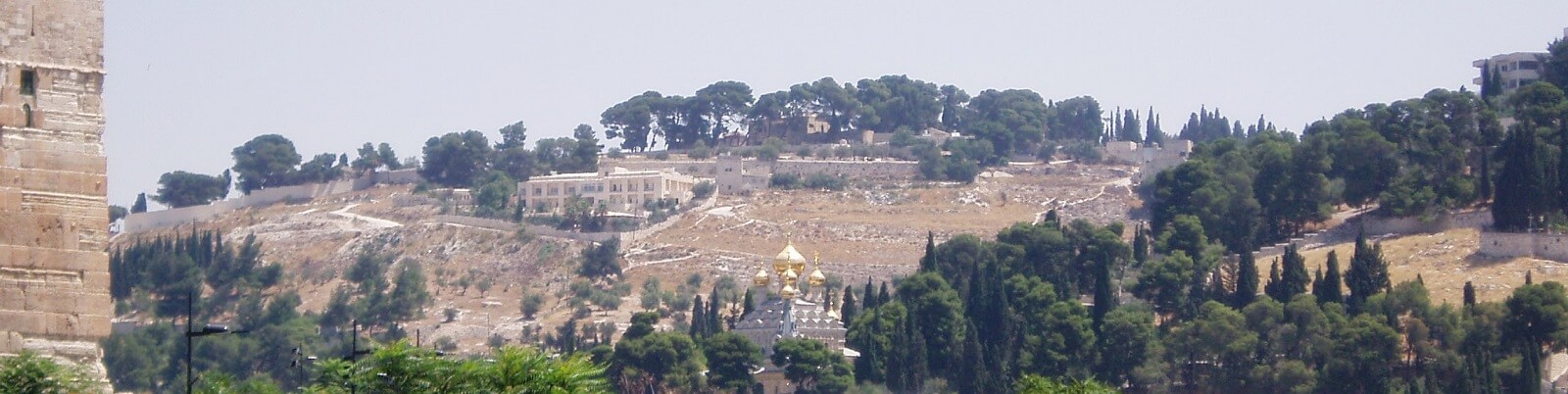
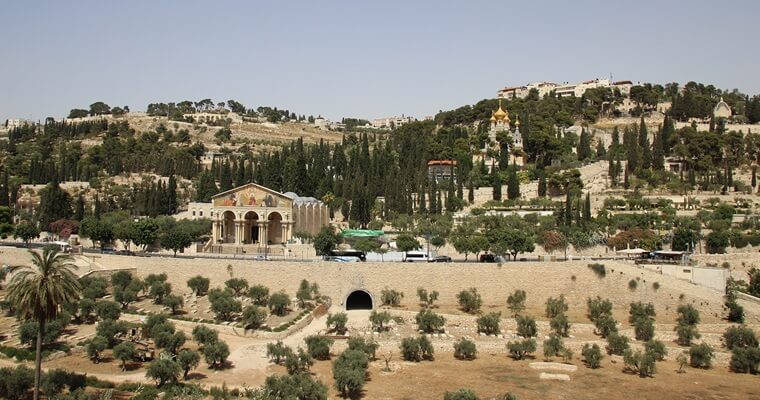
The foundation stone of the church was laid in 1875 by Antonin Kapustin, but it was only inaugurated in 1887. It was built in the Byzantine style on the foundation of an ancient Byzantine church, but its dome structure resembles the Hagia Sophia in Istanbul. In addition to the church building, a tall tower was built in the Italian style, and a large bell was brought from abroad, along with a chapel containing an ancient mosaic from a Byzantine-era church that was on the site, with an indentation that was likely the spot of John the Baptist’s head.
The story goes as follows: John’s body was buried in Sebastia, but his head, which was severed at the request of Herodias, reached the hands of Joanna (Chuza’s wife), one of the women who accompanied Jesus, the manager of Herod Antipas’ household. She is one of the eight Myrrhbearing Women, supported Jesus and the Apostles, and participated in many New Testament events. The head was secretly buried on the Mount of Olives. In the 4th century, a solitary monk named Innocent found the holy head in a bowl, and a church was built on the site in honor of the finding.
Another tradition claims that John the Baptist’s head is in the Church of St. John the Baptist in the Christian Quarter, and some also say it is in the Great Mosque in Damascus. Either way, several heads were brought to Jerusalem without bodies. For example, the head of Santiago (Saint James) is in the Armenian Church in Jerusalem, while his body is in Santiago de Compostela. But it’s not just the head—some people have their body buried elsewhere and their heart in Jerusalem, like Princess Aurélie de Bossi in the nearby Church of Pater Noster.
The church is called the Church of the Ascension because Jesus ascended to heaven from the Mount of Olives. This is the place of redemption and resurrection according to the three religions. Inside the church is a stone upon which Mary stood when Jesus ascended to heaven.
The person responsible for the church in the early years was Father Parthenius, who planted trees, cultivated the garden, excavated the antiquities, and also installed a prayer cave for himself at the edge of the property. He was murdered by unknown assailants in his isolated home in 1909, which remains one of Jerusalem’s mysteries.
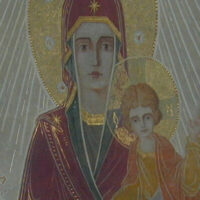
In 1906, it was decided to establish a convent for women on the site. By 1914, it had 150 nuns, most of them Russian, who engaged, among other things, in icon painting and goldsmithing. The iconostasis in the church is from Russia, and it contains an important holy icon of Mary, called “She Who Hears.”
This icon is one of the peaks of the new Russian icon painting, as described by Uspensky. It is a painting that expresses the new Christian mystical concept and conveys a kind of emotion, like the Mona Lisa. It was brought to the site by mysterious pilgrims and helped the nuns during the difficult times of World War I. Today it is in the renovated iconostasis.
After the Communists rose to power in Russia, the ecclesiastical properties in East Jerusalem were in the hands of the independent Russian Church (White Russian Church, ROCOR), whose seat moved abroad. However, after the War of Independence, the State of Israel transferred all the Russian assets on the western side of Jerusalem to the Communist regime, and the people of the White Russian Church moved to East Jerusalem, thus increasing the importance of the structures on the Mount of Olives. There was, and still is, another Russian convent called “Gorniy” in Ein Kerem, and after the War of Independence, its nuns moved to the Mount of Olives.
The Church of Mary Magdalene
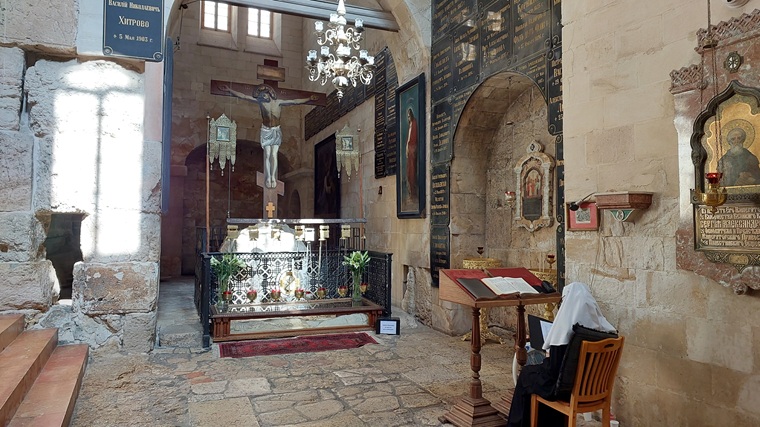
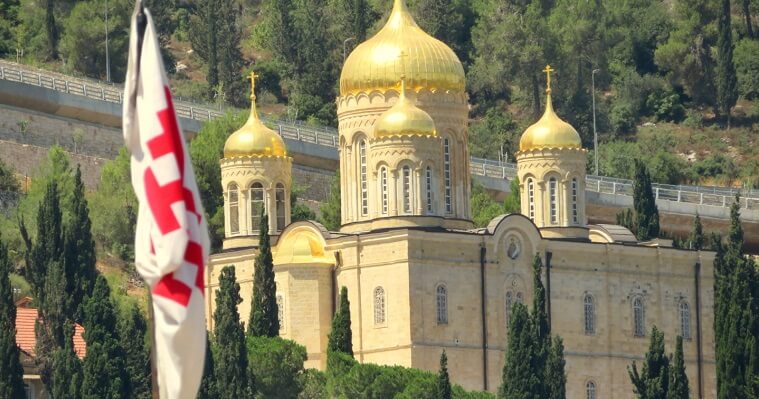
The Church of Mary Magdalene was built in 1890, in memory of Tsar Alexander III’s mother, Maria Alexandrovna. The crypt holds the remains of Elizabeth Feodorovna (Ella), Tsar Nicholas II’s sister-in-law, with her loyal maid, and also the remains of her niece, the English Princess Alice of Battenberg. This is a place of holy women who converted to Orthodoxy.
Elizabeth Feodorovna made a pilgrimage to Jerusalem in 1892, and the visit spiritually changed her, leading her to adopt Russian Orthodoxy. In her youth, she was one of the most beautiful women in Europe, courted by Kaiser Wilhelm II (ruler of Germany) and Prince Frederick II, Grand Duke of Baden. Synchronically, Frederick II’s father, Frederick I, was one of the greatest supporters of Herzl and helped arrange a meeting with Wilhelm in 1898.
Elizabeth, who was a German Prussian princess, married the Russian Prince Sergei Alexandrovich, Tsar Alexander III’s brother, in 1884. He headed the Imperial Orthodox Palestine Society and led building projects in Jerusalem, including Sergei’s House. He inaugurated the Church of Mary Magdalene during a visit to Jerusalem in 1888. He was assassinated in 1905. After the murder, Elizabeth became more religious, sought to pardon the assassin, and after a few years established a convent near Moscow and engaged in charitable work. She was considered a saint by the masses even during her lifetime. She was murdered by the Communists in 1918 and officially became a saint of the Church in 1981.
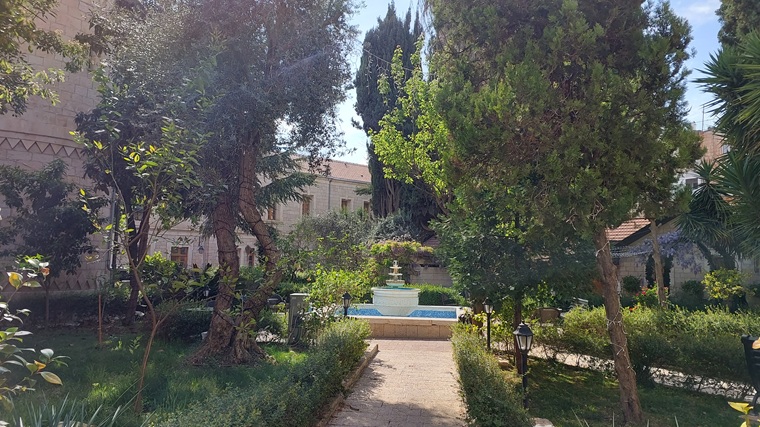
In the back of the courtyard, there is a place where Mary, mother of Jesus, threw her clothing belt to doubting Thomas, thus linking Mary Magdalene to other Maries. The church has seven domes—an archetypal number—and the beautiful and spacious courtyard has stairs that once led to the summit of the Mount of Olives.
Mary Magdalene
Mary Magdalene appears in Luke as a woman Jesus cleansed of seven demons. She appears in John, Mark, and Matthew as being present during the crucifixion, during the burial, and as a visitor to the tomb after Jesus arose from death. Her mentions in these events suggest she was a close disciple of Jesus, and perhaps even had an intimate relationship with him. In John, Mary calls Jesus “Rabbouni”—a term for Master (or possibly Husband), and Jesus replies, “Do not hold on to me,” implying she was accustomed to touching him.
As written in the New Testament:
“After the Sabbath, at dawn on the first day of the week, Mary Magdalene and the other Mary went to look at the tomb. Suddenly there was a violent earthquake, for an angel of the Lord came down from heaven and, going to the tomb, rolled back the stone and sat on it. His appearance was like lightning, and his clothes were white as snow. The guards were so afraid of him that they shook and became like dead men. The angel said to the women, ‘Do not be afraid, for I know that you are looking for Jesus, who was crucified. He is not here; he has risen, just as he said. Come and see the place where he lay. Then go quickly and tell his disciples: “He has risen from the dead and is going ahead of you into Galilee. There you will see him.” Now I have told you.”
“So the women hurried away from the tomb, afraid yet filled with great joy, and ran to tell his disciples. Suddenly Jesus met them and said, ‘Greetings.’ They came up to him, clasped his feet and worshiped him. Then Jesus said to them, ‘Do not be afraid. Go and tell my brothers to go to Galilee; there they will see me.'” (Matthew 28:1–10).
“At this, she turned around and saw Jesus standing there, but she did not realize that it was Jesus. He asked her, ‘Woman, why are you crying? Who is it you are looking for?’ Thinking he was the gardener, she said, ‘Sir, if you have carried him away, tell me where you have put him, and I will get him.’ Jesus said to her, ‘Mary!’ She turned and cried out in Aramaic, ‘Rabbouni!’ Jesus said, ‘Do not hold on to me, for I have not yet ascended to the Father. Go instead to my brothers and tell them, “I am ascending to my Father and your Father, to my God and your God.”'” (John 20:14–17).
Some connect the figure of Mary Magdalene to Mary, the sister of Martha of Bethany, who anointed Jesus’ feet with spikenard oil during Holy Week, sat at his feet, and wiped the oil with her unbound hair—a symbol of a married woman (unmarried women used to tie their hair up in the Second Temple period, according to Jewish custom).
In addition to the New Testament, there are apocryphal books, especially the Gospel of Mary and the Gospel of Philip (see below), which state that she was Jesus’ closest disciple, to whom he transmitted the secret teaching. Furthermore, there are various traditions regarding her fate after the crucifixion, particularly in France, where it is believed she arrived and spread Christianity, lived in solitude in a cave in the mountains, and died and was buried in their land.
According to the Gospel of Mary Magdalene, a Gnostic book from the 2nd century CE, Jesus used to kiss her on the mouth and reveal to her the secrets of the spiritual path, and she was his most beloved disciple. The kiss on the mouth was considered in antiquity a way of transmitting the pneuma—the spiritual essence—from a teacher to his successor. The book is a dialogue between Jesus and his disciples, especially with Mary Magdalene. Consequently, Mary Magdalene explains to the disciples how to use visions within the spiritual journey, how to operate the mind, and how to ascend through four heavens. She teaches them that where the thought is, there is the treasure. The book presents Jesus as an enlightened teacher who transmits knowledge to humanity through Mary Magdalene.
The Gospel of Philip also relates that Jesus would kiss Mary on the mouth. This Gospel tells of five Christian mysteries, the greatest of which is the Mystery of the Bridal Chamber—the mystical marriage between the soul and God, whose allegory is the love portrayed in the Song of Songs. The union that a person strives for is with a spiritual twin, but on another level, it can also be that a union between a man and a woman transmits the “Seed of Light” of the chosen people. The Mystery of the Bridal Chamber is not for everyone, but only for liberated and enlightened souls. Is it possible that there was a mystical union between Mary Magdalene and Jesus?
According to a painting in the Russian Church of Mary Magdalene in Jerusalem, Mary Magdalene appeared before Emperor Tiberius in Ephesus and tried to persuade him to become a Christian. However, the Russians believe that Mary Magdalene’s remains are not in Ephesus and not in France, but in their church in Jerusalem.
Three Maries
Three Maries were present at the crucifixion and resurrection. But who were these three “Maries”? One of them was probably Mary, Jesus’ mother, and the second was Mary Magdalene, but who was the third Mary?
The Gospels are not uniform regarding the three Maries. One possible Mary is Mary Salome, the mother of James and John, the sons of Zebedee—Jesus’ close disciples besides Peter—and thus the wife of Zebedee, whose identity is unclear. Mary Salome is a Myrrhbearer. Some claim she was the sister of Mary, Jesus’ mother. In the Gospel of Thomas, Mary and Salome are mentioned. According to Ethiopian traditions, she accompanied Mary and the Holy Family to Egypt. Mary Salome appears in Luke as being present at the crucifixion and resurrection, but in John, another Mary replaces her as one of the three Maries—Mary, the wife of Clopas.
According to John 19:25: “Near the cross of Jesus stood his mother, his mother’s sister, Mary the wife of Clopas, and Mary Magdalene.” This led to the assumption that Clopas was Joseph’s brother and that his wife was named Mary. Her tomb is in Saintes-Maries-de-la-Mer in France, where, according to legend, the three Maries arrived by boat. John, the author of the Gospel, moved to the Greek island of Patmos towards the end of his life, so it is logical that other disciples also wandered to different places in the Roman Empire.
Another possibility is Mary of Bethany, the sister of Lazarus—whom Jesus raised from the dead—and the sister of Martha. She is probably the one who sat at Jesus’ feet to hear his words while her sister busied herself in the kitchen, anointing his feet with oil and wiping them with her hair (some identify her with Mary Magdalene). She is called a Myrrhbearer. After the stoning of Stephen, she fled with her brother Lazarus and Mary Magdalene. Some say they are the ones who arrived by ship in France.
The letter M is associated with the feminine principle in Kabbalah and is instinctively connected to the word mother in all languages. The number three is an archetypal number that always appears in the feminine context, as it is related to the cycles of time—past, present, and future. And the Sacred Feminine was responsible for birth and also for death, so it is fitting that three women by the name of Mary were present at the time of death, and that a woman—Mary Magdalene—would be the first to see Jesus after the new birth—the Resurrection.
The Alexander Nevsky Church
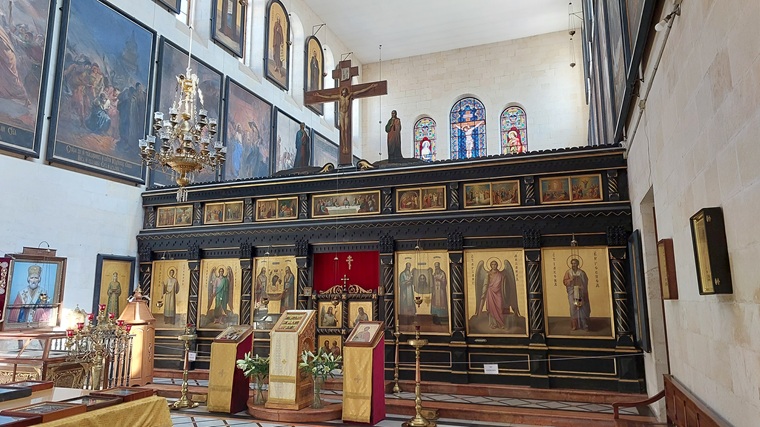
Adjacent to the Church of the Holy Sepulchre is the Russian Alexander Nevsky Church, named after the Russian military commander Alexander Nevsky, who, in the 13th century (Middle Ages), expanded the borders of Russia and established its rule in the northwest up to the location where St. Petersburg was later founded. He set the Russian policy of resistance to Western Europe and defeated the Teutonic Knights and the Polish in a series of decisive battles that enabled Russia’s independence in later generations. The church was initially built as a Russian royal complex in Jerusalem, and was only officially inaugurated as a church and monastery in 1896.
In the 19th century, with the increase of Russian influence in the Ottoman Empire and the increasing flow of pilgrims, the Russians began to build various complexes in Jerusalem. In 1857, land was acquired near the Church of the Holy Sepulchre. When construction began, they discovered a large triumphal arch and a gate nearby. Initially, it was believed that the gate was the one through which Jesus left the city walls on his way to the crucifixion, and to this day, people pass through its wicket (an allusion to the rich man passing through the eye of a needle). However, it was later revealed that the remains date to the time of Hadrian and are therefore later than Jesus’ time.
In addition to the triumphal arch and plaza, the eastern wall of the ancient Byzantine Basilica of the Holy Sepulchre and the edge of the Cardo street were discovered at the site. All these ancient remains, including the gate and the triumphal arch, were preserved within the new church complex. It is a large structure containing halls with the ancient remains, a Russian-style church, and a hospice. At the entrance, one can see a living room from the 19th century used by members of the Russian royal family when they made pilgrimages to the Holy Land. The church is currently under the care of the Russian Orthodox Church Outside Russia (ROCOR) of the White Russians, who believe in the religious importance of the Tsar family.
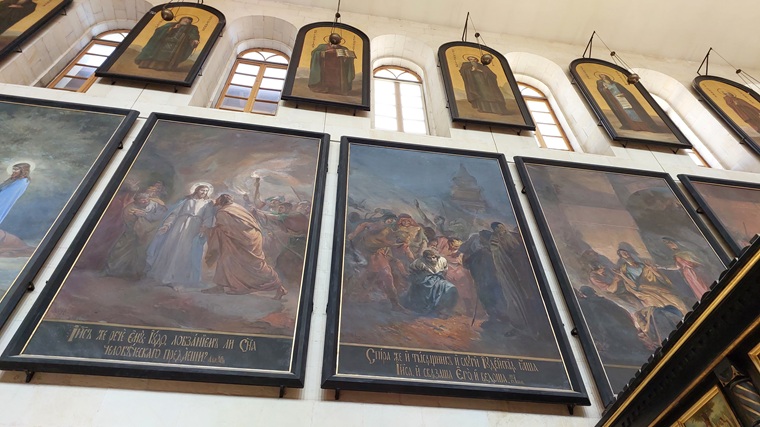
The church hall contains a cycle of paintings by the famous Russian painter Nikolai Koshelev, who also knew how to paint icons—meaning he was part of the Christian Orthodox religious establishment. He painted many churches in Russia and around the world. He came to the Holy Land in 1891, painted the portrait of Antonin Kapustin, and 18 paintings of the Passion of Jesus.
According to a Russian scholar named Uspensky (a different one), the faces of the saints are not rigid; their attractiveness lies in the unmoving serenity, yet there is an impression of movement forward by the body, the hands stretched out in prayer, and the eyes. The eyes and face of the saints express the depth of the person’s spiritual life; they show the superiority of spirit over flesh that characterizes icons in general, and Russian icons in particular.
Koshelev’s paintings are a pictorial expression of the words of the Cherubim singing on Holy Saturday (Holy Fire): “Let all mortal flesh keep silence… and lift itself above all earthly thought.” The faces of the saints breathe this absence of all earthly thought in the flesh, which is illuminated by the Holy Spirit and reduced to silence. They are free from the weight of the flesh and filled with spiritual tranquillity.
Footnotes
[1] Price, R. M. (2000). The Holy Land in Old Russian Culture. Studies in Church History, 36, 117–130
[2] Palmer, G. E. H., Sherrard, P., & Ware, K. (Eds. & Trans.). (1979–1995). The Philokalia: The complete text (Vols. 1–4). London: Faber and Faber
[3] Sabaneeff, L. (1965). Religious and mystical trends in Russia at the turn of the century. The Russian Review, 24(4), 354–368. Wiley.
[4] At that time, the oldest manuscripts of the New Testament and the Old Testament were discovered, dating to the 4th century, the most famous of which is the Codex Sinaiticus, which Porphyrius also saw.
[5] Butova, R. B. (2017). Archimandrite Antonin (Kapustin) and Mount Athos. Bulletin of the Yekaterinburg Theological Seminary, 2(18), 73–87