The Romanian Connection
After the Russian Orthodox Church, the Romanian Orthodox Church is the largest Orthodox Church in the world, with more than 20 million believers and a deep mystical theology. It features a profound synchronistic connection to Jerusalem.
Paisius Velichkovsky (Paisius of Neamț – 1722–1794) was one of the important Russian startsy (spiritual elders), the man who translated the Philokalia (a compilation of Christian mystical writings) into Church Slavonic in the 18th century CE and sent emissaries to bring the Philokalia across Russia. But he did not operate only in Russia; he also worked in Romania and Greece.
As a young man, Paisius came to Mount Athos and lived there for seventeen years, four of them in complete solitude under the guidance of a spiritual teacher. He helped establish the Skete of Prophet Elijah there. After his years on the holy Mount, he was invited by the ruler of Moldavia to his country. Initially, he was at the Dragomirna Monastery in Bukovina, but the Austrian occupation of the area led him and his disciples to move to Neamț in Moldavia in 1779, where he lived and worked for 15 years, passed away, and was buried in 1794. During his stay at Neamț (after which he is named), Paisius translated the Philokalia into Slavonic and parts of it into Romanian.
Paisius’s disciple, Archimandrite Gheorghe, renewed the Cernica Monastery near Bucharest and continued the learning, teaching, and practicing of the Philokalia there. Later, a theological school was established at the monastery, led by the scholar Dumitru Stăniloae (1903–1993). He was one of the most important theologians of the Orthodox-mystical Christian renewal movement. Relying on the Philokalia and the practice of Hesychasm (Christian meditation), he developed the perception that a person can become God-like while alive (Theosis). His doctoral thesis was on “The Life and Work of Patriarch Dositheos of Jerusalem and His Connections with the Romanian Lands” (see chapter on Dositheos in the second book), and his life’s work was the translation of the Philokalia and other Christian mystical writings into Romanian.
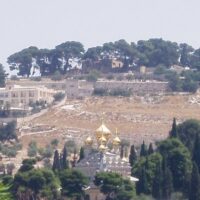
The religious revival of post–World War I Romania led to the building of a Romanian church in Jerusalem. In 1927, construction began on a church dedicated to Saint George on Shivtei Yisrael Street, which was completed in 1938. It features a dome and architectural elements of traditional Romanian style in stone and wood, with the most prominent motifs taken from the Brâncovenesc style.
The church was designed by the renowned Romanian architect Dimitrie Ionescu-Berechet (1896–1969), who served as the chief architect of the Romanian Orthodox Church for 33 years. He built and renovated the most important churches in Romania, and for the purpose of planning the church and studying additional architectural styles, he also visited Jerusalem. Dimitrie’s grandfather was one of the most important church painters in Romania, and Dimitrie was also involved in this field. Generally, many of the frescoes in Orthodox churches in Jerusalem in particular, and in Israel in general, that were painted or restored in the last hundred years were done by Romanian artists, who are considered experts in this field. The church somewhat resembles an important historical monastery in Romania from the 14th century, where Mircea the Elder is buried, called Cozia Monastery.
Patriarch Cyril II
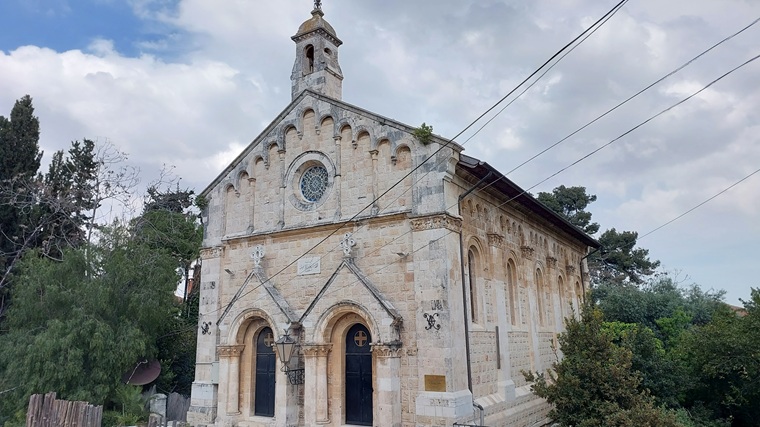
From the time of Dositheos the Great (see chapter in the second book) until 1845, the Greek Orthodox Patriarch of Jerusalem resided in Constantinople and was under the patronage and influence of the Patriarch of Constantinople. In 1845, partly due to a combination of political and internal church circumstances, the Patriarch of Jerusalem was chosen for the first time by the Brotherhood of the Holy Sepulchre residing in Israel, and not by an external factor. His name was Cyril II, and he moved the seat of the Patriarchate to Jerusalem.
Cyril II (1792–1877) was born on the island of Samos and educated in monasteries there. In 1819, a few years before the outbreak of the Greek War of Independence, he joined the Brotherhood of the Holy Sepulchre and came to Jerusalem. There he became abbot of the Monastery of the Mother of God in Gethsemane. In 1830, he became the Metropolitan of Sebastia and Lydda, and in 1845 was elected Patriarch of Jerusalem. He was very active in the Christian renewal of the city, held an impressive coronation ceremony in the Church of the Holy Sepulchre, and moved his residence to the Greek St. Constantine Monastery in Jerusalem instead of Constantinople.
Cyril II was very popular with the local Christian-Arab population. He established educational and charitable institutions, renovated churches, and elevated the status of Jerusalem. Among other things, he established a printing press in the Old City and founded an Orthodox Theological Seminary at the Monastery of the Cross that operated from 1852–1909. The Russian Father Uspensky was very active in this project. The seminary had a large and important library containing some of the ancient writings that the monk Theophanes and Father Uspensky had collected in the desert monasteries. At its peak, nearly 500 people from all over the Orthodox world studied there.
Cyril II renewed and built Greek Orthodox churches throughout the country. He began the construction of the St. Simon Monastery and Church in New Jerusalem in 1859 and renewed the St. George Church in Lydda (Lod), in cooperation with the local population and the Russians (Order of St. George), beginning a tradition of local festivals in honor of St. George from 1871. In addition, he supported the monasteries of the Judean Desert.
Cyril II had good relations with the renewing Bulgarian Church and supported it, as well as with Russian Prince Nikolayevich, whom he hosted in Jerusalem in 1872, and with Tsar Alexander II, who gave him money for the renovation of St. George’s Church in Lydda. The increased Russian presence and the arrival of pilgrims in Jerusalem strengthened the position of the local Greek Orthodox Church.
After the death of Nikolayevich, and against the background of Cyril II’s refusal to sign the declaration condemning the schismatic Bulgarian Orthodox Church, he was deposed from his position by the Synod of Bishops of the Church of Jerusalem. After several years, his name was cleared, and he was asked to return to his post but refused, claiming he was too old—proving once again that he was a man of God and not of politics.
Patriarch Gerasimos I
Gerasimos I was Patriarch of Jerusalem from 1891–1897 and excelled in the decoration and renovation of churches (18 churches and four monasteries, including seven iconostases) [1]. He was a man of the world, a graduate of the Theological Seminary in the Valley of the Cross, who completed his studies in mathematics and physics in Greece, taught at the Theological Seminary in the Valley of the Cross, served in Constantinople and Antioch, and had connections in Constantinople, Russia, and with the new Greek government.
Gerasimos renovated the St. Onuphrius Monastery in the Hinnom Valley, the main Orthodox monastery in Jerusalem named after Constantine and Helena, as well as parts of the dome of the Church of the Holy Sepulchre, the churches of Harambalos and St. Nicholas in the Christian Quarter, the Holy Apostles Monastery – Gali-Viri (Viri Galilaei), and more. He promoted independent Orthodox educational institutions and also archaeological research, and it was he who revealed the Madaba Map to the world. In short, he was the great builder of the Greek Orthodox Church and strengthened its independence against the growing Russian influence.
The New Armenia
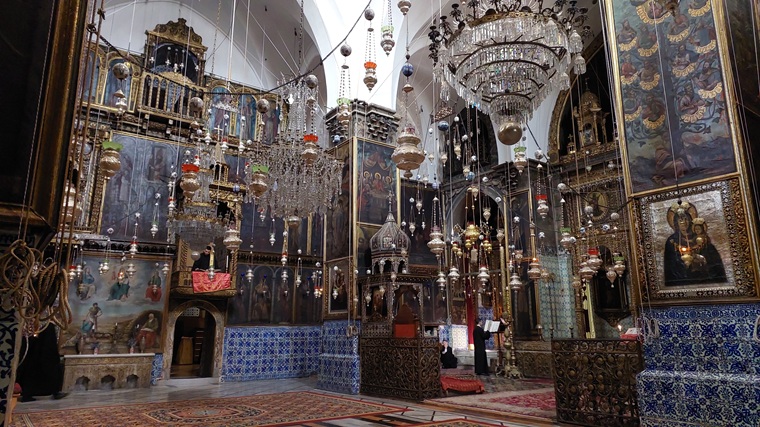
In 19th-century Jerusalem, the Armenians were one of the largest Christian communities, with a separate quarter and an important part of the Church of the Holy Sepulchre. At the beginning of the century, they still had an important role in the Ottoman Empire, despite tensions that emerged and eventually led to the Armenian Genocide in World War I.
In the early 19th century, the Russians conquered parts of Armenia, leading to an Armenian cultural, religious, and national revival. Even earlier, in the 18th century, the cleric Mkhitar of Sebaste founded the Mekhitarist Order—an Armenian Catholic order whose goal was to serve as a bridge between the West and the Armenian culture and people in the East. They arrived in Venice and received the island of San Lazzaro, which is still in their possession today. There they established the first printing press of its kind, an important library, and a learning center. The first Armenian historians came from there. A splinter group from this order established a center in Vienna in 1811, which also became a kind of university of Armenian culture and religion. Another center was established in Moscow in 1815.
In 1828, the Russians conquered Eastern Armenia from the Persians, and for the first time in centuries, a Christian rule prevailed there. According to the historian George Bournoutian, the area conquered by the Russians, called the “Khanate of Yerevan,” roughly corresponds to present-day Armenia. The mid-19th century was the era of the Springtime of Nations; the ideas of liberty, equality, and fraternity also found a home in Armenia. In addition, there was an Armenian Enlightenment movement supported by the Church and monasteries. The leader of this movement in its early stages was Khachatur Abovian (1805–1848).
With the appearance of the national revival movement, the “Armenian Question” began. The Armenians were the largest Christian minority in the Ottoman Empire. They had representation in all cities, were part of the educated and secular-minded elite, and held senior economic positions. The masses in Western Armenia, on the other hand, were mostly farmers and suffered from clashes with the local Kurdish and Turkish populations and harassment by the authorities, which in some cases escalated into persecution and pogroms. Things deteriorated during the reign of Sultan Abdul Hamid, who adopted a Pan-Islamic policy. Between 1894–1896, riots known as the Hamidian Massacres occurred, resulting in hundreds of thousands of Armenian casualties.
Around the same time, an extraordinary Armenian personality, Patriarch Mkrtich Khrimean (Khrimian Hayrik), stayed in Jerusalem for three years (1890–1893) before becoming the Catholicos of All Armenians in Etchmiadzin from 1893–1907. He is considered a promoter of the Armenian national and cultural revival, a defender of the common people, and was nicknamed the “Father of the Armenians.”
Ethiopians in Jerusalem
In the mid-19th century, several talented kings rose to power in Ethiopia, succeeded in ending the anarchy, uniting the country under one central rule, and transforming it into an important regional power. They began campaigns of conquest that led to the tripling of Ethiopia’s territory and to its becoming a vast empire.
The first king was Tewodros II, who ascended to power in 1855. After a series of successful wars, he managed to unite the country and ruled until 1867. Early in his career, he was aided by the energetic Abuna (head of the Ethiopian Church) Salama, but eventually came into conflict with him. This was the first time in many years that the ruler had real power. Tewodros saw himself as a legendary, messianic Christian ruler who would renew the glorious days of Ethiopia (hence the name). He led religious reforms, restricted the power of Catholic and Protestant missionaries, made the Debre Tabor region in Amhara his capital, and began a campaign of conquest that expanded the Empire’s territory, mainly to the south. Eventually, he clashed with the British and was killed in battle with them.
In 1872, another talented ruler, Yohannes IV from Tigray, ascended to power, moving the capital to Mek’ele in the north. He saw himself as a religious crusader and began an energetic Christianisation campaign of the Muslim, pagan, and Jewish populations. He died in battle with the Sudanese in Metemma in 1889.
Yohannes was succeeded by Menelik II, who had been the ruler of Shewa. Even before becoming Emperor, he conquered many territories in the south and east, creating a kind of Christian Amhara colonialism and making Amharic the national language. His ally was Abuna Mathewos, who served as head of the Church for 45 years until 1926. Menelik founded Addis Ababa in 1886 and moved the capital there. In 1889, he was officially crowned Emperor of Ethiopia, and his power grew. His army was equipped with rifles and expanded to large numbers. In 1896, he confronted the Italians at the Battle of Adwa and defeated them. This was the first time that an independent African kingdom had defeated a modern European army, and it happened with the help of the Ark of the Covenant, which was brought out for the campaign from its hiding place in Axum.
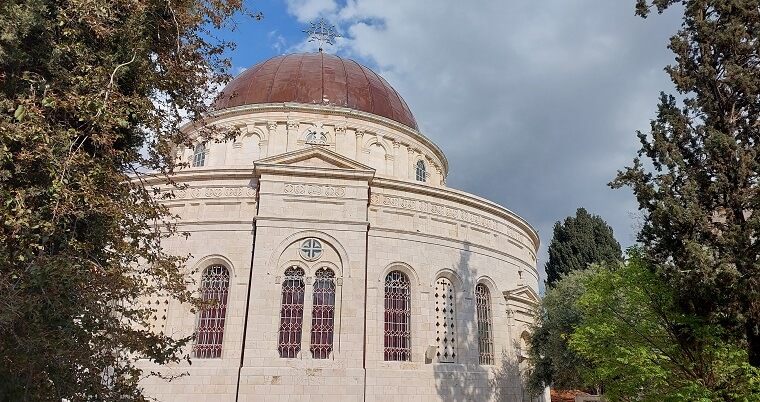
The new Ethiopian Emperors began building in Jerusalem, starting with Tewodros, who strengthened the existing Ethiopian presence and compounds, continuing with Yohannes, who began building a large church called the “Covenant of Mercy” (Kidane Mehret) and a nearby monastery called “Paradise” on Ethiopia Street, off Prophets Street, opposite Ben Yehuda’s house, and culminating with Taytu, Menelik II’s wife, who built the Ethiopian Consulate and public buildings on Prophets Street.
The Kidane Mehret Church was completed in 1893. It is named after a covenant that Mary made with God regarding the people of Ethiopia, ensuring her intervention on their behalf at Judgment Day. At the center of the church there is a Tabot (Ark of the Covenant) brought from Ethiopia inside a square room that symbolizes the Holy of Holies; it is surrounded by a circular building with a dome that symbolizes the world and the heavens. The structure of the sanctuary is composed of a three-tiered hierarchy, like the Temple in Jerusalem. The innermost part is the square Holy of Holies, which only priests enter, and in its center is a kind of altar on which rests the Tabot—a replica of the Ark of the Covenant. The Tabot is brought out once a year, on the Feast of Epiphany (which the Ethiopians observe on January 19), or on the church’s feast day, wrapped in shrouds, and this is a great moment for the believers who bow before it and break into song and dance, just as King David danced before the Ark. Surrounding the Holy of Holies is a circular space into which only pure people enter. Around this space is a wide circular corridor that the rest of the congregation can enter, women separately on one side and men on the other; part of it is dedicated to the choir and musicians.
The Ethiopians believe that their royal dynasty is descended from Solomon and the Queen of Sheba, and an interesting story is that the last great king of the dynasty—Haile Selassie—found refuge in Jerusalem during World War II. Ethiopia was conquered by the Italians for five years (1936–1941), and Haile Selassie went into exile and first arrived in Jerusalem for a few weeks. Initially, he lived in the King David Hotel, and later moved to a house on Prophets Street near the Ethiopian buildings and the church.
Rastafari religion
One of the new religions that has recently appeared is that of the Rastafari from Jamaica, descendants of Black slaves who see Haile Selassie as the incarnation of the Messiah and the appearance of God in the world. They embraced their African heritage and saw the Ethiopians as a model of a culturally superior African people that had never been under foreign rule. The Ethiopian model led them to adopt the Kebra Nagast (The Glory of Kings), the Ethiopian book of kings and its alternative history, which designates Ethiopia as the New Zion. According to their view, the white world is the wicked Babylon, and the Black world is Zion, and therefore the story of Jesus is not to be accepted, and instead there is the story of Haile Selassie.
The religion began with a royal visit by Haile Selassie to Jamaica in 1966, which led to the breaking of a drought of several years. According to the Rastafari, the signs of Jesus’ crucifixion were visible on Haile Selassie’s hand. They number about one million people, mainly in Jamaica, and became known worldwide for their reggae music and its prominent representative—Bob Marley. The name comes from their hairstyle—Rasta (Lion of Judah). They smoke ganja (cannabis) as a way to free themselves from the influence of white Babylon and connect to another state of consciousness of Zion. According to them, King Solomon smoked cannabis and opium from plants that grew in his gardens. They believe in the possibility of connecting to the Light of Prophecy with the help of cannabis, meditation, and other techniques, and in charismatic leadership. Some of them aspired to return to Africa, and Haile Selassie gave them land in a village called Shashamane in the Syrian-African Rift Valley area. The Rastafari speak a special type of Amharic that is considered a sacred language for them, use specific colors in their clothing, and listen to reggae music.
According to Ran HaCohen, “The Rastafarians developed their own culture and way of life under the influence of Ethiopian Christianity, including a pronounced biblical component, such as adherence to biblical dietary laws. Alongside the Bible and the New Testament, the Kebra Nagast is one of the holy books of the movement.” Haile Selassie died in 1975, but according to the Rastafari, he is not dead and will return in due course. Because of his importance, his visit to Jerusalem during such a critical period of his reign and of the world is considered highly significant.
Footnote:
[1] Levy, A. (2018). Patron of the Churches of Jerusalem: The Greek-Orthodox Patriarch Gerasimos I, 1891–1897. Cathedra: For the History of the Land of Israel and its Settlement. (Hebrew)