Alchemy and the Umayyad Dynasty
Following Caliphs Abu Bakr, Umar, Uthman, and Ali ibn Abi Talib, who are considered to be the four Rightly Guided Caliphs, the Umayyad dynasty rose to power and ruled the Muslim world for 90 years, from 661 CE until 750, from their capital in Damascus. The first Umayyad ruler was General Mu’awiyah himself, who belonged to one of the respected families of Mecca that initially opposed the Prophet, but after the conquest of Mecca in 630, he converted to Islam and was appointed as a military commander who participated in the conquest of Syria during the time of ‘Umar, thereafter being appointed as the governor of Syria by the next Caliph, who was his relative—’Uthman. Following the assassination of ‘Uthman, he took a stand against ‘Ali and his descendants, and after ‘Ali’s death, he was declared Caliph in Jerusalem on January 24, 661. On that same day, a severe earthquake occurred that destroyed Jericho.
Mu’awiyah ruled the expanding Muslim Empire for 20 years during which he elevated the status of Jerusalem. According to tradition, when he received a delegation from Iraq, he told them: “You have come to the Holy Land, and you have come to the land of gathering and the resurrection of the dead, and you have come to the land in which the graves of the prophets lie” [1]. Among other things, he promoted and developed the Muslim pilgrimage tradition to Jerusalem, which complements or replaces the pilgrimage to Mecca (most pilgrims to Jerusalem were those who were on their way to Mecca and combined the two sites).
Mu’awiyah’s dynasty was continued by his son Yazid I, who ruled for three years. During his time, the massacre of Husayn and the Prophet’s family took place in Karbala. The Shi’ites claim that he was a heretic, an adulterer, a drunkard, and even connected to a Satan-worshiping cult. Be that as it may, after his death, his son Mu’awiyah II rose to power for a few months, but he died without heirs, and the empire descended into anarchy.
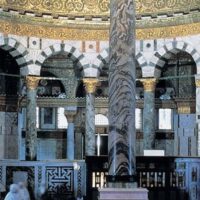
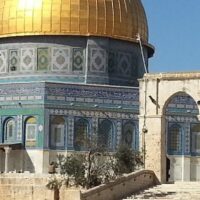
Following this, two things happened: one was that a rebel named Ibn al-Zubayr, who was a companion of the Prophet (the first child born to the emigrants from Mecca to Medina), took control of the holy cities of Mecca and Medina and large parts of the Arab world. His kingdom constituted a kind of competition to the rule of the Umayyad House. The second was that the rule passed to another branch of the dynasty. Thus, the son of Mu’awiyah II, Yazid, became an alchemist instead of a Caliph (see chapter on Alchemy), and his cousin Marwan I became the Caliph. Although he ruled for a short time (less than a year), he managed to stabilize the empire. He was succeeded by ‘Abd al-Malik, who ruled for 20 years and began a new era in the history of Jerusalem—rebuilding it magnificently, especially the Temple Mount complex and the Dome of the Rock. ‘Abd al-Malik’s son, al-Walid, continued the building projects in Jerusalem and built the Al-Aqsa Mosque.
Another son of ‘Abd al-Malik, named Sulayman, became the governor of Palestine (Jund Filastin). He used to spend long periods in Jerusalem and founded the city of Ramla, and later became a Caliph himself (715–717). He was replaced in his position by ‘Umar II, who was considered a devout and righteous man (apparently the name does something) and used to go on a walking pilgrimage to Jerusalem wearing coarse wool clothes. He was succeeded by another brother, Yazid, and then for 20 years by Hisham ibn ‘Abd al-Malik (724–743), who built Hisham’s Palace in Jericho. In any case, the dynasty’s rule was relatively short—85 years—and in 750 they were replaced by the Abbasids, who moved the capital to Baghdad.
A little-known fact is that the first Umayyad Caliph, Mu’awiyah ibn Abi Sufyan, was declared Caliph in Iliya—which is Jerusalem. Some say that afterward he went to pray at the Church of the Holy Sepulchre and the Tomb of Mary, as the Dome of the Rock did not yet exist. Therefore, the caliphs who followed him were also declared in Jerusalem.
Damascus—the center of Umayyad rule—is not far from Jerusalem, and it is possible that the Umayyads even considered moving their capital to Jerusalem—a place considered to be more important religiously. The Umayyads probably planned to stay in Jerusalem in the summer and descend to their palaces in Jericho in the winter, which is why magnificent palaces were built south of the Temple Mount and no less magnificent palaces in Jericho. The same arrangement existed in Damascus—where they stayed in the summer—and in the winter, they descended to their palaces near the Sea of Galilee, in Beit Yerah or Khirbet Minya, where the weather was milder.
other words, throughout the years, the Umayyads built in and around Jerusalem a complex arrangement of sacred sites that included palaces, mosques, pilgrimage routes, and the marvelous and unique structure of the Dome of the Rock—in a way that reflected their evolving beliefs and the connection between the spirituality of the past and that of the new religion. People from other religious backgrounds, such as the Jewish convert Ka’b al-Ahbar, participated in the planning and construction, contributing their spiritual knowledge to the new building projects.
The Umayyad Palaces
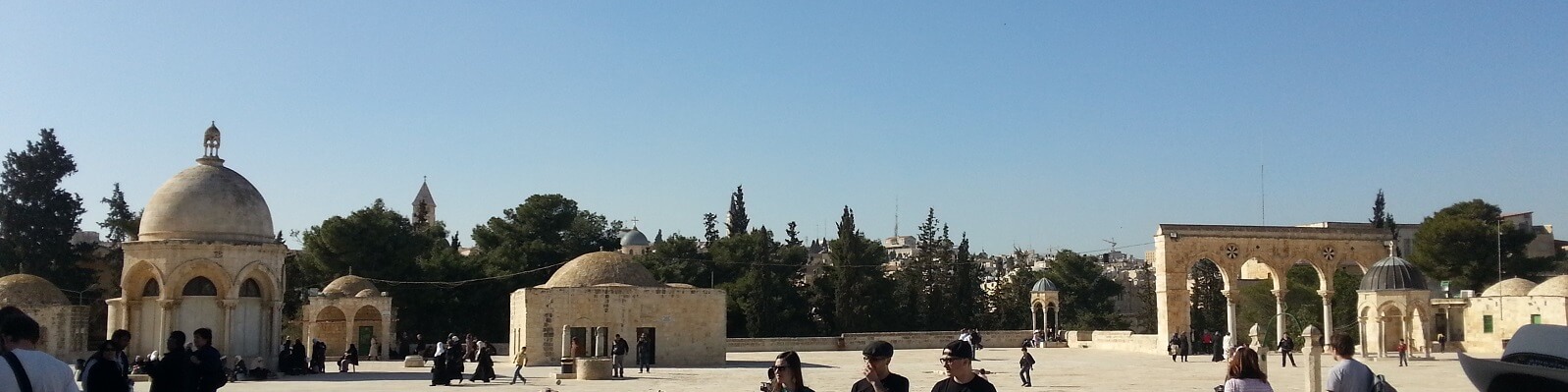
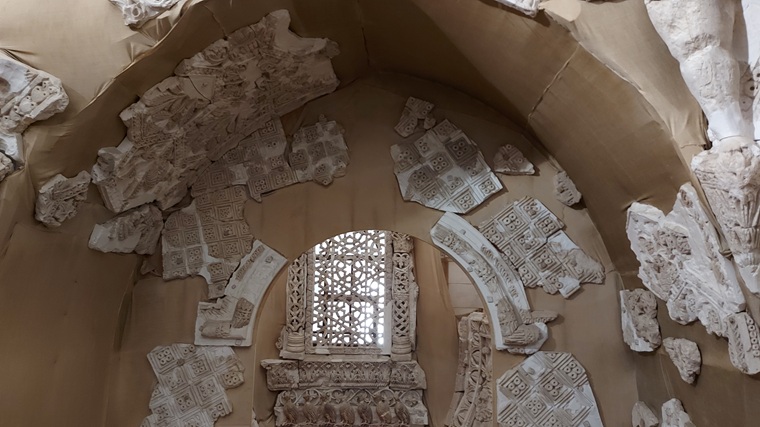
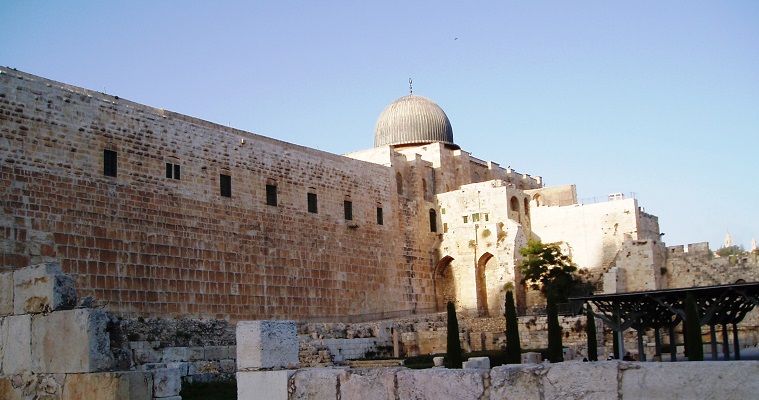
South-west of the Temple Mount plaza, there was once a large complex of five palaces that seemed to wrap around the plaza’s south-western corner. The area of each palace was about eight dunams (approx. 2 acres), and they rose to a height of 2-3 stories with a square courtyard in the center. In the Davidson Archaeological Garden, a reconstruction of the foundations of one of them can be seen. According to Rosen-Ayalon [2], the palaces were part of a master plan for the entire Temple Mount complex by the Umayyads. The western wall of the central palace is parallel to the western wall of the Temple Mount complex, and the eastern wall borders a street on a clear north-south axis connecting the Dome of the Rock, the Al-Aqsa Mosque, and the palace area. The northern wall of the palace is parallel to the southern wall of the Temple Mount complex, and only a narrow street separates them. In the past, there was a bridge over the street connecting the palace directly to the Al-Aqsa Mosque and the plaza next to it.
The construction of such large palaces in Jerusalem led to the thought that the Umayyad rulers planned to move their capital from Damascus to Jerusalem, only that they did not manage to complete the move because they were replaced by the House of Abbas in 750 CE. Some archaeologists argue that the construction of the palaces was never completed. However, the Caliph considered to be the builder of the palaces is al-Walid, who ruled in the years 695–705, a long time before the rise of the House of Abbas, and it is not logical that they were not completed. Al-Walid was a great builder who built the Great Mosques in Damascus and Medina, and the construction of the palaces corresponds to his completion of the Al-Aqsa Mosque and the completion of the sacred complex of the Temple Mount and Jerusalem. In any case, the palaces were probably occupied in some way or used to host pilgrims.
Early Muslim Alchemy
One of the assistants and close associates of ‘Abd al-Malik was Khalid ibn Yazid, the son of the second Umayyad Caliph, Yazid I. He is considered the first Muslim alchemist. Khalid was destined to be Caliph, but he was too young when his brother Mu’awiyah II died, and he accepted the transfer of the Caliphate to another branch of the family, to Marwan I. When he matured, he dedicated his time and energy to studying esoteric knowledge, the mystical interpretation of the Qur’an, and alchemy. In addition, he was appointed to many positions, including the governor of the Homs region and the commander of the army. He was active during the construction of the Dome of the Rock, and it is possible that he was responsible for the knowledge used in the construction of the marvelous building (he was 24 years old at the time of construction).
In legends, he is called King Khalid. Instead of aspiring to be Caliph, he developed a much greater ambition, which was to achieve eternal life. And so, Khalid became the first Arab alchemist. As a young man eager for knowledge, he commanded Greek and Coptic scholars (some from the generation before the Muslim conquest) from Egypt to translate the ancient Hermetic alchemical literature into Arabic.
We learn about Khalid’s activities from the letters of Ahmad al-Baladhuri—a Muslim historian from the end of the 9th century. According to the legend, a monk named Marianos taught him the alchemical knowledge and wrote for him the first book on alchemy to be published in Arabic. One of the names of the book is “The Epistle of the Wise Monk Maryanos to the Prince Khālid ibn Yazīd” but it is usually called “The Book of the Composition of Alchemy” (Kitāb ṣan‘at al-kīmiyā’). The monk Marianos studied under one of the greatest Byzantine alchemists, Stephanus of Alexandria, and was the last to preserve the tradition of ancient knowledge (see the chapter on alchemy in the first book).
In addition to Khalid, the figure of a son of the ruler Marwan I also stands out during that period, as he became a Sufi dervish named ‘Adi ibn Musafir, and later founded the Yazidi religion. From this, we learn that some of the Umayyad rulers engaged in esoteric practices and mysticism and studied spiritual traditions that were common in the ancient world at that time, such as alchemy—translating them into Arabic and integrating them into the new culture and religion that was spreading worldwide and was still in the process of formation.
It should be noted that among the Shi’a, there is also a claim of alchemical studies by none other than the sixth Shi’ite Imam, Ja’far al-Sadiq, who was active during the time when the Abbasid Empire took control of the Muslim world. According to their claims, the most famous Muslim alchemist, Abu Musa Jabir ibn Hayyan, was one of his students.
With the emergence of the Sufi orders in Islam, spiritual alchemy developed, linking the heart to the Philosopher’s Stone—but this was not the physical heart, but rather a spiritual organ within us that reflects the unseen worlds. The purpose of this alchemy is to clean the mirror of the spiritual heart and activate dormant energetic centers in the human system. This is done through introducing a person to extreme emotional states that create new substances within him, and through practices of meditation, breathing, mantras, and more. The term “Alchemy of the Heart” [3] appears as the title of one of the books by al-Ghazālī, the great Sufi scholar of the 11th century.
In the Middle Ages, the alchemical teachings were transferred to Europe through the encounter of Muslims in Spain, Sicily, and the Crusades. This can explain from another angle the adoption of the Dome of the Rock as a symbol of the Templar Order.
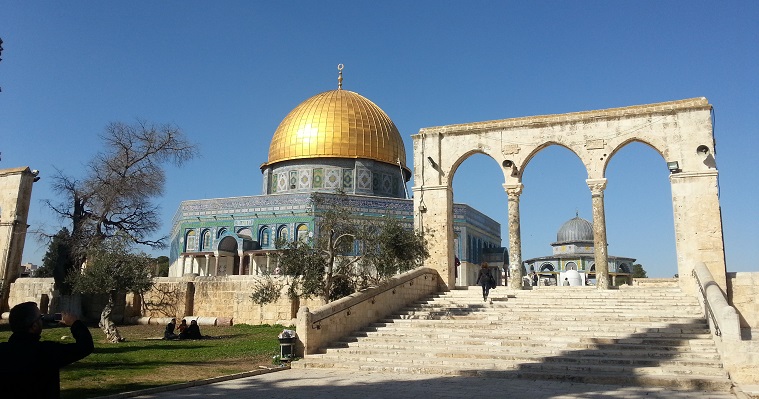
In general, it can be said that the Dome of the Rock has alchemical symbolism, whether conscious or unconscious. The Foundation Stone is the Prima Materia (First Matter) on the one hand, and the Philosopher’s Stone on the other. Above it is the Dome which, with its interior decorations, symbolizes a journey of transformation and ascension—the Alchemical Journey. The exterior of the Dome expresses the goal of the alchemical process—the transformation of base metal (the Prima Materia) into gold. The geometric relationships and proportions in the building create a kind of mandala that expresses the union of opposites, and therefore also the Spirit of God, or the Throne of Glory. The colors of the Dome of the Rock—yellow and blue—are the sun in the sky, symbolizing the seven heavens above the earth, between us and God. This is connected to the ascension of Muhammad through the seven heavens, which are the seven wandering stars in the sky. There is a connection between the seven metals known in antiquity and the seven stars or heavens (see the chapter on Astrology in the first book).
Footnotes:
[1] Levana, Ofer. 2000. Studies in the Status of Jerusalem in Early Islam: A Collection of Articles. Yad Izhak Ben-Zvi, Jerusalem. p. 97.
[2] Rosen-Ayalon, Myriam, The Early Islamic Monuments of al-Haram al-Sharif: An Iconographic Study, Jerusalem: The Institute of Archaeology, The Hebrew University of Jerusalem, 1989.
[3] al-Ghazālī. (2010). The Marvels of the Heart: Science of the Spirit (Book XXI of the Iḥyāʾ ʿUlūm al-Dīn) (W. J. Skellie, Trans.; T. J. Winter, Foreword). Louisville, KY: Fons Vitae.