The Early Muslim Period
At the beginning of the 7th century CE, a miracle happened to the Arab tribes of the desert: God chose them as the chosen people and sent them a prophet who brought a new message and religion. With the help of this new and revolutionary religion, they quickly became the rulers of the world. Muslim armies burst forth from the Arabian Peninsula and conquered the entire Middle East, including Jerusalem. The conquest of Jerusalem had important spiritual and religious significance—it connected Islam with the religions that preceded it, Christianity and Judaism, and transformed the new religion from a desert religion of remote tribes into a universal religion.
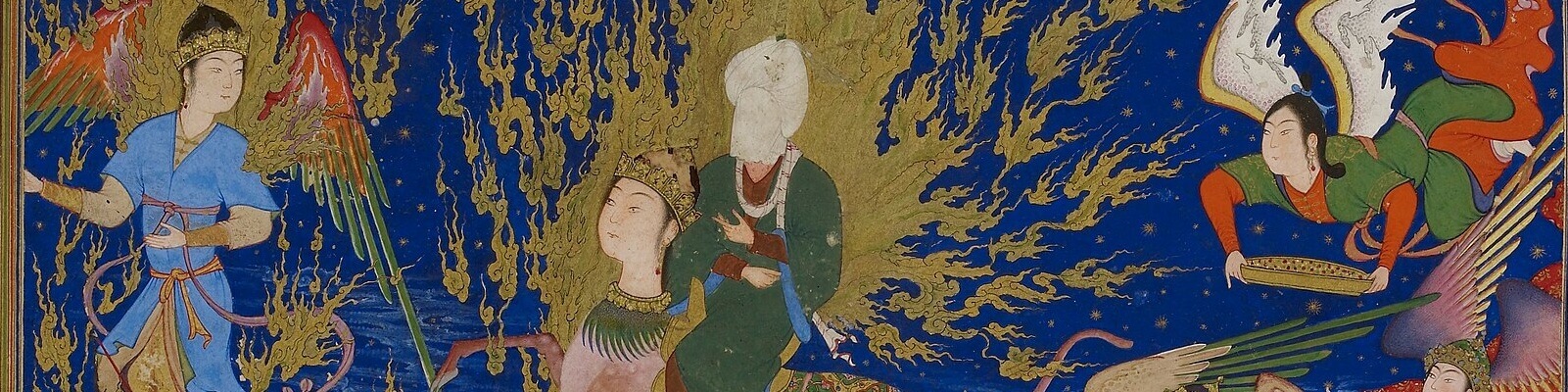
The three holiest cities for Muslims are Mecca, Medina, and Jerusalem. Some claim that Jerusalem is only third in sanctity, but the hierarchy of holiness is misleading, as the three holy cities are three different faces of the same thing, complementing one another. Furthermore, every believing Muslim is obligated to make a pilgrimage to Mecca once in their lifetime and prays towards it, just as Jews pray towards Jerusalem. However, for the first two years of the prayer commandment, Muslims prayed towards Jerusalem, because it was here that Muhammad arrived on the Night Journey. Here he met the prophets who preceded him and received their blessing, and from here he ascended through the seven heavens to meet God and receive the secrets of prayer [1].
The Night Journey to the Farthest Mosque (Al-Aqsa Mosque) in Jerusalem was the most important and greatest mystical experience in Muhammad’s life. For twenty-two years, he received revelations from the Angel Gabriel, and precisely at one of the difficult moments of his life, just before the migration from Mecca to Medina, a marvelous thing happened to him, and he met God directly for the first and only time. Within the Islamic mystical movement, there are many traditions regarding what happened in Jerusalem as part of the Night Journey, and so various Sufi mystics throughout history have endeavored to make this journey—which is perceived as an allegory for a person’s spiritual journey—themselves. The Night Journey is called Al-Isra wal-Mi’raj—the horizontal journey that leads to the vertical journey.
Muslims accept the Judeo-Christian tradition regarding Jerusalem as the place of the world’s creation and the place of the Day of Judgment, trial, and redemption. The White Foundation Stone in Jerusalem complements the Black Stone in Mecca, and when the day comes, the Black Stone will reach it in a miraculous journey, and all souls will gather for judgment in the Temple Mount plaza. The one who will weigh the deeds on the scales will be none other than King David [2]. In other words, Islam sees itself as the continuation of Judaism and Christianity, and therefore Muhammad had to come to Jerusalem.

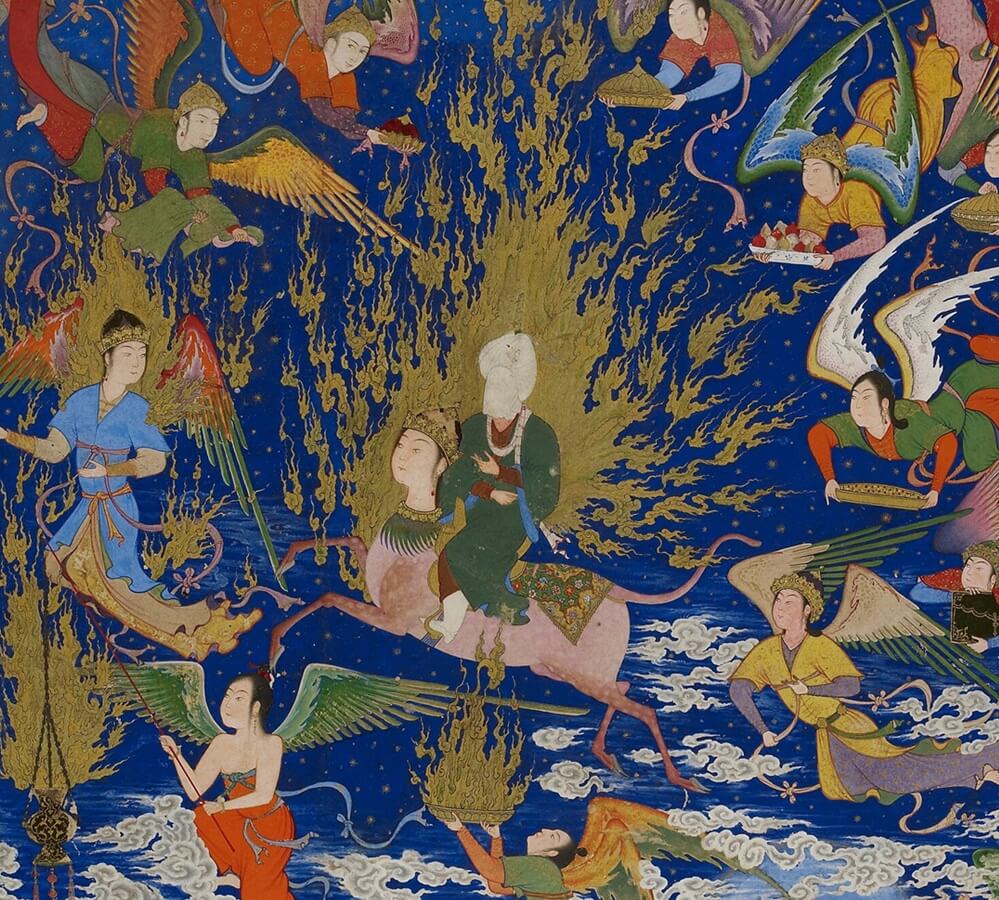
Some claim that the Night Journey was to another place and not to Jerusalem, but in the Sūrat al-Isrāʾ (The Night Journey), where this story appears, six verses discussing the Temple in Jerusalem appear after the first verse discussing the Night Journey. Their proximity points to the identification of the Farthest Mosque with Jerusalem. Thus it is written:
“Glory to Him who journeyed His servant by night, from the Sacred Mosque, to the Farthest Mosque, whose precincts We have blessed, in order to show him of Our wonders. He is the Listener, the Beholder. And We gave Moses the Scripture, and made it a guide for the Children of Israel: Take none for protector other than Me. The descendants of those We carried with Noah. He was an appreciative servant. And We conveyed to the Children of Israel in the Scripture: You will commit evil on earth twice, and you will rise to a great height. When the first of the two promises came true, We sent against you servants of Ours, possessing great might, and they ransacked your homes. It was a promise fulfilled. Then We gave you back your turn against them, and supplied you with wealth and children, and made you more numerous. If you work righteousness, you work righteousness for yourselves; and if you commit evil, you do so against yourselves. Then, when the second promise comes true, they will make your faces filled with sorrow, and enter the Temple as they entered it the first time, and utterly destroy all that falls into their power.” (Sūrat al-Isrāʾ 17: verses 1–7).
The mosque in this chapter is the Temple in Jerusalem, and hence the identification of Jerusalem with the Farthest Mosque. The Qur’an was written down twenty years after Muhammad by people who remembered him and were his companions, so it can be argued that from the beginning of Islam, Jerusalem was identified with the Farthest Mosque and was sacred to Muslims. Muhammad’s arrival in Jerusalem and Israel (the Blessed Land) was the moment when Islam turned from a local message and religion into a leading universal religion, continuing and leading the tradition of the great religions and Western spirituality. Hence, the special place of Jerusalem in Islam, which differs from that of Mecca and Medina.
Islam cannot be a world religion without Jerusalem and the Land of Israel, without the connection to what was, to the prophets of the Old and New Testaments, to the other religions, to human history and culture. Israel in general and Jerusalem in particular are the heart of Western culture, the place from which the great religions emerged and where a transition occurred between East and West, Egypt and Europe, the past and the future. And if Islam does not have this connection, it is a marginal religion that emerged from the deserts of Arabia and will return to them; if it has it, it is a universal religion destined to spread throughout the world.
The transition of Islam from a marginal local event to the heart of human civilization is connected to a person—Muhammad—and a place—which, however strange it may sound, is not Mecca and Medina in the desert but Jerusalem. Jerusalem is the meeting point of Islam with human past and present civilizations, the place where the relay baton passed from Christianity and Judaism to the new religion. However, it is not only Jerusalem in the narrow sense, but the entire Land of Israel, which is called the Blessed Land in the Qur’an.
Islam began in one of the most remote and desert regions of the world, the heart of the Arabian Peninsula, a place where nomadic tribes lived for ages, far from cultural centers, without education, on the margins of human history and the search for meaning. And it became one of the richest and most diverse religious movements that changed the face of the world. Jerusalem is a mirror of the development of the various Muslim civilizations and the Muslim faith, both external and internal-spiritual, throughout the generations. Jerusalem has always been a center of Muslim mysticism, and sometimes also a center of Sharia (law) and knowledge.
One thousand and two hundred years of Muslim rule is a long and glorious period, during which various Muslim empires with different beliefs and origins ruled Jerusalem. During this long period, the city was consecrated and nurtured; there were saints, poets, mystics, and sages here. Religious institutions and houses of prayer, Sufi centers, mosques, and rulers’ palaces were built. Thus, it is impossible today to separate Jerusalem from its Muslim heritage, just as it is impossible to separate it from its Jewish and Christian heritage. It is no secret that there is a national conflict over the Holy City today, but it is not a religious conflict and should not be made into one. Jerusalem is sacred to the three religions—and not only to them.
After the conquest of Jerusalem by the Caliph ‘Umar in 638 CE, it became part of the empire of the Rightly Guided Caliphs ‘Uthman and ‘Ali, and later part of the Umayyad Empire, whose capital was nearby in Damascus. The Umayyad rulers glorified and built Jerusalem; ‘Abd al-Malik built the Dome of the Rock only fifty years after Muhammad’s death, with the intention of making Jerusalem a political and religious center that would compete with that of Mecca, which was in the hands of his rivals. His son, al-Walid, continued the work and built palaces and the Al-Aqsa Mosque, and together with the works of the other Caliphs, a new sacred complex was created in Jerusalem.
In 750 CE, the Umayyad Caliphs were replaced by the Abbasid dynasty from distant Baghdad. Some of the Abbasid Caliphs visited Jerusalem, and they preserved and nurtured its sanctity, but naturally, the city’s importance declined, and with the disintegration of the empire in the 10th century, the rule in Jerusalem passed to local dynasties, until in 969 another great empire with a Shi’ite religious orientation, whose center was in Egypt and not Baghdad, took control of Jerusalem—the Fatimids. This led to a new wave of construction and the creation of a different sacred complex, in which the status of Jerusalem was strengthened, and the Al-Aqsa Mosque was rebuilt.
The Crusader conquest of Jerusalem and the wars with the Crusaders led to the strengthening of Jerusalem’s status and sanctity in the eyes of the Muslims. Thus, with the reconquest of Jerusalem by Ṣalāḥ ad-Dīn (Saladin), many Sufi centers and madrasas (religious schools) were established there. Jerusalem became a city of scholars and mystics. Various Muslim peoples, such as Afghans, Indians, Turks, and others, built centers of Sufi orders connected to their homelands and religious learning institutions (madrasas) in Jerusalem. The pilgrimage movement increased, and Sufi mystics from all over the world came to Jerusalem with the aim of experiencing Muhammad’s Night Journey and imitating it—to die to themselves in order to be born anew in God.
The Ayyubid state founded by Saladin was replaced by the Mamluk Empire, which permanently expelled the Crusaders from the Land of Israel and ruled Jerusalem for 267 years. During this period, many religious structures were built—madrasas, khānqāhs (Sufi centers, also called zāwiyas)—and a new sacred complex that spread throughout the city was established.
In 1517, the Ottoman Empire conquered Jerusalem. During their time, the Jewish presence in the city strengthened and the Jewish Quarter developed. The Ottomans rebuilt the city walls, added madrasas and khānqahs, Muslim public buildings, and also allowed some Christian and Jewish construction—creating a new sacred complex. At the same time, after a magnificent start, in the 17th–18th centuries, the city was forgotten and sank into a kind of dormancy. Many interesting spiritual things related to the three religions continued to happen, but physically it remained relatively small and undeveloped.
The greatest change came at the beginning of the 19th century—the start of the modern era, the rediscovery of Jerusalem by the European powers, and its reconstruction. The Ottomans were still there and participated in the festivities until the end of the First World War, but the city was no longer the same city.
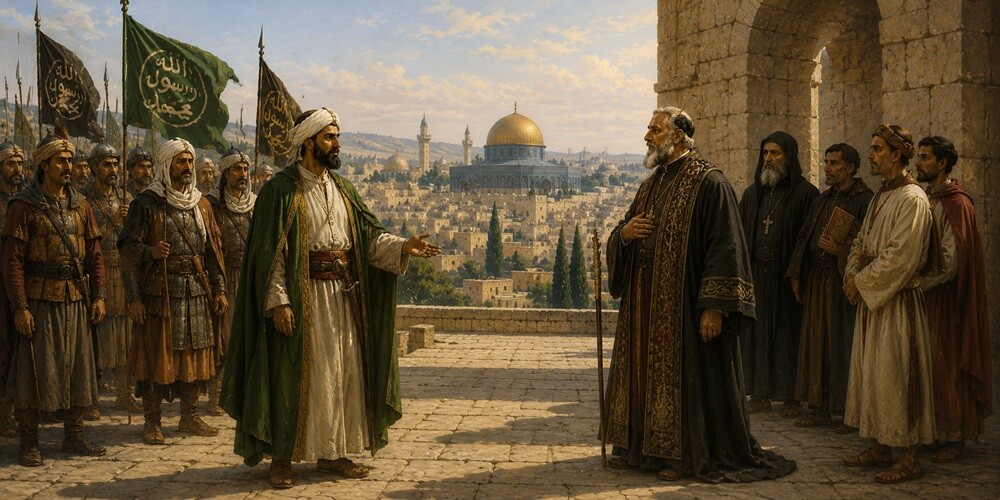
Caliph Umar ibn al-Khattab and Patriarch Sophronius of Jerusalem
The Story of Caliph ‘Umar
Caliph ‘Umar (ruled 634–644) is the second of the first four Caliphs (the Rightly Guided) and essentially the founder of the Muslim Empire. After Muhammad’s death in 632, the elderly Abu Bakr succeeded him for two years as the leader of the Muslims. He worked to stabilize the new Ummah (Nation), but it was ‘Umar who began the phenomenal expansion and conquests. He defeated the Persians and took control of their empire, defeated the Byzantines, and conquered their territories in the Middle East, conquering Jerusalem in 638.
‘Umar was considered an honest, humble, and righteous ruler even by the Christians, and therefore, after a two-year siege, they agreed to surrender and hand over the keys to the city only to him. After the surrender, Caliph ‘Umar gave the Christians a Charter of Rights that is preserved to this day, and despite its discriminatory and humiliating conditions, it promises basic protection to members of other religions, and in those days this was an important achievement.
‘Umar used to wear simple clothes and ride a donkey. When he prepared to enter Jerusalem, his advisors advised him to enter riding a horse and dressed elegantly, but ‘Umar rejected this, claiming it was not his character. When he ascended to power, he wept bitterly. When asked why he was crying, he said: “I am afraid that I will make a mistake and there will be no one to correct me.” The companions swore that they would tell him the whole truth, and so it was.
Near the Church of the Holy Sepulchre is the oldest mosque in Jerusalem, called the Mosque of ‘Umar—this is the original Mosque of ‘Umar, not the Dome of the Rock. It is the first Mosque the Muslims built, and behind it is a beautiful story: the Muslim army besieged Jerusalem for two years and could not conquer it. Finally, the Patriarch Sophronius agreed to surrender, but only to Caliph ‘Umar himself. After the surrender, Sophronius took him on a tour of the city, and first and foremost to see the Church of the Holy Sepulchre—the holiest place in the world for Christians and the most magnificent building in the city. During the visit to the church, the Muslim time for prayer arrived. ‘Umar asked the host’s forgiveness and went outside to pray. When he returned, the Patriarch asked him why he went outside? ‘Umar replied that he feared that the Muslims would consecrate the place where the Caliph first prayed after conquering the city, and if this place were inside the church—it would become a source of contention between Muslims and Christians. Therefore, he went out to pray outside, in a place that would not pose a threat to the church [3].
And indeed, where ‘Umar prayed, outside the Church of the Holy Sepulchre, a mosque was built to commemorate this event—a mosque called “Al-Umariyya” or the Small Mosque of ‘Umar. The mosque exists to this day, but it was rebuilt during the Mamluk period on the ruins of a Crusader structure built on the ruins of the original Mosque of ‘Umar (see chapter “the Rise of Sufism”). One can enter the mosque, see the impressive Crusader arches, and recall the beautiful story.
‘Umar had an advisor named Ka’b al-Ahbar [4], who was an Arab Jew who converted to Islam, probably of Yemeni origin. This man arrived in Medina during ‘Umar’s rule and became a kind of counselor on Jewish and Israel matters for ‘Umar and the other companions. He accompanied ‘Umar on his campaigns of conquest in the Land of Israel, and upon his entry into Jerusalem as a conqueror, guided him to the holy sites. Together they ascended to the Temple Mount complex, and al-Ahbar identified the location of the Temple for ‘Umar and advised him to clean the ruins and garbage that had accumulated there—and so it happened. The rock, which had meanwhile been washed by the rain, was fenced off and became a place of prayer.
Al-Ahbar is the source of several of the Hadith traditions, especially in the genre called the Isrāʾīlīyāt traditions—concerning the Jewish prophets who preceded Muhammad and the Land of Israel. According to some Shi’ites, he had a bad influence on Caliph ‘Umar, which led him to deny ‘Ali. According to other sources, he was proficient in the Torah and interpreted it prophetically. According to his belief, everything is written there, and thus he could prophesy things to ‘Umar that would happen in the future, and this probably strengthened his influence over him. There were other Jews who converted to Islam at that time, who saw prophecies in the Torah about the coming of Muhammad, such as ‘Abd Allāh ibn Salām from Yathrib (Medina). After ‘Umar’s death, al-Ahbar supported ‘Uthman and became his advisor.
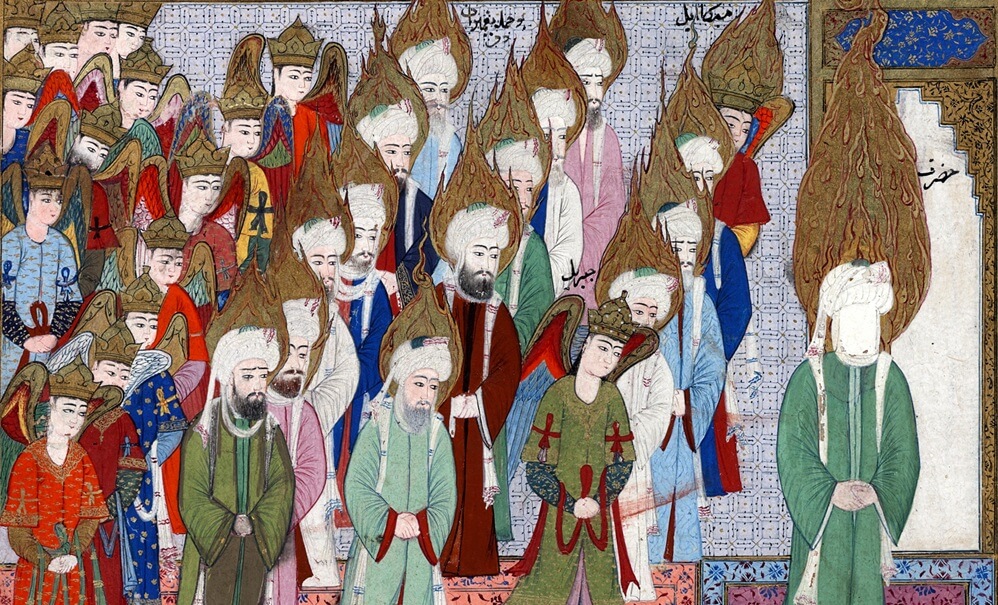
Prophet Muhammad and the Prophets
Ṣaḥāba – The Companions of the Prophet
Those who transmitted Muhammad’s teachings to others, as well as the descriptions of his life and the things he said, were the people around him, who were called the Companions—the Ṣaḥāba (or Aṣḥāb)—many of whom were from the Anṣār, the original tribes of Medina who converted to Islam and accepted his leadership. The accepted Companions numbered several dozens of people; they spread Islam throughout the nascent empire and were considered an authority on matters of religion and society. The traditions they preserved later became the Hadith, which is the Muslim law, and the memory of some of them preserved the revelations of the Qur’an.
Some of them had a connection to Jerusalem. One of the most important of the Ṣaḥāba in the context of Jerusalem is Abū ad-Dardāʾ, a young man who became one of the first believers in Muhammad. When Muhammad organized his supporters, he created friendships between the Anṣār—the original tribes of Medina—and the Muhājirūn (migrants) who came to it from Mecca and other places in the world to join the growing Muslim community. Abū ad-Dardāʾ’s friend was none other than Salmān the Persian, who is of great importance in the transmission of mystical knowledge and also has a connection to Jerusalem (see below).
Abū ad-Dardāʾ was a merchant. After converting to Islam, he abandoned his occupations and dedicated his life to asceticism and religious devotion, traveling the world as a zāhid—the wise man of the young Muslim community. He was an expert on the Qur’an, one of the few who collected and remembered the revelations of the Qur’an that came to Muhammad in real time and which he recited (the revelations were initially remembered orally, and only in the days of Caliph ‘Uthman were they written down). When the Muslims, led by ‘Umar, conquered Syria, al-Dardāʾ—with the support of the commander Mu’awiyah—became the first qāḍī (judge) of Damascus and essentially founded a school there, where he taught the Qur’an and religion to tens of thousands of students, raising generations of teachers and scholars. But before that, he spent a few years in Jerusalem and established Muslim religious life there, and even afterward, he made sure to visit the city and promote its sanctity.
Al-Dardāʾ’s young wife, Umm ad-Dardāʾ as-Sughra, was from the second generation who did not know the Prophet directly, but she knew the Qur’an by heart, learned from all the great scholars of the generation, and became one of the most influential and decisive women in the young Caliphate. She taught men and women, entered all the mosques, and was a teacher of Caliphs (‘Abd al-Malik) and common people alike. Half of her time she spent in Jerusalem, where she sat in silence with Ka’b al-Ahbar, and half of her time in Damascus, where she died in 703 and was buried near her husband. She was an educated and righteous woman—accepted and influential—who brought about the custom for women to pray with the same body postures as men, one of many who would follow her in Jerusalem and in Islam.
The network of Companions (Ṣaḥāba) that was founded in Medina moved to the territories of the expanding empire, and so some of the Ṣaḥāba can be found in many places in Israel. According to Sufi tradition, a large part of them engaged in mysticism, receiving from Muhammad the internal-spiritual tradition of Islam, which was not intended for the masses.
Among the Ṣaḥāba was a group called the People of the Bench—Ahl aṣ-Ṣuffa. They numbered over three hundred, and they neither sowed nor grazed nor traded. They ate in the mosque and slept there, sitting on a wide, shaded stone bench outside Muhammad’s mosque (house)—hence their name. The Prophet was friendly with them and asked people to respect them and recognize their virtues. These people lived lives of holiness and poverty, devoted to prayer and weeping much for their sins.
Some say that the name “Sufis” came from them. According to later sources [5], a number of the Prophet’s companions came to Jerusalem and spoke in its praise, including ʿAbd Allāh ibn Masʿūd, one of the first reciters, teachers, and interpreters of the Qur’an; Bilāl ibn Rabāḥ, the first muezzin (caller to prayer); and ʿAbd al-Raḥmān ibn ʿAwf, one of the ten people promised Paradise by the Prophet Muhammad and an advisor to Caliph ‘Umar in drafting the Pact of ‘Umar with the Jews and Christians in the Holy City.
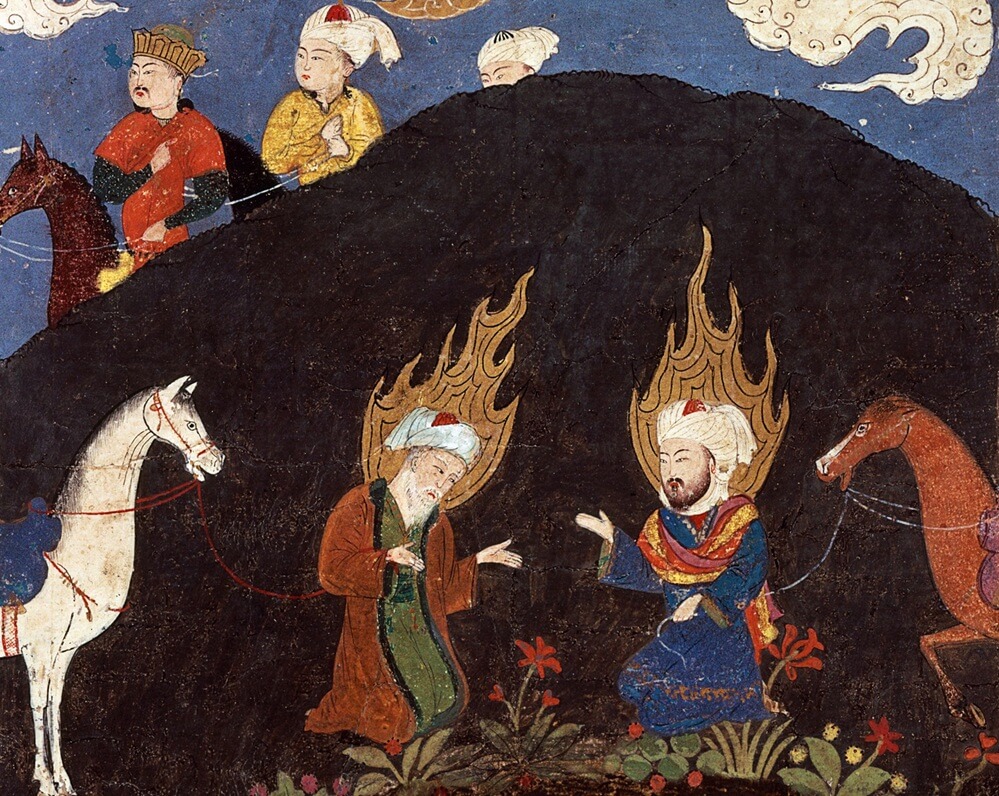
Alexander, Ilyas, Khidr, and the Fountain of Life
Abdāl – The Transfer of the Spiritual Energy Torch
In Islam, there is an emphasis on the fact that there are people who are close to God (Sūra 3:40), and this is manifested in the appearance of saints from the beginning of Islam, and even more so from the 8th–9th centuries with the appearance of the first Sufis. The esoteric parts of the Muslim teaching leave open the possibility of mystical union with God—God will guide those who focus on Him to it. The possibility of communication between God and man is based on the fact that man is composed not only of a body but also of a soul. The essence of man is the heart, which contains the secret and the secret temple of consciousness—Sīr—through which God can speak to man, and in which the secrets of God are revealed. Man also has a nafs, which is the soul of the body, an ego that leads man to error, and also a divine spark—the tranquil soul. The journey is a transition from the animal soul (the body) to the tranquil soul, with the model being Muhammad the Prophet.
Among the saints, there is a special group called the Abdāl—the meaning of the name is “substitutes” or “those who change form.” They are a kind of 36 righteous people (like the Jewish Lamed-Vav Tzaddikim), by whose merit the world exists, but in mystical Islam, they number 300, 400, or 356 people of various ranks, at the head of whom is a person who is the Qutb (Pole), and beneath him three or seven people, and beneath them forty. The numbers vary from order to order, but the idea is similar: a fixed number of righteous people connected to a cosmic order by whose merit the world exists. When one of them dies, another righteous person immediately replaces his place—like the unit of the Immortals in the Persian army.
The Abdāl have supernatural powers and are sometimes unaware of who they are and of their power until a revelation occurs, but even in this way, they maintain the world. They bestow blessing (baraka) and perform miracles (karamāt). Collectively, they constitute a substitute for the presence of the Prophet Muhammad on earth. At their head stands a person who is the Pole of the Generation and the Ruler of Time—meaning he is capable of being in two places simultaneously—a Pillar of the World (Tzaddik Yesod Olam).
The Abdāl can appear in different forms, through different people, and at different times, and from this one can conclude that they can appear as Jews and Christians—or at least appeared so in the past, before the revelation of Islam, as the world existed before then too. The ability of the Abdāl to appear in a different form each time explains the transfer of spiritual energy and the passage of the spiritual baton from Christian monks to Muslim saints—the ability of the torch of spirituality to pass from person to person, from culture to culture, from religion to religion.
The Muslims who came to Jerusalem encountered a developed Christian spirituality here—monasteries, churches, libraries, ceremonies, worship, and prayer—and a large part of this passed into Islam. Christian spiritual traditions, such as the repetition of the Lord’s Prayer while inhaling and exhaling (Hesychasm), influenced the development of the Sufi dhikr (remembrance of God) practice. The Christian monks referred to the figure of Elijah as a model, while the first Muslim saints referred to Khidr (al-Khiḍr), a legendary figure who resembles Elijah and is linked to him in Sufi writings.
The transfer of the spiritual torch from Christianity to Islam appears in the story of Salmān the Persian, who was guided by a solitary monk to go to Mecca and become a student of the Prophet Muhammad. When Islam came to the city of Sarajevo in the Balkans, we have reports of a meeting between Christian scholars (the Bosnian Church) and the leaders of the Mawlawiyya Sufi order, in which they transferred the spiritual energy to them.
Is it possible that something similar happened in Jerusalem? When a teacher blesses a student on the spiritual path, he transfers the pneuma (spirit) to him by breathing on him. Is it possible that this is what happened here too?
According to to Muslim tradition, most of the Abdāl are in the land of Shām, meaning in the region of Syria and the Land of Israel. One of the reasons for this is that the Day of Judgment will take place here, in which they will have a role. The traditions of the Day of Judgment were transferred from Christianity and Judaism to Islam, and therefore it is reasonable to assume that there was a transfer—both in the form of learning and in the form of energy—of spiritual traditions from Christian to Muslim in the 7th century CE. Muhammad’s arrival in Jerusalem on the Night Journey meant a connection with Christian and Jewish spirituality.
The Qur’an repeats the stories of the Old and New Testaments in a slightly different version; Islam accepts the validity of Christianity and Judaism and their holy scriptures and only claims that it is the new revelation that continues them. It is possible to call the same thing by several names, and as it is said, truth has many expressions, and one can reach Rome in many ways. Religion and spirituality are an essential capacity in man that touches the deepest archetypes. But in addition to this, there were probably meetings—whether physical or spiritual—synchronicities and coincidences that connected the different religions in the city throughout the generations. Christianity and Judaism continued and continue to play a central role in Jerusalem’s spirituality, but from the 7th century CE onward, another component was added to them, which is similar in its essence and yet different and unique to itself.
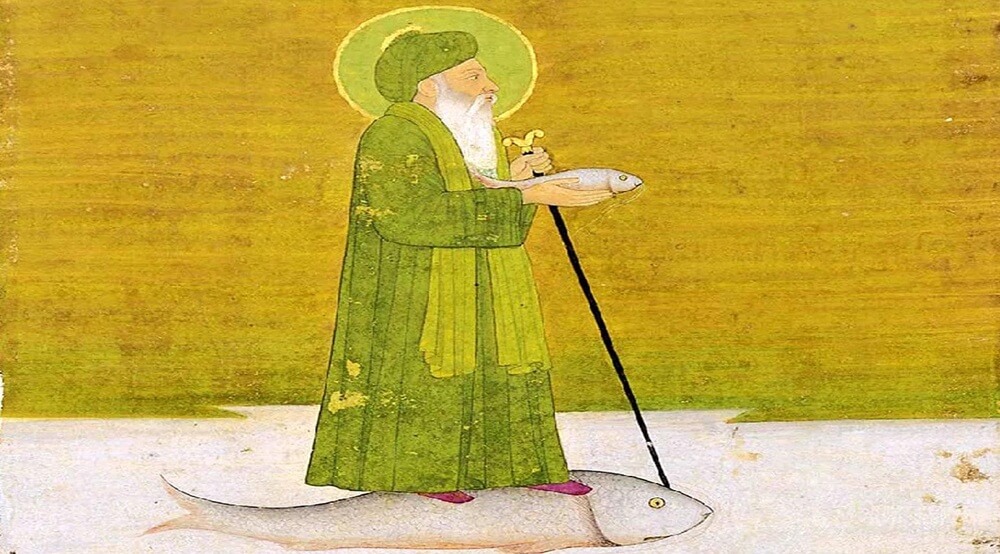
Khidr and the Fish
The Dome of Al-Khidr
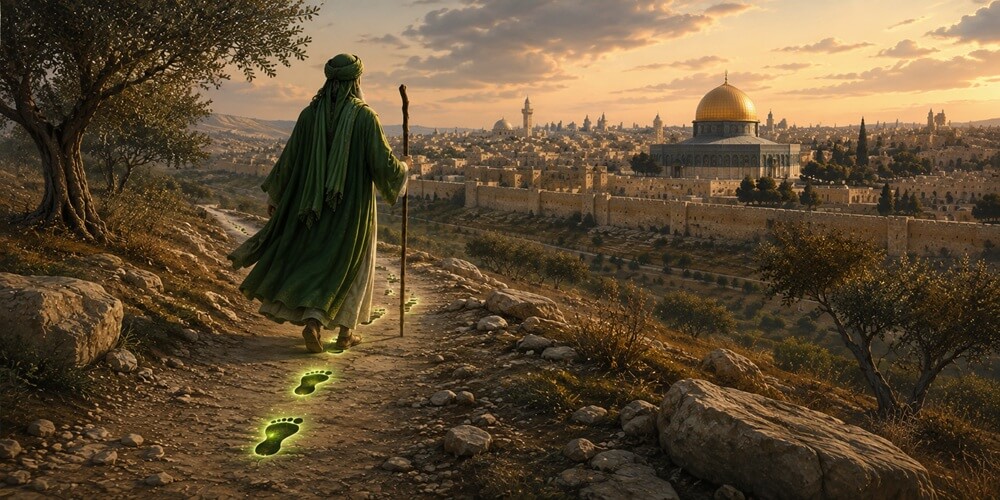
One of the most important hidden saints for Muslims is Khidr—the Green One, the Guide of Souls. He is the saint with the definitive “the,” to whom a dome on the Temple Mount plaza is dedicated. The belief in Khidr is based on a story that appears in the Sūrat al-Kahf (The Cave) in the Qur’an, about a servant of God who was sent to guide Moses in the esoteric teaching. He is a kind of immortal man who can change form, and his sign is that the earth on which he treads turns green. The color green symbolizes the actualization of the life energy—spiritual renewal [6].
Muslim tradition claims that Khidr and Elijah meet once a year and spend the month of Ramadan in Jerusalem. Some identify Elijah with Khidr or Saint George, but mostly they are considered separate people [7]. According to Muslim traditions, before Muhammad ascended to heaven, he received Khidr’s blessing at the spot where the Dome of Khidr now stands on the Temple Mount. Khidr was at Muhammad’s funeral, but no one noticed him; he met ‘Ali at the Kaaba, guided many of the Sufi saints and teachers over the years, and appears before people to this day. I have a Muslim friend who claims that Khidr appeared before him one day while praying in Jerusalem.
According to Indian tradition, there are enlightened people in the world who live forever, and their dwelling place is somewhere in the Himalayas. They are called Rishis and are sometimes described as saints living in caves, sustaining themselves by meditation that sometimes lasts for years. They have understood the supreme truth, and their role is to guide humanity. In the past, they were more involved in worldly affairs, but today only those willing to pay the price can come into contact with them. Similarly, in New Age movements such as Theosophy, there are stories of the Hidden Masters of Central Asia, who guide humanity and are a kind of immortal being.
The traditions of special enlightened people who have attained eternal life and lead and guide humanity are an Indo-European tradition and also existed among the ancient Iranians (Persians). The book Shahnameh by Ferdowsi [8] tells of legendary kings who lived for thousands of years, some of whom did not die but only disappeared and will return when the day comes. In addition, ancient legends tell of the Fountain of Youth, located in a mythological place near a legendary primordial mountain (Mount Qaf), whose waters grant eternal life and wisdom to whoever drinks from them. Ancient Mesopotamian mythology also tells of the hero Gilgamesh, who embarks on a journey of adventure to find the secret of eternal life.
The traditions about enlightened people who live forever found a home in Islam in the figure of Khidr—the guide of souls, who lives forever and can take any form, with his sign being green grass sprouting where he trod. Khidr helps people in distress and guides those who are ready towards the spiritual path.
The figure of Khidr is identified with the figure appearing in Sūra 18 (The Cave) as “one of Our servants,” and so it is told: Moses, the greatest of the prophets in the Qur’an after Muhammad, was limited to the exoteric side of religion—the side of the Law—and was not versed in the esoteric teaching, the mystical side. Therefore, he asked for someone to guide him and went to meet the Servant of God (Khidr) at the meeting place of the two seas: the salt sea and the sweet sea. The salt sea symbolizes ordinary knowledge, the knowledge of the Law, which Moses is versed in and which he could cross at will. The second sea is a sea of sweet water, symbolizing the hidden knowledge—the life-giver and life-changer. In this sea, Moses is still a baby in a box, carried wherever the current takes him.
Thus it is written: “Recall when Moses said to his servant, “I will not give up until I reach the junction of the two rivers, even if it takes me years.” Then, when they reached the junction between them, they forgot about their fish. It found its way into the river, slipping away. When they went further, he said to his servant, “Bring us our lunch; we were exposed in our travel to much fatigue.” He said, “Do you remember when we rested by the rock? I forgot about the fish. It was only the devil who made me forget it. And so it found its way to the river, amazingly.” He said, “This is what we were seeking.” And so they turned back retracing their steps.” (Sūrat al-Kahf 18: 60–64). After Moses returns to that special place, he finds there a person full of knowledge and mercy—Khidr—and he understands that this person was sent to teach him and introduce him to the spiritual world, and therefore asks to be under his patronage.
According to ancient Persian tradition, one of the signs of the Fountain of Youth—or, by another name, the Fountain of Eternal Life—is that if a dead fish is put into its waters, it comes back to life. The fish symbolizes fertility and also spiritual resurrection (and therefore, in the symbol of the sign of Pisces, which is the last of the astrological zodiac, there are two fish pointing in two directions: one toward the manifest world—death—and one toward the hidden world—life). The Fountain of Youth is at the meeting place of the two seas. When Moses and his attendant reach it, the dead fish in their bag comes back to life, but he does not notice it, and only later, when his attendant tells him, do they turn back to look for the place where they were.
When they reach the place, they meet the Servant of God (Khidr), and he is willing to accept him on the condition that he does not try to understand his actions. “Then they came upon a servant of Ours, whom We had blessed with mercy from Us, and had taught him knowledge from Our Own. Moses said to him, “May I follow you, so that you may teach me some of the guidance you were taught?” He said, “You will not be able to endure with me. And how will you endure what you have no knowledge of?” He said, “You will find me, God willing, patient; and I will not disobey you in any order of yours.”'” (Sūrat al-Kahf 18:65–69).
Moses must learn to accept destiny without question. The truth is different from what it seems to him or what he thinks. Moses unknowingly agrees to this condition, but after Khidr does strange things that Moses perceives as morally incorrect (he is the prophet of moral law), he becomes indignant about it, and contrary to their initial agreement, he is not willing to accept the decree of fate simply. Moses largely refuses to come to terms with things—to accept events as they are, to be a Muslim—from the root salama, which means “to submit” or “to surrender,” which is the true meaning of being a Muslim.
Khidr pokes a hole in the boat of poor fishermen, and the boat sinks. Moses is indignant about this. Khidr says to Moses, “Did I not say that you would not be able to have patience with me?” Moses apologizes and asks for another chance, but then Khidr kills a boy, and Moses says, “Have you killed a pure soul for one not [guilty of] killing a soul? You have certainly done a deplorable thing.” Moses is unwilling to accept the death of a person without fault, because the moral law is “Do not murder.” But Khidr is not a murderer, but a Servant of God. In this case, too, Moses apologizes for his judgment and asks for another chance: “If I ask you about anything after this, then do not keep me as a companion. You have certainly reached from me an excuse.”
They continue walking and reach a city of bad people who refuse to feed them, yet Khidr repairs a collapsing wall, as a case of the wicked being prosperous. Moses says, “If you had wished, you could have taken for it a payment,” and by this, he oversteps the bounds and is forced to part from Khidr—but not before Khidr explains the reason for the actions. And so he says:
“As for the boat, it belonged to paupers working at sea. I wanted to damage it because there was a king coming after them seizing every boat by force. As for the boy, his parents were believers, and we feared he would overwhelm them with oppression and disbelief. So we wanted their Lord to replace him with someone better in purity, and closer to mercy. And as for the wall, it belonged to two orphaned boys in the city. Beneath it was a treasure that belonged to them. Their father was a righteous man. Your Lord wanted them to reach their maturity, and then extract their treasure—as a mercy from your Lord. I did not do it of my own accord. This is the interpretation of what you were unable to endure.”” (Sūrat al-Kahf 18: 79–82).
The story of Moses comes to teach us that there is a level of religion that is beyond the normal level of the Law—a path that is beyond good and evil—where everything is one and leads somewhere, where everything works out for the best. This is the mystical path. Khidr has knowledge that stems from the World of Truth, and everything he does stems from this truth. Khidr, like the “Pole of Time,” is able to move through time and foresee the future. He can see what is about to happen and how things happening now will lead to certain results in the future, and he acts on God’s mission according to God’s command and not out of his personal will.
are legends that Khidr was a contemporary of Abraham and wandered with him, or a contemporary of Moses. Some connect him to Alexander the Great’s journey to the East in search of the Fountain of Youth. According to one of the Muslim traditions, at the time Alexander conquered the land, he came to Jerusalem and met Khidr there. He then led him on a journey eastward to find the Fountain of Youth. The connection to Alexander is supported by the fact that in the Sūrat al-Kahf, after the story of the Servant of God and Moses, there is a reference and another story about the Two-Horned One (Dhul-Qarnayn), who ruled the earth, reached its ends in the East and West, and built a wall to prevent the invasions of Gog and Magog until the Day of Judgment: “They ask you, [O Muhammad], about Dhul-Qarnayn. Say, ‘I will recite to you a report about him.’” (Sūrat al-Kahf 18:83). The Two-Horned One is identified with Alexander.
Many of the Sufi shaykhs met with Khidr: ʿAbd al-Qādir al-Jīlānī, Ibn ʿArabī, and others. Similar to Elijah, who teaches the Kabbalists the secret teaching, Khidr is the teacher on the spiritual path—especially for those who follow the Uwaisī way, a path of spiritual and not necessarily physical communication with a teacher. He is the leader—the ruler of the Abdāl (see previous section)—a kind of 36 righteous ones who have metaphysical powers and guard Islam. At their head is the Pole of the Generation, and from this, the Pillar of the World is Khidr, or he is guided by Khidr. Khidr’s role is to lead a person to himself—to recognize the inner divinity within him—and even after death, Khidr is a guide of souls, like Hermes in the underworld.
The Dome of Khidr on the Temple Mount is in one of the northwestern corners of the upper platform, not far from the Dome of the Spirits. The structure is a hexagon with a diameter of 1.5 meters, and it is unclear when it was built—perhaps during the Mamluk or Ottoman period. Beneath it is a space that was previously used as a zāwiya in honor of Khidr, and today there is a legend claiming that Solomon imprisoned the spirits—the jinn—who helped him build the Dome of the Rock there. Muslim tradition sometimes confuses dates and can simultaneously tell two seemingly contradictory stories, and thus Solomon and David are the legendary builders of the Dome of the Rock.
Footnotes:
[1] Grabar, O. (1996). The Shape of the Holy: Early Islamic Jerusalem. Princeton University Press.
[2] Silverman, D. P. (1999). “Jerusalem in Islamic Tradition.” In L. I. Levine (Ed.), Jerusalem: Its Sanctity and Centrality to Judaism, Christianity, and Islam (pp. 141–163). Continuum.
[3] The Book of Jerusalem – The Early Muslim Period 638-1099, edited by Yehoshua Prawer, Yad Ben-Zvi Publishing, p. 47.
[4] Levana, Ofer. 2000. Studies in the Status of Jerusalem in Early Islam: A Collection of Articles. Yad Izhak Ben-Zvi, Jerusalem. p. 87.
[5] Hasson, Isaac. “The Literature of the Merits of Jerusalem in Early Islam.” In: Cathedra – A Quarterly for the Study of the History of Eretz Israel and its Yishuv, No. 15 (1972–1980), pp. 131–150.
[6] Kaplony, A. (2008). Al-Khiḍr in Islamic tradition and in the Holy Land: The meeting point of prophets, saints, and places. Jerusalem Studies in Arabic and Islam, 33, 303–331.
[7] Schiller, A. (Ed.). (1996). Religion and Worship and Muslim Saint Tombs in the Land of Israel (Issue 117-118). Jerusalem: Ariel Publishing House.
[8] Ferdowsi, A. (1992). Shahnameh: The Book of Kings (Eliezer Kagan, Translation, Introduction, and Notes). Jerusalem: Bialik Institute.