The Night Journey
Al-Isrāʾ wal-Miʿrāj (The Horizontal Journey Leading to the Vertical Journey) is a concept in Sufi Islam that refers to the Night Journey of the Prophet Muhammad to Jerusalem, but in fact describes the spiritual journey of a person, which has two main stages: the first is involvement in life, which is on the horizontal plane, and the second is the ascent through the spiritual states toward God, which is on the vertical plane.
Muslim tradition connected the first verse of the Sūrat al-Isrāʾ (The Night Journey): “Glory to Him who journeyed His servant by night from the Sacred Mosque to the Farthest Mosque, whose precincts We have blessed, in order to show him some of Our wonders. He is the Listener, the Beholder” (Sūra 17: Al-Isrāʾ, verse 1), with verses from the Sūrat an-Najm (The Star), which state: “Then He revealed to His servant what He revealed. The heart did not lie about what it saw. Will you dispute with him concerning what he saw? He saw him on another descent, at the Lotus Tree of the Extremity, near which is the Garden of Repose, as there covered the Lotus Tree what covered it. The sight did not waver, nor did it exceed. He saw some of the great signs of his Lord.” (Sūra 53: An-Najm, verses 10–18), into a single narrative: One night, the Prophet Muhammad ascended upon a miraculous creature called al-Burāq, which had the body of a horse, the wings of an eagle, and the face of a beautiful woman, and rode it to Jerusalem. There, he met the prophets who preceded him, received their blessing, and ascended from the Foundation Rock to the spiritual heavens—through the seven heavens—to meet God and receive the commandment of Muslim prayer from Him. The place where he met God can be called the “Eighth Heaven,” symbolized by the octagon, but it is not exactly a place, nor exactly a heaven, but something that is beyond time and space.
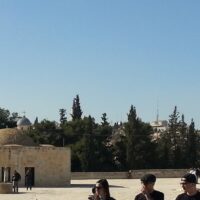
The narrative of the Night Journey first appeared in the early biography of the Prophet Muhammad by Ibn Isḥāq in the mid-8th century [1], but there is a basis for the assumption that the tradition is older and existed already at the time of the construction of the Dome of the Rock in the late 7th century. Many of the structures on the Temple Mount plaza, such as the Dome of Joseph and the Dome of Gabriel, are connected to this tradition, and it is likely that, to a large extent, the Dome of the Rock itself is a symbolic architectural expression of the Night Journey.
The Qur’an has many mentions of the seven heavens through which the divine command descends. In Sūra 65, verse 12, it is written: “It is Allāh who created seven heavens and from the earth the like of them. [His] command descends among them so you may know that Allāh is over all things competent.” In Sūra 41, verse 12, it is stated: “And He completed them as seven heavens within two days and inspired in every heaven its command. And We adorned the nearest heaven with lamps and as protection. That is the determination of the Exalted in Might, the Knowing.”
The concept of seven heavens between us and God is pre-Islamic and common to Judaism, Gnostic Christianity, the mystery cults of the ancient world, Hermeticism, Neoplatonism, and others.
According to a hadith transmitted by Mālik ibn Anas, when Muhammad came to Jerusalem on the Night Journey, he met the Angel Gabriel there and received a blessing from him [2]. Gabriel tested him, and after he chose correctly (a cup of milk), they ascended through the seven heavens, and in each heaven, they met a prophet: in the first, Adam; in the second, Jesus and John; in the third, Joseph; in the fourth, Idrīs (Enoch); in the fifth, Aaron; in the sixth, Moses; and in the seventh, Abraham, with the angels surrounding the heavenly Kaaba. Beyond the seventh heaven is the miraculous Lote Tree, and above it, the Glory of God. God revealed the secrets to Muhammad and commanded him to perform the prayer—initially 50 times a day, but after a short negotiation with the help of Moses, five times a day. In other words, in Jerusalem, a connection occurs between Muhammad and the chain of continuity of human spirituality, and he becomes the New Man.
The sanctity of Jerusalem in Islam stems from the tradition of the Night Journey—Al-Isrāʾ wal-Miʿrāj—but for the Sufi mystics, the Night Journey of the Prophet Muhammad has a deep meaning related to the spiritual journey as such. A large part of the Sufi terminology regarding the mystical experience and their interpretation of the spiritual path is connected to this journey. In other words, the turning point from an earthly life to a spiritual path, and the mystical experience that results from it, are described in terms of Al-Isrāʾ wal-Miʿrāj. The Night Journey symbolizes a turning point in life arising from the completion of one type of journey—the earthly one—and the beginning of another type of journey—the spiritual one.
The secrets of the Night Journey of the Prophet Muhammad are many. One of them is that prayer can serve as a gate through which we pass from a horizontal journey—existence in this world—to a vertical journey and to union with God. The mystic discovers this secret in the postures of prayer, which connect standing—a vertical state—with prostration—a horizontal state. The question is: what can cause us to pass from one type of journey to another?
Various Sufis throughout history have tried to answer this question. Thus, al-Bisṭāmī says: “I stood with the righteous, and I found no progress with them. I stood with the warriors for the cause, and I found not a single step of progress with them. I stood with those who pray much and those who fast much, and I did not progress a single step. Then I said, ‘O Allāh, what is the way to You?’ And Allāh said, ‘Leave yourself and come.’”
It is is worth mentioning in this context that because Jerusalem is the place of the Night Journey, during which the Prophet Muhammad experienced a unique encounter with God, it became a holy city for Islam—not only in a religious-legal sense but also as a center for mystics and Sufi orders. It is a place where one can complete the earthly journey and begin another type of journey centered on the mystical experience. For this reason, Jerusalem was the first place where Sufi mystics, such as al-Bisṭāmī (see below), reached the degree of annihilation and resurrection in God—in Arabic, fanāʾ and baqāʾ.
Phenomenologically, the story of Al-Isrāʾ wal-Miʿrāj (the Night Journey) involves a transition of dimensions and planes—what Eliade calls the Axis Mundi and the hierophany of the sacred within the profane. In addition, the Night Journey involves an act of complete surrender to God—islām to a power greater than ourselves—which leads to an experience of the sacred, as William James describes in The Varieties of Religious Experience: “A sense of a friendly continuity between the ideal power and our own life, and a voluntary surrender to its sway,” which is followed by “a tremendous lightening and a great sense of freedom when the cramped walls of the ego fall down” [3].
walks the path of the world in his life—career, studies, family, society—this is the horizontal journey, the whole catastrophe, as Zorba the Greek put it. We all have to go through it, and we are all in it at any given moment of our lives. But there are people who complete this journey, whether willingly or by necessity, and begin to seek answers to life’s questions in other places. They begin another type of journey—a vertical journey in the realms of the spirit—and there are those who remain on the earthly plane all their lives.
Some people reach a wall, an obstacle from which it is impossible to continue and move forward, and all that remains for them is to change direction: to descend or to ascend. Those who choose to ascend begin the vertical journey. Often the turning point is connected to a surprising event, an unexpected encounter—usually with a teacher (shaykh) who, through his being, essence, and sometimes the “miracles” he performs, changes the lives of those walking the horizontal journey and causes them to “change direction.” Sometimes the turning point is connected to an encounter with a place—and many times it is Jerusalem.
The Dome of the Rock
This magnificent building stands over the Rock—which is the center of the world, the place of the world’s creation according to Muslim tradition (they adopted the Jewish narrative). It is also the place from which Muhammad ascended to heaven through the seven spheres, and the plaza surrounding the building is the place of the Day of Judgment.
Beneath the Foundation Rock lies the Cave of the Spirits, connected to the underworld. Muslim belief holds that the souls of the dead await the Day of Judgment there. On the surface of the Rock, Muhammad’s footprint is visible, and above the Rock, the Dome is spread, symbolizing the heavens through which he ascended. Thus, there is a vertical physical connection of three elements relating to the world beneath the surface (both physical and underworld), the earthly world, and the heavenly world—and thus the Rock in the Dome of the Rock becomes an Axis Mundi.
With the Muslim conquest of Jerusalem, Caliph ʿUmar ascended the Temple Mount, cleaned the plaza—which the Christians had deliberately left in ruins as testimony to the truth of Jesus’ prophecy—and erected a modest wooden mosque in the place of, or near, the present-day Al-Aqsa Mosque. The first mosque was very humble, similar to the mosque Muhammad built in Medina. Because the Prophet said that a mosque must be modest, similar to Moses’ Tabernacle tent, the original mosque was built of wooden planks and essentially looked like an open courtyard. But this mosque was destroyed, and we do not know its exact location.
Fifty years later, the Umayyad Caliph ʿAbd al-Malik decided to build a magnificent structure on the empty Temple Mount plaza. To justify his endeavor, he used the tradition of the prophetic words of Kaʿb al-Aḥbār, a Jewish convert to Islam who was an advisor to Caliph ʿUmar, which states: “Be glad, Jerusalem, and it is the Temple and the Rock, and some call it the Sanctuary. I will send My servant ʿAbd al-Malik to you, and he will build you and adorn you. And I will return to Jerusalem its rule as it was at first, and I will crown it with gold and silver and pearls. And I will send My creations to you and set up My Throne of Glory on the Rock, and I am the Sovereign God and David the King of the Children of Israel” [4].
Islam in its early stages was still unformed and similar in spirit to Judaism; therefore, many Jews—both converts and non-converts—saw the construction of the Dome of the Rock as a “sign of the beginning of the Redemption.” After its establishment and for two hundred years, a Jewish family was involved in maintaining the Dome of the Rock—an unprecedented event in Muslim history. Mujīr ad-Dīn writes: “Jewish attendants who were exempt from the poll tax, whose number was initially ten and later rose to twenty, for the cleanliness and purification of the mosque,” and “a group of Jewish attendants who made the glass and the lamps and the cups and the large lamps and other things” [5].
Initially, Jews were given the right to pray in or near the Dome of the Rock building, but over time, the Muslims distanced them from the place, and they were forced to move their place of prayer to another, more secluded location on the Temple Mount. However, during the time of Caliph al-Maʾmūn, in the first half of the ninth century, even this was denied to them, and they were completely expelled from the Temple Mount compound.
Fifty-two years after Muhammad’s death, at the time of ʿAbd al-Malik, in 684, the Muslim Caliphate was torn by internal struggles. The cities of Mecca and Medina revolted against the legitimate rule of the Umayyad Caliphs and declared ʿAbd Allāh ibn al-Zubayr as their leader. Al-Yaʿqūbī writes: “Then ʿAbd al-Malik forbade the people of Syria from going to Mecca, because Ibn al-Zubayr was forcing the pilgrims to swear allegiance to him… But the people complained to him, asking how he dared prevent them from making the pilgrimage to the House of God, and ʿAbd al-Malik replied to them: ‘Has it not been said by the Messenger of Allāh (Muhammad) that a person should make the pilgrimage to three places: to the mosque in Mecca, to the mosque in Medina, and to the mosque in Jerusalem? And this Rock upon which the Prophet placed his footprint shall be for you instead of the Kaaba.’ And then ʿAbd al-Malik built a dome over the Rock and hung curtains there, and the people used to circumambulate the Rock, and this custom continued throughout the days of the caliphs” [6].
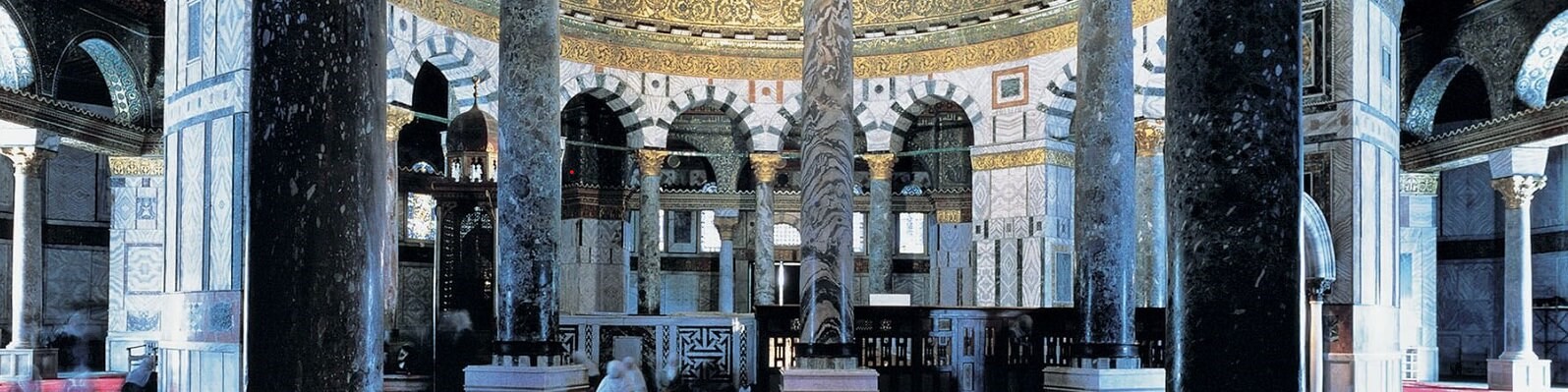
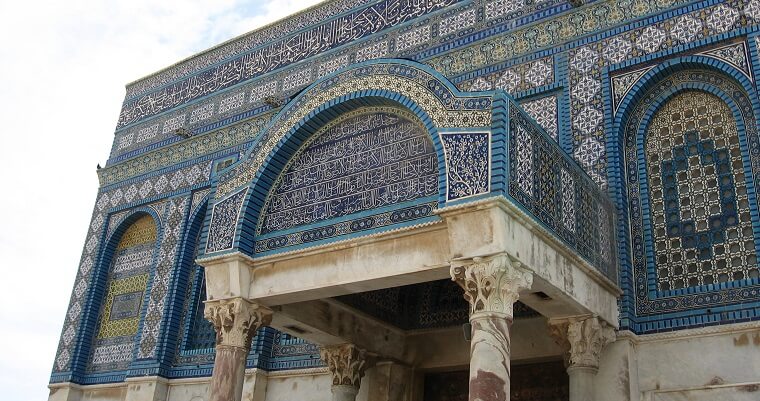
According to Rosen-Ayalon [7], the essence of the structure is revealed through its decorations—the inscriptions, mosaics, marble slabs—and the connection between them. The Dome of the Rock has an architectural formula: a systematic use of a specific unit, a decorative scheme, a complex and sophisticated conception, and an overall iconographic connection. The interior of the building was covered with a variety of decorative techniques, relating both to one another and to the building itself. The result is a harmonious and beautiful structure, thus fulfilling one of James’s characteristics of holiness: “The emotional center’s shift into the realm of harmonious and affectionate feelings, from the ‘No’ to the ‘Yes’” [3].
When Muhammad reaches the heavens, he meets the Lote (Emerald) Tree in Paradise, laden with precious stones, and therefore one of the main motifs in the building’s decorations is plants—especially trees—with gems on them. The decorations include floral rosettes, unfolding floral scrolls, plant shoots, heavenly trees, plants emerging from amphorae, and also wings with a kind of crown shape above them—winged creatures whose origin is probably in the Persian artistic tradition. Altogether, they create a kind of mystical forest, reminding us of Paradise.
The light penetrating through the colored windows creates a feeling of Paradise, and it is reinforced by symbols that were understood by the believers at the time. One of them is baskets with flowers, representing the good deeds of man with which he stands before God on the Day of Judgment. The tree with the gems symbolizes the Tree of Life in Paradise.
According to ancient Gnostic literature (The Apocalypse of Zephaniah, as quoted by Clement of Alexandria), the angels in Paradise have crowns on their heads, and this explains the crown decorations in the Dome. Another decoration is wings, which probably represent angels. One of the striking features of the building is the sawn marble. In the Hekhalot literature, it is told of four who entered the Pardes (orchard/paradise), and in the sixth palace they saw a kind of waves of flowing water against them—but it was actually marble: “And they entered the sixth palace, and there was a great light like crashing waters, and waves against them—and they were afraid. And the angel said to them: ‘Do not fear, these are not water, but marble shining like water'” (Hekhalot Rabbati). Thus, the marble in the Dome of the Rock creates a feeling of flowing waves, and it hints at the ascent through the heavens.
The extraordinary art revives the building and introduces a numinous spiritual component into it. The mosaics, for example, were made of real gold so that they would sparkle in the light and thereby become a kind of living jewelry—sparks of spiritual light. Like the Temple that stood there before it, the Dome of the Rock structure reflects a heavenly archetype, and the gold in this case is connected to the sun and the divine power behind the sun. The beauty is expressed in the materials, but also in the composition of the colors, in the geometry, in the proportions, in the symbols, in the orientation, and in the architecture. The beauty is also expressed in the completeness of the building and its connection to the environment. According to Grabar [8]: “The special completeness of this building and its rare beauty were achieved not only by the decorations, which are a masterpiece, but also by the building plan, which is made with perfect symmetry and proportions.” All this affects us through archetypes that exist in our perception.
The structure represents the state of Paradise through its decorations and the extensive use of motifs of gems—especially plants—and yet it also contains openings to Hell: a nearby room where the demons were imprisoned (beneath the Dome of the Spirits), and a place where the deeds of human beings will be weighed on the scales on the Day of Judgment. This is the place where the world was created, but also where it will reach its end, and existence will begin in another way [9].
Although the Dome of the Rock is identified today mainly with the Night Journey, its essence at the time of its establishment was the possibility of reaching eternal life and returning to the state of Paradise, whose characteristic feature is beauty. According to Muslim mysticism, God has 99 names—half of which are related to Power, which is the immanent movement from top to bottom, and half of which are related to Beauty, which is the transcendent movement from bottom to top. It can be said that the Dome of the Rock is a place of transition between dimensions—between the world of the living and the world of the dead, between the world of the future and the world of the past. It was built to evoke a sense of holiness in the visitor and activate high religious feelings, as evidenced by the diaries of pilgrims throughout the generations. The design of the structure was so successful that it became a model for imitation in Europe throughout the Middle Ages.
Colors
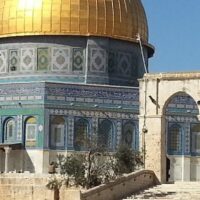
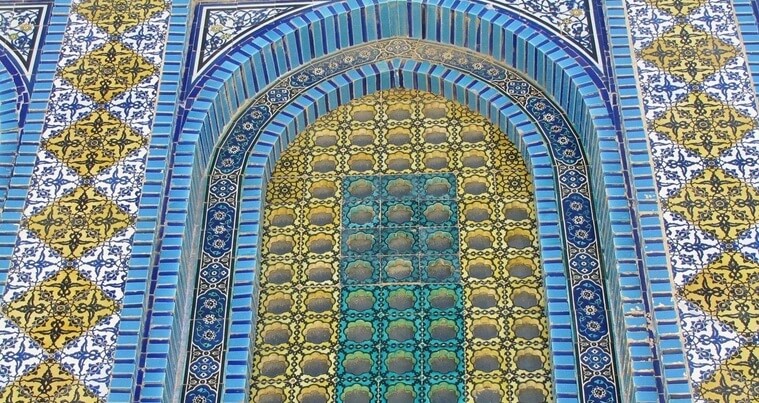
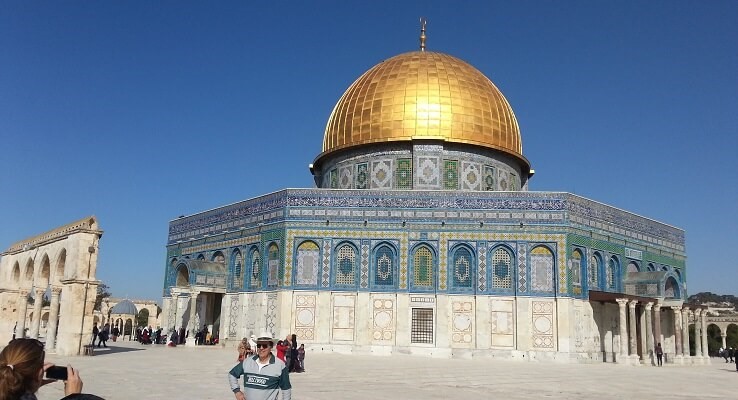
A prominent aspect of the Dome of the Rock’s beauty is its colors. The original color of the dome was gold, and that of the structure was blue; these are two colors that complement each other and fit perfectly within the landscape context of the Dome of the Rock in Jerusalem. Throughout history, there were periods when the gold disappeared and the dome was black. However, today the colors are similar to the original ones and remind us of the sun in the sky.
It is possible that the reason for choosing the “sun” colors is related to the fact that this is the place from which Muhammad ascended to the heavens through the seven spheres. These were perceived as corresponding to the seven stars that move in the sky: the Sun, Moon, Mercury, Venus, Mars, Jupiter, and Saturn—with the most important of them, and the one that causes the whole system to move, the seat of the Logos, being the Sun. Thus, we have the appearance of yellow (gold) and blue as representing divinity in ancient Egypt—the color of the god Amun-Ra (as appears in the burial mask of Tutankhamun)—and in Mesopotamia, colors that appear in the temples of the gods at the tops of the seven-stepped ziggurats.
The connection of the Dome of the Rock to the sun also appears in its orientation. The structure of the Dome of the Rock is oriented toward the cardinal directions. To its east lies the highest peak in Jerusalem—the Mount of Olives—and if one continues the line connecting the summit of the Mount of Olives and the Dome of the Rock, one reaches the location of the Church of the Holy Sepulchre. This line is considered the main energetic line of Jerusalem and is called the Messianic Line. The Dome of the Rock also relates to it in its proportions—the diameter of the Dome of the Rock is 20 meters, which is identical to the diameter of the dome of the Church of the Holy Sepulchre, located exactly to its west. In the past, there was also a similar structure on the summit of the Mount of Olives. The sun that rises exactly to the east of the Dome of the Rock, above the Mount of Olives, is reflected in the colors of the building and in the dome that catches the first sunrays and disperses them throughout the city.
The combination of yellow and blue also has a psychological and artistic effect. According to the famous art critic Kandinsky [10], the warmth of a color is its tendency toward yellow, and the coolness of a color is its tendency toward blue. Yellow and blue create the first great contrast, which has a dynamic nature. Yellow has a sharp and angular eccentric movement, and blue has a circular concentric movement. A yellow surface appears to approach the viewer, and a blue surface appears to recede from him. “Yellow” is more material and earthly, and its power can be painful and aggressive. Blue is typically a heavenly color that usually instills deep tranquility. The mixing of yellow with blue creates a quiet movement, and the result is peace, calm, and serenity. However, the combination of these colors in Jerusalem’s architecture is rare—and in this case, also perfect—and it attracts the eye and moves the viewer to another plane. One can only imagine what would happen if the color of the dome were green, as appears in other mosques; without entering into a value judgment, aesthetically there would be a flaw.
The colors of the Dome of the Rock can also be interpreted symbolically. According to Bennett [11], gold in Islam is the color of knowledge—the knower is none other than the known. Muslim tradition tells of gold and precious stones in Paradise, as does Jewish tradition. In addition to the external light, there is also internal light: colored windows let in mystical light in shades of blue, green, and yellow.
Sacred Geometry
According to Bennett [11], the Dome of the Rock was built as a temple and not as a mosque, and one must wonder why. The answer he gives is that the structure is an archetype of the spiritual journey and a model for Islamic mysticism. The octagonal structure symbolizes the first stage of the spiritual journey, which is the acquisition of the eight good qualities—these are the Throne of Glory of God, held by the angels and through which holiness can appear. The Dome symbolizes the heavens, which represent the second stage of the spiritual journey—the mystical experience. The square, or the Rock in this case, symbolizes the earth—the earthly. The combination of the square, the circle, and the octagon represents the Complete Man (the archetype of the Spiritual Man—a term in Muslim mysticism), who appears in the figure of Muhammad.
Geometrically, the uniqueness of the structure is that it reflects the measurements of the dome. The dimensions of the octagonal structure are derived from the continuation of the two squares that enclose the dome. That is, closing the circle of the dome with two squares and extending their lines will create an octagonal star with the dimensions of the building. Thus, the three stages of the spiritual path—earthly, psychic, and spiritual—appear in the architecture of the structure. The combination of the square and the circle in one structure reminds us, of course, of Jung’s reference to mandalas composed of a square and a circle as an expression of the Self. Jung describes the Philosopher’s Stone as the “squaring of the circle” (Tractatus aureus) [12], and thus the structure is a geometric expression of the connection between opposites.
The scholar Karen Armstrong agrees with this approach [13]. According to her, the square Kaaba in Mecca symbolizes the earth, and around it people walk in circles symbolizing completeness. In the Dome of the Rock, there is an octagon, which is the first step out of the stability of the square. Inside the octagon is the circle of completeness, which is the place to strive for. The structure symbolizes the end of one type of journey—the earthly one—symbolized by the horizontal vector, and the beginning of another type of journey—the spiritual one—symbolized by the vertical vector. The Dome symbolizes the ascent through the seven spheres (the seven stages in the spiritual journey) to heaven, and it can also be said to represent a connection between opposites.
According to Rosen-Ayalon [20], “The Dome of the Rock in particular, and the Temple Mount complex in general, came to symbolize the navel of the world—Omphalos—where the Tree of Life grows, the Axis Mundi of the world. The plan of the complex reflects pre-Islamic influences, but mainly the conceptions and beliefs related to Paradise, the Day of Judgment, and the Resurrection, which were transferred from Christianity and Judaism to Islam. The Rock is the center of the complex, just as the Rock was the center of the Church of the Holy Sepulchre.”
The Dome of the Rock expresses the belief in the existence of a kind of intermediate entity between this world and the hidden divinity, which is the Throne of God (similar to the Shekhinah in Judaism). This belief is based on verse 255 in Sūra 2 (The Cow) of the Qur’an, where it is stated that “His Kursī (Footstool/Throne) extends over the heavens and the earth.” This verse is engraved in its entirety at the top of the dome, which indicates that the structure—or at least the dome—was perceived as a kind of Throne of God, a place of Shekhinah, the manifestation of God in this world.
Graphically, in the center of the dome there is a small blue circle set against a gold background, from which the geometric decorations branch out. This is the center of the world—a point of meditative concentration within the mandala that is the dome—which, in its colors (a reversal of blue and gold), symbolizes a spiritual sun. According to Yitzhak Hayut-Man [14], at the top of the dome is a circular inscription containing the “Verse of the Throne” from the Qur’an. The concept of the heavenly Throne in Islam is similar to what the Prophet Ezekiel saw in his vision when he entered and exited the Temple—a vision later called the “Vision of the Chariot.” Placing this verse above the heads of the figures declares that the “Sanctuary of the Dome of the Rock” is the heavenly Throne, constituting the Throne of the Divine Judge on the “Day of Judgment.”
In addition, the Qur’an contains allusions to various motifs related to the Dome of the Rock, such as the Rock (Sūrat al-Kahf 18:63); the Blessed Land (Sūrat al-Māʾidah 5:21; Sūrat al-Anbiyāʾ 21:71); the Ascension to Heaven (Sūrat an-Najm 53:1–17); David and Solomon (Sūrat Ṣād 38:30, 35); and more.
In the center of the dome’s ceiling is an exceedingly complex circle, based on the symmetry of 16 and 32 figures, with three circles symbolizing the metaphysical division of Spirit, Soul, and Psyche, between which 32 “paths of wisdom” meander. The dome is full of subtle shapes intertwining and creating more and more rings of expansion, and it seems as if there is something alive and bubbling there—perhaps the leakage of divine vitality from the central point to the multitude of forms in the universe. In our time, the painting can be interpreted as belonging to the family of fractal images created by computer enlargements of places within the “Mandelbrot set,” creating a feeling of floating and diving into infinite spaces.
The Dome of the Rock is a kind of microcosm of the world—what is called the “image of the world”—and this is expressed by the fact that the structure represents both heaven and earth. Its dimensions and geometric proportions make it a perfect structure, combining a circle, a square, and an octagon, which relate to one another. According to Bennett [15], the square or the Rock symbolizes the earthly, and the octagon the first stage of the spiritual journey. Geometric shapes are part of the symbolism of Muslim mysticism; they reflect the worlds of archetypes and divine intelligences, as the origin of mathematics lies in the worlds of the angels.
Many secrets are hidden in the structure of the Dome of the Rock, some of which are revealed in the hidden proportions that exist within it. For example, the height of the dome’s base is equal to its diameter, which reflects the dimensions of man, where the distance from outstretched hand to outstretched hand is equal to the person’s height, as can be seen in the famous drawing of the Vitruvian Man. Another example: the height of two isosceles triangles—each side of which equals the diameter of the dome—is equal to the height of the structure. Yet another: the width of the outer corridor of the octagon is one-third of the diameter of the dome, while the height of the central columns is exactly one-third of the height of the dome’s summit (forty meters). And so on.
The proportions of two-thirds and one-third appear in the human body and also in our perception—they are considered harmonious in art. Even if one does not consciously notice these relationships, they affect us positively and evoke the aesthetic experience and, subsequently, the experience of holiness.
Furthermore, according to Jung [16], the combination of a triangle, a square, and a circle creates the Philosopher’s Stone: “Make a circular circle from a man and a woman, produce a square from it, and a triangle from within it. Circle the circle, and thus you will obtain the Philosopher’s Stone, the Rose of the Philosophers” (Rosarium Philosophorum). Indeed, the combination of the hidden geometric shapes in the architecture of the Dome of the Rock turns it into a kind of Philosopher’s Stone, supporting the attribute of the Dome of the Rock as a place of connection between worlds—the place from which the world was created, and the place from which Muhammad ascended to heaven.
The Dome of the Rock is an almost perfect structure in terms of its sacred measures and sacred geometry—so much so that some say it is the Temple to which the Freemasons refer, and that the David and Solomon of the Freemasons are Abu Daoud and Salman, two of the architects of ʿAbd al-Malik’s temple [17]. First, David and Salman surrounded the Rock with twelve columns and four piers supporting the dome. The dome rests on a circle of columns whose dimensions equal the smallest circle that can be drawn around the Rock. Around this inner circle is another circle of sixteen columns and eight piers supporting the octagon located beneath the dome and rising toward it, and around this circle is yet another circle—the walls of the octagonal building—with four openings toward the four cardinal directions. The three circles symbolize the stages of the world’s formation and the map of the world as it was perceived then: in the center is the Foundation Rock and Jerusalem, around it the land, and around that the ocean—the sea.
This is reminiscent of the Jewish tradition, which likens the world—with Jerusalem at its center—to the pupil of a human eye: the dark part, the iris, represents the rest of the world, and the white part, the ocean. “Jerusalem is in the middle of the world, and it is like the pupil of the eye, from which light goes out to the whole body” (Yalkut Shimoni, Ezekiel, Siman 345).
From an artistic perspective, the Dome of the Rock is an almost perfect structure as well. The abundance of arches and columns, and their special arrangement, create an illusion of depth and space that infinitely surpasses the actual size of the structure. “The central ring of supports was shifted by about three degrees during construction to increase the viewing space, thereby allowing both the nearby columns and the most distant ones to be seen simultaneously” [18].
The Dome of the Rock in Relation to its Surroundings
The Dome of the Rock relates to the other structures on the Temple Mount plaza: the total diameters of the six small domes in the structure of the Gate of Mercy are equal to the diameter of the Dome of the Rock’s dome, while the diameter of the dome in the nearby Al-Aqsa Mosque is half the diameter of the Dome of the Rock’s dome [19]. I am sure there is also a connection between the volume of the Dome of the Rock and that of the Al-Aqsa Mosque and the other buildings on the plaza, but this topic has not yet been investigated.
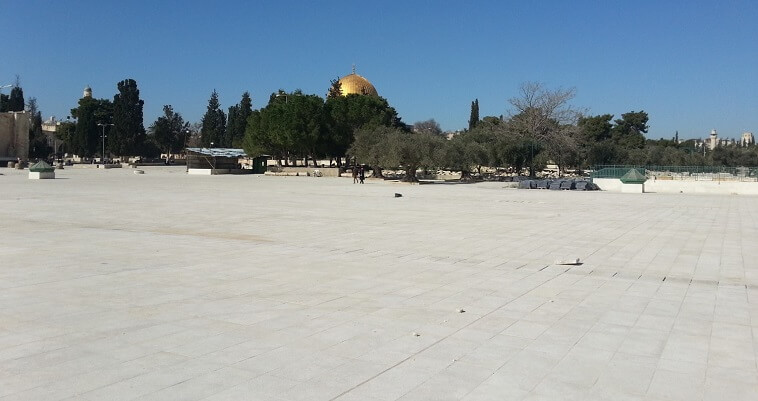
The Dome of the Rock is located on the large artificial plaza of the Temple Mount, upon which an elevated platform stands, supporting the structure and other auxiliary buildings. The elevated plaza is reached by eight flights of stairs, each ending in free-standing arches. There is significance to the directions and numbers of the arches, and also to the numbers and directions of the stairs, as part of the overall complex. They create a kind of invisible boundary whose effect is stronger than that of a built boundary. The architectural components of the complex create a gradation of holiness—beginning with the plaza itself, continuing through the inner plaza, followed by the two ambulatories (corridors and arches) inside the structure, and culminating in the Rock and the Dome above it, which are the heart of the matter. Thus, a kind of image of the world is created.
Generally, the Temple Mount complex has two axes connecting the central monuments: one running north–south and the other east–west. On the east–west axis are the main western flight of stairs, the eastern flight of stairs, and the five arches at its end, which are unique in their number (five—not found anywhere else), along with the Dome of the Chain. On the north–south axis are the Dome of the Rock and the Al-Aqsa Mosque, with a flight of stairs between them leading to the upper plaza. The axis continues to the Hulda Gate in the southern wall and the Umayyad Palace structures.
According to Rosen-Ayalon [20], the Dome should be viewed as part of a larger and more complex system, including the entire plaza and even the nearby Umayyad palaces—the result of ʿAbd al-Malik’s planning in the late seventh century. Each of the structures on the plaza is connected to a specific component and can only be understood by analyzing the meaning and interpretation of its iconography in relation to the others, as dramatic relationships exist between the various components.
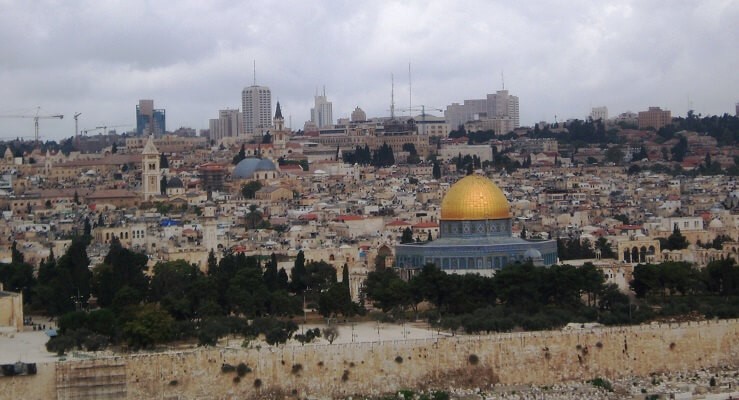
The Dome of the Rock relates not only to the Temple Mount plaza but also to the entire valley and surrounding landscape in which the Old City—the Holy Basin—lies, thereby creating something distinct from the seemingly “ordinary” landscape. It is located at the center of the intersections of the lines of sight from the surrounding mountain peaks. The octagonal structure was built in harmony with the surrounding peaks and viewpoints. Each side of the octagonal building faces one of the eight peaks encircling the valley of Jerusalem, at the center of which stands the Dome of the Rock. In other words, the meeting point of the intersecting lines connecting the eight peaks surrounding the Dome of the Rock (for example, the line connecting Mount Scopus to Mount Zion) is located at the Dome itself [21]. The arches and stairs—which also have a similar function—are positioned in accordance with this alignment.
Furthermore, the viewing space from the Dome of the Rock—and toward the Dome of the Rock—is especially wide and encompasses a large part of the city. The Dome of the Rock dominates the city’s landscape and constitutes the main central point in the panorama unfolding before the eyes of anyone gazing at Jerusalem—the Axis Mundi within the unique landscape of the Holy Basin [22], the point of stillness within the surrounding noise.
And the view from the Dome of the Rock is equally remarkable: as soon as one ascends to the elevated plaza, the circular shape of the surrounding mountains is revealed. This view is not fully visible from the lower plaza of the Temple Mount, but only from the upper one, and it gives the impression of an amphitheater. There is a topographical and geographical circle oriented toward the east—the Mount of Olives, the highest mountain in the area, the place from which the Messiah will come and the Redemption will begin according to Muslim tradition, the place of the Day of Judgment, the place from where the sun rises.
Solomon and David
According to Muslim tradition, Solomon rules over the demons and the world beyond:
“So We placed the wind at his service, blowing gently by his command, wherever he directed. And the demons—every builder and diver—and others fettered in chains. ‘This is Our gift; so give generously or withhold, without account.’” (Sūrat Ṣād 38:36–39).
There are several buildings north of the Dome connected to him: the Dome of the Spirits, the Dome of al-Khidr (where Solomon imprisoned the demons), Solomon’s Throne (where Solomon sat watching the demons even after he died), and the Dome of Solomon (where Solomon offered his famous prayer after the dedication of the Temple).
The Northern Gate of the Dome of the Rock is called the Gate of Paradise. Inside the building near this gate there was once a black tile that the Arabs claimed covered an opening leading to Paradise. The tile was called Balāṭat al-Jinna—the Tile of Paradise—and had cross-shaped nails on it. It was also considered to cover the tomb of King Solomon. In the past, people used to enter the Dome of the Rock from the north. However, the main entrance today is from the west, and the door is closed; consequently, the gates of Paradise are also closed. The Northern Gate is also called the Gate of the Shofar, because the angel will sound the shofar there to announce the Day of Judgment. Above the door is the inscription: “Indeed, those who fear Allāh… will be led to Paradise.” Opposite the entrance, a few steps away, is a bench facing south with seven prayer niches that Muslims attribute to the seven heavens.
According to Muslim tradition, David is connected to the Day of Judgment and will be the judge of souls at that time. Thus it is written: “So We gave him understanding of the case; and to each [of them] We gave judgment and knowledge” (Sūrat al-Anbiyāʾ 21:79). “O David, indeed We have made you a successor upon the earth, so judge between the people in truth…” (Sūrat Ṣād 38:26).
The gate on the eastern side of the Dome is called the Gate of King David, and next to it is an entrance to Hell—the place where the guilty will be thrown. The Hebrew tradition claims: “There are three entrances to Hell—one in the desert, one in the sea, and one in Jerusalem” (Tractate Eruvin 19). Muslim tradition adopted the Jewish narrative and states that on the Day of Judgment, the Angel Raphael (each of the four main angels is connected to one of the four cardinal directions) will gather the believers in the Valley of Jehoshaphat opposite. David will sit at the eastern gate of the Temple Mount and judge the people. Another tradition says that this will be under the Dome of the Chain, east of the Dome of the Rock—a beautiful structure with columns, from which a chain will hang, upon which the scales of the Day of Judgment will be suspended.
According to Muslim tradition, David will be the judge of souls at the Day of Judgment. Thus it is written: “So We gave him understanding of the case; and to each [of them] We gave judgment and knowledge” (Sūrat al-Anbiyāʾ 21:79). “O David, indeed We have made you a successor upon the earth, so judge between the people in truth…” (Sūrat Ṣād 38:26).
Footnotes:
[1] The original text did not survive but appears in the quotes of later writers such as Ibn Hishām.
[2] Reiter, Yitzhak. From Jerusalem to Mecca and Back: The Muslim Consolidation Around Jerusalem. Jerusalem: Jerusalem Institute for Israel Studies, 2005.
[3] James, William, The Varieties of Religious Experience: A Study in Human Nature, translated by Yaakov Kopelivitz, Jerusalem: Bialik Institute, 1949.
[4] Levana-Kafri, Ofer. (2000). Studies in the Status of Jerusalem in Early Islam: A Collection of Articles. Jerusalem: Yad Ben-Zvi. p. 15.
[5] Schiller, Eli, The Dome of the Rock and the Foundation Rock, Jerusalem: Ariel, 1976.
[6] al-Yaʿqūbī, Kitāb al-Buldān.
[7] Rosen-Ayalon, Myriam, The Early Islamic Monuments of al-Haram al-Sharif: An Iconographic Study, Jerusalem: The Institute of Archaeology, The Hebrew University of Jerusalem, 1989.
[8] Grabar, O. (2006). The DOME of the Rock. Harvard University Press.
[9] Grabar, O. (1996). The Shape of the Holy: Early Islamic Jerusalem. Princeton University Press.
[10] Kandinsky, W. (1972). Concerning the Spiritual in Art: Especially in Painting (S. Shichor, Trans.) [Studies in Art and its History]. Bialik Institute.
[11] Bennett, Clinton, “Islam,” in Jean Holm and John Bowker (eds.), Sacred Place, London: Continuum, 1998, pp. 88–114.
[12] Carl Gustav Jung, Psychology of the Unconscious, translated by Haim Isaac, Tel Aviv: Dvir, 1987.
[13] Armstrong, Karen, “Sacred Space: The Holiness of Islamic Jerusalem,” Journal of Islamic Jerusalem Studies 1 (1997), pp. 5–20.
[14] Hayut-Man, Yitzhak: Three Religions in One Dome. Aherim Hayim Monthly, September 2000.
[15] Bennett, Clinton, “Islam,” in Jean Holm and John Bowker (eds.), Sacred Place, London: Continuum, 1998, pp. 88–114.
[16] Jung, C. G. (2005). Psychology and Religion (Yoav Sapir, Trans.; Yosef Schwartz, Scientific Ed.). Tel Aviv: Resling, p. 88.
[17] Hayut-Man, Yitzhak: Three Religions in One Dome. Aherim Hayim Monthly, September 2000.
[18] Schiller, Eli, The Dome of the Rock and the Foundation Rock, Jerusalem: Ariel, p. 11.
[19] Rosen-Ayalon, The Early Islamic Monuments of al-Haram al-Sharif, p. 34.
[20] Rosen-Ayalon, Myriam, The Early Islamic Monuments of al-Haram al-Sharif: An Iconographic Study, Jerusalem: The Institute of Archaeology, The Hebrew University of Jerusalem, 1989.
[21] Schiller, Eli, The Dome of the Rock and the Foundation Rock, Jerusalem: Ariel, 1976. p. 43.
[22] Schiller, Eli, The Dome of the Rock and the Foundation Rock, Jerusalem: Ariel, 1976.