The Golden Age of Sufism
Saladin conquered Jerusalem in 1187, and the city was ruled by his descendants for a short period, until 1229. Following this, we have a short Christian rule, a short Khwarazmian rule, and finally, in 1260, the city fell to the Mamluks, beginning a new period that lasted until 1517. This period is characterized by the construction of religious buildings, madrasas, mosques, and zawiyas, and the presence of Sufi orders in the city.
The Golden Age of Sufism began in the 12th century and lasted until the 18th century. During this time, many in the Muslim world were members of Sufi orders or sympathized with Sufism. The Sufi movement became the largest mystical movement in human history. Charity funds passed through the Sufi centers (zawiyas), and not through the mosques, as is the case today (which is what gives power to the various Islamic movements). For example, if someone wanted to become a doctor in the Mamluk Empire, he had to belong to one Sufi order or another.
The connection between Sufism and the political rule of the Land of Israel began in Saladin’s time, following the model of Nizam al-Mulk. Saladin fought not only the Crusaders but also the Shi‘ite Fatimids—not only in a political and military sense, but also ideologically. The strength of the Shi‘ite administration was its reliance on professional guilds and organized groups led by charismatic religious leaders (the imams), and this is exactly what the Sunni Sufi orders offered. Therefore, the Sunni counter-revolution was based on their organization, some of which, as mentioned, were connected to professional guilds, villages, and neighborhoods.
Many of the soldiers in Saladin’s army belonged to Sufi orders and came as groups with their sheikh leaders. There is a misconception that Sufis are people of love and flowers—which is not the case. Sufi orders often led military struggles, but they maintained, or at least strove to maintain, values of nobility and humanity, as was the case with Saladin, who sympathized with them and was a disciple of some of the great Sufi sheikhs, such as ʿAbd al-Qādir al-Jīlānī, or at least consulted with them.
Saladin’s Conquest of Jerusalem
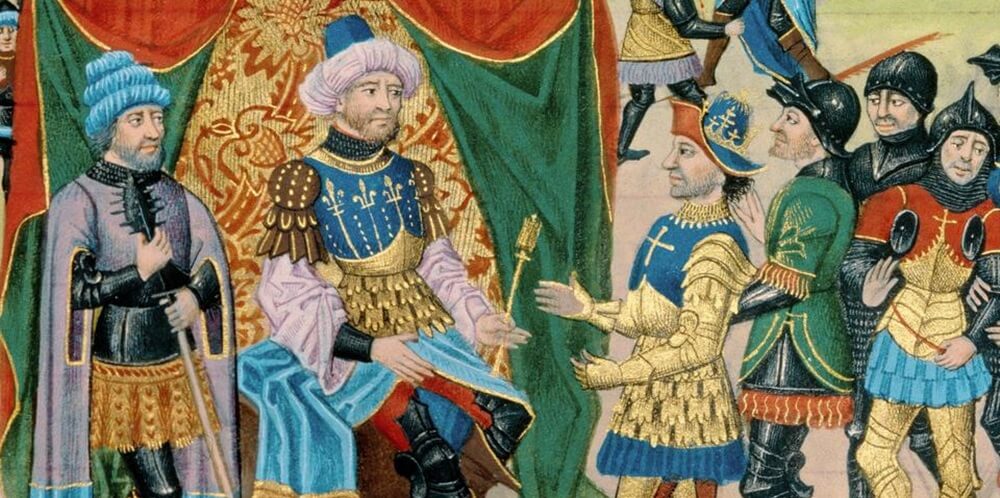
Saladin waited for the date of Muhammad’s Night Journey, al-Isrāʾ wa-l-Miʿrāj, to enter Jerusalem. His soldiers established neighborhoods in the city, such as Abu Tor, Sheikh Jarrah, and the Mughrabi Quarter near the Jewish Quarter, which were founded by groups of Sufis headed by a sheikh and belonging to different orders. In contrast to the Christian Crusaders, he did not massacre the inhabitants of the city who surrendered to him and left many of the Christian churches intact, especially the Church of the Holy Sepulchre.
Following the Muslim conquest, dozens of zawiyas and madrasas were established throughout the city, sometimes in combined complexes. They received government support and served as a breeding ground for state officials, officeholders, and military personnel. Saladin left the Christian churches standing, with a few exceptions. One was the conversion of the Patriarch’s Palace next to the Church of the Holy Sepulchre into a khanqah for Sufis, perhaps Qalandaris. The idea was that instead of the splendor of the representative of the religion, the modesty of the true religious people would prevail. Initially, he confiscated the place and used it as his residence for a short time, and then deemed it right to give it to the dervishes.
Mystery of the Two Minarets
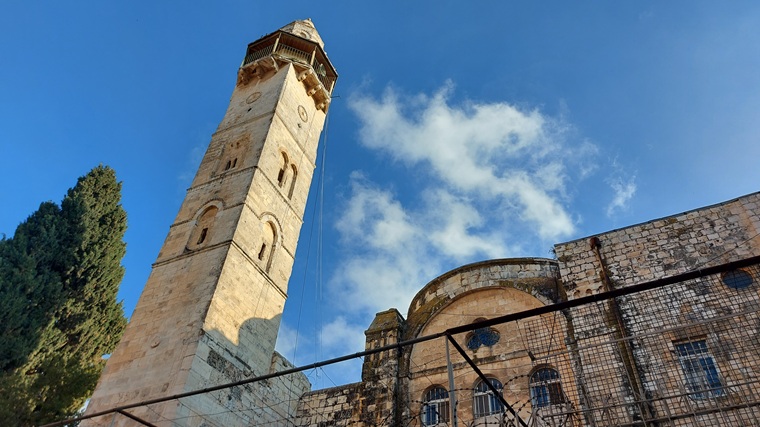
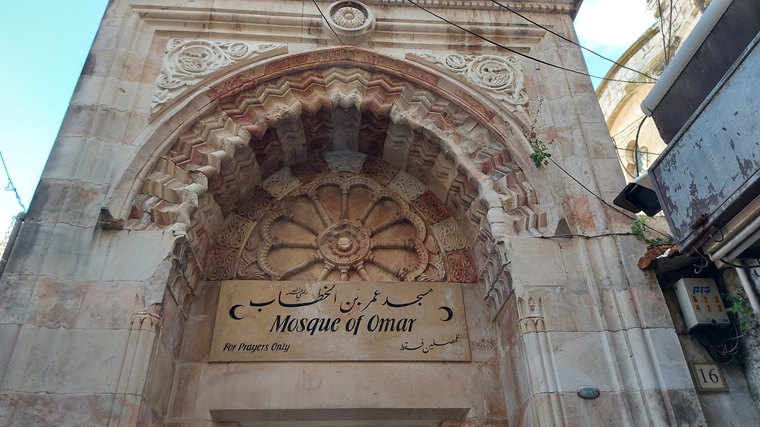
On the site of this khanqah, located on Khanqah Street (named after it), north of the Church of the Holy Sepulchre, a minaret was built in 1417 by the Mamluks, at the same time that a similar minaret was built on the other side of the Church of the Holy Sepulchre, at the location of the Mosque of Omar. The surprising thing is that the two minarets reach the same height, even though their starting points are different. The height of the minarets matches the height of the Rotunda dome of the Church of the Holy Sepulchre. If you connect a straight line between them, it crosses the dome exactly at its center and passes through the entrance threshold, with the dome being equidistant between the two minaret towers. If you continue this line, it reaches Mecca. What we have here is a kind of Muslim “feng shui” designed to harness the energy of the holiest place in the Christian world toward the Islamic religion and its center in Mecca.
The connection between the Mamluk minarets near the Church of the Holy Sepulchre is also called the “Mystery of the Two Towers.” In this context, it should be noted that when the Mamluks conquered the city, they also built four minarets (towers) on the borders of the Temple Mount—three on the western side and one in the northeastern corner. The towers were built over a long period, but it is possible that they were part of an overall design aimed at energetically empowering the Islamic essence in Jerusalem, achieved through the construction of these tall buildings from which the call to prayer is made.
The call to prayer is synchronized between the different minarets, with the minaret at the Chain Gate initiating it. Some of the Christian bell towers (one of which was personally designed by Kaiser Wilhelm II) are also synchronized with each other. Thus, a competition for the skyline and soundscape of Jerusalem was created.
Tower Symbolism and Sufi Philosophy
In the principles of sacred architecture (as seen earlier), the pillar symbolizes man (Vitruvius), and the tower is essentially a large pillar, sometimes built according to proportions found in the human body—for example, 1:6, as in the ideal Doric column, expressing the proportion of the feet in relation to the height of a human being.
Furthermore, according to mystical Islam, the human being has three parts: an animal part (the commanding soul), a human part (which is the journey), and an angelic part (the tranquil soul). Thus, the base of the tower is the earthly–animal part of man; the tower itself is the path a person must take in life; and the upper part of the tower, from which the muezzin calls to prayer, is the angelic part. This division also exists in the teachings of the Freemasons, as expressed in the tower of the YMCA building in Jerusalem (see the chapter in the third book), and possibly in Christian towers as well.
According to Sufi philosophy [1], the tower symbolizes the spiritual journey on one hand and the connection between heaven and earth on the other. Man is topocentric—dividing space according to his location—and the moment he stands, a division of forward–backward, right–left, and also up and down is created. Man’s feet are on the ground and his head is in the sky; the nadir connects with the zenith of the earth, and thereby man connects the earth to the sky and the stars.
According to the teachings of sacred geography and architecture, such as Feng Shui, the tower is a kind of acupuncture point on the surface of the earth, which is considered a living entity. Therefore, it is placed in a special location, and together with other towers, it creates a network that amplifies the energy of the earth and the presence of heavenly energy on its surface. Hence, towers will sometimes be located in a specific arrangement, expressing a geometric shape, a celestial alignment, or referencing energetic points on the ground.
Indeed, during the Mandate period, the British city planners created a circle of towers around the Holy Basin of Jerusalem (see chapter in Book Three). Another tower that once stood in Jerusalem was the Jaffa Gate Clock Tower, built by Sultan Abdul Hamid on the 25th anniversary of his rule. After the British conquered the city, they removed this tower, allegedly for aesthetic reasons and in accordance with the principles of the Arts and Crafts movement, but it is possible that there was an additional consideration of symbolism and the energetic influences of sacred architecture.
Muslims emphasize, within their science of sacred architecture, the orientation of buildings—especially towers and religious structures—along a certain axis, which is usually connected to the Black Stone in Mecca. Sometimes there are also proportional relationships and measurements between the height and width of the tower and the mosque it serves, and between different towers, as is wonderfully demonstrated in the case of the two towers on both sides of the Church of the Holy Sepulchre.
The alignment of two religious buildings toward Mecca is a common feature of sacred architecture in Islam and was already considered by Kaʿab al-Aḥbār in the design of the Temple Mount in the 7th century. This is called the joining of the two qiblas.

The Qadiriyya, Rifa’iyya, and Suhrawardiyya Orders
It needs to be understood that Sufi orders are not necessarily structured and rigid institutions with constitutions and rules like Christian religious orders. In many cases, an “order” is essentially a designation for a certain emphasis in the path—unique practices and prayers interpreted by local sheikhs. The large orders, such as the Qādirī or Shādhilī, are a kind of umbrella term for various groups that believe in and follow the method of the founding saint, who emphasized a particular aspect of the spiritual teaching and left behind books and traditions. Under this broad umbrella, there are many groups connected to one sheikh or another.
Furthermore, throughout history, there were professional guilds that adopted the identity of specific Sufi orders. On top of this, one must recognize that Sufi orders and their different streams are not contradictory to one another but respect each other, and it is not uncommon to find a person belonging to several orders. The following is an overview of some of the major Sufi orders that appeared in the Middle Ages and influenced Jerusalem.

The Qadiriyya Order
The first Sufi orders founded in Baghdad were the Qadiri and Rifa’i, both of which emphasized mystical states on the path to God. The Qadiri (Qadiriyya) order was established by the followers of ʿAbd al-Qādir al-Jīlānī (1077–1166) and is considered one of the largest Sufi orders in the world. However, this order does not have a central, organized body, but is rather a kind of movement relying on authorization and a network of sheikhs and zawiyas.
Abd al-Qādir al-Jīlānī is considered the Patron of Saints, the Reviver of the Religion, the Chief of the Angels, and more. His followers attribute 99 names to him and believe that Muhammad had already prophesied his coming. To some extent, he continued the work of al-Ghazālī. His teachings and fame spread during his lifetime and intensified after his death. Following him, an order was established that draws on the mystical teachings found in his books and performs the order’s unique dhikr rituals.
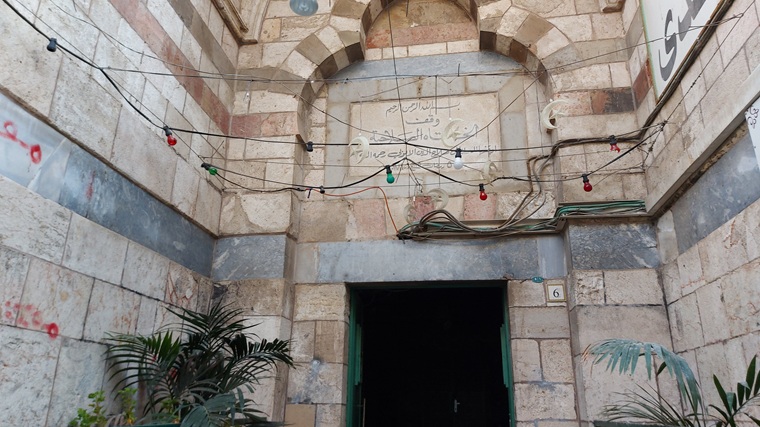
There are several branches of the Qadiri order in Israel, and at least two in Jerusalem, including an active zawiya of the Qadiri order—also called the Afghan Zawiya—northwest of the Temple Mount in the heart of the Muslim Quarter. The zawiya was founded in the 17th century (1633) by Muhammad Pasha, the ruler of Jerusalem, who contributed to many Sufi institutions. It is one of the few buildings that remains as it is and still fulfills its traditional function. The zawiya has one entrance with three steps, benches on its sides, and an inscription mentioning the Qadiri order. At the heart of the zawiya is a large courtyard with vegetation. On one side are 11 cells that presumably served as dwellings or places of seclusion for the dervishes. On the northern side there is an assembly hall for ceremonies, and on the eastern side a mosque. The site also contains residences that served the sheikh and the followers. The mosque is divided into two parts, topped by two domes, and they contain 12 windows—numbers that are symbolic.

The Rifa’iyya Order
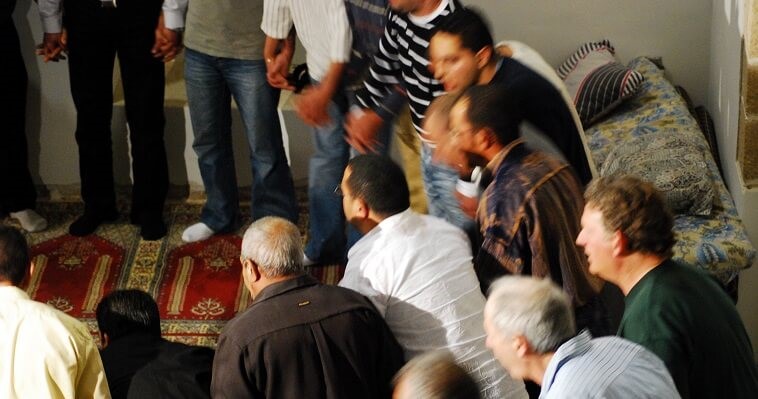
The Rifa’i order was founded by Sheikh Ahmad Rifa’i (1110–1183) in Basra. Sheikh Ahmad was the cousin of ʿAbd al-Qādir al-Jīlānī, and there is still a closeness between the two orders today. He lived in southern Iraq, was a gifted orator, mastered the sciences of spiritual states, and performed miracles. His followers are known, among other things, for their daring acts: riding lions, playing with swords, and even charming snakes. This is the only order that draws blood during ceremonies and performs acts in the spirit of the Indian fakirs—something not accepted by the other Sufi orders. It is also close in spirit to Shi‘ism.
A famous Sufi sheikh, Shaykh Muhammad Said al-Jamal ar-Rifai, who was a descendant of Ahmad Rifa‘i but primarily taught within the Shadhili order, lived in Jerusalem until recently. In Sufi Islam, a person is often initiated into several orders or belongs to several at once, and the shaykh was also a Rifai. The order has zawiyas throughout the land, the most famous of which is in Umm al-Fahm. The followers use drumming in their ceremonial dhikr, and these drums once played a central role in the Nabi Musa celebrations that began in Jerusalem.
The Suhrawardiyya Order
One of the orders that had the most influence during the time of the Crusades was the Suhrawardi order, and Saladin was probably one of its adherents. There are several sheikhs in the Suhrawardi family. The first official founder of the order was Abu al-Najib Suhrawardi (1097–1168), who was the head of the Nizamiyya University in Baghdad and a student of al-Ghazali. However, the true and significant founder was his nephew, Shihab al-Din Umar al-Suhrawardi (1145–1234), who had a school in Baghdad to which students came from all over the world. He was recognized as the Chief of the Sufis, and his famous book is ʿAwārif al-Maʿārif—Knowledge of the Knowers.
Shihab al-Din had close ties with Saladin. He was a frequent visitor to the Ayyubid court in Damascus and had great influence, including in mundane matters. He was recognized as the Chief of the Sufis and went on various diplomatic missions. The role of the Sufis at that time was to strengthen Sunni Islam against Shi‘ism—to create a new social framework relying on the Sufi sheikhs instead of the Shi‘ite imams, Sufi brotherhoods, professional guilds, and a new ideal of man.
The Suhrawardiyya promoted the Futuwwa movement—one in which a person respects the elders, is kind to the young, prefers his equals, and possesses the qualities of fata (chivalry). He prefers the good of others over himself—in short, he is noble. And this is what Saladin exemplified in his life.
The Philosophy of Illumination
Another charismatic and unique figure in the Suhrawardi order was the nephew of Shihab al-Din Umar al-Suhrawardi, Shihab al-Din Yahya ibn Habash Suhrawardi (1155–1191), who spread a revolutionary philosophy called the Philosophy of Illumination. He was called Shaykh al-Ishrāq, which means “Master of Illumination,” and also “the Morning Star.” His important book is The Philosophy of Illumination. This Shihab al-Din died young, and some say the ʿulamāʾ killed him, which is why he is also called the “Slain Sheikh.”
Yahya Suhrawardi dedicated his life to linking the original Eastern religions with Islam. He claimed that all the wise men of the ancient world preached one and only one teaching. For him, Hermes, Plato, Pythagoras, and Zoroaster were the great teachers of humanity. In his philosophy, he connects Persian cosmology with the Ptolemaic star system, the Neoplatonic idea of emanation, and often cites the Qur’an in this context.
When he was young, he had a mystical vision in which he saw “innumerable creatures of light formerly contemplated by Hermes and Plato, and the celestial radiation—the source of glorious light and the kingdom of light proclaimed by Zoroaster and to which the legendary Persian king Kay Khosrow ascended.” And so he writes:
“Among the ancient Persians, there was a community of human beings who lived according to the guidance of God and therefore walked the right path. These were great religious sages who were not at all like the Magi. Their doctrine of light, which is identical to that found in the mystical experience of Plato and his predecessors, is the subject I dealt with in my book The Philosophy of Illumination, and before me, no one had done such a thing.” [2]
In his teaching, Yahya Suhrawardi refers to a world of imagination, called ʿālam al-mithāl in Islam, which exists between us and God. Within it is a kind of image of a Perfect Man—Adam Kadmon in Kabbalah—who is an embodiment of light. According to Suhrawardi, in every generation there is a Pole on which the world stands. The way to liberate the light within us is to study the Pole, who is the light in the world, or his envoys. The path of study is through imagination and intuition, enriched by critical reason.
Yahya Suhrawardi recounts the revelation of the Pole of the generation that he experienced: “Suddenly I was enveloped in tenderness; a blinding flash appeared, followed by a transparent light in the form of a human being. I gazed and saw him… He came toward me, greeted me with great warmth that dispelled my confusion and fear and made room for intimacy, and then I began to complain to him about the difficulty I encountered in the problem of knowledge.”
“Awaken and know yourself,” he told me, “and your problem will be solved.”
The activation of the human imagination enables human beings to return to God by knowing ʿālam al-mithāl, the world of pure mirrors. According to a scholar named Corbin, “Suhrawardi was the first to establish an ontology of the intermediate world (called ʿālam al-mithāl), and all the Gnostics and mystics of Islam will return to this subject.” According to Eliade, Yahya Suhrawardi, in his book The Philosophy of Illumination, attempts to revive ancient Iranian wisdom and Hermetic Gnosticism.
According to Yahya Suhrawardi’s teaching, which somewhat resembles the Kabbalah, we live in a world of shadows, but there are sparks of light within us and in the world around us, whose source can be faintly perceived. Man must find them and purify and refine the light and wisdom within him. Yahya Suhrawardi teaches the use of intuition and imagination as tools for discovering the truth, instead of logic. For example, the student in the Suhrawardi order reports his dreams to the sheikh. Suhrawardi refers to the concept called the “East of Light,” which is the place of the revelation of truth, and some have linked this metaphysical place with the concept of the Celestial Jerusalem.
Mysticism is destined to renew the old mythology that the monotheistic religions allegedly abandoned. The realm of imagination will allow us to rediscover the hidden spiritual lights within us, just as the symbolic interpretation of the Qur’an reveals its true spiritual meaning. The Prophet Muhammad saw the intermediate world (ʿālam al-mithāl) on his Night Journey to Jerusalem. The symbols in the scriptures, such as Paradise and the Day of Judgment, are as real as the phenomena we experience in this world—but not in the same way. Yahya Suhrawardi tried to provide an explanation for the symbols of imagination that had a decisive influence on human life, even though the reality to which these symbols refer remains elusive.

Ibn Arabi, the Seal of Saints
The eaching of Yahya Suhrawardi somewhat resembles the teaching of one of the most renowned Sufi thinkers, the Great Sheikh Ibn Arabi (1165–1240), who also visited and worked in Jerusalem. His teaching finds resonance today in the hearts of many in the West and in Israel. He is called the “Seal of the Saints” (just as the Prophet Muhammad is the “Seal of the Prophets”), and also the “Great Sheikh.” These names attest to his immense importance in the development of Sufi mystical thought. His uniqueness lay, among other things, in the metaphysical doctrine he developed, in which he refers to the world as a combination of opposites—where things are the opposite of what they seem—and to the existence of an intermediate world of imagination, ʿālam al-mithāl, between us and God (similar to Suhrawardi).
Ibn Arabi was born on the 27th of Ramadan (Laylat al-Qadr) in the year 560 AH, in Murcia, southern Spain. His family included Sufi scholars and people close to the court. Some say his father was a student of ʿAbd al-Qādir al-Jīlānī, the founder of the Qadiri order. Even from childhood, Ibn Arabi was known as a special child of visions, a prodigy. He received a comprehensive education in all areas of Sufism, including metaphysical doctrines, cosmology, esoteric interpretations, the science of letters and numbers, and the various stages of the path. As a student, he spent long periods engaged in Sufi practices such as reading, prayer, fasting, repentance, isolation, meditation, and wakefulness, and had many extrasensory experiences, including visions, communication with the dead, healing powers, and more.
After he grew up, Ibn Arabi moved to North Africa, where he received guidance on the spiritual path from Khidr (the guide of souls), whom he met walking on water while sailing in a boat on the sea. This guidance led him to make a pilgrimage to Mecca, where a vision was revealed to him in which he appeared as the “Seal of the Saints.” In Mecca, he wrote the book The Meccan Illuminations, and afterwards he traveled throughout the Middle East, including several visits to Jerusalem. Later in his life, he wrote his monumental book The Seals of Wisdom, in which he dedicates a chapter to each of the 27 prophets appearing in the Qur’an, who are perceived as archetypes that together make up the composition of the “Perfect Man” (the Prophet Muhammad).
His importance lies in the fact that he connected the Sufi mysticism that developed in Andalusia and the Maghreb (in the West) with that of the Middle East [3].
The Great Sheikh never took anything at face value and claimed that our visions require translation. He clearly and fluently explained the connection between the visible worlds and the invisible worlds, the metaphysical structure of the universe, and the chain of creation in its various stages from the absolute to the particular. Ibn Arabi developed the motif of the Perfect Man, who connects heaven and earth: “Know that the Perfect Man is the pillar that supports the heavens; through him God sustains them lest they fall to the earth. When the Perfect Man ceases and passes into the intermediate world, the heavens will collapse, and this is what God Almighty said: ‘The sky will then be so torn that it will be frail’ (Sura 69: Al-Haqqa, verse 16).”
Ibn Arabi visited Jerusalem for the first time in 1204. He wandered throughout the Levant—Syria, Lebanon, and Israel—for many years until he decided to settle in Damascus in 1223. This was six years before the Christians regained Jerusalem, except for the Temple Mount complex. Even while living in Damascus, it can be assumed that he continued to visit Jerusalem, and in any case, he was involved in the events of the region, the country, and the holy city—whether directly or indirectly—and this is expressed in his writings about the Jewish prophets, who constitute the vast majority of the Qur’anic prophets.
His poetry is an expression of religious tolerance and universality, which is also expressed in the Talmud and in the poetry of Jalal ad-Din Rumi, who was influenced by him. He died in Damascus in 1240. Before he died, he angered the ʿulamāʾ (the religious establishment) by saying: “The thing you are looking for is under my feet.” Indeed, when they excavated his grave, they discovered that a treasure was buried in the ground in the area where his feet had been interred.
Ibn Arabi’s teaching influenced various orders that developed and flourished in Israel, especially the Shadhili order from Acre, which also had a presence in Jerusalem.

The Mughrabi Quarter and Abu Madyan
The Mughrabi Quarter, which existed near the Western Wall before it was demolished, was actually a neighborhood of religious immigrants from North Africa and Muslim Spain, supported by a waqf established by Saladin’s son. The residents were mainly members of Sufi orders who wished to live in Jerusalem, and some were also people who were forced to leave the Muslim kingdoms in Spain and North Africa due to political events. Thus, just as Jewish exiles from Spain came to Jerusalem, so too did Muslim exiles from Spain, who arrived in Jerusalem already in ancient times and founded a neighborhood near the Jewish Quarter.
In the Mughrabi Quarter, there were several zawiyas established in the 13th–14th centuries and perhaps later. One was for the followers and family members of Abu Madyan, the important North African Sufi of the 12th century, who influenced, among others, the Shadhili order, which was of great importance in the Mamluk Empire. A second zawiya was established by the followers of a person named al-Maṣmūdi, who was probably connected to the Shadhili order as well, being part of the unique development of North African Sufism. To this day, there are representatives of the Shadhili order in Jerusalem.
Abu Madyan (1126–1198) is considered the most important North African saint. He was a teacher of Ibn Arabi and influenced Abu al-Hasan al-Shadhili. He was born in Spain and moved to Algeria, bringing the Sufi spirituality of Andalusia to the Maghreb. North African Sufism is fundamentally different from that of the Middle East; it integrates into daily life and combines internal contemplation with external events, forming a kind of third way between the path of intoxication of Bistami and the path of sobriety and gradual ascent of Junayd.
Abu Madyan made a pilgrimage to Mecca, where he studied directly with ʿAbd al-Qādir al-Jīlānī (1078–1166), the founder of the Qadiri order, who was in Mecca at the time. He emphasized contentment and gave expression to emotion, in addition to asceticism, prayer, nobility, and loyalty to the sheikh. He wrote Sufi poetry and works that spoke both to the common people and to the intellectual elite, possessing an expressive ability that still resonates today. He was the teacher of ʿAbd al-Salām ibn Mashīsh, who was the teacher of Abu al-Hasan al-Shadhili.

Abu al-Hasan al-Shadhili
About eight hundred years ago, a young seeker named Abu al-Hasan al-Shadhili set out in search of the Pole of the Generation, the Sāḥib al-Waqt—the Master of the Time. Sufis claim that in every generation there is one person through whom the world is sustained, and he is called the “Master of the Time” or the “Pole of the Generation.” The meaning of the term is that this person is connected to the Divine Essence (Ḥaḍra Muḥammadiyya) and can be present in any place simultaneously.
After many hardships and wanderings, Abu al-Hasan reached Iraq, where he met a holy man who told him that the man he was seeking was in the land from which he had come—Morocco—and that his name was Moulay ʿAbd al-Salām ibn Mashīsh. Abu al-Hasan returned to Morocco, and there he met Ibn Mashīsh, an ascetic and solitary Sufi known as the “Pole of the West.” He lived in a Sufi monastery located at the top of the Mountain of the World [4]—Jabal al-ʿAlam—not far from the Strait of Gibraltar. Ibn Mashīsh was a student of the Great Sheikh Abu Madyan, who brought the Sufi teaching from Andalusia in Spain to the Maghreb countries.
Sheikh Abu al-Hasan went a long way only to discover that what he had been seeking throughout his long journey around the world—the Sāḥib al-Waqt, the Master of the Time—had been in his homeland all along. And then he discovered that what he had been looking for outside himself was within himself the entire time.
al-Hasan al-Shadhili was accepted as a student by Sheikh Ibn Mashīsh and eventually became his successor. Upon the Sheikh’s death, he moved to the village of Shādhiliyya near Kairouan, Tunisia, from which he received his name. Like his master, he also secluded himself in a cave on a high mountain near the village, called Jabal Zaghouan, and there he had a vision instructing him to go to the city of Tunis, establish a zawiya there, and teach Sufism.
During his life, Sheikh Abu al-Hasan performed many miracles and received guidance from Khidr and the Prophet Muhammad. He emphasized the mystical aspect of Islam and came into conflict with the religious establishment in Kairouan, which caused him (along with another vision he received) to move to Alexandria, Egypt, in 1244. In his new home, he became an admired figure, and many sought his door. He built a large center in Alexandria and gathered forty close students around him. Although he became blind in 1248, he participated in the Battle of al-Mansurah in 1250 against the Seventh Crusade, also called the Second Battle of Hattin [5]. Some even claim that this may have contributed to the Muslim victory.
Abu al-Hasan died and was buried in 1258 in the oasis of Humaithra, located between Aswan and the Red Sea. Near his grave are two sacred wells, one containing sweet water and the other bitter water, symbolizing the Sheikh who bridged the two types of knowledge—the visible and the hidden—in his life and teaching.
Sheikh Abu al-Hasan al-Shadhili taught that one should avoid exaggeration in asceticism and that a person should be as he is, because wisdom lies in finding God within life, not outside it: “Remove the idols from your heart and give your body rest from this world, then you will be as you wish. When a person is humble in spirit, God does not punish him for stretching his legs to rest from his efforts, but He does punish the one whose efforts are accompanied by arrogance.”
The most important thing on the spiritual path according to Abu al-Hasan al-Shadhili is humility, and so he says: “O Allah, You decreed lowliness upon Your people until they become strong. You decreed upon them to lose until they are found. He who has not been humbled will not be strong, and he who has not lost will not be found. Whoever claims to have found without lowliness deceives himself, and whoever claims to have found without losing lies.”
He demanded that his students work, acquire a profession, and be part of society, and so he said: “In this path, there are no practices of monasticism or eating coarse bran bread; rather, it is all patience in the face of God’s decree and trust in His guidance, for God said: ‘And We appointed leaders from among them, guiding by Our command, when they were patient and certain of Our signs.’ (Sura 32: As-Sajdah, verse 24).”
After the death of Abu al-Hasan al-Shadhili, his teaching spread through his student al-Mursi, after whom the zawiya in Alexandria is named. Very quickly, and even during the lifetimes of the two great Sheikhs, the Shadhili order became one of the largest and most influential in Egypt and the countries of North Africa—Tunisia, Libya, Morocco, and Algeria. Membership in the order was, in many cases, linked to membership in professional guilds. The order played an important role in the Mamluk Empire, where many professionals (such as doctors or lawyers) were required to belong to Sufi orders.
Footnotes
[1] Bakhtiar, L. (1976). Sufi: Expressions of the Mystic Quest. Thames & Hudson.
[2] Eliade, A History of Religious Ideas, Vol. 3, p. 126.
[3] Gordin, R. (2007). Angels Don’t Dream: The Teachings of the Sufi Shaykh Ibn ‘Arabi. Carmel.
[4] The mountain is located in the center of the Ceuta peninsula, the African equivalent of the Gibraltar peninsula. In other words, near one of the two columns that hold the world according to Greek mythology, the other being the Rock of Gibraltar to the north. It is likely that the place was holy since ancient times. Nevertheless, most studies identify the Pillar of Hercules with the nearby Jebel Musa.
[5] Contrary to popular belief, Sufis were active in the military struggles of Islam, especially in border areas. Saladin’s army, for example, was partly composed of groups based on Sufi orders. As in the Indian epic the Bhagavad Gita, the main thing in the spiritual path is not the earthly deed but the value attached to it. Every person must fulfill their duty in the world, sometimes it is the struggle for freedom, but one must always remain human and do things for the right reason, and the best example of this is the Prophet Muhammad.
[6] Johnson, P. (2015). An Indian Corner in Jerusalem. Jerusalem Quarterly, 62. P.97.