Christianity After the Crusades
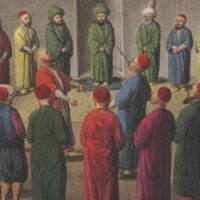
The re-conquest of the Land of Israel by the Muslims was completed in 1291. From that time onward, Catholics were generally not permitted to gain a foothold in the Holy Land. The only organization that was an exception in this regard was the Franciscan Order, due to the historically good relations it maintained with Islam, starting with Francis of Assisi, but even this exception was not granted all at once. On the other hand, the Orthodox Christian denominations were allowed to remain in the Holy City, and their rights were secured within the framework of the Charter of ʿUmar. They were an organic part of the Middle East and a significant portion of the population in Muslim empires such as the Ayyubid and Mamluk.
However, even in the 14th century, the stream of pilgrims continued to flow into the city, bringing with it exceptional people and events. Jerusalem, under the renewed rule of Islam, remained a center of spirituality and sanctification for all three religions. With the return of the Muslims to the city, the Jews were allowed to return to their holy city, one of the first being Nachmanides.
Bridget of Sweden in Jerusalem
Bridget of Sweden (1303–1373) is one of the six patron saints of Europe (the other five are Cyril and Methodius, Benedict of Nursia, Catherine of Siena, and Edith Stein). She was born into a Swedish noble family, married, served in the royal court, and had six children, one of whom also became a saint—Catherine of Sweden. At the age of 32, she went on a pilgrimage to Santiago with her husband, during which he fell ill and died upon their return. Following this, she joined a Franciscan monastery as a Third Order nun and dedicated her life to prayer and acts of charity.
As part of her repentance, she established a Christian community, a kind of new order later called the Bridgettines, which included double monasteries for women and men together. In 1350, she set out with her daughter and a delegation of priests and students to Rome to gain recognition for the order. These were the days of the Black Death, and the Pope was in Avignon, not Rome. Thus, a journey that was supposed to take a few months turned into a 20-year stay in Rome, until the Pope returned and approved the new order. Afterwards, she planned to stay in Rome for the rest of her life, but fate had other plans.
She had visions of Jesus from the age of 10. In addition, she had prophecies regarding the future, which some say have even been fulfilled in our time. Bridget’s importance lies in the fact that she developed new prayers. One day, while meditating on his suffering, Jesus appeared before her and taught her a prayer to atone for the 5,480 wounds he sustained on his body. Essentially, these were 15 paragraphs that referred to the Seven Last Words of Jesus on the cross as they appear in the various Gospels. The prayer Bridget instituted was called the “15 O’s.” It entered the cycle of hours and was considered to have supernatural power, even to the point of atoning for sins.
Bridget came to Rome with her beloved son, Karl, but he went astray, which greatly saddened her. In 1371, Jesus appeared to her again and commanded her, at her advanced age, to go on a pilgrimage to the Holy Land. On her way to the Holy Land, she stopped in Naples, where Karl flirted with the queen. Bridget prayed for God’s help, and as a result, Karl fell ill and died. But when she finally arrived in the Holy Land, at the place where God sacrificed His Son, she had another vision. She saw Karl on the Day of Judgment with the Devil trying to condemn him, but because of her prayers and tears, the Devil could not recall Karl’s sins and could not condemn him. God dismisses him in shame and calls Karl “the Chosen Son.”
Bridget stayed at a poor hostel in Jerusalem and visited the holy sites. At Golgotha, she had one of the four crucifixion visions of her life; in Bethlehem she envisioned the birth of Jesus; on the Mount of Olives, His Ascension; and at the Tomb of Mary she had a vision of Mary, who commanded her to return to Rome. Bridget went to be baptized in the Jordan and returned to Rome. Shortly after her return, she died. The baptism was a kind of preparation for the birth into the world after death. Her visions of various events in Jesus’ life, such as the Nativity, inspired Christian painting of those times.


The Order of the Golden Fleece
In the 14th century, the figure of Philip de Mézières (1327–1405) stands out. He made a pilgrimage to Jerusalem and consequently worked to establish a new order of knights called the Order of the Passion of the Lord, whose goal was the liberation of Jerusalem from Muslim rule. This was an order that sought to renew the ideal of chivalry and correct the weakness of the Crusader armies—namely, their lack of self-discipline and order. De Mézières endeavoured in the Kingdom of Cyprus, France, and throughout Europe to promote a new crusade and was one of those who pushed for the Crusade of Nicopolis (helping Bulgaria repel the Ottomans), which ended in bitter failure. He wrote the book The Dream of the Old Pilgrim, in which he describes Jerusalem as the center of the world. In a way, his order was a precursor to another order that was established several decades later.
The Order of the Golden Fleece was founded by Philip the Good, Duke of Burgundy, in 1430, and exists to this day. The King of Spain heads its Spanish branch, and Karl von Habsburg, head of the House of Habsburg, heads the Austrian branch. There are nine exemplary figures that the knight must follow and emulate: Hector, Alexander the Great, Julius Caesar, King David, Joshua, Judas Maccabeus, King Arthur, Charlemagne, and Godfrey of Bouillon. Some identified the Golden Fleece with Gideon’s fleece that received the dew as a symbol of God’s blessing (Judges 6:37): “Look, I will place a wool fleece on the threshing floor. If there is dew only on the fleece and all the ground is dry, then I will know that you will save Israel by my hand, as you said.”
Philip the Good (1396–1467) was a descendant of Godfrey of Bouillon. He worked for Jerusalem and donated money to build the Chapel of the Holy Spirit in the Upper Room of the Last Supper on Mount Zion, where there is a window with his heraldic symbol, and he requested that his heart be buried there. It can be assumed that the importance of this room for him stems partly from its proximity to the Tomb of David, the ideal knightly figure. Philip dispatched missions to the Land of Israel; in his time, the Kingdom of Cyprus became a vassal of the Mamluks. One of the people he sent to Jerusalem was Guillebert de Lannoy, a member of the Order of the Golden Fleece. Guillebert also traveled on behalf of King Henry V of England and wrote a book about the possibility of renewing the Kingdom of Jerusalem and the Crusades. Another envoy was Bertrandon de la Broquière, who also wrote a book about his travels.

Jerusalem in Italy
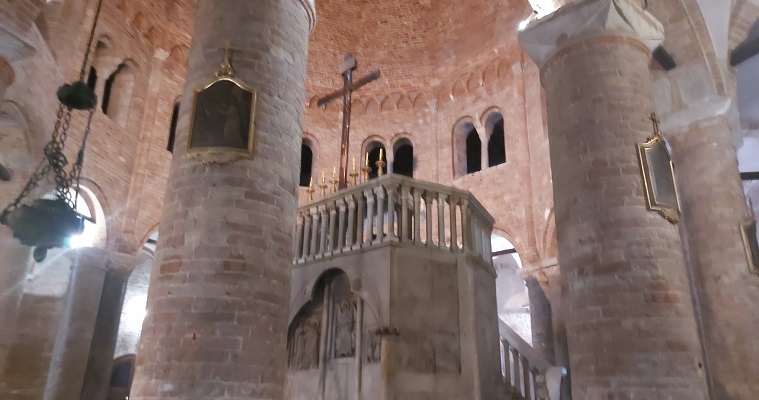
The phenomenon of transferring Jerusalem and Israel to Italy is evident in the presence of the Holy Stairs (Scala Sancta) in Rome, the House of Mary from Nazareth in Loreto, and also through the figure of Francis, who becomes a second Jesus, receiving the stigmata in Italy. It culminates in the Nine Sacred Mountains (Sacri Monti) of Piedmont and Lombardy, where large complexes were created that imitate the holy sites in the Holy Land and the Via Dolorosa in Jerusalem.
The perception of a Sacred Mountain develops in 14th-century Christianity and is expressed in books such as Dante’s Divine Comedy. It is, of course, much older and exists in all religions and historical periods. According to Mircea Eliade, the symbol of the Sacred Mountain is archetypal and represents the act of creation, time beyond time, the source that seeks renewal and to which we wish to return. The mountain is an axis mundi connecting planes—heaven and earth. Climbing the mountain symbolized, in Christianity, the spiritual journey of man from earth to heaven. The Sacred Mountain symbolizes the Church, holiness, the Celestial Jerusalem, the place of eternal creation.
It all begins with a Franciscan friar named Bernardino Caimi (1425–1500), who returned from the Holy Land in the 15th century, where he was entrusted with the custody of the Church of the Holy Sepulchre and responsible for the holy places. He decided to copy the sites he saw in Israel to Italy, to build the Celestial Jerusalem near his residence in Milan. The place was also intended for those who could not make it to Jerusalem, so that they could at least enjoy the art and representation of the places connected to Jesus’ ministry on earth. Dozens of chapels were built to commemorate the various events and places in Jesus’ life and were decorated with realistic painting and sculpture, vividly bringing to life the stories of the Old and New Testaments and arousing the emotions of visitors.
The most important and oldest site among the Nine Sacred Mountains is the Sacro Monte of New Jerusalem in Varallo, located above the town of Varallo Sesia on the slope of the “Three Crosses” Mountain. At the top of the mountain are two plazas between buildings with balconies, where events that took place in Jerusalem are represented in models of real places. In addition, there is a basilica dedicated to the Assumption of Mary at the site. The place became a model for other Sacred Mountains that were built in the following centuries. The mountains feature a miniature pilgrimage route through which pilgrims connect to the story of Jesus. The Varallo Sacred Mountain has 45 chapels decorated with frescoes and over 800 statues made by various artists in different periods, especially in the 16th century, the period of the Counter-Reformation.

Spirituality of the Late Middle Ages
The development of Christian mystical thought can be seen through the sequence of the following figures: Meister Eckhart; Henry Suso (Heinrich Suso, 1295–1366); Johannes Tauler (1300–1361), a member of the Friends of God Society; Rulman Merswin, founder of the Friends of God; Jan van Ruysbroeck (1293–1381), founder of Groenendaal; Geert Groote, founder of the Brethren of the Common Life; and Thomas à Kempis, author of The Imitation of Christ. One could also include Wycliffe and Jan Hus in this list.
According to Steiner [1], the 400 years from the 13th to the 17th century were a preparation for the modern age. Awareness shifted from a reference to the spirit to a reference to physical things—reality. The age of human and world discoveries began. For example, in the Middle Ages, mountains were considered sacred and places whose divine repose above the clouds should not be disturbed. Petrarch was the first to climb a mountain above the clouds, thereby breaking the divine peace.
Eckhart was a student of Thomas Aquinas. He worked during a time of great change, when King Philip the Fair fought with Pope Boniface VIII and suppressed the Templar Order. He wrote about the difficulties facing man in this world and how to cope with the events of fate, in the spirit of Boethius’s (early 6th century) Consolation of Philosophy, the last of the classical thinkers and one of the most influential books of the Middle Ages. Eckhart wrote a book on heavenly consolation in this spirit. He turned to simple people and illustrated the inner spiritual path leading to God. One of his sayings: “The eye with which I see God is the same eye through which God sees me. My eye and God’s eye are one eye, one sight, one knowledge, and one feeling.”
Tauler was a student of Eckhart, and according to Steiner, Eckhart pointed the way, but Tauler walked it. He was an independent preacher in his views who refused to take part in the power struggles between the Church and secular rule. In 1339, he had a fateful meeting with the “Friends of God” in Basel, a society of spiritual Christianity that claimed the possibility of a direct connection with God. It was influenced by the events of the time, including the Little Ice Age, climatic disasters, and social disintegration, and saw them as signs of the end times. One of his sayings: “Man is like three people: an animal man as he is according to the senses, then a rational man, and finally the highest man, God-like.” One is external, a sensory animal man; the second is internal, a rational man with intellectual faculties; the third is the Spirit, the highest part of the soul.

Rulman Merswin, a wealthy banker from Strasbourg, was one of the leaders of the “Friends of God.” He reached the top of the pyramid at the age of 40 but felt empty and chose a monastic path along with his wife. After a few months, he had a vision of bliss and immediately afterward a state of emptiness and depression. Thus, he met Tauler, who became his confessor and advised him to stop the ascetic practices and choose the path of inner contemplation and cleansing the mirror of the heart. Following this, he had dreams and visions that he would meet a Friend of God and establish a spiritual community, and so it happened. A man called the “Friend of God from the Oberland” came to him and guided him in the true religion. Some claim this was Nicholas of Basel, and some say it was Merswin himself in the guise of his Higher Self. Be that as it may, after three years, Merswin walked by the Ill River near Strasbourg and saw an island there with a ruined monastery. He realized that this was the place where he needed to found the community—the Green Island—and so it was. He bought the island, which became a magnet for mystics and seekers of the Christian path and a home for a unique spiritual community. They lived according to the guidance of the Spirit without rigid rules and called themselves a branch of the Knights of Saint John (the Hospitallers).
After Merswin’s death in St. John’s House on the Green Island, a box was discovered containing writings of the “Friend of God from the Oberland,” including a story about his meeting with the Master of the Scriptures. The story is about a charismatic preacher whose lectures the Friend from the Oberland attends, in which the Christian mystical teaching is brilliantly unfolded, but the lectures are hollow. The Friend addresses the lecturer and exposes the emptiness of his words, and when the latter becomes angry, an inner voice within him tells him to listen to the man. The Friend gives him 23 sentences that are the alphabet of religion and offers him the opportunity to meditate on them alone as a way to correct his path, and so it happens. The lecturer retires from public activity and loses his intellectual ability for two years, during which he becomes an object of ridicule, and then the inner voice tells him to ascend the pulpit again. When he does, words come out of him that strike everyone with amazement at their spiritual power: “The Bridegroom is with us! Go out to meet him.” Forty people in the audience faint. Tradition linked the Master of the Scriptures with Tauler, who was close to and influenced by the Friends of God.
Following his meeting with the Friends of God, Tauler understood that the tasks and lives of the simple man are no less complex and sacred than those of the scholar. In one of his lectures, he says: “One can weave, another can make shoes—both are gifts of the Holy Spirit. If I were not a priest, I tell you, I would consider it a great privilege to make shoes, and I would strive to make them in the best possible way so as to be an example to all.”
And yet, he understood that when God chooses to purify a person, He does so in a total way that is sometimes difficult to bear. Thus, during the Black Death, Tauler remained in Strasbourg and treated the sick without fear or dread.
In the writings published by the Friends, they offer a morning and evening practice: to retreat into oneself upon waking and see what lives within—what one wakes up with—and then to cast off anything low or evil, if any, and direct oneself to the work of God; and in the evening, to see whether the work of God was indeed done or whether one sinned, and if so to thank God for it, and if not to repent and promise that tomorrow it will be corrected.
A contemporary of Tauler and connected with the Friends is the mystic Henry Suso, who wrote wonderful lyrical poetry expressing the spiritual search of the Christian mystic. He was an extreme ascetic in his early years, under the motto No Cross, No Crown, but became a mystical troubadour in the second half of his life, the last of the great Romantics of the Middle Ages. He wrote The Little Book of Truth and also The Little Book of Eternal Wisdom. About his writing, he says: “Whoever reads my writings in the right spirit, something will stir in the depths of his heart and bring him to a fervent love, a new light, a longing and thirst for God, contempt and rejection of his sins, and a spiritual aspiration that is renewed by grace.”
Ruysbroeck is another person connected to the Friends of God, but he founded his own society based in the Low Countries rather than in southern Germany. He lived a regular life as a priest until the age of 50, supported by his uncle, who was also an active churchman. Then he had an experience that caused him to turn to a spiritual life and retire from his duties. At the same time, his uncle met a mysterious man who ascended the pulpit in his church, spoke wonderful things, and then turned to him and told him, in everyone’s presence, that this miracle had happened for his sake so that he would turn to God. Another person who experienced similar things joined them, and in 1343 the three men left Brussels, went into the forest, and settled in an abandoned hut in the Green Valley (Groenendaal), establishing a Christian spiritual community that attracted many visitors, one of whom was Tauler. Another important man was Groote, who was deeply influenced by Ruysbroeck.

One day, Groote turned to Ruysbroeck with the question: How is one to be spiritual?
The answer was: “You are spiritual to the extent that you have the will to be spiritual; that is all.”
The questioner did not like the answer and turned to leave, and then Ruysbroeck said: “My dear children, I said that your spirituality was what you wished it to be so that you would understand that your spirituality is entirely relative to your good will. Go into yourselves. Do not ask others about your progress; examine your will, and from this alone you will discover the measure of your spirituality.”
Groote was a professor of philosophy in Cologne, and one day while watching a game, a mysterious stranger approached him and said: “Why are you standing here? You need to become another person.” Shortly thereafter, he fell ill, and when he was on the verge of death, he remembered the stranger’s words and swore that if he recovered, he would do everything in his power to become another person. Groote recovered, and then one of his former teachers in Paris, who had become religious, came to him and invited him to join the faith, and so he did. He turned to the spiritual journey, refused to become a priest, and instead became a wandering preacher who spoke to people in a simple and loving language—neither threatening the punishment of hell nor promising a reward in paradise, but emphasizing the love of God. During his wanderings, he came to the Green Valley and was deeply influenced by the community there and the teaching of Ruysbroeck, which led him to want to found a similar community. Thus, the Brethren of the Common Life was established in Deventer, sustained by copying rare books that he acquired (this was before the printing press), and adopting orphaned children. Among those who joined the new fraternity was Thomas à Kempis, who became an important mystic himself and wrote the influential book The Imitation of Christ. He was also Groote’s biographer. And so he writes: “I have never seen people so devout, so full of their love for God and their fellow human beings; living in the world, they were completely out of this world.”
A few years after Groote’s death, a young boy of 12 was brought to the fraternity to grow up there and be formed by its ideals—Erasmus of Rotterdam, one of the greatest thinkers of the 15th century and one of the most important heralds and influencers of the Reformation. Another person who grew up in the community was Nicholas of Cusa.
Nicholas of Cusa was born in 1400, ran away from home, and grew up in the spiritual Christian association in Deventer, with Thomas à Kempis as one of his teachers. He studied law at the University of Padua but failed his first trial. As a result, he changed course, became a priest, and participated, as the Archdeacon of Liège, Belgium, in the Council of Basel, which determined the future of Christianity—concurrent with the founding of Cosimo de’ Medici’s Platonic Academy in Florence in 1437. The council lasted several years. Nicholas became a papal diplomatic envoy and was sent to Constantinople, where he had a kind of epiphany and his philosophical ideas were revealed to him “in the heart of the sea as a gift from above from the Father of Lights.” These ideas were “Learned Ignorance” and the “Coincidence of Opposites.”
He continued to work in Constantinople and Germany, becoming a cardinal in 1448 and serving in the position for 20 dramatic years, during which Constantinople was conquered, the printing press was invented, and Athens was conquered in 1456, thereby ending what remained of Hellenism. During this period, Leonardo da Vinci and Pico della Mirandola were also born.
Nicholas taught a perception of the eternity and infinity of the universe, universalism, and a new spirituality suitable for the emerging Renaissance. He was a mathematician and astronomer whose connection with the East led him to understand that the Earth moves through the universe like any other star, thereby preceding Copernicus. Despite being both a scientist and a theologian, he did not fall into the trap of materialism on the one hand and scholasticism on the other, but maintained an openness to additional forms of knowledge, especially spiritual knowledge. According to Steiner, the most important achievement in Cusa’s spiritual life is “Learned Ignorance,” a type of perception that is higher than knowledge in its ordinary sense. In this, he continues the tradition of Pseudo-Dionysius the Areopagite.
He was the last of the great thinkers of the Middle Ages who was also involved in international politics, tried to connect East and West, and presented in his book On the Peace and Agreement of Religion a vision of a world religion whose center would be in Jerusalem. Nicholas of Cusa believed that the only place in the world that can unite East and West, past and future, and serve as a beacon of spiritual light for humanity is Jerusalem. It is not clear whether he ever visited Jerusalem, but what is interesting is that the chain of events described above, and the chain of teachers and spiritual guides transferring knowledge and pneuma (spirit) from one to another, culminated in Nicholas of Cusa’s vision of a New Jerusalem.

The Emergence of Western Esotericism
The Renaissance appears in its full glory in Italy, especially in Florence in the 15th century. The Ottoman expansion in the Balkans and Greece in the 14th–15th centuries led to the migration of scholars to Italy and Florence. Thus, scholars such as Plato of Mystras in Greece brought to Florence the writings of the ancient Greek philosophers and also the writings of the Corpus Hermeticum [2] (see the chapter on Ancient Wisdom in Book 1), a summary of the wisdom of ancient Egypt. As a result, Cosimo the Great founded the Neoplatonic Academy to translate these writings, and this led to the revival of the occult sciences. The Mamluks were ruling the Holy Land at this time.
Marsilio Ficino (1433–1499) was the head of the Neoplatonic Academy in Florence, a learned monk and humanist who is considered the one who began the revival of Western esotericism. According to Eliade [3], Cosimo de’ Medici brought the Corpus Hermeticum (a collection of ancient esoteric writings from Alexandria from the 1st–3rd centuries CE, attributed to Hermes Trismegistus) to Ficino, and he translated it into Latin, thereby bringing Neoplatonism and Hermetism back to the forefront and providing a comprehensive science for understanding the structure of the spiritual worlds and the occult.
Ficino upheld the existence of ancient wisdom (prisca theologia) and emphasized the harmony between Hermetic magic and Christianity. According to him, Hermes received his inspiration from God and was a wise man who prophesied the birth of Jesus. In addition to him, there is a line of ancient enlightened ones such as Zoroaster, Moses, Hermes, Orpheus, Pythagoras, and Plato. This idea appears in works of art from his time, foremost on the floor of the Siena Cathedral [4], and represents an aspiration toward a universal, trans-historical, primal religion.

The question was: Who is Hermes? And many people of the Renaissance identified him with Moses [5]. He is triple in wisdom, representing the three wise men who visited Abraham and the three Magi who came from the East to honor the birth of Jesus. They brought with them three gifts—myrrh, gold, and frankincense—representing these three sciences: astrology, alchemy, and magic.
The three sciences are three types of ancient wisdom:
the law of Magic is “like attracts like”;
the law of Astrology is “as above, so below”;
and the law of Alchemy is “thought creates.”
The Wisdom of the Sun is represented by Alchemy. Its goal is to bring the body to perfection through refinement, and this process is called Magnum Opus. The Wisdom of the Moon is represented by Astrology, and its goal is to find a balance between inner and outer (the movements of the planets are symbols in the mind of the One). The Wisdom of the Unseen Worlds is represented by Magic, and it has two faces: one is black magic, and the other is theurgy (the activation of powers)—white magic, a connection with angels and the powers of God with the aim of turning man into God and ultimately bringing about the unification between man and God.
In simpler words, and as I understand it: Magic deals with summoning powers and connecting to powers. The aspiration is a connection to increasingly higher powers, to the point of unification with God. Alchemy is a science of transformative processes whose goal is to connect to the gold within us—in other words, to attain eternal life. Astrology is the knowledge of how to live in a harmonious way according to our place and role in the universe. A person must act according to his astrological inclination; the entire universe is within us, and we need to synchronize the microcosm with the macrocosm.
In the Renaissance, there is a distinction between demonic magic and natural and celestial magic, between black magic and white magic. Natural magic unites nature and religion, uses rituals and summoning, connects to high natural forces, and communicates with entities that are not part of the created physical world, as there is a connection between natural magic and astrology. Ficino practiced spiritual celestial magic, centered on harmony between man and the movements of the universe. Pico della Mirandola said that theurgy is divine magic based on a connection between human beings and angels or gods. Both believed in a basic power that exists in the universe beyond visible phenomena and which can be harnessed for the benefit of man. For them, magic is related to the study of the universe and nature and the aspiration for human development. Magic is the contemplation of nature and its divinity. There are powers that can be harnessed for the development of man. Hermeticism and magic are related to each other, and there were people who tried to connect the two.
Ficino’s path was continued by Pico della Mirandola (1463–1494), who added the Kabbalah to the corpus of ancient knowledge. Both Ficino and Mirandola knew Hebrew. The importance of the discovery of the ancient writings led them to a renewed interest in ancient Hebrew sources, and they discovered that the system of forces in the Kabbalah is very similar to the description of the upper worlds in the Corpus Hermeticum. This contributed to the importance of Moses as a teacher of wisdom and led to his appearance in mosaics and paintings throughout Italy. Within this framework, interest in the Land of Israel—and especially Jerusalem—also awoke, both in the context of the Temple, its dimensions, the materials used for it (metals, stones, animals, plants), and in the context of the supreme human possibility heralded by the coming of Jesus.
Mirandola connected Kabbalah to alchemy, humanism, and Hermeticism. He wrote the essay Oration on the Dignity of Man, which is considered the manifesto of humanism. Despite his young age, he was highly respected by Michelangelo, who called him an “almost divine man,” and he influenced Machiavelli, Johannes Kepler, and indirectly also Newton.
Mirandola, like his friends, believed that there was an ancient teaching of wisdom and truth from which all religions developed, and which was practiced by the great enlightened ones of human history—Zoroaster, Hermes, Pythagoras, Moses, Plato, and others. If this is the case, then remnants of it can be found in all religions. Therefore, he was interested in other religions and other spiritual traditions.
Mirandola studied at the University of Padua, where there were Jewish teachers who taught him Hebrew, such as Elijah Delmedigo, from whom he also learned Kabbalah. Among other things, he read Sefer Yetzirah, works by the rabbi and Kabbalist Abraham Abulafia, and presumably also the Zohar. He attempted to demonstrate the superiority of the Christian religion through Jewish mysticism. The study of Kabbalah became integrated with the study of Hermeticism and Neoplatonism, creating a new syncretism capable of encompassing the “scientific discovery of nature” without sacrificing the sacred.
The belief in an ancient universal wisdom and the view of Moses as one of its teachers led to a renewed interest in Judaism and Jerusalem. Exposure to Kabbalistic doctrine—and its similarity to the Neoplatonic teachings found in the Corpus Hermeticum—enabled its integration into the new science and learning of the Renaissance. All this was supported by Jewish scholars who lived in Italy and collaborated with Renaissance thinkers and with members of the Franciscan Order, which was then active in the Holy Land. The connection of the de’ Medici family to Jerusalem is particularly noteworthy. For example, in Florence there is the 15th-century Rucellai Sepulchre, a chapel containing a replica of the Church of the Holy Sepulchre.
It must be understood that, according to the esoteric humanistic philosophy of the Middle Ages, there existed a religion above all religions—an ultimate, universal truth toward which everyone aspired. For this reason, one could learn from the Kabbalah or from Muslim Sufism. One of the greatest Christian philosophers of the German Renaissance, Nicolaus Cusanus (1401–1464), who was also a cardinal and papal envoy, writes in his book On the Peace and Agreement of Religion that he hopes for a covenant of unity that all religions will one day sign among themselves in Jerusalem—and hence the importance of the city [6].
With the Ottoman conquest, the way for visits to the Land of Israel was opened, especially in light of the improved status of Venice (see the chapter on the Development of Christian Kabbalah). Thus, Grand Duke Ferdinando I de’ Medici (1549–1609) donated an altar with bronze reliefs—a masterpiece of the Renaissance—to the Church of the Holy Sepulchre. It was made by the sculptor Giambologna (1529–1608), the last of the great Renaissance sculptors, in 1587, and it recalls the bronze doors of Pisa Cathedral, which has a physical connection to Jerusalem: it is located in the Field of Stars (Campo Santo), which is covered with soil brought from Jerusalem.

Footnotes:
[1] Steiner, R. (1980). Mysticism at the dawn of the modern age (2nd ed.; K. E. Zimmer, Trans.; P. M. Allen, Intro.). New York: Steinerbooks. (Original work published 1901)
[2] Trismegistus, H., & Copenhaver, B. P. (1995). Hermetica: The Greek Corpus Hermeticum and the Latin Asclepius in a new English translation, with notes and introduction. Cambridge University Press
[3] A History of Religious Ideas, Vol. 3, p. 218.
[4] See my book Sacred Italy, Prauge Publishing.
[5] The Elements of Gnosticism by Stuart Holroyd.
[6] Cusanus, N. (1453). De Pace Fidei [On the Peace of Faith] (W. F. Wertz, Trans.). In Toward a New Council of Florence: “On the Peace of Faith” and Other Works by Nicolaus of Cusa.
[7] an early chapel in Florence, the Rucellai Sepulchre, contains a replica of the Church of the Holy Sepulchre.