Jordanian Muslim Jerusalem
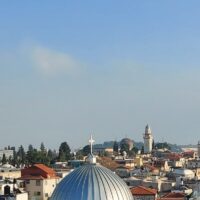
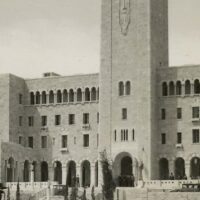
The Jordanian army took control of the Old City in 1948, which led to the expulsion of the Jewish population from the Jewish Quarter. At the end of the war, Jordan controlled the entire Old City, and the rest of the city was divided between East and West, with the Jordanians controlling the neighborhoods of northern and southeastern Jerusalem, the Old City, and the Mount of Olives. During this period, there was continued activity of the different Christian denominations in Jordanian-controlled Jerusalem, both European and Eastern: Catholic, Orthodox, Armenians, Syrians, Copts, Ethiopians—all continued in the building of institutions and churches.
The renewed Muslim rule of the holy sites in Jerusalem led to a Muslim revival centered around the Dome of the Rock. It was mostly state-supported Islam; the times were marked by nationalism in the Arab world, modernism, and the decline of traditional religious institutes and ways of life. However, humans continued to look for answers to the enigmas of life, and there was the emergence of new Sufi teachers, such as Hashim al-Baghdadi of the Qadiri Order.
Since the end of the Mamluk period (15th century CE), two famous Sufi families—Al-Dajani and Al-Alami—lived in Jerusalem (see chapter) and contributed to the city’s transformation into a religious and spiritual center. According to Evliya Çelebi, who visited the city at that time, there were no less than 70 different Zawiyas in the city. Over time, many of the other important families—Husseini, Khaladi, and even some of the Nashashibis—became connected to the Sufi orders. And so, in Jordanian Jerusalem, we have a Shadhili-Yashruti group with members from the Husseini and the Dajani families.
In the At-Tur neighbourhood on the slopes of the Mount of Olives, a Zawiya was established around one of the prominent Shaykhs in Jordanian Jerusalem, a mystic whose disciples throughout the land still tell wonders about—Shaykh Hashim al-Baghdadi of the Qadiri Order. There is Sufi activity on the Temple Mount itself and in other places throughout the city; the Afghan Qadiri Zawiya and the Uzbek Naqshbandi Zawiya (discussed in a previous chapter) continue their activity as well.
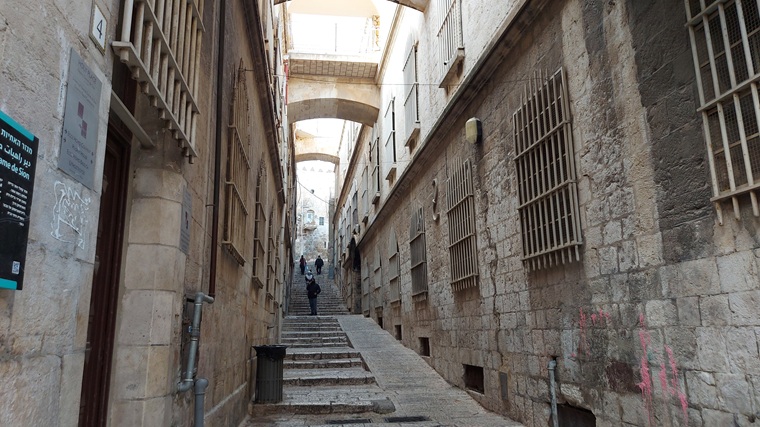 Mawlana Street in the Muslim Quarter of Jerusalem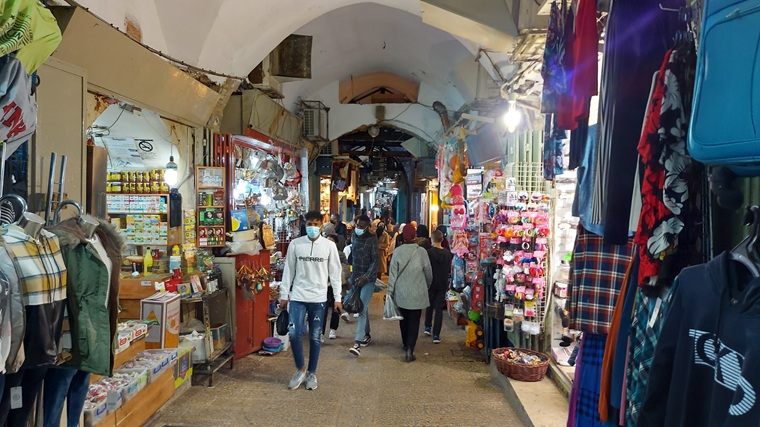
Market Street, Old City, Jerusalem
Shaykh Hashim al-Baghdadi
Muhammad Hashim al-Baghdadi (1905–1995) was the head of the Qadiri Order in East Jerusalem for many years. He was a third-generation resident of Jerusalem from a family who came from Baghdad, descended from the Prophet Muhammad; his father was a Sufi Shaykh, so the spiritual light was passed down in the family. In 1935, after completing his initiation, he took over the leadership of the Qadiri Order branch in Jerusalem from Shaykh Salih al-Sar’aini, with the approval of the other Shaykhs. Additionally, he received spiritual initiation in an Uwaisi way (spiritual communication with a deceased person) from Fatimah, daughter of the Prophet Muhammad and one of his ancestors, as well as from the important Egyptian Shaykh al-Badawi, who lived in Egypt in the 13th century.
Hashim al-Baghdadi was close to the Husseini family in his youth, was recruited to the national cause, and became known as a fearless fighter in the Arab Revolt of 1936 and the War of Independence. Contrary to popular belief, the members and leaders of the Sufi orders participated in the holy war (Jihad), and they often led units of followers, as in the time of Saladin. The issue was not whether to fight or not, but to preserve one’s humanity under all circumstances while fulfilling one’s duty, as Arjuna is commanded in the Mahabharata, the Indian national epic, before going reluctantly to war with his relatives and brothers. Al-Baghdadi viewed Saladin as a student and successor of Abd al-Qadir al-Jilani, founder of the Qadiri Order.
During the Great Arab Revolt, al-Baghdadi was arrested by the British authorities, and following a vision he had, moved to Damascus, where he completed his education. In the early 1940s, he returned to Jerusalem and established a home and Zawiya on the Mount of Olives, and later became the Imam of the Salman al-Farsi Mosque.
Shaykh al-Baghdadi was granted mystical visions in which he met Al-Khidr—the Muslim guide of souls—the prophets, and the Prophet Muhammad, Messenger of God. Many of the visions were connected to the Temple Mount plaza, the gates, the Dome of the Rock, and the al-Aqsa Mosque. Al-Baghdadi met Al-Khidr and discussed matters with him in the cave beneath the Dome of the Rock. The encounter had a purifying effect.
The Sufi mystics of Jerusalem had the privilege of going to pray on the Temple Mount, especially on Laylat al-Qadr (Night of Power – 27th Ramadan, when the Qur’an was first revealed to the Prophet Muhammad) and Laylat al-Isra’ wal-Mi‘raj (the Night Journey), both of which were linked to their personal mystical experience. Praying and meditating at the place where the Night Journey occurred helped them complete their own journey and ascent.
Over the years, the Lesser Jihad in which al-Baghdadi participated (the wars) turned into the Greater Jihad—the war against the lower self (Jihad al-Nafs), which is a spiritual state. Indeed, in his Zawiya on the Mount of Olives, Shaykh al-Baghdadi led the Dhikr into the night. The ecstatic, repetitive movement of the participants, the singing and recitation, the effort and the absorption, cleansed the energy of the Holy City and allowed for a new beginning in the morning.
After the Six-Day War, Shaykh al-Baghdadi completed his transformation and preached for peace and dialogue with the Jews, not in the political sense but on a human, person-to-person basis. He emphasized that we are living in the time of the False Messiah, after whom the True Messiah will come [2].
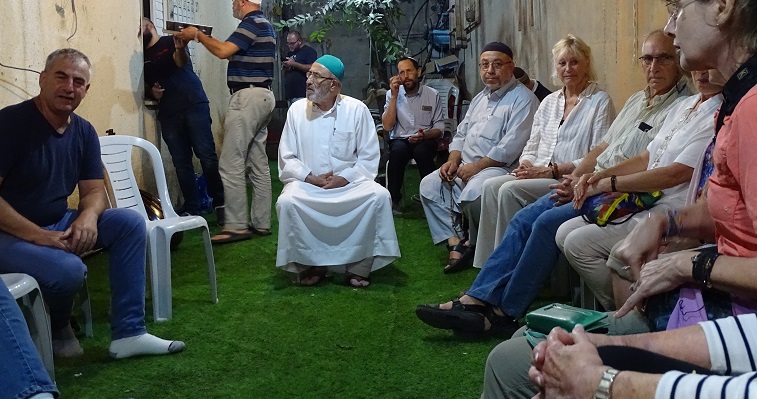
Dhikr of the Qadiri Order
Following is an explanation by Shaykh Ghassan Manasra, the student and son-in-law of Shaykh al-Baghdadi, about the Dhikr practice of the Qadiri Order: The essence of the Dhikr is the public recitation of God’s name aloud, with several phrases that are repeated. In the simple way, the name Allah is repeated in three tones, from low to high, starting slowly and gradually increasing the pace to a very fast rhythm, or until the Shaykh stops the Dhikr.
When the pace of the Dhikr begins to increase, a singer enters the circle and chants religious songs and verses from the Qur’an, moving around the circle counterclockwise while chanting. The singer stops next to each person participating in the circle and sings a religious song, a song of love for the Prophet, or praise of God. With the song, he penetrates the heart of the person next to whom he stops. The person performing the Dhikr continues to say “Allah” at the same time that he is listening. At the same time he is transmitting, he also receives. At the same time he is sending, he is absorbing. The Dhikr allows for two-way movement. It allows for separation between the mouth and the ear. The mouth utters the words on its own, and the ear receives the song and brings it into the heart.
The tongue utters the word and returns it into the heart, where the main work is done. The heart receives the spoken word and processes it within. The word enters the heart, and the heart dissolves it, creating a direct connection with the manifestation of the Divine Light. Afterward, the word leaves and circulates in the participants’ circle.
The role of the Shaykh is central; Dhikr cannot be performed without a Shaykh. His mission is to connect the group with the Light of the Prophet, which passes directly through him. The group cannot enter the state of true Dhikr without connection to the Light of the Prophet coming through the Shaykh. The Shaykh prepares his students spiritually, mentally, and physically for the performance of the Dhikr.
When the Dhikr begins, the Shaykh feels the light within him dispersing in all directions of the circle. This is a hidden spiritual light that the eye cannot perceive. It can only be felt. It is an internal feeling that cannot be described. The light flows directly from the Shaykh’s heart and enters the hearts of the participants. The Shaykh feels everything that is happening with every single person in the group and reacts accordingly. If the Shaykh feels, for example, that one of the followers is beginning to enter a state that he cannot contain, he approaches and places his hand on the follower’s heart, and the follower returns to his normal state.
The Shaykh opens the Dhikr, and throughout he directs the group and every single member of it. He is the director of the hearts; he directs the voice to be in one tone so that the group unites into one heart. The power of the group is expressed in the Great Heart. If we enter the Dhikr circle, we will be connected to the light in the Shaykh, and it will bring us all to one great heart. This heart coalesces until it contains a much larger amount of light than the heart of the individual. Therefore, the rank of the “Great Heart” is higher than the rank of every single heart. And everyone in the group receives it.
The Dhikr ceremony is held on Monday or Thursday evening each week. Monday is the day the Prophet Muhammad was born, and Thursday is the day connected to Friday, the holy day. This is the night when the angels are scattered everywhere on Earth. The ceremony is held between the evening and night prayers, or after the night prayer. Sometimes the ceremony lasts for many hours, depending on the state of the followers.
The place where the Dhikr acts and influences is the heart. When we perform the Dhikr, we disconnect from the world and leave the body. When we return to life, it is as if we have emerged from the sea onto dry land. The drops of water disappear over time, but they remain internally, within the heart. The heart is a container and the guide of the human. If the heart changes, then all of a man’s actions and behavior will also change.
The person who performs the Dhikr changes. First of all, he feels joy on his forehead and within his eyes. Joy generates positive actions. Within man’s spiritual system, joy is an inseparable partner of love. If we have reached joy, we have reached love. The natural place of love and joy is the heart. And when joy and love enter the heart, they remove every black stain and cleanse it.
Countless Dhikr ceremonies were held in Shaykh al-Baghdadi’s Zawiya in Jerusalem, as in the various Zawiyas in Jerusalem for hundreds of years. For the followers of Shaykh al-Baghdadi, the presence of the Shaykh and the holy moments of the ceremonies are what made Jerusalem special. They are the ones who vividly recreated Muhammad’s Night Journey. They are the ones through whom the world exists, creation is renewed, and abundance flows to the world.
The Muslim holy places in Jerusalem cannot be discussed without relating to the activity that took place in them, the emotions and energies that were invoked by living people. They are the ones who brought the stones and buildings to life, and this is true for the Jewish and Christian holy places as well.

Footnotes
[1] Azaryahu, M., & Reiter, Y. (2015). Geo-Politics of a Pantheon Creation: The Burial of Muhammad Ali in Al-Haram al-Sharif/Temple Mount, 1931. Jerusalem: Jerusalem Institute for Israel Studies.
[2] Abu Ras, K. (2023). The Sufi Shaykh of Jerusalem: The Life and Teachings of Shaykh Muhammad Hashim al-Baghdadi. Tel Aviv: Edra.