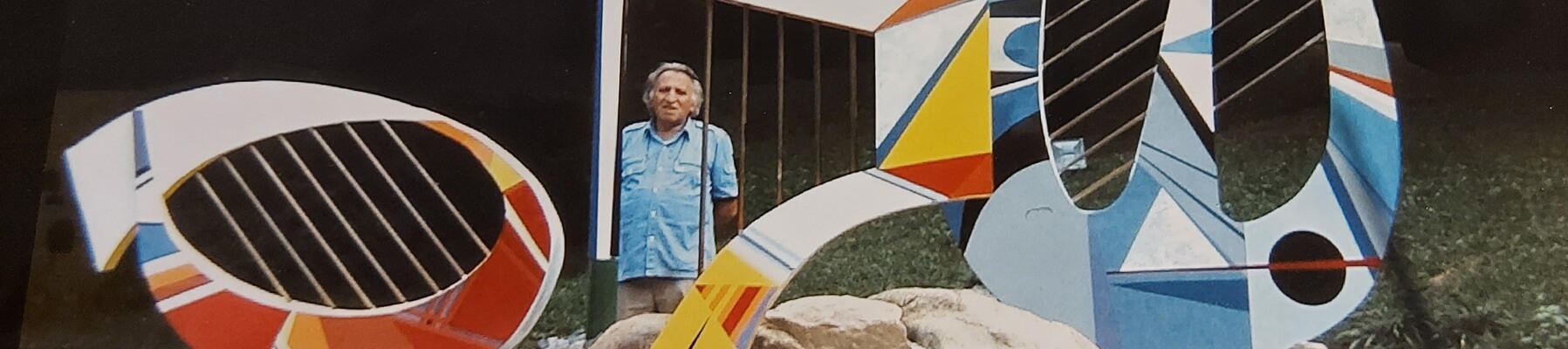
Boris Schatz
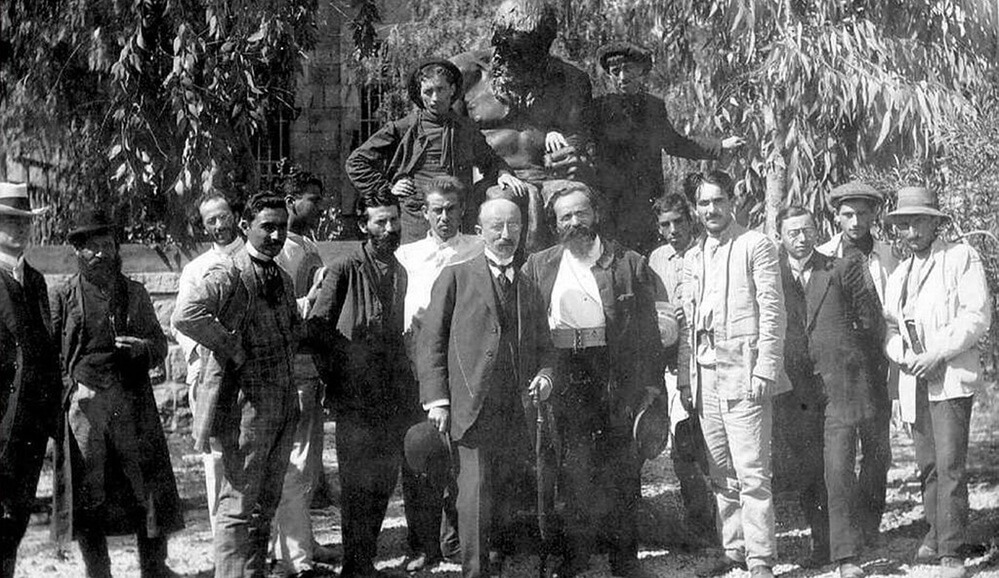
Boris Schatz was a famous sculptor and painter who established the Bulgarian Academy of Art in Sofia, which he headed from 1895 to 1905. In 1903, he became a Zionist following a meeting with Herzl, and upon completing his work in Bulgaria, he immigrated to the Land of Israel and established an art center there in 1906, which later became the “Bezalel” School of Arts and Crafts. In 1908, together with friends, he established the “New Jerusalem” group, which aspired to renew the face of Jerusalem based on the ideas of socialism, idealism, and the Arts and Crafts movement.
In other words, the first attempts at communal living, which predated the founding of the kibbutz, took place two years earlier in Jerusalem. Among the members of the “New Jerusalem” group, amongst whom were Yosef Nahmani, Menachem Shmueli, Alexander and Tzipora Zeid, Yehezkel Hankin, and others. Schatz supported Hebrew stonemasons of the Second Aliyah, and they moved to the city and lived a life of cooperation and labor, as a prelude to cooperative settlement in other places.
After 1908, many of the first stonemasons left, and in their place, intellectuals such as Rachel and Yitzhak Ben-Zvi, Eliezer Ben-Yehuda, and later also David Ben-Gurion joined the movement. They established a newspaper and educational institutions (the Gymnasia), but all of this came to an end during World War I.
In 1918, Boris Schatz was forced to stay for several months in Tiberias due to World War I. There, in exile, he wrote his utopian novella The Built Jerusalem, which describes his meeting and journey in the land in the company of Bezalel ben Uri, the builder of the Tabernacle, one hundred years later, in the year 2018. A central chapter is dedicated to the description of Jerusalem, at the center of which—on the Temple Mount—the Third Temple is built, serving as a museum and a center for art and culture. The Dome of the Rock was moved, with the consent of the Muslims, to the Jaffa Gate area. The residents enjoy progress and creativity in cooperative life within the framework of cooperative societies. However, it seems that the optimism was premature.
The Connection Between Art and Religious Experience
It was John Dewey in his book Art as Experience (1934) who argued that the aesthetic experience is what gives meaning to life, elevating us from the plane of the ordinary and the mundane into the unified, the moving, and the empowering. Man is a living creature in interaction with the environment, and this interaction occasionally allows a glimpse into another reality, another mode of perception, through the aesthetic experience. This does not invalidate the role and importance of art for its own sake, but rather emphasizes its role as a guide, and the role of the buildings designed to display it (some of which were built in a way intended to support the aesthetic experience—for example, a smooth wall behind the painting or spacing between paintings) as a kind of temple designed to sanctify this experience.
Museums as Temples
The temple of modern Western society is, to a large extent, the museum, if only because the original temple was intended to evoke a religious experience, whereas the temple-museum is intended to encourage an aesthetic experience. The two experiences are similar to one another in that they redeem man from an ordinary, mundane, and one might even say boring mode of perception, activating in him another mode of perception associated with other states of consciousness.
Mircea Eliade argues that religious experience is natural and essential for our lives, therefore in a secular culture like ours, the structures of religion are found in other places. Thus, in my opinion, one can understand the emphasis on art in the modern era and the construction of magnificent museums all over the world, starting with the Louvre in Paris, continuing with the British Museum, museums in the United States, museums in the Vatican, and so on. Much of the art of ancient times was linked to religious expression, and in the modern era too, art, which takes on an abstract tone, is intended to express ideas and offer a direction for mankind. Many of the artists who led the abstract painting movement were influenced by spiritual movements such as Anthroposophy and Theosophy (Kandinsky, for example), and the presentation of their art in museums, and sometimes even the structure of the museums themselves, expresses the importance of society’s search for spiritual directions, a new religion.
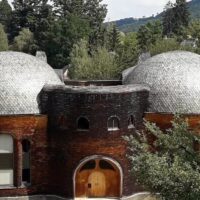
In Jerusalem is one of the most famous and important paintings by Paul Klee, who was, one might say, a kind of prophet of the new era. A painting called Angelus Novus, or by the name given to it by Walter Benjamin—the Angel of History. It is the figure of an angel with large eyes, a giant head, and hands raised upward in a posture of prayer, who, according to Walter, appears to be moving away in terror from the “pile of debris of history” that keeps growing higher and manifests in our time, while he is thrust by a storm wind toward the future. The painting recalls Steiner’s attempt to create a sculpture of the new man—”The Representative of Humanity”—at the Goetheanum in Switzerland, at roughly the same time and against the backdrop of the same cultural climate.

Art and Spirituality
In 1912, Wassily Kandinsky published his book Concerning the Spiritual in Art, in which he argues for several stages in the encounter with a work of art. First, sensory impression. Following that, and concurrently, improvisation—an internal, spiritual impression. This stage will differ for each and every person according to their psychological makeup. And finally, after further processing, the composition is created—an arrangement in space, an intellectual action involving consciousness, which also integrates prior points of reference into the process.
According to Kandinsky, the relationship between nature and art leads to a cognitive psychological affect accompanied by metaphysical symbolism (that is, the artist discovers the divine hierophanies present in nature). The artist must lead society toward evolution, toward a new perception of forms in nature. It is as if someone implanted in man a series of impressions received from the environment in which he lives, within which hints toward the spiritual evolution of mankind in the future to come were embedded. In other words, art expresses the spiritual, the ideal, and also directs and summons it.
In ancient times there was a clear and strong symbiotic connection between art and spirituality. The first works of art were made in a religious context, and particularly in Jerusalem; Hiram Abiff, the builder of the Temple, was a man full of wisdom, understanding, and knowledge who knew how to perform craftsmanship, and even earlier, in the days of the Tabernacle, the first Jewish artist, Bezalel, played a crucial role.
God created the world, and the creative process is the closest thing to this act. The point is to connect with objective art (and such art exists), which touches upon universal archetypes related to the higher parts of man existing within and his perception. This is what artists have tried to do throughout the generations, including in Jerusalem, and even more so with the awakening of the city in the 19th century and the massive construction of religious buildings within it, and during the Mandate period when religious freedom was granted and the city’s unique cosmopolitan character was encouraged.
Thus, we find many artists visiting Jerusalem during the Mandate period (such as Marc Chagall) as well as those who create and live there. Jewish immigration brings many artists to the city, but so does the British administration and its associated societies that encouraged art, such as the Arts and Crafts movement (see article). Christian organizations, and particularly architect Barluzzi, bring artists to the city. Within the framework of artistic architectural projects—such as in the YMCA building—there is collaboration between Jewish and Christian artists, particularly in the context of shared interests and membership in shared societies such as the Freemasons.
In the 19th century, painters from various painting schools arrived in Jerusalem and received inspiration and direction for their work there, famous painters such as William Hunt – Symbolist painting, or James Bartlett – the Sublime. In the 20th century, many more followed
According to Ashbee’s grand concept of the city, the Tower of David became an exhibition center and essentially a large gallery. The Association of Hebrew Painters and Sculptors encouraged local artistic activity in Jerusalem and throughout the country.
Mordecai Ardon and Stained Glass Windows in Jerusalem
Abstract art was supposed to lead humanity to new thought, a different kind of awareness, and modern spirituality, but it didn’t fulfill its promise, however Jerusalem abounds with this type of art to this day—one of the most prominent examples, quite literally, being the Chords Bridge at the entrance to the city. The bridge, the creation of the world-famous architect Santiago Calatrava, brings the horizontal experience of Jerusalem at its entrance point, through the cables and the shape of the angular line, into the vertical dimension. The simplicity, size, and clarity of the lines—diagonal and perpendicular—in contrast to the surrounding hustle and disorder, allow a different kind of experience for anyone open to it, rather than for someone preoccupied with “how much it cost.”
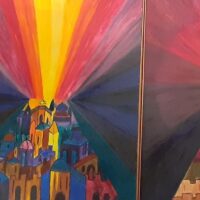
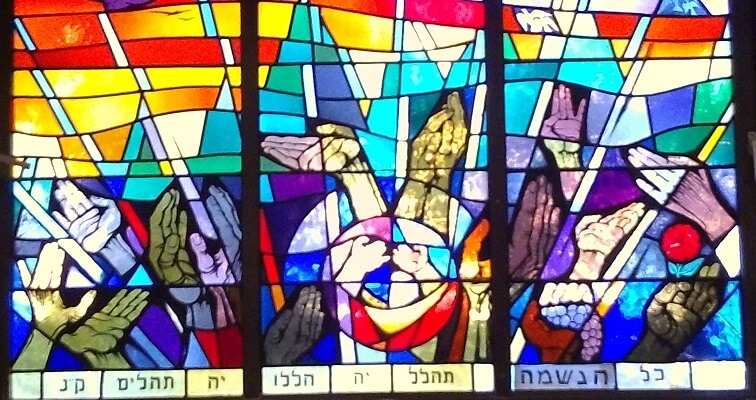
But returning to more classic examples of abstract and spiritual art in Jerusalem, one of the best examples is the monumental work of the painter Mordecai Ardon: the passage of stained glass windows in the former National Library building at Givat Ram. Ardon was a student of Kandinsky and Paul Klee at the Bauhaus school in Germany, and later became a famous international artist in his own right, who painted the landscapes of Jerusalem and found in them a hidden metaphysical meaning also linked to Kabbalistic theories, as appears in his works. The creation of the Ardon Windows was carried out in the 1980s after the death of his wife and was apparently part of his process of recovery. It is based, according to him, on contrasts between colors—blue and red—shapes, and motifs, in a way that leads to resolution, as every great work of art that encompasses an aesthetic experience. The work highlights the centrality of the city, its blood-soaked history, and the vision and possibility of Tikkun (rectification) and the transformation of Jerusalem into a temple for all nations in the spirit of Isaiah’s vision.
Parallel to the execution of this work, and perhaps in competition with it, another wonderful colorful stained glass window was installed in a large and important public building in Jerusalem: the stained glass windows of the Great Synagogue, made in 1982. It was created by the French-Jewish artist Regina Heim, and similarly to the stained glass in the National Library, it also integrates Kabbalistic motifs.
Marc Chagall and Nicholas Roerich
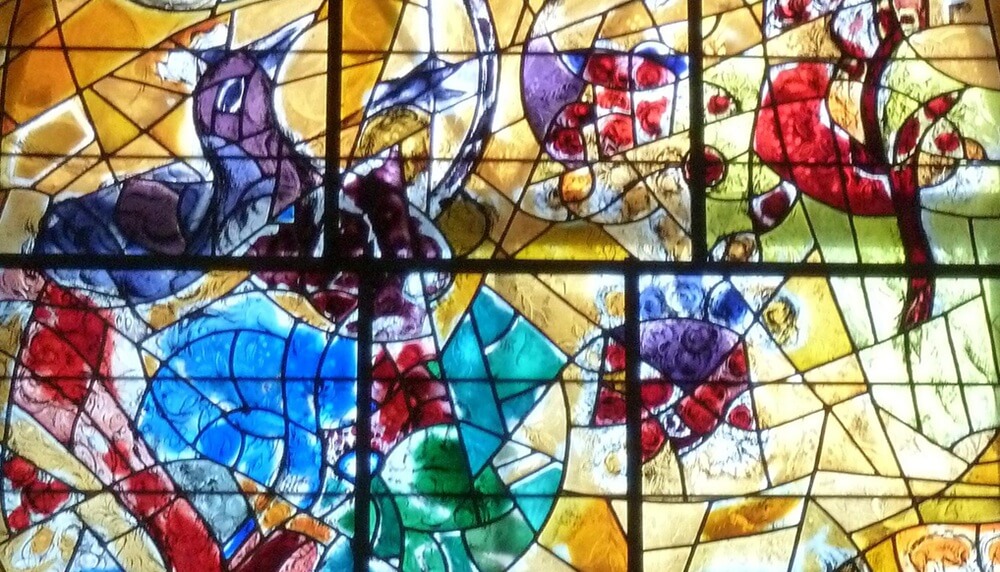
Marc Chagall (1887–1985) is the most famous Jewish painter of all time, and it can be said that his life’s mission was to bring the spirit of the Jewish shtetl that disappeared from Eastern Europe, with its spiritual and human aspects. In Jerusalem, there are three buildings where his art appears on a large scale: the first is the synagogue of the Hadassah Hospital, where one of his most important and famous art works is integrated—the stained glass of the Chagall Windows, with representations of the twelve tribes. Equally important works are located in the Chagall State Hall in the Knesset building, where there are mosaics and tapestries that he created. The third building is Binyanei Ha’Uma (The International Convention Center), where there is a relief of his and replicas of the windows. Chagall’s world is full of color and symbolism, with wondrous figures and recurring motifs.
He was born and raised in a town near Vitebsk in the Jewish Pale of Settlement—a place that was the heart of the Hasidic movement—to a destitute Hasidic family. He studied in a heder, but thanks to his mother’s support, he reached a modern school and art studies, and at the age of 19 moved to St. Petersburg, where he studied at the school of the Imperial Society for the Preservation of Fine Arts, a school whose director was the renowned painter and mystic Nicholas Roerich. This secured him a study scholarship and also protected him from military conscription.
Roerich was an impressive figure, among the most prominent cultural figures and painters of Russia in the first half of the 20th century, but beyond that, he was also a researcher, archaeologist, philosopher, and mystic. Roerich is considered the most important painter of Russian history and its greatest landscape painter. In his paintings, he combines Byzantine-Russian mysticism with the modern, historical motifs, and visions of tomorrow. Within Russian Christianity, there is a mystical current called Hesychasm and traditions of enlightened people—elders residing in monasteries across the vast country. This current has its own books, such as “The Book of the Dove,” and it experienced a revival at the end of the 19th century, part of which was connected to special individuals from the Russian Church who active in Jerusalem—see the chapter on Russians in Jerusalem.
Roerich was influenced early in his career by the ideas of Russian mystical Christianity, and he was also close to Russian mystical circles outside the Orthodox Church, such as the Sophiology movement, Vladimir Solovyov, Dostoevsky, and also to modern esoteric movements, particularly the Theosophical Society. In 1899, he met his soulmate, partner, love, and source of inspiration, Helena Roerich, who became his wife in 1901. Together, they journeyed across Russia in the years 1903–1904 to collect the sparks of light from all the special places and ancient monasteries, while simultaneously engaging in discovery, preservation, and documentation. Helena was interested in Eastern philosophies and teachings, and she infected her husband with this interest as well. She was a channeler who claimed that Master Morya, who revealed knowledge to Helena Blavatsky, appeared to her revealing knowledge that was set down in writing in a series of books such as Fiery World and Supermundane, The Inner Life, Leaves of Morya’s Garden, and more. The two founded the Agni Yoga Society, which combines Eastern and Western spirituality, in 1920. In later years, they launched study and discovery expeditions to Tibet and brought Tibetan Buddhism to the West.
It is difficult not to notice the similarity between the work and path of Roerich and Chagall, and it seems that their encounter was synchronic. First of all, Chagall’s first important works were in 1908 in Vitebsk, after two years of studying under Roerich. It was then that he also met the love of his life, and similarly to Roerich, she was the one who inspired his path forward. His first known painting is a view from a window, which corresponds with Roerich being a landscape painter. But the main point is that Roerich attempts through his paintings to discover, document, and preserve the Russian spiritual-religious heritage while transferring it to a universal-mystical dimension, and Chagall does exactly the same with the local Jewish heritage. Art is a way to discover a spiritual reality.
In addition, both Chagall’s and Roerich’s art is symbolic; it has a kind of language of its own. With Chagall, it is angels, flying figures, a rooster, etc. Furthermore, in both of their works, one finds a brilliant and prominent use of colors. Both also long for a kind of mythical homeland; with Chagall, it is the shtetl or representations of Jerusalem; with Roerich, it is rural-Christian Russia or Shambhala and the Himalayan mountains in the second stage of his life. I am not claiming that Roerich was the primary influence on Chagall or that he was a direct teacher of his, but rather that synchronically the two men met, and it is possible that this meeting played a role in shaping the artists they became. In 1931, Chagall visited Jerusalem for the first time and painted landscapes of the city, and in 1977, he became an Honorary Citizen of the City of Jerusalem.

International Style and Garden City in Jerusalem
Kandinsky, together with Paul Klee, started the architectural school of the Bauhaus in Germany, from which developed the International Style that greatly influenced building and planning in the Land of Israel in general—with an emphasis on Tel Aviv—and in Jerusalem in particular, where some of the movement’s most important architects operated: Richard Kaufmann, Leopold Krakauer (who was also a painter), and Erich Mendelsohn. This style manifests in horizontal lines, in a building that flows into its environment, and in functionality. It suited the pioneering spirit and the limited resources of the early settlers, but the high ceilings and numerous balconies bring a sense of well-being to those living in them to this day. The new International Style also suited the concept of Jerusalem as a microcosm and influenced the character of the people who resided in the neighborhoods where it was present. It was meant to serve the needs of life so the residents could focuse their lives on their things, preferably on their spiritual quest. However, there was no reference to this suggestion of mine from the outset, and I bring it as someone who knows how these houses feel from the inside.
Kaufmann, who planned several of Jerusalem’s neighborhoods such as Rehavia, Talpiot, Beit Hakerem, and Kiryat Moshe, was influenced by Ebenezer Howard’s Garden City theories, and this is what gives these neighborhoods their beauty and relaxed character to this day.