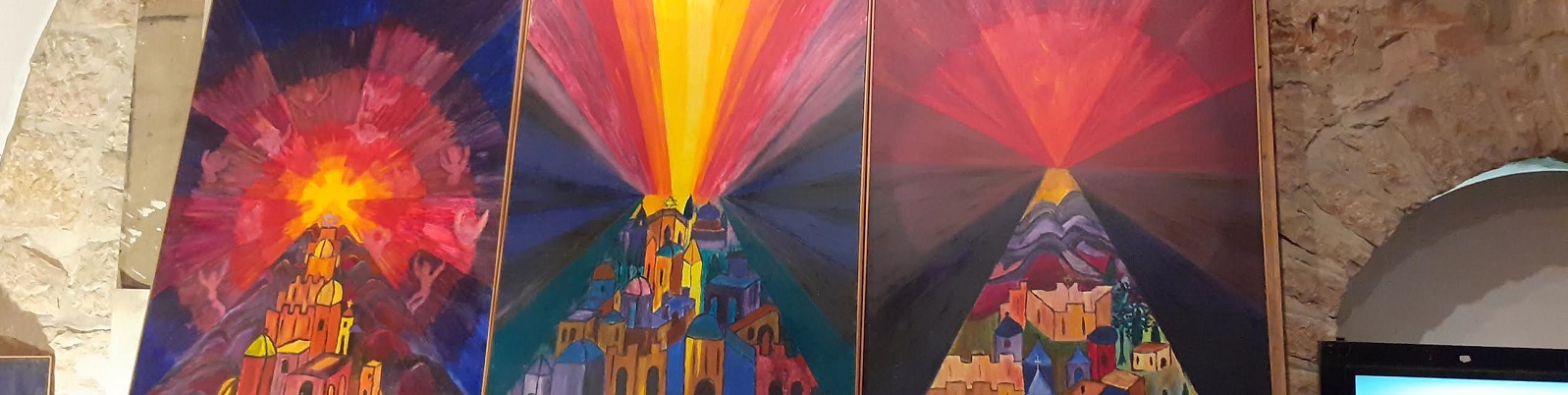
Jerusalem, the City That Was Bound Together
In the year 1967, the miracle of the Six-Day War occurred; the city that had been divided was bound together, Jews returned to pray at the Western Wall and to visit the Temple Mount, the Divine Presence rested for a brief moment upon the land, and there was a feeling that anything was possible. The 1960s were also a period in which the world opened up to spirituality, to a new being and experience of the hippie generation. The moral rigidity that began in the Victorian era and was full of hypocrisy, discrimination, and separation dissolved, and in its place came emphases on love and universality, freedom and equality. The spiritual revolution of the 1960s foretold a new world, drawing part of its inspiration from Eastern religions – Buddhism, Yoga, Zen, and Hinduism as they were presented to the West – and another part from Christianity, Jewish, and Islamic Mysticism as well as original thinkers, use of psychedelic drugs use and more.
Alongside love and liberation (including feminism), many spiritual movements began to appear that we today call “New Age movements,” or New Religious Movements. Part of the inspiration for these movements came, as mentioned, from Eastern doctrines, but another part stemmed from the mysticism of familiar religions, from original thinkers that related to the modern way of life, which no longer suited old religious concepts. For example, in new age spirituality there is an emphasis on the individual and self-fulfillment, in contrast to obedience and negation of the ego that characterize the old religions. The developing Western affluent society, the relative peace that prevailed in the world, and the turning of one’s back on traditional religions and nationalisms that had disappointed – all of these allowed new energies to be directed toward something innovative and different from what had before. Spiritual knowledge of different traditions was open for whoever wanted it, and the Western way of life provided time and conditions for those who were willing to give up a career to engage in spiritual practice of one sort or another.
This global process also reached Israel, especially after the astounding victory of the Six-Day War. It seemed as though the security danger had passed and the dream had come true, and there was no longer a need to direct all energy and resources toward the security-national direction. Knowledge from the East and contemporary spiritual doctrines arrived in the country and found fertile ground here, as did the new Western music and the “hippie” lifestyle. There was no longer a need to apologize for the fact that a person had not served in the Palmach; cultural heroes appeared in the fields of poetry, fiction, theater, and dance, and ultimately also in the spiritual realm. People like Shlomo Kalo, for example, became popular even though they drew their part of their inspiration from foreign sources.
The New Age Movement
The beginning of the New Age is considered to be the 1960s, the hippie revolution, but its realization happens in the 1980s and 1990s. In the 1960s, there was a youth revolution against the establishment (Bob Dylan: you can’t trust anyone over 30), which had leftist political implications: Che Guevara, etc. In the 1980s, the movement encompasses all ages, the political dimension disappears, and it becomes more related to spirituality and self-fulfillment. There is no rebellion any more only spiritual growth. Hanegraaff refers to the New Age and defines it from the year 1975, and includes only sources that have the spirit of the 1980s – a time when the movement reached its peak. He also defines it as Western, industrial, and refers to English sources. This movement adopts world mystical literature: Buddhism, Sufism, Kabbalah, and also psychology and self-fulfillment. Hanegraaff distinguishes New Age movements from the New Religious Movements of the late 19th and early 20th centuries.
New Age movements differ from new religions in that they do not have a normative doctrine, recognized leaders, or shared practices. There is a difference between a cult and a current – a sect. The New Age is not necessarily related to cults, but rather it is a free current of thought, and some would also say, consciousness. Its characteristics are universality and self fullfilment, as well as a connection to the environment. These are ideas that appear through a new literature; a cluster of phenomena that are linked to one another by contact of contiguity, and which share a similarity in the beliefs they promote and the questions they try to answer.
Hanegraaff notes five categories that are an essential part of New Age movements: channeling, healing and growth, new science, neo-paganism, consciousness and positive thinking. He notes one hundred representative books that were published over a period of two years, from 1990 to 1992. According to his claim, the New Age is a popular, eclectic phenomenon, related to culture. Unlike structured religious movements that possess a rigid hierarchy and dogma, it was a spontaneous, open popular movement.
According to Hanegraaff, in the 1960s alternative communities were established, with Findhorn in Scotland being the example. The perception changed: no longer waiting for the apocalypse, but building life now. The New Age in the narrow sense started in England and was influenced by Theosophy and Anthroposophy, and in the broad sense at the end of the 1970s and the beginning of the 1980s a mass movement of alternative ideas began. In America, “New Thought” appeared, metaphysics, a search for a new paradigm influenced by Eastern doctrines and an eclectic collection of teachings, channelings, Kabbalah, and more.
One of the differences between the New Age approach and that of cults and religions is the question of whether the new time will be one of transformation, light, and love, or an apocalypse. In the New Age movement, the prevailing understanding is that change will come within existing frameworks – the world will continue to exist but a new consciousness will develop; consequently a new culture will appear. Furthermore, the question arises whether there will be a messianic-like figure bringing a new gospel to humanity as the religions claimed, a teacher who becomes more than human, or whether the new time will be characterized by a spiritual archetype, such as the return of Christ in the form of light and love and new consciousness.
The New Age movement caught on in a most profound way in Israel, and several of its important teachers visited Jerusalem, and branches of their doctrine were established in it. I chose to tell about several movements with which I had a personal acquaintance, and famous figures who visited the city after its unification. This is, of course, not a complete list, but rather a starting point for research and thought.
Hanegraaff, W. J. (1996). New age religion and Western culture: Esotericism in the mirror of secular thought. Leiden: E.J. Brill
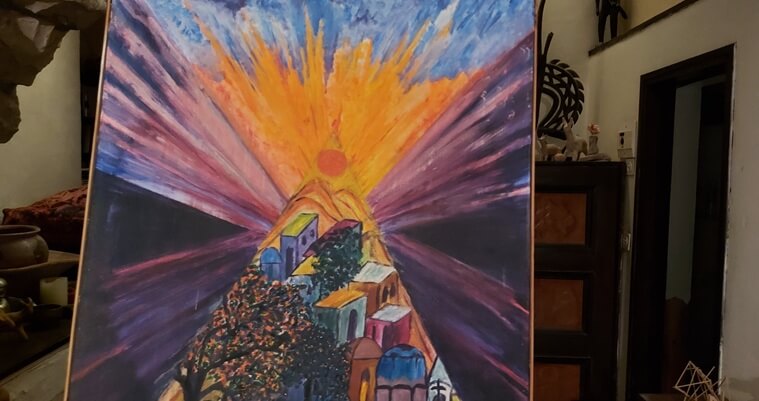
Spiritual Movements in Jerusalem
The 1980s and the beginning of the 1990s were the time when there was a possibility for development of a new consciousness, and a spiritual turning point for human society, which would complement the freedom and prosperity of Western society and the investigative spirit of science. before the Communications Revolution and the breaking of post world war order, there was a feeling of possibility of spiritual progress.
In Jewish Jerusalem at that time, there were several groups of path-seekers that usually included the best of the youth, both those connected to global movements and local initiatives. At the beginning of the 1980s, there was already tension in the air between Jews and Arabs in the Old City, but there was also an illusion of peace and the possibility of coexistence, until everything ultimately shattered in the first Intifada in 1987. However, in 1993 the Oslo Peace Accords were signed between Rabin and Arafat, and for a brief moment there was a feeling that everything was possible again, and then came the terrorist attacks and the second Intifada. In parallel to them, the global processes of the emergence of the internet and later of social networks, and the gate closed for the time being.
In Jerusalem, there were branches of Anthroposophy and Theosophy dating back to the Mandate days, but in the 1980s, cult-like groups were added, such as “Emin,” the Fourth Way, Scientology, Osho, and others. There were, of course, the traditional mystical movements that we have discussed at length and which received a new dimension, but with the gaining of legitimacy for engaging in alternative fields in the 1990s and even earlier, countless groups, local spiritual teachers, channelers, healers, and so on appeared. Among the serious local movements that operated in Jerusalem, one can count the Argaman circles of Pascal Themanlys, the White Brotherhood of Aïvanhov and Deunov, the students of Colette Aboulker-Muscat, the students of Yosef Safra who later established the community of Neot Semadar, the Gurdjieff groups – one of whose focal points was the Alexander Technique teacher Shmuel Nelken – and of course many Buddhist and Yoga groups, shamanism, and more.
After the liberation of the Old City, a new phenomenology of holiness developed, connected to nationalism around the Western Wall plaza, and parts of Religious Zionism took on a messianic tone. The presence of Evangelical groups from the United States increased with the rise of the status and influence of the great friend of the State of Israel, and thus a Mormon university and other Evangelical institutions were built in Jerusalem. Among the many tourists who began flocking to Jerusalem were many important global spiritual teachers, and suffice is to mention Thich Nhat Hanh and the Dalai Lama.
Pascal Thémanlys and Colette Aboulker-Muscat
Max Théon was a Jew of Polish origin; he was born in 1848, knew several languages, and was a mysterious figure – an occultist and Kabbalist who influenced the establishment of the “Hermetic Brotherhood of Luxor” in London. In 1900, he appeared in Tlemcen, Algeria – the burial place of Abu Madyan, the great Sufi of North Africa, the capital of Al-Jazairi’s rebellion, and the location of a vibrant and mystical Jewish community – announcing an esoteric doctrine that his wife, Alma Théon, channeled. Following this, a movement called the “Cosmic Movement” began.
Théon wrote about the people who lived before the appearance of Adam, about advanced ancient civilizations, and about the next stage in human evolution, claiming that all secrets lie within the Book of Genesis. Some say he was sent to spread external knowledge to the world on behalf of groups of Kabbalists in Poland, just as Gurdjieff received the blessing of the Naqshbandi order in Central Asia. Be that as it may, after his wife’s death, he sank into depression, and those who led the movement were his disciples Louis and Mirra Thémanlys, who established a kind of spiritual-cultural salon in their home in Paris. A prominent member of this circle was Mirra Alfassa, who later founded the spiritual community of Auroville in India. It seems that Théon planned to immigrate to Jerusalem, and in any case, he supported Zionism; ultimately, the son of Louis and Mirra Thémanlys fulfilled his vision.
Pascal Thémanlys (1909–2000) was the son of Louis and Mirra, a poet, an enthusiastic Zionist, and one of the unrecognized teachers of esoteric study in Jerusalem. In 1949, Pascal Thémanlys immigrated to Israel and worked at the Jewish Agency as the person in charge of relations with France, and even established the Israel-France Friendship Association. He was in contact with orthodox Kabbalists as well as with Gershom Scholem, Martin Buber, and Hugo Bergmann. After his retirement, he established study groups called the “Argaman Circles.” According to the group’s website, Max Théon knew how to read people’s auras and tell them what is the root of their soul, their reincarnations, and their rectifications (tikkunim). The circles exist to this day. And in the context of French immigration to Jerusalem, one must also mention Colette Aboulker-Muscat (1909–2003); she was one of the most interesting women of the 20th century – a channeler and healer who developed a spiritual method based on meditations and imagery drawing her inspiration from Kabbalah. She arrived from Algiers, lived in Jerusalem, and passed away there.
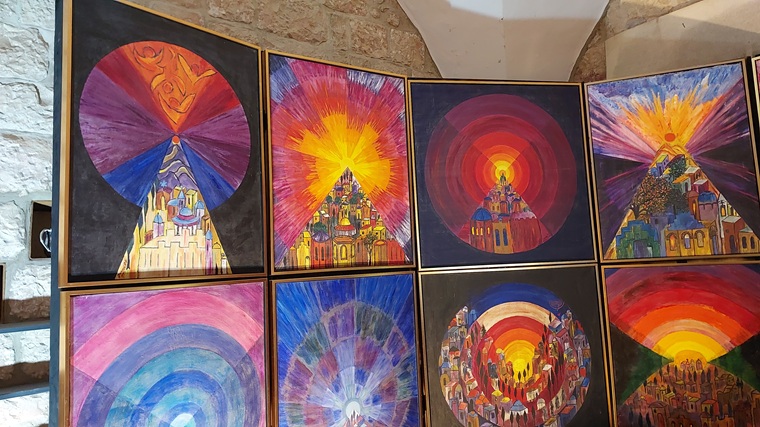
Yosef Safra – Spiritual Zionism
Yosef Safra was a theater man and a thinker, who from the 1960s onward engaged in personal development and consciousness and began teaching people how to know themselves, based primarily on the teachings of Gurdjieff, who claimed that people are essentially automata and asleep, and are unaware of who and what they truly are. Yosef was born in 1931 and was an impressive man with a clear and magnetic voice. From his years of maturity, he participated in plays and various cultural enterprises. At the end of the 1960s, he moved to live in the hippie colony of Rosh Pinna, and those who knew him say that he possessed great integrity and internal honesty, willing to “slaughter sacred cows” and unwilling to compromise on his truth and that of others. After ten years of experimentation in “the teaching” and in navigating community life and relationships in Rosh Pinna, he moved to Jerusalem in 1977, and there he began to gather around himself a group of young and talented disciples. Many of them were veterans of combat units and the salt of the earth who were dissatisfied with the socio-cultural crisis of the world and of Israel, with the values of the materialistic Western society, and the lack of meaning they saw around them.
The disciples met for regular weekly meetings at Yosef’s house in Jerusalem. Initially, a group was founded that met on Wednesdays, and later on, groups were founded on the other days of the week. The meetings always began in the same way: Yosef asked those present to bring up what they were going through, and when things were raised, he addressed them and showed the truth or the lack of truth within them. He focused particularly on the automatic way of thinking that conditions us and causes us to identify with that imaginary thing called the “ego,” and thereby separates us from reality and from the world. Twice a year, the groups went out to an abandoned ruin in the Judean Hills (not far from Neve Ilan). There they set up a camp for a few days, engaged in physical and spiritual activity (such as meditation), and held discussion groups. This was a time of consolidation and reflection of the self through the activity and the encounter with others.
In the 1980s, the teaching expanded and developed. Some of the group members began to work together in construction projects, and a kind of perception developed that through physical work, a person learns to know themselves and reach their limits; there lies the opportunity to witness the “automatic ego” and to develop consciousness that will subsequently bring true freedom and presence. In 1989, the members of the group decided that they were mature enough to establish a “school” for the full self-study of man – that is, a framework that would operate 24 hours a day and in which people would be a part. They thought that the best framework that would allow for such a “school” was a kibbutz, where there is also a fulfillment of the Zionist idea which Yosef Safra and his people loved. The kibbutz exempts a person from dealing with thoughts of livelihood and a daily schedule, and just like in a monastery, allows a focus on work – both physical and internal. At the same time, the people of Neot Semadar emphasize repeatedly at every opportunity that they are not a “kibbutz,” but a “school.”
Shmuel Nelken – Gurdjieff and Alexander
Gurdjieff was a spiritual teacher who operated at the beginning of the century and, according to George Hintlian, lived for a certain period in Jerusalem (see article on Indian Spirituality in Jerusalem). The central emphasis in Gurdjieff’s teaching is that man is controlled by the mechanical and automatic “self,” and the primary effort on the “work” is to break free from the shackles of that control; this is achieved through observation and self-remembering. Throughout their lives, people develop all kinds of identities that they think are their “I,” but in reality, this is not the true “I” but a personality – an ego – which must be discarded in order to connect with the essence. This process requires uncompromising self-observation, which is sometimes a difficult and frustrating process. What can assist this process is working in a group and relationships with others, during which the other reflects to you what lives within yourself. In other words, there is a difference between the “I” and the “self” which is more internal and essential, work is required to discover it. We are full of judgment, unfounded prejudices, mistaken assumptions, illogical expectations and hopes, baseless fears and worries about ourselves and about others. It is a long journey to get rid of them, or at least to know them, since the thought that we can get rid of our “I” completely is also a type of illusion.
Gurdjieff’s theories regarding the automatic ego correspond with the teaching of the Alexander Technique, which is a method for healing and correct posture. Frederick Matthias Alexander (1869–1955) was an actor who suffered from hoarseness and voice problems. After despairing of external help, he began an internal examination and discovered that his posture in relation to the back, neck, and head was not good while he was reciting. He began to work on himself and habituate himself to adopting a straight and relaxed posture, but when he came to practice and recite again, the problems repeated themselves. To his surprise, he discovered that despite his feeling that he was standing correctly, the reality as he saw in the mirror was that he was using his body in a distorted way just as he had done previously. His conclusion was that one cannot rely on the senses when changing habits, because they interpret the change with the help of the previous habit and only reinforce it. What is required is an intervention and an external criterion, and in his case, it was the work in front of the mirror.
Like Gurdjieff, Alexander also discovered that we are controlled by the “automatic ego.” Although it seems to us that we are in control and making decisions, and although it seems to us that we have changed, we cannot rely on our sensations; in fact, we are unaware, or in Gurdjieff’s language – “asleep.” In addition to this, Alexander discovered that the way to posture is first of all to project the thought and connect to external imagined line connecting the earth to the sky – a kind of axis like in the dance of the Whirling Dervishes. However, this cannot be done in a positive way (“doing”); one must let go, practice “non-doing,” and let the teacher guide the student with their hands on how to reach this place, while the teacher – who already has experience and familiarity with the field – works on themselves all the time.
It is no coincidence that the first teacher of the Alexander Technique outside of England was a man named Shmuel Nelken from Jerusalem, who was also very active in Gurdjieff study groups. Nelken established a school for teaching the Alexander Technique in his home in Rehavia, which was visited by dozens of people every day, some of them in a three year-long track of studies. Many of them were connected to the community of Yodfat, where there is a concentration of practitioners of Gurdjieff’s doctrine, or to other Gurdjieff groups throughout the country. In addition to the center in Rehavia, Gurdjieff study groups had a center in Ein Karem, at Aviva’s house, and Yosef Safra’s disciples who lived in a commune in Jerusalem also adopted parts of his doctrine. Today, several groups of the “Fourth Way” that incorporate Gurdjieff ideas operate in Israel. Shmuel managed the school for the Alexander Technique in Jerusalem for 41 years, from 1974 until his death in 2015.
The Dalai Lama
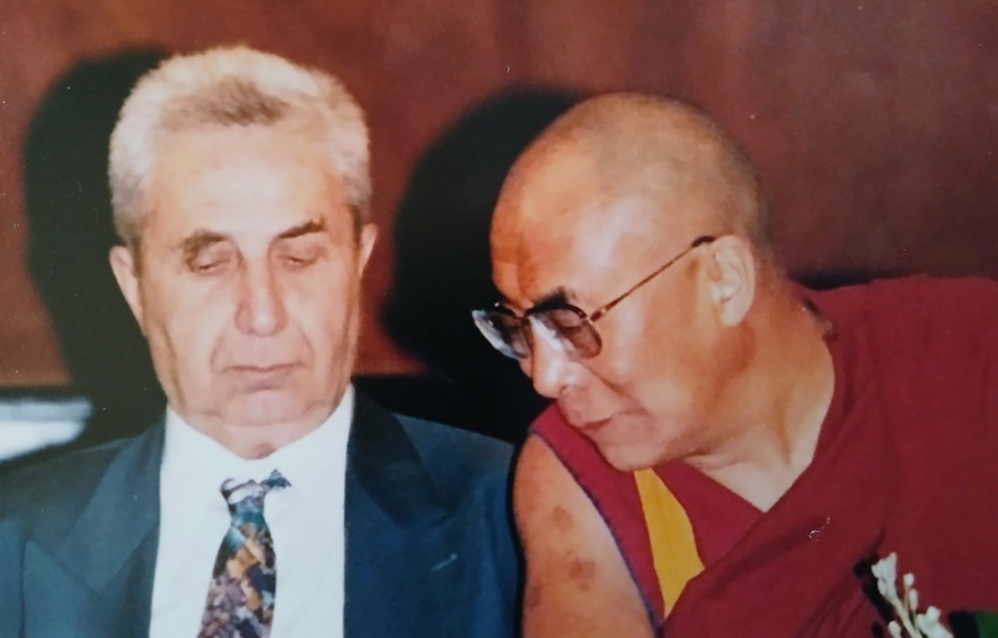
One of the spiritual giants of our time is the Dalai Lama (born in 1935), the spiritual and political leader of the Tibetans, who carries a message of peace, tolerance, and love throughout the entire world, despite the severe oppression of his people in his homeland. In 1994, he visited Israel, perhaps to energetically support the fresh peace accords. He visited the holy sites of the three religions in Jerusalem and also met with my father at the Hebrew University (he was the rector at that time, and the Dalai Lama received an honorary doctorate from him).
The Dalai Lama visit was not only a visit of peace but a connection between Eastern and Western spirituality. In Israel, there are many students of Buddhism in general, and of Tibetan Buddhism in particular, who view him as an enlightened teacher. Since then, the Dalai Lama has visited Jerusalem several times, participated in interfaith conferences, and met with chief rabbis and Muslim sheikhs, with his last visit taking place in 2006. He expressed interest in the ability of the Jews to survive for a long time in exile, and even joked that he is a reincarnation of Rabbi Yochanan ben Zakkai, who moved the Sanhedrin from Jerusalem to Yavne, preserving and renewing Judaism after the destruction.
Paulo Coelho
One of the most successful authors in the world is Paulo Coelho (born in 1947), the recurring motif in whose books is a spiritual journey in search of truth and personal development. Thus, for example, his first well-known book The Pilgrimage (The Diary of a Magus) tells of the journey along the Camino de Santiago, and his most famous book The Alchemist deals with a journey to Egypt in search of a physical and spiritual treasure. And if we are dealing with journeys and pilgrimages, there is nothing quite like Jerusalem for this purpose. Coelho published a book titled Manuscript Found in Acre, the plot of which takes place in Jerusalem in the year 1099, just moments before the Crusader conquest, but we are still waiting for the masterpiece that will be called “The Journey to Jerusalem” or a similar name.
In this context, it must be remembered that pilgrimage to Jerusalem was always part of the preparation for death. Paulo Coelho visited Israel for the first time in 1999, just before the year 2000, and visited it several times afterward as well. It is to be assumed that these visits assisted him in writing the book Manuscript Found in Acre. Coelho is the best-selling Portuguese-language author, and he represents a type of new South American and Latin spirituality.
Notes
[1] https://abpw.net/cosmique/argaman/morim/pascal-h.htm
[2] Parapsychology, p. 217