The Romans Become Christians
In 310 CE, Constantine the Great (reigned 310–337) ascended to power in Rome with the blessing of Jesus, who revealed the symbol of the cross to him on the eve of the decisive battle against his rivals. Thanks to this symbol, he won against the odds. After his victory, he made Christianity a legal and state-supported religion. It took him 12 years to gain control of the eastern part of the empire, after which he moved the capital to Constantinople (today Istanbul) and convened the Council of Nicaea in 325 CE, where the principles of the Christian faith were established. In Rome, pagan beliefs still held great influence. Therefore, Constantine moved the center of cultural and religious activity to Constantinople and established the new capital for the new religion there. Together with his mother, he began the construction of Christian Jerusalem, the Church of the Holy Sepulchre, and other churches in Israel and throughout the world.
Administratively, the empire was divided into East and West, but only at the end of that century, after the death of Theodosius the Great in 395, was it officially divided into two Empires. From that time on, the eastern part was called the Byzantine Empire, and it existed for more than a thousand years. The Byzantine Empire is an important part of the Christian cultural heritage. Its role and importance were downplayed for many generations by the hegemony of Western European historiography. But until the Renaissance, Byzantium shone, while Europe was generally plunged into darkness.
Theodosius the Great (reigned 379-395) was the last ruler to rule over the Western and Eastern parts of the Roman Empire as a single unit. It was he who finally abolished pagan worship and established Christianity as the official religion. He convened the First Council of Constantinople in 381 and appointed Gregory of Nazianzus as patriarch and leader of the council. In doing so, he supported the line of Basil the Great and brought an end to the debate on Arian heresy. In fact, Theodosius established a certain type of Christianity as the state religion and relied on the help of Christians in building the new state. He managed to repel the barbarians from the borders of the empire and to Christianize the Goths (Germanic tribes that crossed the Danube).
The world of the Mediterranean at the time of Jesus was divided into two cultures: in the Western Mediterranean, people spoke Latin and the culture was Roman, while in the Eastern Mediterranean, people spoke Greek and the culture was Hellenic. The two parts belonged to the same empire, yet they were different in their culture and religious orientation. The difference between the two sides of the Mediterranean was not only political and historical. The eastern side tended more towards the mysteries and the western side towards morality. The Roman-Latin worldview was one of discipline, order, values, hierarchy, and ritual worship, accompanied by a sense of guilt that was part of the Roman character. The Hellenic worldview was one of mystery, closeness to nature, and an attempt to see order and divinity within it, the cultivation of beauty and art, and a desire for a pure life based on a belief in redemption and resurrection.
These two worldviews are expressed in the differences between the character of the Western-Catholic Church and the character of the Eastern-Orthodox Church. In the Orthodox Church, the essence of Christianity is not guilt (sin) and obedience, but the mystery of life.
The mysteries of the ancient Greeks, which related to the cycles of time, human life, and the forces of nature and were expressed in theater and art, found a new home in Orthodox Christian worship. The cosmic drama of death and rebirth becomes human in the figure of Jesus. The various events in his life are allegorical and relate to essential situations in human life and the different stages on the spiritual path. Jesus is “the Son of God who appeared as a man, in order to show human beings the way to become God” (Athanasius). The desire to attain eternal life and become godlike, as in the initiation ceremonies of Eleusis and Samothrace, becomes the essence of Orthodox Christianity.
Different components of the mystery cults’ worship can be seen within Orthodox Christianity. Mary, the mother of Jesus, replaces the figure of the Great Mother of the Hellenic world—Demeter, the goddess of the earth, and before her, Gaia. Thus, the figure of the ancient pagan goddess appears, surprisingly, in the mosaics of Orthodox churches and monasteries. This is because it is the same earth that Jesus walked upon and watered with his blood, and through this, it was sanctified. Mary is an earthly mother who carried God—Jesus—within her, and therefore there is a mystery in Orthodox Christianity called the Mother of God (Theotokos).
The Greeks were the first pagans to accept Christianity. Most of the letters of Paul and Peter in the New Testament are addressed to Greek-speaking communities. The book itself was written in Greek and is influenced by the concepts of Hellenic philosophy and the teachings of the mystery schools. In the world that preceded Christianity, there were three preferred subjects of study: athletics, art, and mythology. Through mythology, people learned the secrets of life and death, sorrow and joy, the mysteries of human existence, and they experienced catharsis (purification). The Christian story replaced mythology. Through art, people felt part of something greater and were inspired, and this continues in the Orthodox Church as well. The Christians gave up only athletics, and instead of admiring the human body and human qualities as the measure of all things, they developed an admiration for the figure of the spiritual athlete.
The Land of Israel and Jerusalem were under the influence of Hellenic Orthodox Christianity, which at the time of Constantine led the Christian world from its center in Constantinople. The Christians who were in Jerusalem for the most part spoke Greek or Aramaic. The transition from pagan Roman rule to Christian Byzantine rule encouraged the transition from the Latin language to Greek, until the latter became the official language of the empire. It can be said that Jerusalem returned to Hellenic circle of influence after hundreds of years of Latin rule. But these were Hellenes of a different kind, who admired Jewish morality and sanctified the places where Jesus suffered, was crucified, and resurrected.
Byzantine Jerusalem
After Emperor Constantine took control of the eastern part of the Roman Empire in 324 CE, a new chapter began in the history of Jerusalem. Queen Helena, Constantine’s mother, came to Jerusalem at the request of Bishop Macarius with the aim of identifying the holy places. She found the place of Golgotha and the burial cave of Jesus, and the True Cross in a nearby cistern and identified other places such as the place of birth in Bethlehem.
The first churches that were built were the Church of the Nativity in Bethlehem, the basilica of the Church of the Holy Sepulchre, and the Eleona Church on the Mount of Olives, a place where Jesus taught the disciples before and after his death. A little later, the rotunda of the Church of the Holy Sepulchre, the Church of the Ascension on the Mount of Olives, and the Mother of All Churches on Mount Zion were built. These are the central churches of early Byzantine period, but many other churches were also built and a tradition of pilgrimage to Jerusalem began. Constantine himself contributed to this when at the end of a church council in Tyre in 335, he commanded everyone to go on a pilgrimage to Jerusalem and make the council’s conclusions there. It is not clear whether he himself came to the city. On the one hand, it can be assumed that if he commanded everyone to do so and was at the head of the council, then he also joined. On the other hand, it does not appear in the writings[1].
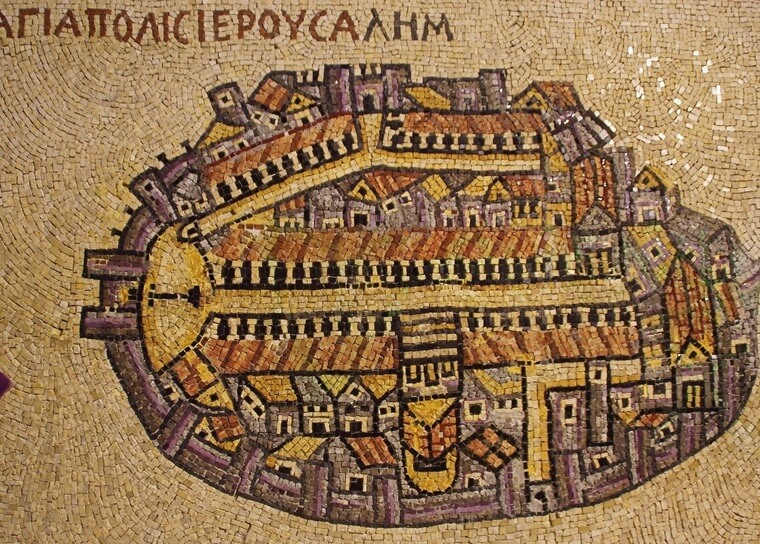
The new Byzantine Jerusalem was built as a City of God, with a comprehensive and sacred design that was carried out for generations, and in the end, created a complex and magnificent city. Throughout its existence, the Holy City was built several times in the image of an ideal city, as a realization of the divine city, and then it was destroyed. In every period, the city reached a peak, a realization, and a completion, and this was expressed in a complex and complete system of buildings and sites that turned it into a kind of living temple. This was the case in the First Temple period, the Hasmonean period, the Herodian period, during Aelia Capitolina, and in Byzantine Jerusalem as well. But in the end, every “ideal” city was destroyed, and a new ideal city was built on its ruins.
The Byzantine city of Jerusalem, at its peak, had 50,000–100,000 inhabitants, including thousands of clergy and monks, and flourished in its splendid form for almost 300 years. It contained many churches, pilgrimage routes, holy relics and sites, public buildings and palaces, monasteries, procession routes, and more[2]. The city created a fractal complexity, mirroring the complexity of the universe, the structure of the invisible worlds, and of man—a world that exists in itself, with different central points that relate to one another and echo what exists beyond it.
Above the Mount of Olives was a cluster of churches, the main ones being the Eleona and Ascension churches, along with many monasteries. At the foot of the mountain were the Tomb of Mary and the place of Gethsemane. A little further down the stream stood the Church of Siloam. Above it, on Mount Zion, was the Mother of All Churches—the place of the Last Supper—as well as the Church of Peter and the Rooster, monasteries, and sites of various religious communities and denominations.
In the Christian Quarter stood the Church of the Holy Sepulchre and, next to it, the Patriarch’s Palace. In the area of the Armenian Quarter, there were churches for the Armenians and Syrians, as well as branches of the Judean Desert monasteries. In the Jewish Quarter was the Church of the Nea and a church dedicated to Lady Wisdom — Hagia Sophia (in the area of the Hurva Synagogue). In the Muslim Quarter stood the Church of St. Anne and the palace of Empress Eudocia. North of the city was the Church of St. Stephen (today St. Étienne). In nearby Bethlehem stood the Church of the Nativity, and on the way to it, the Church of the Kathisma and many monasteries. In the Valley of the Cross stood the Monastery of the Cross.
The large monasteries of the Judean Desert built hostels for pilgrims. Thus, the Monastery of Mar Saba, led by Saint Saba, established a branch in Jerusalem—a Metochion—to serve as a residence for pilgrims, especially those planning to continue their journey to the monastery itself. Peter the Iberian built a monastery that functioned as a hostel for pilgrims from the Caucasus. There were also large hospitals inspired by the spirit of Cosmas and Damian—holy physician brothers of Arab origin who were executed for their faith at the end of the 3rd century CE. A church was built in their honor in the Muslim Quarter, and near the Church of the Holy Sepulchre and the Nea Church, hospitals were established in their spirit. This marked the beginning of the tradition of sacred healing, which would later be continued by the Hospitallers. In addition to churches and monasteries, there were charities and welfare institutions throughout the city.
Orthodox Christianity
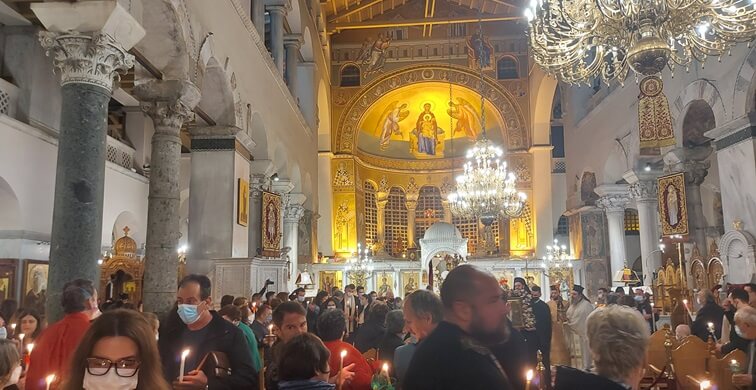
When Christianity began to spread in the world, it had no organized hierarchical structure, and each group of believers created its own leadership. Christianity was pluralistic and democratic, with the common denominator among its people being faith, spirituality, and mutual responsibility. And then suddenly the unbelievable happened: the entire Roman Empire, which had persecuted Christians for hundreds of years, became Christian with the emperor at its head.
The adoption of Christianity by the Roman Empire led to two important results: the establishment of one holy and universal church under the patronage of the emperor and the determination of the principles of the Christian faith at a council of Nicea convened by the emperor in which all the leaders of the Christian world participated in 325 CE. The Council of Nicaea was the first ecumenical (all-Christian) council. It established uniform principles for Christianity, published the creed – the first Credo of Christianity, and determined the administrative structure of the church.
It was decided that the organizational structure of the Church would remain democratic, while theology and matters of faith would become dogmatic. The empire was divided into four provinces, corresponding to the four main and most populous cities. At the head of each province stood a patriarchate, leading an independent church. The four patriarchs were considered equal in status, all under the leadership of the emperor—by the grace of God. It was the emperor who convened church councils in which theological issues were to be decided. Initially, there were four patriarchates, each presiding over a major region of the empire: Rome, Constantinople, Alexandria, and Antioch. In the 5th century, a fifth patriarchate was added—that of Jerusalem—due to the city’s spiritual significance. Bishop Juvenal of Jerusalem, who played a key role in this decision, became its first patriarch.
With the fall of the western part of the empire to the barbarians and the disappearance of the imperial rule, the patriarch of Rome began to fill the void that was created and decided at this opportunity that his status was above the others, and thus Catholicism was created, as a deviation from the original way of Christianity. In the rest of the Mediterranean, a hegemony of one patriarch or another was not possible, because they were under the rule of the Byzantine emperor, who was considered the 13th apostle. The churches that maintained the original organizational structure called themselves Orthodox, meaning “keepers of the straight path.”
The principles of Christianity were determined at the Council of Nicaea, and starting from this time anyone who deviated from these principles was persecuted and eliminated over time, and thus the Gnostic movement disappeared and other heretical movements went underground. Over time, disputes and divisions arose among the Christian world, revolving around questions such as the nature of Jesus, whether he was divine or human, the divinity of Mary, and so on. At times the disputes took on a national character, and thus divisions began, first to break away from “standard” Christianity were the Arians and Nestorians, and than the Monophysite churches, which became the national churches of the Syrians, Egyptians, Armenians, and Ethiopians.
The Council of Chalcedon in 451 established the Diophysite belief—the doctrine of the dual nature of Jesus—as a principle of faith, and condemned Monophysite Christianity, which held that Christ had only one nature. Early Christian theology was founded on the teachings of the three great Church Fathers: Basil the Great, Gregory of Nyssa, and Gregory of Nazianzus. Later, John Chrysostom was added to this esteemed group. Over time, the original form of imperial Christianity came to be known as Orthodox Christianity.
Over the years, other peoples and regions converted and accepted the Christianity in its Orthodox form, official recognizing the status of the Byzantine emperor, and they created additional independent patriarchates within the body of the church. The first were the Georgians and Bulgarians, immediately followed by the Russians and Serbs, and today there are fifteen independent Orthodox patriarchates, led by fifteen different patriarchs, all of whom maintain the traditional way of organizational independence and democracy in making decisions concerning the entire church, with the Patriarch of Constantinople having the status of first among equals.
Due to the nature of Orthodox Christianity, many times a new patriarchate was national in character, connected to a country’s history, under the patronage of the ruler, examples are the Bulgarian, Russian and Serbian Churches.
The most important and second-largest Christian community in Israel today is the Greek Orthodox Church—an independent patriarchate centered in Jerusalem. This patriarchate serves Orthodox Christians in Israel, the Palestinian Authority, and Jordan. It is distinct from the Greek Patriarchate based in Athens and constitutes a separate organizational structure. Although it maintains ties to Greece through the Brotherhood of the Holy Sepulchre, it operates independently.
Orthodox Mystery
The four fathers of the Orthodox Church are Saint Basil, Gregory of Nyssa, Gregory of Nazianzus, and John Chrysostom, all of them outstanding people who were active in the 4th century CE. Their theological concepts are based on great thinkers from the 2nd and 3rd centuries, including Origen and Clement. They emphasized the duality of body and spirit and the mystery of the connection between them, which is expressed in the dual nature of Jesus. And therefore, in Christianity, there is a visible layer and a hidden layer. Prayer, for example, is a kind of secret kept for those who know: “Be careful not to reveal in a way that profanes the holy secrets.”[3]
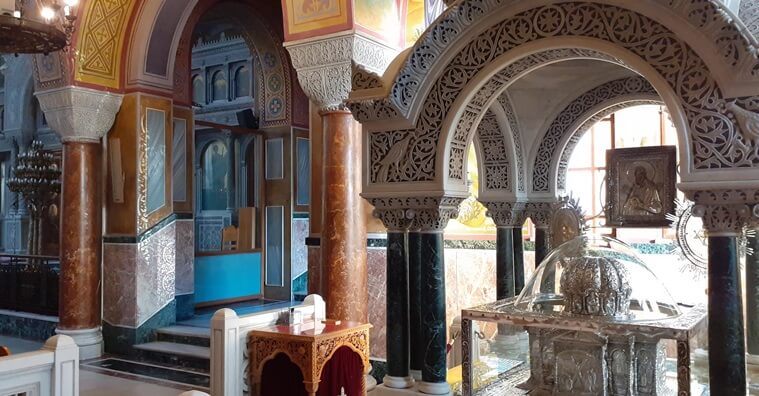
The concept of visible and hidden, body and spirit, is a mystery that is also expressed in the structure of the Orthodox Church. In the Byzantine period, there was usually a courtyard outside the church—an atrium—where those who wished to join the religion were taught the deep meaning of the worship, the mystery of the appearance of Jesus in the world, and the events of the New Testament, and the church hall were the miracle of the Eucharist happened.
Inside an Orthodox church, there is an area that is hidden from the body of the church by an iconostasis that is partially opened only at certain times, which is a kind of Holy of Holies, a place where the miracle of the Eucharist and worship take place. The altar is the place where the holy appears, Paradise. The doors of the iconostasis are the doors of Paradise. The center of the church is the earth, which is rectangular, and therefore there are four walls around it that hold the dome. And sometimes the central space has four branches in the shape of a cross, symbolizing the four winds of the heavens. The church is the universe and at the same time embodies the world[4].
One of the expressions of the Orthodox mystical concept is the allegorical and mystical translation of events in the life of Jesus and the apostles. These are perceived as representing something much deeper, an archetype, a mystery that has an effect on our lives here and now. Such is, for example, the event of the Annunciation in Nazareth. The angel says to Mary, “Blessed are you among women” – and she becomes pregnant, by the very saying of the word. There is a mystery here of creating something by a word, just as God created the world by a word, and it is so absurd that even Joseph, Mary’s husband, finds it difficult to believe. But it also appears in our lives: “We become what we think about.” We think in words, and these words are realized. (The mystery of the Annunciation recently appeared in a popular movie called “The Secret.”)
The first miracle that Jesus performed was turning water into wine at a wedding in the village of Cana. This event draws directly from the ancient Greek Dionysian traditions. The mystery is how do you turn water, which represents ordinary life, into wine, which represents life with divine inspiration? And the answer, in my understanding, is that this miracle happens at a wedding, and this teaches us that a good relationship can turn water into wine, and in fact, any connection between opposites.
At the Last Supper, Jesus passes the cup of wine among his disciples and says to them: “This is my blood that you are drinking.” In the ancient world, wine represented the quality of the soul, and therefore alcohol is called “spirits.” A person is empty and indifferent, but drinking wine is enough to cheer his heart. What is the source of joy? The answer of the ancients was that it comes from wine. Wisdom also comes from wine: the ancient Greeks used to hold a symposium after the meal, in which they would lie on couches, drink wine, and talk about philosophy. It was the wine that was considered to bring the spirit of wisdom!
Water is the quality of matter without spirit, while wine is the quality of matter with spirit. What then is the secret of turning matter without spirit into matter with spirit? Jesus teaches us this secret. This is the mystery that appears in this simple and seemingly trivial miracle story. On the surface, there was no wine, so he performed a miracle, because he is able to do everything. But below the surface, the story has a hidden meaning, related to the appearance of the spirit in matter, or if you will, to embodiment.
The miracle of the loaves and fishes is another mystery. Usually, when you share something, it decreases accordingly, but here the fish and bread multiplied. What is the mystery that causes this? What is the secret of abundance? The secret is love. The more you give of it, the more there is. This is the New Covenant, which is a covenant of the heart, as opposed to the Old Covenant, which is a covenant of action.
Love is a very important factor in early Greek Christianity, as it appears in Paul’s letter to the Corinthians, chapter 13, verse 1: “If I speak in the tongues of men and of angels, but have not love, I am a noisy gong or a clanging cymbal.” It is a win-win situation, in which one plus one equals three, not two.
Notes
[1] Barnes, T. D. (1981). Constantine and Eusebius. Cambridge, MA: Harvard University Press.
[2] Ashkenazi, M. (2000). Jerusalem in the Byzantine Period. Jerusalem: Bialik Institute.
[3] Eliade, History of Religious Ideas, Vol. 3, p. 52.
[4] Eliade, History of Religious Ideas, Vol. 3.