From Temples to Churches
In the 4th century CE, the Romans converted to Christianity and began building churches instead of temples. Until then, Christianity had been a persecuted religion with no public buildings, but when Constantine the Great accepted Christianity, things changed dramatically. The first churches adopted the models of Roman buildings and temples. Four basic designs were adopted: the first and most important was that of the basilica; the second was the rectangle; the third, the octagon; and the fourth, the circle (rotunda).
The word “basilica” comes from the word “basileus” – king. It was the most important public building in a Roman city, used for citizen gatherings, commercial activity, and as a courthouse. The classic basilica shape was a large, high central hall with two smaller and lower side aisles. The main nave was supported by columns, and above them was a raised roof. This design allowed light and air to enter and created a sense of height. The basilica, as much as possible, maintained certain proportions: the ratio between the height and width of the main hall and the side aisles was one to two. This ratio appears in all the buildings of the ancient world and expresses harmony.
Among the architectural proportions, two were most important: one is the golden ratio, and the second is the ratio of one to two, or two-thirds to one-third. This proportion appears in the human body structure (for example, the length of the nose is one-third of that of the face), and therefore it was the basis for the design of all temples in ancient times, including the Temple in Jerusalem. This ratio is aesthetically pleasing and is perceived as beautiful cognitively. Theologically, it expressed the Roman trinity of gods—Jupiter, Juno, and Minerva—and cosmologically, it was an expression of the three worlds, the principles that make up the world (heaven, earth, and underworld, as well as sun, moon, and stars). The one-to-two, or two-thirds and one-third, proportion was enthusiastically adopted by Christians to symbolize the Holy Trinity, which is the basis of all things.
Christians made slight changes to the basilica form: In classical architecture, the basilica had two apses (large, rounded recesses in the wall) on the narrow sides where judges sat or statues of gods were placed, the entrance being on the longitudinal side. In the Christian Basilica only one apse remained, and instead of statues an altar was placed for the Eucharist ceremony (the embodiment of Jesus’s flesh and blood through wine and bread).
In a Christian basilica, there are two rooms on either side of the main apse. The one on the right is called the diaconicon and serves as a sacristy for priestly vestments, and the one on the left is called the prothesis, used for preparing the bread and wine. Priests pass from the diaconicon to the prothesis behind the apse, and from there to the altar in the apse. A holy relic is usually placed under the altar inside a box.
Christians adopted the Roman basilica structure as a design for churches, especially large urban churches. This form allows for the creation of a large, well-lit, and unobstructed space for gathering people and focuses the worshippers toward the apse on the eastern side, where the divine embodiment ceremony (the Eucharist) takes place. The orientation of the apse toward the east expressed the identification of Jesus with the principle of light, the figure of the sun. Because of this, a hierarchy of sacredness was established in the building. The closer one gets to the apse, the greater the sanctity. This led to moving the entrance to the basilica from the longitudinal side.
In roman Basilica there was a second apse in the west and the entrance was in the middle of the building, therefore they did not have to walk the entire length of the hall on a journey from the entrance to the altar in the east, in the west wall of the Christian Basilica was an opening, or three openings, were installed, in a shape that mimics a triumphal arch. A square courtyard with columns around it, called a narthex, was added west of the entrance of the basilica. In the 4th-5th centuries, those who had joined the new religion would gather there to receive instruction in the mysteries of the faith. In the 6th century, the flow of new members decreased, but the narthex remained as an architectural element.
Two other Roman building designs that Christians adopted as models for churches are the octagon and the circle (rotunda). In classical architecture, temples for female deities were built in a circular shape, and those for male deities were built in polygons with right angles, usually square, but often the chosen polygon was an octagon. The octagon symbolized for Christians the resurrection of Jesus on the eighth day of the Holy Week and the kingdom of heaven, which is above nature (represented by the number seven). For this reason, many of the early churches, such as those in Caesarea or Capernaum, were octagonal. The most important and famous octagonal church in Italy from the period after the Christianization of the empire is the Church of San Vitale in Ravenna, built in the 6th century CE. The circle symbolized perfection and spirituality. An octagonal church can be found in Jerusalem at the Kathisma near Ramat Rachel, and a circular rotunda is to be found in the Church of the Holy Sepulchre.
According to Eliade[1], there were two types of churches at the beginning of Christianity: basilicas and martyria (martyrs’ churches, which had a dome and an original altar dedicated to a saint). The saint was perceived as a connector between heaven and earth, a continuation of the embodiment of Jesus in matter. In some churches, there were special chapels called “martyrium.” The tombs (churches) of the saints became massive pilgrimage sites, with stories of miracles developing around them, with sacred objects, and relics that brought blessings. The saint proclaimed the messianic transformation of matter; he was a divine revelation, a paradox of simultaneous existence. An embodiment of Christian dogma. In Byzantine Jerusalem, there were several martyrium churches, but the most important and fundamental of them all is the Church of the Holy Sepulchre.
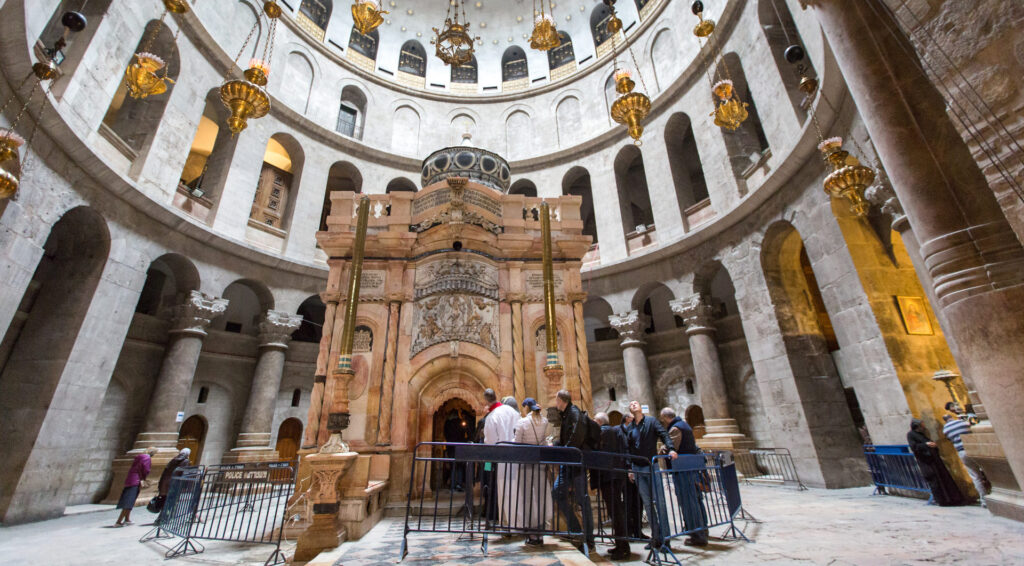
The Rotunda at the Church of the Holy Sepulchre
The rotunda, which is a circular building with a dome, symbolized for the Romans the divine principle of creation, order of the universe, cycle of life, and victory over death. Emperor Constantine built several rotundas in various places around the world, such as the mausoleum for his mother Helena and the tomb of his daughter Constantia in Constantinople, so it was only natural that he would use a rotunda design to mark the location of Jesus’s empty tomb. However, the rotunda in Jerusalem is different; its secret is that it echoes the Pantheon, the most famous temple in the Roman Empire.
The Church of the Holy Sepulchre in Jerusalem is somewhat similar in its function to the Heraion temples in other Greek and Roman cities, which commemorate their founding heroes. The founding hero of Heavenly Jerusalem is Jesus, who defeated death and founded the new religion. In addition, the rotunda is a kind of burial mausoleum, and in this way, three worlds are connected—the underworld, the earthly world, and the heavenly eternal world. The square structure of the tomb and the circle around it represent the earth, and the dome represents the heavens. In other words, the structure is the axis of the world (Axis Mundi).
The Church of the Holy Sepulchre is connected to the act of creation and its renewal through Jesus’s sacrifice. His death and resurrection during Passover symbolize the re-creation of the spiritual world—the world of light. Therefore, the most important ceremony held in the Church of the Holy Sepulchre is the Holy Fire ceremony on Holy Saturday, when a miraculous fire descends from heaven and lights the candles of the believers at the tomb. This is a return to primordial time, a return to eternity. While today the emphasis of the place is more on darkness (the mysticism of darkness), in the past—during the Byzantine and Crusader periods, when the building was more complete and homogeneous—it was filled with alternating inflows of sunrays and placed greater emphasis on light.
At the heart of the rotunda stands the Holy Tomb, which was once a rock with a tomb carved into it. Today the tomb seems to rise from the floor, but until the time of the church’s Constantine, it was covered by a rocky hill. To expose it, the surrounding rocks were carved away and the area leveled, and in this way the tomb was “resurrected,” just like Jesus. Above the tomb is a dome in the shape of a perfect semicircle, at the top of which is an opening that allows a rays of light to penetrate (later the dome became a cone, and then a dome again). The model for this design is the Pantheon.
According to Barrie[2], the Pantheon is built so that the light entering from the opening in the ceiling enlivens the space and connects it to the movement of the sun and moon in the sky, thus creating the connection between the circle and the straight line, the earthly and the heavenly. The Pantheon is not only circular in its floor plan but also in the space it creates—a perfect semicircle—and this is one of its most impressive features. Its walls are built to react to the light entering from the ceiling with plays of light and shadow. In the eyes of many visitors to the Church of the Holy Sepulchre, the most impressive aesthetic experience in the Church is the penetration of a ray of light from the opening of the rotunda’s dome into the space of the rotunda.
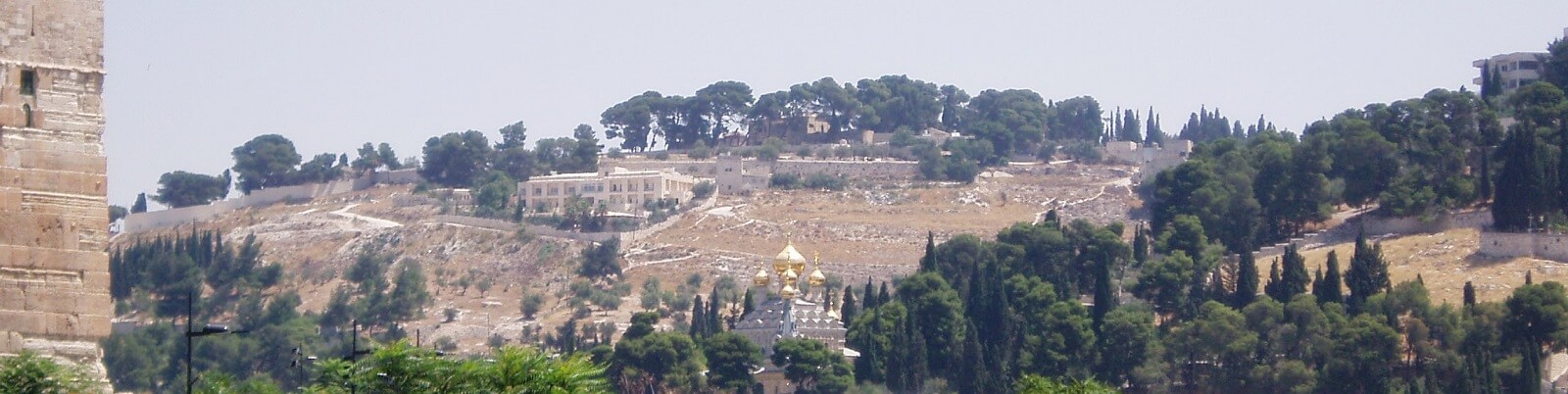
In the original structure of the Church of the Holy Sepulchre, there was additional penetration of sunbeam into the rotunda: the original Church had an opening to the east towards the sunrise over the Mount of Olives. (Unlike other churches in the world where the entrance is from the west and the apse is in the east). During sunrise a first sunbeam would penetrate through the opening the circle of the rotunda, similar to what happened in ancient stone circles and sun temples of the classical world.
The original rotunda had a straight facade with eight columns on the eastern side, and from the front, it also looked like the Pantheon. The area where the Catholicon and the Rock of Calvary are today was a courtyard with columns, and to its east, a huge basilica was built that extended from the Cardo (the main street) to the rotunda. In time, the great basilica was destroyed, and the circular rotunda structure is the only part that remains of the original 4th-century complex of the Holy Sepulchre. In the 11th century, the rotunda was connected to a church built in the courtyard area, in place of the old destroyed basilica, and at this opportunity, the Rock of Calvary and other sites that were in the courtyard were also included in the complex.
The symbolism of the sun in early Christianity led to churches being oriented east and to the designation of Jesus’s birth date on the shortest days of the year, December 25th. Jesus is the solar hero who dies and rises again. The orientation of the Church of the Holy Sepulchre toward the east echoed the orientation of the Jewish Temple on an east–west axis. The sunrise over the Mount of Olives, as seen from the Church of the Holy Sepulchre, re-enacted the cosmic drama of Jesus’s death and resurrection.
The connection between the straight line and the circle simulates the connection between the masculine and the feminine, between the spiritual and the physical world. The spiritual (masculine) is the straight line that impregnates the physical (feminine) which is the circle, and in this way, the space is sanctified and, in fact, reborn. The physical ray of light penetrating the rotunda’s space from the dome symbolizes a spiritual ray of light, an embodiment of the spiritual in matter. It is similar to Christian icon paintings where a white ray of light from the deity is seen entering the forehead of the newborn baby Jesus.
In Christian symbolism, the Holy Trinity is symbolized by the sun, which is the Father; how the sun shines and affects us, appearing in this world, which is the Son; and the sunbeam identified with the Holy Spirit. The circle is the earthly world in its lower sense or the divine heavenly world in its higher sense. The circle is sanctified by the penetration of the ray of light into it and becomes heavenly. It can be said that the rotunda, the place of Jesus’s burial, symbolizes his physical body. It is impregnated by the sunbeam, the Holy Spirit that enters it, and thereby a new birth (the resurrection) is made possible, and the rotunda, especially its dome, is filled with life, elevated to another level of existence, becoming a manifestation of the universe, the divine, on earth.
The rotunda structure, as mentioned, mimics the Pantheon in Rome, except that it is slightly larger. The diameter of the Pantheon is 43 meters, while the diameter of the rotunda is 23 meters. According to Arculf (a Frankish pilgrim who visited Israel in the second half of the 7th century), the original rotunda had twelve columns and they were arranged in four groups of three columns facing the four directions. This is perfect symmetry. The height of the original columns was 7.15 meters and their diameter was 1.20 meters. This is a similar ratio to the classic Doric order of one to six, creating Doric columns that symbolized the male body. In other words, the columns symbolized the 12 apostles of Jesus—representing man—and the whole place was intended to sanctify humanity through sacred proportions reflected in the human body. The proportion of one to six is the ratio between the size of the feet and a man’s height—a man being six feet tall. In the apse of the great basilica to the east, there were also 12 columns, and so the two structures, separated by a courtyard, corresponded with each other.
At the heart of the rotunda stands the Holy Tomb. Today it is a structure called the “Aedicula” which was built at the beginning of the 19th century, but in the past, there was a rock with a tomb carved into it. Over the years, people took pieces of the rock as souvenirs and eventually it disappeared, and all that remained was the stone ledge on which Jesus’s body was laid in the empty tomb, and the Aedicula was built around it. In the western side of the rotunda there is an opening in the wall that leads to the Syrian Chapel, part of which is carved into the bedrock. From the small chapel, Jewish burial caves from the Second Temple period, carved into the rock, open up, and this is probably what Jesus’s nearby tomb looked like two thousand years ago. The discovery of the tombs in this place strengthens the theory that the Church of the Holy Sepulchre is the true site of Jesus’s burial and resurrection.
Part of the remains of the eastern wall of the great Byzantine basilica can be seen today inside the nearby Alexander Nevsky Church complex. The straight line of the basilica expresses the continuity of time and the journey of the world and man from fall to salvation. The circular shape of the rotunda symbolizes eternity, the divine, the connection between planes. The union is not only between the straight line and the circle but also, metaphorically, between the eternal and the temporal. The Eternal appears through the earthly drama of Jesus’s death and resurrection, through the cross and suffering in this world, and by this, the material world is sanctified. The empty tomb reveals that death exists only temporarily, while Jesus’s resurrection symbolizes the possibility of attaining eternal life.
Cyril of Jerusalem (313-86)
One of the most important early Christian teachers, who became the bishop of Jerusalem for 38 crucial years of Christian consolidation (348-386), was Cyril of Jerusalem. He was born in a village near Jerusalem and is still highly regarded by local Christians today. During a famine in the country, he sold church items to feed the poor, and for this, he was persecuted by the Bishop of Caesarea, who opposed him on ideological and political grounds. Cyril emphasizes free will, and that sin comes from human choice. The remedy for sin is repentance that leads to a moral life. Cyril emphasizes the love of God; his writings are healing and comforting, forgiving and enabling. He himself forgave all those who wronged him and did not hold a grudge or speak ill of anyone.
After the empire became Christian, many people wanted to be baptized into the new religion, and they needed to be guided in the principles of faith. Cyril held a mass baptism in the Church of the Holy Sepulchre in 348. To prepare the people, he wrote a groundbreaking and important catechism, 18 lectures in which he told about the principles of faith, the resurrection of the dead, the nature of Jesus, and more. In his additional and final sermons, he revealed the meaning of the sacraments.
He argues for the existence of a secret teaching that can only be revealed to the chosen, called “mysteries.” “The Spirit comes gently and makes himself known by his fragrance; it is not felt as a burden, because God is light. When the Spirit approaches, rays of light and knowledge flow from it. The Spirit comes with the gentleness of a true friend to save, heal, teach, advise, strengthen, and comfort.” The world is held by faith that appears in all things. Jesus went to his death willingly and gave himself for his followers, forgiving them for their deeds.
In 351, Cyril saw a cross in the sky above the Church of the Holy Sepulchre and was sure it was a sign of Jesus’s second coming and the central role of Jerusalem in the divine plan of salvation. He wrote a letter to Constantius II (the son of Constantine the Great): “In these holy days of Pentecost, on May 7th, at about the third hour, a very large cross of light appeared in the sky above Golgotha, and extended to the Holy Mountain, the Mount of Olives. This sight was not revealed to just one person but was clearly and very brightly seen by all the city’s inhabitants, and it was not a fleeting spectacle of a trick of the imagination, as some might think, but was clearly visible for many hours, surpassing the rays of the sun in its brightness.”
According to Yaakov Ashkenazi[3], Cyril sought to renew the idea of Christian Jerusalem as a symbol of the unity of both empire and faith. The miracle of the appearance of the cross of light in the sky is also mentioned in the writings of other historians of the period, and it is possible that an atmospheric phenomenon caused this vision. The cross of light revealed the place where Jesus was crucified and ascended to heaven, serving as atonement for the earthly crucifixion. The phenomenon led to mass conversions and is reminiscent of similar natural events that inspired conversions in other parts of the country (such as the flooding of Petra gates) and throughout the world.
One can see a development in the appearance of holiness in Jerusalem through the different appearances of the cross. Empress Helena found the earthly cross on which Jesus was crucified in 325 CE, and twenty-six years later, the heavenly cross was revealed in the skies of Jerusalem. In the same way, the Church of the Holy Sepulchre was consecrated in 335, and twenty years later, Cyril promoted the spiritual and religious concepts of the holy city. He developed a unique liturgy for the city and encouraged pilgrimage, as appears in the descriptions of the pilgrim Egeria at the end of his life.
Helena found the true cross in the underground spaces near the Church of the Holy Sepulchre. After it was removed from the depths of the earth, the cross was raised up, symbolizing the victory of Christianity. The ceremony of raising the cross occurred on September 14th, and became one of the holidays of the liturgical year. It followed the day on which Constantine’s Church of the Resurrection (the Holy Sepulchre) in Jerusalem was consecrated, establishing a new Christian world order. The fallen cross was raised, and became a new tree of life in a new world; the fragrance of the wood spread throughout the universe. when the cross was raised the crowds shouted “Jesus is risen.” However, In 351, the cross underwent sublimation and appeared as a figure of light in the sky.
The cross is Jesus’s weapon, the tool by which the curse on the human race was removed. Earthly creatures were able to return to their divine state and the devil was defeated. The cross is the axis of the world, the pillar of support that holds the universe. It breaks the power of the barbarian nations, strengthens the scepter of kings, and supports Christian culture. If Jesus is a new man, then the cross is a new tree of life, returning the fallen world to the state of eternal Paradise. The cross envelops the heavens with its two arms and overflows with grace to the four corners of the universe.
After the appearance of the heavenly cross in Jerusalem, Christians placed a large, luminous cross on the Ascension site on the Mount of Olives that symbolized the victory of Christianity, similar to the illuminated crosses that are erected today in many high places around the world.
The prophecies of the coming of the Day of Judgment were confirmed by the rise to power of Julian the Apostate in 361, who was considered the Antichrist prophesied in the scriptures. From the Jewish point of view, this was the beginning of the days of the Messiah because Julian wrote a letter to Hillel III, the president of the Jews of the Land of Israel, in which he expressed his desire to rebuild the Temple in Jerusalem, as it is written: “And I will restore it as you have long hoped to see it, and there I will praise the Almighty with you.” But the Christian God intervened. According to legend, Cyril said a prayer that caused an earthquake that stopped the planned work, and indeed the Land of Israel suffered a strong earthquake in May 363, which, among other things, destroyed the city of Susita near the Sea of Galilee, and this was a clear sign of God’s wrath. In the same month, Julian’s attempt to expand the empire’s borders failed, and a month later, he was killed on the battlefield. His last words were “Galilean, you have won.” A Christian emperor came to power in his place.
In 381, the Second Church Council was held in Constantinople, convened by the Christian emperor Theodosius, the man who established Christianity as the official and sole religion of the Roman Empire. The council received Cyril with great honor as the defender of Christianity and the representative of the holy city. At this council, Jerusalem was declared “the mother of all churches.” Cyril was glorified at the end of his life and probably died in 386. In 1883, he was declared a Doctor of the Church by the Pope.
According to Cyril, Jerusalem is the eternal city of God; it did not lose its sanctity but bequeathed it to Christians, and therefore it must be rebuilt, in contrast to the opinion of other Christians who argued that its destruction was a consequence of the Jews’ betrayal and proof of the truth of Jesus’s prophecies, and therefore it should be left as it is. From Cyril’s time onwards, the building of the city of Jerusalem began both physically, spiritually and theologically. His work was continued by other great people.
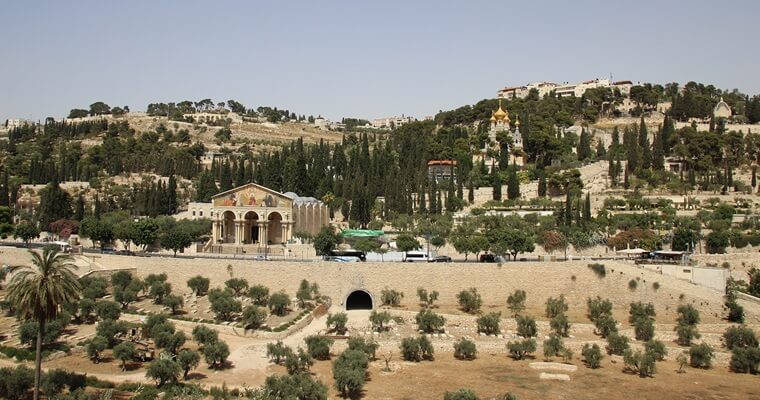
Churches on the Mount of Olives
At the beginning of Holy Week, Jesus arrives in Jerusalem from the Mount of Olives riding a white donkey, like the destined Messiah. And thus, Kiril led the Palm Sunday procession from the Mount of Olives to Jerusalem.
Jesus spends a large part of Holy Week on the Mount of Olives, He stays at the home of Martha and Mary and raises Lazarus from the dead in Bethany to the east of the Mount of Olives. dries up the fig tree in Bethphage, and weeps over the city’s fate on the eastern slopes of the mountain, in the place where the red heifer used to be sacrificed and where the Church of Dominus Flevit (The Lord Wept) is located today.
He spends his last hours as a free man at the foot of the Mount of Olives, in Gethsemane), where he experiences the pangs of the underworld. After the resurrection, he comes again to the Mount of Olives, teaches the disciples the Christian mysteries and the hidden meaning of the Lord’s Prayer, and ascends to heaven after 40 days, with two mysterious figures on either side of him, from the mountain summit.
The mount of olives was sanctified in Jewish tradition, considered to be the place of resurrection. It became a holy Christian mountain during the Byzantine period, with a unique concentration of churches and monasteries. The archetype of a holy mountain appears fully on the Mount of Olives and is later copied to other places in the Christian world. Unlike Mount Zion or Mount Moriah, the Mount of Olives was not built on in earlier periods, but served as a burial place, so the Christians could shape it as they wished.
On the rock on the summit, there is a footprint of Jesus who ascended to heaven (It is said that there were once two footprints of Jesus on the same rock, not just one), and around this place, an important circular church was built that was clearly visible from the Church of the Holy Sepulchre. This is one of the three holy rocks that together form the “Messianic Line”—the energy line of Jerusalem. The other rocks are the Rock of Calvary and the Foundation rock on the Temple Mount, and there is a connection between the places: The Temple that stood over the foundation rock was oriented toward the summit of the Mount of Olives.
Above and around the rock of Calvary the Church of the Holy Sepulchre was built, its entrance on the east side, unlike other churches whose entrance is from the west, oriented toward the summit of the Mount of Olives. Above the rock of the Mount of Olives, the Church of the Ascension was built. The three rocks and the buildings erected above them are located on the same east-west axis. This is the axis of the setting and rising sun, of death and rebirth.
Near the Church of the Ascension, a large church called Eleona was built by Empress Helena herself, with a cave in its center which is now within the complex of the Church of the Pater Noster. Above it was an open courtyard whose column bases are still visible today, and to its east, a small basilica. It is not clear whether the holy rock was inside the church or remained outside it, as in the case of Calvary and the Church of the Holy Sepulchre. What is clear, however, is that later the Ascension complex was separated from the Eleona Church, and a separate church was built on it at the end of the 4th century CE.
It is very possible that at the beginning of the Byzantine period, the Ascension site and the rock remained empty, because Christians believed that this was the place of Jesus’s transfiguration, and not Mount Tabor, as suggested by Eyal Davidson[4], and therefore the place could serve for Jewish ceremonies for those who believed that this was the place of the Shekhinah’s ascension to heaven. Near the Ascension site is the Russian Church of the Ascension, in whose courtyard additional Byzantine church remains and mosaics have been discovered.
When the disciples ask Jesus how to pray, he teaches them the following prayer: “Our Father in heaven, hallowed be your name, your kingdom come, your will be done, on earth as it is in heaven. Give us this day our daily bread, and forgive us our debts, as we also have forgiven our debtors. And lead us not into temptation, but deliver us from evil (for yours is the kingdom and the power and the glory forever, Amen)” (Matthew 6:7-13). This is “Lord’s Prayer”, the most important Christian prayer.
According to Christian tradition, Jesus taught the prayer in the cave at the summit of the mountain, as it appears in Luke 11:1-4, but not only the words of the prayer but also its hidden meaning, and this happened after his death, as hinted at in the verse “And over a period of forty days he appeared to them and spoke with them about the kingdom of God” (Acts 1:3). Later, and especially in the Byzantine period, many of Jerusalem’s patriarchs were buried in this cave, which in encompassed within the Pater Noster monastery complex.
Many Christian mystics tried to explain the deep meaning of these words, including Francis of Assisi and Teresa of Ávila, about whom we will elaborate later. The wording of the prayer is ancient and likely comes from Essene circles.
In addition to the Eleona and Ascension churches, there were 24 other churches and monasteries on the Mount of Olives during the Byzantine period. Among them, the double monastery of Melania. Many monks lived in caves carved into the soft limestone, some of which were old burial caves. Various traditions were associated with the mountain, such as it being the burial place of the head of John the Baptist (at the site of the Russian Church of the Ascension), and more. Processions took place from the Church of the Holy Sepulchre to the Eleona Church during the celebrations of the Ascension, and the mountain would be filled with candles at night, as if on fire
In the Secret Gospel of John (a Gnostic text from the 2nd century CE), it is told that John watches Jesus’s Ppassion of crucifixion, and a voice inside him calls him to come to the Mount of Olives, where he finds Jesus in a cave. He reveals to him that he was not crucified, but that the one who was crucified was actually Simon of Cyrene, who had swapped bodies with him. Jesus teaches him the mysteries of revelation and salvation in the cave, and after a few weeks, he ascends to heaven, and descends again dressed in robes of light, and teaches the disciples the great mysteries for 14 years. As a result of this book and the other traditions related to the teaching of the mysteries, the cave was also sanctified for the Gnostic movement and the branches of Christian mysticism as well. Thus, the historian Eusebius writes in the 3rd century CE that “in this cave the Savior of the world initiated his friends in the wondrous mysteries.”
The churches and monasteries of the Mount of Olives were destroyed by the Persians at the beginning of the 7th century, and with the Muslim conquest, the summit of the mountain remained empty and was used as a place of worship by Jews, and especially Karaites, who believed that this was the place of the Shekhinah’s ascension from the Temple to heaven, and the place of redemption. During the Crusader period, the Church of the Ascension was rebuilt in an octagonal shape, as part of the sacred plan of Jerusalem and as a possible reflection of the octagonal structure of the Dome of the Rock. At the heart of the Crusader church was an Aedicula open to the sky with unique capitals on which griffins (mythological creatures that are half-lion and half-eagle) appear, a symbol of Jesus’s ascension to heaven and the sunrise over Jerusalem at this spot that echoes it every morning.
After the conquest of Jerusalem by Saladin, the Crusader church was destroyed and the place was transferred to the Muslims. The inner part of the church, a hexagonal Aedicula without a roof, remained intact, but it was covered with a dome by the Muslims and a mihrab was installed in it. Today, the small building above the holy rock is inside a large open octagonal courtyard surrounded by a wall. The courtyard and the building are maintained by the Muslim Al-Alami family, who live nearby, but serve as a place of Christian prayer and visitation, especially at the time of ascension. In the cave below the summit, there is a holy tomb that is identified by Christians as the tomb of Pelagia and by Jews as the tomb of Huldah the Prophetess.
At the end of the 19th century, the Pater Noster complex, a monastery of the Carmelites nuns, was built on the site of the Byzantine Eleona Church. At the entrance to the church of the site, there is a monument of a reclining woman. This is the French Princess Aurelia de Bossi, who came to Israel in 1866 and purchased the church site, which had been in ruins since the Crusader period. She built the current building, which was completed in 1875, and transferred it to Sister Xavier—a Carmelite nun from France—to be used by the order that had returned to the Holy Land at that time. The monastery is currently home to 17 Carmelite nuns. On the walls of the monastery’s courtyards, buildings, and corridors, is the Lord’s Prayer in more than 160 languages.
The founder of the Carmelite order, Saint Teresa of Ávila in 16th-century Spain, gave a wonderful interpretation of this prayer. According to her, the first word “Father” alludes to the fact that God is the Father of all and not just of Jesus. The second word “heaven” refers to spiritual heavens that exist within us, because the heavens were created on the first day of creation and the firmaments on the second, and it is impossible to have physical heavens without a firmament. The prophetic verse “hallowed be your name, your kingdom come” teaches us that for the kingdom of heaven to come, we must first magnify the name of Jesus within us. And so on…
notes
[1] Eliade, History of Beliefs and Religious Ideas, Vol. 3, p. 48.
[2] Barrie, Thomas, The Sacred In-Between: The Mediating Roles of Architecture, Abingdon: Routledge, 2010.
[3] Yaakov Ashkenazi, Mother of All Churches, Yad Izhak Ben-Zvi Press, 2009, p. 55.
[4] Eyal Davidson (2022), “‘And as they went up to the Mount of Olives’: A Proposal for the Identification of the ‘Ascension of the Shekhinah’ Site in Jerusalem in Medieval Jewish Traditions,” In the Highland’s Depth (IHD), 12, p. 92.