
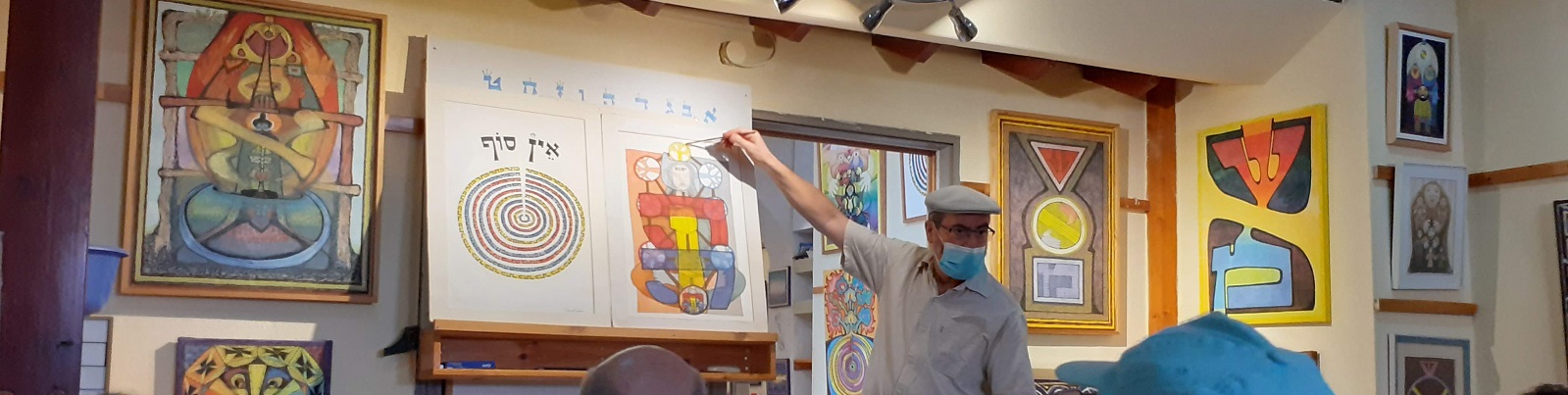
Ancient Jewish Mysticism
One of the things that appears in the Second Temple period is early Jewish mysticism, which is largely based on several passages in the Bible. The most important of these are chapter 1 of Genesis, the Book of Daniel, various prophecies of the prophets, the Song of Songs, Isaiah chapter 6, various Psalms, and especially chapter 1 of the Book of Ezekiel, in which the Vision of the Chariot appears.
The literature of early Hebrew mysticism was called Hekhalot and Merkavah literature. The Vision of the Merkavah—the Chariot—presents the divine worlds as a supreme chariot with all that accompanies it: the wheels, stormy wind, cloud, flashing fire, and the living creatures running back and forth; the figure of the lion, the eagle, angels, and the dynamism of ascent and descent.
Biblical commentators added to this the description of the angels exclaiming “holy” before God, as in Isaiah 6, the visions of Daniel, and more. Out of all these was woven a wondrous and mysterious vision of the upper world, at the center of which is the Merkavah—the Chariot—above it the Throne of Glory on which God sits, and around Him camps of angels—some with specific functions and others whose sole purpose is to praise and sing before Him.
Thus, toward the end of the Second Temple period, in parallel with the appearance of interpretation and the Oral Torah, a body of mystical teaching and literature was developing, explaining the structure of the spiritual worlds, how one can ascend through them, and merit the vision of God.
Jewish mysticism refers to a heavenly ascent (or descent), which only very few are capable of enduring (a kind of Pardes – spiritual realms into which one must enter). The early circle of the “Descenders to the Chariot” was concerned with their personal matter – reaching the firmament of Araboth.
As long as the Temple existed, mysticism was connected to it. With the decline of the Temple’s spiritual stature due to its desecration by the Greeks, the cessation of the priestly line of the House of Zadok, and the mixing of politics with religion in the days of the Hasmonean kings, some of the mystics reached the conclusion that one could not rely on the Temple alone to sustain the world’s spiritual energy. There must be people who could connect to the heavenly Temple. These were the “Descenders to the Chariot.”
The early Jewish mystics had to escape the ordinary religious attitude of the midrash – interpretation. They relied on the earliest Tannaim to describe the mystical experience. They developed apocryphal writings that came from their visions and were organized within cults and sects. In their view, there are three main aspects to the secret of divinity: the first aspect is the secret of the Creator of the world, associated with the figure of Metatron, the Prince of the World; the second aspect is the secret of the Shiur Komah (the mystical measurement of the Divine stature) and the supreme form of the divinity; and the third aspect is the conception of the Pleroma – the multiplicity of powers within the depths of divinity. All of these lead to the idea of direct union with God, reaching the seventh heaven and beholding Him.
The first Hebrew mystics operated mainly in Jerusalem and its surroundings, as appears in the story of Rabbi Ishmael the High Priest. They were influenced by the spiritual schools that were then spreading throughout the world, which was becoming increasingly universal – the Orphic brotherhoods, the teachings of Pythagoras, Platonic philosophy, and the mystery cults of Persia, Mesopotamia, and Egypt, among others.
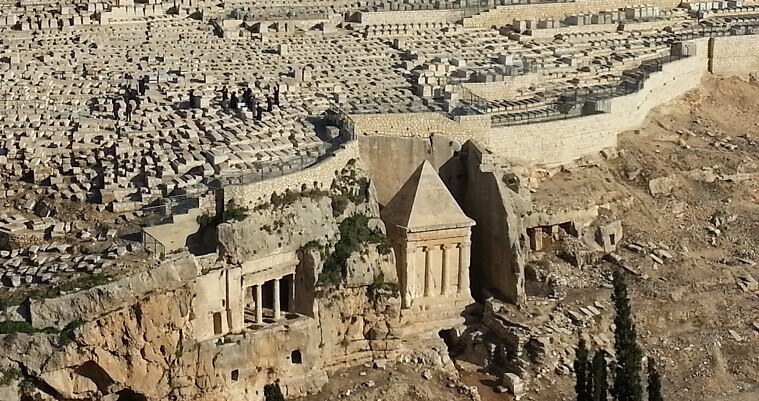
Resurrection on the Mount of Olives
The Greek mystery cults of Demeter emphasized death and resurrection, seen through the withering of vegetation in the summer and its sprouting again in the winter and spring. They recalled the mystery cult of Inanna and Dumuzi in Mesopotamia or the Canaanite Tammuz.
Death and rebirth had always been on man’s mind, starting from prehistory and associated with the cycles of vegetation in the period of the Goddess culture. Just as vegetation withers and the seed is planted in the earth, so there is a process of change and refinement that leads to a new birth as a spiritual being after death. This is not reincarnation but transformation, metamorphosis, and was therefore connected to initiation rites.
No wonder death and rebirth are a major theme in Jewish mystical thought. According to Jewish belief, from the moment we are buried and placed in the ground, wherever in the world that may be, at the time of the resurrection our remains will make their way underground to the Mount of Olives, where the bones will burst forth to the surface and be clothed with skin and flesh. We will rise to life and pass on to the Temple Mount plaza.
A Midrash from the 11th century, Pesikta Rabbati, says: “And those who were swallowed up in Rablatah – the Holy One, blessed be He, makes tunnels for them from below. And they are carried along in them until they reach beneath the Mount of Olives in Jerusalem, and the Holy One, blessed be He, stands upon it, and it is split open for them, and they ascend out of it. As Zechariah says: ‘And his feet shall stand in that day upon the Mount of Olives, which is before Jerusalem on the east.’” The righteous will sprout from the earth, as in the verse: “They shall spring up as the grass of the earth” (Psalm 72:16). The bodies of those buried on the Mount of Olives are exempt from decay – which is said to be as painful to the dead as a needle in the flesh of the living – and also from the “chastisement of the grave.”
The final prophecy in Zechariah links the Day of Judgment with the Mount of Olives: “And his feet shall stand in that day upon the Mount of Olives, which is before Jerusalem on the east, and the Mount of Olives shall be split in the midst thereof toward the east and toward the west, and there shall be a very great valley; and half of the mountain shall remove toward the north, and half of it toward the south. And ye shall flee to the valley of the mountains; for the valley of the mountains shall reach unto Azal; yea, ye shall flee, like as ye fled from before the earthquake in the days of Uzziah king of Judah; and the Lord my God shall come, and all the holy ones with Thee.” (Zechariah 14:4–5).
There is a Second Temple period text called The Testament of Naphtali (from the Testaments of the Twelve Patriarchs), in which there is also a reference to the Mount of Olives: “And in the fortieth year of my life, I saw a vision upon the Mount of Olives, on the east of Jerusalem, that the sun and the moon stood still.”
Possibly because of these beliefs, and because of the association of rebirth with the rising sun (the Mount of Olives is east of the Temple Mount), since the days of the First Temple the Mount of Olives was a preferred burial site for the inhabitants of Jerusalem, who sought a burial place outside the city (because of the impurity of the dead, it was forbidden to bury inside the city).
Thus, we find burial systems from the First Temple period in the village of Silwan, and from the Second Temple period in the Kidron Valley and also on the slopes of the mountain. Haggai, Malachi, and Zechariah are buried on the Mount of Olives; their burial cave is located beneath the Seven Arches Hotel and is called the “Cave of the Prophets.” It contains 26 burial niches, circular corridors, and an entrance hall with niches for purification and washing of hands.
The Jewish cemetery on the Mount of Olives is the most important in the world, and many important figures are buried there, from Menachem Begin to great rabbis. Today more than 70,000 people are buried on the Mount of Olives, and at the time of the resurrection they will be the first to rise and thus merit eternal life.
After the destruction of the Temple, the Mount of Olives was considered the holiest place for Jews, together with the Golden Gate (Sha’ar HaRachamim) and the eastern wall of the Temple Mount (not the Western Wall as today). This was because the belief was that before the destruction, the Shekhinah departed from the Temple, went out through the Golden Gate, and passed to the Mount of Olives, and from there ascended to heaven; and in the future, on the day of redemption, it would return to the Mount of Olives and enter the Temple Mount from the east.
In Ezekiel 11:23 it is written: “And the glory of the Lord went up from the midst of the city, and stood upon the mountain which is on the east side of the city.” On the basis of this conception, Lamentations Rabbah (Petichta 25) says: “For three and a half years the Shekhinah sat upon the Mount of Olives, hoping that perhaps Israel would repent – but they did not. And a voice went out proclaiming: ‘Return, O backsliding children! Return to Me, and I will return to you!’ And since they did not repent, she said: ‘I will go and return to My place.’”
During the time of the Temple, the ritual of burning the Red Heifer was performed on the Mount of Olives, a rite that purified people from the impurity of death. According to the Torah, the heifer was to be taken outside the camp to the east, slaughtered, and its blood sprinkled toward the Tent of Meeting. The heifer was then burned, with cedar wood, hyssop, and scarlet thread thrown into the fire. After the burning, a pure man collected the ashes and placed them outside the camp in a pure place, and with this ash people were purified from corpse impurity.
The fall from Eden brought death, and therefore purification from the impurity of death is the beginning of redemption, which strengthens the spiritual significance of the Mount of Olives in connection with redemption and the Messiah. Some identify the place of the burning of the Red Heifer with the courtyard of the Dominus Flevit Church on the Mount of Olives.
The Mount of Olives is connected in Jewish sources with a collective resurrection of the dead and a process of national and universal redemption. The question arises: what is the connection of the Mount of Olives to personal redemption, and is there such a connection? In the Byzantine period, there were monasteries and places of seclusion on the Mount of Olives that enabled a process of theosis – the transformation of a person into a god and connection to divine light. It seems that the place was considered conducive to this, not only the Mount of Olives itself but also the whole area east of Jerusalem.
From the heights of the Mount of Olives one sees the Judean Desert; the sharp contrast between the desert and the settled land made it a place of prophets, saints, and hermits, a place of spiritual communities and initiation. The geography of a high mountain to the east of the valley of Jerusalem made it into a cosmic mountain, a place of spiritual light. Thus, the Freemasons believe that the body of Hiram Abiff was buried on the slope of the mountain and was discovered and raised from the earth after seven days – a story that of course carries symbolic meaning. The resurrection of Lazarus in Bethany, on the slope of the Mount of Olives, hints at the importance of the Mount of Olives, as does the coming of the Messiah from there into Jerusalem.
And yet, the clearest parallel to spiritual initiation as practiced in the Greek Mysteries of Eleusis (Demeter) is the death and resurrection of Jesus. But not only did Jesus die and rise again; Lazarus, a few days before him, also rose again on the Mount of Olives, and some (Steiner) say that he was the first to undergo initiation in the new way.
The establishment of the Temple as a permanent site in Jerusalem was the Jewish people’s bonding with the land, but that land also contained the mystery of resurrection. According to Ezekiel’s vision, the bones will rise again from the earth, and according to the later prophets this process will be connected with the splitting of the Mount of Olives in two.
Messianic Expectation
The people of Israel developed messianic hopes during the Second Temple period, and they were not the only ones. Similar beliefs were widespread among the peoples of the East following the conquests of Alexander the Great. The political and spiritual crisis created by the conquest gave rise to prophecies about the coming of a great conqueror from the East who would defeat the Greeks and restore order. Such messianic hopes were especially strong in Egypt and in Persia.
The idea of the divine king was deeply rooted in the consciousness of the Egyptian people, and therefore the ideology of restoring the ancient order found wide acceptance in the hearts of those who hated the Macedonian conquerors. The Persian religion was oriented from its beginning toward the end of days, in which truth would triumph and falsehood would perish; therefore, it easily accepted messianic ideas according to which, in the destruction of wickedness, the foreign invaders would also be annihilated.
In Hebrew tradition, the end of days was connected with the renewal of prophecy. It is hard to adequately estimate the loss suffered by Israel because of the cessation of prophecy at the beginning of the Second Temple period. The people of that generation understood that the channels of heavenly inspiration had been blocked, and that all teachings were temporary so long as there was no prophet to provide divine sanction for what was happening in Israel’s world.
The first testimony of the hope for the renewal of prophecy at the end of days appears at the conclusion of the Book of Malachi. The anonymous author expresses his hope in a poetic way in the closing words of the book: “Behold, I will send you Elijah the prophet before the coming of the great and dreadful day of the Lord. And he shall turn the heart of the fathers to the children, and the heart of the children to their fathers; lest I come and smite the earth with utter destruction” (Malachi 3:23–24). The hope was that Elijah, who had ascended to heaven in a whirlwind, would return and renew prophecy at the end of days.
However, it was not always thought that the prophet of the end times would necessarily be Elijah; there was also talk of a prophet in general. Thus, in the Dead Sea Scrolls and in the Book of Maccabees it is said: “Until a true prophet shall arise.” The people of the Second Temple saw themselves as devoid of divine inspiration, yet they remembered that Israel was descended from the prophets. The term “sons of the prophets” in the Second Temple period meant that the people of Israel were no longer prophets, but they were commanded to preserve the spark of prophecy, and they possessed an inspiration that enabled them to decide matters of law and to understand the words of the ancient prophets.
The prevailing mood at the end of the Second Temple period was a yearning for the First Temple and its deification, together with the expectation of the return of the ideal Temple in the end of days. Over time, Israel reconciled itself to the cessation of prophecy and saw the sages as the heirs of the prophets in the chain of tradition. In the Talmud we find the saying: “From the day the Temple was destroyed, prophecy was taken from the prophets and given to the sages.” Even earlier it was thought that “A sage is preferable to a prophet.” However, another Talmudic opinion maintains that “From the day the Temple was destroyed, prophecy was taken from the prophets and given to fools and children.”
The people of the Second Temple interpreted this as referring to the destruction of the First Temple; they did not see their own Temple as equal to that of Solomon, and therefore considered it as if it were destroyed, until a Third Temple would arise in accordance with Ezekiel’s vision, which some said would descend from heaven.
The prophecies of the destruction of the Temple by the great prophets and those that followed, including the prophecies of the future in Daniel, were part of a fundamental worldview of eschatological seers and redeemers in the Second Temple period, who saw the events around them as signs of the fulfillment of the prophecies. Some interpreted the books of the prophets and their prophecies in the light of current events and believed that the generation in which they lived was the last generation before the end of days. Many developed an actual, immediate messianic expectation and acted in order to hasten the end of days, in accordance with this outlook.
The victory of the Maccabees over the Greeks was considered part of the historical sequence leading to redemption, and likewise the damage to the Temple, the profanation of the Jewish sacred things, and changes in faith, as well as struggles between different religious groups, were perceived as part of the historical process. It is characteristic of apocalyptic thought to see the forces that bring about the end of days as already active within history, which strives toward its own conclusion.
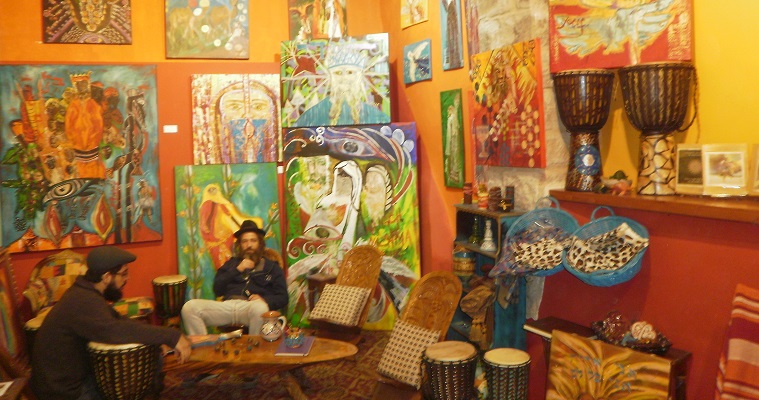
The Use of Colors in Judaism
Color had an important role in the Tabernacle and later in the Temple, and it was associated with divine command. Color appeared in the precious stones—the stones of the breastplate, in the garments of the priests, in the curtains and decoration of the Temple, and more. Color appeared in stories such as Joseph’s coat of many colors, the rainbow as a covenant between God and the earth, and more. Light itself has an important role in the chapter of Genesis, in the Torah, and in the Bible as a whole, and it is one of the main images used to describe divinity.
According to Jewish mystical understanding, there is physical light and spiritual light, and they are connected to one another, like a flame bound to an ember. Since the dawn of history, colors have been used to describe that hidden reality which is difficult to express in words, as a way to depict the spiritual worlds.
In ancient Egypt, each god was associated with a color—for example, Osiris with green, Seth with red—and there was extensive use of colors in tombs and temples. In Mesopotamia as well, colors were of great importance. The Sumerians built massive stepped pyramids as the centers of their sacred complexes, which were called ziggurats, and this tradition passed on to the Akkadians and Babylonians. Each pyramid had seven steps, which were connected to a system of seven planets and seven colors that also appeared among the Babylonians.
Herodotus refers to the great temple of Nebuchadnezzar, whose base was 272 feet, rising to seven stories, and he claims that this temple was dedicated to the seven planets and painted in seven colors: the lowest level was black—Saturn; the second, orange—Jupiter; the third, red—Mars; the fourth, yellow—the Sun; the fifth, green—Venus; the sixth, blue—Mercury; and the seventh, white.
The system of seven colors associated with the seven visible planets that move in the heavens also appears in Judaism. In Jewish Kabbalah, each of the seven lower sefirot of the Tree of Life, what is called Ze’ir Anpin, is connected to a color and a planet. There are different systems of colors that relate to the seven lower sefirot of the Tree of Life; one of them is that of the rainbow. Another, more widespread system, associates the sefirah of Chesed with white, Gevurah (Judgment) with red, Tiferet with yellow, Netzach with green, Hod with blue, Yesod with violet, and Malkhut with black.
Another system of color that appears in Judaism as well as in other spiritual traditions is a system of four colors, corresponding to the four elements, the four states of matter, the four directions, and more. This system appears in the four colors of the Tabernacle: fine linen (white), scarlet, purple, and blue. In Kabbalah, this is expressed as red, white, black, and green, corresponding to the worlds of Atzilut, Beriah, Yetzirah, and Asiyah.
According to Kabbalah, the four basic colors from which the world was founded are red, white, black, and green. As it is written: “And indeed, just as the true existence in which it was was drawn from the four upper corners, so this existence was drawn from the four lower corners, and this is what they said (in chapter 11 of Pirkei de-Rabbi Eliezer): He began to gather the dust of the first man from the four corners of the earth—red, black, white, and green.”
As mentioned before, in the Tabernacle and in the Temple there was use of four colors: blue (tekhelet), red (scarlet worm), purple (argaman), and white (fine linen). Each color has several manifestations: the first manifestation is in the work of human beings upon the earth, in the world of Asiyah (Action). The second manifestation is in the world of Yetzirah (Formation), the world of nature and the human soul. The third manifestation is in the world of Beriah (Creation), which includes within it the heavenly bodies of various kinds (the Work of Creation). And the final and highest manifestation is in the world of Atzilut (Emanation), the spiritual worlds that are not visible to our eyes.
The first reference to color is in the Torah. There it describes light created on the first day, while the sun was created only on the fourth day, from which it is understood that there are hidden worlds of light—the ten sefirot connected to the world of Atzilut. The world of Atzilut is revealed through the world of Beriah, namely the heavens and the heavenly bodies, and within this framework the rainbow has great importance as a symbol of the covenant between God and the earth.
Rabbi Yose the Galilean says: “The rainbow comes only to protect the world, like a king whose son sins, and whenever the king sees the queen, his anger toward his son subsides. As it is written: ‘And I will see it to remember the everlasting covenant.’ Therefore, the rainbow appears only to protect the world… and it is revealed only in the precious garment of royalty…”
He asks: “And in exile, when the Holy One, blessed be He, distances Himself from the queen, how can the queen be clothed in the garment of royalty in exile?” And he answers: “No. For in exile she does not have a garment of royalty. But in exile her garment is one of darkness, that is, blackness. And she said: Do not look upon me because I am blackened.” (Song of Songs)
Color is connected to light; the numerical value of the word or (light) is equal to the Hebrew word raz (mystery), and thus color (light) hints at the hidden meaning of the Torah. Our world is immersed in darkness, because it is a physical world and does not shine. The role of Judaism is to bring light to the world, to be a light to the nations.
Thus the Zohar (Ra’aya Meheimna) says: “If there is a righteous one whose merits and deeds serve to illuminate Malkhut and strip her of the dark garments of the literal without the secret, and to adorn her with garments of colors that illuminate the secrets of the Torah, what is written of him? And I will see it to remember the everlasting covenant. And I will see it—that is, in the illuminating secrets of the Torah, for light is called mystery (raz).”
A Midrashic Teaching about the Fetus
In the Talmud there is a Midrash (Niddah 30b) about a fetus who studies Torah in its mother’s womb while a candle burns upon its head. The fetus is granted deep vision of what takes place in Paradise and in Gehenna, beyond what will happen to it in this world. In Paradise it sees the righteous sitting with a crown of light upon their heads, while in Gehenna the sinners are beaten with lashes of fire (pulses de-nura).
The contrast between the gentle light of the candle, which preserves the sense of the hidden light (or ha-ganuz) that a person must realize in life, and the threatening fire, is the journey we must undergo in our lives. The candle burning on the fetus’s head represents the divine halo. Since the fetus is, as it were, in the realm of the hidden light that existed in the world at the time of its creation, its vision is not limited. Therefore the fetus understands all the paths open before it and knows its destiny.
The difference between light and fire symbolizes the existence of two worlds, physical and spiritual, yet they are connected “like a flame bound to an ember.” This appears in the flame of a candle, which sometimes serves as the focus of a form of Jewish meditation (as described in the writings of Aryeh Kaplan). The light of the candle includes two aspects: the white and yellow light in the upper part of the flame (the hovering halo), which symbolizes the approach to divine and spiritual contact, the higher sefirot drawing near to the divinity hidden within itself; and the blue or black light at the lower part of the ember, which symbolizes contact with the material and the reversal of life and death.
Colors are a way of explaining the operation of the sefirot—as parables, and also as tools to direct the mind and imagination toward the sefirot. The Ramak (Rabbi Moshe Cordovero) says: “And there is no doubt that colors have access to the actions of the sefirot and the drawing of their flow. For this reason, when one needs to draw down the flow of mercy from Chesed, one will picture before oneself the name of that sefirah in the color of that quality required, according to the color of the attribute—if perfect Chesed, then pure white; and if not so much, then a whiteness like the lime of the sanctuary, and so forth, as we will explain in Sha’ar ha-Kavanot.”
According to the Ramak [1], if you wish to connect to the energy of Chesed (Mercy) and to call forth the flow of Chesed, think of the color white, and even wear white. If you wish to connect to the energy of Din (Judgment), to make correct decisions and call forth the influence of Judgment, think of the color red, and even wear red garments. An example of this is given in the garments of the High Priest in the Temple of Jerusalem. The High Priest would usually be dressed in golden garments, which are associated with red, reflecting his role for most of the year as engaged with Judgment and aiding him in that function. However, on Yom Kippur he would remove those garments and wear white garments, because on Yom Kippur the desired influence was the influence of mercy—Chesed; the entire ritual of Yom Kippur was performed in white garments.
The connection of white to the sefirah of Chesed appears in the verse: “Though your sins be as scarlet, they shall be as white as snow” (Isaiah 1:18). And so the Zohar says: “He offers his sacrifice to the fire, which is red; he sprinkles the blood around the altar, which is red; the attribute of Judgment is red; they pour it forth (the fragrance) and the smoke rises entirely white; then the red turns to white, the attribute of Judgment is transformed into the attribute of Mercy” (Zohar II:22b). The red sin comes to the altar in the form of the red blood, it is burned and consumed by the vapor, and it ascends as white smoke to heaven, to God. This is the role of man in the world: to turn the attribute of Judgment into the attribute of Mercy through compassion.
A particularly important color in Jewish mysticism is blue (tekhelet). This is the only color that appears in all the four elements: blue in the waters, blue in the heavens, blue in stones in the earth, and blue in the inner part of the fire. Therefore it connects the worlds. In addition, tekhelet is attributed to the sefirot of Malkhut and Binah, which are the creative entities.
Tekhelet appears in the first light of day, the pale blue on the horizon that is drawn out of blackness, even before the red disk of the sun appears. It is the secret behind the division of colors and signs (white and red). And so Rabbi Meir said: “Why is tekhelet distinguished from all other colors? Because tekhelet is like the sea, and the sea is like the sky, and the sky is like the Throne of Glory, as it is said: And under His feet was like the work of a pavement of sapphire stone, and like the very heaven for clearness” (Menachot 43b). For this reason the color tekhelet was chosen for the tallit, and consequently for the flag of the State of Israel.
According to mystical teachings, energy has three garments: the first is colors, the second garment is sounds, and the third is scent (but not in the ordinary sense). Therefore, sounds were important in the worship of the Temple, accompanied by the singing and playing of the Levites; scents were important in the worship of the Temple, created by the incense compounded of twelve ingredients; and colors and visions as well (including the sunrise).
It is fascinating to regard the Temple through the gateway of color, sound, and scent; this takes us out of political-national contexts and brings us to a universal, human perspective that is also relevant to our lives today.
In all the cultures and religions that operated in Jerusalem we find the use of colors, partly deliberate and partly intuitive, and mostly in a spiritual context—from the use of color in icon paintings and Christian art, through the meaning of color in Islamic mysticism and the colors of the Dome of the Rock, through the heraldic shields of medieval Christianity, and ending with the use of colors in Jewish art and architecture in the late Middle Ages and modern times, according to the Kabbalistic framework and the connection between colors and sefirot, as we find in places such as the Sephardic synagogues and the Beit El yeshiva. We will return to this subject later.
Bibliography
Dan, J. (1993). Toledot ha-mistikah ha-yehudit [The History of Jewish Mysticism]. Jerusalem: Am Oved. (Hebrew).
Dan, J. (1998). Sifrut ha-heikhalot ve-ha-merkavah [The Literature of the Hekhalot and the Merkavah]. Jerusalem: Magnes. (Hebrew).
Scholem, G. (1941). Ha-merkavah ve-ha-mistikah ha-kedumah [The Merkavah and Early Jewish Mysticism]. Jerusalem: Bialik Institute. (Hebrew).
Scholem, G. (1998). Ha-zramim ha-‘ikarim ba-mistikah ha-yehudit [Major Trends in Jewish Mysticism]. Jerusalem: Am Oved. (Hebrew).
Liebes, Y. (1988). Meḥkarim ba-mistikah ha-yehudit [Studies in Jewish Mysticism]. Jerusalem: Magnes. (Hebrew).
Kaplan, A. (1997). Meditatsyah u-Kabbalah [Meditation and Kabbalah]. Jerusalem: Tevunot. (Hebrew).
Portal, B. (1837). Des couleurs symboliques dans l’antiquité, le moyen-âge et les temps modernes. Paris: Treuttel et Würtz.
Footnotes
[1] Cordovero, M. Pardes Rimonim, Sha‘ar 21: Sha‘ar ha-Gevanim [The Gate of Colors]. (Hebrew)