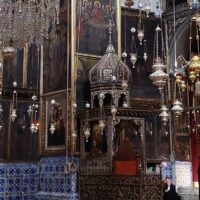
It was not only Roman Catholics who arrived in Jerusalem at the beginning of the 13th century, but also members of other Christian denominations. One of the most important and influential among them in the Middle East at the time was Georgian Christianity—the national faith of an advanced, powerful Caucasian kingdom at the height of its power prior to the Mongol invasions.
The great queen of the Georgians was Tamar, the great-granddaughter of King David (the Builder) and sister of Absalom. The names these monarchs chose for themselves reflected their belief that they belonged to the lineage of the House of David.

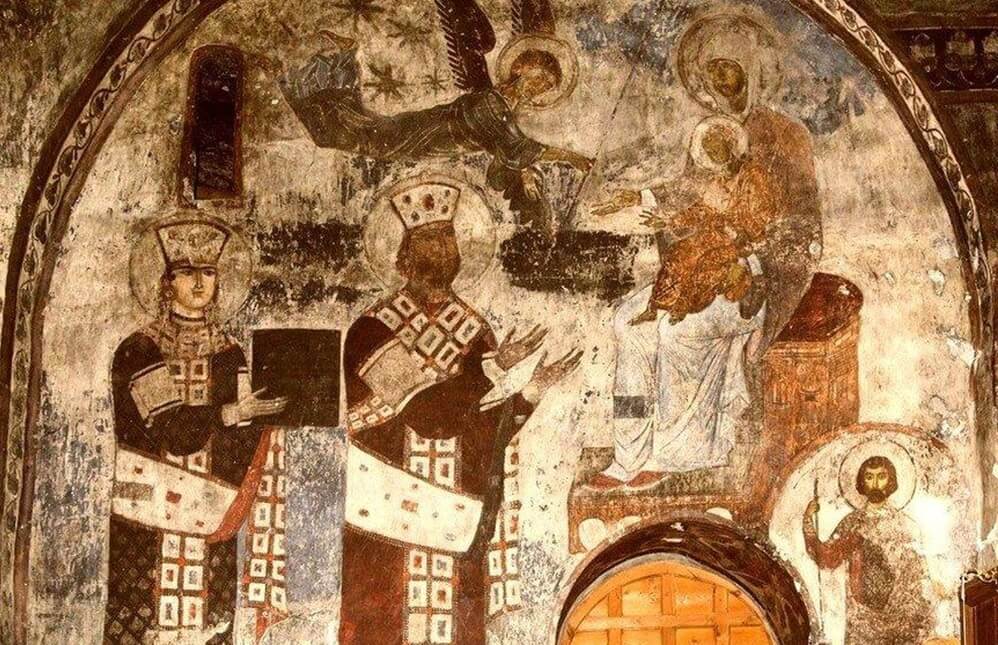
Queen Tamara and Rustaveli in the Monastery of the Cross
Tamaraa was born in 1166, and at the age of 18 she became the first and only Queen Regnant of Georgia. This initially caused opposition, but she was eventually accepted by the people and the Church and is still considered the greatest queen in Georgian history, having managed to bring Georgia to the peak of its power and influence. In addition to her rule over Georgia, Tamaraa helped establish the Byzantine Empire of Trebizond in 1204, after Constantinople was conquered by the Latins during the Fourth Crusade. She liberated large parts of Armenia, took control of large areas in Azerbaijan, led a successful invasion into Persia, and defeated Muslim and Turkish armies in several battles.
Tamara ruled for 30 years, until 1213, during which time the Georgians became the strongest Eastern Christian power in the Middle East, replacing the Byzantines as representatives of Eastern Christianity. The Georgians integrated into the region and were part of a flourishing trade network on the Silk Roads from which everyone benefited. They were allied with the Alans, nomadic tribes from north of the Caucasus, whose prince, David, was Tamara’s second husband, and with the Armenians, who experienced prosperity and independence under her patronage. In addition, Georgia maintained good relations with Muslim states, which appreciated its tolerance and openness toward Islam, especially the Sufi orders, in contrast to the hostility of the Europeans. All this was expressed in the establishment of many Georgian monasteries in Jerusalem, where there had been a Georgian presence since the Byzantine period (see chapter on Peter the Iberian).
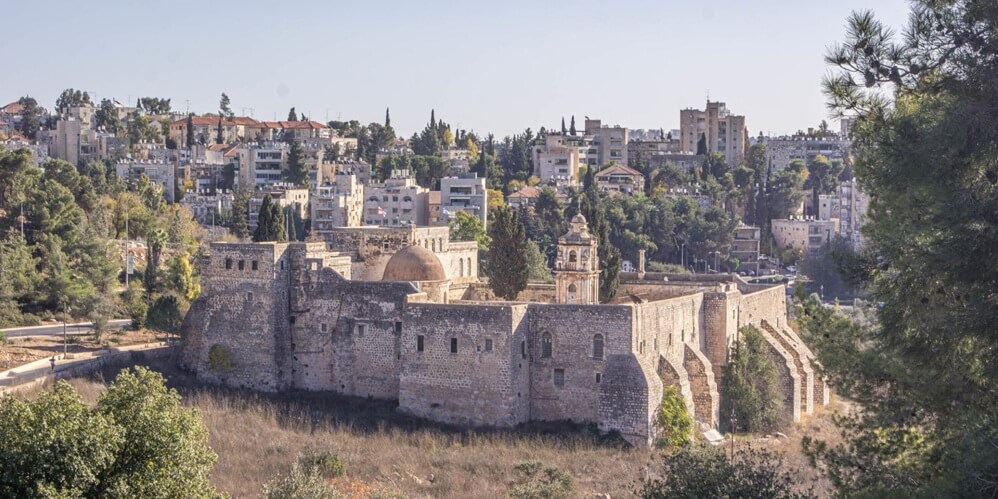
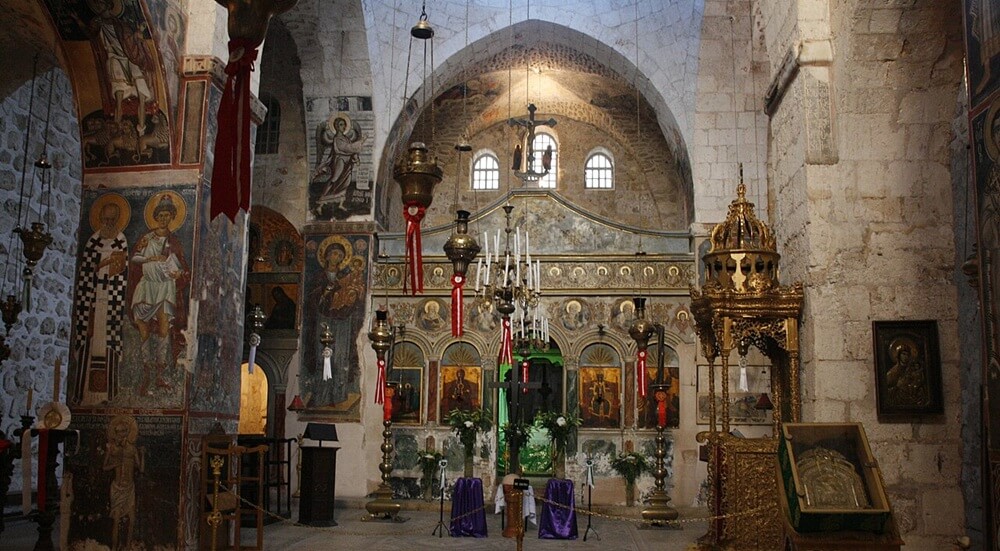
There were eight Georgian monasteries in Jerusalem, the largest and most important of which was the Monastery of the Cross. Tamara was in contact with Ṣalāḥ ad-Dīn (Saladin), requesting protection for the Georgian Christians, and she received many rights from him. Under pressure from the kingdom’s nobles, Tamara initially married a Russian prince, but she divorced him after two years, citing corruption and sodomy, and four years later married the Alan prince David, who was her greatest supporter and ruled alongside her. The couple had two children: George IV and Rusudan, who reigned one after the other after Tamara’s death. Her era was a golden age of architecture, painting, culture, and art. The ideal of chivalry developed in parallel to that of medieval Europe, and Saint George, the knight who rescues a maiden from the dragon, was chosen as the patron saint of Georgia (hence the name).
Tamara’s advisor and treasurer was a man named Rustaveli. The two apparently fell in love, and Rustaveli was forced into exile in Jerusalem, where he wrote the poem The Knight in the Panther’s Skin [1], which became the national epic of Georgia. The book tells the story of a military commander in love with the daughter of the King of Georgia. One day, the two lovers see a mysterious knight clad in a panther’s skin and try to capture him, but he escapes. The commander sets out on a three-year quest to find him, and in the end he finds the knight, who turns out to be in love with the daughter of the King of India and was forced into exile from his country because the king did not approve of the match. The commander helps the knight, and together they free the beloved daughter of the King of India.
Rustaveli wrote the poem, which is structured in a characteristic rhyme scheme, during his exile in the Monastery of the Cross in Jerusalem. This was around 1190 or 1200, after Jerusalem was conquered by Saladin. The interesting detail in the context of Tamara is that her burial place is not exactly known. According to legend, it was in the Bagrati Cathedral, but there is no precise location. Some legends say she was brought to the Church of the Holy Sepulchre, which she was unable to reach during her lifetime. In any case, she is buried like a flower in the hearts of the Georgians, along with the national writer and her beloved, Rustaveli.
The Father of the Serbs
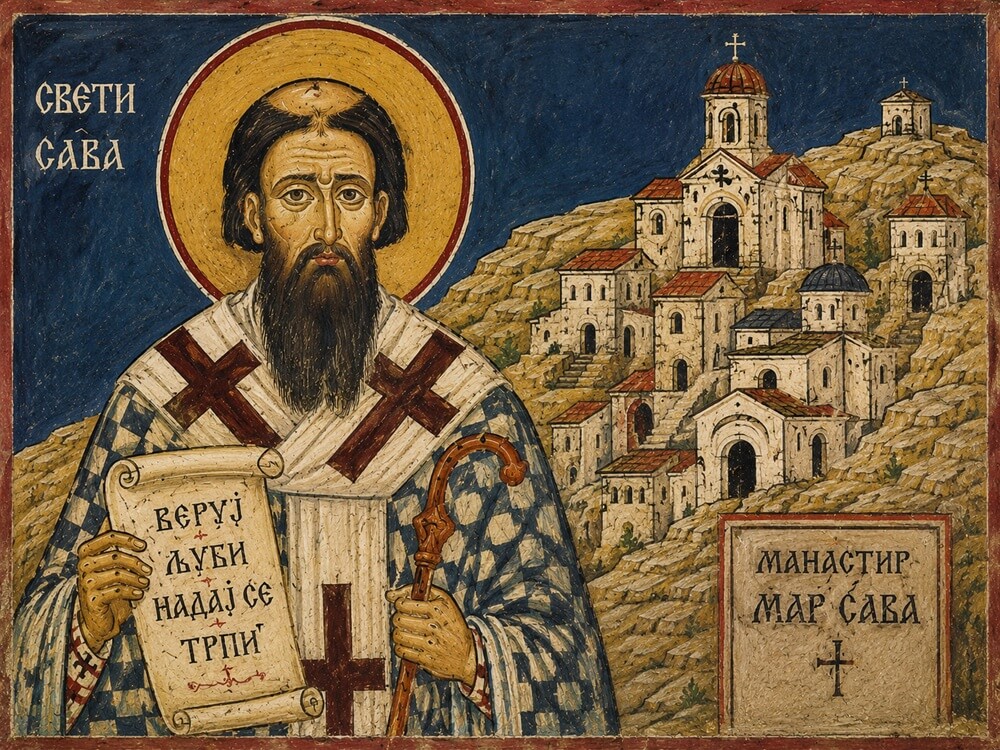
Concurrently with the rise of Georgia to the status of a strong Christian power in the Caucasus at the beginning of the 13th century, Serbia became the strong Christian power in the Balkans. This is connected to a saint named Sveti Sava, who had a physical, mystical, and synchronistic connection with Jerusalem and its surroundings, especially the Mar Saba Monastery. After the re-conquest of Jerusalem by the Muslims, the Catholics were expelled from the Holy City, but the Orthodox churches, such as those of the Georgians and the Greek Orthodox [2], were allowed to operate there. In this context, the figure of Saint Sava (Sava, 1169–1236) [3] stood out.
He was the youngest son of the great Serbian ruler Stefan Nemanja I, and as such, he ruled the areas of present-day Herzegovina for two years (1190–1192). However, an unknown event occurred after which he decided to abandon the pleasures of rule and become a monk. At only 18 years old, he left for the spiritual monastic Christian center of Mount Athos, which was beginning to develop at that time.
On Mount Athos, he delved into the depths of Christian mysticism and adopted the name Sava, after one of the fathers of monasticism in the Judean Desert in the 5th–6th centuries, who established many monasteries, the most famous of which is Mar Saba near Bethlehem. The original Sabas dealt with theological issues and provided a mystical interpretation of the New Testament. This interpretation was preserved in the monasteries on Mount Athos and was later compiled into a book that is a kind of Orthodox Zohar called the Philokalia [4]. In addition, he wrote a Typikon (rule) for monasteries throughout the Byzantine world.
The younger Sava (I chose this spelling to distinguish him from the elder Sabas, the founder of the Mar Saba Monastery in the 6th century) joined the Russian Monastery of Saint Panteleimon on Mount Athos, where he was guided by a monk knowledgeable in spiritual teachings, and then moved to the Orthodox Vatopedi Monastery (both monasteries exist to this day). When his father tried to persuade him to return to Serbia, he replied: “You have achieved everything a Christian ruler can do; come and join me now to live a true Christian life.” And so it was. Stefan Nemanja I joined his son, and together they spent three years on the mount. They received the Hilandar Monastery from the Byzantine emperor and renovated it. It was re-dedicated in 1199 and served as the first Serbian academy. Not long after, the father died and was buried there.
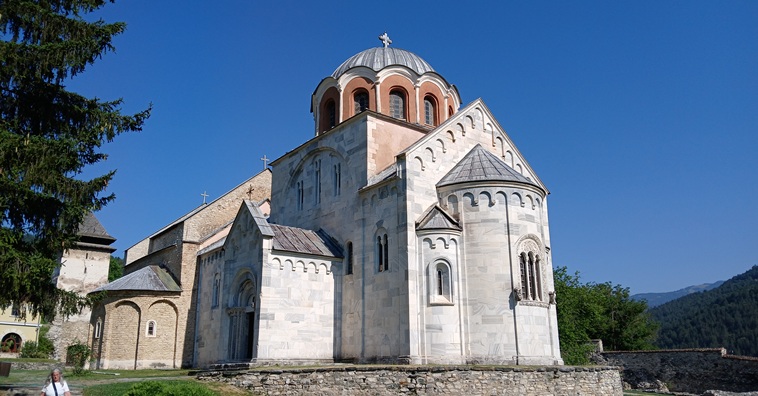
Like the saint after whom he was named, the younger Sava also wrote a rule for solitary monks, and in 1204, twelve years after his arrival at Mount Athos, he received the title of Archimandrite—in charge of monasteries. In that same year, Constantinople was conquered by the Crusaders of the Fourth Crusade. Boniface of Montferrat (Piedmont, Italy) established a kingdom in 1205 with its capital in Thessaloniki and ruled the monasteries on Mount Athos. Sava did not get along with this strange change of rule. Furthermore, the situation in his own country was not good. His two brothers began a civil war against each other, one helped by the Hungarians and the other by the Bulgarians. His father’s legacy was neglected and forgotten. Sava decided to act. Fourteen years after arriving at Mount Athos, in 1206, he returned to Serbia with his father’s remains and reburied them in the marvelous Studenica Monastery. By this act, he reconciled his brothers, reminded them of who they were and of their purpose, and brought peace to the land.
He then worked in Serbia and abroad to achieve independent status for the Serbian Church. His brother was the king, but independence and monarchy were not complete at that time without an independent church; as long as the Christians in Serbia were subject to the authority of the Orthodox Church in Byzantium, there was no full independence. And so, in 1219, Sava was declared by the Byzantine Patriarch of Constantinople the head of the independent Serbian Church, which was not subject to anyone and was in unity with the other Orthodox churches.
Sava reorganized the Serbian Church as an independent and unique church with its own saints and scriptures. He recruited a young, loyal, and talented generation of original Serbian clerics who would preserve and promote Serbian Christian teaching throughout the kingdom. He founded Serbian monasteries and bishoprics according to a division into districts subject to the central archbishopric in the capital city, wrote the first constitution of the Serbs, called the Nomocanon, which included religious and civil law for the new state, and founded a school for translating books from Greek and Latin into Old Slavonic. He also wrote his father’s biography, The Life of Saint Symeon, which created a national mythology and ethos that united the people. Sava’s actions solidified the idea of the Christian state under the leadership of the sacred Nemanjić dynasty. In addition, his work led to the spread of education and the anchoring of Christian morality and values.
In 1229, Sava set out on a journey to the Holy Land. His brother Stefan Nemanja II was no longer in power, and his son Radoslav had ascended in his place. At this time, Jerusalem was ruled by the Crusaders following the Fifth Crusade of Frederick II. Sava acquired properties for the Serbian Church in Jerusalem, including the Church of Michael in the Christian Quarter, visited the Mar Saba Monastery in the Judean Desert, and received as a gift the staff of the original Sabas and a holy icon of the Mother of God with Three Hands (Trojeručica), painted by John of Damascus after his miraculous healing (his hand was severed at the caliph’s command and grew back). He also received another icon of Maria lactans (Mary nursing), which shows his connection to the developing Mariology beliefs of that time.
Sava traveled to Saint Catherine’s Monastery in Sinai, establishing ties with this spiritual center, and continued from Israel to visit Thessaloniki, Mount Athos, and Byzantium before returning to Serbia. He traveled around the land for four intensive years, teaching the secrets of religion, theology, laws, and monastic life, built churches throughout Serbia and the neighboring lands, and began the construction of a marvelous cathedral at the new archbishopric (and later Patriarchate) site in Peć in Kosovo.
The cathedral in Peć was designed to express the structure of the universe and the laws governing the world, as well as mystical Christian cosmology. It still stands and is an embodiment of ideas from Christian sacred architecture. In doing so, Sava implemented what he had seen and learned around the world, especially in Jerusalem. Like Lalibela in Ethiopia, he created a model of the Heavenly Jerusalem in the new land of Serbia, which was based on and connected to the earthly Jerusalem.
In 1234, King Radoslav was replaced by his brother Vladislav, and Sava set out on another journey to Israel. He bought monasteries in Acre and Jerusalem, spent time with his friend, the important Greek Orthodox Patriarch Athanasius II (1231–1244), visited Alexandria and holy sites in Egypt, returned to Jerusalem, traveled to Armenia and Antioch, continued to Constantinople, and from there to the Bulgarian capital Veliko Tarnovo to meet another friend of his, King Ivan Asen. There he fell ill and died in 1236. King Vladislav himself came to request his bodily remains, which were transferred to the Malisheva Monastery in Serbia.
Sava is considered the Father of the Serbian Nation, and many legends were written about him. The Serbian flag features the symbol of the double eagle four times, along with four ‘S’ letters, which express the words of Sava: Samo Sloga Srbina Spasava, meaning “Only Unity Saves the Serbs.” This is the slogan that the father of the Serbs preached to his people, and which they repeat to this day.
Sveti Sava adopted the monastic rule of Jerusalem and made it the monastic rule of the Serbian Church, instead of that of Constantinople. He built the Patriarchate in Peć, Studenica monastery, and many other churches and monasteries throughout Serbia. Some of them following the model of the Church on Mount Zion (the Mother of all Churches) and the Mar Saba Monastery. He acquired the Monastery of John the Theologian (the author of the Gospel) on Mount Zion and established a Serbian presence in the city.
Serbia in Jerusalem
In the 14th century, one of the great Nemanja dynasty kings, King Milutin, established the Monastery of the Archangels in Jerusalem as the center of the Serbian presence in the city. This was a large complex near the Church of the Holy Sepulchre, established in 1312, which also included a hospital and a hostel for Serbian and Slavic pilgrims (Bulgaria was a parallel Slavic power that may have been a partner in this enterprise). The last and greatest Nemanja king, Stefan Dušan, supported the monastery, as did the city of Dubrovnik. During this period, the Serbian presence in the Mar Saba Monastery increased, and there was a connection between the two monasteries. In the 15th century, the wife of Sultan Murad II, who was the daughter of the last Serbian king Đurađ Branković, provided financial support to the monastery in Jerusalem.
In the 16th century, with the Ottoman conquest of Jerusalem, there were several highly influential Serbian officials in the sultan’s court, primarily the Grand Vizier Mehmed Pasha Sokolović, who was all-powerful during the years 1565–1579. During these years, the Serbs set the tone in the Mar Saba Monastery and built the defense tower that still stands there today. There was a religious pilgrimage of Serbs to Jerusalem and the bringing of holy objects back to Serbia, including sacred icons, relics of saints, and images of the city.
However, at the beginning of the 17th century, the power of Serbian Christianity was broken, and the Mar Saba Monastery passed to the Greek Orthodox, as did the Archangels Monastery in the Old City. But even at the end of this century, the great Patriarch Arsenije III made a pilgrimage to Jerusalem in 1680 and visited the Mar Saba Monastery, the Holy Sepulchre, and the city’s churches. This visit changed his life and also the history of Serbia, but that is a topic for another book.
Serbian pilgrims brought images of Jerusalem on cloth and as icons (proskynetaria) and placed them in churches and special sites in Serbia [5]. They believed in the existence of a Heavenly Jerusalem and an earthly Jerusalem and compared their saints, especially Prince Lazar, to Jesus. Heavenly Jerusalem was the ideal for their churches and cities, including Belgrade.
The church of the Monastery of the Archangels exists to this day in the Old City and is located at 9 Saint Francis Street, inside an inner courtyard. At its center is an ancient column that was one of the columns of the Temple, and according to tradition, this is the column to which Jesus was tied during the flagellation. The church is now called the Church of the Archangels Gabriel and Michael and is held by the Greek Orthodox, despite the Serbs having submitted an official request to have it returned to them.
King Lalibela and Jerusalem
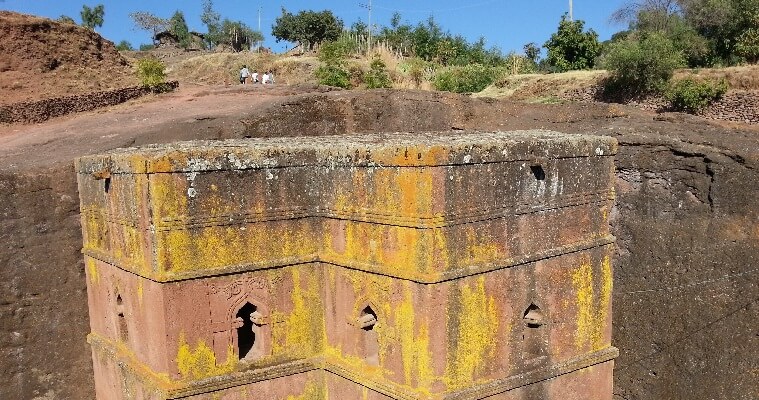
Ethiopian Christianity began in the Byzantine period (see chapter in Book 1), and since then it has existed as an independent Christian and cultural entity in the heart of Africa, with periods of ups and downs. During the time of the Crusades, the Zagwe dynasty rose to power, which at first did not have a fixed capital. However, after the rise to power of their greatest king, who lived in the 12th century and was named Lalibela (1162–1221), a heavenly Jerusalem was built in Ethiopia and served as its spiritual and political capital for a time.
When Lalibela was young, his brother (Harbay) tried to poison him so that he would not compete with him for the throne. While hovering between life and death, he had a vision in which angels carried him to the Heavenly Jerusalem in the seventh heaven. They flew him over the holy sites in the city, and he was commanded to build their likeness in Ethiopia.
Following the conflict with his brother, Lalibela was forced to flee Ethiopia and go into exile for twenty-five years. During this time, he arrived at the earthly Jerusalem, which was held by the Crusaders. There he learned the science of building, architecture, and engineering, as well as spiritual traditions from Egyptian monks, Syrian desert ascetics, and the Christian Crusader orders of Jerusalem (the Templars). While in Jerusalem, God appeared to him again and commanded him to return to Ethiopia despite his fears, promising him that his brother would vacate his place.
Lalibela returned to Ethiopia, became king, and, with the help of what he had learned while in the Holy City, began the construction of the Heavenly Jerusalem on earth—a city hewn out of rock, the likes of which had never been seen, built in the model of the city that was revealed to him in his vision when he was young and of the city he knew during his exile.
Lalibela arrived in Jerusalem in 1160 and returned to Ethiopia in 1185, two years before Jerusalem fell to the Muslims and four years before the Ethiopians received custody of parts of the Church of the Holy Sepulchre from Saladin. Concurrently, in 1182, the first versions of the Holy Grail story appeared at the court of Marie of Champagne, written by a man connected to the Templars, Chrétien de Troyes. In 1195, Wolfram von Eschenbach wrote the most esoteric version of this story, in which the Grail becomes a stone and the King of Ethiopia and the Templars are mentioned. A few years later, sculptures of the Queen of Sheba, the Holy Grail, and the Ark of the Covenant appeared in Chartres Cathedral.
According to Graham Hancock [6], these coincidences point to a connection between the Templars, the Holy Grail legends, and Ethiopia. The Templars planned to conquer Egypt together with the Ethiopians, and for this purpose they maintained contact with them through letters and visits. Hancock mentions an Ethiopian delegation that visited the Pope at the beginning of the 14th century, as well as a legendary letter sent in 1165 by Prester John (a legendary Ethiopian king—perhaps Lalibela) to Pope Alexander, in which he spoke of his armies and power. The king received a reply from the Pope only in 1177. The letter refers to the king’s request to receive an altar in the Church of the Holy Sepulchre and is addressed to Harbay, Lalibela’s brother, who was the king at the time.
Be that as it may, after Lalibela returned to Ethiopia, he himself became king and built the Holy City of Lalibela for about twenty years—a New Jerusalem in Ethiopia, according to the model of the Heavenly Jerusalem but also with reference to the earthly Jerusalem. Lalibela hewed the city out of rock and used 30,000 workers for this purpose. Legend has it that the king’s workers labored during the day, and at night, while everyone was asleep, white angels descended from heaven and continued the work. According to Hancock, the white angels who came at night and helped King Lalibela build his new capital were masons from the Templar Order who came with Lalibela from Jerusalem.
The Templars were interested in Ethiopia because the Ark of the Covenant was there, and they sought it because it was the Holy Grail to them. According to Hancock, it is possible that the Templars did indeed succeed in finding the Ark of the Covenant and, along with it, the Shamir Stone with which the stones for the Temple were hewn. The arrival of the Templars in Ethiopia in the 12th century, and the renewed use of ancient miraculous technologies related to the Ark of the Covenant, enabled the hewing of the city of Lalibela out of rock—a city that is an example of sacred architecture and a continuation of the traditions of sacred architecture apparent in the Dome of the Rock (their symbol) and the Temple.
Some of the churches built in the New Jerusalem—Lalibela—were named after sites in Jerusalem, emphasizing the connection to the Holy City, and some after other sites in the Land of Israel, such as the Jordan or the Galilee. During the construction, Jesus appeared to Lalibela and told him that he was bestowing the sanctity of Jerusalem upon the place, and therefore Rohā (Lalibela’s ancient name) is still called “Zion” and is considered a Second Jerusalem. The ancient Ethiopian book that tells the story of Lalibela is called Ghedle Lalibela.
Until Lalibela’s time, Axum—the city where the Ark of the Covenant was located—was considered the Second Jerusalem and was called “Zion.” It had many magnificent churches that were later destroyed. The churches of Lalibela imitate the style of the churches of Axum. Moreover, the largest and most important church in Lalibela, Medhane Alem (“Savior of the World”), was likely built as a copy of the ancient Ark of the Covenant Church in Axum, which itself relates to the dimensions of the Jewish Temple, since the Ark of the Covenant was located in the Temple.
The city hewn out of rock remained hidden for many years, and the first Europeans who visited the place could not believe their eyes. To this day, it is a holy pilgrimage site for Christians and also an amazing tourist attraction.
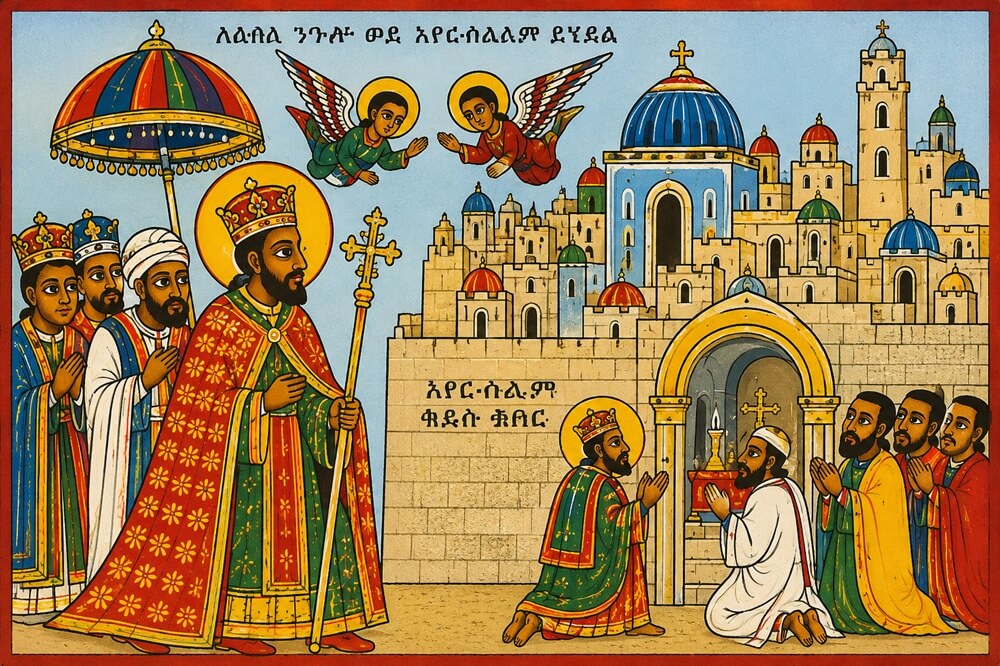
Tekle Haymanot
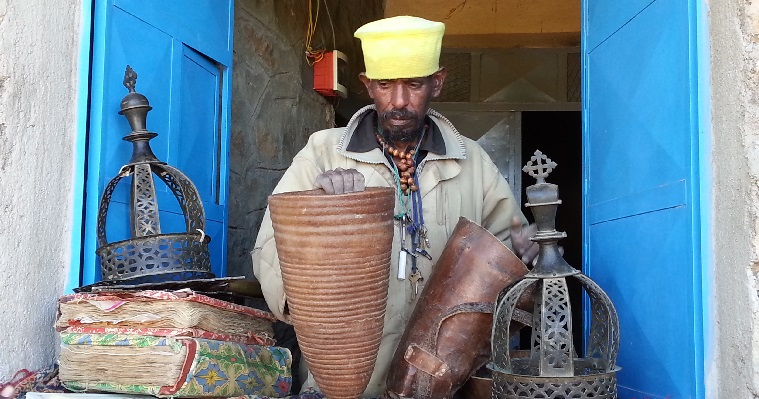
The Ethiopians have a small Patriarchate courtyard in the heart of the Old City, with a church dedicated to Tekle Haymanot (1215–1313), the most important Ethiopian saint, the counterpart of Saint Francis both in time and in spiritual undertaking and achievements. Tekle Haymanot was an ascetic monk who led a religious, cultural, and popular revolution in Ethiopia, one of whose results was the return of the Solomonic dynasty to power as leaders of a religious theocracy and the beginning of Ethiopia’s Golden Age. His figure is somewhat reminiscent of Theodosius, who founded a monastery near Bethlehem in the 6th century and used to stay awake standing on his feet all night.
The meaning of the word Haymanot is “faith.” The similarity in sound shows the connection between the Amharic language and the Hebrew language; both are Semitic languages that draw words from the same source. According to legend, after completing his studies at the monastery on Lake Hayq, he moved to Debre Libanos and secluded himself in a cave near the existing monastery for 21 years. When he arrived there, he stuck eight spears into the ground—two from each direction—pointed at him, so that if he fell asleep or moved from his place, he would be pierced by them. He turned his face toward a chest he had built and installed on the east side, and thus he remained standing and praying for 21 years, standing on one leg all that time. Tekle Haymanot mortified himself to such an extent that his other leg eventually dried up and fell off, and since then his symbol is a saint standing on one leg, with the other leg beside him—separate from the body.
Furthermore, during the 21 years of asceticism, he neither ate nor drank. Every year, a raven would bring him a single grain. He wept for the bitter fate of the people of Ethiopia, and his tears turned into a holy spring that flows from the cave to this day. Those who do not believe can see his images in all Ethiopian churches, standing on one leg with his other leg separated from his body, lying on the floor. And the meticulous can visit the cave where he secluded himself and see the spring that flows there.
Tekle Haymanot’s act of sacrifice energetically cleansed Ethiopia and allowed for a new beginning. Like in Saint Francis’s case, this was a kind of second appearance of Jesus in the world, this time in Ethiopia. The legends about him aroused great enthusiasm and swept all of Ethiopia in a wave of religious ecstasy. His influence was so great that, thanks to his power and authority, he succeeded in restoring the Solomonic dynasty to power and establishing it as the rulers of Ethiopia instead of the Zagwe dynasty in Lalibela, thereby opening the door to the Ethiopian Golden Age, which lasted 300 years. The center of gravity shifted from the Lalibela and Tigray regions to Shewa, Amhara, and the highlands around Lake Tana, and from the Agaw people to the Amhara people.
Tekle Haymanot claimed a genealogy reaching back to Zadok, the High Priest in Solomon’s time, or in other words—he was a descendant of the son of the High Priest Ezra who “brought” the Ark of the Covenant.
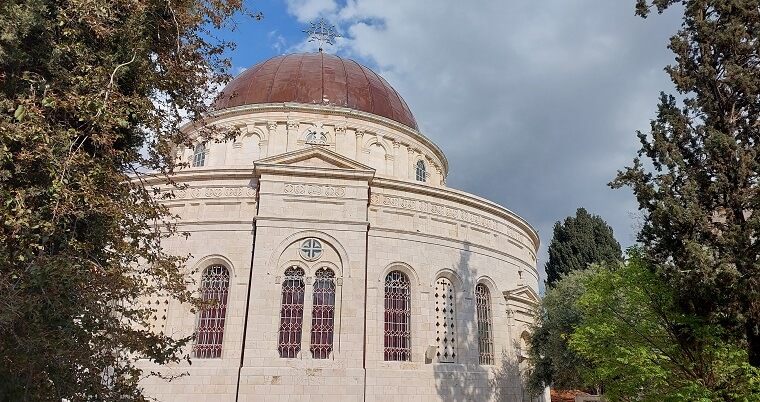
The Gadl Spiritual Champion
A foundational book in the Ethiopian Church is the Gadl (Book of Heroes and Heroines), in which the ideal of man is presented in its clearest form. This probably began with biographies that came from outside, such as that of Saint Anthony of Egypt, the founder of monasticism, which were translated into Ge’ez, and continued with the cultural revival of the 13th century. The monks nurtured the Gadl stories, incorporating an original Ethiopian dimension into them, which reached maturity during the Gondar period.
The word Gadl indicates a tension between two opposing forces. Within the holy people, there is a struggle—Tegadlo—which has two layers: the first layer is public criticism of the rulers; within this context we can understand the deeds of the heroes—the church fathers, who shape the spiritual values in social life. The second layer is the struggle within man with the passions and lower parts—Tegadlo—aimed at acquiring complete control over the body by maximally reducing the power of physical desire. Thus, there is a hidden assumption that man is a place of deep contradictions arising from the antagonism between spirit and body.
The public layer is at times an external expression of the inner struggle. The decay and corruption in society and politics reflect the failure of the battle against the passions and the victory of the ego. Winning the personal battle ensures the correction of the world through the public struggle. Thus, intense spiritual practices are an opening to successful rule, and in any case, prolonged prayers, fasting, and monasticism are important components in suppressing and weakening physical passions.
This perception is reminiscent of Gnostic doctrines, and its origin is likely outside Ethiopia—perhaps in the Greek tradition (man has a body and a soul—Numa), and perhaps in the Hebrew tradition or that of Egypt and Syria. In Ethiopian Christianity, there is a psychology of the soul and a psychology of the body. Ethiopian Christianity refers to the Sega—the flesh, the Nefs—the soul [7], and the Akal—the body. The writers of the Gadl use and refer to the combination Nefse–Sega (Nefs–Sega), which is soul-body.
Part of the Gadl was directed toward the rulers, such as Lalibela, part toward the priests, and part toward the believers, as is required of a people that is the true Israel. The Ethiopian religious education system was aimed at creating monks and spiritual people of the highest rank. The focus is placed on mental and spiritual development, while the study of the physical world is secondary in importance. The students are directed to suppress their physical desires so that the spirit can flourish; the material world is sacrificed on the altar of the spiritual. The best example of the Gadl of a holy man who rejects the physical world is that of Tekle Haymanot.
Footnotes:
[1] Rustaveli, Shota. (1969). The Knight in the Panther’s Skin (D. Gafonoff, Trans.). Tel Aviv: Sifriat Poalim.
[2] One of the figures who stands out during this period and with the renewed Christian conquest is the Greek Orthodox Patriarch Athanasius II.
[3] Savić, A. Z. (2020). Athos – Jerusalem – Sinai: Peregrinations and identities in the Lives of St Sava of Serbia. In I. Feodorov (Ed.), South-Eastern Europe and the Eastern Mediterranean: Proceedings of the Session held at the 12th International Congress of South-East European Studies (Bucharest, 2–6 September 2019) (pp. 23–41).
[4] Palmer, G. E. H., & Ware, K. (Eds. & Trans.). (1979). Philokalia: The Eastern Christian spiritual texts (Vols. 1–5). Faber & Faber.
[5] Ivanić, B. (2006). Pilgrimage in medieval Serbia and “proskynetaria”: Pilgrims’ icons from Jerusalem. Series Byzantina, 4, 55–6.
[6] Hancock, G. (1993). Sign and the Seal: The Quest for the Lost Ark of the Covenant. Simon and Schuster.
[7] Reminiscent of the reference by the Muslim Sufi mystics.