Christian Alchemy
Alchemy reached the West before the Renaissance, and according to Eliade, the first Latin translations of alchemy, including the Emerald Tablet, were made in the 12th century [1]. During the Middle Ages, alchemy passed to Europe through the encounter between Muslims and Europeans in Spain, Sicily, and the Crusades. With the development of the Renaissance and the arrival of the Corpus Hermeticum in Italy, alchemy experienced a new revival. Cornelius Agrippa is considered the most important alchemist at the beginning of the 16th century, but it was Paracelsus who gave alchemy a more medical and scientific dimension.
Cornelius studied and trained in the occult under the Dominican Abbot of Sponheim (near Cologne), Johannes Trithemius. Together they wrote Cornelius’s important book on the occult, Of Occult Philosophy. The book is an encyclopedia of the occult, including alchemy, magic, astrology, and more. This book emphasizes the importance of studying texts from different religions. Abbot Trithemius asked Cornelius to keep the teaching secret, and at the end of his life, he even bequeathed his library to him. Thus, it can be assumed that some of the knowledge in the book is encrypted and not fully revealed, and that it is based on an ancient teaching. The same Abbot Trithemius also taught Paracelsus in the same place.
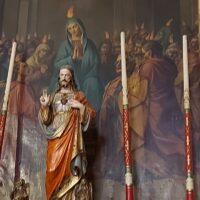
Christian alchemists claimed that Jesus Christ is the Philosopher’s Stone. If the process is viewed as an allegory for human life, the first stage on the path is the dissolution (or melting) of the personality, which corresponds to the alchemist’s death: “He who wishes to enter the kingdom of heaven must first enter his mother’s womb with his body and die there.” Afterward, through the encounter with the Philosopher’s Stone, a process of purification and maturation—a union of opposites—is experienced. The Stone heals diseases, restores youth, and is a life-elixir that ultimately grants eternal life.
According to alchemy, the world is composed of four elements, and metals are composed of a mixture of sulfur and mercury. However, each metal has a different ratio between them, so the way to turn iron into gold is first to separate the two components and then to recombine them in a different proportion. The belief developed that alchemy could influence the workings of nature and cause the spiritualization of matter. The aspiration of matter is to achieve perfection. The microcosm and the macrocosm reflect each other, but nature needs human intervention and assistance in order to reach perfection.
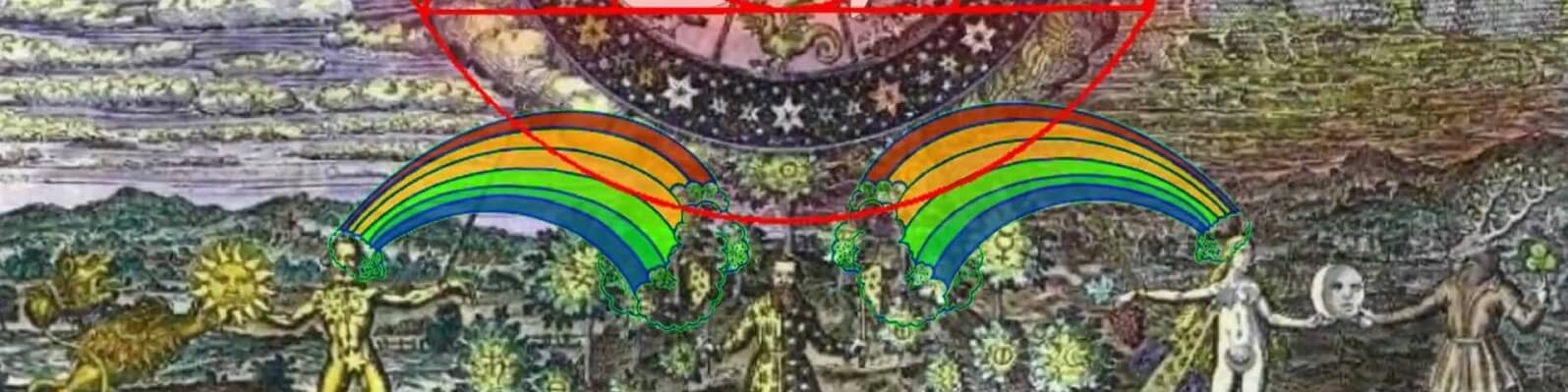
In terms of external presentation, alchemists sought the component that would help them in the transformation of base metals into gold, which is the Philosopher’s Stone. The process of change (the Work) is called the Magnum Opus and consists of three or four stages. First, the base metals are dissolved or broken down into their components. This is done by blackening, so the process is called Nigredo (from the Latin for “black”). Then, the substances are purified and refined. This process is called Albedo (from the Latin for “white”). At some stage, a little of the new substance is introduced, or in other words, the gold within us awakens. This process is called Citrinitas and is related to the color yellow (you need gold to produce gold). Finally, the substances are recombined in their new form, and the alchemists’ gold is created in the process called Rubedo (from the Latin for “red”).
It is interesting to note that, symbolically, black is represented by the raven. In Christian iconography, the raven fed Elijah in the cave. White is symbolized by the dove landing on Jesus’ shoulder (he himself is the gold), and red is symbolized by the rose, representing mystical Christianity and Jesus’ sacrifice (blood).
In addition to the four elements, alchemy also taught about four states: dry, wet, hot, and cold. Matter is built from a combination of all of these. Metals have two external qualities and two internal qualities. For example, externally, gold is composed of heat and moisture, and internally, it is composed of coldness and internal dryness. Silver has other qualities. If the internal qualities are removed from it, it will turn into gold, and this is done through an elixir—a life potion composed of plant and animal substances that brings healing to the soul and body.
Alchemy also speaks of three substances and three colors. Paracelsus spoke of three alchemical elements: in addition to sulfur and mercury, there is a third element, salt, and together they constitute the Trinity, the primordial matter. Mercury is the feminine element, the soul, the Holy Spirit. Sulfur is the masculine element, the spirit, the Father. Salt is the solidity or the body, the Son. Mercury is the dissolution of matter, sulfur its burning, and salt the residue after the burning.
Paracelsus
One of the great spiritual figures of the 16th century is the great magus Paracelsus (1493–1541). According to his statements in his book Opus Paramirum, he visited the Land of Israel in search of knowledge, meaning in Jerusalem. Not much is known about what he did in the city, but it may be related to the city’s connection to alchemy and the occult teachings in which he was interested (see chapter on alchemy in the first book).
Paracelsus was born in Switzerland and taught in Basel, but he traveled throughout Europe and largely represents what is called the “German Renaissance.” He was a physician and is considered the first modern physician who relied on research and observation and did not blindly accept ancient traditions. In addition, he was also an alchemist and astrologer, and was interested in Hermetics and the occult.
His conception of medicine is close to the alternative current. He claimed that health depends on the balance of man, who is a microcosm reflecting the macrocosm and living in harmony with it. The cause of diseases is external toxins, and the dosage is what distinguishes between poison and medicine. The goal of alchemy is not the production of gold and silver, but the “investigation of the utility and power of medicines.” The physician must also be an astrologer and mystic who understands the soul, as physical illness begins in the soul. To a large extent, he revived the tradition of herbalism, linking plants to energies and astrological influences.
At the age of 24, with the Ottoman conquest of Jerusalem, he set out on a seven-year journey across Europe and the Middle East (including Egypt, Jerusalem, and Constantinople) in search of the lost knowledge of the occult sciences and alchemy that could not be found in books. After his return, he invented the Magical Alphabet, a magical script for amulets, and began practicing medicine.
At the age of 32, Erasmus of Rotterdam called him to teach with him at the University of Basel, where he lasted about two years before falling out with the establishment. He was a genius with great knowledge but with little patience for human beings and mental rigidity, and so he wandered from one cultural center to another across Germany. Everywhere he went, he healed, engaged in magic, prophesied according to astrology, and simultaneously wrote books on medicine and spiritual subjects, and was active in all kinds of secret societies and organizations related to the Reformation movement.
Already in his lifetime, Paracelsus became a legend. After his death, his writings were edited by Johannes Huser of Basel, and they served as the basis for the teaching of the Order of the Rosy Cross (Rosicrucians). Paracelsus noted the archetypes of form shared by plants and human beings; for example, a plant root in the shape of a shoulder will affect the shoulder. He found a connection between the different body organs and the stars, and his thought largely resembles the conception of nature and medicine of Rudolf Steiner.
Paracelsus spoke of alchemy as expressing man’s ability to create. The thought of the alchemists linked spirituality with the creative power of human beings and paved the way for the modern world and technological development. Man completes God in the process of creation, but what he creates is spiritual, and therefore Paracelsus says that all ancient thinkers must come to him, to his land, and so must all mystics and ancient teachings. He creates his world, ascending from the earthly to the spiritual by his own power.
Balthasar Walther
Eighty years after Paracelsus’s journey to the Near East, another person who was also interested in alchemy and mysticism followed in his footsteps. Balthasar Walther (1558–1631) was an original thinker, mystic, and scholar who greatly influenced the thought of Jakob Böhme, one of the pillars of developing Protestant thought and spirituality. He was a physician and a Kabbalist interested in alchemy and the teachings of Paracelsus, working in Poland and Transylvania (where he wrote a book about Michael the Brave, the first unifier of Romania), as well as in the Holy Roman Empire.
He studied in Leipzig and traveled across Europe. He came into possession of ancient manuscripts of magic and alchemy, and to deepen his understanding, he made a pilgrimage to Jerusalem, Damascus, and various sites in the Middle East and Africa. As part of his travels, he learned from Jewish Kabbalists and Sufi teachers, a kind of second Christian Rosenkreutz (see below).
According to Penman’s article [2], Balthasar was in Israel in the years 1597–1599, and as part of this, he certainly visited the Mount of Olives—meaning Jerusalem—and apparently continued to come to Israel for four more years after the initial journey. During his life, he was exposed to the book Sefer Raziel HaMalakh (Book of Raziel the Angel), which was supposedly given by the Angel Raziel to Adam, but was probably written in the 13th century, perhaps by Abraham Abulafia. The book contains much practical Kabbalah, and the symbol of the Star of David plays a central role in it for the first time. Another book that Balthasar delved into was Picatrix (The Goal of the Sage), which contains texts of magic and alchemy from ancient Muslim sources.
In 1612, he met Jakob Böhme (1575–1624) and became his close friend and colleague. Together they wrote the book 40 Questions on the Soul. Balthasar supported Böhme’s philosophy until his death in 1631. According to their view, there is a process of fall and redemption in the world that depends on man—a union of opposites through love. At the same time, an important rabbi known as the Shelah HaKadosh from Prague arrived in Jerusalem, and there was a revival of the Jewish community there, until a pasha hostile to Judaism came to power in 1620.
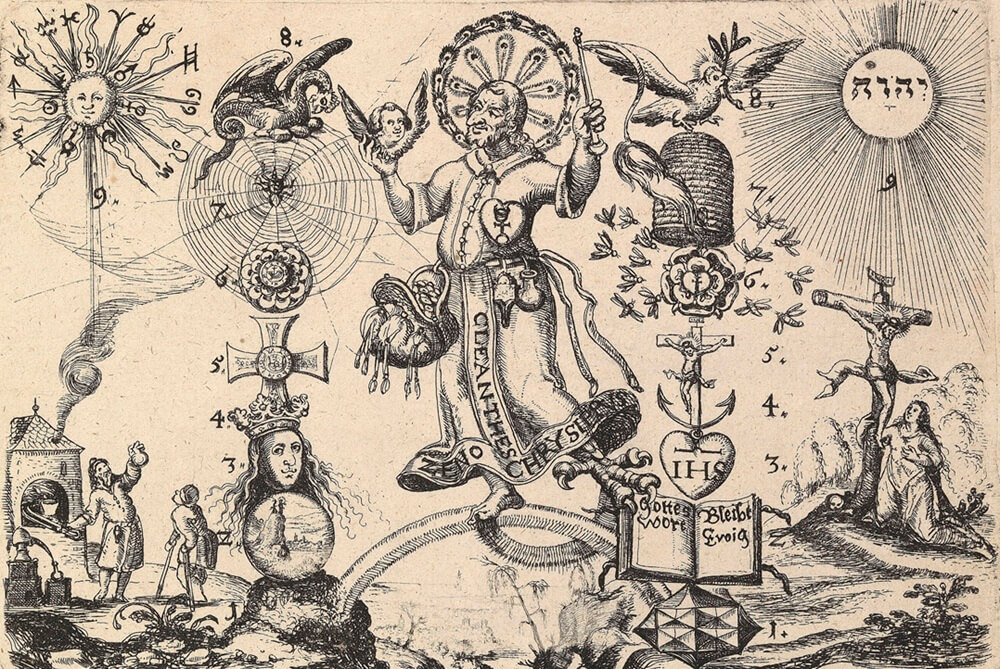
Christian Rosenkreutz
One of the prominent appearances of Christian esoteric mysticism is a treatise published in 1614 about a man named Christian Rosenkreutz, who traveled to the Middle East in the 14th or 15th century and learned mystical secrets in Egypt, Morocco, Arabia, and the Holy Land. Upon his return, he founded a secret organization, the “Brotherhood of the Rosy Cross,” which revived the ancient esoteric knowledge. According to the writings, the Rosicrucian Order is a brotherhood of magi and sages that has existed for two hundred years and wishes to change the way things operate in the world. To this end, it decided to reveal itself and calls on all those whose spirit is close to its heart to join it [3].
After the first treatise, additional treatises appeared that aroused great enthusiasm and established the belief in the existence of universal brotherhoods operating behind the scenes to improve and guide the world, and in the possibility of the resurrection of human society and culture through the implementation of esoteric knowledge. The names mentioned in the treatises included Giordano Bruno, Paracelsus, and other great magi. They sought, first and foremost, to bring about a reform in education. At their center was a proposal to establish a community of scholars and to develop a new educational system based on alchemical philosophy, to create a place where the divine secrets with which the world is infused are revealed (this can be seen as the roots of the Anthroposophical education system), and to bring about a change in the religion and culture of Europe through a bold synthesis between occult traditions and the natural sciences.
Some believe that the person who wrote the first manifesto of the society was a German Protestant philosopher named Valentinus Andreae, who wrote another book called Christianopolis, which influenced Francis Bacon’s New Atlantis.
In the first public manifesto of the society, called Fama Fraternitatis, it is recounted that Rosenkreutz, accompanied by some friends, set out for Jerusalem to learn the secrets of alchemy, Kabbalah, magic, and the spiritual path from the sages of the East. However, on the way, he met enlightened people who guided him to a place called Damcar in Arabia, where he stayed for three years, during which the secrets of nature, the universe, and the structure of the spiritual worlds were revealed to him.
The second manifesto, published a year later, Confessio Fraternitatis, presents a vision of a new universal religion and a union between East and West. The third important manifesto, published another year later, Chymische Hochzeit des Christian Rosenkreutz (The Chymical Wedding of Christian Rosenkreutz), is a legendary story about a mystical marriage between a king and a queen and Rosenkreutz’s journey through imaginary worlds. The connection of Jerusalem to all this lies in its being the most suitable place for the union between East and West and, consequently, for the mystical marriage and the connection between the masculine and the feminine.
Many years after the publication of these writings, a man named Pascal Beverly Randolph attempted to physically implement the ideas written in them, a topic covered in the third book.
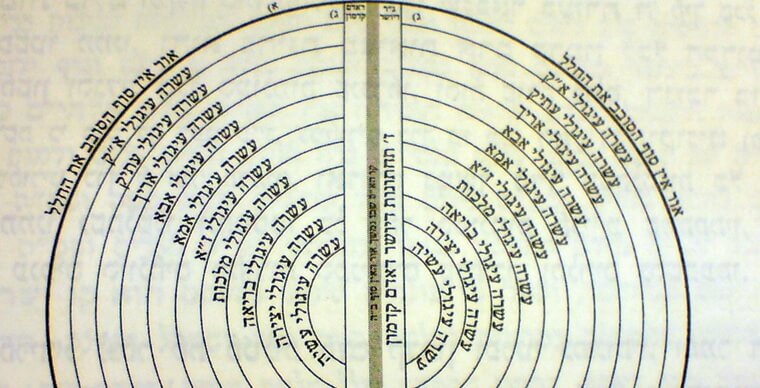
The Development of Christian Kabbalah
The 16th century is characterized not only by a renewed interest in alchemy, astrology, and the occult sciences, but also by the study of Kabbalah, which took on a Christian hue following its treatment by Pico della Mirandola and others as an ancient wisdom teaching. One of the first people to develop Christian Kabbalah in the West under Mirandola’s influence was Johannes Reuchlin (1455–1522), one of the pioneers of Hebraism, who defended Judaism and Jewish scriptures and was a friend of Martin Luther.
Thus, a man named Guillaume Postel (1510–1581), a Christian French Kabbalistic scholar, traveled to Jerusalem and the Land of Israel on a mission from King Francis I of France in 1537 after delving into the teachings of Kabbalah and the Corpus Hermeticum. Following this visit, he brought back to Europe ancient manuscripts, including an old copy of the New Testament in Aramaic. The effort to translate and print these books brought him into contact with the Jewish printer from Venice, Daniel Bomberg, who supported his second trip to the Holy Land in the years 1548–1550. There is documentation of a letter from him dated 21 August 1549, during the time of Suleiman the Magnificent, and afterward he joined Gabriel de Luetz, the ambassador of King Henry II of France to the Sultan, who was active there along with a group of scholars.
Postel was a language expert who knew Hebrew and Arabic and probably Aramaic, with a universal worldview, who preached a true religion based on the wisdom of all religions but under the patronage of the King of France and the Catholic Church. Postel had universal messianic ideas, and in this context, he assigned an important place to Jerusalem. In his writings, he revealed the role of Jerusalem in the tikkun olam (“repair of the world”) and the Temple as a universal spiritual center, connecting the city with the redemption of humanity. The city is a symbol of the possible unity of all religions in the future.
Postel wrote about heavenly harmonies, the union of nature and grace, and more. He was friendly with Ignatius of Loyola and was a member of the Jesuit Order for a period, but eventually set out on his own independent path that led him to clash with the Church.
Footnotes:
[1] Eliade, Mircea, A History of Religious Ideas, Vol. 3, translated by Yotam Reuveni, Tel Aviv: Nimrod, 2001. p. 225.
[2] Penman, L. T. I. (2006). A second Christian Rosencreuz? Jakob Böhme’s disciple Balthasar Walther (1558–c.1630) and the Kabbalah. Aries: Journal for the Study of Western Esotericism, 6(2), 155–182.
[3] Anonymous. (1614/1998). The Rosicrucian manifestos: Fama Fraternitatis and Confessio Fraternitatis (T. M. Johnson, Trans.). York Beach, ME: Samuel Weiser.