Christianity in the Ottoman Period
The conquest of Jerusalem by the Ottomans led to an increase in the flow of Christian pilgrims to the Holy City. It was important for the Empire to maintain good relations and trade ties with European powers, which was reflected in the granting of religious rights and a general attitude of tolerance towards minorities. This was also a general characteristic of the Ottomans, as explained in the chapter on the Ottoman Empire. The Ottomans ruled not only the East but also large parts of Europe. One out of every four inhabitants of the Empire was Christian.
The administrative and economic establishment of the Ottoman Empire, especially in the large cities, relied heavily on non-Muslim minorities – including Greek Orthodox Christians, Armenians, and Jews – who often served as officials, translators, merchants, diplomatic advisors, bankers, and educated individuals. Additionally, the Empire’s international trade relied on a close network of ties with Europe – mainly through Venice, Genoa, Spain, France, and later Britain. In other words, the Ottoman Empire, despite being the stronghold of Islam and the Muslim Caliphate, was to some extent also a multinational and multireligious empire, and this led to a situation in Jerusalem that was different from what had existed previously.
The period of Ottoman rule in Jerusalem can be divided into three parts. The first part is the 16th century, a time of energetic construction during which the sultans were involved in the city’s affairs (from afar), and the central government was strong and effective. The 17th–18th centuries were a time of economic and social decline, during which governance was mostly in the hands of local, sometimes backward, entities, and the city declined in status. Finally, the 19th century was a time when Jerusalem awakened, grew, and renewed itself (this period, which is already related to the modern era, will be covered in the third book).
St. Savior Monastery and the Spanish Connection
St. Savior Monastery is the center of the Franciscan Custodia Terrae Sanctae in Israel, a kind of city within a city, a self-contained quarter with a bakery, a printing press, schools, residential buildings for monks, workshops, and more. The site was acquired at the end of the 16th century, and it houses the leadership of the Custodia; traditionally, the head of the Custodia is Italian, and the financial administrator is Spanish.
The story of the site is connected to the greatest Spanish king, Philip II (1527–1598), and his relationship with Boniface of Ragusa (Dubrovnik), the head of the Custodia Terrae Sanctae from 1551–1564.
Philip II ruled a vast empire that included South America, the Philippines, the Low Countries, and southern Italy, but he was also officially the “King of Jerusalem,” inheriting the title from his grandfather Ferdinand. During his reign, Spain reached the peak of its power, and its empire had 23 million people, a number similar to that of the Ottoman Empire. The Spanish succeeded in stopping the Ottomans at the Battle of Lepanto in 1571 thanks to the intervention of Mary. They took patronage over the Custodia Terrae Sanctae of the Franciscan Order in the Holy Land and were honored by the Ottomans as the representatives and protectors of Christians in the Holy Land.
Previously, and for historical reasons related to the Mamluk Empire, it was the Kingdom of Aragon that took patronage over the Franciscans, and subsequently the unified Kingdom of Spain under Isabella and Ferdinand, which was in a kind of alliance with the Mamluks against the rising power of the Ottomans [1]. Isabella and Ferdinand contributed funds to the Custodia Terrae Sanctae, and a representative of the Custodia was present at their courts. The monks provided the Spanish monarchs with information about what was happening in the East, formed a network of intelligence and learning, and also brought holy objects from Jerusalem to Spain.
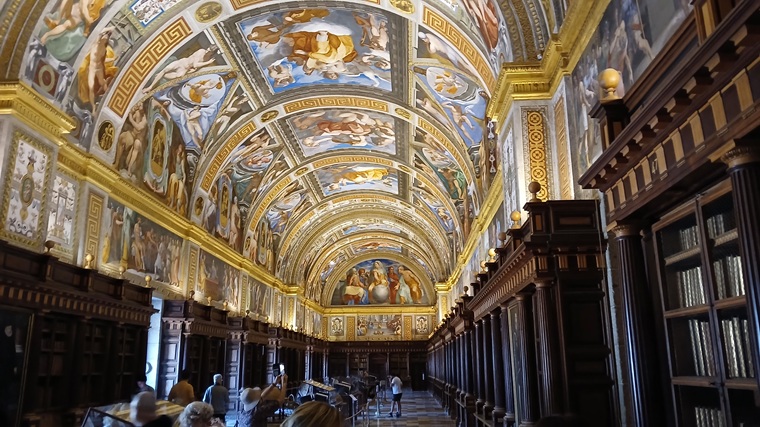
Philip was in conflict with the Pope, and it was important for him to emphasize his connection to Jerusalem. Beyond that, Philip saw his father Charles V, who was also the Holy Roman Emperor, as King David, and himself as Solomon building Jerusalem and the Temple. Philip, who was interested in sacred architecture, built a permanent center for the Spanish Crown—the monastery and palace of El Escorial—in a manner that would resemble the Temple of Solomon. The chosen site was 45 km from Madrid, and its landscape was reminiscent of Jerusalem.
Philip established in El Escorial a court of learning, a kind of university, and one of the most important libraries in Europe—a center of enlightenment and humanism, since Solomon was the wisest of men. One of the institution’s goals was the study of the sacred geography and history of Israel, which in a way brought Israel to Spain. The scholars discovered ancient similarities and connections between Spain and Israel and between the Spanish and Hebrew languages. A new type of scholar and a new science of biblical research, called critici sacri, was created. On the other side of Madrid, the University of Alcalá developed, focusing on Hebrew and Hebraic studies.
Various scholars came to El Escorial, and some of them engaged in the esoteric architecture of the Temple, introducing into the royal architecture measurements, proportions, and patterns related to the Temple, based on the assumption that they contained an additional dimension of meaning.
El Escorial was built at the same time as St. Peter’s Basilica in Rome, which was also built according to the pattern of Solomon’s Temple (its materials were allegedly spoils taken from the Temple in Jerusalem by the Romans; the right bronze door of the Basilica was said to have been taken from the Temple Gate in Jerusalem, as were the twisted columns around the altar, etc.). The idea of El Escorial and St. Peter’s Basilica was to transfer the energy of the Temple from Jerusalem to Europe, from the Jews to the Christians, and the competition was between Rome—which claimed to be the New Jerusalem—and Spain. Philip developed the idea of Spain as the New Zion, and over time, a belief also developed that the Spanish were descendants of Jews who arrived in Spain after the destruction of the First Temple, meaning they were of Israelite origin.
In the Book of Obadiah (Chapter 1, 20–21) appear the following words: “And the exiles of this host of the children of Israel shall possess that of the Canaanites, even unto Zarephath; and the exiles of Jerusalem, that are in Sepharad (Spain in Hebrew), shall possess the cities of the South. And saviors shall come up on Mount Zion to judge the mount of Esau; and the kingdom shall be the Lord’s.” This passage suggests that the exiles of Jerusalem, perhaps as early as the time of Nebuchadnezzar, found refuge in Spain.
The Spanish scholar Benito Arias Montano tried to explain this verse differently from the ancient translators of the Bible (such as Jerome), who identified Sepharad with the Bosphorus. Montano’s teacher, a man named Vázquez Matamoro, made a pilgrimage to Jerusalem, and Montano relied on him and on Benjamin of Tudela to become familiar with the Land. He also knew Hebrew fluently and delved into the explanations of Spanish Jews regarding this phrase. He argued that there was already a connection between Spain and Jerusalem at that time and that the verse refers to Spain itself.
According to ancient traditions of Spanish Jews, as Moses ibn Ezra of Granada claimed based on a passage from Josephus Flavius, Nebuchadnezzar, who wanted to surpass the achievements of Hercules, reached the Strait of Gibraltar—that is, Spain—and brought some of the Jewish exiles there. According to the biblical commentator Isaac Abravanel, the Jews were exiled to Spain during the time of Nebuchadnezzar by Pyrrhus, King of Spain, who helped the Babylonians and in return received a third of the captives.
Montano relied on his knowledge of languages and claimed that some of the place names in Spain were of Chaldean origin and some of Hebrew origin, such as the city of Toledo, which he argued was derived from the Hebrew word toldot (“generations”).
In any case, after the Reconquista, the Spanish sought a national ethos to rely on, and the theories about Hebrew origin suited them perfectly. The geography of Spain reminded them of the Land of Israel, and on the other hand, Spain was like Rome—the center of a vast empire where the sun never set—meaning a second Jerusalem. Therefore, Boniface of Ragusa, who was the head of the Custodia Terrae Sanctae in Jerusalem, naturally turned to Philip, the greatest and most important European ruler holding the title of King of Jerusalem, requesting funding and approval for the renovation of the Church of the Holy Sepulchre, the holiest site in the world for Christians.
The Ottomans, who wanted good relations with the Spanish, agreed, and in 1555 Boniface renovated the Aedicule in the Church of the Holy Sepulchre (the structure of the tomb itself) and was the last person to see the stone of the tomb itself. He also renovated the roof of the Church of the Holy Sepulchre. Additionally, he was involved in the purchase of the St. Savior compound, also with the help of Philip, with whom he corresponded personally.
In 1523, the Franciscans were expelled from their historic center on Mount Zion, and they sought a new center in Jerusalem. With the connections and money of Spain, Boniface and Philip succeeded in acquiring a large area in the Christian Quarter near the Church of the Holy Sepulchre, which contained a Georgian monastery, and in 1560 the place became the seat of the Custodia and was renamed St. Savior Monastery. The name may be related to the historic Church of San Salvador in Oviedo, Spain.
Philip’s era was also a time of the development of Christian mysticism. Teresa of Ávila (1515–1582) founded the Discalced Carmelite Order, which later established a monastery on the Mount of Olives in Jerusalem. John of the Cross (1542–1591) was a poet and mystic, and her companion on this path, a member of the Carmelite Order. However, the order most identified with Spain and which had great influence in the Spanish colonies was the Jesuits. Not many know this, but the order was founded thanks to a vision experienced by its founder during a visit to Jerusalem (see below).
The time of Philip and the establishment of St. Savior Monastery coincide with the period of the Council of Trent (1545–1563), which convened to address the Reformation and contemporary issues and initiated the Counter-Reformation. At the beginning of the council, there was a desire—mainly from the Spanish side—to declare a new crusade, but the council decided instead to strengthen the monastic orders, especially the Jesuits and the Custodia of the Franciscans, and to emphasize the concept of the spiritual Heavenly Jerusalem that arises from within the Catholic Church and the Sacraments, rather than the earthly Jerusalem.
In summary, in the 16th century, with the beginning of Ottoman rule in Jerusalem, the Franciscan Custodia Terrae Sanctae was under Spanish patronage and influence, and the Spanish played a decisive role in the acquisition of its new location in the Christian Quarter. However, over time, the Italian influence naturally grew stronger, and with the decline of Spain’s status, it eventually became predominant.
Jerusalem in Spain
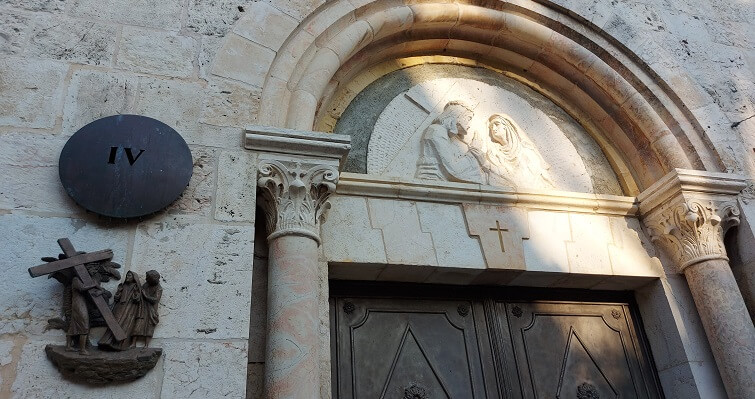
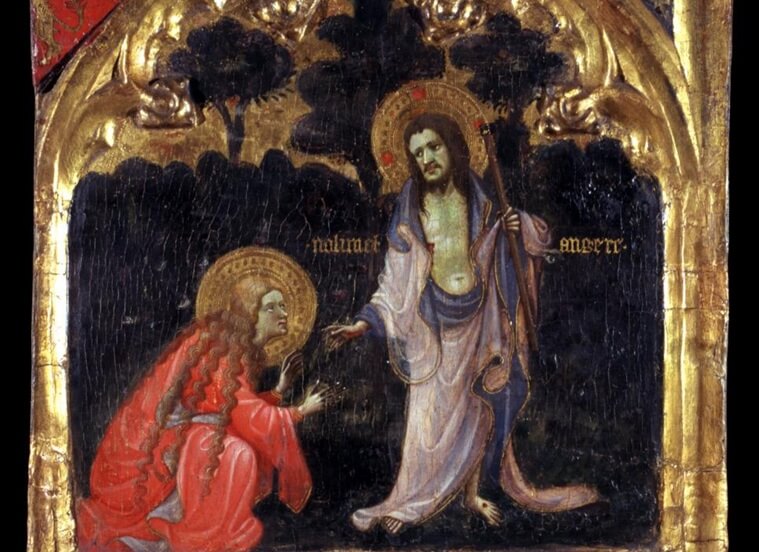
The concept of the Via Dolorosa is usually attributed to the Franciscans. However, the first appearance in Europe of a complete route of this kind was in Spain at the beginning of the 15th century among the Dominican Order. The Dominican friar Álvaro of Córdoba (1350–1430), an advisor to the rulers of Castile, sought to promote reforms in the Church. To gain inspiration, he visited the Holy Land in 1418–1420 and was deeply impressed by the sites of Jerusalem, especially Golgotha Hill and the Via Dolorosa. During his visit, he experienced visions and insights, and when he returned to Spain, he established the Escalaceli (“Stairs to Heaven”) Monastery, seven kilometers from Córdoba, which contained the first Via Dolorosa of its kind in Europe.
The monastery was built in an area whose landscape was reminiscent of Jerusalem and extended over a large tract with several sites identified with locations in Jerusalem. At the center of the complex, Álvaro built a cloister. On the mountain to the east there was a cave, which was identified with the Mount of Olives—where Álvaro would retreat and pray. West of the cloister was a hill on which he placed three crosses, symbolizing Golgotha. The distances between the different hills were accurate, corresponding to those in Jerusalem. Between the hill and the cloister, the first Via Dolorosa of its kind was built, with stations such as the place of the arrest, the scourging, the crowning with thorns, and more. The monastery was connected to royal circles, and the Dominican reform in Spain began there.
A second Via Dolorosa was created in Castile in 1521 by the Marquis of Tarifa and military commander of Andalusia, Fadrique Enríquez de Ribera of Seville, who made a pilgrimage to Jerusalem in 1518 together with the Spanish Renaissance poet and scholar Juan del Encina. The journey had a profound influence on both companions. Ribera expressed his experiences by renovating the family palace in Seville, adding Renaissance elements he encountered in Italy, renaming it the “Pilate’s Palace,” and creating a first complete Via Dolorosa that begins at this palace and passes through the city streets. Ribera accurately measured the stations and precisely replicated the distances. Many followed his example, and in fact, it was the Spanish who established the final formula of the 14 Stations of the Via Dolorosa.
Spain was typologically compared to the Land of Israel. Pilgrims saw a resemblance between the landscape of Israel and that of Spain and claimed that, of all the European countries, Spain was the one most similar to Israel. The resemblance between the Toledo region and Jerusalem was especially emphasized.
Bernardino Amico da Gallipoli was a Franciscan monk of Neapolitan origin who stayed in the Holy Land for five years on behalf of the Custodia Terrae Sanctae and on a mission from the Spanish kings. He accurately and meticulously measured and mapped the Christian holy sites. He returned to Spain in 1598, shortly before the death of Philip II, and published his book Trattato delle piante e imagini dei sacri edifizi di Terra Santa (Treatise on the Plans and Images of the Sacred Edifices of the Holy Land) during the reign of Philip III (1620). The book contains illustrations and plans of the city’s churches, most notably the Church of the Holy Sepulchre, the Church of the Nativity, and the Via Dolorosa, which he measured with great precision. The measurements include repeated units of 100 and 60 paces, as well as 75 and 90. This appears to be the first reference to a divine synchronization of the stations.
The subject of the measurements of the holy sites was a central theme among pilgrims in the Middle Ages. Many measured the distances between the stations of the Via Dolorosa, the distances between the various places within the Church of the Holy Sepulchre, the dimensions of the Holy Sepulchre itself, and more. This resonates with the importance of measurements in Gothic and Renaissance architecture and with a verse in Paul’s Epistle to the Ephesians 3:18: “May be able to comprehend with all saints what is the breadth, and length, and depth, and height,” as well as with Revelation 11:1: “And there was given me a reed like unto a rod: and the angel stood, saying, Rise, and measure the temple of God, and the altar, and them that worship therein,” and with Revelation 21:15–17: “The angel who talked with me had a measuring rod of gold to measure the city, its gates and its walls. The city was laid out like a square, as long as it was wide. He measured the city with the rod and found it to be 12,000 stadia in length, and as wide and high as it is long. The angel measured the wall using human measurement, and it was 144 cubits thick.” According to the tuning-fork principle, constructing a structure according to the same measurements as a holy site transmits the energy (mana) of the holy site to its imitation.
Another important aspect of Bernardino’s work is that around that time, the practice of guided-imagery meditation on the events of the Via Dolorosa at the original sites began. The drawings and illustrations of the holy places assisted in the formation of the imagined image. The period was one of Christian meditations—Teresa of Ávila used guided-imagery meditations, as did Ignatius of Loyola. The detailed architectural drawings also served another purpose: enabling the replication of the structures of Jerusalem in Spain. Thus, countless imitations of the Church of the Holy Sepulchre and other Jerusalem sites were erected in Spain, including the Cathedral of Granada, begun in 1528. Additionally, as in Italy, sacred mountains and Vias Dolorosas were constructed in various places in Spain that allowed for tracing and connecting to the events of Jesus’ life and the Passion.
Ignatius of Loyola
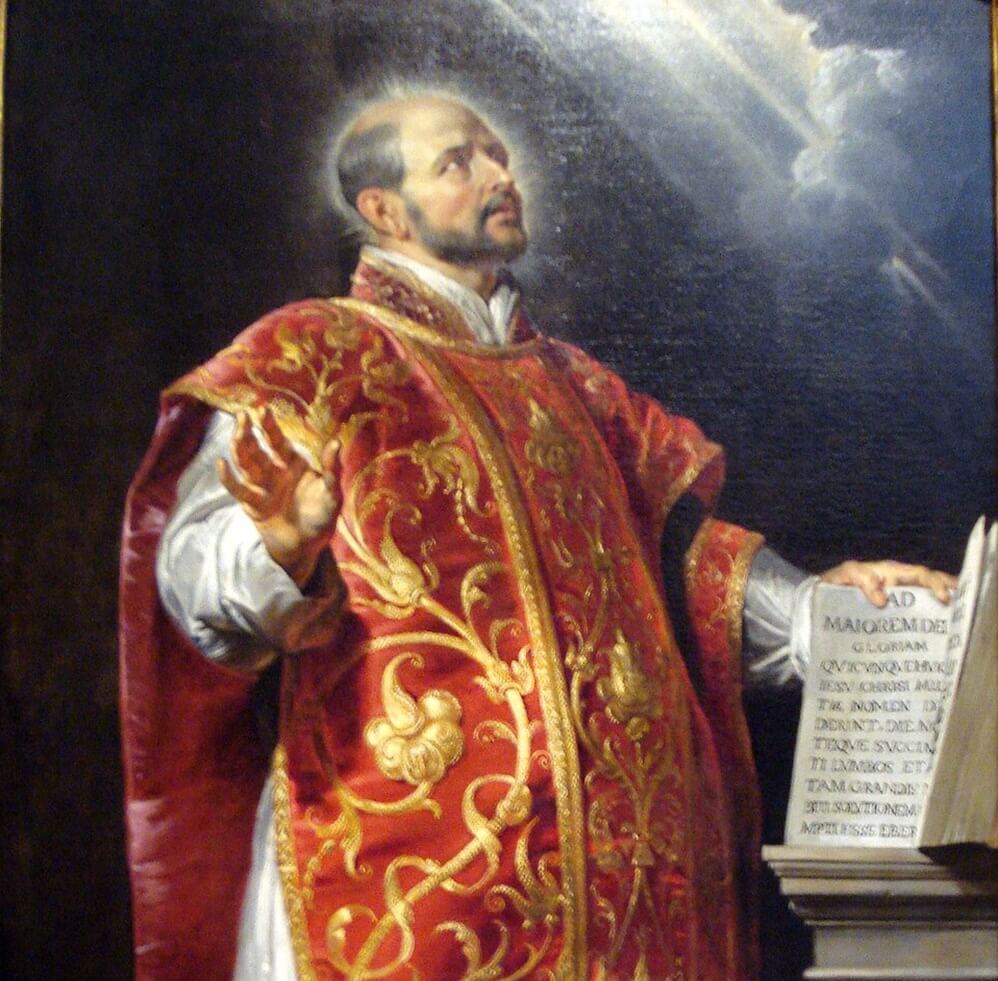
The 16th century is the Spanish century, also in religious terms. Some of the most important saints of the Catholic world were active in Spain during this period. One of the most famous among them is Ignatius of Loyola (1491–1556), the founder of the Jesuit Order. The story of his sanctification is connected to a pilgrimage he undertook to Jerusalem.
At the beginning of his life, similar to Saint Francis, he was captivated by the ideal of chivalry and courtly love. However, he was severely wounded in war, and following the injury, he underwent religious experiences and a process of repentance that culminated in a pilgrimage to Jerusalem. In 1523, shortly after the conquest of Jerusalem by the Ottomans, he made a pilgrimage to the Holy City. His journey was the climax of the conversion process he was undergoing and of the new ideal of his life. Following the experiences he underwent, Ignatius decided to spend the rest of his life in Jerusalem and to bring the Gospel to the inhabitants of the Land.
Ignatius set out with nothing. Miracles occurred to him along the way, and when he finally reached Jerusalem and saw the walls from afar, he experienced a joy and exaltation he had never known before. The next day, he visited the Church of the Holy Sepulchre and asked the head of the Franciscan Order to accept him as a monk in his service. One day, he ascended to the site of Jesus’ Ascension on the Mount of Olives and prayed alone before the stone bearing Jesus’ footprint. As he walked away, he realized he had not paid attention to something and felt a strong urge to return to the site. He returned, and there he experienced a profound revelation of the Christian Jesus—an elevated state of consciousness, comfort, and peace of mind that he carried with him for the rest of his life.
Despite Ignatius’s decision and desire to stay and serve God in Jerusalem, he was not permitted to remain in the Holy Land and was forced to leave and return to Europe, abandoning his great dream. But the few days he spent in the city led him to believe in the existence of a Heavenly Jerusalem. When he returned to Europe, he later founded the Jesuit Order with seven other men, and together they vowed to dedicate themselves to missionary work in Jerusalem. However, this dream too did not come true due to the events of the time, and the Jesuits instead set out to spread the teachings of Jesus through missionary work throughout the world, especially in the New World and in distant lands.
Only after many years did the Jesuits succeed in reaching Jerusalem, and today several Jesuit institutions exist there like the Pontifical Biblical Institute. The Church of San Salvador in the St. Savior Monastery, the seat of the Custodia Terrae Sanctae in Jerusalem, largely resembles the mother church of the Jesuit Order in Rome.
Ignatius of Loyola wrote the book Spiritual Exercises [3], considered one of the most important works in Christianity and the foundation of the order’s distinctive practice. The book outlines a 30-day personal repentance program, divided into four parts and usually carried out in isolation at a special retreat center for a month, as a way to discover the inner Jesus.
The first part is a contemplation of sin in the practitioner’s life, seeking repentance and forgiveness. The second part is a form of guided imagery of Jesus’ journey in the Gospels up to his arrival in Jerusalem, and it is related to life choices. In the third part, one reflects on Jesus’ Passion, which is connected to sacrifice and acceptance. In the fourth part, one reflects on Jesus’ Resurrection, which is associated with faith and a mystical religious experience.
The purpose of the spiritual exercises is to acquire the ability to discern between good and evil—an inner voice that tells us what is right and what is wrong—to recognize the struggle taking place within a person between the passionate soul and the aspiration toward deification, and to receive divine grace.
Footnotes
[1] Folda, J. (1998). Spain and the Holy Land: Medieval images from the third crusade to the reign of Ferdinand and Isabella. Gesta, 37(1), 63–78.
[2] Amico da Gallipoli, B. (1953). Plans of the Sacred Edifices of the Holy Land (T. Bellorini & E. Hoade, Trans.; B. Bagatti, Preface & Notes). Jerusalem: Collectio Maior 10.
[3] Ignatius of Loyola. (1951). The spiritual exercises of St. Ignatius: A new translation based on studies in the language of the autograph (L. J. Puhl, Trans.). Loyola Press.