
Iconography and John of Damascus
Alongside the establishment of Islam in the Land of Israel, the rise of the Umayyad Empire, the construction of the Dome of the Rock and the Al-Aqsa Mosque, and the emergence of the first Muslim scholars and holy men, the majority of the local population continued to practice their former faiths. Thus, we witness the development and appearance of significant Christian figures and new Christian spiritual traditions even during the period of the Muslim conquest. It is also worth noting, in this context, the parallel development of Jewish thought, institutions, and sacred sites.
Even today, in Jerusalem, one can observe several parallel worlds: a complete Christian sphere of orders, institutions, doctrines, rituals, and practices that functions throughout the city—largely unknown to the Jewish public—and alongside it, an even more extensive Muslim world of mosques and educational institutions such as madrasas and zawiyas. The same situation existed during the Early Arab period.
The central claim of this book is that there are connections and bridges between these worlds—mutual influences and forms of synchronization, a transfer of spiritual energy from culture to culture and from person to person, completing the shared human quest for meaning. In this context, the most significant Christian contemporary of the Umayyad caliphs—who was also in contact with them—was one of the greatest Christian thinkers of all time, a man who left a profound mark on history and was deeply connected to the Christian life of the city and the surrounding desert. Despite his final association with Jerusalem, he is known as John of Damascus.
 Mar Saba Monastery

John of Damascus
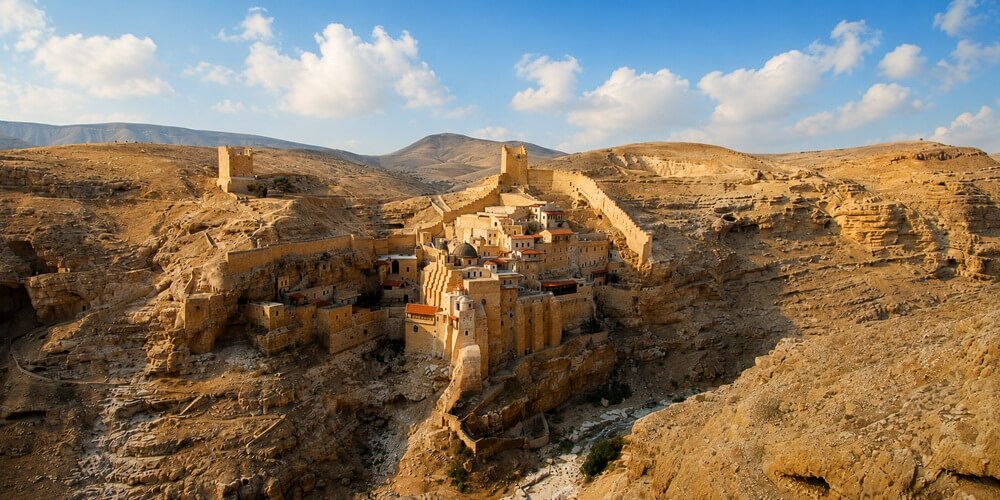
The figure of John of Damascus (675–749) is known to us through the writings of John of Jerusalem, the Patriarch of Jerusalem during that period. The two figures collaborated in the late Umayyad era. John of Damascus resided at the Mar Saba Monastery near Jerusalem but was also actively involved in the city’s religious and public affairs. The third member of this Christian “trinity” of the period was the monk Cosmas of Maiuma, John of Damascus’s adopted brother since childhood, who later joined him at Mar Saba and worked alongside him in the major ideological and theological debates of their time.
John of Damascus is the most significant Christian figure of the Umayyad period. His importance in the history of the Land of Israel and Jerusalem is immense, yet it extends far beyond the boundaries of the Umayyad Empire. John of Damascus stands among the greatest theologians of the Orthodox Church—the last of the Great Fathers—and one of those who shaped the course of Orthodox Christianity for generations to come. His contribution is particularly notable in two areas: the veneration and theological defense of icons, and the doctrine of the Assumption of Mary into heaven.
John of Damascus was born into a respected Christian family in Damascus. His father was the finance minister for the first three Umayyad Caliphs—Muawiyah, Yazid I, and Abd al-Malik—and as such, he was involved in the Dome of the Rock and Temple Mount project. The young John received an excellent education, some of it classical, including from teachers brought from the West. He was exposed to the Umayyad court and personally met the Caliphs, and in his youth he followed in his father’s footsteps, becoming an important official in the court as well. However, his soul sought God, and at the age of 30, he turned to the Christian path and became a monk at the Mar Saba Monastery. Despite this, he naturally had influence in the Damascus court, and he probably continued to visit there and perhaps fill certain roles.
After the death of Caliph al-Walid, he was replaced by his brother Sulayman, who had previously been the governor of the Land of Israel and founded the city of Ramla as its capital. Sulayman began an intense military campaign to conquer Constantinople and besieged the holy city. Up to that point, the Arabs had gone from strength to strength: they had taken control of Damascus and Jerusalem, conducted military campaigns that reached the walls of Constantinople, and seized a massive empire stretching from India and Central Asia to Spain. There was a feeling among Christians that God was turning His back on them, and they questioned why God favored the Muslims and not the true holders of the faith in Jesus.
The commander of the Byzantine army was a man named Leo III. He organized a revolt and seized power in Constantinople in the middle of the Muslim siege. According to his understanding, the failures of the Christians stemmed from the idolatry they had adopted—the worship of images (icons) and holy objects. Leo began a campaign against the veneration of icons and, to the surprise of many, won unexpected victories on the battlefield, removing the threat to Constantinople.
Consequently, the new emperor tried to strengthen the Christian faith in a monotheistic direction. He removed the image of Jesus from the palace gate in Constantinople, convened a council that declared the veneration of icons heresy, and so on—but it did not help. In 726, there was a devastating eruption of the volcano Thera in Greece, which was the last straw. Leo subsequently issued an edict prohibiting the veneration of icons. Anyone who did not comply was imprisoned, tortured, and sometimes executed. The power of the emperor was almost limitless. Icons were removed from all churches and monasteries, and the only person who stood against the tide was John of Damascus.
The supporters of icons in the Byzantine Empire were silenced and persecuted, but John of Damascus lived in the Umayyad Caliphate, free from the emperor’s tyranny. He published epistles explaining the importance and role of icon veneration and the rationale that sanctifies them. According to John of Damascus, from the moment God became incarnate in the flesh (image), the biblical prohibition on the worship of images was removed. The images are not important in themselves but because of what they represent. The miracle of the Incarnation reappears through the icons, some of which were miraculously painted by the hand of God.
The epistles encouraged the opponents of Iconoclasm (the persecution of icon supporters) but infuriated the emperor. He sent a letter to his counterpart, the Caliph in Damascus, accusing John of Damascus of planning a rebellion and asking him to cut off his hand—the very hand that painted the icons—and so it was done. However, there was a divine intervention. A few days after John of Damascus’s hand was severed and even displayed in public, he prayed devoutly before an icon of the Mother of God, and then the miracle occurred—his hand was restored as if nothing had happened, thus proving that the painters of icons create them through the grace of God and not by their own power.
The grateful John of Damascus added a silver hand to the icon before which he had prayed, and since then it has been known as the Three-Handed Icon (Trojeručica). It continues to perform miracles and is kept to this day in the Hilandar Monastery on Mount Athos. It is considered the most sacred object held by the Serbian Church, which maintains the monastery.

Another aspect of the Christian faith that John of Damascus encouraged and affirmed was the veneration of Mary and the beliefs regarding her Dormition on Mount Zion, her burial in Gethsemane, her Assumption into Heaven, and more. He declared them authentic, and the holy burial place in the Valley of Josaphat as the true Tomb of Mary. The emphasis on Mary’s Assumption into Heaven came at a time of Christian inferiority compared to Islam in Jerusalem, and against this backdrop, the figure of the Mother stands out. Like Rachel weeping for her children who go into exile, it also strengthened the tendency toward mystification as an explanation for the physically illogical situation from the Christians’ perspective.
It should be remembered that Mary was the one who helped John of Damascus after his hand was severed, and therefore she was perceived by him as an intercessor for humanity—a ladder upon which people could ascend to heaven. John of Damascus wrote many hymns to Mary, as well as music. He is also known for his comprehensive book on the Orthodox faith, The Fount of Knowledge, which includes a summary of the teachings of the great Desert Fathers—the first systematic theology of its kind. John of Damascus raises arguments against heresies and, for the first time, presents a comprehensive argument against Islam, portraying Muhammad as a false prophet.
The book demonstrates the breadth of John of Damascus’s knowledge in both Greek philosophy and the Qur’an, as well as in the writings of the Church Fathers who preceded him. John of Damascus turned the Mar Saba Monastery into an important center of learning and a library, where the work of translating texts from Greek into Arabic was carried out. However, the Mar Saba Monastery is located in the vicinity of Jerusalem, and he also had a metochion—a dependency of the monastery—in the Old City itself. John of Damascus collaborated with the clergy of Jerusalem in shaping Byzantine church music and in developing new Christian theology [1].
His adopted brother and companion, Cosmas of Maiuma, composed songs based on the works of Gregory of Nyssa and wrote hymns for Holy Week and Christmas prayers. These hymns were originally intended for the Church of Jerusalem but were later adopted by the entire Orthodox Church. To this day, Jerusalem remains a center for icon painting, as well as for the sale and exchange of icon images from around the world.
 Iconostasis of the Greek Catholic Church in Jerusalem
Icon Painting
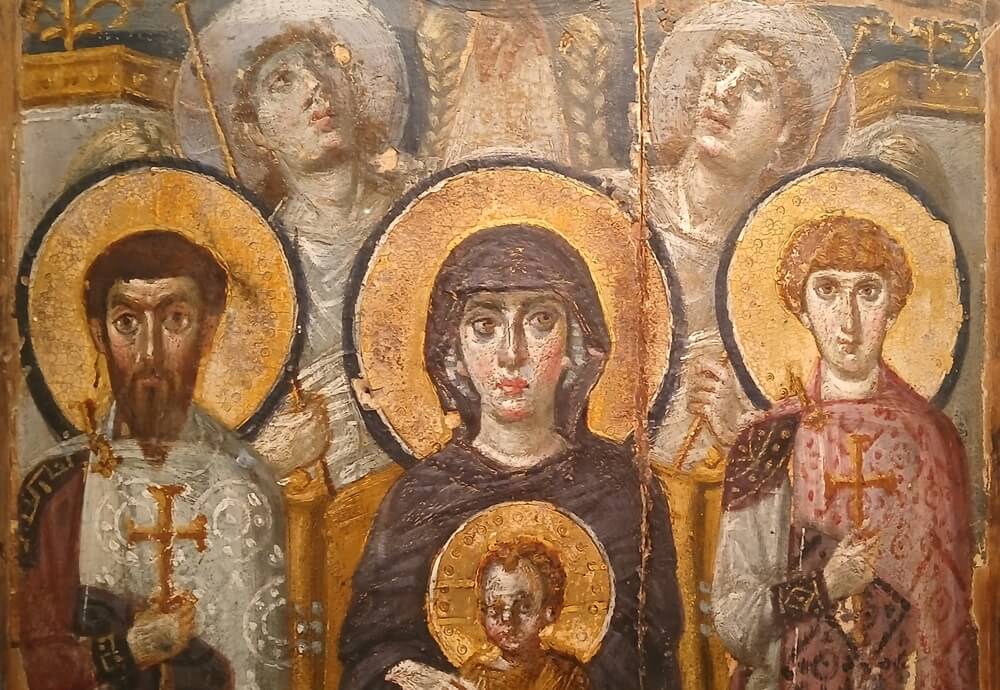
The veneration of icons (or holy paintings) appears in the 3rd century, initially in cemeteries and private rooms, with their use increasing alongside the development of the veneration of saints. Some scholars believe that the origin of icons lies in the art of wooden coffin paintings in Egypt. When comparing the images on Egyptian burial coffins with the icons of Saint Catherine (the location of the world’s oldest surviving icons), a strong resemblance can be seen. Another group of researchers argues that the source lies in the pagan–Roman world [2].
In any case, by the third century, icons had begun to be venerated, and they were used in religious processions. The central rationale for this was the continuity between the image and the figure it represents. Icons were perceived as an organ of the Divinity itself. Just as Jesus was incarnated in matter, so the quality of the subject of the painting was believed to appear through the painting itself. Icons were considered capable of bringing blessing, carried on banners into battle, used for healing the sick, and employed as amulets to bring success in life.
According to Ouspensky [3], icon painting begins with catacomb paintings in Rome and other places in the empire while Christianity was still being persecuted. The purpose of these paintings was not to depict life naturalistically, as in classical art, but to provide answers to the questions of life. The relationship between the figures and the objects becomes symbolic, and the figure is reduced to minimal representation and maximal expression. The figures are presented facing the viewer, their state being one of prayer. Many of the symbols are taken from the pagan tradition.
“The word of the Gospel is an image, and an image is a word. What words convey through the ear, images show silently through their form,” says Basil the Great, the most important theologian of the Orthodox Church at the end of the 4th century. “And by these two means, which mutually accompany one another… we receive knowledge of the same single thing.”
The dogma of icons was shaped at the Trullan Council, also called the Quinisext Council, held in Constantinople at the end of the 7th century. At this council, rules for icon painting were established. The sacred is not in the iconography itself, nor in what is presented, but in the method of presentation and in how it is conveyed. The teaching of the Church appears not only in the subject but also in the manner in which it is expressed. Art, through new symbolism, expresses the glory of God.
The subsequent Church council was the Second Council of Nicaea, which took place at the end of the 8th century. After fifty years of civil war in the Byzantine Empire surrounding the issue of the use of icons (Iconoclasm), the Council, which confirmed and restored the veneration of icons, stated: “We preserve, without innovation, all the traditions of the Church established for us, whether written or unwritten. One of these is icon painting, which is parallel to what the Gospels teach and refer to… because one shows the other, and one is clarified by the other.”
According to the Church Fathers, the purpose of icons was to elevate the person: “Icons lift the soul and mind of the believer, who sees in the icon the realm of the spirit, the incorruptible, the kingdom of God—in the closest form that can be reached by material means.”
The icon painter is called the “writer” of the icon because he creates a language. When he begins the work, he offers a special prayer, asking God to guide him to paint as faithfully as possible to the source.
The iconographer must be a person of prayer and live a life of prayer and fasting—“the iconographers painted while praying.” Iconography depicts the saints not as they were in their daily lives, but as they are in eternity. The iconographer conveys his vision of the heavenly world not through symbols such as a sunset or angels playing a harp, but through mystical shapes and colors. Iconography expresses spiritual forms that emerge from natural phenomena—a world beyond the world of phenomena, a spiritual world.
Iconography is theology in line and color. The forms of the saints and the outlines of the events are fixed and archetypal. The iconographer uses traditional shapes and techniques. One of the striking features of these images is the unnatural shape of the clothing. The folds of the garments form geometric shapes, indicating a heavenly order. The faces are also stylized, showing human nature transforming into the divine, rather than depicting real faces. The hands are usually slender and expressive, sometimes shown in gestures of blessing. The halo is always a perfect circle. Buildings, plants, and animals are depicted in a schematic and simplified manner. The iconographer also distorts the order of time and space: events that occurred at different times can appear as if they are happening simultaneously. Size often depends on spirituality.
According to Ouspensky, the Orthodox view explains that Jesus has a hidden Father and an earthly Mother. The moment he was born to an earthly Mother, he acquired a representation that parallels the image of his Mother, and therefore he must have a representation in art—because if not, he was not truly born. Thus says John of Damascus, the greatest defender of icon veneration during Iconoclasm: “I saw the human image of God, and my soul was saved.”
The Orthodox belief is that already in this life, the Holy Spirit enters our nature, mixes with it, fills it, and transforms us. A person grows into eternal life. Even while still on earth, he attains the beginning of this life—the beginning of the process of deification—which will be fully realized in the life to come. This is related to the Transfiguration on Mount Tabor: Jesus’ body was changed and shone like the sun, white like light. The person appears in divine glory. He receives the grace of the Holy Spirit and becomes a sharer in divine glory, in that uncreated and divine emanation—he unites with the Divinity.
Beauty is not related to creation but is a property of the kingdom of God. The continuation of these views is that the Son of God is a revealed divine truth. The subjective efforts of people toward God—the personal side of faith—meet here with God’s answer to man: His revelation. Objective knowledge is experienced, and the person expresses it in word or image. Therefore, liturgical art is not only an offering we give to God but also the descent of God’s Spirit upon us—within us. This is one of the places where a person meets God: eternity with time, grace with nature. Through the Incarnation of the Son of God, man receives the possibility to restore his likeness to God with the help of the Holy Spirit.
A person can make himself an icon of the divine with the help of his inner work—by revealing his condition and the grace bestowed upon him to others. In other words, he can create an external icon from the matter surrounding him, which has been consecrated by God’s descent upon the earth, and this is aided by figures and visual images. From this point of view, icon painting is a higher form of art that actually concerns both the painter and the observer.
 Original Icon of Lukas St Mark Church Jerusalem
The Principles of Icon Painting
The icon is not meant to evoke emotions in themselves. Its task is not to arouse one human emotion or another, but to lead every emotion, as well as thought and all other human faculties, toward sublimation and Transfiguration. The divine light in icons penetrates all things. There is no single source of light that illuminates objects from one side or another. Objects do not cast shadows, because shadows do not exist in the kingdom of God. Everything is bathed in light, and in their professional language, iconographers call this light the background of the icon.
There are stages in the process of icon painting: it begins with the meditation and intention of both the icon’s commissioner and the painter, who studies the figure and looks for traditional forms of depiction. The icon painter asks God to guide him in painting as faithfully as possible. According to Ouspensky, the iconographer prays while painting; he annihilates himself and surrenders to the truth, working for the glory of God. This is objective art (if such a thing exists). He is free from the desires of the world. His freedom is spiritual, not artistic.
After a period of preparation, the painting itself begins. The work is done on a wooden panel onto which several layers of crushed marble or gypsum mixed with egg and honey are applied as a ground. The egg is a symbol of Jesus, and the white background symbolizes the spiritual purity behind the world of phenomena. In addition, because the icon’s colors are partially transparent, the light of the ground glows—sometimes unconsciously—through the image. After the white ground is completed, the areas of the icon that are to be gilded, symbolizing the spiritual and divine world, are prepared. The gold is genuine gold leaf. Once the background is ready, the painting of the figures begins. The figure is transferred in pencil, and its lines are incised so that even after coloring they will remain clear. The halo around the head is marked using a compass with a red pencil, and the coloring process begins.
The colors are derived solely from natural materials and mixed with egg yolk. The coloring is done from dark tones to light ones. First, everything is painted with a dark base color, and then the lighter tones are applied on top. The body areas are initially painted in dark olive green, and then gradually lightened. The dark colors underneath give depth to the figure.
Colors have meaning. Red symbolizes the incarnation of the divine in the earthly; blue symbolizes divine inspiration; white represents purity and primordial light; gold signifies nobility and heavenliness. Green, on the other hand, symbolizes growth and renewal. Jesus’ colors are blue on the outside and red on the inside, meaning Divinity that briefly took on flesh and blood. Mary’s colors are the opposite—red on the outside and blue on the inside: she is human (red), who contained God (blue) within her.
There is a certain regularity in the painting. The length of the nose, for example, must be one-third the length of the face, equal to the height of the forehead, and also equal to the height of the chin together with the beard. Just as all creation fell through the fall of man, so it will be sanctified through his holiness; therefore, an icon must contain a person within it, and that person is the center. The architecture is always in the background of the icon, never the emphasis, because although the event may be tied to a specific place and time, it is also beyond time and place. Even if the event occurs inside a building, the structure serves only as a background for the image. The person is always represented in a detailed and orderly manner, with everything in its proper place.
The composition of the icon features depth and spatiality. There is a representation of three-dimensionality, but it does not detract from the two-dimensional flatness of the figures, which employ a kind of reverse perspective focusing on the viewer of the image. The reverse perspective prevents the viewer from entering the image and instead directs attention back to the viewer and to the processes he undergoes while observing the icon. Sometimes the background of the figures defies logic; separate architectural details, such as doors or windows, are presented in an illogical manner. This demonstrates that the event depicted in the icon stands outside the laws of human logic, beyond earthly existence.
According to Ouspensky, an icon can be technically perfect but spiritually low. Icons are the revelation of the future sanctification of the world, the approaching change, and the outline of its realization. They are the sanctification of grace and the presence in the world of the holy. The grace of the Holy Spirit that was in the saints remains in the images. A particularly sacred icon will sometimes be displayed separately and become an object of prayers and supplications. However, the complete appearance of the icons is within the framework of the iconostasis (icon screen), which separates the holy from the mundane.
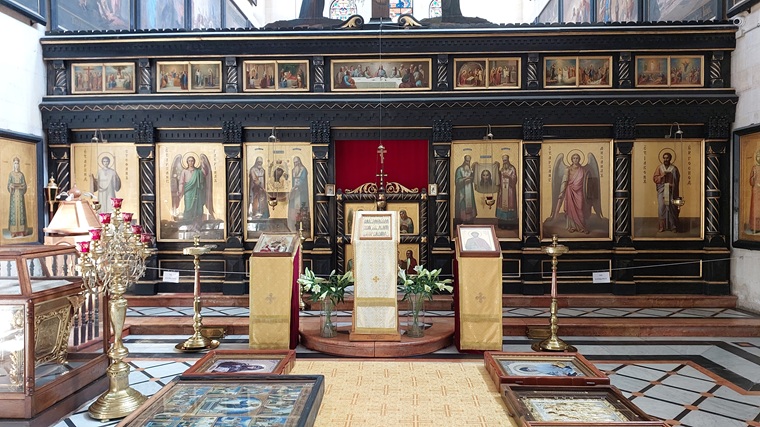
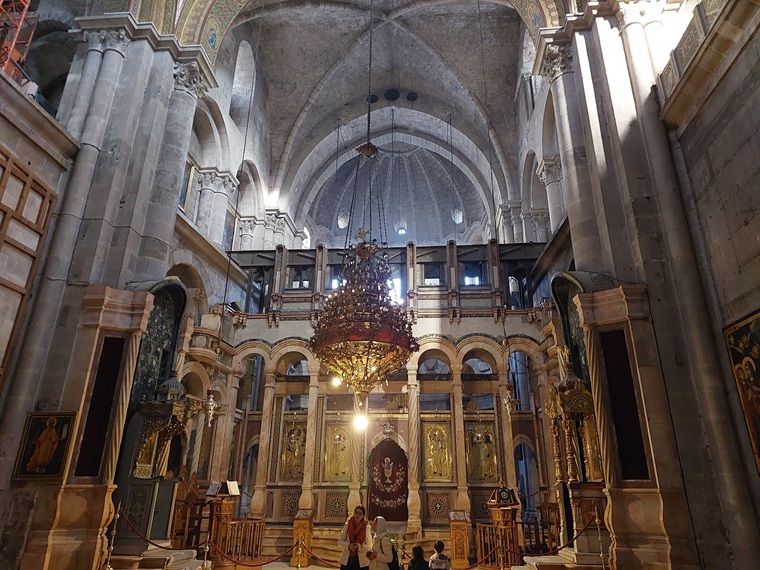
One of the most beautiful examples of an iconostasis can be found in the Greek Catholic Church in Jerusalem, but there are other iconostases in many churches of the city. Many icons can be found in well-known holy places, including some particularly sacred images, such as the image of Mary as Panagia Ierosolymitissa at the Tomb of Mary.
The Iconostasis
The essence of the Church is the manifestation of the heavenly Jerusalem, and this is expressed in its architecture and art. The holy area in the church represents the spiritual dimension of the person, while the body of the church represents the physical dimension, and thus the iconostasis distinguishes between the spiritual and the physical. There are invisible connections within the overall arrangement, expressed in the church paintings and in the iconostasis. The body of the church symbolizes the heavens, while the holy area symbolizes what lies above them. The screen is a boundary between the worlds, and thus says Saint Symeon of Thessaloniki: “The pillars in the iconostasis represent the firmament, separating the spiritual from the sensory-physical, and therefore the upper spiritual beam represents the unity in love between heaven and earth. Thus, in the center between the holy icons, there are images of the Savior and the Mother of God, and this means that they live both in heaven and among human beings.” Indeed, the iconostasis developed from the Deisis—the triad of Jesus, Mary, and John—which stands at the heart of the screen.
On the screen, there are rows: at the top one sees the Prophets of the Old Testament, and sometimes the Saints. In the middle, one sees the twelve major feast days: six of Jesus—Nativity, Presentation in the Temple, Baptism, Transfiguration, Entry into Jerusalem, and Ascension; four of Mary—her Nativity, Presentation in the Temple, Annunciation, and Dormition (or Assumption); and in addition to these, Pentecost and the Exaltation (finding) of the Cross.
Below the rows at the top is the Tchin, the heart of the iconostasis, which represents Divine Order. At its center is Jesus, and on both sides John and Mary, followed by angels, then apostles, Church Fathers, and so on. Note that Mary and John are placed higher than the angels. The door in the center of the iconostasis symbolizes the entrance to the kingdom of God, and therefore the declaration of the kingdom of God appears on it—the Evangelists, the Annunciation, and the Last Supper. Through it, the priest exits with the Holy Bread and Wine to deliver the body and blood of Jesus to the believers.
Icons of Saints
In Byzantine society, holy people were of great importance. According to Ouspensky, there is a connection between the veneration of icons and the veneration of saints. However, holiness cannot be discerned by human means, because it is invisible to external physical observation. When we encounter saints in life, we pass by them without noticing their holiness, because holiness has no external signs. “The world does not see the saints, just as the blind do not see the light.” The iconographer does not have the capacity to see the saints either; therefore, he must paint by divine grace. “Even if the iconographer saw a saint in his life, he does not paint him naturally but spiritually, illuminated by heavenly grace.”
Every saint has his or her own unique representation, and sometimes an object or attribute accompanies their image, symbolizing their essence and life. In many icons, saints hold a scroll quoting their words or a saying that illuminates something essential from their lives. Therefore, there are guidelines for painting icons. It is not a simple undertaking. Saint Basil said: “What the books of the Gospel say in words, the iconographer says in his work.”
A person can reach a state in which his regular thoughts and feelings—those belonging to the fallen state after Eden—are replaced, with the help of the Holy Spirit, by a state of concentrated prayer. The entire being of the person becomes whole and ascends to God; everything that is disordered becomes ordered, everything that is without form receives form, and his life becomes filled with illumination. Only in this state can a person truly paint an icon.
the faces of the saints featured in the icons lose the sensory aspect of decaying flesh and become spiritual. This is a visible expression of the dogma of the Transfiguration, and it has important educational significance. Pictorially, this is expressed in a particularly narrow nose, a small mouth, and large eyes. This is the saint whose senses have been refined; the organs of the senses have changed, creating a renewed harmony with the body. The saints face the world but have a hidden aspect to them, and therefore they are presented in a three-quarter profile, even when their movement is toward the central point of the composition. Presentation in full profile indicates a disconnection from the Divinity, and this is reserved for non-holy figures.
The faces of the saints are painted in a precise and direct manner. The basic green-brown skin tone is light and transparent, and the white beneath it shows through, creating a play of light and shadow that gives the face depth and luminosity.
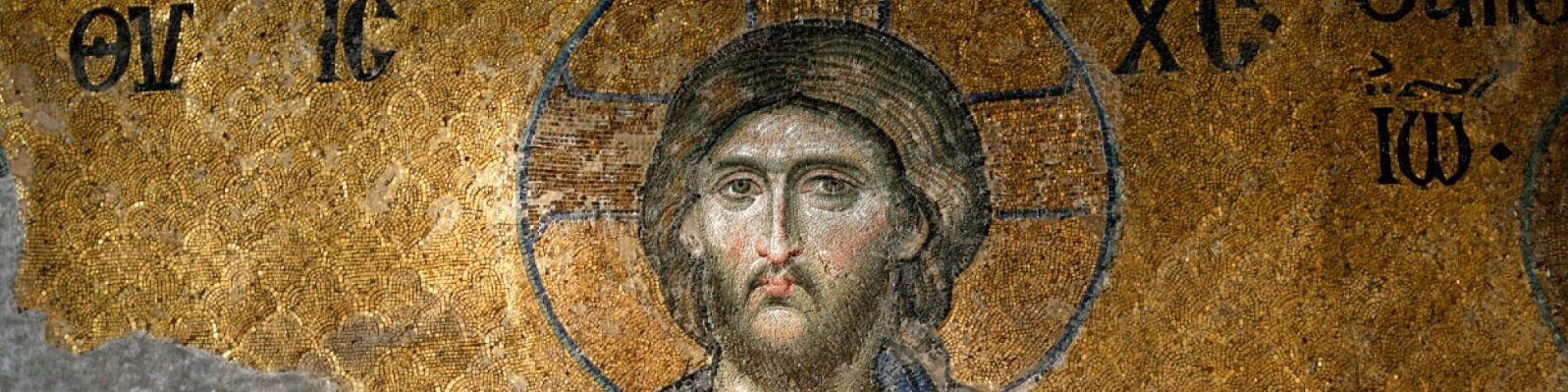
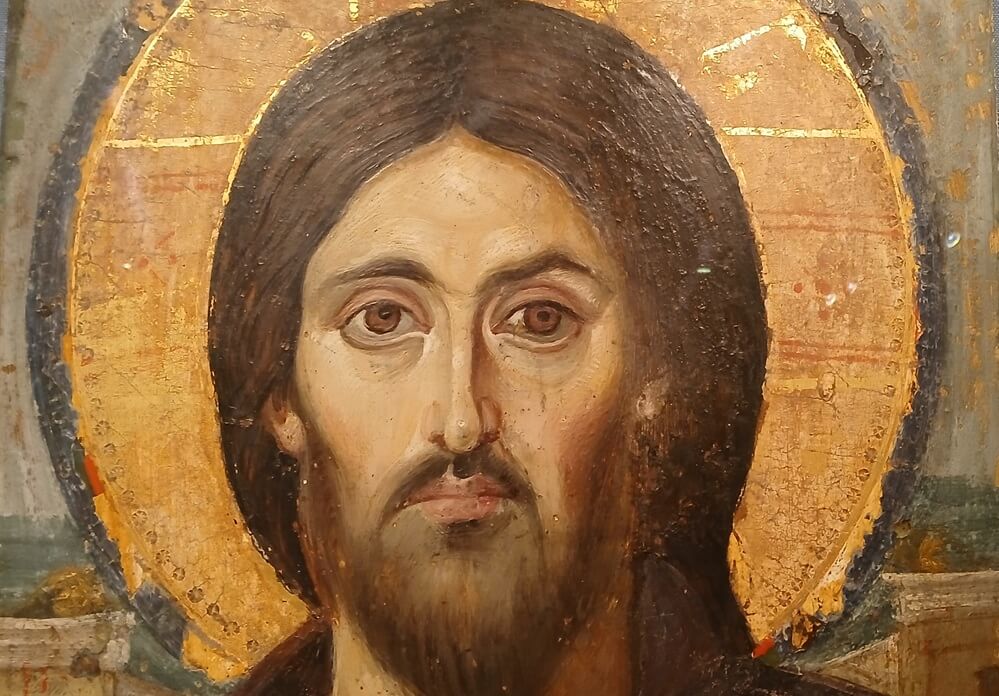
The most important figure in icons is Jesus, of course, who revives the image of man in the image of God, restoring man’s original spiritual beauty. Three types of icons of Jesus can be distinguished, corresponding to three archetypes: in the first, only the head appears; in the second—a half figure, as in the Pantocrator depiction; and in the third—a full figure, sometimes shown standing.
According to Ouspensky, the first icon of Jesus is called The Savior Acheiropoietos (meaning “an icon not made by human hands”). It is an image through which the Word manifested itself in the temple of the body, and therefore the law prohibiting images is annulled. According to legend, Jesus gave Abgar, King of Edessa, a cloth on which His face was imprinted. This is called the Mandylion, and it was also said to have been miraculously imprinted on bricks known as Keramidia.

This figure of Jesus has a narrow nose and arched eyebrows forming a palm shape. Jesus is spiritual yet involved in the world, looking at the viewer—unlike the Buddha, who is distant. His eyes are penetrating, full of compassion. Behind his head is a cross with the letters EHE (Ahi), which are the three letters God speaks to Moses: “I AM WHO I AM” (Exodus 3:14). Below are the first two letters of the two words Jesus Christ: IC XC (Iēsous Christos). In all images of Jesus, Mary, and the saints, this name must appear.
Another image of Jesus is as Ruler of the World (Pantocrator)—sometimes he is surrounded by an octagonal star symbolizing the coming age, sometimes a mandorla (an elongated and pointed ellipse) surrounds him. Around Jesus are cherubim and sometimes also the Evangelists, who announced his doctrine to the world. The scroll in Jesus’ hand symbolizes wisdom, which transforms suffering and sorrow into joy and illuminates them, because one understands why it is so.

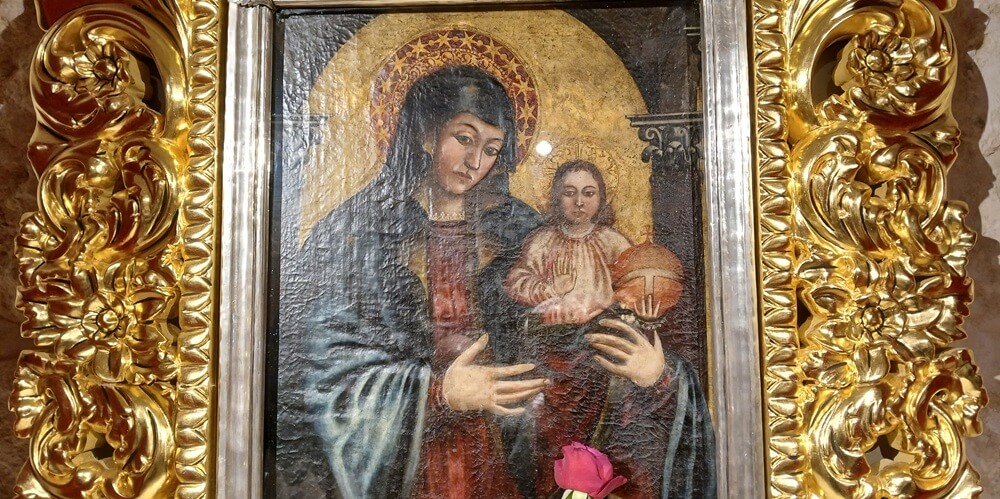
The second important figure in icons is Mary. There are four primary types of icons of Mary, from which two hundred known variations have developed today: in the first, Mary appears on a throne; the second is called Mary, Mother of Mercy—Panagia Eleousa—in which she presses her cheek against that of the infant Jesus; in the third, Mary prays for humanity and is depicted with her hands raised upward while the child Jesus is shown within her—this is called Mary of the Sign (Platytera, “wider than heaven”); and the last is called Mary Showing the Way—Hodegetria.
Mary Hodegetria is the most common icon type in Christian art. Mary is shown with Jesus on one arm, while her other arm points or directs the viewer toward him. The original image was said to have been painted by Saint Luke in Jerusalem, and Mary told him that her blessing would always remain with the icon. He sent it to Theophilus in Antioch along with his Gospel. It reached Constantinople in the 5th century when Eudocia sent it to Pulcheria. A church was built in Constantinople specifically for this image. The name—“Showing the Way,” or “Guide”—appeared in the 9th century, perhaps related to the fact that the icon guided the emperors before they went out to war. The question in these icons is where Mary and Jesus are looking—not necessarily at each other, but rather at us, or at something hidden.

Mary Platytera—Our Lady of the Sign—appears in many apses of churches. In this representation, Mary raises her hands in a prayer position, and the infant Jesus is shown on her knees. This was a common representation of the great mother in the Greco-Roman world, especially in relation to the cult of Isis and Osiris. However, in Christianity it is an incarnation of prayer. The first images appeared in the 4th century in the catacombs. There are also images of Mary without Jesus—Orans—but when he is present on her, it is called “The Sign.”
In the upper row of the iconostasis—the Tchin, the order of the old world—the Prophets appear with Mary in the center. The most important prophet is Isaiah, also called “the Fifth Gospel,” because he says: “Therefore the Lord himself shall give you a sign; behold, a virgin shall conceive and bear a son, and shall call his name Immanuel” (Isaiah 7:14). And so, Mary is Our Lady of the Sign.
In other icons, the Mother of God is seated on a throne, her left hand on Jesus’ shoulder and her right hand on his thigh. On both sides stand two angels. The child is in the state of a Pantocrator, a scroll in his left hand and blessing with his right. This shows that she is the throne of God, and therefore above the angels and archangels.
The Panagia Eleousa icon is an expression of love and affection between Jesus and his mother. These types of icons are full of human emotion—motherly love and human tenderness. The Mother grieves for her son and is therefore full of compassion for all humanity. Human emotions are purified by the divine light. The Divine Mother is the compassionate heart that intercedes for human beings.

To conclude this chapter on icons, it should be remembered that Jesus and Mary were incarnated in Jerusalem, and that their first paintings (icons) appeared in Jerusalem—both miraculously and through Luke and others who knew them during their lifetime and painted accordingly. The icons depict events in Jesus’ life, and therefore many of them include a background of Jerusalem.
In addition, Jerusalem was, throughout the generations—and especially during the Byzantine period—an important Christian center, and a unique school of painting developed there, influenced by both Eastern and Western traditions. Jerusalem is a meeting place of different Christian denominations, peoples, and cultures, and thus there is mutual fertilization also in the field of religious painting, with the emergence of artistic innovations as a result. This is a large and extensive topic, and the scope of this book is too limited to elaborate on it.
And finally, just as Jerusalem inspired the painters who rediscovered it in the 19th century (see Book Three), so too its unique light, landscape, historical events, buildings, and the people living in it inspired the icon painters who worked in it or visited it throughout the ages. And despite the relatively strict rules of icon painting, this is expressed in their work.
Footnotes
[1] Sabo, T. E. (2012). The Proto–Hesychasts: origins of mysticism in the Eastern church (Doctoral dissertation, North-West University).
[2] Grabar, A. (1968). Christian Iconography: A Study of Its Origins. Princeton University Press
[3] Ouspensky L, Lossky V. The Meaning of Icons. Boston Book & Art Shop; 1969

