The Brotherhood of the Holy Sepulchre
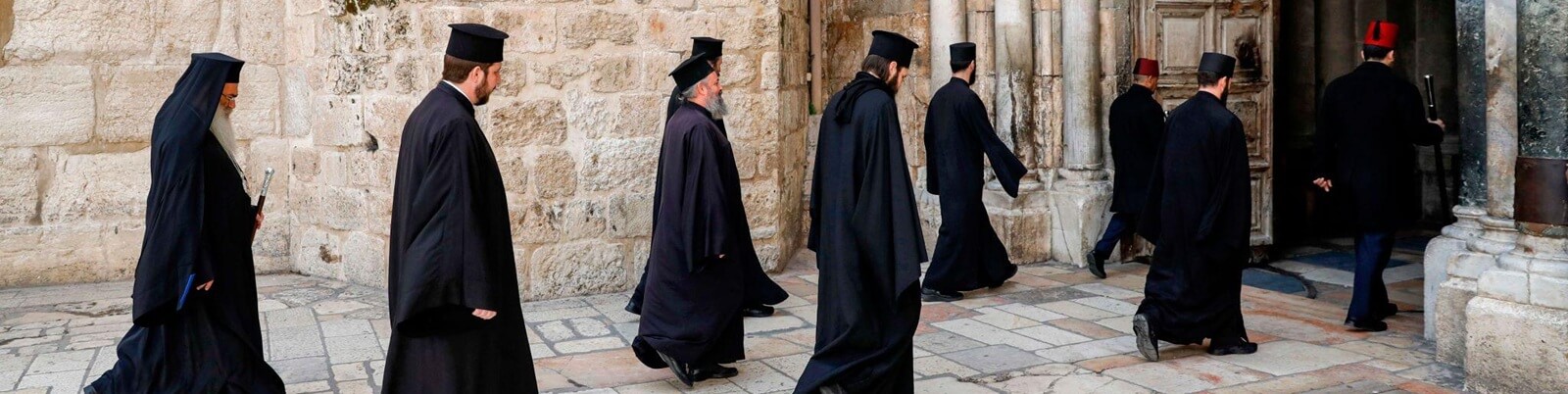
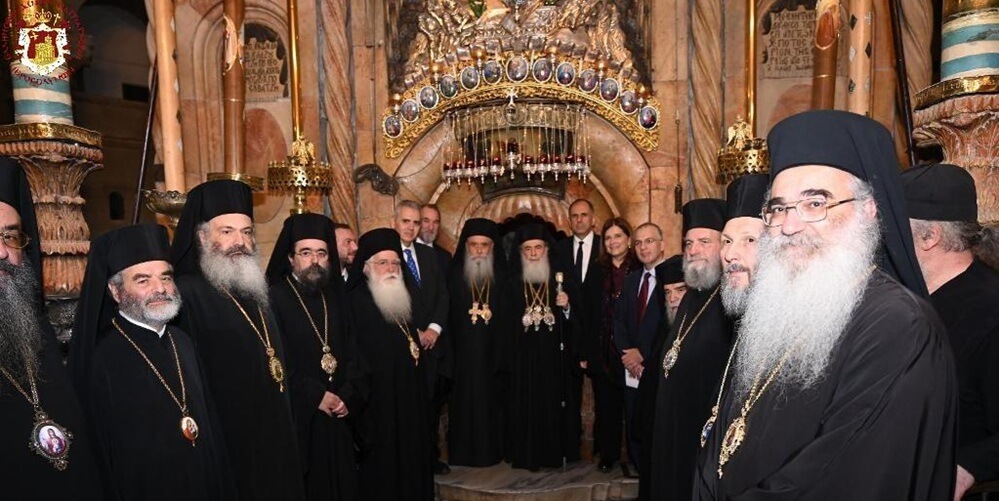
During the Ottoman period in Jerusalem, the Greek Orthodox Church held a senior and dominant status—both because it was the largest Christian community and because it represented the other Orthodox Churches, including the Russian, Romanian, Serbian, Bulgarian, and others. Beginning in the 5th century, the Roman Empire recognized five Patriarchates (see Book One), one of which was based in Jerusalem. The Christians of Israel and Jordan were under its authority, as they continue to be today. The Greek Orthodox Patriarchate of Jerusalem is responsible for the Orthodox Christians of the Holy Land, not for those of Greece. The body belonging to this Patriarchate and entrusted with the guardianship of the Christian Holy Sites—serving as a kind of supreme council for the Orthodox community in the region—is the Brotherhood of the Holy Sepulchre. Its emblem is the Taphos Cross, formed by the combination of the Greek letters Tau (T) and Phi (Φ); the word Taphos means “tomb” or “sepulchre.” To some extent, the Brotherhood of the Holy Sepulchre can be compared to the Custodia Terrae Sanctae of the Franciscans, which operates within the Latin Patriarchate of Jerusalem.
According to tradition, the Brotherhood of the Holy Sepulchre existed as early as the Byzantine period. However, at that time the Land of Israel was part of the Byzantine Empire and under the authority of the Christian emperor, who decided all matters concerning the Church of the Holy Sepulchre and the other Holy Sites. When the Muslims conquered the region, the situation changed. Patriarch Sophronius appeared before Caliph ʿUmar and requested his permission for the Brotherhood to continue overseeing the Christian Holy Places. ʿUmar asked him what they should be called. Sophronius pondered deeply, and then the verse came to him: “Listen to the voice of my cry, my King and my God” (Psalm 5:3). Therefore, he asked that they be called Melkites, from the word for “king” (melekh in Hebrew/Syriac), meaning “King’s Men,” and so it was. Saladin and later the Mamluks confirmed the Melkites’ rights over the Holy Sites, as did the Ottomans, who conquered Jerusalem in 1517. In time, however, the members of the Brotherhood decreed that the “King’s Men” were to be exclusively Greek, and thus the Brotherhood became a monastic body of Greek origin only—closed to the local Christian population, yet exercising authority over it.
The historical progression is that, in 1534, a Greek Orthodox Patriarch named Germanus, who was also a Greek patriot, came to power. He expelled the Arab Christians from the Brotherhood of the Holy Sepulchre and enacted a law stipulating that only Greeks could be members. In other words, there was a Greek “hostile takeover” of the ancient Church of Jerusalem. The seat of the Greek Patriarchs of Jerusalem for most of the Ottoman period was in Constantinople, not in Jerusalem, and only in the 19th century did they return to the city.
The Brotherhood of the Holy Sepulchre numbers slightly more than one hundred monks, among whom are the senior officials of the Patriarchate. It is responsible for the Orthodox Holy Sites and controls a large compound in the Old City near the Church of the Holy Sepulchre, which includes six churches, a monastery, an important library, and a museum—a kind of city within a city. Historically, the most important Patriarch of the Greek Orthodox Church of Jerusalem, and the one who established the core tenets of its faith, was Dositheos II.
Who was Dositheos II?
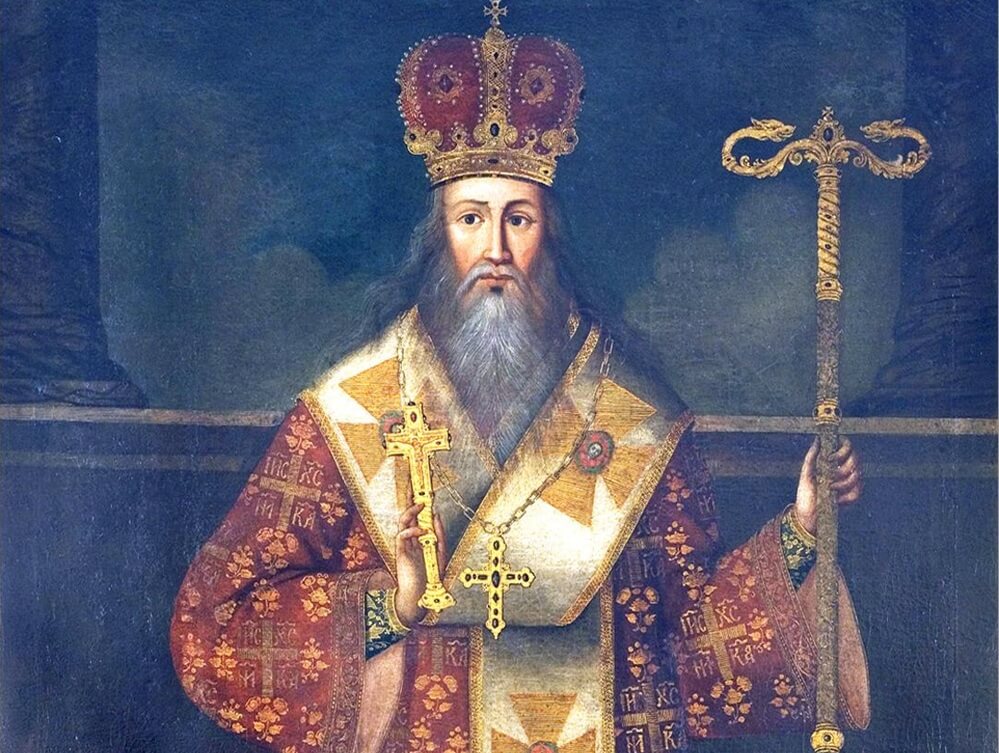
Dositheos II was the Greek Orthodox Patriarch of Jerusalem from 1669 to 1707. He is considered one of the most important theologians to have arisen within Orthodox Christianity in the later centuries, contributing significantly to the consolidation of the core tenets of Orthodox belief. In 1672, Dositheos convened an important Church council (Synod) at the Church of the Nativity in Bethlehem—known as the Synod of Jerusalem—which was attended by dignitaries from across the Orthodox world. At the council, the Orthodox faith was redefined in response to, and in opposition to, the spread of Protestant (specifically Calvinist predestination doctrine) and Catholic teachings [1].
One of the essential principles established by the council was that salvation cannot be attained by faith alone, by grace, or through the Sacraments without the fulfillment of moral obligations and religious practice. This principle, which differs from Catholic doctrine, was accepted by the entire Orthodox Christian world. Its significance is profound: in Catholicism, it is claimed that salvation comes to man through divine grace, received by participation in Church rituals, the Sacraments, and similar means. This claim grants the Church and its priests considerable authority. However, Dositheos established that participation in Church rituals and acceptance of priestly authority are not sufficient. To be accepted by God, faith and ritual participation alone are not enough; a person must lead a moral life and ascend the steps of the spiritual path toward perfection. The extension of this view is that there exists an open path by which man may approach the Divine—a path of mystical experience.
The decisions of the Synod of Jerusalem not only distinguished Orthodox Christianity from the Catholic faith (Tertullian, one of the most important Fathers of the Catholic Church, said: “I believe because it is absurd,” meaning that the greater the absurdity, the stronger the faith can be), but also reaffirmed the existence of Orthodox mysticism, the concept of Theosis (the possibility for man to become God), and the practice of Hesychasm (Christian meditation leading to union with God). Additionally, the council emphasized human free will, meaning that man bears the responsibility of moral choice, thereby distancing itself from the Calvinist Reformed Church’s view, which held that fate is predetermined.
The Synod of Jerusalem rearticulated the eighteen core tenets of the Orthodox faith, making it one of the most important declarations of faith in the history of the Orthodox world. The religious and spiritual prestige of Jerusalem made it possible to convene representatives from across the world and conferred divine legitimacy on the decisions made there.
Dositheos also acted on both the religious and political levels to strengthen Orthodox Christianity against the threats posed by the Reformation and the Catholic Church. In 1662, he re-established the Brotherhood of the Holy Sepulchre in Jerusalem, whose purpose was to protect the interests of the Orthodox world within the Church of the Holy Sepulchre—interests that lay at the heart of the international struggle for hegemony in Europe. Furthermore, he traveled to Romania, Serbia, Bulgaria, Georgia, and Byzantium to enlist the support of the independent Orthodox Churches for the council’s decisions and for the Orthodox presence in Jerusalem. In doing so, he helped these Churches consolidate their own core beliefs.
Dositheos focused most of his efforts on Russia, which was emerging as a rising power in the world. He corresponded with Peter the Great and may even have met him, urging him to abolish the Church’s subordination to the Tsars—though this was never achieved. During that period, peace treaties were signed that redivided the Balkans between Austria and the Ottoman Empire (the Treaty of Karlowitz), as well as other treaties that divided the Black Sea regions between Russia and the Ottoman Empire. Dositheos sought to persuade the Russians to intervene and assume a central role in protecting Christianity in the Holy Land, but he apparently failed in these efforts.
To solidify Orthodoxy and support the international efforts to strengthen the Orthodox Patriarchate of Jerusalem—and likely for other, partly historical reasons—Dositheos composed a book on the history of the Greek Orthodox Patriarchate of Jerusalem, the publication of which established and reinforced the arguments for its significant historical and theological status. Dositheos died at the age of sixty-six, after thirty-eight years as Patriarch of Jerusalem. He is buried in the Chapel of the Forty Martyrs, adjacent to the Church of the Holy Sepulchre.
Undoubtedly, Dositheos was one of the most influential Patriarchs of Jerusalem. However, due to a combination of circumstances, he was appointed to his position by the Patriarch of Constantinople, rather than by his predecessor in Jerusalem. At that time, there was also a Metochion (a dependency of a monastery) belonging to the Jerusalem Patriarchate in Constantinople, where Dositheos spent most of his time. From that period onward, the Orthodox Patriarch of Jerusalem generally resided in Constantinople and was appointed by the Patriarch of Constantinople, a practice that continued until the time of Cyril II in 1845 (to be discussed in the third book).
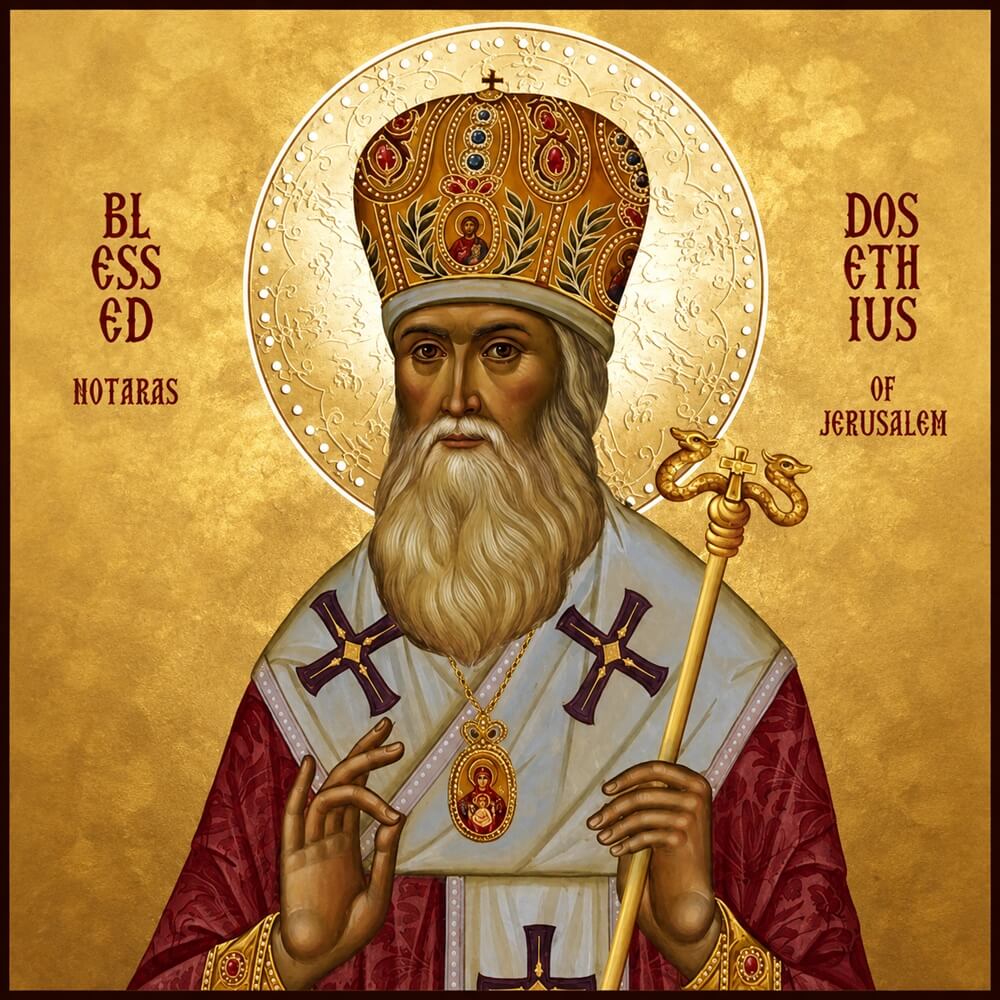 Dositheos II, Greek Orthodox Patriarch of Jerusalem in the 17th century
Serbian visitor to Jerusalem
The flow of Christian pilgrims to Jerusalem during the Ottoman period included many from Orthodox countries such as Russia, Romania, Serbia, and Bulgaria. One of the most important among them was Arsenije III Crnojević (1633–1706), often regarded as a kind of Moses of the Serbs. He led a revolt against the Ottoman Empire and orchestrated the Great Migration from the Kosovo–Peć region to Novi Sad and the Vojvodina province, an event that changed the face of the Balkans. He is buried in the Krušedol Monastery, on the slopes of the holy mountain Fruška Gora.
Arsenije was born in Montenegro but grew up in the monastery of Peć, where he was elected Patriarch in 1673. Upon taking office, he began extensive tours throughout the Balkans, established ties with Venice, and strengthened the position of the Serbs, who were under pressure from the Ottomans. In 1680, he decided to make a pilgrimage to Jerusalem, and along the way he visited Kratovo and Skopje in Macedonia. He visited the Church of the Holy Sepulchre and Mar Saba Monastery, and his journey is recorded in a diary. Upon his return to Serbia, he openly supported the revolt of Đorđe Branković against the Turks in 1683. The war that began that year led to a Turkish defeat at the gates of Vienna and several turbulent years during which Ottoman armies swept through Serbia, destroying everything in their path. They looted the treasury of Peć and imprisoned Arsenije for several months in 1687. His life was in danger, and he decided to leave Kosovo; however, in 1688, the Austrians conquered Serbia, and Arsenije returned as a liberator.
To Serbia’s great misfortune, the tide soon turned in favor of the Turks, and about two years later they reconquered the territories they had lost, including Serbia. Fearing revenge, Arsenije decided—together with about 70,000 people—to leave Kosovo along with the retreating Austrian forces. The Austrian Emperor Leopold invited the Serbs and other Balkan peoples into the Habsburg Empire and granted them certain rights. The assembly in Belgrade accepted the Habsburg terms, and Arsenije was recognized by the Austrians as the leader of both the nation and the Church. Tens of thousands of people crossed the Danube and Sava rivers on their way north. To counter pressure from the Catholic Church on the Serbs to convert, he received a letter of protection from the Austrian government and, with its support, traveled throughout the Empire, strengthening the Serbian Orthodox faith.
This great migration led to the creation of the Serbian province of Vojvodina (the word vojvod means “governor,” referring to Arsenije), to the rising importance of the city of Novi Sad, and to the founding of new monasteries on the holy mountain Fruška Gora. In addition, a Serbian army was established, which helped the Austrians halt the advancing Turks and later suppress the Hungarian revolt.
Just as the Armenian general Vardan in the 5th century received inspiration to launch a national revolt during his visit to Jerusalem, supported by Euthymius the Great, so too did Arsenije, who presumably received encouragement from Serbian Orthodox monks in Jerusalem and at the Mar Saba Monastery. And as in Vardan’s case, the revolt—though ending in military defeat—ultimately led to religious autonomy and ensured the preservation of the national heritage.
Footnotes
[1] Dowling, T. E. (1913). The Orthodox Greek Patriarchate of Jerusalem. Society for Promoting Christian Knowledge.