The Madonna and the Crusades
An important element in the motivation of the Crusaders was the veneration of Mary, the mother of Jesus, and of Mary Magdalene. An image of Mary was emblazoned on the flag carried by the leader of the crusade, the Pope’s legate—Adhemar. The day chosen to launch the First Crusade was the day of Mary’s Ascension to Heaven (Assumption). The call for the Second Crusade took place in Vézelay, Mary Magdalene’s burial place, and the Third Crusade also set out from there.
The Marian beliefs developed concurrently with the emergence of Benedictine monasticism in the West, partly because her veneration was a compensation for their vow of celibacy and fulfilled their need for a feminine figure, the anima, in their lives. In the following centuries, prayers addressed to Mary began to appear, along with Marian feast days; churches were dedicated to her, and this trend intensified toward the millennium with the Cluny reforms (a leading monastery in southern France) that emphasized vows of celibacy, contrary to what had been customary before.
Mary embodies the qualities of compassion, grace, mercy, love, and forgiveness. She is the one with the Immaculate Conception, and the implication of this is that she was free from the original sin of all humanity—a kind of Second Eve who came to correct what the First Eve had corrupted—making it permissible to think about her and, I dare say, even to “fall in love” with her.
The belief in Mary became widespread in the 11th century, and there were several reasons for this. Firstly, Jesus was increasingly perceived as a Judge and less as a mediator for mankind, and when another mediator was needed in his place, the most suitable candidate to replace him was, of course, Mary. Another reason was that Jesus’ life began to be studied and referenced more, with books appearing about his childhood, and in this context, the figure of the mother was also emphasized. Additionally, in the Middle Ages, physical relics of Mary began to appear in Western Europe—hair, nails, tears, milk, clothing, and more—which added to her perceived reality [1].
In the 11th century, prayers to Mary were written that became part of the annual liturgy, such as Salve Regina—Hail, Holy Queen—and Alma Redemptoris Mater—Loving Mother of Our Redeemer. In the 12th century, two more important liturgical hymns were added: Ave Regina Caelorum—Hail, Queen of the Heavens—and Regina Caeli—Queen of Heaven [2].

The developing art of the Middle Ages exalted the figure of Mary. This was a new art that connected the mundane world with a number of parallel symbolic, religious, and supra-religious universes. It relied heavily on imagery and placed great value on images, gestures, and ritual acts. Art became a tool in the hands of religion, stemming from the perception that one could experience the emanations of God and not just rely on faith, as had been the case until then. Abbot Suger (Abbot of the Saint-Denis Monastery in Paris in the 12th century) believed that simple thought ascends through material things and that a sense of holiness can be evoked through images, sculptures, and architecture. For this purpose, he developed Gothic architecture, as it first appeared in the Saint-Denis Monastery and the Notre-Dame Church in Paris. In this art form, Mary appears in sculpture as a Queen, a Madonna (beloved), and a Divine Mother.
Great and important queens in the 12th century developed the ideal of courtly love and elevated the status of women. This went hand in hand with the development of Marian worship and the cult of Mary; all these elements were intertwined. The first and most important queen was Eleanor of Aquitaine, Queen of France and later of England. She participated in the Second Crusade to Jerusalem and played a central role in it, fostering strong connections to the spiritual leaders of the period, foremost among them Bernard of Clairvaux. It seems as if there was an alliance between the leaders of the Church and the monarchy—kings and queens—designed to promote the cult of Mary and the importance of the feminine. Part of this was the development of the ideal of courtly love in the courts of Eleanor of Aquitaine and her daughter Marie of Champagne, and a complementary part was the development of Marian doctrines and worship.
It was clear to the leading figures of the 12th century that force was not the solution to the problems of Christian society, and that the emphasis of chivalry on warfare and masculinity brought conflict and bloodshed and distanced people from God. A kind of alliance developed between educated and reformist circles in the Church and royal circles led by the great queens of France, foremost among them Eleanor of Aquitaine. This alliance offered a new and revolutionary solution to the problems of Christian society: the glorification of the spiritual qualities of woman and the harnessing of the chivalric ideal to feminine adoration as a source of guidance and inspiration.
The value of love was highlighted—not just theoretically, but specifically the love for a woman—something that was inconceivable in earlier periods. All these new ideas are expressed in the Holy Grail story cycles, which first appeared at the court of Marie of Champagne (Eleanor of Aquitaine’s daughter). It was Chrétien de Troyes, a writer sponsored by this court, who first put the stories into writing. Generations of children, some of whom became knights, grew up on them. These same children were the ones who set out on the Crusades and pilgrimages to the Holy Land.
The Church and the authorities sought ways to restrain the violent and wild masculine component in society, and for this, the place of the woman had to be empowered. This was done both by deifying the figure of Mary and making her a symbol of purity and contemplation, and by developing the ideal of love between a man and a woman. The woman’s role is to refine and educate the man. There is a kind of alliance between the woman and the Church. The understanding developed that women are softer and therefore capable of being shaped by the will of God. They can become the image of God. In contrast, man is proud and therefore less worthy and harder to shape according to God’s demands. The Holy Lady is the one who can guide the knight in the final stages of his quest, refining and improving him. By contemplating her, he connected to the higher part within himself and reached a kind of mystical union with God.
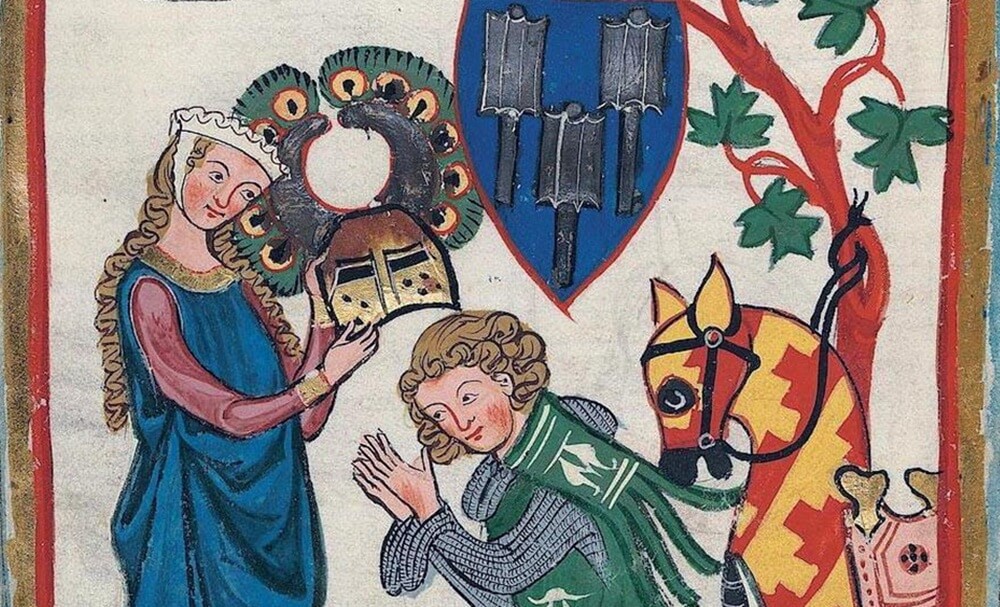
The connection between courtly love and the cult of Mary appears in the similarity of the language used in Christian mysticism and chivalric romances—the same words, the same gestures. The suffering of separation and the idealization of the beloved are very similar to mystical feeling and thought. There is a great similarity between earthly and heavenly love [3]. Both involve unconditional love without expectation of reward. The language of the pilgrim and the language of the rejected lover are similar; the mystic is stabbed and wounded by his love for Jesus or the Virgin, just as the lover is wounded by his love for the Lady. The transformation of love into ecstasy is related to the mystical experience, especially in the world of the Middle Ages. The way courtly love is described cannot exist without the Christian social context.
Courtly love (and love in general) is religious in essence, and the lovers and poets express the terminology of the Christian mystical experience. The lover approaches the Lady as an atonement for his sins; he begs for forgiveness and asks for grace and salvation, exactly as in the cult of the Virgin. The joy of the lover turns him into a “new man,” just as in baptism. He abandons everything for her sake, just as the rich man did for Jesus—sacrificing property, family, and duty—for the love of his Lady. He takes upon himself the cross of love.
Courtly love and the Marian cult were influenced by the love poetry of the Sufis, which the Crusaders encountered in the East. Damascus, Antioch, Tripoli, Acre, and Jerusalem were meeting places with Sufi mystics and poets. The Mystical Garden is a fundamental concept in the mysticism of the East, and along with the rose and the nightingale it passed to the West. Thus, Jerusalem became a heavenly image in the thought of Bernard of Clairvaux—a gate to Paradise, the place of the Mystical Garden—and this is expressed in the new church architecture promoted by Queen Melisende and in the city’s planning, especially at the sites related to Mary—Saint Anne and the Tomb of Mary.
Bernard of Clairvaux is the most influential religious figure in Europe in the mid-12th century—a mystic and theologian, a gracious orator who crowned popes and educated and advised kings, and also the most important figure concerning the Crusades to the Holy Land. He was the man who called for and brought about the launching of the Second Crusade to the Holy Land. He was the one who promoted the pilgrimage to Jerusalem, the cult of Mary, and reforms in the Church, as well as Gothic architecture and art.
From Bernard’s time, Mary appears as Jesus’ spouse, similar to the bride and groom in the Song of Songs, with Jesus as the groom and Mary as the bride. Following this, Jesus became the groom of the nuns. The ultimate goal of the nuns is mystical union with God, but this is achieved through a mystical marriage with Jesus, and for this purpose they wear a veil and a ring and go on a three-day honeymoon.
Bernard delivered 84 sermons on the Song of Songs, in which the groom is Jesus and the bride is implicitly Mary—sometimes the Church, and sometimes the individual soul. God is Love, and from the moment the soul feels this spontaneously, it can receive the Kiss of Life. The soul leaps toward God, thereby reflecting Him and creating a renewed connection with Him, and this is the only way to overcome the Fall.
Mary is the first who succeeded in achieving complete union with Jesus, by being kissed by him while nursing him. Bernard made the connection to Mary personal and intimate. In the Order he founded (the Cistercian Order), which spread throughout Europe, the monks wore white in honor of Mary, and in their churches they built a special chapel dedicated to her. According to Pringle, during the Crusades two Cistercian monasteries were established in Israel: one near the settlement of Matta in the Jerusalem mountains, and the other at the Church of the Visitation in Ein Karem [8].
 Bernard of Clairvaux Receives the Virgin Mary’s Milk – Lactatio Bernardi.
The Crusader Tomb of Mary
The first Queens of Jerusalem, Morphia (died 1113) and Melisende (died 1161), were buried in the Tomb of Mary, while their husbands, the kings, were naturally buried at the entrance to the Church of the Holy Sepulchre. A large monastery was established around the Tomb of Mary, which later included the area of Gethsemane. The monastery was founded by Godfrey of Bouillon in 1101, immediately after the conquest of Jerusalem, perhaps as a sign of gratitude to Mary for her help in this deed, in the same year that the royal Fontevraud Abbey was founded in France, which had a connection to Jerusalem (see chapter on Bethany).
The monks in the Abbey of Saint Mary of the Valley of Jehosaphat were from the Benedictine Order, and many properties in the Land of Israel were given to the monastery as endowments. It was one of the most important monasteries in the kingdom.
The rise of Mary’s status during that period was expressed in the building of sites related to her, primarily the Tomb of Mary, Bethany, and the Saint Anne complex. The Tomb of Mary was a center of Christian mysteries, the Saint Anne complex was largely the convent of the royal family’s women and the nobility, and Bethany was likewise.
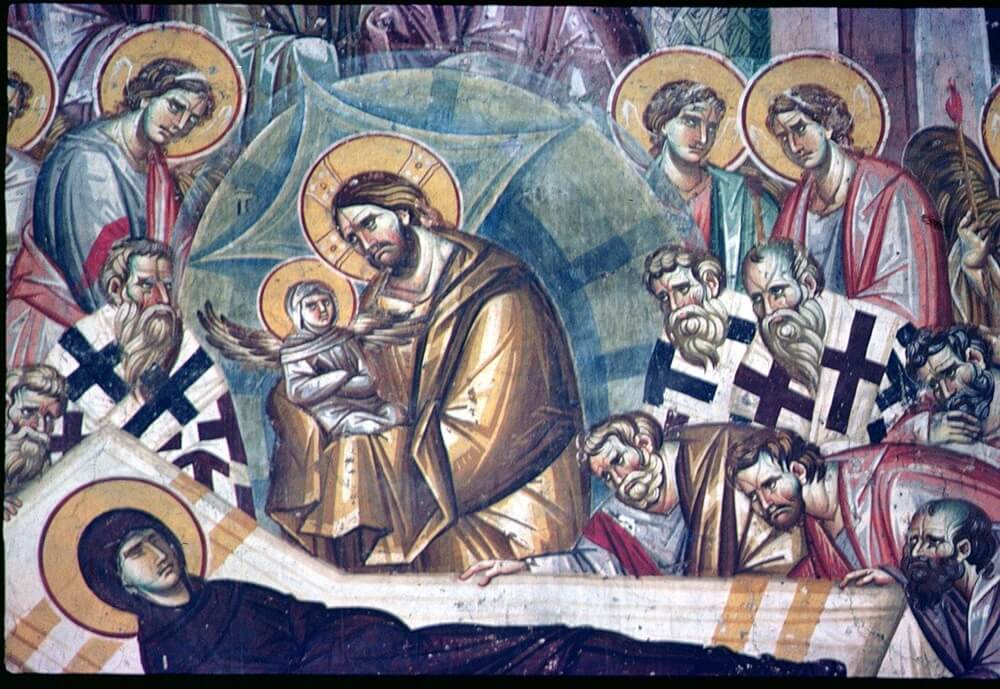
Mary, the mother of Jesus, appears 20 times in the New Testament, the last time in the context of Pentecost, but what became of her is not written, and many of the traditions related to her rely on apocryphal literature, especially the Protoevangelium of James. There are several legends about her death, and one of them tells that she moved to live with the disciple John in Ephesus, where she died and ascended to heaven. However, the more accepted traditions are that she continued to live in Jerusalem with the young Christian community, as appears in the Book of Acts, and when her time came, she fell asleep on Mount Zion, in the place later called the “Mother of All Churches,” today the Dormition, and from there she was taken for burial in the Tomb of Mary in the Valley of Jehoshaphat. After three days, the tomb was opened so that the doubting Thomas, who arrived late, could bid her farewell, and lo and behold—it was empty.
After her burial, while she was only “sleeping” (Dormition), all the angels, prophets, the army of heaven, and Jesus at their head descended to gather her soul, which resembled the soul of a baby girl, and took it along with her incorruptible body to heaven. Thus, Mary’s baby soul is seen in the hands of the adult Jesus in the spiritual world, as a reverse image of the baby Jesus held by the adult Mary in the physical world. The disciples and followers gathered to pay her last respects at the moment of her death, and seeing the army of heaven led by Jesus come to take her soul to heaven, they spontaneously turned in prayer to Mary (instead of to Jesus as before), asking her to intercede for them in heaven.
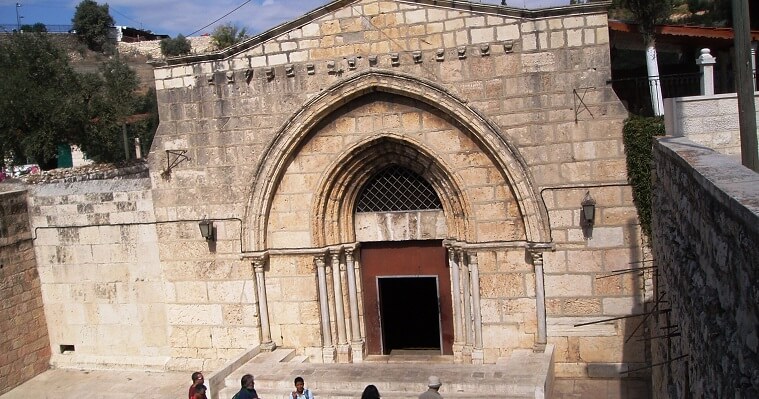
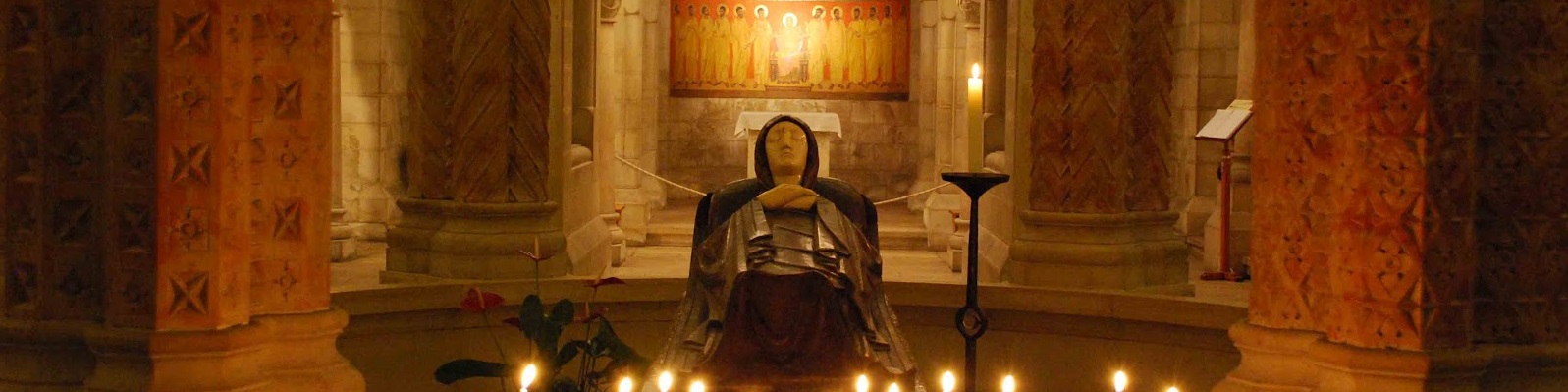
The surprising thing is that the traditions recount that because Mary bore God within her body, her flesh was sanctified and was also taken to heaven (in addition to her soul). Thus, when the tomb was opened after a few days, it was found empty, and this is the situation to this day. Following this, a church was built above the cave where she was buried already in the 5th century. When the Crusaders arrived in the land, there was a Byzantine church above her empty tomb. During Melisende’s time, the church was rebuilt on a grand scale: the tomb cave underwent renovation and became a magnificent crypt, and a large structure was built above it. This structure was later destroyed by Ṣalāḥ ad-Dīn, and today only the crypt remains.
The tomb itself is located in a large and deep crypt built in the shape of a cross. The Crusaders separated the empty Tomb of Mary from the walls of the crypt and created a complex somewhat similar to the tomb in the Church of the Holy Sepulchre, thereby symbolizing the connection between Mary and Jesus and the fact that she too, like him, ascended to heaven and now functions as the Queen of Heaven and a mediator for human beings. Christians longed for Mary’s mediation because she was the only one to whom Jesus could not say no. They arrived at the place with the Ave Maria prayer on their lips and her pictures holding the baby Jesus in their hands, knowing that everything she would ask of him would be answered.
The façade of Mary’s tomb is typically Crusader, as are its other parts. The entrance door with its ribbed arches opens into a wide corridor descending into the womb of the earth. One descends broad stairs that are unique in Jerusalem, reminiscent of stairs at holy pilgrimage sites in Europe such as Monte Sant’Angelo or Le Puy. Immediately after the descent, on the right side, there is a small room containing the tomb of Queen Melisende, the builder of the place. Above the room is a dark dome that was only discovered in the 1970s when lighting was sought for the church. The dome, which is actually a high domed cylinder, is a unique element found only in monasteries in Armenia (such as Haghpat Monastery from the 10th century [5]), and it symbolizes eternity. It is possible that Melisende’s mother, the Armenian princess Morphia, was also buried there.
On Melisende’s tomb is an image of Anne and Joachim, Mary’s parents, who, according to a late and erroneous tradition, were buried here, and therefore the chapel is dedicated to them. On the other side of the stairs is a chapel containing the traditional burial place of Joseph, Mary’s husband. The identification is based on a late tradition, but there is no dispute about it, as it is fitting that Joseph should be buried with his wife (ostensibly). Bodil Thurgotsdatter, the wife of Eric the Good, King of Scandinavia, who died in 1103, is also buried in this chapel.
At the end of the stairs, one turns right into the Byzantine crypt: here is the empty tomb of Mary, covered by a Crusader aedicule supported by slender marble columns whose capitals are artistic sculptures and resemble similar columns on the Temple Mount and in the Ascension complex on the Mount of Olives (indicating a connection to the Templars). One can enter inside and see the empty tomb shelf up close. On the walls around the tomb are paintings depicting the various events in Mary’s life.
The crypt is part of an architectural cross: its long part is the descent stairs; the right arm is the Tomb of Mary; the left arm contains an Armenian crypt with an additional cycle of paintings showing events from Mary’s life; and the head of the cross is currently blocked by a wall.
In front of the Crusader entrance façade to the Tomb of Mary is a sunken courtyard, from whose corner a corridor leads to another underground space called the “Cave of Betrayal,” which is held by the Franciscans. The place is linked to Judas’s betrayal of Jesus and the anguish in the Garden, but the Franciscans also celebrate the Assumption of Mary there, if only because they do not have a holding in the nearby Tomb of Mary, which is held by the Armenians and the Orthodox.
The Tomb of Mary is located in the lowest place in Jerusalem, situated at the foot of the highest place to its east—the summit of the Mount of Olives. It can be assumed that, as part of the sacred geography of antiquity, this was a place of worship for the feminine deity, linked to the caves that symbolized the womb of the earth, while the summit of the mountain was a place of worship for a masculine deity. It is interesting to note that Mary ascended to heaven from the lowest place in Jerusalem, while Jesus ascended to heaven from the highest place located to its east. These are two different ascensions that occur in different places and whose fruit is different. Mary’s ascent is actually called the “Assumption”; the usage of a different word shows its different nature.
Mary is sacred to Muslims as well, and inside the crypt there is a miḥrāb (prayer niche), because Muslim pilgrims used to visit the holy tomb and pray there. Today, the place is held by the Greek Orthodox and the Armenians, with the Franciscans holding the adjacent Cave of Betrayal. Above the descent to the tomb is the tomb of the Muslim Sufi scholar from the 15th century, Mujīr ad-Dīn, who claimed that Muhammad saw a supernatural light shining from the tomb during his Night Journey to Jerusalem. The story appears in the important book he wrote, History of Jerusalem and Hebron, which serves as a source for understanding the Mamluk period.

Mary Does Not Die but Ascends to Heaven
In ancient times, many cultures had traditions of ascension to heaven for kings, heroes, and enlightened people. Thus, Hercules reaches Olympus and becomes one of the gods; pharaohs become gods; Alexander the Great, and so on. In the Roman Empire (which ruled the world in Jesus’ time), the belief in the ascension of human beings to heaven and their transformation into gods was called apotheosis and was attributed mainly to emperors. The Roman tradition was influenced by beliefs from the East (Persia), Egypt, Hellenism, and more.
In Jewish apocryphal literature, the story of Enoch (Metatron), who ascended to heaven and became second-in-command to God, appears. Elijah the Prophet also ascended to heaven and will return on the Day of Judgment. The New Testament recounts the ascension of Jesus 40 days after his death, and Gnostic literature extensively elaborates on this subject. In addition, among the different Christian sects, there were traditions of the ascension of John, as well as of other saints (disciples), so it was very logical that a belief would develop about the Assumption of Mary after her death, especially given the fact that she bore God within her womb.
The New Testament does not tell what became of Mary, the mother of Jesus, after the crucifixion, and there is no mention of her death or what happened afterward. Over the years, traditions and legends began to appear about her life after the crucifixion, about what occurred at her death, and, from the 5th century onward, also about her Assumption to heaven after her death. These beliefs were accepted among official circles in the Church and became widespread in the 7th century, and perhaps even earlier.
A Syriac book from the 3rd century is the first to mention the Tomb of Mary in Jerusalem and recounts the presence of the Apostles there and the taking of her body to heaven by the Angel Michael. Another book from the 4th century mentions a cave in the Valley of Jehoshaphat to which her body is taken, where Jews tried to attack her on the way, and all sorts of miracles occurred. Mary stays in an inner room of the cave for three days, until Jesus arrives, awakens her from slumber, and takes her to heaven. In a 5th-century book called Pseudo-Melito, the story of Mary’s Dormition on Mount Zion appears for the first time [6].
The beliefs in the Dormition and Ascension of Mary strengthened and solidified in the 6th–7th centuries and became an important part of the Christian belief system. But only in 1950 did Pope Pius XII decide to accept the Assumption as a dogma. The problem with the dogmas of the Immaculate Conception (later) and the Assumption is that they place and present Mary as an independent divine entity, not dependent on her Son. Moreover, if Mary was born without sin, then she is exempt from the punishment of death, and if she ascends to heaven without dying but only by falling asleep, she is superior to Jesus, who suffers death and agony. Therefore, some suggested, like the great thinker from the early 17th century Francis de Sales (after whom the Salesian Order is named) [7], that Mary died of love; her heart broke from her great love for Jesus and her sorrow over his suffering.
In any case, by the 7th century, the identification of the Tomb of Mary in the Valley of Jehoshaphat in Jerusalem as the place of her burial and Assumption to heaven was accepted. The empty burial cave became a site of visitation, worship, and pilgrimage, and Mount Zion was identified as the place of her Dormition. The Arab conquest (in 632 CE) sent shockwaves through the Christian world, and the traditions concerning Mary and the holy sites intensified. These traditions received the stamp of approval from the great thinker and mystic John of Damascus at the beginning of the 8th century, who claimed that the Dormition, burial, and Assumption are authentic traditions documented by John the Evangelist (see chapter on John of Damascus).
The belief in the Assumption of Mary stems from the understanding that time causes the change of matter, while the spiritual is eternal. Therefore, release from sin is also release from the shackles of time and matter, and consequently from death. Thus, Mary did not die, and even her body did not change after death because it was pure, and it ascended to heaven along with her spirit. Mary’s Assumption to heaven symbolizes and constitutes a prelude to the resurrection of the dead on the Day of Judgment and the end of history—a time when there will be a refinement of the physical world and the appearance of a new body, a new soul, and a new heart in humankind.
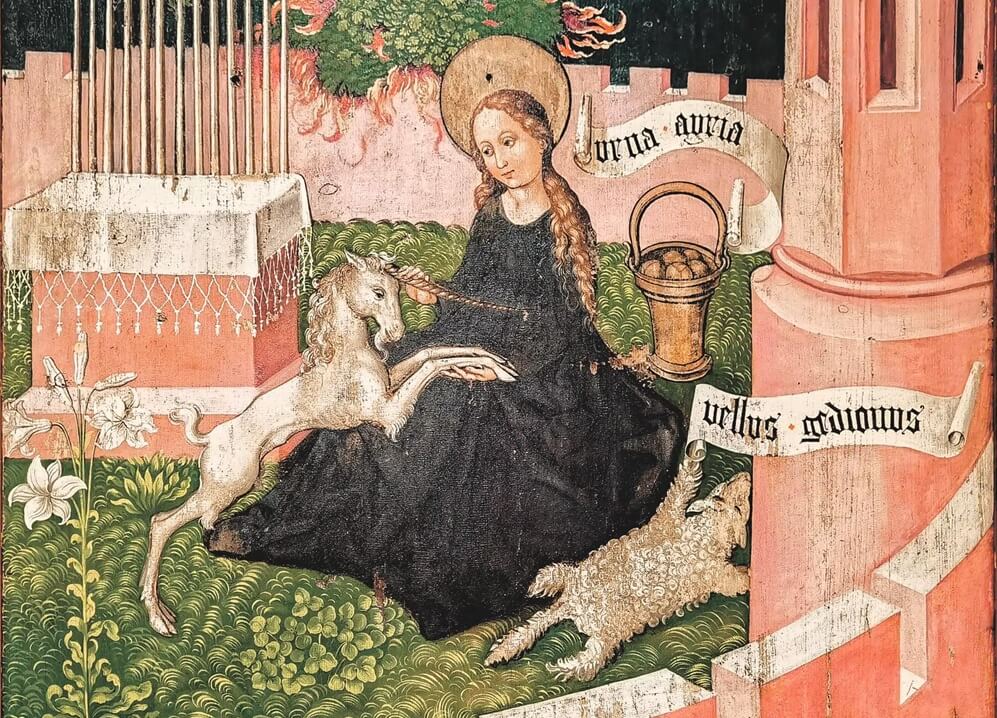
Mary’s resurrection is linked to and symbolized by the blooming of flowers, medicinal plants, and precious stones—all expressions of the eternal. Her complete virginity and Assumption to heaven both testify to Mary’s completeness, as two sides of the same coin. It is important to emphasize in this context that the Christian resurrection at the end of days will be individual, independent, and personal. Thus, after Mary’s Assumption to heaven, she becomes the Queen of Heaven and serves as a mediator for human beings, fulfilling her individual role as a motherly figure.
Mary nurtures and raises the believers, until she is consumed by divine love. Her body is taken to heaven and does not decay—Jesus descends from heaven and gathers her in his arms, raising her into the spiritual world. Mary demonstrates a path available to human beings who wish to reach the Divine, or as Athanasius (Patriarch of Alexandria in the 4th century) said: “Jesus is God who appeared in man to show man the way to become God.” And the one who shows the way is Mary.
Mary nurtures and raises the believers until she is consumed by divine love. Her body is taken to heaven and does not decay—Jesus descends from heaven and gathers her in his arms, raising her into the spiritual world. Mary demonstrates a path available to human beings who wish to reach the Divine, or as Athanasius (Patriarch of Alexandria in the 4th century) said: “Jesus is God who appeared in man to show man the way to become God.” And the one who shows the way is Mary.
The Assumption is one of the four Marian dogmas of the Catholic Church (the other three are the Immaculate Conception, Virgin before and after, and Mother of God), which was finally accepted only in 1950. In Mary’s Assumption to heaven, there is a dimension of apotheosis—the transformation of a human into a god after death. Even before her, there were people who ascended to heaven, such as Enoch, who became Metatron, a deputy of God. However, Mary ascended with her body, which means that her body was sanctified and refined during her life, and matter became spiritual. But then the question is asked: what happened to her body when it reached heaven? For example, did she stop drinking and eating? Were there bodily excretions? Did matter undergo transformation? And if so, why was it necessary to raise her body?
Part of the answer is that Mary’s Assumption to heaven has a dimension of the fulfillment of the prophecies about the resurrection of the dead—a transition to another type of body, the refinement of human nature on the way back to its natural state. The meaning of Mary’s Assumption to heaven is the final correction of the original sin of Eve and a return home to the state of human existence in Paradise. Mary, who enabled the arrival of Jesus in the world, enables, by this act, the arrival of human beings in heaven. The Assumption is a prefiguration of the resurrection of the dead on the Day of Judgment, even more so than the ascension of Jesus. And there is something else here: the Assumption is a kind of reward for Mary’s deeds in this world; she raised Jesus into the physical world, and he raises (ascends) her into the spiritual world. The good news is that there is justice in human life and a reward for good deeds.
Footnotes:
[1] Mary’s house from Nazareth also miraculously arrived in the city of Loreto in Italy after the fall of the Crusader Kingdom.
[2] Warner, Marina. (2000). Alone of all her sex: the myth and the cult of the Virgin Mary. Vintage.
[3] Underhill, E. (2018). Mysticism: A study in the nature and development of man’s spiritual consciousness. Routledge.
[4] Gest, K. L. (2010). Chivalry: The origins and history of the orders of knighthood. Ian Allan Publishing.
[5] Kenaan-Kedar, N. (1998). Armenian architecture in twelfth-century Crusader Jerusalem. Assaph Studies in Art History, 3, 77-91.
[6] In the 14th century, a tradition developed that the doubting Thomas arrived at the time of the Assumption, and Mary threw her belt down to him from heaven so that he would believe in her resurrection.
[7] The Order has several schools and institutions in the land, including in Nazareth and Jerusalem.
[8] But in terms of Jerusalem, Bernard of Clairvaux’s most important contribution was his role as the spiritual father of the Templar Order and the one who provided the ideological justification for the creation of the figure of the New Man, a combination of a monk and a knight, in his epistle In Praise of the New Knighthood from 1128 [4].