Whirling Dervishes in Jerusalem
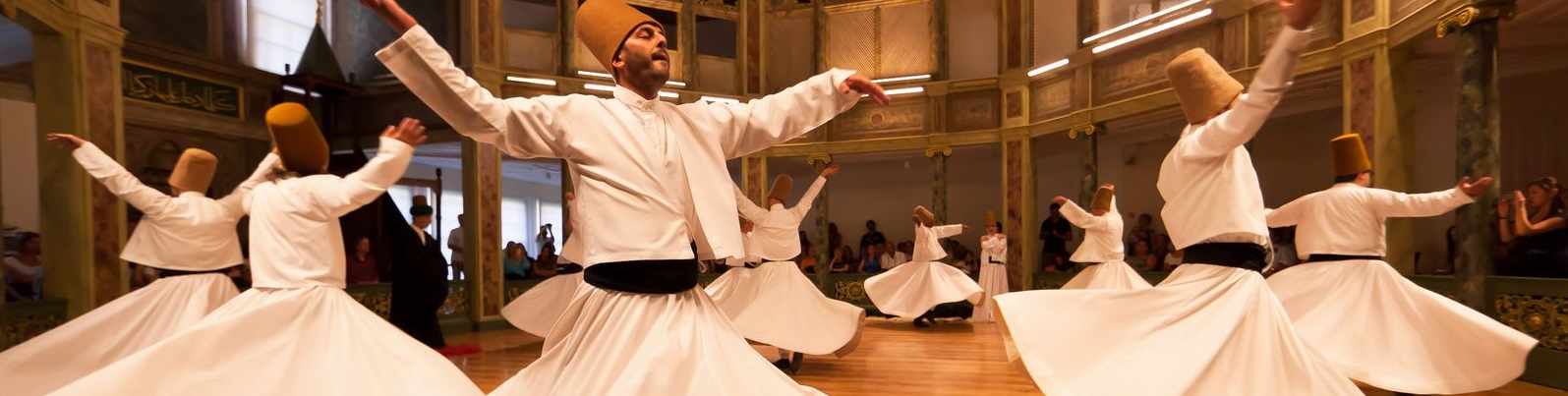
It appears that the Bektashi Order established a center for its rituals in Jerusalem in the 16th century, but the more important order established in Jerusalem during this period—one that also held significant status in the Ottoman Empire—was the order of the Whirling Dervishes. It was founded by the poet and mystic (and also advisor to rulers) Jalāl ad-Dīn Rūmī in the 13th century in Konya, Turkey, and operated in Jerusalem until the end of the Ottoman period. This is one of the most fascinating Sufi orders, supported by several Sultans and considered part of Turkish culture to this day.
A visitor to the historical center (now a museum) of the Whirling Dervishes in Konya sees a large map of the Middle East indicating the locations of their centers. One of these centers is in Jerusalem, and indeed, from the 16th century with the arrival of the Ottomans—and perhaps even before—we find a presence of this order in Jerusalem. The Whirling Dervish order is also called the Mawlawi Order, after its founder, Jalāl ad-Dīn Rūmī, who was known as the “Teacher”—Mawlānā in Turkish. During Ottoman rule, it became increasingly popular among the Ottoman administration and army stationed in Jerusalem, as well as among the local residents, especially the elites.
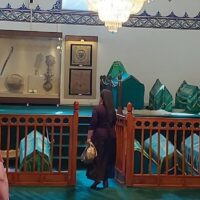
In the heart of the Muslim Quarter there is a complex called “Al-Mawlawiyya” that was once a Khānqāh (center) of the Mawlawī Order. Inside it is a mosque from after the Crusader period, rooms from the Mamluk period, and halls from the 16th century. During the Crusader period, the place served as a church dedicated to Saint Agnes. The Mamluks converted it into a Muslim Madrasa (school), and the Ottoman ruler Khāḍawri Beg added the third floor in 1587 and turned the place into a Khānqāh, allocating it to the order of the Whirling Dervishes, and creating a waqf (religious endowment) of 500 gold coins from the tax revenues of villages in the area for the Khānqāh—an amount that allowed for the employment of a shaykh and servants on a full salary.
Khāḍawri Beg turned a large rectangular hall into a whirling dance Semahane ceremonial hall, and that hall eventually became a mosque, with a miḥrāb (prayer niche) added to it. It can be seen today in the heart of the complex and was recently renovated. The place features an inner courtyard accessed by a doorway with steps. Surrounding the courtyard are various rooms, with a mosque to the north. In the courtyard is the tomb of Shaykh Ali, who was the leader of the order in Jerusalem. On the south side of the courtyard is a room with three tombs of other leaders. Above the entrance lintel is an inscription naming the founder and the date.
The Sufi explorer ʿAbd al-Ghanī al-Nābulūsī visited the place in the 17th century and described the semāʿ ceremonies held there. Al-Nābulūsī was a practicing Sufi who belonged to the Naqshbandī and Qādirī orders. He visited the land in 1688/9, and this may be related to the arrival of the al-Bukhārī family from Uzbekistan and the founding of the Naqshbandī zāwiya (lodge) in the Old City. Al-Nābulūsī wrote a commentary on Ibn ʿArabī and preached tolerance between religions.
It is worth mentioning in this context that in 1915, Mehmed Bahāʾ ad-Dīn Veled (1867–1953), the last head of the Whirling Dervishes Order in Konya, visited Jerusalem before its dispersal by Atatürk. He commanded a unit of Whirling Dervishes in the Ottoman army [1].
The Mawlawī Order (Mawlānā)
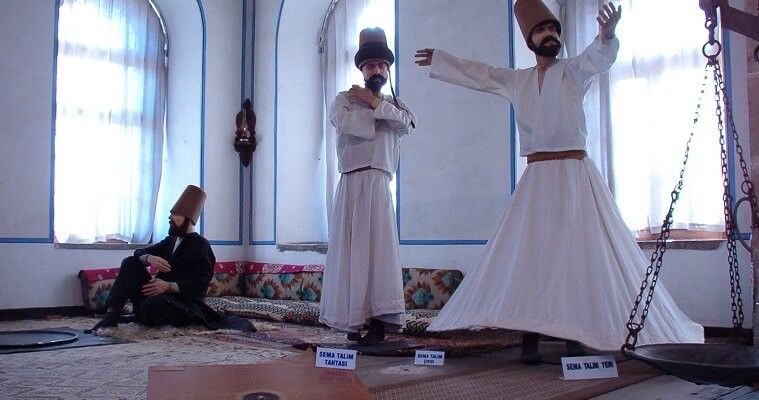
The Mawlawī Order was founded in the 13th century by the mystic and poet Jalāl ad-Dīn Rūmī (1207–1273), who was of Persian origin but lived and worked in Seljuk Konya. At a young age, he traveled throughout the Middle East with his family, and as part of this, he also visited Jerusalem. Rūmī is considered the patron saint of the Turks and the most important poet in the Persian language. The influence of his poetry and books was—and still is—enormous. Unlike many other founders of Sufi orders, Rūmī’s story is well known and accessible, and he enjoys great popularity today, especially in Israel and in the West in general [2].
Rūmī was born a little more than 800 years ago in Balkh in present-day northern Afghanistan, then part of a land called Khorasan. He left it as a child and moved with his family to Konya, Turkey, where he lived, died, and was buried at the age of 66. He had a full and fulfilling life, with the central event being his meeting at the age of 37 with the “Friend”—Shams Tabrizi. This meeting transformed him from a well-respected teacher and religious leader into a poet, dancer, and lover of God. But it would not have been possible without the events that led up to it, nor complete without what came after. To be ready and available for the encounter with the “Friend” (Dūst in the Sufi language), Rūmī had to receive initiation from a broad spectrum of teachers and accumulate rich life experience. And after the encounter with the Friend, he had to complete the process by connecting with additional spiritual “friends” and acting in the spirit of love that reached its peak in the writing of his monumental work—the Masnavī—and in the perpetuation of the tradition of dance and music, the practice, and the initiation of the order he left behind.
The young Rūmī was considered a prodigy. He was born into an educated and established family, received the highest scientific and cultural education imaginable, and was personally guided by the best teachers, foremost among them his father—Bahāʾ ad-Dīn. His education included, besides school studies, travels around the world and meetings with the great scholars of the generation. At the age of 13, he left his hometown with his family due to the Mongol invasion and wandered with them for several years throughout the Middle East, including a visit to Jerusalem. When they finally settled in Turkey, his career took off, and concurrently he raised a family, taught, wrote, and received the highest religious and educational position in Konya. Religiously and spiritually, he was prepared for his transformation.
Rumis father, a profound Sufi scholar, was the first to introduce him to the hidden secret of the Sufi teaching. After him, his training was continued by a teacher named Burhān ad-Dīn, who was an expert in the “science of states.” In addition, he met with other teachers and even traveled for a year to study at a center of solitary Sufis (Khilwatīs) in Damascus. At the age of 37, Rūmī was at the peak of his career, but inside he was empty and desolate, and when he met the “Friend,” that twin soul who revealed himself as his spiritual complement, he was ready. The meeting with Shams Tabrizi transformed his life: the religious preacher became a dancer, the scholar a mystical poet. Rūmī, with Shams’s help, entered a mysterious and strange world that no one before him had known. He became a Lover. Shams Tabrizi taught Rūmī the dance of the Whirling Dervishes—that simple movement that returns man to God. He would spin ecstatically for hours around a pillar in his house as the mystical poetry he wrote flowed perfectly from his mouth.
According to the Sufis, every person has a complementary soul—a Friend whom they must meet during their lives, and without this encounter, they are unable to realize their inherent spiritual potential. In the third book, we will see how this feature appears in the meeting between two other people, the painter William Hunt and the visionary Henry Monk, in the 19th century. The Friend leads the person to an encounter with the God within him. And so it was in Rūmī’s case: he learned the meaning of spiritual love through the encounter with Shams Tabrizi. However, after Shams’s disappearance, Rūmī needed to open up to other “friends” (sometimes there are several Friends), to the beauty of life, and to the brotherhood of mankind. He had to turn his love for the “Friend” into love for God, and this was done first by transferring the archetype to other people, and finally by writing a book intended for the whole world.
When Shams Tabrizi disappeared after a few years, a heartbroken Rūmī died and was resurrected through finding other friends: Zarkubī, Ḥusām ad-Dīn, and finally he reached a state in which he said, “There are a thousand Shamses in every hair of my beard.” He internalized the figure of Shams Tabrizi and the love between them and dedicated himself to the service of others. Rūmī taught and guided, supported and led, revealing the secrets of the spiritual path—the secrets of love. Rūmī became the “Teacher”—Mawlānā—and following his teaching and the example of his life, the Mawlawi order of Whirling Dervishes was established, with the help of his son Sultan Walad.
Rūmī taught a deep spiritual philosophy centered on the perception that man is in the image of God and has the possibility to unite with Him through love: “From the moment you enter the material world, a ladder is placed before you to enable you to escape.” Man was initially a mineral, then a plant, and then passed into the animal kingdom. “Then you became a man, gaining consciousness, thought, and faith.” In the end, man will return to being an angel, and his home will be in heaven. But even this is not the final stage: “Man will pass the angelic state, penetrating the ocean of Divine Unity, so that your drop of water will become a vast sea.”
Man was created in the image of God: “My image is imprinted on the King’s heart. The King’s heart will be sick without My image. The light of reason flows from My thought. The heavens were created from My primordial nature. I have a kingdom of the Spirit. I was born with the King, but I receive the light from Him.”
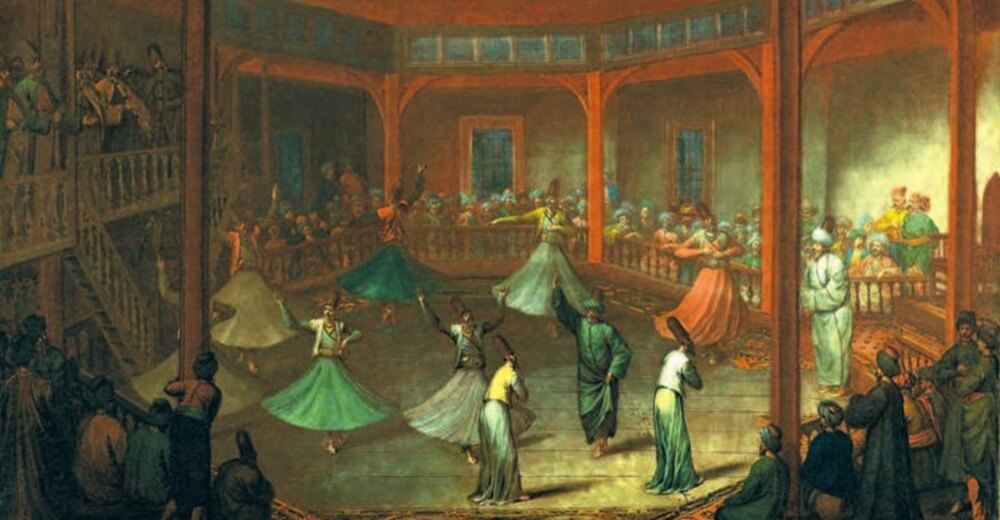
As is the nature of great teachers, Rūmī encapsulated all his teaching in two simple things: the first is the playing of the ney flute made of bamboo; the sad sound it emits is the longing of the bamboo to return to the swamp where it grew, and this is also the natural state of man. The second is the whirling dance that every child performs naturally. Rūmī would whirl ecstatically in his house, and while doing so, he dictated marvelous verses to his secretary and spiritual friend (dōst) Ḥusām ad-Dīn, which became the six volumes of the Masnavī—the Qur’an in Persian. His path of developing the unique spiritual way was continued by his son, Sulṭān Walad. He established the rules of a unique whirling dance ritual called Semāʿ, which simulates the soul’s journey after death and its return to the source from which it came.
The Order of the Whirling Dervishes developed a tradition of initiation and dedicated itself, in addition to performing rituals, to social service. It established centers in the large cities of the empire called tekke in Turkish or khānqāh in Persian, where each place had a school, a dance hall called semahane, a hostel, and public kitchens that were used to feed the residents of the tekke, guests, and the city’s poor. The Head Cook was the chief initiator of the tekke. Over the years, the tekkes of the Mawlawīs became centers of learning, philosophy, sciences, music, and art.
The tekkes of the Mawlawī Order were often meeting places for Ottoman officials and army officers together with the local Muslim aristocracy. This was the case in Jerusalem, as appears in Dror Ze’evi’s book on Ottoman Jerusalem [3], in the center of the Whirling Dervishes in the Muslim Quarter, and probably also in another center established in Rās al-ʿAmūd—and so it was in other places as well.
Evliya Çelebi
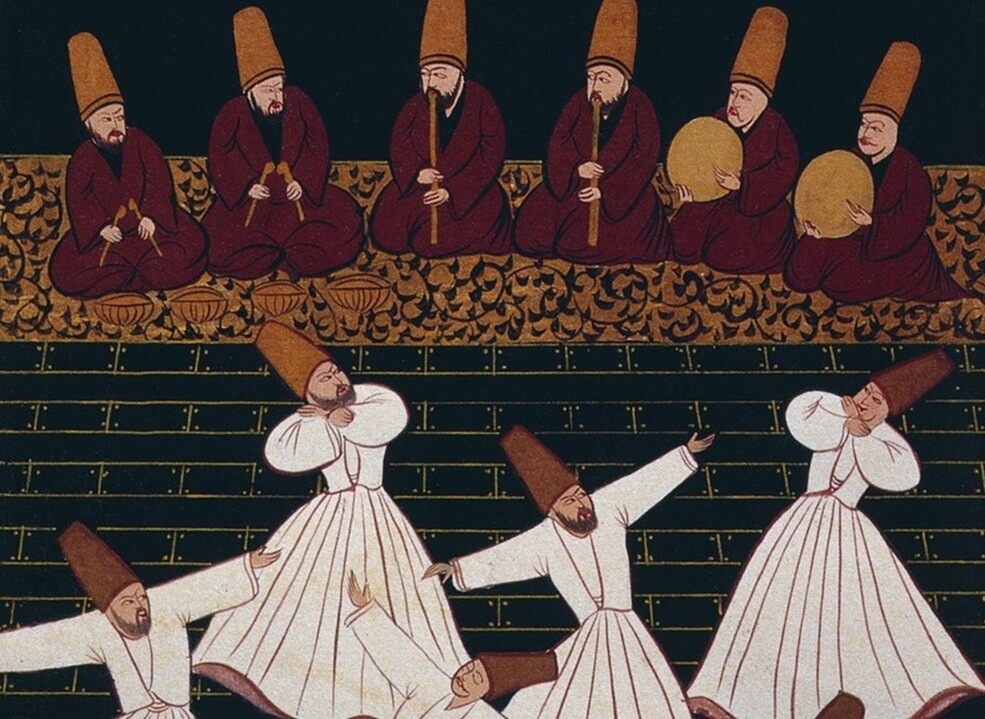
Evliya Çelebi was an Ottoman explorer who described his visits to Jerusalem in the 17th century. He portrays himself as a descendant of Aḥmad Yasawī, the great shaykh of Central Asia, and a practicing dervish—probably belonging to the Gülşenī Order, which is a branch of the Khilwatī Order. He was a gifted musician with a sense of self-humor. Evliya Çelebi traveled throughout the empire and wrote a book about his journeys. He visited Jerusalem twice, and his descriptions of the city and the land are of great importance. According to him, there were no fewer than 70 Sufi centers (zāwiyas) in the city at that time [4].
Another visitor to Jerusalem during that period (Rosa) describes the Sufis thus:
“They are similar to Christian monks. Their ‘monasteries’ and homes are preserved and well kept, and in the gardens of the houses they grow flowers and plants from which they distill various perfumes. Music is an important part of their worldview, and most of them engage in playing music and singing. Many of those who come to Jerusalem come to visit the Holy Redeemer Monastery to listen to the singing and the organ music. The status of the Sufis in local society is highly respected, and many dedicate their property to them. The district governors and their protégés are also friendly with them and attach great importance to them. They participate with them in mysterious ceremonies, where they pass a string of beads from hand to hand and call upon the names of Allāh…”
The Khilwatī Order
Evliya Çelebi belonged to the Khilwatī Sufi Order. Some say that the founder of the order was Ḥasan al-Baṣrī, one of the first Sufis and the teacher of Rābiʿa al-ʿAdawiyya, whom we wrote about in the first book, but historically the first appearance of the order is in the 14th century. The first developer of the order and its unique path was a shaykh from Azerbaijan (Baku) named Seyid Yahya Bakuvi (Shirvani). He wrote a book called Wird al-Sattār, which is read by almost all branches of the order. This is a path that emphasizes seclusion, periods of detachment, and meditation as a means to reach [spiritual] states. It has a historical and spiritual closeness to the Bektashis and also some shared poets.
In the Ottoman Empire, there were several main Sufi orders. The Khilwatiyya was one of the most important. It emphasized introspective contemplation, the inner person within us, and the fact that true reality exists only within—in contrast to other orders that look outward, at the world and at nature, where the actions of God can be seen. The Khilwatiyya Order encouraged the practice of seclusion for many days, during which the secluded person would experience visions and ascend the spiritual ladder. The seclusion was carried out in closed rooms in hidden places in mosques or tekkes, for forty days or other defined periods.
The order spread during the time of Bayezid II, an Ottoman Sultan who favored the Sufis. It took root in Ottoman society, splitting into many sub-currents, and emphasized vigorous collective dhikr (remembrance of God), proper conduct (adab), and periods of seclusion in which there is an aspiration to reach higher states of awareness. The emphasis is on the individual. The most famous poet associated with them is Niyāzī al-Miṣrī from the 17th century, who was a friend of Shabbatai Zevi and also frequented Bektashī circles.
Muṣṭafa ibn Kamāl ad-Dīn al-Bakrī (1688–1748) was a shaykh of the Khilwatī Order who renewed it and brought about its expansion and establishment in Israel and Egypt. He was born in Damascus but spent most of his active years in Jerusalem. In 1710, he came to Jerusalem for four months that turned into forty years, during which his center of activity was the Khilwatīs’ zāwiya in Jerusalem. He trained Khilwatī shaykhs to spread the order in Egypt, but they came to him in Jerusalem for initiation. As part of the reforms he instituted, he forbade followers from belonging to other orders, emphasized orthodoxy, reformed the recitation of the mantras (wird), and commanded that they be performed only in public, and more [5]. The shaykh used the building constructed on the Temple Mount, known as the Dome of Shaykh Muḥammad al-Khalīlī, northwest of the Dome of the Rock, as a meeting place. He was supported by Muḥammad Pasha, the ruler of Jerusalem from 1701 onward.
Sufi Center on Mount Zion
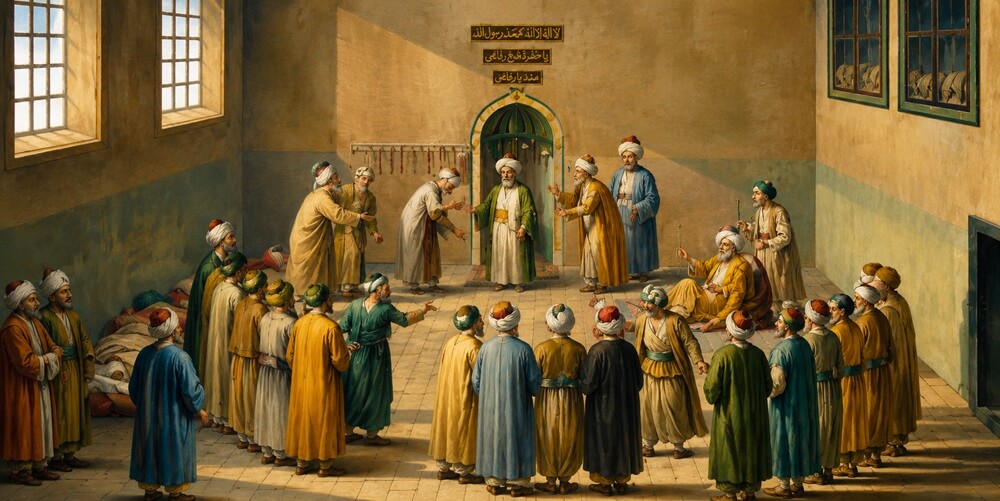
One of the most impressive places in Jerusalem is the joint complex of the Tomb of David and the Room of the Last Supper on Mount Zion, sacred to Christians, Jews, and Muslims. During the Ottoman period, a Sufi zāwiya operated there, led by shaykhs from the Dajānī family. It is unclear to which order the zāwiya belonged. The founder of the place, Shaykh Aḥmad Dajānī, was the head of the Sufis in Jerusalem, so it is possible that the place was a kind of overall zāwiya—a meeting place for the various orders, as exists elsewhere in the world—or it may have been the Khilwatī zāwiya, the one that Evliya Çelebi mentions.
The Tomb of David is a structure whose foundations date back to the end of the Second Temple period. According to researchers, David is not buried there, because according to the Bible he was buried inside the city, which did not reach the borders of Mount Zion in his time. However, it is possible that the place was sacred to Jews during the Second Temple period, when a neighborhood of priests and Essenes existed on Mount Zion. This is suggested by archaeological excavations that discovered a priestly neighborhood there, and it is known that the Essenes were from priestly circles. There is also a nearby gate called the “Essenes’ Gate,” which appears in the writings of Josephus Flavius. The structure itself is built of large stones that were in use during the Herodian period, and its shape resembles a synagogue. It is possible that another person from the Davidic dynasty is buried there, or that David’s bones were moved here.
In any case, Jesus was a Messiah from the Davidic line, and the Christian tradition that probably developed in the Middle Ages identified the Room of the Last Supper with a room on the second floor of the building. And because Peter says in the Book of Acts during the miracle of Pentecost, “Brothers, I may confidently say to you regarding the patriarch David that he both died and was buried, and his tomb is with us to this day” (Acts 2:29), and since this miracle happened in the Room of the Last Supper, Christians took the saying literally and identified the tomb beneath the Room of the Last Supper as the Tomb of King David. This identification was accepted by Jews and Muslims.
The Room of the Last Supper was part of the Byzantine “Mother of All Churches,” which was established in the 5th century. However, the Byzantine church was destroyed by the Persians at the beginning of the 7th century CE and was rebuilt by the Crusaders in the 12th century CE, so the current structure is mostly Crusader. Inside the hall are slender Crusader marble columns with capitals featuring the pelican bird, which symbolized Jesus in the Middle Ages. The pelican pierces its chest to feed its young with its blood, symbolizing the sacrifice of Jesus in general, and also what he said at the Last Supper: “Drink from it, all of you; for this is my blood…” (Matthew 26:27–28). But in addition to the Christian elements, one can also see a Muslim miḥrāb, a preacher’s pulpit, and a wonderful glass window with Arabic inscriptions from the 16th century.
With the re-conquest of Jerusalem by the Muslims, the Crusader “Mother of All Churches” was largely destroyed, yet a Franciscan presence continued to exist in the parts that survived. After the Ottoman conquest of Jerusalem at the beginning of the 16th century, a fierce dispute arose between the Jews and the Christians regarding the ownership of the tomb building. Sultan Suleiman the Magnificent, who rebuilt the walls of Jerusalem at that time, resolved the matter by transferring the place to the control of a charismatic shaykh from the Dajānī family.
The Dajānī family is one of the leading and influential families in Palestinian society in general and in Jerusalem in particular. Its origin is connected to the Prophet’s family. At the beginning of the 16th century, the family, led by Shaykh Aḥmad Shihāb ad-Dīn Dajānī, moved to Morocco, a land with a Sufi inclination, where the shaykh became an important Sufi teacher and leader. One day, King David appeared to him in a dream and said to him: “O Ahmad, save me, my salvation is in your hands.” The shaykh understood that David was referring to his burial place on Mount Zion, which was not being properly cared for by the Christian monks who held the place. Following the vision, he made a pilgrimage to Jerusalem and worked to become responsible for the site. His request was granted by the Sultan, and he became the leader of the Sufis in Jerusalem and in Israel.
The traditional role of Sufi shaykhs in the Ottoman Empire was to be in direct contact with the sultans and report to them on matters in their regions of residence. The shaykh died in 1561 and was buried in a magnificent tomb in the Mamilla cemetery, which serves as a pilgrimage site to this day.
Over the years, the Dajānī family established an entire neighborhood around the Tomb of David on Mount Zion, with three courtyards and three mosques. The oldest mosque is located in the halls of the Tomb of David itself. The second mosque is in the Room of the Last Supper, inside which a beautiful marble miḥrāb was installed in three colors (red, black, and white). Beautiful colored windows with Qur’anic calligraphy referring to David were added—“judge between the people in truth and do not follow your desires” (Sūrat Ṣād, verse 26)—and the third mosque is on the roof. Decorated ceramics of high quality were installed throughout the site, and a cemetery developed outside the houses.
Until he War of Independence, an active Zāwiya existed in the complex. After the War of Independence, the place passed into the custody of the Ministry of Religious Affairs, which turned it into a Jewish holy site, with a yeshiva, a museum, prayer rooms, and a viewpoint overlooking the Old City. Christians were allowed to return and use the Room of the Last Supper for prayer and visitation.
Sufi Center on the Mount of Olives
The tradition of the resurrection of the dead and the Day of Judgment is linked to the Mount of Olives in Islam. There is a Sūra in the Qur’an called Sūrat aṭ-Ṭūr—The Mount. The word Ṭūr in Islam usually refers to Mount Sinai, but some have linked it to the Mount of Olives, which is why the neighborhood on the Mount of Olives is called Aṭ-Ṭūr. Sūrat at-Tīn (The Fig) in the Qur’an begins with the words, “By the fig and the olive, and [by] Mount Sinai…” hence the connection of the Mount of Olives to Mount Sinai.
The Mount of Olives is mentioned as a holy mountain in Qur’anic commentary and in the Hadith. According to belief, on the Day of Judgment, there will be a bridge from the Mount of Olives to the Temple Mount plaza, thin as a hair and sharp as a razor, over which the resurrected souls will pass on their way to judgment. The bridge will rest on seven arches, which is why the hotel built on the Mount of Olives during Jordanian rule was called the Seven Arches Hotel.
In addition to the connection to the Day of Judgment, Muslims believe in the sanctity of Jesus and that he was taken to heaven from the summit of the Mount of Olives. However, unlike Christians, they do not accept his resurrection and believe that he ascended bodily and will return as the Messiah on the Day of Judgment.
In any case, when Ṣalāḥ ad-Dīn (Saladin) conquered Jerusalem, he confiscated the complex of the Crusader Church of the Ascension. The rock with the footprint of Jesus ascending to heaven certainly reminded him of the Foundation Rock with the footprint of Muhammad in the Dome of the Rock. The place became a Muslim place of worship. The rock area was covered with a dome, and a miḥrāb was placed in the Aedicule structure. To respect the Christian tradition, the Muslims allowed pilgrimage to the site and established an additional mosque nearby. The remains of the surrounding church were finally destroyed in 1480, creating an open area with the small Aedicule building at the center, enclosed by a hexagonal wall.
In 1614, Shaykh Abū Saʿīd Asʿad Efendī, who was the Muftī of Istanbul, arrived in Jerusalem and established a Zāwiya and a mosque near the place of the Ascension on the Mount of Olives. He endowed a considerable waqf to the site and appointed his deputy, Muḥammad Pasha, who was the ruler of Jerusalem at the time, as the person in charge of the complex. Muḥammad Pasha was probably the Sufi Shaykh Shams ad-Dīn Muḥammad al-ʿAlamī, the head of the ʿAlamī family in Jerusalem at that time. He was buried in the crypt beneath the Zāwiya, along with other family leaders.
The ʿAlamī family are descendants of the Prophet through his grandson Ḥasan. Some of them came to Jerusalem from Morocco at the end of the 12th century as part of its re-conquest by Saladin. The head of the family, the Sufi Shaykh Muḥammad al-ʿAlamī, led a group of followers, and in return for their military services, the family received extensive landholdings on the Mount of Olives. The participation of Sufi groups in the holy wars was common, and many of the settlements that Saladin established after the victory, including neighborhoods in Jerusalem such as Abū Tōr, belonged to Sufi groups of followers. A Sufi Zāwiya was usually also a family affair, and in this case, the family apparently had a fondness for high places, as they also received responsibility for the Maqām (shrine) of the Prophet Samuel in Nebi Samuel.
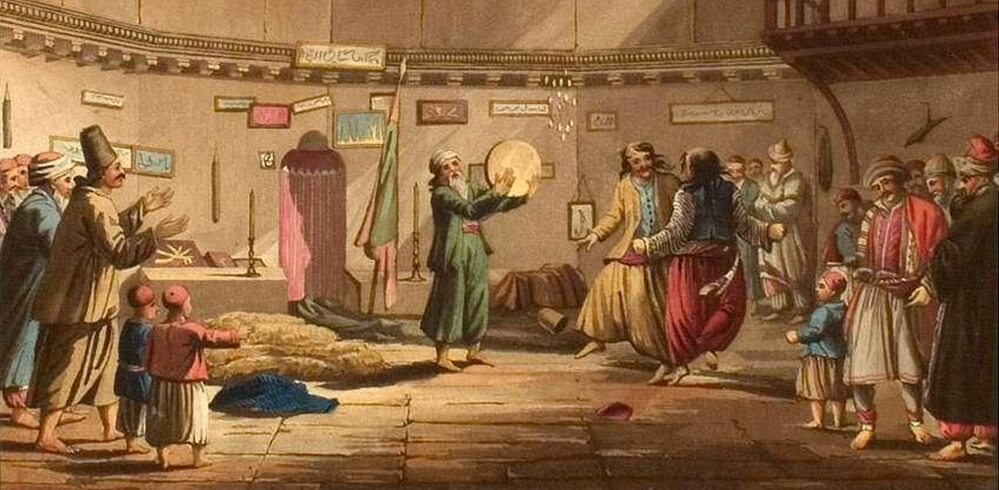
Inside the complex at the summit of the Mount of Olives are the Mosque of the Ascension and the Sufi Zāwiya called Zāwiyat al-Asʿadiyya, named after its founding Shaykh. As in the case of the Tomb of David, this is probably a general Zāwiya for all orders. The Shaykhs of the ʿAlamī family also served in public positions in the Temple Mount Waqf and in public service. Adjacent to the Zāwiya is a crypt of the Shaykhs and family members, as well as rooms and houses, and beneath it is a commemorative tomb of Rābiʿa al-ʿAdawiyya, the Sufi poetess of love from the 9th century CE, whom we wrote about in one of the chapters at the beginning of this book.
Footnotes:
[1] Zarcone, T. (2009). Sufi Pilgrims from Central Asia and India in Jerusalem (p. 168). Kyoto: Center for Islamic Area Studies at Kyoto University. P. 77.
[2] Chittick, W. C. (1983). The Sufi Path of Love: The Spiritual Teachings of Rumi. State University of New York Press.
[3] Ze’evi, Dror. (1997). The Ottoman Century: Jerusalem District in the Seventeenth Century. Yad Izhak Ben-Zvi.
[4] Çelebi, E. (1980). The Land of Israel in the Seventeenth Century in the Description of Evliya Çelebi (Editors: A. Schiller and others). Ariel Publishing.
[5] Weigert, G. (n.d.). Shaykh Mustapha Kamal al Din al Bakri – A Sufi reformer in eighteenth-century Egypt. The Israeli Academic Center in Cairo.