Herod’s Vision for the Temple
Herod wanted to build in Jerusalem a Temple that would amaze all who saw it—a world wonder that would stand alongside the other wonders of the ancient world. A sanctuary that would be a source of pride and identification for Jews everywhere, a building symbolizing the greatness and importance of the Jewish people, and a milestone in their integration into the new Roman world order. He wanted to build a structure of a scope and scale never before seen in Israel, employing the latest Roman innovations in architecture and construction.
For this purpose, he trained a thousand priests to build the sacred structure itself, giving them autonomy in that part of the project, as though saying to them: “Look, I know what you think of me, but it will not help you—I am here to stay. Instead of wasting our time in quarrels, let us harness our joint powers to elevate the status of the Jewish people and their God in the world, by rebuilding the Temple.” He probably also offered to contribute his own wealth to the project (he was the richest man in the land), as if to say: “For every coin you put in, I will put in two.” In addition, he hinted that if they did not spend the treasures accumulated in the Temple treasury, there was a danger that in the future another Crassus might come and plunder them. In short, the priests were persuaded—especially since the High Priest was Herod’s own appointee.
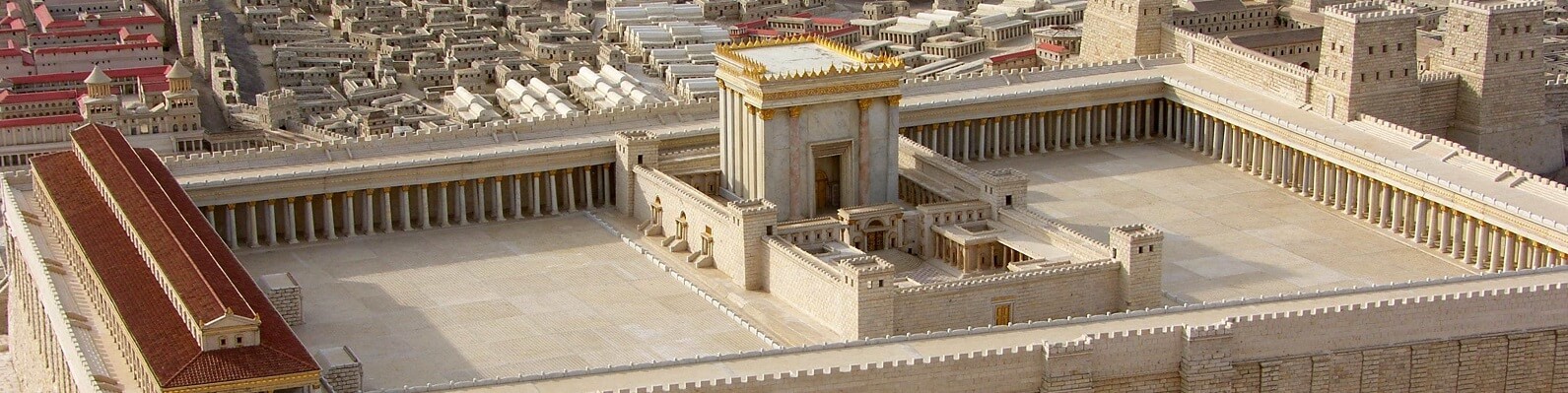
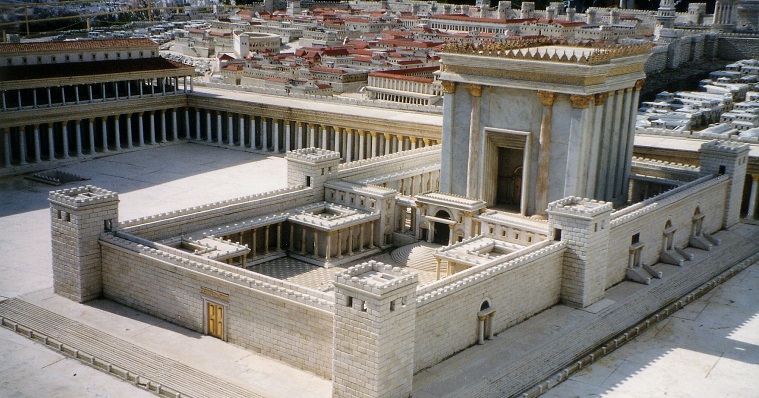
The dimensions of Solomon’s Temple had apparently been grand, as described in the Book of Kings, whereas the Second Temple built by the returnees from Babylon and later renewed by the Hasmoneans was relatively modest. Herod returned to the original scale by “wrapping” the existing building within a new one, thus magnifying its volume several times. In this way the worship was not interrupted, nor was there any need to destroy what already existed. It is important to remember that the inner dimensions of the Temple were sacred and fixed, but Herod wanted to create the appearance of a larger and more impressive sanctuary. Thus, within the “envelope” of the old Temple he built a monumental façade rising to a perfect square—50 × 50 meters—of gleaming white stone that sparkled at sunrise, with a great entrance at its center above which hung a golden menorah, the focal point of the rays of light. Around the building he added chambers, raising the entire structure to the height of the façade—50 meters[1].
On the southern side of the Temple Mount plaza, Herod built a colossal basilica, the largest covered hall in the world at that time. Supported by 700 giant columns, it stretched 190 meters in length. Gentiles were allowed to enter the basilica, and it was apparently the center of public and commercial activity of the Temple complex. To the north of the Temple Mount, a massive fortress was built. Some claim that its construction preceded the entire project, while others maintain that it was completed at the end. The fortress could house up to 2,000 men and was connected by a tunnel to the city’s citadel and Herod’s palace near today’s Tower of David. In addition to the fortress, other structures were erected on the Temple Mount: halls for the Sanhedrin, priestly courts, and colonnades for shelter from the rain.
Herod wanted to create a vast sacred esplanade upon which would rise buildings and a Temple the likes of which the world had never seen. He sought to reproduce similar plazas found elsewhere in the ancient world (such as Cyrene in North Africa), in line with his tendency to replicate the wonders of the ancient world and then improve upon them (Caesarea’s harbor, for example, was a replica of Piraeus in Greece; Herodium a copy of Augustus’ tomb in Rome). But Jerusalem’s mountainous topography posed a challenge, for the Temple stood on a hilltop. Yet Herod was not a man to be deterred. In his vision, he saw the possibility of creating a flat platform where it seemed impossible, extending the Hasmonean plaza northward and southward so that it rose fifty meters above its surroundings. In this way, he turned the hill into a level plateau, producing a sacred precinct that astonished all who saw it. “The wall itself was the greatest work that men had ever heard of” (Antiquities XV, 396).

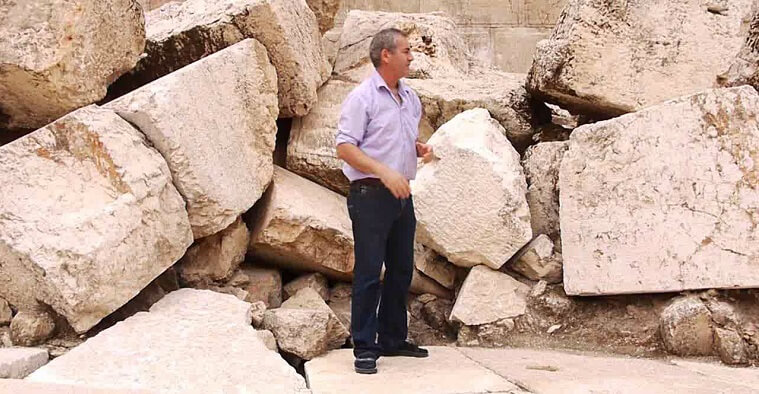
The supporting walls of the Temple Mount stretched for over 1,500 meters. They were 4.5 meters thick, and at the southeast corner the stones rose to a height of 50 meters (with additional buildings above them rising many more tens of meters). Altogether, the retaining wall created a vast platform of 140 dunams (about 35 acres), allowing over 100,000 people to stand comfortably upon it, and over 200,000 in close quarters (as still occurs today during the Muslim Laylat al-Qadr prayers).
Herod’s construction followed the principles of classical Greco-Roman temple architecture. Within the buildings of the Temple Mount, and particularly the Temple itself, there were proportions, harmonies, and symmetries that emphasized the beauty of the place—from the perfect square façade to the balance and proportion between it and the rest of the building. Although Herod’s Temple was not built according to the classical Greek orders, it evoked an archetypal impression; according to the Rabbis, it looked like a roaring lion. The ideal of its beauty was reinforced by the composition of the Temple within the larger Temple Mount plaza—its position relative to the basilica and the Antonia Fortress, its proportions and harmonies in relation to them, its integration with the colonnades and porticos, chambers and balustrades, courts and gates.
As in other Roman sanctuaries, Herod’s Temple incorporated the use of fine stones, monumental staircases and gates, courtyards, and decorative features on the building’s exterior, such as Helena’s golden menorah at the entrance or golden spikes on its roof—ostensibly to ward off crows but in fact also a symbol of the spiritual light radiating from it, turning the Temple into an image of the sun. Another important contribution was the Temple’s alignment with the sunrise in the east over the Mount of Olives and its relationship to the surrounding hills (see the chapter on Jerusalem’s Sacred Geography) and the city encircling it.
In other words, the Temple became more than it had ever been before: not only a place of worship but also an architectural expression of the ideals of beauty and perfection, leading to an experience both aesthetic and sacred. The new Temple was mirrored in the new Jerusalem—above all in Herod’s palace and his citadels (the Antonia to the north of the Temple Mount and the Phasael fortress, today’s Tower of David). These were constructed from the same stones and architectural modules as the Temple itself, thereby creating a connection between monarchy and sanctuary, and establishing the Temple as the political center of the Jewish people both in the land and throughout the Diaspora.
Sacred Architecture
The principal building activity in antiquity was devoted to temples and palaces, which were often linked together. In cultures such as Egypt or Persia—both of which believed in magic—as well as in the classical cultures of Greece and Rome, though with different explanations, the architecture of temples expressed the structure of the human spiritual body and of the invisible worlds. Within this framework, significance was attached to the choice of materials, colors, orientations, proportions, ornamentation, and the overall layout of the temple. In other words, there was an ancient form of feng shui in Egypt and Mesopotamia, in which temples were constructed to summon energy and create an atmosphere that would act magically upon the world. Thus, if a ruler wanted more abundance or peace in his land, he would build a temple to invoke that energy.
With the rise of Greek philosophy and the Hellenistic domination of the East, sacred architecture became the chief means of expressing the cosmic order discovered by the philosophers and sages. This was a divine order, yet one that was related to the human being. Sacred architecture became concentrated within mystery schools and circles of initiates. It did not concern itself only with the building itself but also with its relationship to its surroundings, its effect on visitors, and its placement within the framework of local and national sacred geography.
With the rise of the Roman Empire, architecture became the “queen of the arts.” In order to create a uniform and high standard throughout the empire, schools of sacred architecture were established, and building codes were written. The architects supervising the imperial construction projects were directly subordinate to the emperor and not to local rulers. Part of the curriculum of temple architects’ education included philosophy and theology, based on the view that architecture—especially of temples and public buildings—should express in its design the order of the cosmos, as reflected in the structure of the universe and especially the structure of the human body, and that it should originate from a moral standpoint.
Thus wrote Vitruvius, the architect of Augustus, in his On Architecture (Book III), about the relationship between the human body and the symmetry of temples[2]: “Nature has so designed the human body that the face, from the chin to the top of the forehead and the roots of the hair, is a tenth of the whole height. So too the palm, from the wrist to the tip of the middle finger. The head, from the chin to the crown, is an eighth, and with the neck and shoulder, from the top of the chest to the roots of the hair, a sixth; from the center of the chest to the crown, a quarter. As for the height of the face: from the bottom of the chin to the base of the nostrils is a third of the face, as is the nose, from the base of the nostrils to the line between the eyebrows. The forehead, from that line to the roots of the hair, is likewise a third. The length of the foot is a sixth of the height of the body; the forearm a quarter; the width of the chest also a quarter. The other parts likewise have proportional measurements, and the use of these by painters and sculptors of old brought them to great and admirable excellence.”
The proportions of the human body thus sanctify two numerical systems: one is the decimal system, used for measuring distances, and the other is the system of six and twelve, used for measuring time. As Vitruvius writes: “The ancients established the number ten as the perfect number,” but he adds: “Mathematicians held a different view and said that six is the perfect number, since it is composed of units more suitable numerically for their calculations.”
Proportions such as two-thirds and one-third, or the golden ratio, express cosmic truths and appear in the Temple: two-thirds and one-third is the ratio of the length to the width of the sanctuary hall, and the golden ratio is found in the measurements of the Ark of the Covenant. According to Pythagoras, the world is unified because it is numerical: number creates the harmony between opposites—these are simply different numerical (interval) values. Numbers exist within things, just as God dwells within the priest. Unity is the law of God; evolution is the law of life; and number is the law of the universe. One of the most important expressions of number is in the sacred architecture of buildings and temples.
Number appears not only in proportions but also in the repetition of certain architectural elements and in classifications that express cosmic order. Thus we have the numbers three, seven, and twelve, which appear in the Temple in the number of its furnishings, in the number of branches of the menorah, and in the number of loaves of bread; we have the number ten in the size of the cherubim above the Ark (ten cubits), and in the Ten Commandments within it; and we have reference to the human body through the use of a measurement derived from it—the cubit.
Philo of Alexandria wrote in his Questions and Answers on Genesis and Exodus[3]: “Just as an architect, when about to build a city, first designs its plan in his mind, so God first created the world in thought, which served him as a model for the creation of the sensible world. After completing the preliminary preparations of architecture, which lasted three days, and on the fourth day suspending the luminaries in the heavens, the Creator proceeded on the fifth day to the work of the engineer—that is, the creation of living creatures. For nothing is more fitting to the nature of living beings, which are distinguished from those without spirit, than the number five, as they possess the five senses alone.”
The importance of numbers appears in the calendar, in commandments, in the number of daily prayers, in the age of bar mitzvah, and in many other matters—including the developing science of gematria, in which, for example, the Hebrew words Raz (mystery) and Or (light) share the same numerical value.
In addition to numbers, one of the main tools of sacred architecture was the use of modules—both of volume and of surface. Every body was made up of squares or cubes in whole numbers and with significant measures, such as the cubit related to the human body. In the case of the Temple, the module was a square of ten cubits by ten cubits, or a smaller one of five by five. The module served as a tool, a foundation, a planning grid. The Egyptians were probably the first to use modules in their art: as a preparation for painting, for example, they drew a grid of squares upon which they based the drawing.
The conception behind the use of modules was that art should be objective and reflect cosmic truths, not be left to chance. Thus, rules had to be set: temples demanded artistic compulsion. Theologically and philosophically, Egyptian art strove for the eternal and fled from the transient; the Egyptians sought to express timelessness, not temporal existence. Aristotle, by contrast, distinguished between actualized life and potential life: the Greeks sought the actual, the Egyptians sought the potential. The Temple in Jerusalem, in its essence, leaned more toward the Egyptian, but Herod attempted to add to it the element of beauty derived from the Hellenistic-Roman tradition, according to which numbers, proportions, geometry, shapes, relations, modules, and measurements were the basis of sacred architecture. But in addition to these there was also the artistic dimension—the dialogue between human beings and the sacred place (the building), the beauty and sublimity that cannot always be expressed in words.
Plato’s theory of anamnesis (recollection) held that we recognize geometric forms almost instinctively—and I would add, archetypically—and that our very ability to recall them indicates that we brought this knowledge into this world from another level of existence. It aids the soul in its process of recollection, reconnecting with its eternal state. Therefore, there is importance in engaging with geometry, mathematics, and the stars (the Stoic view). These geometric forms can be seen, sensed, and experienced in buildings—that is, in sacred architecture.
Herodian Sacred Geography
Before Augustus built his mausoleum in Rome, he first erected a new temple to all the gods—the Pantheon—at a new location (the Field of Mars), far from the Capitoline Hill and the site of the ancient temples. He then measured the exact distance of the Pantheon from the Capitoline Hill, and at precisely the same distance due north he established his own tomb on the banks of the river. Such were the measurements.
Augustus was drawing upon the Roman tradition of sacred architecture and sacred geography, whose roots lay in Egypt. One must understand that the ancients conceived of the earth as a single great organism. Accordingly, the temples of Egypt were arranged in relation to the organs of Osiris’ body, and the land was perceived as the figure of Osiris spread upon the earth—or else as a reflection of the heavens, the cosmos inscribed upon the ground. Humanity and the universe were seen as mirroring one another, so there is no contradiction in finding both a reflection of the skies—such as Orion’s Belt in the alignment of the pyramids of Giza—and also the outline of a human body in the layout of sacred structures.
If Herod borrowed from Augustus the ideas for the design of his own tomb[4], then one would expect to find sacred architecture, orientations, and distances embedded in Herod’s constructions as well. And indeed, Herod’s tomb at Herodium lies on a precise north–south axis with the summit of the Mount of Olives, the traditional and most important burial ground of Jerusalem. If we connect the towers of the Citadel of David—specifically the Phasael Tower, which can be seen from Herodium—with Herodium’s own tower, the line points toward Petra, and more precisely to its most prominent landmark: Mount Aaron, the place of his mother’s origin.
The official story explaining Herod’s choice of Herodium as his burial place is that in 40 BCE, while still a young man and ruler of Judea on behalf of the Romans, he was forced to flee Jerusalem following the invasion of the Parthian army with Mattathias Antigonus II. He made his way to Petra in Jordan, since his mother was a Nabataean princess, hoping to find refuge there. The rebels’ army pursued them, and at the site of Herodium his mother’s chariot overturned. Herod was compelled to halt and fight back, and by a miraculous turn he triumphed and escaped. In memory of this wondrous victory and deliverance, he chose Herodium as the place of his tomb.
Yet, an examination of sacred geography suggests that there may have been other reasons for this choice. Not only is the site situated south of the Mount of Olives, but if we measure the distances between Herod’s major monumental projects—the Temple Mount in Jerusalem, Hebron, Sartaba, Masada, and especially the nearby fortress of Hyrcania—we discover that all the distances are multiples of the distance from Herodium to Jerusalem. The distance from Herodium to Jerusalem equals the distance from Herodium to Hyrcania; one and a half times that equals the distance to Hebron; three times that equals the distance to Masada; four times that equals the distance to Sartaba, and so forth. This is more than coincidence.
In my understanding, Herod employed international architects who had been trained in schools of sacred architecture in Rome and perhaps in other centers as well. These architects designed his principal buildings and temples, as well as his fortresses whenever possible, according to sacred proportions and alignments that reflected the structure of the human being and of the cosmos. The planning thus created a sacred geography across the whole land, mirroring similar monumental schemes throughout the Roman world.
The Nabataeans—at first Herod’s allies and later his rivals—constructed their own monuments, and especially their capital Petra, in precisely the same period and according to similar principles. But that will be discussed in another essay.
Footnotes
[1] Peretz, A., & Vershevsky, A. (1992). The Construction of the Temple Mount Complex by Herod – Organization and Execution [Hebrew]. Cathedra: For the History of Eretz Israel and Its Yishuv, 66, 3–46
[2] Rowland, I. D., & Howe, T. N. (Eds.). (2001). Vitruvius: Ten Books on Architecture. Cambridge: Cambridge University Press.
[3] Philo, Daniel-Nataf, S., Amir, S., & Niehoff, M. (1986). Writings [Hebrew]. Jerusalem: Bialik Institute.
[4] Magness, J. (2019). Herod the Great’s self-representation through his tomb at Herodium. Journal of Ancient Judaism, 10(3), 258–287. Göttingen: Vandenhoeck & Ruprecht.