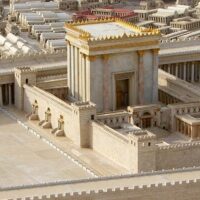
Priests, Levites, and Prophets in the Temple
The traditional priests in the Tabernacle and the Temple were from the tribe of Levi, descended from the lineage of Aaron. According to Menachem Haran[1], they formed a special class from the lineage of Phinehas (Aaron’s grandson), who received divine grace after being zealous for the Lord in the struggle against the Moabite heresy that spread among the people of Israel (Numbers 25:9). The priests mediated between the divine presence that dwelled in the Tabernacle and the Temple and the people of Israel, and through them to the rest of humanity. They were a gateway to holiness, elevated above the people, and it was impossible to have a temple without them. For this reason, they adhered to special laws of purity, dedicated their lives to the service of God, and in return were supported by the people.
According to Haran, the priests were sanctified in a way somewhat similar to the priests in the temples of Egypt and Mesopotamia. Like them, they probably engaged in hidden teachings, including techniques for connecting to the prophetic light. Many of the prophets were priests, or prophesied through their connection—whether physical or spiritual—with the Temple. For example, Jeremiah was a priest, Ezekiel was a priest, and so were others.
Traditionally, prophecy was the role of priests in the great temples of Egypt, Greece, and other cultures of the ancient world, but this was a form of prophecy whose main purpose was the revelation of the future, usually through signs and omens related to ritual. For example, in the temple of Dionysus at Perperikon in Thrace, prophecy was given by observing the smoke rising from wine poured onto a fire. In Roman temples, prophecy was based on examining the entrails of sacrifices, and so on. Hebrew prophecy, however, did not rely on omens but on a direct connection with God, which had a moral dimension. The prophets did not simply predict what was going to happen but sought to shape and guide the future as agents and messengers of God. They watched over the Hebrew nation as the pioneer of humanity in the work of repairing the world and bringing spiritual light to it.
The most famous biblical priest-prophet is Ezekiel, son of Buzi the priest, who was privileged to experience a mystical journey in his vision. Another important priest-prophet is Ishmael, a high priest who, at the end of the Second Temple period, experienced an ascent through the heavens when he entered the Holy of Holies in the Temple, and he is one of the “descenders to the chariot” (yordei merkavah). As mentioned, Jewish prophecy was directly connected to God’s intervention in world affairs, and its main purpose was moral admonition and guidance, in line with the basic Jewish concept of free will. At the same time, the prophets also foretold what was going to happen, and it is possible that they sometimes used signs. The prophetic state included mystical experiences and visions, such as Ezekiel’s merkavah vision, which could be interpreted as symbols or omens for the future. Thus, there were groups among the Jewish people, such as the Essenes, who engaged in interpreting the words of the prophets—for example, Habakkuk—as allegories relating to their own time.
Parallel to the earthly Temple, there was a celestial Temple, and the prophets had access to it. According to Michael Schwartz[2], the Hekhalot literature reflects an esoteric teaching that existed among priestly circles, and it is possible that this knowledge came from mystical experiences of encounters with higher worlds. The wise men and priests were close to the source of holiness and knew the magical names—the names of the angels. The priests served in the Temple just as the angels served in heaven, continuing the tradition of Moses, who was privileged to see on Mount Sinai the plan of the spiritual Temple and its vessels. This concept of the priesthood as possessing divine powers and secret knowledge was also shared by the Essenes, who saw themselves as continuators of the priestly tradition of the Temple. They learned the names of the angels and the secrets of plants and stones, knew the holy names, and used them as a substitute for the Temple service.
One of the most important emphases in the lives of the priests (especially during the days of the Second Temple) was to maintain purity. According to Kaufman, in the Temple there were holy dust and water, and the priests had to purify themselves before approaching the service. However, the purity was not only physical—over the years, spiritual elements were added that allowed for elevated spiritual states, mystical journeys, and prophecy.
Although some dispute this, in my understanding, the priests were also healers by the very act of purifying from impurity. It is important to note in this context that healing was an integral part of temples in ancient times. People used to come to temples to dream in special rooms and, through this, receive answers to their problems. Afterwards, rituals of exorcism and magical incantations were performed by healing priests. The very arrival at the Temple was considered a blessing and a step on the path to healing, and the offering of the sacrifice was another step that allowed for the fulfillment of wishes and requests.
The priests in the Temple in Jerusalem did not engage in healing for its own sake, and certainly not in magical medicine, which was integrated into Judaism in later periods (for example, exorcism). In general, the priesthood in Israel was different from that of other ancient peoples in that it did not engage in practical magic, including healing. However, praying to God, offering Him a sacrifice, and asking for His grace helped in the healing process, and the place to do that was the Temple.
Among the priests, the most important role was that of the High Priest, who was considered the spiritual successor of Aaron. This role was traditionally reserved for the family of Zadok. The High Priest was dressed in special garments: an ephod, a breastplate, a miter, a crown, a tunic, and an apron. On the breastplate were 12 precious stones of different types, on which were inscribed the names of the tribes. The letters that made up the names would light up when the High Priest entered the Holy of Holies to inquire about national matters, and through this, the answer of God was received. On the shoulders of the High Priest were two precious stones bearing the names of the tribes. The crown was probably a band around the head with the words: “Holy to the Lord.” The garments of the High Priest, and especially the breastplate, enabled him to be exposed to the mirror of prophecy and to reach the level of a prophet. But what did the High Priests see, and what did they feel when they stood in the Holy of Holies before the cloud? No one knows.
The priests were judges and teachers, and there is no doubt that they were involved in writing down the Torah. In fact, one of the sources of the Torah is the Priestly Source, which includes most of the book of Leviticus and parts of Genesis, Exodus, and Numbers, and it naturally focuses on religious rituals. Beyond that, it seems that the priesthood was also engaged in writing moral and prophetic literature (such as the book of Ezekiel). Therefore, it saw itself as a privileged nobility that should lead the people. The priests saw themselves, especially at the end of the First Temple period and during the Second Temple period, as superior to the civil service and the monarchy. This was expressed in the placement of the Sanhedrin meetings in the Chamber of Hewn Stone in the Temple courtyard.
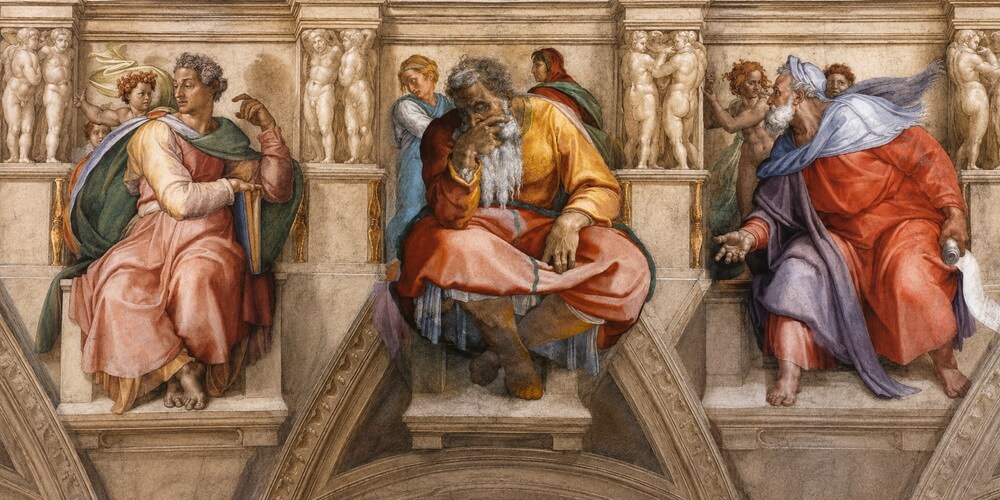
Ezekiel, Jeremiah, Isaiah from right to left
Isaiah and Hezekiah
In 727 BCE, King Hezekiah came to power, reigning for almost 30 years. He was active during a critical period, during which the Assyrians destroyed the Kingdom of Israel and threatened to conquer Jerusalem. Hezekiah carried out many building projects in Jerusalem: “And Hezekiah built towers in Jerusalem” (2 Chronicles 32:5), and he dug the Siloam Tunnel, which brought the waters of Siloam into the city. He was the greatest builder of Jerusalem and the most important religious reformer since the days of David and Solomon.
Jerusalem in the time of Solomon was a city of about 5,000 people, and its walls surrounded the City of David ridge and the Temple Mount—a narrow and elongated city that widened to the north. The areas of the Jewish Quarter, the Tyropoeon Valley, and Mount Zion were not inhabited and were not included within the walls. Over the years, the city expanded, and houses and markets were built outside the walls, as also happened in Jerusalem in the 19th century. When Hezekiah came to power, he built a thick and massive wall that included the new neighborhoods within the fortified city, as part of fortifying Jerusalem’s status and preparing it for the expected challenges. Some claim that the verse “Jerusalem that is built as a city that is united together” (Psalms 122:3) refers to this building project.
In Hezekiah’s Jerusalem, about 20,000 people lived. The strengthening of the city’s status was also connected to the rise in the status of the priests and the development of the monotheistic religious idea, represented by Isaiah, the first of the great prophets. Within this framework, Jerusalem’s status was elevated to that of a city that exists by the grace of God. The scattered centers of worship (the high places) throughout the country were weakened and partially destroyed, and the orientation of the inhabitants—including the remnants of the Kingdom of Israel—shifted toward the sanctification and elevated status of Jerusalem, which became the exclusive center. The city was privileged to be saved by a miraculous divine intervention of an angel during the Assyrian siege.
Hezekiah prepared the city for the siege, and among other things, he sealed the outlet of the water from the Gihon Spring and dug a winding tunnel to the Pool of Siloam inside the city. Some Hebrew sources condemn him for this, as he did not rely on God’s protection. Many years later, a spark from Hezekiah’s soul was reincarnated in Rabbi Haim Vital, who was asked by the Ottoman authorities to reveal the source of the water, and as a result, access to the spring was reopened. Rabbi Haim Vital and the Ari were active in the area of the Kidron Valley. The Ari identified the burial place of the prophet Zechariah son of Jehoiada, but he did not enter the area of the holy city, even though he was born in it. In his adulthood, he chose to remain in the realms of repair of the outside and not to hasten the redemption by entering Jerusalem. Only a spark of his soul was later reincarnated in the soul of the Rashash, who established a Kabbalistic yeshiva in Jerusalem itself.
The question arises as to why the Siloam Tunnel is not straight but winding. Some claim that the quarrymen followed a natural crack in the rock or did not know the correct direction, while others suggest that they sought to bypass the burial place of David and the kings of the dynasty in order not to desecrate it. In any case, it was an impressive project. The quarrying was carried out from two directions, and at the meeting point of the quarrymen, an exciting inscription—the Siloam Inscription—was found, which is now housed in a museum in Istanbul.
Hezekiah began a project of removing the high places and centralizing worship: “He removed the high places and broke the pillars and cut down the Asherah and broke in pieces the bronze serpent that Moses had made, for until those days the people of Israel had burned incense to it, and it was called Nehushtan” (2 Kings 18:4). In the end, Hezekiah did not succeed in completing the religious reform of centralizing worship in Jerusalem, and the one who completed the work was King Josiah. However, the idea of the holy, chosen status of Jerusalem emerged in his time, mainly through the prophecies of Isaiah.
In the days of Hezekiah, the idea of divine choice emerges—a historical choice that depends on the grace and will of God. God chose Jerusalem and the house of David, and through this, God became transcendent above nature. The pagan gods were connected to nature and were therefore worshiped on every hill and under every green tree. Even the God of Israel, in the beginning, appeared through a connection to the earth, and therefore it was permissible to worship Him at high places, and He had temples in other locations in Judah. As long as God appeared through creation, His dwelling place—the Tabernacle—was mobile, and He could be worshiped in local temples such as the Israelite temple in Arad and the altar in Beersheba. But from the moment God became transcendent beyond nature, He could be worshiped only in the place He had chosen (Jerusalem), and His words could be heard only through the one He had chosen (a prophet). From this, the obvious conclusion is that the high places must be removed. This idea of divine choice is also connected to something that will happen in the future—the vision of the end of days—and not necessarily to the present. The holiness of Jerusalem becomes eschatological.
Hezekiah summoned all the people of Israel to the Temple to offer the Passover sacrifice together. Until then, everyone had offered it in their place of residence. In doing so, he made Jerusalem the center of the camp of Israel, as it had been in the time of the desert, and therefore he is considered the second David. According to legend, Hezekiah tried to avoid having children because he knew (perhaps prophetically) that his offspring would be wicked. However, after he became ill, he had no choice but to fulfill the commandment to be fruitful and multiply. He married the daughter of the prophet Isaiah, which indicates the depth of the connection between them. The son who was born, Manasseh, became king and was considered a wicked ruler who brought pagan worship back to Jerusalem.
In 720 BCE, the Assyrians destroyed the Kingdom of Israel and exiled the ten tribes. The Assyrian king at the time was Sargon II. Twenty years later, his son Sennacherib made his way to Jerusalem with the intention of doing the same to the Kingdom of Judah. But thanks to Isaiah, Hezekiah, and God’s intervention, the city was saved, and its destruction was postponed for another 115 years.
However, it seemed that God was angry, and the Jews did not fully understand what He wanted: He did not want sacrifices, offerings, incense, Sabbaths, holidays, or even prayers. All He wanted was justice, doing good, right intention, and acting on behalf of orphans and widows. This is the great innovation of the prophets, which adds a dimension of active morality and universality to the Jewish religion. The Jews are meant to serve as an example for the entire world, and therefore they took upon themselves the observance of the commandments—but the spiritual and moral message is intended for all of humanity.
And so God says through His prophet: “What to me is the multitude of your sacrifices? says the Lord; I have had enough of burnt offerings of rams and the fat of well-fed beasts; I do not delight in the blood of bulls, or of lambs, or of goats” (Isaiah 1:11). God is tired of the Sabbaths, the prayers, and the holidays, and He wants something else: “Wash yourselves; make yourselves clean; remove the evil of your deeds from before my eyes; cease to do evil, learn to do good; seek justice, correct oppression; bring justice to the fatherless, plead the widow’s cause” (Isaiah 1:16–17). It seems that for this to happen, a great disaster must come—a scorching of consciousness—after which a change of perception will occur. The new Jewish religion will be universal, embracing the world. God is also the God of the nations, not only the God of Israel: “For out of Zion shall go forth the law, and the word of the Lord from Jerusalem. He shall judge between the nations, and shall decide disputes for many peoples; and they shall beat their swords into plowshares, and their spears into pruning hooks; nation shall not lift up sword against nation, neither shall they learn war anymore” (Isaiah 2:3–4).
Isaiah presents first-of-its-kind descriptions of a divine revelation to a prophet, which appear in more detail in Ezekiel. In addition, he offers utopian visions of the end of days and redemption: “It shall come to pass in the latter days that the mountain of the house of the Lord shall be established as the highest of the mountains, and shall be lifted up above the hills; and all the nations shall flow to it, and many peoples shall come, and say: ‘Come, let us go up to the mountain of the Lord, to the house of the God of Jacob, that he may teach us his ways and that we may walk in his paths'” (Isaiah 2:2–3). This vision turns Jerusalem into a heavenly ideal connected to all of humanity. And it is probably this that protects the city—for now.
His partner, King Hezekiah, takes practical steps to prepare for the disaster. He builds the Broad Wall that protects the city, mainly from the north. The remains of the wall that Hezekiah built can still be seen today inside the Jewish Quarter, where there is an exposed section of a very impressive wall, 7 meters wide and 8 meters high. On this very wall, one can imagine the prophet Isaiah standing and proclaiming to the Assyrian army besieging the city: “Therefore thus says the Lord concerning the king of Assyria: He shall not come into this city or shoot an arrow there, or come before it with a shield or cast up a siege mound against it. By the way that he came, by the same he shall return, and he shall not come into this city, declares the Lord. For I will defend this city to save it, for my own sake and for the sake of my servant David” (Isaiah 37:33–35). Near the Broad Wall is a tower, which was also probably built by Hezekiah, known as the Israelite Tower.
In addition, as mentioned, Hezekiah dug a tunnel 533 meters long, which brought water from its source in the Gihon Spring, on the side of the Kidron Valley, through the heart of the mountain to the Pool of Siloam, located in the Tyropoeon Valley within the new walls. Water was considered holy in ancient times and held great importance in purity rituals in the Temple, especially during holidays such as Sukkot. Bringing the water into the city allowed not only for the supply of water for physical survival (as cisterns could also be used, as in the War of Independence), but also for the continuation of religious life. Furthermore, the area of the original Gihon Spring became a burial ground, and diverting the water helped prevent its contamination.

Isaiah vision of Jerusalem
Josiah and Jeremiah
After the time of Isaiah and Hezekiah, two pivotal developments occurred that made Jerusalem eternal and prepared the people for the coming exile and destruction—two developments that enabled the continued existence of the Jewish people and prevented their disappearance, as had happened to the ten tribes of Israel 150 years earlier. The first was the discovery of the Book of Deuteronomy, marking the beginning of the writing of the Torah and the religious revolution of King Josiah. The second was the prophecies of Jeremiah concerning the destruction of the city and its eventual revival, which framed the catastrophe as divinely ordained—intended to lead, in time, to redemption and the emergence of a new Jerusalem, as Isaiah had prophesied.
In 639 BCE, at the age of only eight, the last great king of Judah, Josiah, came to power and reigned for 30 years. He promoted social, political, and religious reforms, but it seems that those who stood behind him—especially in the early years—were priestly circles in the Temple (such as Hilkiah the priest), and perhaps also members of the royal family who opposed the policies of the king’s father and grandfather.
Josiah’s father, Amon, was a king who was influenced by Egyptian beliefs, and his grandfather, Manasseh, promoted pagan worship—especially the worship of Ashtoreth and Asherah. An important part of these rituals was likely astrology and the worship of the stars. We know this because the Bible tells us that after Josiah came to power, he removed all the vessels intended for the worship of the heavenly host from the Temple and stopped the service of the priests who burned incense to the heavenly host: “to the sun and the moon and the planets and all the host of heaven” (2 Kings 23:5).
Josiah had a deep faith in God, and he ordered the Temple to be purified and repaired. During the work in the house, Hilkiah the priest found the Book of Deuteronomy and brought it to Shaphan the scribe, who then presented it to the king. Josiah was shocked by its contents and initiated a religious reform that purified the land of idolatry and grounded Judaism in monotheistic theological foundations. The reform was based on the book—the word of God—and this marked a significant innovation and an important step in the consolidation of the Torah, leading toward the completion of its writing and the transformation of Judaism into a religion of the book.
The book of Deuteronomy, the fifth book of the Torah which is also called Mishneh Torah, introduced a new dimension to religious work. It served as a moral authority that could be turned to at any time. At its end appears Moses’s last speech, his moral will, which emphasizes social justice. The book became a spiritual asset that the exiles took with them to exile, and together with the prophecies of doom and comfort of the prophets, it helped them survive the destruction.
Following the discovery of the Book of Deuteronomy, Josiah gathered all the people of Israel in Jerusalem for a renewed covenant with God on the holiday of Passover: “all the elders of Judah… and all the inhabitants of Jerusalem with him, and the priests and the prophets and all the people, both small and great” (2 Kings 23:2). The enthusiasm and shock spread throughout the nation, and as a result, a campaign to eliminate idolatry and centralize worship in Jerusalem began. The Asherah that was in the Temple was burned, the chariots of the sun were destroyed, the houses of the kedeshot were demolished, the foreign cultic vessels were removed from the Temple, and the high places on the Mount of Olives and elsewhere in the country were torn down.
The Jewish religion was purified of idolatry. The people were reunited around the Temple and the monarchy in a kind of new covenant, committing themselves to fulfill what was written in the Book of the Torah. The holiday of Passover served as a reminder of the nation’s miraculous beginning and the covenant at Mount Sinai. A new era began in the history of Israel. Josiah brought priests from the cities of Judah to Jerusalem, centralized worship in the city, and organized the priestly shifts in the Temple.
But worship is not everything. The Book of Deuteronomy also introduces sublime moral concepts of justice, compassion, and equality. The great prophet of the period, Jeremiah, emphasizes these values and asserts that they are the essential foundation—not the worship in the Temple. According to Eliade[3], Jeremiah dared to hope for a radical change in humanity: “I know, O Lord, that the way of man is not in himself, that it is not in man who walks to direct his steps” (Jeremiah 10:23). This change must be accompanied by a new moral and religious vision, through which an eternal covenant will be established between God and Israel: “I will give them one heart and one way, that they may fear me forever, for their own good and the good of their children after them. I will make with them an everlasting covenant, that I will not turn away from doing good to them. And I will put the fear of me in their hearts, that they may not turn from me” (Jeremiah 32:39–40). This idea is equivalent to a new creation of man.
Jeremiah recognized that Josiah’s religious reform did not address the fundamental problems of the Jewish people—and, I dare say, of the human race—and therefore he spoke out against formal worship and the reliance on the mere existence of the Temple[4]: “Do not trust in these deceptive words: ‘This is the temple of the Lord, the temple of the Lord, the temple of the Lord'” (Jeremiah 7:4). According to Menashe Dubshani[5], Jeremiah nullified the holiness of the place and emphasized the historical process—the covenant made with God at Mount Sinai, rather than the sanctity of the place itself. This way of thinking made it possible to connect with God even in exile. The new covenant would be engraved on the heart, not on tablets of stone. Jeremiah highlighted the inner, psychological, and universal meaning of the Jewish faith—a faith that is not bound by land or place, and that stretches from the past to the future, from the day of the Exodus from Egypt to the end of days.
In the time of Josiah and Jeremiah, dramatic changes took place in the Middle East—political, military, and religious. The Assyrian Empire collapsed, and in its place, a new Babylonian Empire arose, reviving the worship of Marduk and elevating him to the status of a supreme god. The Egyptians gained independence and established a new dynasty in Sais, in the Nile Delta—the burial place of Osiris. According to the earliest Greek writers, there was a spiritual school in Sais where the sacred writings of Thoth and Horus were preserved. Josiah, who found himself caught between the hammer and the anvil of two rising empires, had to choose a side. He chose the right side—but at the wrong time, or perhaps it was simply a matter of fate. Josiah became an ally of the Babylonians and fought against the Egyptians, who had come to assist the Assyrians in their rebellion against Babylon. There, he met his death at the Battle of Megiddo in 609 BCE.
Jeremiah continued to prophesy even after Josiah’s dramatic death in the Battle of Megiddo and composed lamentations in honor of the righteous king. He prophesied during the reign of the last kings of Judah, through the conquest of the land, the fall of Jerusalem, the destruction of the Temple in 586 BCE, and the Babylonian exile. Jeremiah witnessed the fulfillment of his own prophecies—the destruction of the Temple and the exile of the people. He himself was exiled to Egypt, and some of his later prophecies are messages of comfort.
Eliade brings an interesting insight in this context[6]. According to him, what the prophets do in their prophecies is transform historical events into a theophany—an appearance of divinity—and thereby overcome what he calls “the terror of history.” Historical events are determined by divine will, and historical facts are moments in which man stands before God. Within the present lies a promise for the future, and the chaos of the present heralds the redemption to come. This approach would later reappear in Lurianic Kabbalah, many centuries afterward.
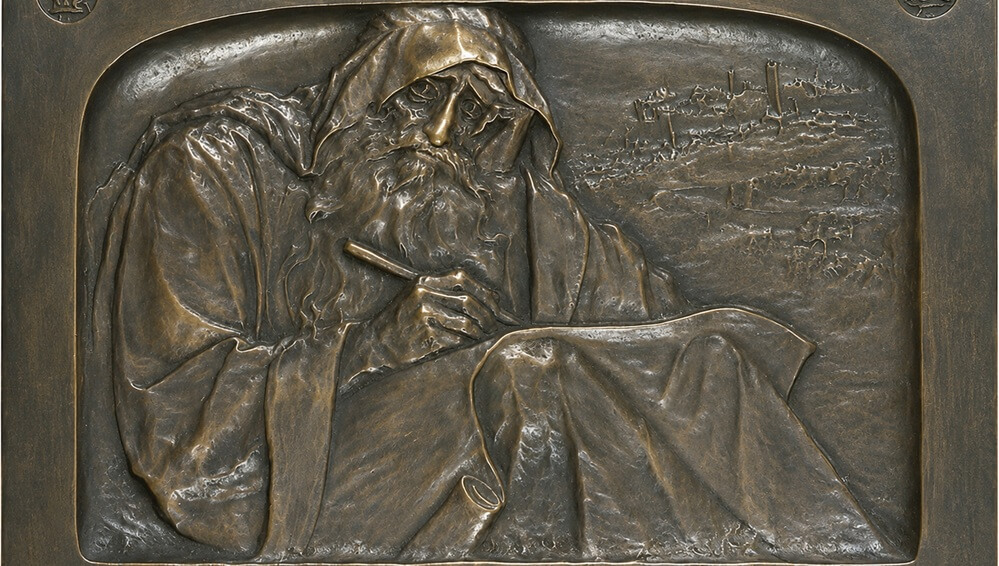
Jeremiah Boris Shatz
The Temple Becomes Heavenly
In general, the two great innovations of Judaism, compared to the religions that preceded it, were the emphasis on mysticism over magic (God is within man and has no image or form), and the emphasis on morality, which stems from the recognition that man was created in the image of God—and from it, the development of laws such as “You shall not murder.” With the appearance of the great prophets, another innovation was introduced: morality is not only found in the observance of the commandments and the keeping of the law, but is also something internal and dynamic—what can be called active morality. A person must seek ways to do good in the world, not only through observing the commandments. This concept appears in Isaiah, the first of the great prophets, who declares: “Learn to do good; seek justice, correct oppression; bring justice to the fatherless, plead the widow’s cause” (Isaiah 1:17). One must demand justice, not merely obey the laws. In the Judaism of the Mishnah, this is expressed in the saying, “Love your neighbor as yourself.” This idea leads to the development of the concept of tikkun olam (“repairing the world”), which expresses the essence of Judaism—but its roots lie in the concept of active morality found in the prophecies of Isaiah, Jeremiah, and others.
The prophets spoke out sharply against the prevailing belief among the people of Israel that sacrifices and pilgrimage to the Temple would protect them from all harm. They condemned reliance on rituals and the deification of the Temple and Jerusalem. Isaiah asserted that ritual has no value in and of itself; the emphasis must be on humanity, justice, and morality. It can be said that, according to him, there is no inherent holiness in the Temple itself—what matters is the observance of the moral laws inscribed in the Ten Commandments housed within it.
The great prophets foretold that the sins of Israel would lead to the destruction of the Temple, and that the one who would bring about its destruction would be God Himself, with the purpose of teaching the people of Israel a lesson and purifying them from their sins. As a result, another Temple would be built in the future—a more perfect Temple. Thus, the local God becomes the God of history, and the actions of the great powers are only tools in His hands to punish the people of Israel and guide them back to the right path. The future Jerusalem becomes a heavenly ideal where “nation shall not lift up sword against nation, neither shall they learn war anymore” (Isaiah 2:4).
Solomon built the Temple as “the sealing of the act of creation,” but already in his dedication blessing he acknowledges that God does not truly dwell in this house. Therefore, following the building of the Temple, an evolutionary process is required to make it heavenly, thereby returning the sacred to its natural place—within human beings. This process unfolds with the help of the great prophets of the late First Temple period: on the one hand, they prophesy the destruction of the physical house; on the other, they present a spiritual Temple—an ideal reality that will be revealed at the end of days.
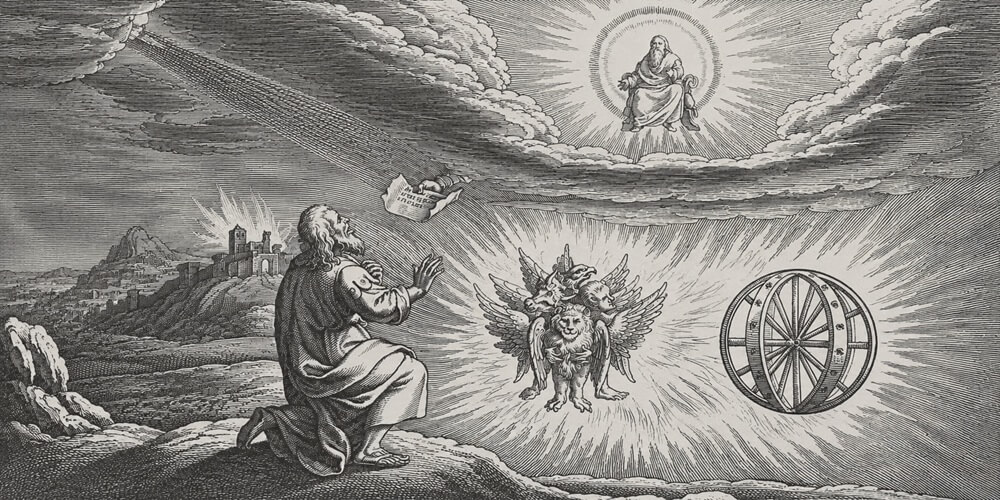
The Visions of the Prophet Ezekiel
Ezekiel, son of Buzi the priest, and Jeremiah were priests who preached a new religious and moral approach. At the end of the First Temple period, a transformation took place: from a ritualistic priesthood focused on Temple service to priest-prophets who acted as religious leaders, similar to rabbis, seeking social and personal renewal. These new priest-prophets were teachers of wisdom on the one hand, and mystics—“descenders to the chariot”—on the other. They remained connected to the Temple, yet were also freed from it through their reliance on the Torah and their understanding of the Temple as a symbol of a spiritual temple.
Ezekiel was exiled to Babylon in his youth, during the exile of Jehoiachin. It was then—while he was far from the Temple and still before its destruction in 586 BCE—that he began to prophesy, and he continued to do so for many years after the destruction. Ezekiel’s prophecies are distinguished by visions and revelations, among them the Merkavah (Chariot) Vision in chapter 1 of his book, one of the most important keys to the Jewish mystical experience. In the Merkavah Vision, the heavens open, and the prophet describes the structure of the divine worlds. But before this vision can be reached, there are three barriers that must be passed (according to the Zohar), described in verse 4: “And I looked, and behold, a stormy wind came out of the north, a great cloud, and a fire flashing forth continually.”
The cloud and the fire describe the influence of the Shekinah’s presence in the Temple on those exposed to it, while the storm represents what occurs in the heart of a person who approaches holiness. The stormy wind is connected to the first experience of holiness, when the mind is emptied of thought—for one cannot approach holiness with thought; a person must first empty himself. In this state, the natural vibrations of the soul are intensified. The state of the cloud symbolizes the stage in which all thoughts are silenced and suppressed outside of consciousness, creating a kind of opacity in awareness. In this condition, one cannot see or experience anything directly, yet it is possible to feel God and hear His words. This may be related to the thick cloud that filled the inner sanctuary. The flashing fire symbolizes the encounter with the world of energies, which can sometimes lead to a sensory overload that is difficult to endure. It represents the spiritual light and the presence of the glory of God between the two cherubim above the Ark of the Covenant.
Ezekiel’s innovation lies in the experience of the divine worlds through vision rather than through a visit to the physical Temple, opening the way for the existence of a heavenly Temple. The Temple was largely replaced by the concept of the divine pleroma of forces, envisioned as a chariot, as described in Ezekiel’s vision with all its parts. To this, the mystics of the late Second Temple period added descriptions drawn from biblical literature: the angels who proclaim kadosh (holy) before God, the visions of Daniel, passages from the Psalms, and more. From all this was woven a wondrous and mysterious vision of the upper world, at the center of which stands the Chariot. Above it is the Throne of Glory, upon which God sits, and around Him are camps of angels—some with appointed roles, and others whose sole purpose is to praise and sing before Him. This vision largely replaced the physical Temple as the spiritual experience to be aspired to, offering a new possibility of connection with God.
The Temple inspired those who remained in its courtyards and chambers, and it is possible that this is why many of the prophets were priests. Yet the ability to prophesy continued even when they were far from the Temple, and even after its destruction—Ezekiel being a prime example. For him, the external Temple became the ideal of a spiritual Temple existing in higher worlds. Thus, he prophesied about the rebuilding of the Second Temple (or the Third, depending on interpretation), described the structure of the divine worlds in the Merkavah vision, and foretold the resurrection of the dead in the vision of the dry bones.
According to Urbach[7], Ezekiel differs from the other prophets: he prophesies in prose, whereas for the others the poetic weight is central. With the other prophets, the visions are realistic and accompanied by interpretation, while with Ezekiel the visions are fantastic, as if drawn from another dimension. For most of the prophets ritual is not important, but for Ezekiel—who prophesied in a foreign land at a time when there was no Temple—ritual retains significance. At the same time, the revival of Israel and the rebuilding of the Temple are presented in a universal context.
According to Eliade[8], Ezekiel addresses the individual more than any other prophet. The presence of God is not limited by place or time but depends on the inner life of the person and his conduct toward others. The importance of the individual is also expressed in the vision of the dry bones, which offers the first hint of life after death. Ezekiel prophesies about a new covenant with the divinity (the Shekinah), a new heart, and a new spirit. He was probably influenced by the Zoroastrian religion that was emerging in the East at this time. However, Ezekiel’s ascent to heaven in the Merkavah vision was likely influenced by Babylonian astrological teachings.
References
[1] Haran, M. (1978). Temples and Temple-Service in Ancient Israel: An Inquiry into the Character of Cult Phenomena and the Historical Setting of the Priestly School. Oxford: Clarendon Press
[2] Schwartz, M. (1999). The conceptual world of Hekhalot literature and early Jewish mysticism. Jerusalem: Magnes Press. (Hebrew)
[3] Eliade, History of Beliefs, Vol. 1, p. 319. (Hebrew)
[4] Some say he is the man who hid the Ark of the Covenant under the Temple courtyards, and since his days the Ark has disappeared and is no longer mentioned in the Bible. Others say that Solomon, who was the wisest of men, prepared tunnels in advance inside the Temple Mount and the Ark was hidden there, waiting until this very day.
[5] Menashe Dubshani. (1970). “The Holiness of Place and Time in the Prophecy of Jeremiah,” Journal for the Study of the Bible and its World, Issue 4 (43), pp. 441-448.
[6] Eliade, History of Beliefs, Vol. 1, p. 324. (Hebrew)
[7] Urbach, E. E. (1960). The Sages: Their Concepts and Beliefs. Jerusalem: The Magnes Press, The Hebrew University. pp. 240-248.
[8] Eliade, M. (1978). A History of Religious Ideas, Vol. 1: From the Stone Age to the Eleusinian Mysteries. Chicago: University of Chicago Press. p. 322.