Freemasons and the Jerusalem Temple
The Freemasons are a very important international order that has been involved, since its appearance on the stage of history in the 17th century, in many of the world’s political and cultural events, such as the French Revolution, the American Revolution, the liberation of South American countries, and more. Many important people were associated with the Freemasons, who claim to continue the spiritual teaching of Solomon, Hiram Abiff, and the builders of the Temple, and to have much more ancient roots [1].
According to books of the Free masons, before the flood there lived a man named Lamech, and he had two wives, Ada and Zillah. From his first wife were born Yavel, who was the father of the science of geometry, and Yuval, who was the father of the science of music. His second wife gave birth to Tubal Cain, who was the father of craft, who worked every kind of wood, gold, silver, copper, iron, and steel, and the daughter Naamah, who was the mother of the art of weaving. The children knew that God would avenge the sin of humanity with fire or water, so they wrote down the sciences they discovered on two columns that could be found after the flood. One was a column made of clay so that it would not burn in the fire, and the other was a column of copper so that it would not sink in the water [2].
In the end, the one who survived the flood was Lamech’s other son Noah. Noah had a grandson named Hermarins, who later became known as Hermes. He found one of these pillars and discovered the science written on it. After delving into it, he began to teach the hidden knowledge, initially to the people of Mesopotamia under the leadership of King Nimrod. Thus, when the city of Nineveh was about to be built, Nimrod sent sixty builders to it and commanded them to be faithful to one another, to live together in faithful love, and to serve their Lord in faith. This was the first Masonic association (lodge).

When Abraham descended into Egypt, he brought with him the secret knowledge from Mesopotamia and taught the Egyptians the seven sciences. He had a student named Euclid (active in the 3rd century BC but according to Masonic legend much earlier), who taught the science of geometry, stonework, and the doctrine of morality. The students created a society that built the magnificent Egyptian buildings, including the pyramids, which are a Masonic symbol. Indeed, according to the Freemasons, when the obelisk called “Cleopatra’s Needle” was removed from Heliopolis in 1878 and transferred to the United States, all the symbolic tools of the masons were found in its foundations: fieldstone and ashlar from white limestone quarried in Aswan, an iron lime spoon, a lead plumb line, compasses, and a hieroglyphic inscription containing the word “temple.”
Masonic knowledge passed from Egypt to Solomon both directly and indirectly. According to a Freemason named Ramsey, who wrote a book on Freemasonry [3], the builders of the pyramids and temples in Egypt were great magicians and advanced scientists, who expressed in their structures the dimensions of the earth, the structure of the universe and man, and created an environment that supported human development. Their advanced knowledge passed from Egypt to the Phoenicians and from there to the builders of the Temple in Jerusalem. Hiram, King of Tyre, sent Hiram Abiff, who was a Master of the Freemasons, to Solomon, and together with Solomon they became the grandmasters of the Freemasons of their time.
And so it is written in 1 Kings 7:13-14: “King Solomon sent to Tyre and brought Huram, whose mother was a widow from the tribe of Naphtali and whose father was from Tyre and a skilled craftsman in bronze. Huram was filled with wisdom, with understanding and with knowledge to do all kinds of bronze work. He came to King Solomon and did all the work assigned to him.”
And in 2 Chronicles 2:12–14 Hiram king of Tyre is saying thus: “Praise be to the Lord, the God of Israel, who made heaven and earth! He has given King David a wise son, endowed with intelligence and discernment, who will build a temple for the Lord and a palace for himself. “I am sending you Huram-Abi, a man of great skill, whose mother was from Dan and whose father was from Tyre. He is trained to work in gold and silver, bronze and iron, stone and wood, and with purple and blue and crimson yarn and fine linen. He is experienced in all kinds of engraving and can execute any design given to him. He will work with your skilled workers and with those of my lord, David your father.”
The Bible is sparing in its descriptions of Hiram abiff, but the Freemasons develop an entire mythology around his figure. The story, as it appears in the Masonic lodges, tells of Hiram Abiff or Adoniram – Lord Hiram, Abiff meaning father. A master builder who was an expert in the secrets of sacred architecture: number, shape, measure, and their application through geometry and architecture. He directed the project of building the Temple and incorporated the knowledge of the spiritual worlds into the dimensions, shape, materials, and design of the Temple.
Solomon recruited 40,000 men to build the Temple, some from other countries. The builders of the Temple were free men organized into three groups: apprentices, workers, and masters. Each group was exposed to secret knowledge according to its rank, and the knowledge served as a tool for personal development. Due to the large number of builders, Hiram Abiff did not know them all personally, so each rank was given a password: the apprentices received the word “Boaz,” the workers received “Jachin,” and the masters, at least initially, the word “Yahweh.” Each word was accompanied by a specific sign or hand position and a unique handshake. When the salaries were distributed, each worker presented the password, symbol, and sign appropriate to his rank, and received his salary.
However, one day Hiram Abiff was attacked by three workers who demanded that he reveal the password of the masters. One of them hit him on the head with a hammer, the second on the temple with a crowbar, and the third on the other temple with a flail. Hiram Abiff died, but the story should not be taken literally; it contains within it the secrets of the initiation ceremony into the higher degrees of the Freemasons that involve ritual death to the old self in order to get reborn as a divine child. The building tools are symbols for the construction of man and the social temple. Just as Solomon built a temple for God, so each person must build himself as a temple for the God within him, and society must build itself as a temple for humanity.
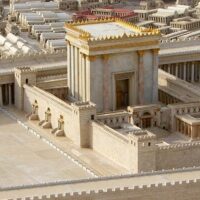
The knowledge of Freemasonry was preserved in the guilds of masons, who spread throughout the world and helped to build the magnificent buildings of antiquity. Almost a thousand years had passed since the construction of Solomon’s Temple, and guilds of Freemasons reconvened in Jerusalem to help build Herod’s Temple.
According to the Freemasons, Freemasonry played an important role in the Roman Empire. As early as 700 BC, professional guilds of masons existed in Rome, which were recognized and granted the status of free artisan guilds by the Roman king Numa Pompilius, the second king of Rome after the legendary king Romulus. In addition, the Roman army was involved in building projects and incorporated the teachings of the sun god Mithras, which were widespread in its ranks. The mysteries of Mithraism contained elements of the teachings of Freemasonry. This suited the soldiers who built the temples, roads, and public buildings in times of peace.
Architecture was considered the queen of the arts and sciences in Rome, and to become an architect one also had to study philosophy. Vitruvius, the architect of the Roman army during the reign of Augustus, describes in his book on architecture the principles for building temples, which were supposed to represent the relationships within them of the human body. A school of sacred architecture was established near Lake Como, and from there came a master named Mamercus Gracchus, who participated in the construction of Herod’s Temple.

Symbols in Freemasonry
Freemasons hold their ceremonies in specially designed halls, which contain elements of the Temple. In the center of the hall is a table with holy books and building tools. On the east side, which is the direction of sunrise, sits the president of the lodge. Towards the east (or at the entrance) are two pillars, one of which represents the sun and the other the moon. They are called Jachin and Boaz, and represent the two pillars that were at the entrance to the Temple. According to the Bible, the one who created these copper pillars is Hiram Abiff: “He erected the pillars at the portico of the temple. The pillar to the south he named Jakin and the one to the north Boaz” (1 Kings 7:21)
Many temples in the ancient world had two columns at the entrance. Sometimes these columns were replaced by two obelisks or two statues. The columns represented the creation of the world and the principle of duality that governs it. In Egypt, these were a column with a papyrus capital representing Upper Egypt and a column with a lotus capital representing Lower Egypt, or two obelisks and pylons at the entrance to the temple. In Greece and Rome, these were Ionic columns representing the feminine element and Doric columns representing the masculine element.
Rashi interpreted the columns Jachin and Boaz in the Temple as representing the moon and the sun, and this interpretation also appears among the Freemasons. The columns are present in the ceremonial hall with a solar globe on one of them and a moon on the other. The participants in the ceremonies pass between them in ceremonial processions, dressed in their costumes and carrying vessels as they face east. In principle, the sun symbolizes strength, clarity, and permanence, while the moon represents weakness, change, and delicacy. In the construction of the Temple of Life, both are needed.
Boaz and Jachin are also pillars of memory: one symbolizes good memories and the other bad memories. According to tradition, inside the pillars made of hollow copper are the writings of the brotherhood. The role of the apprentice (artisan) in the second stage of the work is to awaken the memories within him and organize them. By bringing them to his awareness, the student reduces their power. Only after this process is complete is a person given the ability to truly choose – between good and evil, between the pleasant and the unpleasant. The apprentice cannot ascend the steps of “Jacob’s Ladder” and reach the inner part of his personal temple, which is the third stage of the work, until he reduces the power of his memories, passing between the two as Odysseus passed between the monster Scylla and the whirlpool Charybdis in the Odyssey.
Members of the Masonic lodge wear masonry aprons, gloves, sashes, hats, and symbols, according to their rank. The three ranks of Masonry are Apprentice, Artisan, and Master, and the three virtues associated with them are Faith, Hope, and Charity. In Solomon’s Temple there were three levels: the ground floor, the middle room, and the Holy of Holies. These three levels are the basis for the three ranks of Freemasonry, the three systems of symbols, and the three levels of awareness [4].
In operative Freemasonry, the apprentice worked on polishing the fieldstone with the awl, the mallet, and the chisel, to shape it into the correct form as a hewn stone. The master builder assembled and connected the polished stones in their correct place in the building using a protractor, a level, and a plumb line. The master mason spread cement between the stones with a mason’s trowel to connect and strengthen them, after checking the accuracy of the workmanship and finding the stones worthy of their certificate.
The level, used to measure horizontal areas on the ground, symbolizes the degree of equality between all humans, who were all created in the image of God. Equality is also the idea of justice and the motivation to join others in the effort to create a better society.
The plumb line, pointing upward, symbolizes the idea of nobility – our aspiration to ascend and develop our minds and spirits. The Holy Book opens in the Friends’ Chamber in chapter 7 of the prophet Amos, which states: “This is what he showed me: The Lord was standing by a wall that had been built true to plumb, with a plumb line in his hand. And the Lord asked me, “What do you see, Amos?” (Amos 7:7–8).
By connecting the vertical plumb line to the balanced level, an angle is created, which is the harmonious fusion of two factors that would otherwise be opposite and contradictory to each other. The moral lesson that follows from this is: just as the plumb line and the level come together to create the angle, so people with different personalities and opposing views must become one community, in order to create a fruitful and blessed equilibrium.
The mason’s trowel is a special tool of the Master Mason’s rank and symbolizes his moral role in spreading the cement of brotherhood and goodwill among the brothers. A similar trowel can be seen in the Augusta Victoria Church on Mount Scopus, a testament to the important role of the Freemasons in its construction, (more on that later).
The first goal of every Freemason is to give birth to and reach the light of knowledge in his heart, which will guide him in his steps in life. Freemasons are called sons of light, but this is not a physical light. There is a sun, and there is a light that is beyond the sun – a spiritual light, a divine act that is good. The three great lights of Freemasonry are the Holy Book, the square, and the compasses.
The book is given as a teacher and guide in our faith (it could be the Quran, the Torah, the New Testament, or another holy book). The book symbolizes the divine, the great architect of the universe; it is orientation, direction, purpose, and destiny. The square is used to measure our actions at a right angle, and the compasses is used to delimit our domains, our desires, and passions in our relationships with all people, our moral boundaries, and the scope of our activities in the world. The compasses is the spirit, the psyche, and the square is our integrity and place in the world, our form and social role, how we appear to the outside world.
One of the geometric symbols that the compasses creates is a point inside a circle. If you add two straight lines on both sides you get a Masonic symbol that expresses the duality within which we operate. The two lines symbolize Moses and Solomon, or, if you like, divine wisdom. The same wisdom that allowed Solomon and Hiram to build the Temple is the same wisdom that reveals the secrets of the universe and the meaning of life, and it is the one that should guide us in our lives. In this case, the point inside the circle becomes a symbol of awareness, with the person being the point in the center. In order to focus, he needs the two lines on the circumference of the circle; otherwise, he will scatter in all directions.
Students of Freemasonry must serve their masters with freedom, diligence, and faithfulness, which are implied by chalk, charcoal, and clay. There is nothing freer than chalk, nothing more diligent than charcoal, which, when properly burned, will subdue the hardest metal, and nothing more faithful than clay, which represents the earth, which, though always disturbed, does not withhold from man the greatest good.
An important symbol in Freemasonry is the all-seeing eye. It is found on the wall of the lodge and also on the dollar bill. “The sword drawn into an exposed heart will prove that justice will overtake us sooner or later. And if our thoughts and actions can be hidden from human eyes, then the watchful eye, at whose command the sun, moon, and stars are moved, and under whose supervision even the comets turn in their orbits, examines the kidneys and hearts and rewards each person according to his or her merit, and the fruits of our deeds will be done to us.”
In Freemasonry, numbers have symbolic importance, and in some lodges even letters. The number seven is considered unique from an arithmetic and geometric point of view, since the ancient Greeks were able to create any polyhedron with the help of compasses, but failed in their efforts to construct the seven-sided heptagon. There are seven virtues to which one should aspire: temperance, courage, prudence, justice, faith, hope, and charity. And seven sciences that one should study: grammar, logic, rhetoric, arithmetic, geometry, art, and music [5].
The number three is associated with three steps on the path to holiness, three parts of the Temple, three levels of construction. And also with the holy bible we have tripartite division – Torah, Prophets, Writings, given in third month –Iyar (after Nisan and Sivan), by the third person –Moses (brother of Aaron and Miriam), a member of the third tribe –Levi (after Reuben and Shimon). To the triple people – priests, Levites, Israel.
In Ezekiel’s vision, the prophet sees the ministering angels with three pairs of wings shouting in honor of their Creator – Holy, Holy, Holy – and this is a Masonic symbol that appears on the facade of the YMCA tower, which was designed by a Freemason, (more on this later).

masonic grand lodge
Footnotes
[1] Snoek, J. A., & Bodgan, H. (2014). The History of Freemasonry. Handbook of Freemasonry.
[2] Stevenson, D. (2005). The origins of freemasonry. Cambridge University Press.
[3] Ramsay, A. M. (1749). The Philosophical Principles of Natural and Revealed Religion, Unfolded in a Geometrical Order, by the Chevalier Ramsay,.. (Vol. 2). Knapton.
[4] Anderson, J., & Franklin, B. (2008). The Constitutions of the Free-masons. Lulu. com.
[5] Stavish, M. (2007). Freemasonry: Rituals, Symbols & History of the Secret Society. Llewellyn Worldwide.