Temple Sacred Music
Sacred singing and music have accompanied human religious worship since the hunter-gatherer period. Many of the caves where early man lived have special acoustic properties, and this may have been the reason why he chose them. Studies[1] have shown that the places in the caves where relatively more rock paintings appear are the places with the best acoustics. The voice and singing were among the best means to connect with the energies of Mother Earth, and so we find musical instruments already with the appearance of Homo Sapians 30,000 years ago. Proof of the existence of sacred singing among early man is found in the sacred singing tradition of societies that still live as hunter-gatherers, such as the Aborigines in Australia.
The settlement of villages and the beginning of agriculture 10,000 years ago was accompanied by a tradition of sacred music and dancing, and with the beginning of history 5,550 years ago in Sumer and Egypt, we find a tradition of sacred Music in the temples of Sumer in Mesopotamia by priests called Kalu, and in the temples of Egypt sacred singing and dancing by priestesses of Hathor. The singing of hymns and prayers in Sumer was accompanied by musical instruments, the most important of which was the Lilissu Drum. The purpose of music and singing was, among other things, to appease the hearts of the great gods. The musicians underwent a kind of initiation that lasted three years, and the higher ranks required additional long periods of study and training. Some researchers today claim to have succeeded in reconstructing the ancient Mesopotamian temple singing and music, which is quite amazing and raises hope that it will be possible one day to reconstruct the singing and music of the Levites in the Temple.
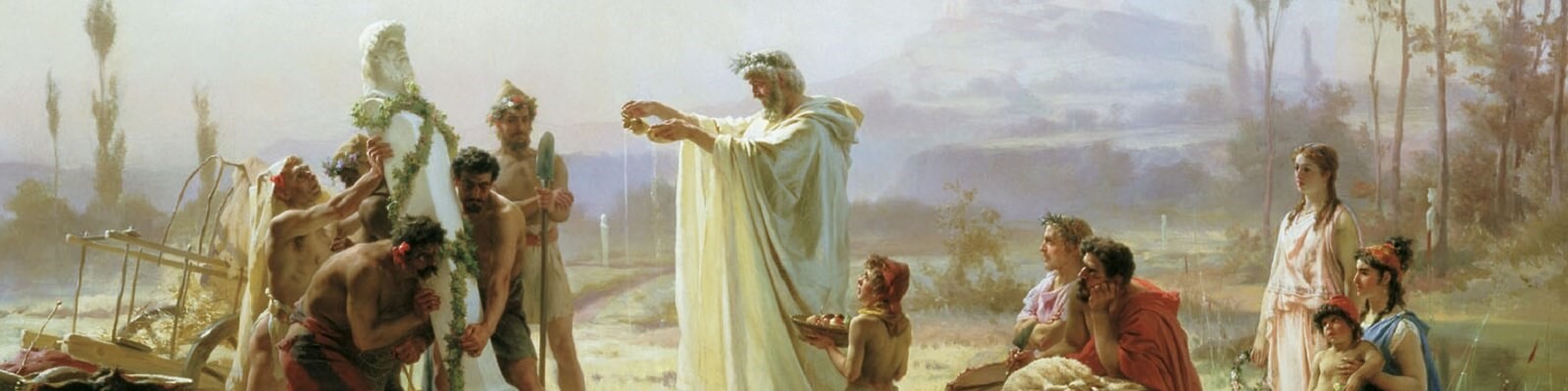
In ancient Greece, there was a tradition and school of sacred Orphic music, named after Orpheus, the legendary mythological musician who descended into Hades to rescue his beloved. One of the students of this school was Pythagoras, who studied the subject of musical intervals and their connection to mathematics and geometry. He discovered that when the length of a string is shortened by half, there is a jump of an octave. Pythagoras claimed that the seven visible celestial bodies moving in the sky each produce a musical frequency determined by the speed of their movement. He called it “the music of the Spheres.” Everything vibrates, and the basic laws that govern our world correlate to the seven vibrations of the seven heavenly bodies that are seen moving on the background of the starry night sky. Pythagoras established a connection between sound and geometry. Some say that he created the musical scale – the chords and octaves – according to the structure of the invisible worlds.
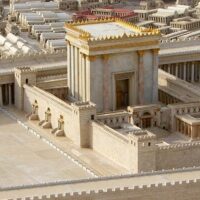
One of the fascinating spiritual traditions in Jerusalem is sacred singing and music, which played a central role in the Temple, and those who were involved in it were the Levites. They were responsible for everything that supported the work of worship, including preparing the altar for the burnt offering, guarding it, and cleaning it. But the highlight of their role was playing and singing during worship, and especially during the offering of sacrifices, when each day had its own song. The songs were chapters from the Psalms that were interwoven with fixed idioms and were accompanied by bowing. The songs and melodies helped raise the intentions of the sacrificers to heaven, to lift the spirits of the people. In addition, the singing imitated the singing of the angels around the throne of glory, with the help of singing like that practiced on the Sabbath day, the Practitioners of Merkavah ascended into the Heavenly temple.

The musicians and singers slept in a special chamber in the courtyards of the Temple. At dawn, they would rise, prepare themselves, and line up on special stands in the courtyard, facing the altar, holding cymbals, trumpets, harps, violins, and on special occasions, flutes. While the priest at the altar of burnt offering poured out the wine offering, another priest would raise a handkerchief, which was a signal for the Levites to blow trumpets, ring bells, play instruments, and sing psalms. During breaks in the singing, the trumpets would blow again, and the people watching the ceremony would bow before the Temple and pray the “Shema Yisrael” prayer.
The recitation of the “Shema Yisrael” prayer at dawn had great importance, and in order to understand it, let us look for a moment at the wording of the prayer as it appears in the Torah: ” Hear, O Israel: The Lord our God, the Lord is one. Love the Lord your God with all your heart and with all your soul and with all your strength. These commandments that I give you today are to be on your hearts. Impress them on your children. Talk about them when you sit at home and when you walk along the road, when you lie down and when you get up. Tie them as symbols on your hands and bind them on your foreheads. Write them on the doorframes of your houses and on your gates.” (Deuteronomy 6:4–9).
The secret of prayer is that it reconnects the soul with the body after they were separated during sleep at night. The connection is made by moving over different parts of the body that relate to verses from the prayer: “Hear” – refers to the head, “with all your heart ” – refers to the chest, “Impress them on your children” – refers to the stomach and the loins, “when you sit at home and when you walk” – refers to the feet. It should be remembered that the Temple symbolized “Adam Kadmon” lying on the east-west axis, his head towards the Holy of Holies and his feet towards the Mount of Olives – the place of sunrise.
The musical instruments, like everything else in the Temple, had a magical effect but also a symbolic meaning: the harp had 22 strings that symbolized the 22 letters of the Hebrew alphabet, the lyre had ten strings that probably symbolized the ten sephirot. Flutes were only played on holidays, and trumpets were blown on special days associated with spiritual awakening. Some claim that those who played and sang were not only Levites but also priests and dignitaries of Israel. On special days there was a choir and a very large orchestra that could include up to six harps, 12 flutes, 120 trumpets, dozens of violins, but only one gong (probably cymbals).
The tradition of sacred singing and music began in the days of King David and is not a commandment of the Torah. David, as is well known, played the harp when the Holy Spirit descended upon him and succeeded in quieting the evil spirit of Saul. David is the sweetest of Israel’s singers and the author of the Psalms that were used in the singing of the Levites.
According to Itamar Greenwald[2], in apocalyptic literature we find the idea of angels singing to God, both in the Bible and in Extracanonical Literature. In Isaiah 6:1–3 it is said: “I saw the Lord, high and exalted, seated on a throne; and the train of his robe filled the temple. Above him were seraphim, each with six wings: With two wings they covered their faces, with two they covered their feet, and with two they were flying. And they were calling to one another: “Holy, holy, holy is the Lord Almighty; the whole earth is full of his glory.” Usually in the Bible there is a double reading like “Go forth from your land,” but we almost never have a triple repetition, so there is some spiritual intention here, perhaps poetic.
In the Book of Tobit, the entourage of the angels sings praises to God. In the Apocalypse of Abraham, he ascends to heaven and the angel sings a song, which Abraham must repeat, and which is supposed to help him overcome his fear. The song has magical theological (divine) qualities and is sung by a man who imitates the angels in his singing.
In Revelation 4, four six-winged creatures sing a song day and night: “Holy, holy, holy is the Lord God Almighty, who was and is and is to come.” The song of the angels is sung in the morning at sunrise, and is also a song of praise to creation. It is usually vocal singing, and is rarely accompanied by musical instruments. There are indeed violins that please God, but it is not the angels who play them, but the twenty-four elders who appear in the vision in addition to the angels. In this regard, the angels are similar to the Levites, whose singing was vocal. Although the Levites played various musical instruments, the main work was singing during the pouring of wine. At first, they would play instruments, and then vocal praise to God began.
According to Greenwald, singing was not recitation but melody. Thus it is written in the Hekhalot Rabbati 2:4: “Praise and song of every day, a scroll and a hymn of times and times, from the logic that proceeds from the mouth of the saints, and from the melody that increases from the mouth of the servants…” Not only do the angels praise God but also the throne of glory.
Hekhalot Rabbati II mention the figure of King David, who was known for his music of the Holy Spirit, and also a dance that the animals and angels would dance during the singing of the Levites. Other traditions claim that there are musical instruments in heaven and they play while Israel prays and say the word – holy. The angels sing incessantly and are always awake, but on the other hand, they sing in parallel with the prayer of Israel below. Singing, therefore, helped in the ascent to the Hekhalot and brought about an encounter with God.
Three prayers a day correspond to three times of a ceremony that takes place in heaven, and to the trinity of holiness, at which time God descends to the throne of honor in the seventh heaven and there is a connection between the worlds. God is usually above the creatures, and only at the hour of good will does he descend to the throne of honor, like a king receiving his visitors. Therefore, the ascent in the chariot and the singing should be directed to this time. This may be the explanation for the flavors present in the prayer and the melodies that accompany it.
At the same time, Yehezkel Kaufman argues that, unlike other ancient temples, the Temple of Israel was a temple of silence, without speech. As it is said in 1 Kings 19:11–12). “Then a great and powerful wind tore the mountains apart and shattered the rocks before the Lord, but the Lord was not in the wind. After the wind there was an earthquake, but the Lord was not in the earthquake. After the earthquake came a fire, but the Lord was not in the fire. And after the fire came a gentle whisper.” He points out that there are hymns for the Levites but no hymns for the priests, and emphasizes that there is singing and music outside the Temple but not inside it.
In any case, the tradition of sacred singing passed from the Levites in the Temple to some of the early Christian communities, Monophysite communities such as the Syrians or the Armenians, who claimed that the melodies of their liturgical songs continue the Levitical singing of the Temple (written by holy men in the 3rd–4th centuries AD).
The Ethiopians also have a special sacred singing tradition that we will expand on later, and the major denominations in the land, the Greek Orthodox and Greek Catholics, also have a tradition of sacred singing. In fact, the Orthodox monks on Mount Athos sing at night the lullaby that Mary sang to the infant Jesus, which contains the formula: Tri-ram, Tri-ram, Tri-ram… somewhat similar to the Hindu Hare Krishna.
Notes
[1] Fazenda, Bruno, et al. “Cave acoustics in prehistory: Exploring the association of Palaeolithic visual motifs and acoustic response.” The Journal of the Acoustical Society of America 142.3 (2017): 1332–1349.
[2] Itamar Greenwald, Angels, Holiness and the Problem of the Synthesis of the Temple Literature, from Chapters in the History of Jerusalem in the Second Temple Period, Yad Ben Zvi.