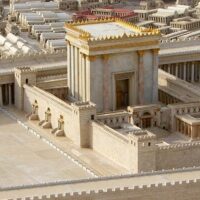
The First Temple
The Temple in Jerusalem was the center of Jewish life for a thousand years, and most of the commandments in the Torah refer to the Temple. To this day, we pray three times a day in the direction of Jerusalem as a substitute for the sacrificial service in the Temple. The holidays we celebrate are mostly related to the Temple, and so on. The Temple was the holiest place in the world for the Jewish people, even though Judaism is supposedly not meant to sanctify a place and opposed the temples of Egypt and the idolatry of the ancient world.
It is a bit difficult to admit, but in many respects (though not all), the Temple in Jerusalem continues the tradition of other temples in the ancient world. It was built two thousand years after the construction of huge temples began in Egypt, where the largest temple complex in the world was located in Karnak, and even more years after the building of temples began in Mesopotamia, from which Abraham came. In Babylon, there was a huge temple complex to Marduk that included the Hanging Gardens and was seen as a reflection of the heavens. In both Egypt and Mesopotamia, the temple marked the place of creation. But not only in distant places—closer to Israel, in Tyre, there was a large temple to Melqart; and also in the Land of Israel, in Megiddo, two thousand years before the Temple in Jerusalem, there was a much larger temple [1].
The Jewish Temple existed for more than a thousand years, with a short interruption of sixty years in the middle (the Babylonian exile). Throughout this long period, a divine energy called the Shekinah was present in a building made of wood and stone in Jerusalem. This was a very physical presence that caused wonderful things to happen and blessed the land with its influence. At that time, Judaism was not a purely abstract monotheistic religion as it is today—that is, a religion whose worship is focused on the moral observance of commandments, prayer, and study—but a real divine presence dwelling in a house made of wood, metal, and stone, that communicated with human beings through priests who served in the holy place, prophets, men of wisdom, sacrificial service, and pilgrimage.
Temples of other cultures in the ancient world, such as those in Egypt or Sumer, also claimed a divine presence that communicated with human beings. They too had priests who served in the holy place, prophets and men of wisdom, sacrificial service, and traditions of pilgrimage. So what was the difference? In the Jewish Temple, there were no statues of gods, unless we choose to see the cherubim on the Ark of the Covenant as such. In the Jewish Temple, there was one Holy of Holies and not several, as in Egypt, dedicated to different gods. The Temple was a solitary temple and not part of a system of temples. Avigdor Aptowitzer claims that the Temple was a temple of silence[2], meaning that inside it there was no singing or prayer. The presence of God was in the form of a cloud, or as the Bible describes it: z’vul (“a lofty habitation”) or arafel (“thick cloud”). In other words, inside the Temple there was “the eye of the storm,” a point of quiet in contrast to the hustle and bustle and activity outside it
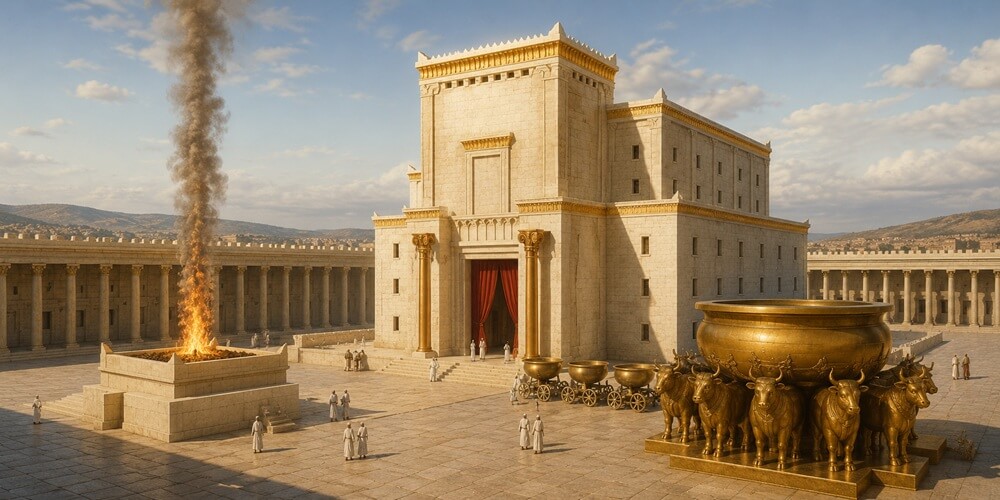
First Temple Jerusalem
The Completion of the Act of Creation
The event at Mount Sinai resulted in the divine appearing in this world, which looked like a pillar of cloud by day and a pillar of fire by night, and its anchor was the Tabernacle. This was a huge breakthrough, as the door was opened for communication between the divine and the human race. However, according to the biblical text, the cloud was over the Tabernacle, and inside the Tabernacle there was only the glory of God, meaning the revelation was not complete. Four hundred and eighty years passed until a more complete appearance of the divinity in the material world became possible, when the cloud came to dwell inside the house—something that was possible only with the building of the Temple in Jerusalem. The building of the Temple was the completion of the historical repair process that began at Mount Sinai, and in a deeper sense, the completion and sealing of the creation process. Therefore, the Temple was built in the place where the creation of the world began—the Foundation Rock.
The connection between the building of the Temple and the completion of the creation process can be understood as follows: the natural world is not an ideal environment for the crown of creation—man. The changes of cold and heat, wind and rain, the scorching sun and wild animals—all these are not friendly to man, and therefore he builds houses in which he can dwell under safer and more protected conditions than in the wild. Human beings improve nature and thus participate in the act of creation, creating a “sanctified” environment that allows them to develop and fulfill their role in the world. This is one of the things that distinguishes us as human beings—the ability to improve and add to creation.
Similarly, it seems that the world is not ideal for the dwelling of the divinity either, and it too needs a house to be built for it, in which it can dwell securely. When the building of the Temple was completed, the cloud that had been over the Tabernacle moved to dwell inside it, together with the glory of God, and in doing so, it was able to fulfill its role: “And when the priests came out of the holy place, the cloud filled the house of the Lord, so that the priests could not stand to minister because of the cloud, for the glory of the Lord filled the house of the Lord” (1 Kings 8:11). And by this, the act of creation was completed. As strange as it may sound, the Temple allowed the divinity to fulfill its role—to spread spiritual light in the world.
In the process of building the Temple, the opposite of what happened in the Tabernacle took place: first, they built the structure, brought in the vessels, arranged the courtyard, and worked with pure intention and systematically. Only then did God respond—this is the magical act. The action of the people of Israel under the leadership of Solomon constituted a summoning of higher forces, and the revelation of holiness was accomplished from the bottom up, which made the revelation more permanent and stronger than that of the Tabernacle, where the revelation was from the top down—the cloud appeared on the mountain and guided the people of Israel as to what needed to be done. In the Temple, on the other hand, the cloud entered the house only after everything was completed—the structure, the vessels, the preparations—and the right prayers and sacrifices were done.
The Temple that Solomon built was the completion of the creation process in that the spiritual light filled it from within, as expressed in the verse: “Then Solomon said, ‘The Lord has said that he would dwell in thick darkness. I have surely built you a house of dwelling, a place for you to dwell in forever’” (1 Kings 8:12). The “thick darkness” is the “darkness over the face of the deep” from the first day of creation, and the darkness turns into light with the appearance of the divinity. The Temple was the place where creation took place anew continually, and its windows—“closed, transparent”—allowed both physical light to enter and spiritual light to be transmitted outward.
The essence of the Temple as containing the spiritual light and connecting to the primordial state of the universe and the state of man in Paradise is expressed in the prohibition against bringing a corpse into the courtyard. The Temple was perceived as the land of eternal souls, a place where it was possible to return to a state of eternal life, as in Paradise. The building of the Temple marked the closing of the circle—a victory over death and an inspiration for the human race to taste from the tree of life [3].
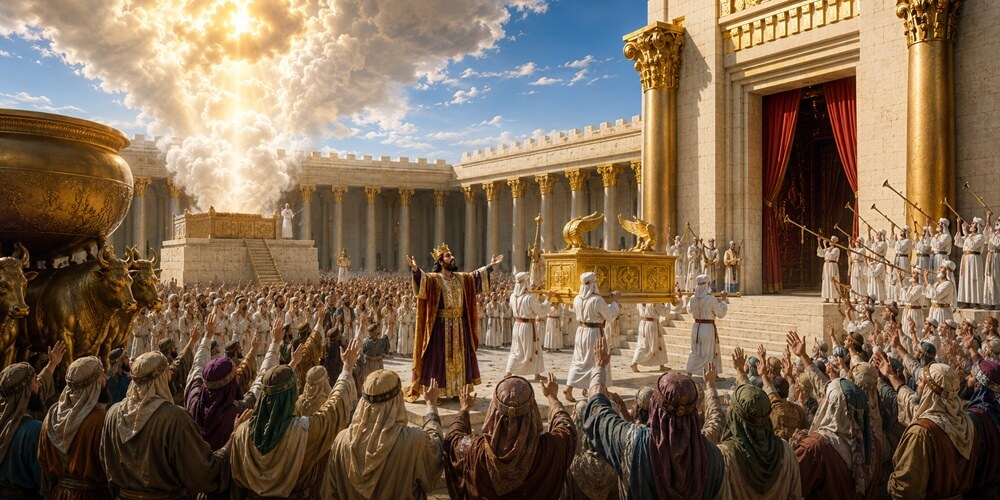
Solomon’s Dedication of the Temple
The Temple as Spiritual Man
Temples in ancient times were built according to the pattern of man, as the researcher R. A. Schwaller de Lubicz showed in the context of the Temple of Luxor in Egypt[4]. This was not just a physical human figure, but a complete, ideal, and spiritual human figure. In the same way, the Temple in Jerusalem is an appearance of the figure of “Adam Kadmon” (Primordial Man) of the Kabbalah, the image of God. This man is composed of ten sefirot—energies that appeared in the process of creation. When the first ray of light penetrated the round space—the Tehiru—it clothed itself in ten garments or vessels that were arranged in the figure of a man of light, or, if you will, the structure of the Tree of Life. In the same way, the Temple in Jerusalem is the clothing of the first ray of light that shines over the Mount of Olives, built on an east–west axis, and every part of it is an appearance of one of the energies—sefirot—of the spiritual man.
The Holy of Holies is the head, the Sanctuary is the body, and Boaz and Jachin, the two pillars outside the Sanctuary, are the legs. The entrance to the building through which the priests enter and leave represents the male and female sexual organs, depending on the movement in or out. Within these parts there is a subdivision: the two cherubim on and next to the Ark of the Covenant represent the two parts of the brain—the right, intuitive hemisphere and the left, logical hemisphere. The glory of the Lord that is between the two cherubim represents the crown on the head of man. The holy vessels inside the Sanctuary—the menorah, the table of showbread, and the altar of incense—represent the inner parts of man and the division that exists in him between physical and spiritual. The Temple is, in fact, a man lying on an east–west axis, with his head in the west.
If we look at things from the perspective of spiritual energies, the two cherubim above the Ark of the Covenant are an appearance of the sefirot of Chochmah (Wisdom) and Binah (Understanding). The glory of the Lord between them is an appearance of the sefirah of Keter (Crown) in this world. The seven-branched menorah in the hall is an appearance of the sefirah of Chesed (Kindness) and can be equated with the giving right hand. The table of showbread in the hall is an appearance of the sefirah of Din (Judgment) and can be equated with the receiving left hand. Bread is physical and limited, created from the heat aspect of fire, while light is infinite.
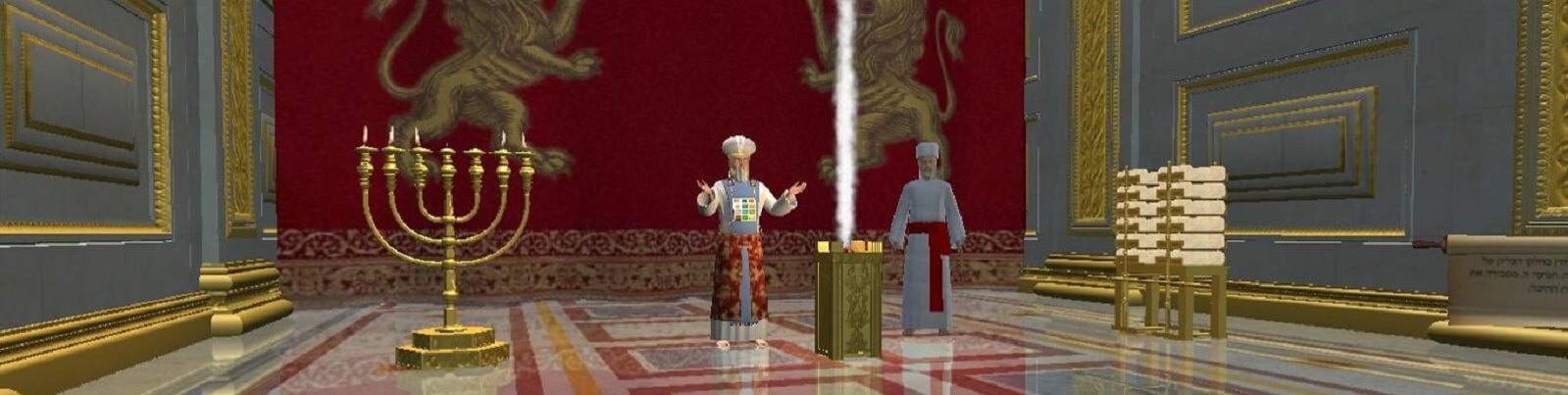
Between the menorah and the table of showbread is the altar of incense, which is an appearance of the sefirah of Tiferet (Beauty). The smoke and the fragrance rising from the incense connect heaven and earth (in the Temple it always went straight up). The altar of incense can be equated with the lungs in their higher sense—of inhalation and exhalation—a connection between the worlds. And so, in the hall where the inner activity of the priests takes place, we have an appearance of three sefirot: Chesed, Din, and Tiferet—the right side, the left side, and the middle[5].
The hall is likened to the upper part of the body, which lies on a horizontal plane, unlike the rest of the body whose defining feature is the vertical posture unique to man. The horizontal plane is the one on which human beings create. The hands are another unique aspect of man, especially the palms, which allow him to do things, to create tools, to play music, and to paint. Between the hands is the heart, which was considered the seat of wisdom in ancient times and also in ancient Hebrew mysticism. The wisdom of the heart is what made it possible to create the vessels in the Temple.
The daily activity of the priests took place in the main hall: the burning of incense, the tending of the menorah, and the weekly activity of replacing the loaves of bread. The service of the priests in the Temple was connected to the World of Creation, the second of the four Kabbalistic worlds. In other temples around the world, there was also an inner hall where the priests performed their duties. Entry to it was restricted only to those who had properly prepared themselves to serve in holiness.
Outside the hall stood two distinct bronze pillars called Boaz and Jachin, decorated with lilies. They represented the influence of the sefirot of Netzach (Victory) and Hod (Majesty) in this world, and constituted the two legs of the Temple. What are these two legs on which the world stands? One is action—victory—the sefirah of Netzach, which continues the right side of the Tree of Sefirot and can be equated with the right leg. The second is the value given to the action—thanksgiving—which continues the left side of the Tree of Sefirot and can be equated with the left leg. One is the principle of action (or content), and the other is the principle of form. Thus, the entrance to the Temple and the two pillars, Boaz and Jachin, on its sides are connected to the World of Creativity, the third of the four Kabbalistic worlds.
Between the two pillars, the priests carried out activities related to the World of Action, the last of the four Kabbalistic worlds. On the one hand, they entered the Temple with reverence, bowing before it. On the other hand, they left the hall after the daily service and blessed the people, spreading spiritual light. Through this dual activity, a connection was created between the sefirot of Yesod (Foundation) and Malchut (Kingship), a union by which the worlds exist and are continually renewed. The blessing that the priests gave to the people was a flow of divine abundance, an action of the sefirah of Yesod, which is associated with the male organ in man. The prayers and prostrations that the priests performed before the entrance to the Temple were a summoning and awakening of the divine energy present in the house, an action of the sefirah of Malchut, which is associated with the female organ in man.
The sefirah of Malchut was also present in the activities that took place in the courtyard (azarah) of the Temple—the sacrificial service and the prayer of the people of Israel—which constituted a summoning of divine forces. In addition, the sefirah of Malchut is considered the dark mirror through which the prophets communicated with God. Later we will see how prophecy was related to the priests in the Temple. The sefirah of Malchut was represented by the darkness and the empty space inside the building that received the ray of spiritual light, the ray of the sun. The sefirah of Yesod was represented and summoned by the rising of the sun over the Mount of Olives and the first ray of light that illuminated the entrance to the Temple.
The union between the sefirah of Yesod and Malchut is the essence of the Temple, which was intended to connect heaven and earth, male and female, God and human beings. The world must remain in constant union between the male and the female, between Yesod and Malchut. This is the meaning of the phrase “the land of Zion, Jerusalem.” Jerusalem is kingship (Malchut) and Zion is the foundation (Yesod) that impregnates the kingship, and without it, it will not be established. The sefirah of Yesod is the foundation of the world, the cause of causes. The sefirah of Yesod is the foundation of the world, the cause of causes. The sefirah of Malchut is the appearance—the embodiment of that cause in matter. The sefirah of Malchut is related to the appearance to King David and the establishment of a house for God and a kingdom for the people of Israel. But a constant flow of abundance coming through the sefirah of Yesod is needed to maintain that kingdom, so that it has content and spiritual life. It is necessary to constantly breathe spirit into the kingdom, and this was the role of the Temple and the priests.
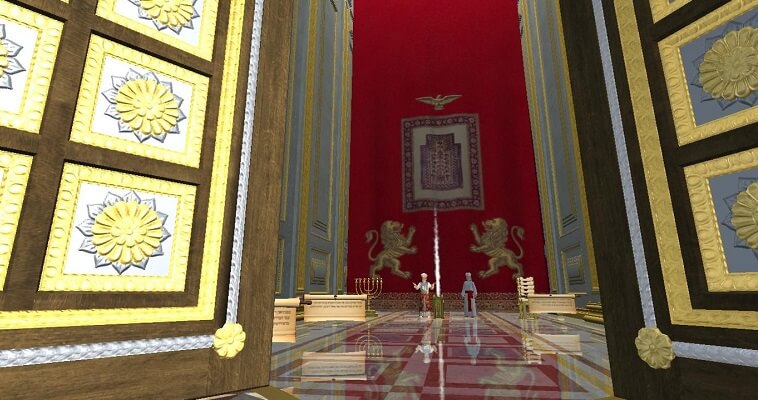
Entrance to the temple
Sun Worship in the Temple
According to Steiner, the prophets were a school that preserved the role of the Jewish people, which is to be a whole nation undergoing initiation, which is why they were so extreme in demanding the observance of the laws of Moses. The exile was part of the initiation of the nation. The first exile was in Egypt, the center of the mysteries of life after death. Moses was an initiate in the mysteries of Osiris. The second exile was in Babylon, the center of the mysteries of life before death, astrology. Daniel was an initiate in this way. Another stage in the initiation of the nation was the building of Solomon’s Temple, whose proportions reflect the human body and whose layout represents the structure of the spiritual man.
Solomon built the Temple as a universal center, and with its inauguration on the holiday of Sukkot, seventy bulls were sacrificed in honor of the seventy nations of the world, one bull for each nation. It is important to remember that Solomon knew seventy languages and had a thousand wives, most of whom were from the nations of the world. Therefore, it is not surprising that foreign influences related to sun worship, which was common in neighboring Egypt and many other places, entered the Temple service[6].
The location of the Temple west of the Mount of Olives revived the cosmic drama of the rising and setting of the sun. Although the Jewish religion does not like to admit it and even holds explicit ceremonies against sun worship (for example, offering the sacrifice with their backs to the sun to make it clear that they do not worship it), similar to the temples of Egypt, the Temple in Jerusalem contains a clear reference to the rising of the sun in several ways.
First, the routine of the Temple service began before sunrise. The priests of the duty watch would rise at first light, wash, put on their priestly garments, walk around the courtyard to make sure everything was in place, cast lots for the day’s duties, clean the coals and embers on the altar from the night’s fire, prepare the fire for the altar, ceremonially purify it, bring the vessels needed for the day’s service, bring the animals that would be offered as sacrifices, and open the doors of the Temple in a special way (always from the inside).
The moment the guard on the tower identified the first rays of the sun, he would shout “Barqai!” and this was the signal for the beginning of the service itself. The priests would begin the slaughter of the sacrifices (with their backs to the sun, to emphasize that they did not worship it) and bring the offerings to the altar. The priests on duty would enter the hall and begin the work of the vessels. The Levites would take their places on the platforms in front of the Temple with musical instruments in their hands and sing the song of the day. All the people would prostrate themselves before the holy place and recite the prayers of the “Shema Yisrael” and the “Amidah.” During the Second Temple period, a menorah called “the Menorah of Queen Helena” hung above the entrance to the Temple. This menorah would sparkle with the first rays of the sun, and its sparks would spread throughout the city, marking the right moment to begin the service.
In other temples of the ancient world, there were also orientations and references to the rising of the sun, and the service was determined by it. The purifications, prayers and singing, offerings to the god, and worship contributed to the daily resurrection of the universe—its re-creation[7]. The cosmic drama of the rising and setting of the sun symbolized the cycle of life: birth, death, and the possibility of being reborn—this time forever—in the spiritual worlds. Often, temples were located so that a ray of the sun would penetrate or illuminate them (or parts of them, such as obelisks) at sunrise on special days of the year, and this later influenced the orientation of churches toward the rising sun
The Temple was a large structure oriented toward the east, with huge doors that opened at sunrise, as if allowing the physical light to enter and the spiritual light to exit. The transition between day and night was emphasized by the opening and closing of the doors (a component that did not exist in the Tabernacle). In addition, in front of the doors was a flight of stairs and two pillars. After completing the work of the vessels, the priests would go out and stand on the stairs, blessing the people and the world with the priestly blessing, facing east toward the rising sun, and spreading the spiritual light toward it. The offering of sacrifices on the great altar, and the slaughter of the animals in the courtyard, were performed with the first rays of the sun, and thus death merged with life. The visitors in the courtyards of the Temple prayed at sunrise, and the Levites sang, echoing and synchronizing with the daily resurrection of the universe.
Twice a year, on the days of the equinox, which fall more or less at the time of the important Jewish holidays, the sun shone directly from the east onto the entrance of the Temple, and it can be assumed that at the opening of the doors, the light would penetrate inside and illuminate the curtain. The first ray of the sun would pierce the darkness and enter the gloom of the Holy of Holies, illuminating (and perhaps also awakening) the being that dwelled between the two cherubim. Many temples in Egypt, from Abu Simbel to the pyramids, were built so that a ray of the sun would penetrate them and illuminate their inner part on a special day of the year. It is possible that this was also the case in the Temple in Jerusalem. This dramatic event symbolized the fertilization of the female by the male and the birth of holiness as a result of their meeting, and in the case of Judaism, the union between the sefirah of Yesod and the sefirah of Malchut.
At the same time, Judaism emphasizes that it does not engage in sun worship and distinguishes between the primordial light, which is spiritual and flows through the upper sefirot, and the light of the sun and moon that emanates from the sefirah of Malchut. If there is symbolism in the rising of the sun as a sign for the beginning of the service, then it is related to the union of the sefirot of Yesod and Malchut—heaven and earth, divinity and the people of Israel. The meeting between the first rays of the sun and the Temple symbolized the abundance flowing through the sefirah of Yesod to the sefirah of Malchut during the service in the Temple. This spiritual union was supported by the worship performed at sunrise.

Thoughts on Sacrificial Offerings
In the Bektashi Sufi Order in Albania, there is a tradition where an initiate dervish personally raises a lamb during his period of initiation. When he is subsequently accepted into the order, part of the initiation rite involves sacrificing that very lamb and turning its fleece into a small rug upon which he sits during rituals. In this context, the lamb willingly offers its neck to the blade, symbolizing the death of the ego. The lamb joyfully embraces death in service of a higher purpose: all things live and die, and the highest possibility for both man and animal is to die for a higher cause—to die in order to be reborn in a different form. Here, the sacrificial offering—the lamb—is an extension of the person’s own self, born from the deep emotional bond forged while raising it. Taking upon the vows of initiation requires the dervish to surrender a part of his personality, materialized through the sacrifice of the lamb that had become part of him.
True sacrifice entails giving up that which is closest to you—an ideal expressed in its most extreme form in the story of Abraham binding Isaac. Isaac is certainly not an object, and his perspective forms a vital part of the narrative; furthermore, nothing can justify human sacrifice. Yet from the individual perspective of the one offering the sacrifice, it represents the surrender of what is most precious and dear for the sake of an ostensibly higher purpose.
Within the sacrificial rites of the Temple in Jerusalem, certain offerings were brought directly from the owner’s personal flock—such as the firstborn animal (Bekhor) and the animal tithe (Ma’aser Behemah)—wherein a person returns a portion of the blessing received back to God. When someone makes a vow, presents a petition, or expresses personal gratitude, they offer burnt offerings (Olah) and peace offerings (Shelamim). While these could be purchased in Jerusalem, the financial outlay itself constitutes a form of sacrifice, representing a return on what was given. Similarly, sin offerings (Hattat) and guilt offerings (Asham) are personal, requiring the individual to relinquish a portion of their wealth in exchange for divine grace. In contrast, the daily offerings (Tamid) and additional festival offerings (Musaf) are communal, devoid of private personal ownership, reflecting collective effort and devotion to the community as a whole.
Sacrifice is a mystery of sharing life with the Divine, of dining with God. Humankind holds the power both to cultivate and to take life, transmuting it into smoke that ascends upward—nourishing the Divine and breathing vitality into the heavens. In the Temple sacrificial rites, immense importance is placed upon fire, the ascending flames, and the smoke. It is not merely the taking of life, but the taking of life and its upward elevation.
According to Jung, within each of us lies the “Self,” an unconscious matrix whose dynamics and projections into the surrounding world give birth to the ego. The relationship between the Self and the ego is akin to that between a father and a son; when the Self seeks realization, the ego must be sacrificed. This is the process of individuation—becoming conscious of our egoic drives and reconciling with them.
References
[1] Adams, M. J., Finkelstein, I., & Ussishkin, D. (2014). The Great Temple of Early Bronze I Megiddo. American Journal of Archaeology, 118(2), 285-305.
[2] Aptowitzer, A. (1931). “The Celestial Temple According to Legend.” Tarbiẓ, (Volume 2), 137-250. (Hebrew)
[3] Macover, M. (2003). The Light of the Temple: The World of Thought of the Temple, 2 volumes. Jerusalem: The Temple Institute. (Hebrew)
[4] Schwaller de Lubicz, R. A. (1998). The Temple in Man: Sacred Architecture and the Perfect Man. Inner Traditions.
[5] Ben-Arieh, Z. (2023). Touching Holiness: A New Perception of the Tabernacle and the Temple. Prague Publishing. (Hebrew)
[6] Shoa, T. (1993). Sun Worship in Ancient Temples and Jewish Holidays. Studies of the Holiday: A Journal of Jewish Culture. (Hebrew)
[7] Belmonte, J. A., Shaltout, M., & Fekri, M. (2009). Astronomy, landscape and symbolism: a study of the orientation of ancient Egyptian temples. In Search of Cosmic Order, Selected Essays on Egyptian Archaeoastronomy, 211-82.