Aelia Capitolina in Jerusalem
After the destruction of Jerusalem in the Great Revolt and leading up to the Bar Kokhba revolt, one of the greatest emperors and builders in Roman history, Hadrian, came to power. Hadrian was interested in spiritual teachings, underwent initiation in the Eleusinian Mysteries, spent much of his time in the provinces of the empire, and in 130 CE, he visited Judea and began a massive building project of replacing ruined Jerusalem with a city dedicated to the gods, based on a sacred architectural plan. This project contributed to the outbreak of the Bar Kokhba revolt.
In the book Memoirs of Hadrian, the French author Marguerite Yourcenar portrays Hadrian as an enlightened ruler who pursued peace and sought the well-being and prosperity of all the inhabitants of the empire[1]. Contrary to this portrayal, in Jewish sources he is called the “crusher of bones” because of his role in suppressing the Bar Kokhba revolt. It took Hadrian three years to suppress the revolt, which he did thoroughly, bringing about the total destruction of Judea and the exile of many Jews.
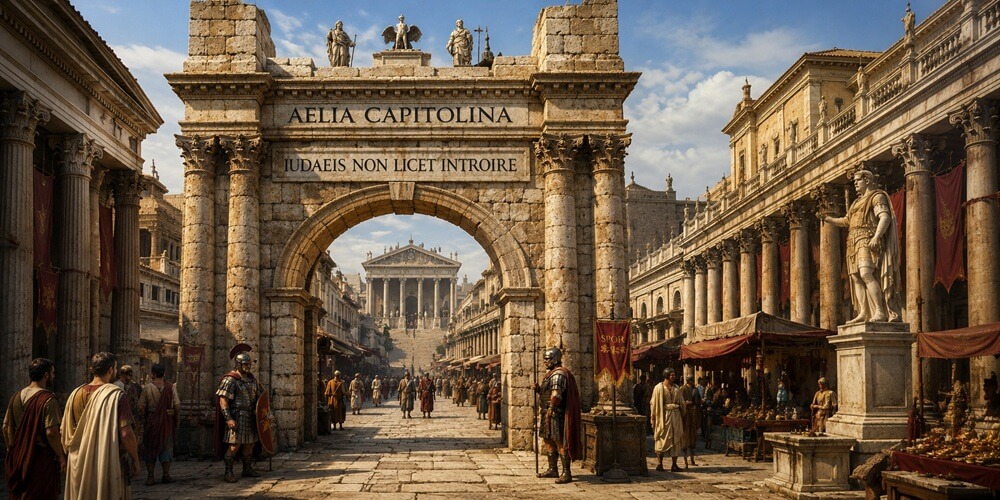
After the revolt, Hadrian completed the construction of Aelia Capitolina, and it became the headquarters of the Tenth Legion and existed as a pagan city for 200 years. Hadrian left Herod’s plaza intact because it fit the sacred plan of the city he wanted to establish, as well as the street grid that was based on the Western Wall. In the place of the Temple, he erected a temple to Jupiter, whose orientation was on a north-south axis (a replica of a similar temple in Baalbek), and on the site of the Rock of Golgotha, he erected a temple to Aphrodite, whose orientation was on an east-west axis. The two temples were located on the Messianic line, and according to this axis, the streets of the Christian Quarter, which was the main part added to the city during his time, were arranged.
Hadrian most likely implemented a plan that already existed under Herod and may have been preserved in the drawers of the school of sacred architecture that was in Rome or Lake Como (according to the Freemasons). It is also possible that he deciphered the spiritual meaning of the Herodian urban planning and sought to add to it, and for this reason, he left parts of the city intact (see chapter on the Old City as a Temple).
In general, the Roman city was oriented according to the cardinal directions[2]. The layout of the main streets and buildings followed these directions, depending on their function. Urban planning was based on the Greek tradition known as “Hippodamian planning,” featuring a crisscross grid of straight streets with a public area in the center. In every city there was one or two sacred compounds in the most central location, with temples dedicated to various gods, both male and female deities.
Temples to male gods such as Jupiter or Mars were built on the north–south axis, connected to the fixed stars and to the eternal abode of the gods, which was in the north (sometimes associated with a mythical mountain or land). Temples to goddesses such as Minerva and Diana were built on the east–west axis. The north–south axis symbolized eternity, while the east–west axis symbolized the cycles of life—birth and rebirth, the act of creation renewed each day by the rising of the sun.
Temples to female deities were built in the shape of a circle, while temples to male deities were built in the shape of polygons with right angles. Usually a square or rectangle, and sometimes also an octagon. One example of a female circular temple is the Temple of the Vestal Virgins in Rome. An example of a polygon temple is the Temple of Jupiter in Baalbek in Lebanon, which had octagonal structure and a basilica, and the same architype was probably used in Jupiter temple on the temple mount in Jerusalem.
Jupiter is the equivalent of the Greek Zeus, the giver of the sign of victory. Ruler of the Olympian pantheon. In the same way the emperor becomes Jupiter, and Hadrian saw himself as his representative and messenger on earth. Therefore the building of Jupiter temple in jerusalem was associated with the state religion and imperial deification.
The new city of Aelia Capitolina had two main temples: a temple to Jupiter on the Temple Mount plaza, and a temple to Aphrodite (Venus) in the area of the Holy Sepulchre, circular in shape. The city itself was square and was divided by two main streets, one north-south, the Cardo, and the other east-west, the Decumanus. The two streets met at a structure with four gates called a Tetrastylon, whose remains are now located at the foot of David Street at the entrance to the Jewish Quarter. The other streets were in a grid pattern, with public spaces in the center[3]. spiritual planning principles decided the distance between the main buildings and the relationship between the streets as well as the different dimensions of the buildings and temples.
According to the descriptions of Aelia Capitolina[4], on the Temple Mount Plaza there was a statue of Jupiter and also of Hadrian on a horse. With the transformation of the Roman Empire into an empire from the time of Augustus and onwards and the deification of the emperors, temples began to be built also for the rulers, who became gods, and sometimes in combination with temples of gods. Hadrian did not wait for his death but built temples for himself while he was alive. He built a temple to himself as Zeus in Athens with a large statue of himself, and perhaps he planned to do the same in Jerusalem.
On the southern side of the Temple Mount Plaza, a building with twelve gates called a Dodekapylon was erected. It is worth mentioning in this context that the number twelve is linked to the stars and the element of heavenly ether. The dodecahedron is one of the Platonic solids that symbolizes the ether, and if Jupiter is the god of the heavens, then he needs the twelve stars (or gods) to accompany him.
According to the architect Tuvia Sagiv, the Temple Mount complex was built by Emperor Hadrian and not by Herod, and in doing so, he covered the smaller plaza that Herod had built. Sagiv argues that the structure and location of the Dome of the Rock and the Al-Aqsa Mosque match the Jupiter temple in Baalbek structure—the Dome of the Rock being the octagon, and the the Al-Aqsa Mosque the Basilica. The current city is in the layout of the Roman city, and if so, then the Church of the Holy Sepulchre is in the location the Aphrodite temple of Aelia Capitolina[5].
It is worth adding in this context that the Romans excelled in order and management. These qualities were expressed in their adoption of architectural styles, as long as it suited their needs and the order they were trying to create they had no problem with learning from others. The essence of Roman temples was order and their being part of the social and political fabric. They expressed the greatness of the empire and the emperor, while the essence of Greek temples was the art and beauty in them, which expressed the greatness of man. The genius of the Romans was expressed in construction. They were the only culture that built not for utilitarian or religious purposes, but for grandeur, to express the social order or commemorate an event. Examples of this are the triumphal arches in various cities.
In addition to the temples, the Romans also built triumphal arches, gate structures, and plazas—forums. A triumphal arch with an adjacent plaza can be found in the Via Dolorosa, and it is integrated into what is mistakenly called Ecce Homo. The side gates can be seen inside the Sisters of Sion monastery and the plaza in its basements (which house an archaeological museum). Another triumphal arch or entrance was near the Church of the Holy Sepulchre with a plaza next to it, and its remains can be seen inside the Russian Church of Alexander Nevsky. An additional and impressive gate structure and plaza can be seen near the Damascus Gate, where there was a column from which the city’s street network began and the distances were measured.
In the area of the Pool of Siloam, the Romans erected a Nymphaeum called Tetranymphon, and in addition, also two bathhouses, which today are the Hamam al-Ain and the Hamam a-Shefa, adjacent to the Temple Mount. They installed a water supply system for the city, and although not much is known about the residents of the city during that period, its history and detailed structure suggest that it was a period of peaceful prosperity that lasted for almost 200 years. The city was divided into seven neighborhoods, and a Roman legion (the Tenth) was also stationed there. The number seven is an important archetypal number, especially in Rome in the 2nd-3rd centuries CE.
As the headquarters of the Tenth Legion, Aelia Capitolina was largely a military city. Of its 10,000-20,000 inhabitants, about 5,000 were direct members of the legion, and the vast majority of the other inhabitants were family members, veterans, and service providers to the army. This had many implications. First, the legionnaires were employed in construction work during peacetime, and this made it possible to build the enormous complexes of the city. Second, all kinds of beliefs and mystery cults, such as that of Mithras, were common in the army, and this contributed to religious life. This also explains the silence in the Jewish sources on Aelia Capitolina and their non-presence in the city.
According to Shlomit Wexler[6], the camp of the Tenth Legion was in the area of the Armenian Quarter, the Jewish Quarter, and Mount Zion today. It was surrounded by a wall and was already established after the Great Revolt. After the Bar Kokhba revolt, other parts of the pagan city were added, the street grid that still exists today, which as if surrounds the legion’s camp from the north and east, the temples, and the monumental plazas.
The Tenth Legion was established by Julius Caesar in Gaul, and he is considered its legendary father and patron, a kind of divine figure for whom ceremonies were held. The symbol of the legion was a wild boar, and at first, it was composed mainly of Romans and Italians, but over time, locals from various nations also joined it. The legion participated in the suppression of the Great Revolt and the Bar Kokhba revolt and was a central factor in the military system in the east of the empire. Its main camp was in Jerusalem, where it was present from the Bar Kokhba revolt until the beginning of the 4th century, a period of almost 200 years. Indeed, when the legion left the city during the time of Diocletian, its decline began.
On the lintel of the Roman arch at the Damascus Gate, the name Aelia Capitolina is written, and on a stone in the wall of the Zion Gate, there was an inscription from that time that begins with the words “To the greatest and best Jupiter Serapis, for the peace and victory of the emperor Nerva Trajan the best emperor…” and this teaches us that the Roman presence in the city predates Hadrian (Trajan was the emperor before him) and that the cult of Jupiter was connected to the cult of Serapis, the Egyptian-Hellenic god. Serapis appears on coins of the city of Aelia Capitolina in the 2nd century, starting from the time of Antoninus Pius
With the victory of the Romans over the Jews in the Bar Kokhba revolt, Aelia Capitolina was built as an act of gratitude to the Roman gods. The city had a kind of master plan, which made it a vast overall temple structure. With the Christianization of Jerusalem, the urban structure was partially preserved but acquired a new meaning—the victory of Jesus over death. The center of the city became the Church of the Holy Sepulchre instead of the Temple Mount.
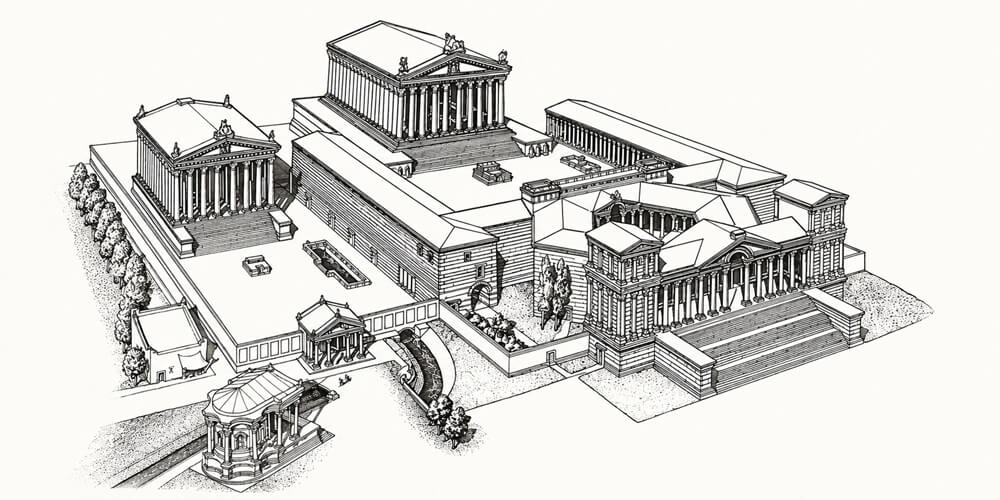
Baalbek Temples Lebanon
Roman Sun Religion
According to Eliade[7], the Roman religious genius excelled in dedicating itself to organic collectives such as the family and the homeland. The ideal Roman citizen must respect his obligations (fide) and the law. A person has meaning only to the extent that he belongs to a group. This appears in the term “Pietas”, the strict observance of the rules of ceremonies and rituals, respect for the relationships between people, honoring one’s father, and so on. There is also Pietas towards the gods, and surprisingly also Pietas towards strangers that leads to a view of all humanity as a brotherhood, and this is what gave the empire its strength.
This point of view was strengthened by Stoic philosophy, which was the leading school of thought in Rome. Another aspect of this philosophy was the important place of astronomy and astrology. Thus, in the 3rd century CE, astrology developed into a kind of astral state religion of the Roman Empire. However, it related to the seven planets visible in the sky moving against the background of the fixed stars, and not to the zodiac. The seven planets were conceived as seven forces that ruled over all aspects of human life and society. They represented a pleroma (array) of forces through which divine power manifested in the world.
Therefore, astrology is not just about predicting the future, but about understanding the energetic-spiritual ecology in which we live, and through which or with which we must act. Furthermore, every physical phenomenon has a root and influence in the upper worlds (the law of astrology is “as above, so below”), and as it is said, “There is no blade of grass that does not have a constellation in the sky that strikes it and says, ‘Grow.'” Within this complex system, the emperor, who represents the sun, has a vital and central role.
The astral theology led to the worship of the sun that reached its peak at the end of the 3rd century CE. However, the cult of the sun contradicted those who placed God outside the visible universe—the Jews and the Christians. They argued that the pagans worshiped the creation instead of the creator. These arguments led to the theory that there is an invisible Jupiter who sits in the firmament beyond the fixed heavens, and the sun is only an expression of it. Beyond the visible sun, there is an invisible, spiritual sun, and from it emanate the intellect and reason, and it rules the world of ideas. This sun is the medium between God and the visible world, but it cannot be seen with the regular eye, but only with the inner eye of the spirit[8].
The adoption of Stoic philosophy led to a deep religious revolution that was influenced by the religion of the East, whose climax was the creation of a new religion, an astrological religion and the cult of the sun. The emperor became the embodiment of the sun, and his power emanated from it. The sun has the qualities of kingship and rule. The sun gives its chosen ones the ability to rule, the emperor in an energetic sense is the son of the sun.
For almost half a century, from 193 CE to 235, Rome was ruled by a Syrian family from Emesa, where there was a temple to Elagabalus – the sun god. In 218, a 14-year-old boy, a priest of Elagabalus who was called by this name, was placed on the throne. The Greeks called him Heliogabalus. The boy tried to elevate the status of the sun god above the other gods. The focus of the cult of Elagabalus was a black stone brought from Emesa. All the religious energies of the empire were directed to the adoration of “Sol Invictus Elagabal.” This was an attempt here to create one monotheistic sun religion, as Akhenaten had done in Egypt. But like Akhenaten’s attempt, it did not succeed.
n 274 CE, there was another attempt by Emperor Aurelian to establish a state sun–emperor religion, and this time it succeeded. He created a cult of the “Invincible Sun,” built a magnificent temple for the sun, and instituted games in its honor every four years. The god Sol Invictus was elevated to the highest rank, along with his priests, and became the official protector of the empire and the emperor. The model on which Aurelian relied was that of Queen Zenobia of Palmyra, whom he defeated in a series of battles.
Following in his footsteps, Emperor Diocletian saw himself as divine—Dio (God)—and as a representative of the sun, as did Constantius Chlorus, who ruled after him in 305. He was the father of Constantine the Great, who made the Roman Empire Christian. A new era began in the world, and at the same time, Constantine also saw himself as a sun figure, with his benefactor Jesus as the ultimate sun figure.
Constantine the Great combined elements of sun religion with Christianity. After him, the last pagan emperor—Julian the Apostate—saw himself as a sun emperor, as the spiritual son of the sun, and as a messenger sent from heaven to renew the religion of astrology and sun worship. But, as is well known, he did not succeed in his endeavor, and Christianity endured.
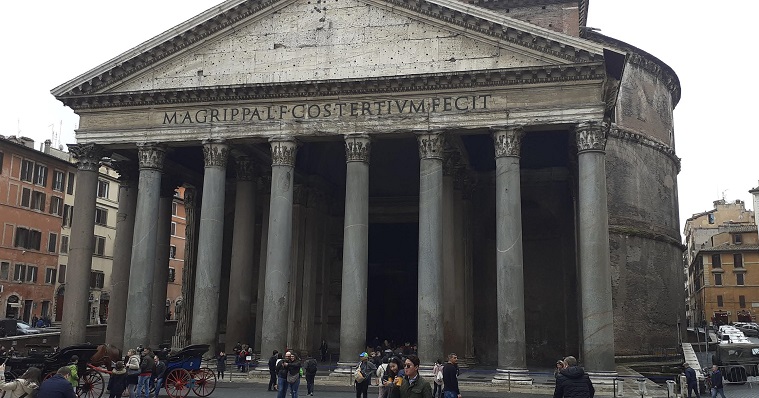
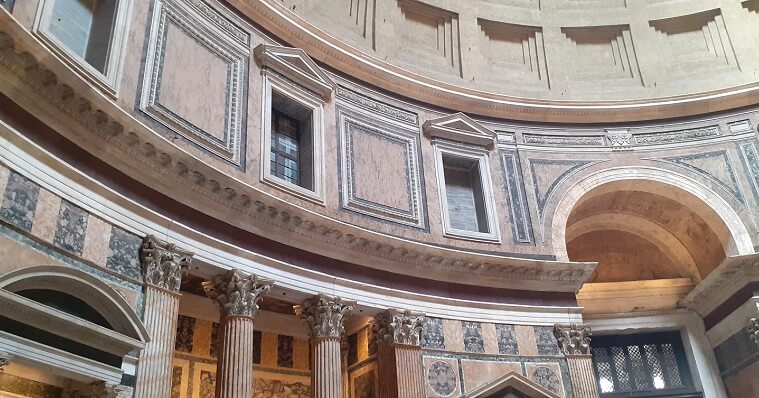
The Temple of Asclepius in Jerusalem
The topic of healing in Jerusalem is an interesting one. Traditionally, priests in temples in Egypt were also engaged in healing, or at least some of them, and therefore one could expect that priests in the Jerusalem Temple will do so as well. So the question is whether the priests in the Second Temple were engaged in healing? On the one we have no direct mention of this, on the other, the Essenes who came from priestly circles were known as healers, and there were also Jewish sects such as the Therapeutae in Alexandria who were known for their healing ability.
Jesus comes to the Pool of Bethesda north of the Temple Mount where there were sick people hoping for healing by dipping in the pool water. It can be assumed that pilgrims to Jerusalem hoped for some kind of healing. Also, the choice of the threshing floor of Araunah the Jebusite by David as the location of the Temple is connected to the cessation of the plague that threatened the inhabitants of the new Jewish capital of Jerusalem, and so on.
In the Hellenic-Roman world of that period, healing was connected to the god of medicine, Asclepius, and to the ability to summon the energy of healing through magical means. The tradition began already in Egypt, with spells, amulets, and potions intended to heal and benefit people, and was based on the prehistoric science of herbs, natural medicine, and shamanic practices. With the beginning of history, the science of healing appears as white magic, which included casting out demons, as seen in the story of Jesus and also in Jewish apocryphal literature from that period. Magic had its scientific side, which was developed by the Greeks and Romans. Classical Greece focused on research in an attempt to understand the functioning of the
The Greek god of medicine was Asclepius, He was the son of Apollo and a mortal woman, received his medical knowledge from Apollo and the centaur Chiron, and was a legendary healer during the Trojan War who became a deity and knew how to bring the dead back to life. His daughter was Hygieia (hence the word hygiene), and he had other children who continued his work as healers after him. Hippocrates was from his dynasty.
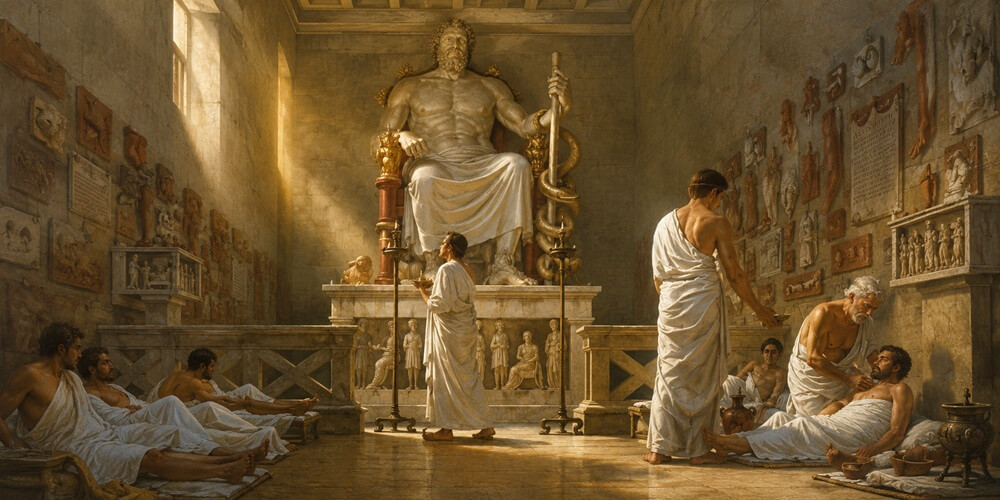
Asclepius was born in Epidaurus and established the Asclepieion there, a temple for the sick, the main part of which was a huge sleeping hall, where the sick slept, waiting for the god to reveal himself to them in their dreams, holding in his hand a staff with snakes, diagnose their illness, and give them the prescription for their sickness.
Many temples to Asclepius were built throughout the Hellenic-Roman world that served as a kind of hospital. Entry into them required a purification process that included a special diet for a few days and ablutions. After that, the sick slept in a special hall in the hope of the appearance of Asclepius in their dreams. They gave the content of the dream to the priest who interpreted it and took treatment accordingly.
The sacred sleep, which was called enkoimesis in Greek (in deep sleep), was helped by the intention and prayer of the one going to sleep, and sometimes also by intoxicating substances – consciousness-altering drugs such as opium, and it led to dreams that were different than usual. In this case, sleep became a tool to communicate with the god, as also appears in the Bible in many cases, such as the case of Solomon whom God appeared to in Gibeon in a dream at night (1 Kings 3:5).
Aelia Capitolina had its Asclepius temple as part of the sacred city plan. It was naturally built in a place that had been used for healing since the Second Temple period, and perhaps even earlier—the Bethesda pools. The remains of the temple were discovered during excavations at the site[9]. In addition, statues of Asclepius in the form of a snake between two columns were discovered, as well as votive statues—representations of sick body parts that were left at the site to heal their owners, and more. Hygieia, the daughter of Asclepius, appears on coins of the city from the 3rd century CE[10].
Notes
[1] Yourcenar, M. (1991). Memoirs of Hadrian (trans. Aviva Barak). Tel Aviv: Am Oved.
[2] Vitruvius, On Architecture, trans. Roni Reich, Tel Aviv: Dvir, 1997.
[3] Wexler, S. (2018). Aelia Capitolina: Roman Jerusalem in Light of the Archaeological Findings. Jerusalem: Yad Izhak Ben-Zvi.
[4] Lendering, J. (2002). Hadrian’s Jerusalem: The transformation of a pagan city. In J. Lendering, Rome and Jerusalem. Amsterdam: Livius.
[5] Sagiv, T. (2007). “The Dome of the Rock as a Temple of Jupiter: An Architectural Perspective.” Cathedra, 125, 5–32.
[6] Wexler, S. (2018). Aelia Capitolina: Roman Jerusalem in Light of the Archaeological Findings. Jerusalem: Yad Izhak Ben-Zvi.
[7] Eliade, History of Religious Ideas, Vol. 3, p. 92.
[8] Cumont, F. (1912). Astrology and Religion among the Greeks and Romans (Vol. 581). GP Putnam’s sons.
[9] Lizorkin-Eyzenberg, E. (2014, December 1). The Pool of Bethesda as a healing center of Greek-god Asclepius. Israel Bible Center. https://israelbiblecenter.com/articles/pool-bethesda-healing-center-greek-god-asclepius
[10] Gibson, S. (2010). The excavations at the Bethesda Pool in Jerusalem. Palestine Exploration Quarterly, 142, 159-181.