Monastic Life
Christian mysticism was prominent in Cappadocia and Alexandria in the fourth century, in the monasteries on Mount Sinai in the sixth century, and in Byzantium and on Mount Athos in the ninth century. Its main advocates were monks who developed the theory of theosis—the transformation of man into a god—and the traditions of Hesychasm, which lead to a connection with the divine light (more on this later). Mysticism played a major role in Christian Jerusalem starting in the third century and continuing through the early Byzantine period.
The Christian scriptures do not explicitly mention monasticism. According to the Christian concept, every Christian is a priest who can maintain a connection with God through Jesus, receive guidance directly from the Holy Spirit, and is entrusted with “the Great Commission” to preach the gospel. Indeed, some of the first disciples and church leaders had wives and children. The phenomenon of monasticism developed later and was consolidated in the third century.
Hints of the importance of monasticism, however, appear in the lives of Jesus and the apostles, in the lives of the prophets, and especially in the life of Elijah. Early Christian monasticism continues, to some extent, the traditions of Jewish sects such as the Essenes and the Therapeutae, who appear in the writings of Philo of Alexandria. The Therapeutae had centers not far from Alexandria, dedicated their lives to contemplative thought, lived in isolated cells, and engaged in healing—just like the first Christian monks. They read Psalms, the Prophets, and the Torah in an allegorical way, interpreting the writings through keys of numbers and esoteric knowledge.
The word monk comes from the Greek word monachos, which means “alone.” Monasticism began with individuals who lived in the deserts of Egypt, especially in the Nitrian Desert. The difficulty of desert life symbolized, for the monks, a struggle with the evil inclination and the overcoming of the animal part in man. It served as a backdrop for their battle with the devil. Thus, the victors in this struggle became miraculous saints—figures who were more in the heavenly worlds than in the earthly one.
According to the first monks, the roots of monasticism lie in the fact that Jesus fasted for forty days in the desert, and also in his saying that whoever wants to be a Christian must leave everything—especially money—and follow him.
With the conversion of Christianity into the dominant religion of the Roman Empire, and the end of the persecution of Christians in the early fourth century, monasticism came to be seen as an alternative form of martyrdom—a spiritual sacrifice to replace the physical sacrifice of Christians who had died for their faith in the gladiatorial arenas. The deserts of Egypt became centers of monastic life that gained momentum and became intertwined with forms of Gnostic mysticism, which was prevalent in Egypt at that time.
solitary Egyptian monks engaged in extreme asceticism, involving fasting, wakefulness, exposure to cold and heat, strenuous work, and every kind of struggle against the body, believing that the suppression of the body led to the growth of spiritual nature and faculties, enhancing the power to see visions and receive revelations. Their food consisted only of bread, sometimes eaten with salt or with bitter herbs and oil, and they drank only water. Their clothing was simple, their sleeping hours were limited, and when they did sleep, it was usually on the floor with a stone for a pillow.
Over time, a need arose to organize the large, spontaneous monastic movement and to create centers of communal monasticism, where it was possible to study and to perform Christian ceremonies and sacraments, such as the mass, which cannot be conducted without a priest, and to ease the lives of individuals. The first to organize the monks into a religious community was a monk named Pachomius. He introduced the monastic form called cenobitic. Consequently, huge monasteries were established, with thousands of monks who lived a life of purity on the banks of the Nile and in the deserts, serving as an example to the world.
In 357 CE, Saint Basil (330–379) visited the monasteries in Egypt, Syria, and Mesopotamia. What he saw impressed him greatly, but he was troubled by the monks’ withdrawal from society. According to his understanding, Jesus’s way was to mingle with society and serve the people, and therefore he established a new type of monastery in Cappadocia that maintained contact with the Christian community and was meant to serve both in a physical way—by providing health care, education, assistance in craftsmanship and agriculture—and in a spiritual way as well. It is doubtful whether basil the great visited Jerusalem or not, however, today there is a church named after him in the Christian Quarter near the New Gate.
The monastic rule of Orthodox Christianity was given by Basil the Great in the 4th century. Reading it, one can learn about the essence and purpose of the monastic path. The monk must be like Abraham, who went at God’s command from his land and his birthplace. He is a stranger to the world, wandering from place to place, fulfilling his role in the best way possible while maintaining the good qualities of modesty, obedience, hope, faith, consideration, and so on.
The monks in the new Orthodox monasteries were busy with the tasks imposed on them by life in the monastery, and they had to be in constant service and activity in a good spirit. It was not a simple struggle. The key to success in it was xeniteia—a life of foreignness, a voluntary exile and detachment from this world. Just as Jesus was a stranger and wandered in the world, suffered, and thereby contributed to redemption, so the monk must follow the path of asceticism, not necessarily physical, and on the way to the truth he must accept everything with love.
The monks must be modest and humble, keep silent, stay away from evil, work constantly and diligently, be patient and grateful, be happy with their lot, avoid evil thoughts, and engage in constant prayer. The monk needs to participate in church activities and feel satisfaction, not be envious or blame others, and confess his sins. He has a duty to care for and encourage the weak and the sick, to assist the holy, to give charity to the needy, to be in harmony with everyone, to offer good words, not to be angry or, God forbid, to quarrel. He must set the Lord before him always, thank God always, desire Him and not himself. [1]
The purpose of the community of monks is to live a holy life. In order to do that, they need to fulfill the rule of the monastery. This leads to sanctification and love of God. The way is through abstaining from the vanities of this world. The monks had to praise God seven times a day, similar to King David. A large part of their time was dedicated to prayer at all hours of the day and night, and this had to be done with intention and not automatically. But the main aspect of monasticism was the focus on the divine presence and the soul, and this was achieved through constant prayer (Hesychasm), entering inward and contemplating, rising above the senses and this world to other realms that can be called the experience of holiness. This is also what gave the monks the strength to deal with everyday life.
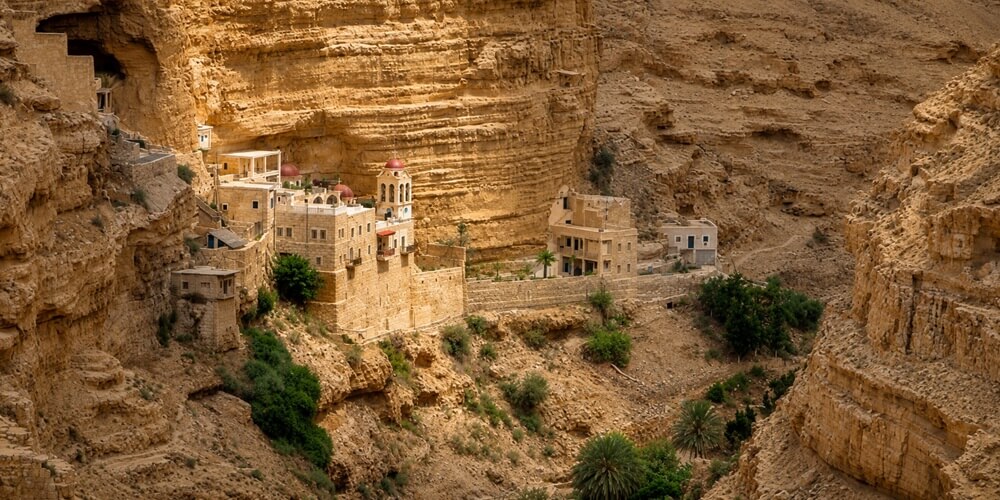
In parallel with the development of monasticism in Egypt, we find similar developments in the Land of Israel, Syria, and the Levant, especially in Jerusalem and the adjacent Judean Desert. The cenobitic monasteries in the Judean Desert adopted the rule of Saint Basil with local modifications. There was a difference between the desert monasteries and the city monasteries, but in both there was a special feature of the Land of Israel: the cooperation between members of different peoples, especially the Byzantine Greeks and the Armenians.
According to Moshe Maoz, the Syrian and Egyptian monks preferred remote places that could not be reached easily, because their tradition was connected to solitude, mental work, and asceticism. Therefore, they chose the most distant and uninhabited deserts, which left the stage of Jerusalem and its adjacent desert to two peoples in particular: the Armenians and the Greeks. Thus, Euthymius, the founder of desert monasticism, was Armenian, but his senior disciple, Saint Sabas, was Greek. Many monasteries on the Mount of Olives were populated by Armenian and Greek monks, and in addition—especially in Jerusalem itself—we also find the settlement of Latin and Georgian monks and nuns.
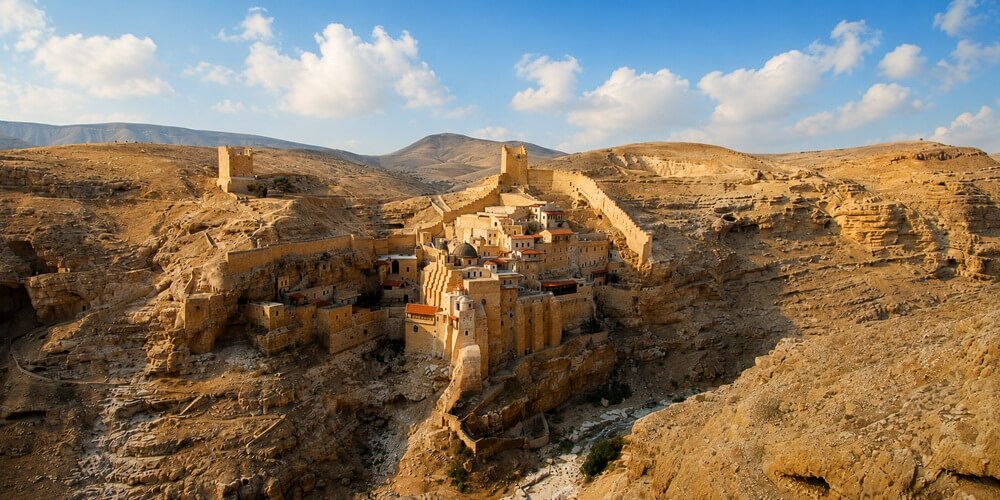
Mar Saba Monastery
Two Melanias
At the beginning of the 5th century, the most important and famous of the monasteries on the Mount of Olives was the double monastery of the elder Melania (350–410) and Rufinus of Aquileia (344–411), consisting of a monastery for men and a monastery for women close to each other (a common practice in the Christian world of that period, mainly in Egypt). It can be said to have been a center of a Christian allegorical school, a place where the literary work of Origen was developed, with the support of John, Bishop of Jerusalem, and probably also Gregory of Nazianzus, the greatest Byzantine theologian of the period.
After the Christianisation of the Roman Empire, many noble women—matrons—were drawn to the figure of Jesus and to the experience of the sacred that Christianity offered, and they became nuns. Houses of virgins were founded in various cities, and large monasteries for women were established in Egypt and other places. The only path that was closed to them was joining desert monasticism, but some women in male disguise, such as Mary of Egypt, still took this path.
One of the famous and respected women who appeared in Jerusalem at the end of the 4th century was Melania. She was born in Spain and was one of the richest women in the world. In her youth, she moved to Rome, married, and had children, but Melania was captivated by the charms of Christianity and decided to leave everything and become a nun. She traveled to the Nitrian Desert in Egypt, which was the most important center of monasticism at that time, lived there for about a year, and made contact with important monastic figures, including Rufinus, who would become her partner on the journey in the years to come.
In 373, there was a persecution of the monks in Nitria by the central Byzantine government, against the background of theological disputes. Many of the monks were expelled to the Land of Israel, and Melania came with them. She established two monasteries on the Mount of Olives with Rufinus: one for women under her leadership and one for men under his leadership. The two adopted the monastic rule of Saint Basil and brought it to the West, but mainly delved into the allegorical interpretation of Origen, with Rufinus being the great promoter of his writings [2].
Melania delved into the reading and interpretation of the Gospel, received guests in her monastery, and held a fruitful dialogue with leading thinkers of the Christian world. She maintained contact with Evagrius Ponticus, who sent her letters and spiritual writings that helped her and her monastery find their way. The monastery became a place of connection between the theology that developed in the East and the Latin West, and a model for other monasteries that were established afterward.
In 380, Jerome and his companion and supporter, a Roman matron named Paula, arrived in Jerusalem, accompanied by others who wanted to fulfill the ideal of Christian life. According to Jerome’s writings, in order to understand Jesus, one must go to the places where Jesus lived and acted. It is impossible to understand the Bible without knowing the geography, just as it is impossible to understand Greek culture without visiting the Acropolis. For this reason, Jerome also learned Hebrew, to know the Bible in its original form, and translated the Onomasticon of Eusebius of Caesarea (a gazetteer from the 3rd century). In a letter to Paula, he claims that a Christian education is not complete without visiting the Athens of Christianity, which is Jerusalem.
Jerome came from a background similar to that of Melania. He was of Latin origin, in contact with Augustine, entrusted with the writings of Origen, and supported by Gregory of Nazianzus, who was also in contact with Melania. Naturally, Jerome and Paula found a home in the monasteries of Melania and Rufinus. They learned from them how to manage a double monastery, lived there for a few months, and then moved to Bethlehem to establish monasteries of their own. Jerome became famous for his literary work, especially his translation of the Bible into Latin directly from the Hebrew source, known as the Vulgate.
Over time, Jerome became increasingly zealous in his religion, renouncing the teachings of Origen and, as a result, quarreling with Melania and Rufinus. Thus, opposite the spiritual and allegorical school of Rufinus and Melania and the center they established on the Mount of Olives, there developed the monastic center of Bethlehem, led by Jerome and Paula. Both were educated people but, to some extent by choice, narrow-minded, emphasizing faith and obedience over free thought. It was only in the time of Melania’s granddaughter, also called Melania (the Younger), that the rift between the two monastic and scholastic centers—the Mount of Olives and Bethlehem—was healed.
The elder Melania had a son who became a senator and an important man in Rome. In time, a daughter was born to him (383), who was named Melania after her grandmother, and perhaps for this reason, she herself became a Christian saint. After her wedding, and after her two small children died and she herself almost died during the second birth, the younger Melania convinced her husband to dedicate their lives to God. The couple went from being husband and wife to spiritual siblings and began their career as founders of monasteries. As early as 406, they established monasteries in Italy. From there, they moved in 410 to North Africa, where they met the important theologian and Church Father Augustine, who largely became their spiritual father. In 417, they moved to Jerusalem and founded two monasteries on the Mount of Olives, continuing the path of the elder Melania and Rufinus, probably near the Church of the Ascension.
Melania the Younger made peace with Jerome and became a central figure in the city, but she dedicated a large part of her time to a life of solitude and extreme asceticism. She established a monastery on the Mount of Olives with a special chapel that was used to store holy relics—a martyrium. She became famous as a holy woman and a mother figure to the population of Jerusalem at the beginning of the 5th century CE. Everyone was inspired by her, including Empress Eudocia, who moved her residence to Jerusalem (see below). Melania died in 439 and was buried in her monastery. Her life was written by a monk named Gerontius, who sought to continue her path and described her as an ideal holy woman.
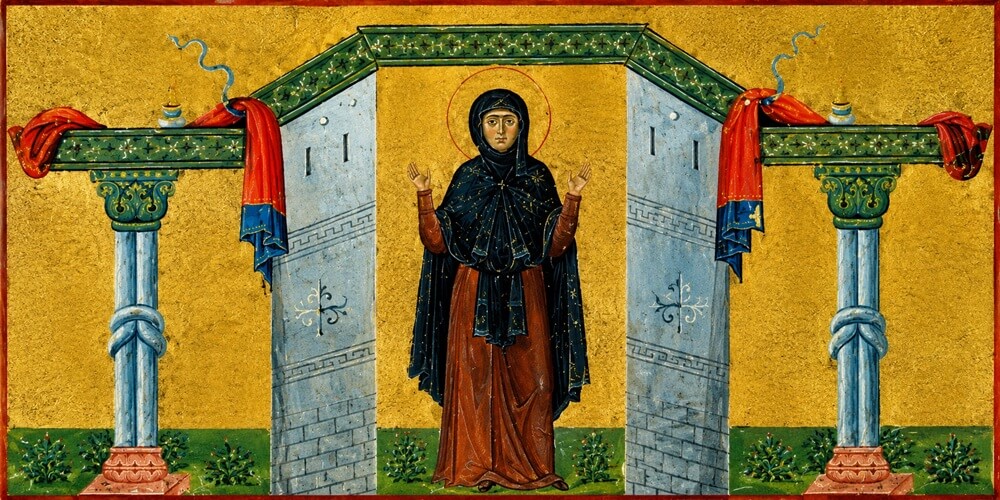
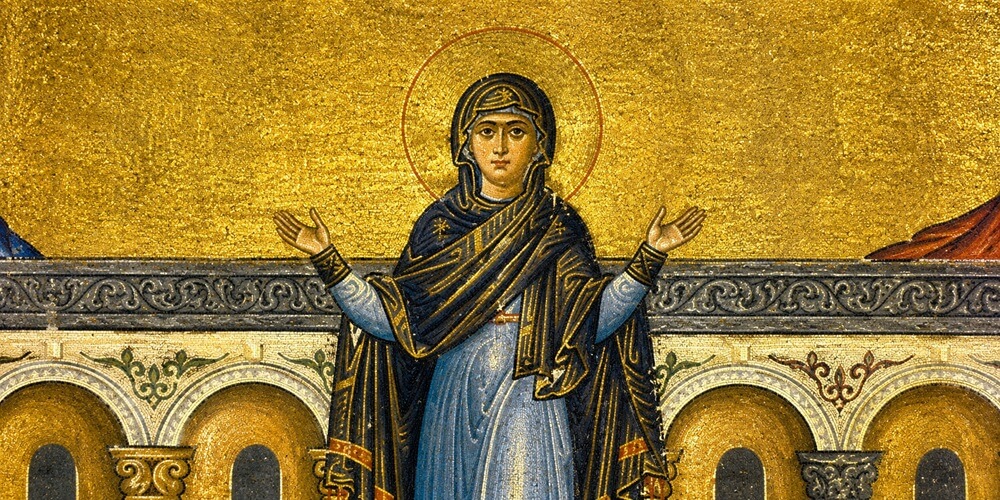
Christian Street in the Old City, there is a Greek Orthodox women’s monastery named Megali Panagia (“the Greatest of All Saints”), dedicated to Mary who shows the way (Maria Odigitria). Beneath the church is an underground room with the tomb of Saint Melania. It is not clear which Melania this is. It may be Melania the Elder, but Moshe Maoz claims that it is Melania the Younger. In any case, from the church, several steps descend to an underground cell where the saint is said to have lived as a hermit and perhaps also written holy books or contemplated the hidden meaning of the Holy Scriptures. It is not clear how she could have been a hermit both here and on the Mount of Olives at the same time, but tradition is tradition.
However, in order to be a holy woman in the 4th–5th centuries, one did not have to be a noblewoman. The path was open to everyone, and there were also many saints who came from the lowest places in society. Two famous saints of the Byzantine period were Mary of Egypt and Pelagia, both former prostitutes who repented. Pelagia, known as the beauty of Antioch, was a prostitute and an actress who one day understood the saying, “Beauty is fleeting and charm is deceitful,” and went to live as a hermit monk (in disguise) on the Mount of Olives. When she arrived at the mountain, she entered a small cell and spent the rest of her days there in prayer and fasting. In the monastic tradition, there was a stream of hermit monks who would enter a small cell for a long period of solitude and asceticism, meditation and prayer, and sometimes for life, and this tradition existed throughout the Mount of Olives. The younger Melania also spent a few years in such a cell that she prepared for herself.
Concerning Pelagia, below the entrance to the Church of the Ascension, there are stairs that descend to an underground cistern, perhaps an ancient well, and within it a tomb structure that Christians identify as the tomb of Pelagia and the place where she lived as a hermit. The Jews identify the same place as the tomb of Huldah the Prophetess, and the Muslims identify it as the maqam of the 8th-century Sufi love poetess Rabia al-Adawiyya. The identification of the same site with three different holy women is part of the charm of Jerusalem, for a person is a person no matter what, and it does not matter through whom one prays. God is one, and what is important is the act of prayer.
A School for Christian Allegory
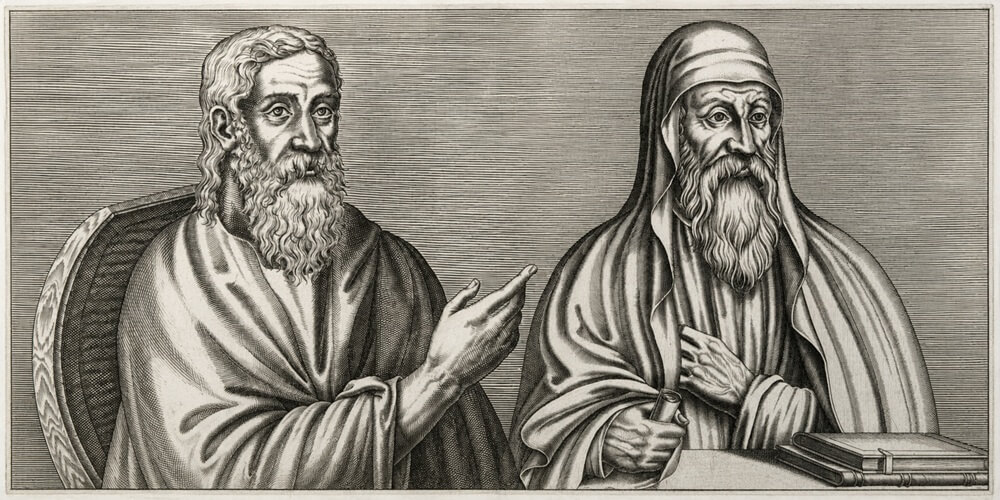
The partner of the elder Melania, Rufinus, translated the writings of Origen and adopted his allegorical interpretation of the Old and New Testaments. Rufinus’s writings and translations brought Greek Christian mystical thought to the Latin world, either directly or through his greatest student, Evagrius Ponticus, who studied in the monasteries of Jerusalem for several years and then went on to apply the spiritual teaching in the deserts of Egypt. He was one of the most important theologians of the late 4th century, who influenced the Church Fathers, is quoted in the Philokalia, and is, among other things, responsible for formulating the concept of the “seven deadly sins,” which later became widespread.
Evagrius offers an interesting reference to the holy places in Jerusalem in the spirit of allegorical interpretation. According to him, the holy places symbolize a spiritual place within a person, an inner reality. Thus, he writes in one of his letters: “When will you become Bethlehem through your deeds, Anastasia (the Church of the Resurrection in the rotunda) through your grace, a place of ascension to heaven from the Mount of Olives through the understanding of God?”
The holy places are a symbol, and if they are taken literally, they can distance a person from God. A pilgrimage to a holy place in itself does not bring a person closer to God, and sometimes might even cause a person to sin through haughtiness of heart. Even living in a holy place has no value in itself unless it is taken symbolically, because God is present everywhere. In this case, the holy place can be an indication of the path that leads to God, which has three components: the understanding of God, good deeds, and the inner life. But for the understanding of God and the inner life to occur, a person must remain in one place, and the wanderings of monks in search of holiness only hinder this. These are the demons who cause the monks to go on pilgrimage and look for God in an external place instead of concentrating on the inner work. Good deeds are what will lead them to God, not a visit to Jerusalem. Wandering itself is also a symbol, as in the case of Abraham, to whom it was said, “Go forth.” The meaning of this is turning one’s back on the world, embracing foreignness and indifference. Interpreting this as physical wandering is merely an easy way to escape from the real struggle.
According to Moshe Maoz[3], in vagrius’s teaching, the Promised Land is a symbol of God’s creation and a connection with God. The walls of Jerusalem are an allegory for the wall of the soul that falls due to the act of Bathsheba. Zion symbolizes the Holy Trinity, pilgrimage is an inner journey to the ideal of the monk, and so on.
The school of mystical allegorical interpretation of the scriptures was not an organized institution but rather a kind of movement that continued to exist throughout the Byzantine period and eventually led to the appearance of the Philokalia, the holy writings of the Neptic monks (those who stay awake at night), as will be described later. An example of Christian allegory is the parable of the Good Samaritan (Luke 10:29–37), as interpreted by Severus of Antioch (528), a monk from the Land of Israel who later became the patriarch of Antioch. And so he says[4]:
“A certain man was going down from Jerusalem to Jericho.” The man is all humanity. Jerusalem is the original heavenly state of humanity. The descent to Jericho is the current state of the human race that falls to the bottom of matter. And on another level, the man is the soul descending to the material world from the divine world, and therefore it is left wounded on the side of the road, and needs the Good Samaritan – Jesus – to save it.
Origen and Clement of Alexandria
Life in the Monasteries
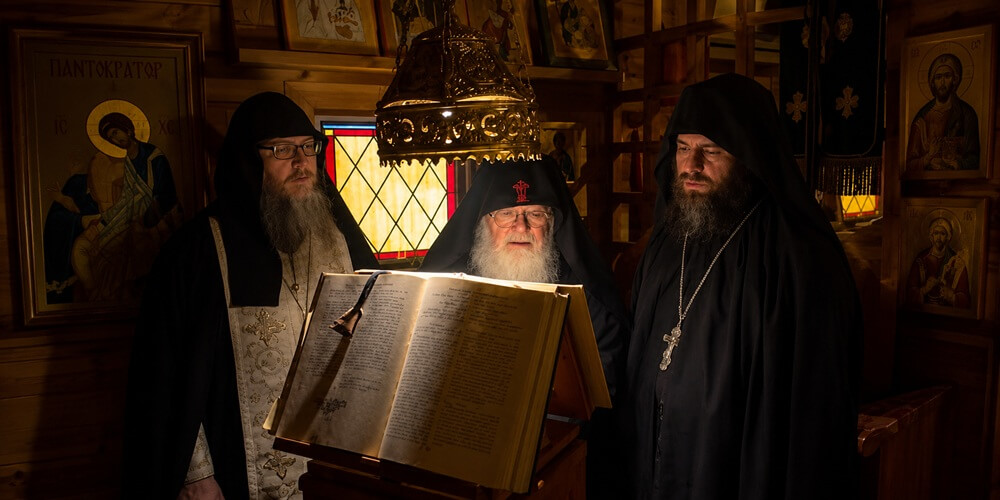
Two types of people came to the monasteries of the Judean Desert and Jerusalem: those who were already monks, whether in Cappadocia or in other places, and who came with the intention of joining a specific monastery; and those who went on pilgrimage to Jerusalem, were captivated by the charms of monasticism, and decided to join one monastery or another, often because of the saint who lived or was buried there. They handed over their few belongings to the head of the monastery and were accepted as new monks, upon whom all the most difficult tasks were imposed. New members underwent a period of candidacy and preparation in order to test their disposition and desire. If they persisted, the candidate had to officially declare that he wished to renounce this world and dedicate himself to the work of God with a whole heart. His head was shaved, he received a garment, and then he joined the monastery as a new monk.
A very important role was that of the abbot. He received his spiritual authority from the first founder of the monastery and was, in fact, all-powerful. His appointment was permanent and for life, and it was obligatory to accept his authority in everything and to obey him. Matters reached the point that anyone who needed to leave the monastery had to first receive the blessing of the abbot, and anyone who did not obey him was severely punished. The abbot was perceived as a father figure and at the same time as possessing special spiritual powers by virtue of his position. He was the authority who decided on the acceptance of new monks. Alongside the abbot, a staff of senior monks often served in administration and participated in various decisions, including the appointment of the next abbot. The abbot’s residence was called the hegemonion and was usually located in the center of the monastery, near the church[5].
role in the monastery was that of the administrator—the oikonomos. He was a kind of deputy to the abbot. The position of administrator was the highest appointment before a monk was ordained as a priest. Sometimes a monk could become a priest only after fulfilling four roles: baking bread, caring for the sick, receiving guests, and managing the economy. The administrator also prepared the work schedule in the monastery. Often, the role of administrator changed hands. Becoming a priest was a great honor and was necessary for receiving the position of abbot, since only a priest could perform the holy ceremonies.
The daily routine in the monastery was divided into three parts: one part for prayer and reading, one part for work, and the last part for eating and rest. This, of course, is reminiscent of the division of the day into three by the Essenes. The monks prayed seven times a day at fixed times. The meal was perceived as a direct continuation of prayer. During the meal, they needed to keep silent while one monk read passages from the Holy Scriptures or from hagiographies about the lives of the Desert Fathers. At night, there were a total of six hours of prayer and six hours of sleep, divided into four hours of prayer and two hours of sleep. Sometimes they would recite Psalms seven times a day in addition to the prayers. The Eucharist was the central ceremony of the week, with the night between Saturday and Sunday sometimes designated as a vigil. This meant that once a week there was a significant joint ceremony.
The clothes that the monks wore were considered sacred and were called the schema. Their color was probably black. They consisted of a cloak, a mantle, and a hood. Each part of the clothing had a drawing or embroidery of a skull on it, symbolizing the resurrection and the monks’ connection to the kingdom of the spirit beyond the kingdom of matter. The care of the sick, the reception of guests, and other acts of social welfare among the monks in the Judean Desert were inspired by the teaching of Saint Basil the Great of Cappadocia. In all the large monasteries, there were hostels, hospitals, and shelters that were maintained and operated by the monks.
Saint Euthymius
The monasteries of the Judean Desert had a strong connection with the holy city. Only a day’s walk away, they were part of the Christian cultural space and the pilgrimage network. The man who is considered the founder of Judean Desert monasticism is Saint Euthymius (377–473), who also had great theological and political influence. He was born into an Armenian noble family in Melitene, Cappadocia. From a young age, he participated in the life of the Church until he was appointed a priest and placed in charge of the monks in his city. At the age of 29, he decided to go on pilgrimage to the holy places in Jerusalem and to settle as a monk in the adjacent desert.
In 405, Euthymius arrived in Jerusalem and decided to settle in the Lavra of Pharan, where he began his life as a monk. While there, he became acquainted with his friend Theoctistus, with whom he would go down to the depths of the desert every year. In their time, a new tradition of long desert journeys under harsh conditions began. The monks started going into the depths of the desert for the forty-day fast before Easter. This custom had a far-reaching influence on the monastic movement, because through it the monks became tough and focused on their goal. They became desert survivors who were well acquainted with the conditions of existence there. The struggle with the desert was also a struggle with the animal part of man and with the devil.
Following this custom, Theoctistus and Euthymius came to Nahal Og, where they founded a new type of monastery—a coenobium that emphasized communal life, allowing for the performance of religious ceremonies and preparation for joining a lavra, where monks lived in solitude during the weekdays and met only on Sunday in the church. The monastery was called the Monastery of Theoctistus, after Euthymius’s friend. After its founding, Euthymius went down to Masada and lived for a while on its summit in solitude. From there, he went to the outskirts of the Zif Desert and established another coenobium that maintained ties with the villagers in its surroundings. After that, he returned to the desert and, in the Adumim Plain, established his third and most important monastery: the lavra that bears his name. Euthymius converted the members of the tribe of a Bedouin sheikh named Aspebetos by miraculously healing his son. The tribe became Christian and remained loyal to him until the day of his death. The members of the tribe settled near the monastery and formed a kind of community with it.
The Euthymius Monastery was the first monastery whose monks were appointed to high positions in the ecclesiastical establishment of Jerusalem. The monastery was only a few hours’ walk from the city, and its monks were integrated into the religious life of Jerusalem. These appointments constituted a fundamental turning point in the history of the monastic movement in the Judean Desert. From that point on, the involvement of the desert monks in the life of the Jerusalem church began. Until then, it had been a spontaneous movement of people who sought to withdraw from society and live a life of solitude in the desert. From then on, it should be seen as an organized and influential movement, which gained a reputation in the eyes of both the ecclesiastical and secular authorities.
Empress Eudocia, who lived in Jerusalem at the time, admired Euthymius and built a tower for him on Jabal Muntar. She also built a water reservoir and a church for him opposite his monastery, in a place called “Qasr Ali.” During his long life, Euthymius maintained contact with the Armenian Church and people, and, being of Armenian descent, even encouraged Prince Vardan to fight the Persians during his visit to Jerusalem.
Euthymius was involved in the dispute between the Monophysites and the Orthodox. He supported the Orthodox line, and for this reason he was forced to leave his monastery for two years. In the end, when the Orthodox line prevailed at the Council of Chalcedon, Euthymius returned strengthened, and his monastery reached the peak of its influence. In 457, Euthymius accepted Sabas as a monk. In the summer of that year, Martyrius and Elias from Nitria in Egypt also came to the monastery. In time, these three monks established monasteries of their own. Sabas founded Mar Saba and became one of the most important figures in the history of desert monasticism. Another disciple of Euthymius was Gerasimus, who later founded a monastery in the plains of Jericho and is also considered one of the most important Judean Desert fathers, the founder of Jordan Valley monasticism[6].
Euthymius died in 473 at the age of 97 and was buried inside his monastery. His disciple Martyrius was elected patriarch of Jerusalem and continued his path, establishing a large monastery in Ma’ale Adumim. According to Cyril, Euthymius was alert and full of energy until his last day: “It is said of him that his appearance was like that of an angel; his behavior was natural, his manners were pleasant. As for his physical appearance, his face was round, radiant, and white, and his eyes were sharp. His height was short, and his beard was completely white, full, and reached his stomach. All the parts of his body were whole. Indeed, his eyes and teeth did not decay at all due to old age, but he remained strong and vigorous until his last day.”

Saint Atien Dominican Church
Eudocia the Byzantine Empress
Many women of noble origin were active in Jerusalem during the Byzantine period, but the most famous and significant of them all was Empress Eudocia (401–460), the wife of the Byzantine Emperor Theodosius II (408–450). She was one of the last educated women of the ancient world—her character is reminiscent of Hypatia of Alexandria in the film Agora. Her father was a sophist and rhetorician, and Eudocia received a classical education, but she was baptized at a young age and became empress in 421. During her years in office, she protected Jews and pagans and befriended important Christian mystics and theologians in the Holy City.
During her time as empress, she clashed with the emperor’s zealous sister Pulcheria, who was probably her friend at first and had helped her marry the emperor. Pulcheria was the driving force behind the attack on the philosopher Hypatia in Alexandria. In her days, the last pagan universities were closed. Opposite her stood Eudocia, who advocated for a tolerant and enlightened Christianity.
Pulcheria accused Eudocia of having an affair with a handsome young officer at court, and her weak-willed husband believed the accusations. As a result, she was exiled from the court to Jerusalem—but the city benefited greatly from this. Eudocia moved to Jerusalem in 443 and had a profound influence on the life and development of the city. She rebuilt the city walls, which enclosed a much larger area than the Roman city—a project that was unparalleled. In addition, she built the complex of Saint Stephen north of the wall (St. Étienne), the Church of Siloam, and probably also the Tomb of Mary, while advancing many other projects. It is said that she discovered the Ark of the Covenant in underground spaces beneath the Temple Mount and hid it in the burial caves under St. Étienne. After 16 years of activity, she died in Jerusalem in 460 CE and was buried in the courtyard of the Church of Saint Stephen (St. Étienne).
The meaning of the name Eudocia is “the benefactress.” As a believing woman, she attributed the building of the walls of Jerusalem to the verse in Psalms: “Do good to Zion in your good pleasure; build up the walls of Jerusalem.” The Talmud says: “Any man who does not have a wife dwells without Torah, without a wall… without a wall, as it is written: ‘A woman shall compass a man’” (Babylonian Talmud, Yevamot 62b). The role of the woman is to build a sacred space and protect it, a house for the work of God. The time of Eudocia was the time of the invasions of the Huns and the destruction of Rome and the western part of the empire. The building of the walls of Jerusalem gave both security and identity to its residents.
It is said that the atmosphere of Jerusalem reconciles, and so after their great quarrel, Eudocia returned to cooperate with her rival Pulcheria, the sister of Emperor Theodosius II, particularly in strengthening the worship of Mary that began to develop at this time. The two women cooperated in bringing the icon of Maria Odigitria—Mary showing the way—to Constantinople, an icon that was supposedly painted by the Apostle Luke while Mary was living in Jerusalem and which was believed to depict the true image of her and Jesus. This caused a great sensation, and as a result Pulcheria built the Hodegon Monastery to house the holy icon. Together they also brought the burial clothes of Mary to Constantinople—the Maphorion, a large blue veil—which are kept in the Blachernae Church, founded by Pulcheria as well. The distinctive feature of these clothes is their healing and enlightening properties, as well as their preservation from the ravages of time thanks to the holiness of the one who wore them.
In 381 CE, at the Council of Constantinople, the belief in the virginity of Mary was affirmed, and her figure was glorified as the Mother of God, although not everyone accepted her divine attribution. In the 5th century, the Patriarch of Constantinople, Nestorius, opposed the belief in Mary as the Mother of God and founded what became known as Nestorian Christianity. His claim was that if Mary is the Mother of God, and God was born in a stable in Bethlehem in the time of Herod, how could the world have existed before? But these arguments did not convince the rest of the Christian world, and at the Council of Ephesus (431 CE), Nestorius was declared a heretic, while Mary, on the other hand, was officially proclaimed the Mother of God.
The undertakings of Eudocia and Pulcheria strengthened the status of Mary in particular and of women in the Byzantine Empire in general. At the Council of Chalcedon in 451 CE, the status of Mary as the Mother of God was reaffirmed, and emphasis was placed on belief in her as a way to reach Jesus. At that time, traditions about the assumption of Mary into heaven multiplied, prayers and holy books were composed in her honor, and a liturgy of feasts commemorating her life was instituted. These included the Feast of the Annunciation on March 25, the Feast of the Presentation of Jesus in the Temple in February (which also became the Feast of the Purification of Mary, recalling how after 40 days from the birth Mary presented Jesus in the Temple and sacrificed two doves according to Jewish tradition), the Feast of the Assumption on August 15, and others.
With the rise in Mary’s status, women began to be guided to follow her example. At the beginning of Christianity, the greatest honor for a Christian was to die a martyr’s death. More than 100,000 Christians died in the persecutions, including many women who were subjected to severe torture designed to break their bodies and spirits. But after the victory of Christianity, there was a need for a different kind of sanctification, which was the monastic way of life. Thus, instead of tortured saints, we find the development of women’s monasteries and stories about beautiful women who became nuns (sometimes in disguise). One example is Pelagia, the Byzantine princess who retired to solitude in a cell on the Mount of Olives until her body looked like a wrinkled sack but her spirit was saved. Another is Mary of Egypt, who was a prostitute and became a nun in the desert for 40 years—a spiritual twin to Mary Magdalene. The new female saints were willing to give up themselves and their lives in order to achieve redemption and holiness, and their inspirational figure was Mary.
Eudocia cooperated with the first Patriarch of Jerusalem, Juvenal, in the construction of the Church of the Tomb of Mary in Gethsemane, at the site where Mary’s rock-cut burial tomb was discovered, along with her burial clothes, which Juvenal brought to Constantinople at the Council of Chalcedon. Beyond strengthening the figure of Mary, this also enhanced the importance and holiness of Jerusalem and led to its recognition as a fifth patriarchate.
Eudocia was connected for a large part of her life to the Monophysite belief and supported Peter the Iberian and his fellow holy monks. In general, most of the Jerusalem monastic movement supported this view, in contrast to the establishment. But following a series of events that she interpreted as divine intervention, she returned to the bosom of Orthodoxy. Her son-in-law, the emperor of the West, was murdered, and her daughter and granddaughters were taken captive by the Vandals. She consulted with Simeon Stylites (see below), who sent her to the man of God near Jerusalem—Euthymius—who told her that the disasters had befallen her family because of her heresy. She repented and thereafter cooperated for the rest of her life with Juvenal, the Patriarch of Jerusalem, in establishing the Orthodox dogma of the dual nature of Jesus. Together they shaped Jerusalem as an ideal ecclesiastical city, “a city whose human and physical landscape, heritage, and image are all directed to matters of holiness.”
As in the days of the Second Temple, the construction of Jerusalem as a holy city was completed and reached its peak with the building of the walls by Eudocia. A fractal complexity was created that reflected the concept of holiness of those days. An arrangement of buildings and sites was established that related to one another and formed a whole world that existed in itself—one not only physical but also connected to spiritual traditions. The development of the city went hand in hand with the development of the pilgrimage routes and tradition.
Tose who initiated the new sacred diagram of Christian Jerusalem were Helena, Bishop Cyril, and Constantine, and those who completed the work were Eudocia and Juvenal. All that remained was to wait for Justinian’s additions, the most important of which was the building of the Nea Basilica. But as in the case of Second Temple Jerusalem, not long after the city was beautifully built and completed, the old order collapsed, and the city was conquered and largely destroyed by the Persians and Arabs.
According to Zeev Vilnai, Eudocia allowed the return of the Jews to the city for the purposes of visiting and pilgrimage, and perhaps also for settlement, which aroused a wave of joy and messianic expectations[7].
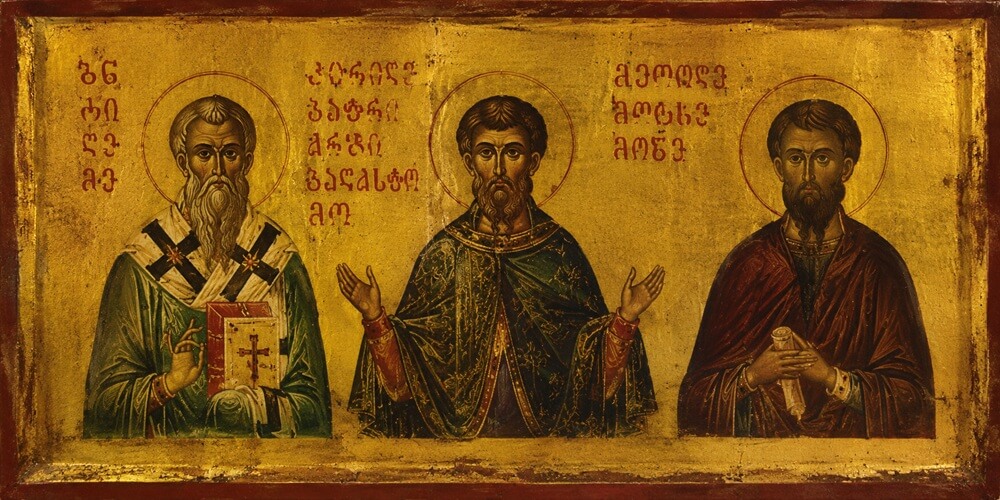
Georgian Golden Saints Petrus the Iberian and Hilarion
The Christian Buddha
Gautama Buddha was an Indian prince who was destined to be a king, but after his unexpected encounter with an old man, a sick man, and a dead man, he left everything to seek the truth. He lived a life of asceticism and monasticism for several years until he finally attained enlightenment.
The story of Buddha is also echoed in the lives of several important figures in the spiritual history of Jerusalem. The first of them is Peter the Iberian (417–491), the son of a Georgian royal family, who became one of the most prominent and influential spiritual figures in the religious landscape of the Land of Israel in the 5th century CE. Some say he is the figure behind Pseudo-Dionysius the Areopagite, the most important early mystical theologian and writer, who had a great influence on the development of Christian mystical thought in the Middle Ages.
Peter the Iberian was the son of the king of Kartli, an ancient Georgian kingdom also called Iberia, whose capital was Mtskheta near Tbilisi. In the holy city, there are objects that came from Jerusalem, and the kingdom was Christianized with the arrival of Christianity in Georgia through Saint Nino, who is also connected to Jerusalem. The sources for the story of Saint Nino are the Church History of Rufinus from the 4th century, the book The Conversion of Kartli from the 7th century, and the book The Life of Nino from the 9th century.
Peter was probably the son of Gurgen, a Georgian king who tried to rebel against the Persians at the beginning of the 5th century (around 523). The rebellion failed, and as a result, the young Peter was sent to Constantinople. He was regarded as the new hope of the Georgians for independence and union with their Christian brothers in the West, especially in light of the strengthening of the Byzantine Empire. But Peter chose the spiritual path instead of becoming a king. Like the Buddha before him, he turned his back on the life of this world and chose to seek eternal life in Jesus.
He arrived at the palace in Constantinople as a 5-year-old boy and was educated by the philosopher Mithridates, who may have been the eunuch John who later accompanied him on his journeys to Jerusalem. The young prince was under the personal care and patronage of Empress Eudocia and was intended to serve as a king who would create a connection between the two kingdoms. At the age of 20, and following a meeting with the younger Melania (mentioned earlier), he decided together with his educator, John the Eunuch, to leave the imperial court, go on a pilgrimage to Jerusalem, and there become a monk.
After arriving in Jerusalem, Peter the Iberian joined Melania’s monastery on the Mount of Olives, and in time he founded a monastery of his own near the Tower of David, called the Monastery of the Iberians. The monastery focused on hosting pilgrims and caring for the sick in the spirit of the rule of Saint Basil, and it became the first center of the Georgians in Israel. Some believe that he also established a Georgian monastery or a Georgian presence in the Monastery of the Cross, and that he or one of his disciples founded a monastery in a place called Umm Lusian, where a first-of-its-kind inscription in the new Georgian script (invented at the beginning of the 5th century by Mesrop) was discovered, in which the name Kartli is mentioned for the first time.
Peter the Iberian chose xeniteia—a voluntary exile, a turning of his back on this world—and he went all the way with his choice. At the beginning of his journey as a monk, he used his connections to support the monastic world and influence theological disputes, but later he cut off ties with his family and even refused to meet with his mother. Unlike other monks such as Sabas, as he grew older he avoided meeting with people he had known, and especially with women who were significant at the beginning of his journey, such as Eudocia. All that interested him was to remain true to the spiritual ideal.
After a decade in Jerusalem, he found himself at the center of the Chalcedonian theological dispute over the nature of God, between the Monophysites and the Dyophysites—a dispute that eventually led the Egyptian, Syriac, Armenian, and Ethiopian churches to declare themselves independent. The monastic movement of Jerusalem played a central role in this dispute. The monks of the Land of Israel brought about the dismissal of Patriarch Juvenal. Although Juvenal eventually returned to his position, this inspired the Christians in Alexandria to depose their patriarch and subsequently to declare an independent church.
Since he was sympathetic to the Monophysite view, in the spirit of ancient Judaism, Peter the Iberian moved—following disputes and persecutions, and perhaps for other reasons—to live in monasteries in Gaza, where he was guided by miraculous figures such as Zenon the Prophet and was initiated into the Christian mystery. In his later years, he lived in Ashkelon and on an estate in Yavne-Yam that was given to him by the heirs of Empress Eudocia. He became famous as a man of wonders, a second Moses, and he had many followers.
After the move to Gaza, Peter the Iberian became a central part of a semi-underground network of monks who advocated for the Monophysite view and clashed with the Dyophysite establishment, and therefore he published his writings under other names. Due to the similarity between his theological views and those of Pseudo-Dionysius the Areopagite, some believe that he is Pseudo-Dionysius the Areopagite. From the writings, one can notice the influences of Gregory of Nyssa, Origen, and, in a different context, Plotinus.
Pseudo-Dionysius probably wrote his writings at the end of the 5th century, under the pseudonym of a saint named Dionysius, who converted to Christianity in the 1st century CE with the arrival of Paul in Athens and not under his real name (and therefore he is called the Impostor). The first person to mention him and who was influenced by his teaching was Maximus the Confessor (died in 662), one of the important figures of the Philokalia. The writings of Pseudo-Dionysius were rediscovered in the Middle Ages and had a great influence on the thought of Thomas Aquinas, on Abbot Suger of Saint-Denis (the teacher of Eleanor of Aquitaine), and on Georgian and Armenian Christianity in the Middle Ages. The art critic Erwin Panofsky claims that the theology of Pseudo-Dionysius the Areopagite influenced the architectural style of the Basilica of Saint-Denis in particular and Gothic architecture in general.
According to Dionysius[8], world is a circular movement of good from God and back toward God, in order and instruction from God. This is a process of enlightenment that progresses in stages and weakens the farther it moves from the source, bringing with it a hierarchy of illumination. The hierarchy is a movement of knowledge and life that emanates from the Father of Lights and reveals the absorption of light that will lead us back to the Father through Jesus, who is the light of the Father. One can receive this light through the holy books (logia), which are a ray of spiritual light. The purpose of the hierarchy is to allow different beings to become like God and to reflect the divine light. Life must pass the light on to other life.
Dionysius calls God beauty: “Thanks to the beauty he emanates on all life, to each according to his measure.” He sees in God the sum and cause of beauty, “the cause of harmony and the garments of the splendor of every creature, for he is the enlightenment of all things, like light, by the flowing of beauty from the radiant source that rises from within him.” Every creature participates in the divine beauty to an appropriate degree and bears the seal of its Creator.
But light is revealed in darkness, and so at the end of Peter the Iberian’s life, darkness prevailed. The Persians took control of Iberia (the name of the ancient kingdom of Kartli—Georgia), turned it into a province in their kingdom, and raised a dynasty of their own to power. The Dyophysites took control of Christian life in the Land of Israel and of the monasticism of Jerusalem. Yet the writings of Dionysius the Areopagite endured, carrying with them the sparks of the spiritual light of figures larger than life who lived here 1,500 years ago.
References
[1] Maoz, Moshe. (2021). Hidden in Holiness: Jerusalem Monasticism in Late Antiquity. Tel Aviv: Gama. pp. 40-42.
[2] Ashkenazi, M. (2000). Jerusalem in the Byzantine Period. Jerusalem: Bialik Institute.
[3] Maoz, Moshe. (2021). Hidden in Holiness: Jerusalem Monasticism in Late Antiquity. Tel Aviv: Gama.
[4] Severus of Antioch. (2011). The Sixth Book of the Select Letters of Severus, Patriarch of Antioch in the Syriac Version of Athanasius of Nisibis. Piscataway, NJ: Gorgias Press.
[5] Hirschfeld, Y. (2002). The Desert of the Holy City: Monasteries of the Judean Desert in the Byzantine Period. Jerusalem: Yad Izhak Ben-Zvi, The Israel Exploration Society.
[6] Patrich, Y. (1993). Judean Desert Monasticism in the Byzantine Period: The Work of Sabas and his Disciples. Jerusalem: Yad Izhak Ben-Zvi.
[7] Vilnai, Ze’ev. (1970). Jerusalem, Capital of Israel (new ed.). Achieber. p. 77.
[8] Beggiani, Seely J. Introduction to Eastern Christian Spirituality: The Syriac Tradition. University of Scranton Press, 1991.