The Works of Justinian
The sacred planning of Byzantine Jerusalem was initiated by Constantine and completed by Justinian, the greatest of the Byzantine builder-emperors (reigned 527–565), who extended the Cardo further south and built at its end, on the slopes of Mount Zion, a great new Basilica church (hence the name Nea), which surpassed all other churches and was dedicated to Mary, the Mother of God. According to legend, when the work was finished, he said: “Solomon, I have surpassed you.”
During the three hundred years of Byzantine Christian rule in Jerusalem, we can distinguish three main waves of construction: that of Constantine at the beginning, that of Eudocia in the mid-5th century, and that of Justinian in the 6th century. However, the Christian understanding of the time was that everything was part of a divine plan to which each ruler contributed his share, sometimes unknowingly.
It is also possible that, as in other great capital cities of the ancient world, there was a master plan for the city that was executed through the ages, based on, on the one hand, the Christian sacred geography, and on the other, Roman sacred architecture. This master plan was preserved by a school of architects, or it might have existed in a design or map of some sort, with each emperor carrying out a part of it, building according to the overall design. Be that as it may, in the 6th century and the beginning of the 7th, Byzantine Jerusalem reached the peak of its splendor, only to be destroyed by the Persian invasion in 614, partially restored with the liberation of the city by Heraclius in 628, and to become a Muslim city, with all that this implied, in 638.
The Cardo was the main street of Roman and Byzantine Jerusalem, aligned along a north–south axis from Damascus Gate southward, a street whose beginnings lay in the Roman period of Aelia Capitolina. After the Bar Kokhba revolt, Emperor Hadrian built a new city according to the Hippodamian grid plan, with intersecting streets and two main avenues. However, in the Roman period, the Cardo reached only as far as the area of the Church of the Holy Sepulchre, where a temple to Aphrodite had stood, and this remained the case also in the early Byzantine period. Toward the end of the Byzantine era, the Cardo extended to the southern limits of the city, as far as the Nea Church in the area of today’s Jewish Quarter, and was rebuilt in magnificent form, with the street reaching a width of 22.5 meters. In addition to the main Cardo, there was a secondary Cardo running southeast and starting from the same point—Damascus Gate—toward the Temple Mount, eventually heading south and reaching the Pool of Siloam. This Cardo was 24 meters wide in its upper section, with a single colonnade, as depicted in the Madaba Map.
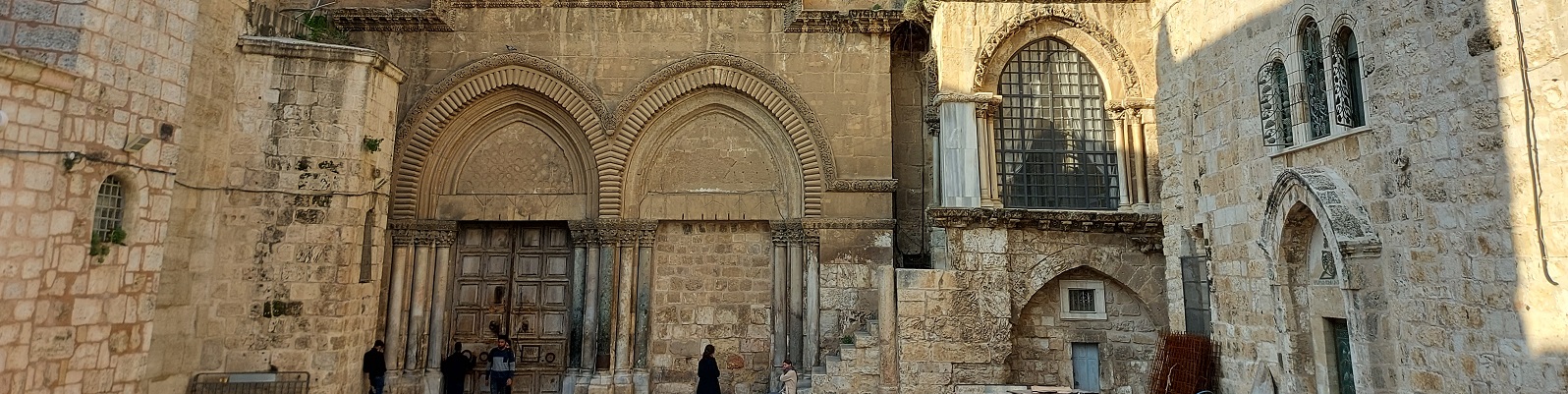
The Church of the Holy Sepulchre, unlike all other churches in the world, was oriented westward, toward the Holy Tomb. The basilica entrance opened to the Cardo, and the apse was facing west. This was a huge basilica, 56 meters long, leading to a round structure—the Rotunda—with a colonnaded courtyard between them that contained the rock of Golgotha.
With the strengthening of devotion to Mary in the 5th century CE, and in order to complete the sacred geography of the city, Justinian built a basilica twice the length of the Church of the Holy Sepulchre, which was called the Nea. This church also extended from the Cardo, but faced east instead of west, and was dedicated to Mary rather than to Jesus. Through this duality of west and east, Jesus and Mary, through the proportional relationship between the two buildings, and through the different rituals conducted within them, there arose a unifying duality which became a feature and generator of holiness.
If in the Church of the Holy Sepulchre the focus was on death and resurrection—especially at Easter, on suffering and sacrifice—in the Nea Church the celebration was of birth, and at times it replaced the Church of Bethlehem as the place where the Christmas Mass was held. The orientation of the Holy Sepulchre to the west was connected with sunset and therefore with death and resurrection, whereas the orientation of the Nea Church to the east was toward birth and life. Mary was the means through which divinity entered the world—Jesus—and the church’s location in the south emphasized the physical aspect of incarnation (since the south was associated with the physical) and was also connected with the places where Mary lived, acted, and fell asleep—Mount Zion.
Between the Nea Church and the Church of the Holy Sepulchre there were religious processions that made use of the wide, well-designed street. To the southwest of the Nea Church stood the Church of Hagia Zion, or by its other name the Church of the Apostles—the site of the Last Supper, the descent of the Holy Spirit upon the disciples, the place of the first Christian community, of baptism and Eucharist, and later also the place of Mary’s Dormition. From the Nea Church, the faithful could continue along a broad processional avenue that was not the Cardo to the Church of the Apostles, connect with the Holy Spirit that descended there at Pentecost, and thus experience a triangle of holiness: Jesus, Mary, and the Apostles (the Holy Spirit). In this way, the three holy places along the same processional route encompassed within them the three most important Christian feasts—Christmas, Easter, and Pentecost.
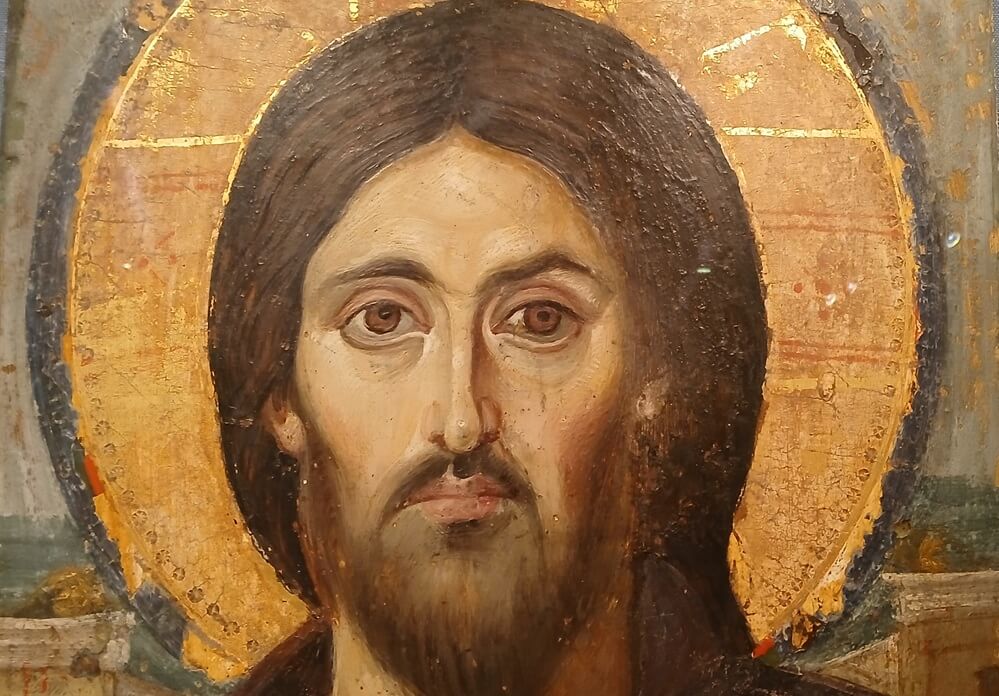
Oldest Icon of Jesus. Sinai 6th Century
The Spiritual Meadows
The monk and mystic John Moschus (550–619) lived and worked in Jerusalem at the end of the 6th and the beginning of the 7th century, the height of the monastic movement and a time of spiritual, religious, and cultural flourishing, just before the Muslim conquest. Fortunately for us, Moschus wrote a book called the “Spiritual Meadows”[1] in which he sketched the spiritual map of Byzantine Jerusalem on the eve of its disappearance: the important Christian figures in the city, the patriarchs, the monastic centers in Jerusalem and its surroundings, and more[2].
Moschus was born in Damascus but became a monk in the Monastery of Theodosius and the Monastery of Saint Sabbas near Bethlehem. At the age of 28, he began to wander across the Middle East, accompanied on his journeys by Sophronius, who would later become Patriarch of Jerusalem at the time of the Muslim conquest. They reached Carthage, where they were exposed to the teachings of Dionysius the Areopagite and Gregory of Nazianzus[3].
Sophronius of Jerusalem (560–638) was a cleric, theologian, mystic, and the last Christian patriarch of Jerusalem before the Muslim conquest. He led the defense of the city but, once defeat was inevitable, he received Caliph ʿUmar and accompanied him into the Church of the Holy Sepulchre, obtaining from him a charter of rights for the Christians. Afterwards, he composed laments over Jerusalem, and even before its conquest he had written poems of longing for the city during his travels, in which he described its main Byzantine sites and the city in all its splendor. He also wrote about the life of Mary of Egypt, a saint who embodied the principle of repentance in Christianity and the possibility of attaining salvation even from the lowest state, thereby providing the masses with a popular holy figure with whom they could identify.
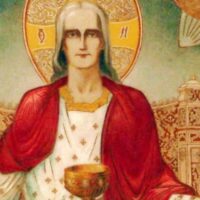
Maximus the Confessor
Sophronius was the teacher of Maximus the Confessor (580–662), one of the most important contributors to the Philokalia (“love of beauty”)—the writings of the Desert Fathers (the “night vigilants”). It can be said that this collection of writings, most of which dates from the Middle Ages, is in a certain sense the Zohar of Christianity. From this we can infer that Sophronius himself probably practiced some form of inner meditative prayer (Hesychasm).
Maximus the Confessor was born, according to some sources, in the land of Israel (perhaps Jerusalem) to Maronite parents, but he grew up in Constantinople, where in his youth he served as the personal secretary of Emperor Heraclius. He later moved to Carthage and studied Neoplatonic writings and other philosophical doctrines, developing his mystical Christian view of the possibility for man to become like God (theosis). He is the most frequently quoted figure in the Philokalia, much of which was written centuries later in the Middle Ages, but which was also based on his thought[4].
Maximus believed in the redemption and return of humanity to a state of unity with God—not only Christians, but all rational souls. He integrated the doctrine of Plotinus into Christian thought: man has a divine origin and longs to return to his natural state, and therefore sanctification is possible. Within man there is a divine spark, the proof of which is that Jesus himself took human form, and thus the divine is present within humanity. The dyophysite doctrine, the dual nature of Jesus as both divine and human, was of the utmost importance, but it had to be understood in a mystical way. Maximus was also the first to write a full biography of Mary.
He was called the Confessor because he endured harsh torture but did not die a martyr’s death. To prevent him from speaking, his tongue was cut out; to prevent him from writing, his hand was cut off. He later moved to Georgia, where he died. Despite this, it is assumed that he remained faithful to his understanding of Jesus’ teaching: “True love and affection, that is, faith and a pure conscience, are clearly the result of a hidden impulse within the heart, for the heart can produce them of itself without any need for external stimulus.” (Maximus the Confessor).
Footnotes
[1] Moschus, J. (1992). The Spiritual Meadow (J. Wortley, Trans.). Kalamazoo, MI: Cistercian Publications
[2] Vasileiou, F. (2025). Holy Places and Liminal Spaces in John Moschos’s Spiritual Meadow. In Boundaries of Holiness, Frontiers of Sainthood: Negotiating the Image of Christian Holy Figures and Saints in Late Antiquity (pp. 203-228).
[3] Chadwick, H. (2017). John Moschus and his friend Sophronius the Sophist. In Late Antiquity on the Eve of Islam (pp. 385-418). Routledge
[4] Maximus the Confessor. (1985). Selected Writings (G. C. Berthold, Trans.). Mahwah, NJ: Paulist Press