Crucifixion and Resurrection Mystery
Orthodox Christianity is characterized by a mystical, allegorical interpretation of the Christian story and a view of the various events as mysteries[1]. Without a doubt, the greatest mystery of all is the mystery of life and death. This is expressed in the mystery of the crucifixion and resurrection. It must be understood that Jesus is crucified anew every day. The cross is our indifference, our unwillingness to do anything with our lives despite the infinite divine giving and love, despite the sacrifice. The mystery of the crucifixion is the waste of our lives in vain, the pursuit of materialism and passions. Even though deep within us there is the recognition that this is not the way, we are still unwilling to perform even the smallest act to save the Son of God who suffers for our sake.
The mystery of the crucifixion is the essence of the Christian way. It is not an event that happened in the past, but a process that we must undergo throughout our lives, in which we must shed the old self and kill the ego in order to be reborn into the spiritual world. This is the most essential and fundamental transition on the spiritual path, and it takes place both in a holistic view of life and at every stage of life, where we must give up our former existence so that we can move on to the next stage. For example, the child who becomes an adult and leaves home dies to a part of his former life in order to be reborn into the world of independence. And for the parents, they too experience a kind of death when their children leave home and begin a new life. The lesson is not to hold on to the horns of the altar, but to let go of what was.
Jesus is nailed to the cross by his hands and feet, but his head remains free, symbolizing our state in this world: our physical parts are bound by the laws of the material world, yet our mind remains free. The cross is an ancient symbol of the material world (representing the four directions, the four elements, and the four states), and one interpretation of the man hanging on the cross is that our spirit longs to be free but is tied to the material realm. The mind desires to go home, but we are stuck in Tel Aviv traffic jams.
Jesus on the cross is man in his most difficult state, hanging between heaven and earth in a state of suffering, a moment before a torturous death, and yet he passes on instructions to Mary and John and connects them: “When Jesus saw his mother and the disciple whom he loved standing by, he said to his mother, ‘Woman, behold your son!’ Then he said to the disciple, ‘Behold your mother!’ And from that hour the disciple took her to his own home” (John 19:26). Despite his condition, Jesus is not focused on himself, and he promises the good thief crucified next to him that he will meet him in Paradise: “Truly, I say to you, today you will be with me in Paradise” (Luke 23:43), and even asks God to forgive those who crucified him: “Father, forgive them, for they know not what they do” (Luke 23:34). In other words, even in the most difficult situation, we have the ability to choose between good and evil.
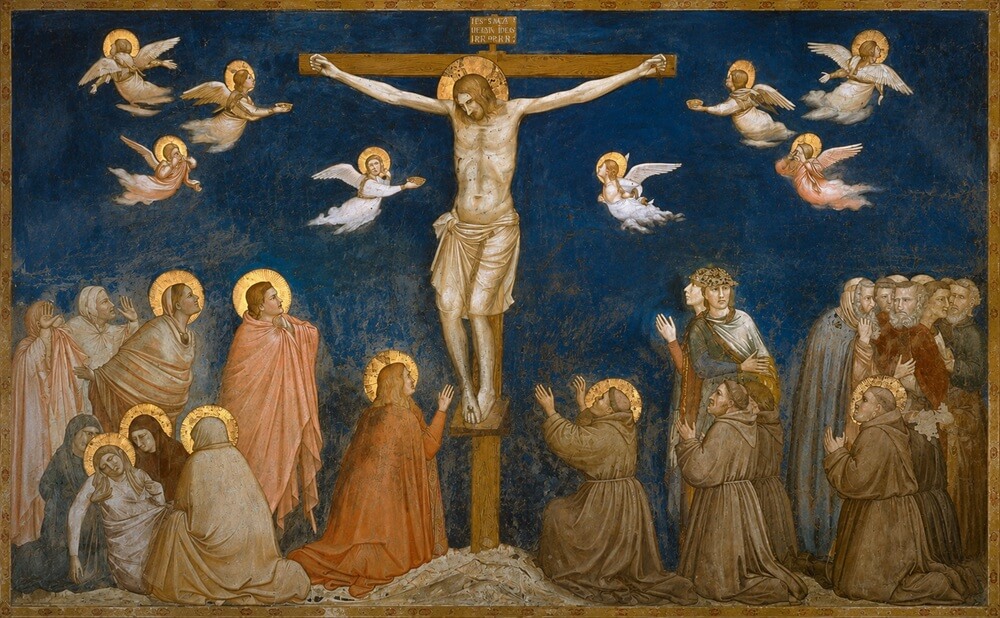
The mystery of the crucifixion is related, in my understanding, to the law of karma. Before Jesus leaves the earth, he makes sure that he has not left scorched earth behind him and asks for forgiveness and pardon for those who harmed him. He forgives them himself and thus does not take with him to the kingdom of heaven negative energies of resentment and revenge that would ultimately harm him.
On Friday at the sixth hour, Jesus gives up his soul to the Creator and says: “Father, into your hands I commit my spirit” (Luke 23:46), but in Mark and Matthew, his last words are: “My God, my God, why have you forsaken me?” (Mark 15:34; Matthew 27:46). The question arises as to why these are his last words? After all, Jesus went to the crucifixion willingly in order to atone for the sins of the human race. Could he not have chosen more “appropriate” words, such as Rabbi Akiva, who in his last moments said: “Hear, O Israel, the Lord our God, the Lord is one,” and lingered on the word “one,” and died.
One of the interesting Christian interpretations is that Jesus wanted to descend to the underworld in order to rescue the souls of the righteous from Sheol, and for this, he had to give up his communication with God, to give up the most important thing of all with which everything can be endured, to give up hope. Jesus was willing to go all the way, to die without the knowledge that he would rise again in order to bring light to the underworld as well as to this world, and therefore he says in his last moments, “My God, why have you forsaken me?”
The mystery of the crucifixion is that, in order to rise again, we must first die to our “old self,” the “old man,” the ego. We must reduce the self to nothing. Therefore, all the mysteries of the ancient world and all rites of initiation—from Egypt to the Freemasons—involved a ritual of simulated death, intended to allow rebirth into the spiritual world. In some of these initiation rites, the initiate remained in an underground, secluded space for three days, just as Jesus stayed in the tomb for three days before rising again.
The mystery of the resurrection stems from the crucifixion that preceded it. True resurrection is a spiritual awakening. This is the real meaning of the story of the resurrection of the dead, which, if taken literally, is nonsense (as in the vision of the dry bones). Resurrection is the realization of the power of life. The mystery of the resurrection is that there is a spiritual element dormant within us that can be awakened. This is the story of Sleeping Beauty—but in our story, it is Jesus who awakens us by his sacrifice, who rouses us from our complacency. Jesus leads us through the dark night of the soul, through the valley of sorrow, through the way of suffering, and by his sacrifice grants us new life in the spiritual worlds. After the awakening of the dormant spiritual part within us as a result of this process, we acquire the nature of Jesus within us.
The essence of Christianity is the resurrection, an event that symbolizes victory over death and the restoration of the world to the point where humanity can return to its original spiritual state, as it was in the Garden of Eden. The ultimate Christian miracle is the resurrection. It is not enough for the Word to be embodied in matter, for the Son of God to appear in this world, and for the kingdom of heaven to be revealed to humanity. What is essential is the resurrection—the triumph over death—otherwise all other things are meaningless, for everything else is fleeting. The resurrection is the central goal to which humanity has aspired throughout the generations. It answers the desperate human search for meaning that appears in all religions and cultures. According to John Paul II, the meaning of the Christian faith is the resurrection, as it appears in the verse: “And if Christ has not been raised, then our preaching is in vain and your faith is in vain” (1 Corinthians 15:14)[2].
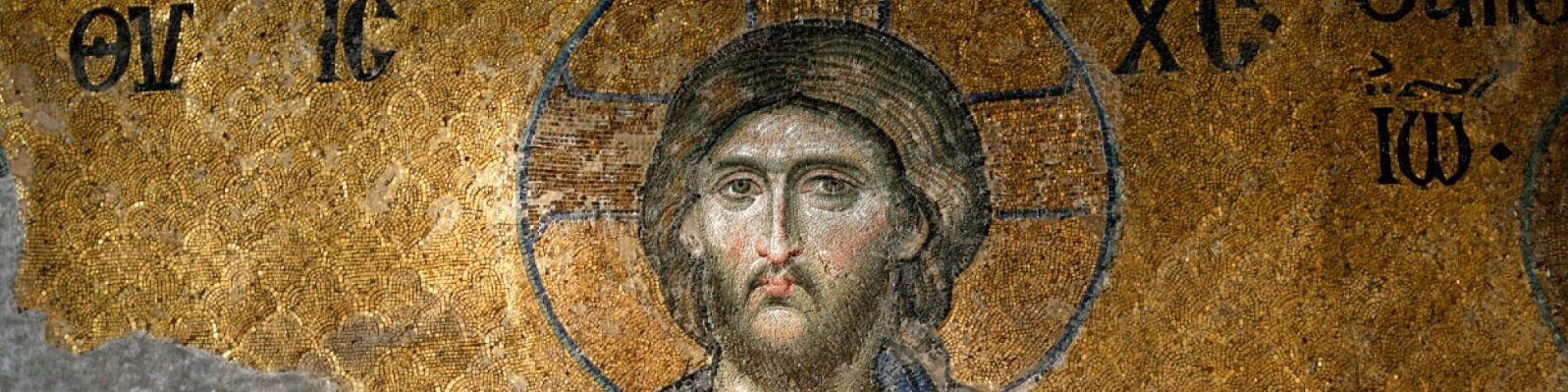
However, Catholic Christianity tend to emphasize the crucifixion. It is Orthodox Christianity that emphasizes the resurrection of Jesus and not the crucifixion. Therefore, Orthodox Christian ceremony is a celebration of sounds and smells, processions and colors, that express life and man.
The resurrection of Jesus helped to strengthen the faith among the disciples, and you, the readers, would also believe if you met someone who rose from the dead. But there is another meaning of the resurrection, which is much greater than the personal resurrection of Jesus. It can be said that the resurrection is a prefiguration of the resurrection of the dead that will come at the end of days, and it heralds the possibility that exists for all human beings to return to their spiritual state. It confirms the principles of the Jewish faith in the coming of the Messiah and redemption. It is the summary of hundreds of thousands of years of human faith. The resurrection carries with it the promise of eternal life, and meanwhile, all we have to do is believe.
Steiner gives another meaning to the mystery of Golgotha (the crucifixion and resurrection) and argues that it changed the spiritual destiny of the world[3]. Since Golgotha, there has been an external religion that is open to all, and an esoteric Christianity whose representative is the Apocalypse (the vision of John). At the beginning of the Apocalypse, Jesus says, “I am the Alpha and the Omega,” meaning that he exists within us. The outcome of the process of crucifixion and resurrection is a Christ impulse that can dwell within us and shape the way we think.
According to Steiner, esoteric Christianity is about the evolutionary development of man, and this is represented by the 24 elders in the vision near God. The mystery of Golgotha is the mystery of individuality, denial, and loneliness that leads to enlightenment, in contrast to the group spirituality that preceded it.
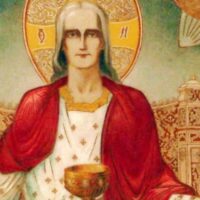
Steiner brings as an example Parsifal from the legends of the Holy Grail who arrives at the castle where the Holy Grail is kept. He is invited to a feast with all those present, and then the spear of destiny and the Holy Grail appear before him carried by miraculous figures, but Parsifal does not react to the sight and does not ask what the Grail is for. And therefore, the next morning he finds himself abandoned, desolate, and mocked, and is forced to spend several years in loneliness and distance until he is ready to accept the challenge and only then finds the castle again.
Parsifal passes through the journey of individuality, which is reminiscent of the journey of the solitary monks in the desert. The denial of the world and loneliness allow a connection to something of a much higher value. Ancient spirituality was the spirituality of a society that existed with the help of collective rituals and processes, but the story of Parsifal heralds something else.
The extreme individuality of Western society hints at a new spirituality, and it can lead to a different kind of connection, personal responsibility, and an inner religion. But if it is in a social context, then it can lead to egoism, as happens today, when people are not willing to pay the price of voluntary loneliness. The solitary monks partly fulfill this new spirituality, but it is not physical loneliness only, because one can be in a cell in the desert and think about life at home, but an existential loneliness.
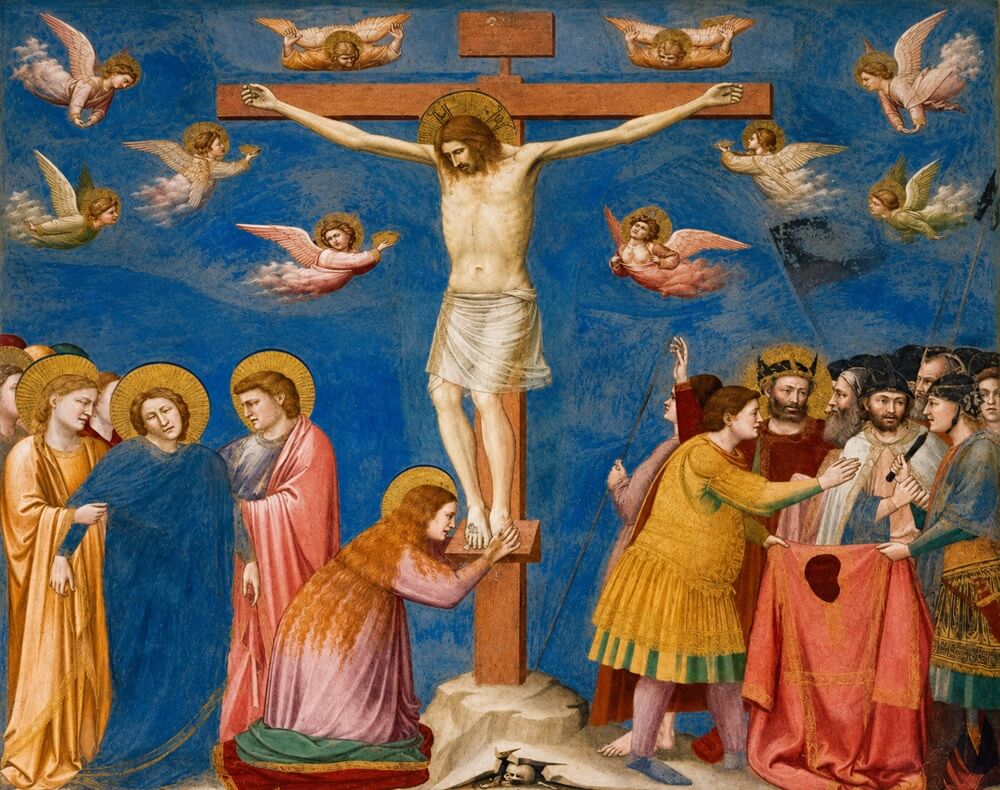
The Crucifixion
The Descent into Sheol (Katabasis)
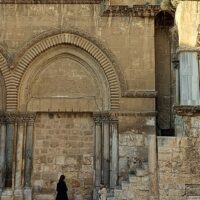
Jesus was buried on Friday afternoon in the tomb at the Church of the Holy Sepulchre, which was probably part of an ancient cemetery. According to Jewish tradition, it is forbidden to visit a cemetery on the Sabbath, and therefore only on Sunday at dawn, Mary Magdalene comes to the tomb and discovers that the large capstone was removed and the tomb is empty. And so it is written: “After the Sabbath, as Sunday morning dawned, Mary Magdalene and the other Mary came to see the tomb. And behold, there was a great earthquake, for an angel of the Lord descended from heaven and came and rolled back the stone from the door and sat on it. His appearance was like lightning, and his clothes were as white as snow, and from fear of him the guards trembled and became like dead men. And the angel said to the women, ‘Do not be afraid; for I know that you seek Jesus who was crucified. He is not here; for he has risen, as he said. Come, see the place where he lay. Then go quickly and tell his disciples: ‘He has risen from the dead, and behold, he is going before you to Galilee. There you will see him.’ He told them.” They left the tomb quickly with fear and great joy, and ran to tell his disciples. Suddenly Jesus met them and said: “Greetings.” They came up to him, took hold of his feet and worshipped him. Jesus said to them: “Do not be afraid, go and tell my brethren to go to Galilee, and there they will see me.” (Matthew 28:1-10).
According to John, there is an intimate moment between Jesus and Mary Magdalene, when they meet and she does not recognize him: “After she said this, she turned around and saw Jesus standing there, but she did not know that it was Jesus. Jesus asked her: ‘Woman, why are you weeping? Whom are you seeking?’ Because she thought he was the gardener, she said to him: ‘Sir, if you have carried him away, tell me where you have put him, and I will take him away.'” Jesus said to her: “Mary!” Then she turned and said to him: “Rabboni!” Jesus said to her: “Do not cling to me, for I have not yet ascended to the Father, but go to my brothers and tell them: ‘I am ascending to my Father and your Father, to my God and your God.'” (John 20:14-17).
This text has led to modern interpretations claiming that Mary Magdalene and Jesus were married, because she calls him “Rabboni” (a name for a master), and he says to her “do not cling to me” (meaning she used to touch him). According to this interpretation, Mary Magdalene was supposed to be the one to continue Christian teaching and spirituality after Jesus, his closest disciple, and this is expressed in the sentence: “Go to my brothers and tell them: ‘I am ascending to my Father and your Father…'” This claim also appears in the Gnostic apocryphal literature, and especially in the Gospel of Philip and the Gospel of Mary Magdalene, where it is mentioned that Jesus used to kiss Mary Magdalene on the mouth – a symbol of the transfer of the spirit, pneuma, in ancient times, and that he revealed secrets to her that he did not reveal to others.
According to John, Jesus appeared to the disciples that same evening in their house and gave them the Holy Spirit. One of the disciples who was not present at the event and was called “Doubting Thomas” refused to believe that Jesus had risen, and so Jesus appeared to them again eight days later and told Thomas to put his hands in the wounds in his hands and side. Thomas cried out “My Lord and my God” (John 20:28) and Jesus said in response: “Because you have seen me, you have believed; blessed are those who have not seen and yet have believed.” The fruit of the resurrection is faith, and the mystery of faith is the possibility of reaching it even without seeing, because it exists within us.
The question is what Jesus did in the time between his burial on Friday and his meeting with Mary Magdalene on Sunday morning (Christians consider this to be three days)? According to hints in the New Testament, he descended to the underworld, broke the gates of Sheol, and rescued the souls of the righteous from there. And so Peter writes: “For Christ also suffered once for our sins, the righteous for the unrighteous, that he might bring us to God, being put to death in the flesh but made alive in the spirit: in which he went and proclaimed to the spirits in prison” (1 Peter 3:18-19). And also: “For this is why the gospel was preached even to the dead, that though judged in the flesh the way people are, they might live in the spirit the way God does” (1 Peter 4:6).
In the ancient world, there were people such as Orpheus or Hercules who descended to the underworld and ascended from it, and by this, they helped their immortality and in the process tried to rescue others, but no one did it for the sake of all mankind. Before the crucifixion, even the purest souls descended to Sheol and there was no possibility of reaching Paradise. When Jesus descends to Sheol, he breaks the gates of Sheol, and there are various references to the fact that in the days after his death, many people rose from the dead and were seen in the streets of Jerusalem: “The tombs were opened, and many bodies of the saints who had fallen asleep were raised, and coming out of the tombs after his resurrection they went into the holy city and appeared to many” (Matthew 27:52-53). The resurrection of Jesus is also the resurrection of all mankind, not only in the present but also in the past. There are many paintings in which Jesus is seen at the time of the resurrection rescuing Abraham and Sarah, or Adam and Eve, from Sheol. He breaks the doors of Sheol or the lids of the coffins.
The descent into the underworld is not described in the New Testament, but is hinted at in various verses. However, because of its archetypal nature, the story was developed in later literature, and this was suitable for the mythological concepts of the new religion and for the hero archetype that Jesus embodied. The katabasis (Descent into the underworld) is one of the reasons why early Christian worship took place in catacombs. This was a necessity of reality, but it was also mystically accepted as appropriate. The dead were buried in the ground, or in underground spaces (later church crypts). Their kingdom was underground, but it was the same ground that knew how to give life, to renew itself every year and sprout the seeds that were seemingly dead from the previous year, the same ground that absorbed the blood of Jesus. The crucifixion, burial, and descent into Sheol of Jesus cemented the divine energy in the ground, to be there for future generations and forever, to allow the development and awakening of the whole world on the way to resurrection. This was a cosmic drama, a hierophany of the appearance of the holy in the mundane, a descent for the purpose of ascent.
According to Steiner, Jesus brought a new spiritual path. He presented a new mystery school, and the first person to undergo initiation in this way was Lazarus, who died and rose again. He became John, the beloved disciple of Jesus, and wrote the Gospel of John. The descent into Sheol of Lazarus was different from the katabasis of other ancient initiation rites. After his “death,” Lazarus met the Logos, the one who stood outside him and was embodied in flesh and became a different person.
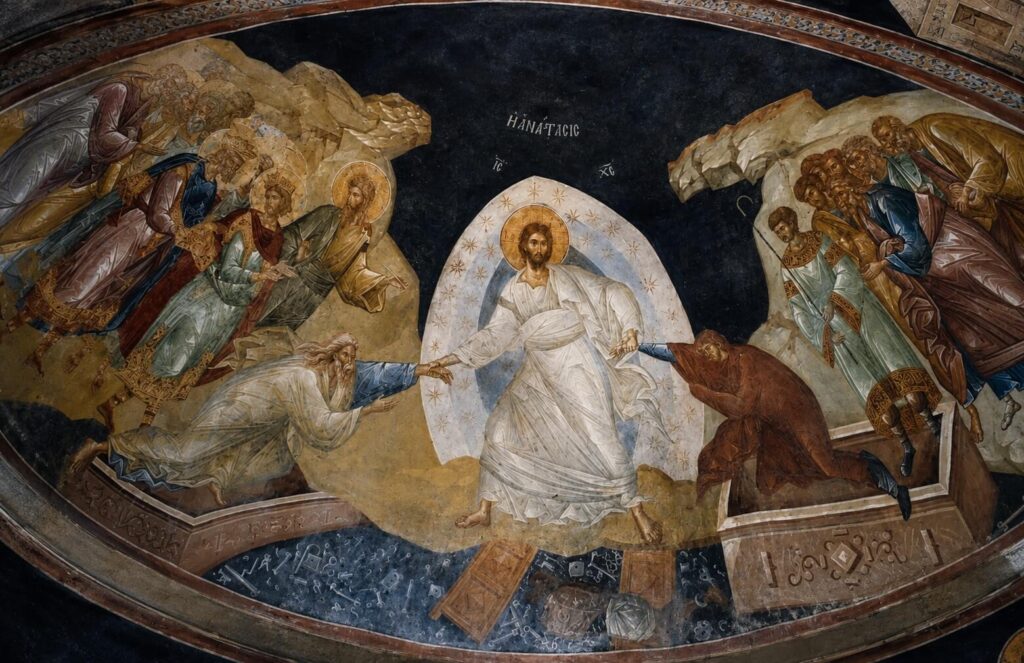
Harrowing of Hell
The Ascension of Jesus
Jesus descended to Sheol in the western part of the city, but he ascended to heaven from its eastern part – the Mount of Olives. The deep meaning of the Ascension is the existence of a connection between the worlds and the possibility for every person to become a god after their death. It is not enough to rise from the dead in this world, but there is a need to reach better worlds, and the promise is that such worlds exist in the upper realms. Jesus defeated death in this world and also in Sheol (the underworld), but in order to complete the victory, he had to return home to his Father and ascend to heaven as a being of light whose place is by the side of God and among the angels.
And so, after Jesus rose from the dead in Jerusalem, he appeared in various places throughout the country and met the disciples for 40 days. During this time, he strengthened their hearts and faith, taught them the “small” mysteries of the Christian way, crowned Peter as the leader of the community after him, and put them through a process at the end of which they were able to receive his power and spiritual authority during the Pentecost. After he completed his mission, it was time for him to return home, and he ascended to heaven.
The Ascension is related to Jesus’s new-old role as one who sits by the side of God and rules over heaven and earth, and for this, he must return to his natural state and place as part of the divine. When he sees the disciples in Galilee, he says to them: “All authority in heaven and on earth has been given to me” (John 21:18). According to Mark, Jesus was carried up to heaven: “So then the Lord, after he had spoken to them, was taken up into heaven and sat down at the right hand of God” (Mark 16:19). According to Luke, the event took place in the area of the Mount of Olives: “Then he led them out as far as Bethany, and lifting up his hands he blessed them. While he blessed them, he parted from them and was carried up into heaven” (Luke 24:50).
Throughout the ancient world, there were various traditions about divine people who died and rose from the dead, and the second part of the story was their deification. In ancient Thrace, for example (today Bulgaria), there was a teacher named Sabazios who rose from the dead and became a god; in Greece, Dionysus, who was born to an earthly mother and a divine father, rose from the dead after the Titans tore him to pieces and became one of the Olympian gods. Hercules became a god after death, and so did others. In the end, all the Roman emperors became gods in the process of apotheosis, which has a deeper meaning of the ascent to heaven. Even in Judaism, there was a tradition of people who ascended to heaven and became a kind of angels, and especially Enoch who became Metatron, the deputy of God.
The Ascension of Jesus is mentioned in Mark and Luke, but it appears in its entirety only in the book of Acts, where it is told that Jesus appeared to the disciples for 40 days and spoke to them about the kingdom of God, that is, he taught them the “small” mysteries. And so it is written: “And when he had said these things, as they were looking on, he was lifted up, and a cloud took him out of their sight. And while they were gazing into heaven as he went, behold, two men stood by them in white robes, and said, ‘Men of Galilee, why do you stand looking into heaven? This Jesus, who was taken up from you into heaven, will come in the same way as you saw him go into heaven'” (Acts 1:9-11). In other words, Jesus will return from heaven to the same place and in the same way that he ascended, and according to Christian tradition, this will happen on the Day of Judgment at the Mount of Olives.
The New Testament tells us that two men—Moses and Elijah—appeared alongside Jesus at the Transfiguration on Mount Tabor. Tradition suggests that the two mysterious men who appeared alongside Jesus at the time of the ascension were Moses and Elijah as well, while others suggested that they were angels.
The Ascension took place from the Mount of Olives because it is the same place from which the Messiah will come at the end of days and where miraculous things will happen. According to the prophecies of Zechariah: “On that day his feet shall stand on the Mount of Olives that is before Jerusalem on the east, and the Mount of Olives shall be split in two from east to west by a very great valley, so that half of the mountain shall move northward, and half of it southward” (Zechariah 14:4). And it must be added that the sun rises over the Mount of Olives every day, and this is the cosmic drama that was celebrated in the Temple and in Jerusalem.
According to Eyal Davidson[4], Christian tradition identified the place of Jesus’s Ascension from the Mount of Olives as the place of the Shekhinah’s ascension to heaven after the destruction of the Temple. The Ascension is a point of contact between his earthly appearance and his divine figure. His dual nature is united and connected. Jerome refers to this in his commentary on the book of Ezekiel, and Eusebius also talks about Jesus’s Ascension to heaven as the fulfillment of Zechariah’s vision about the splitting of the mountain at the end of days and the return of the glory of the Lord to it.
The Ascension reveals to us the secrets of the future and the resurrection of the dead, a time when human beings will return to their spiritual state and dwell in Paradise, enjoying the pleasures of the spiritual world. This belief gives hope, but for the vision to be fulfilled, personal development and transformation are required, an ascent up the steps of the spiritual ladder, and a passage through the various stages of the spiritual path.
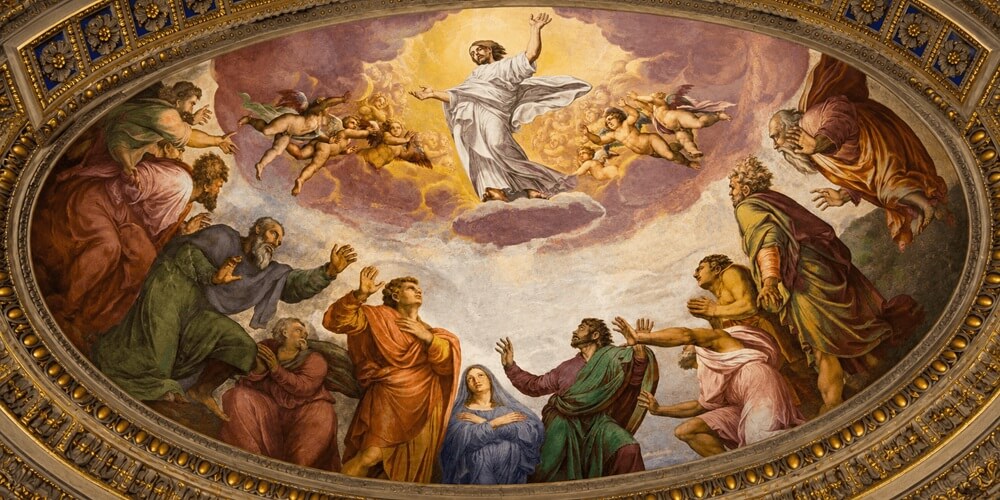
Ascension of Jesus
The Assumption of Mary
There are two people who ascended to heaven according to Christianity: one is Jesus, and the other is his mother, Mary. The term for their ascension in English is different. While the ascension of Jesus is called Ascension, the ascension of Mary is called Assumption, and therefore its nature is different. Jesus returns home to his Father, while Mary opens the way of resurrection for the human race.
In chapter 1 of the book of Acts, Mary is mentioned for the last time in the New Testament: “After this, they returned to Jerusalem from the Mount of Olives, which is near Jerusalem as a Sabbath day’s journey. Peter, and John, and James, and Andrew, Philip and Thomas, Bartholomew and Matthew, James the son of Alphaeus, Simon the Zealot, and Judas the son of James, went up to the upper room where they were staying. All these with one accord were devoting themselves to prayer, together with the women and Mary the mother of Jesus, and his brothers” (Acts 1:12-14). One can learn from this that Mary was present at the Ascension and that she was part of the inner circle of Jesus Disciples, if not the leader of it.
The belief in the Assumption of Mary first appears among fringe groups from the East and in Gnostic movements in the 3rd century CE. Until then, there was no clear tradition about the place of her death, the manner of her death, or the time of her death. In the 5th century, traditions also developed that Mary lived in Ephesus, because she was under the care of John who moved to Ephesus, and there is also a house that is identified as hers. There was a tradition that she was also buried in Ephesus, but it was abandoned. The German mystic of the 19th century, Catherine Emmerich, had visions of Mary’s house and burial place in Ephesus, and some of them were accepted by the Church. But in general, the identification of the place of her burial and assumption was accepted by most Christians to be Jerusalem.
According to John Paul II, Jesus ascends to heaven to be at the right hand of God, and Mary attains the same status a few years after him, and this is a kind of preview of the resurrection of the dead on the Day of Judgment[5]. The Assumption brings with it hope and faith, which are the two pillars of the temple of religion, two feminine qualities that were personified in Christian literature and art, including in some of the churches of Jerusalem. Hope is for the renewed return of Jesus at the end of days and the establishment of the kingdom of heaven on earth, for the redemption of the human race and the return of human beings to the state of Paradise. Faith stems from the fact that this has already happened in miniature, at the time of Jesus’s appearance in the world, his resurrection and ascension to heaven, and the assumption of Mary.
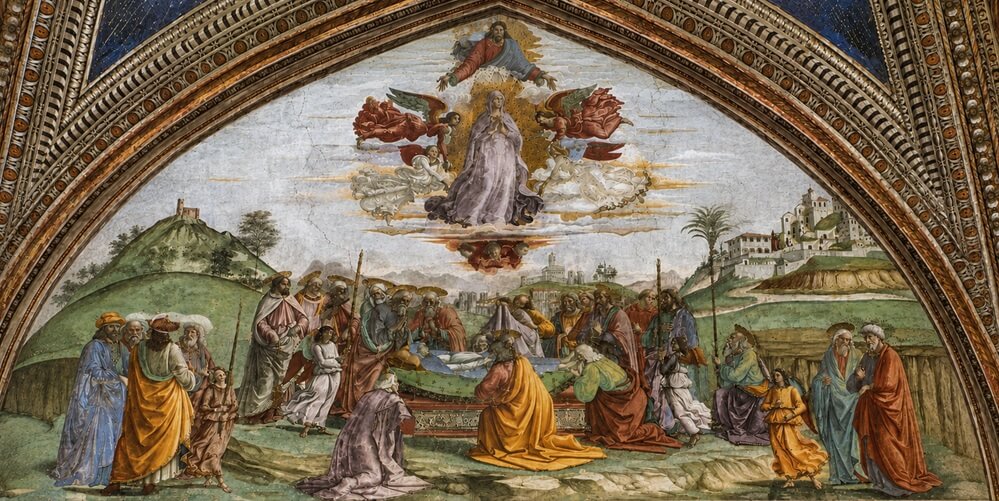
The Tomb of Mary
As far as we know, from the 3rd century onwards, additional traditions and descriptions appear, besides those of the New Testament, regarding the actions and life of Mary. This trend intensified in the 4th century and reached its peak in the time of two important women who lived in Jerusalem—Eudocia and Pulcheria—and so the belief developed that she fell asleep at the end of her life on Mount Zion, was buried in the Valley of Jehoshaphat, and ascended to heaven.
According these late traditions, she was the leader of the early Christian community and liced with the disciples on Mount Zion. After her “dormition,” Mary was taken for burial in the Tomb of Mary in the Valley of Jehoshaphat, but after three days, Jesus came and took her up to heaven in her body and soul, and there she was crowned Queen of Heaven, sitting by the side of Jesus and mediating for human beings who, thanks to her, receive forgiveness and nurture hope.
A Syrian book from the 3rd century is the first to mention the Tomb of Mary in Jerusalem and tells of the presence of the apostles in it and the taking of her body to heaven by the angel Michael. Another book, from the 4th century, mentions a cave in the Valley of Jehoshaphat to which her body is taken, with various miracles occurring along the way as the Jews try to harm her. In the 5th century, her burial clothes were found and a church was built to house them in Constantinople. In a 5th-century book called Pseudo-Mileto, the story of Mary’s dormition on Mount Zion appears for the first time[6].
The Tomb of Mary is located in the lowest place in Jerusalem, which is at the foot of the highest place to its east, the summit of the Mount of Olives. It can be assumed that as part of the sacred geography of ancient times, this was a place of worship for a female deity that was associated with caves that symbolized the womb of the earth, while at the summit of the mountain there was a place of worship for a male deity. It is interesting to note that Mary ascended to heaven from the lowest place in Jerusalem, while Jesus ascended to heaven from the highest place to its east. These are two different ascents that take place in different places and whose fruit is different.
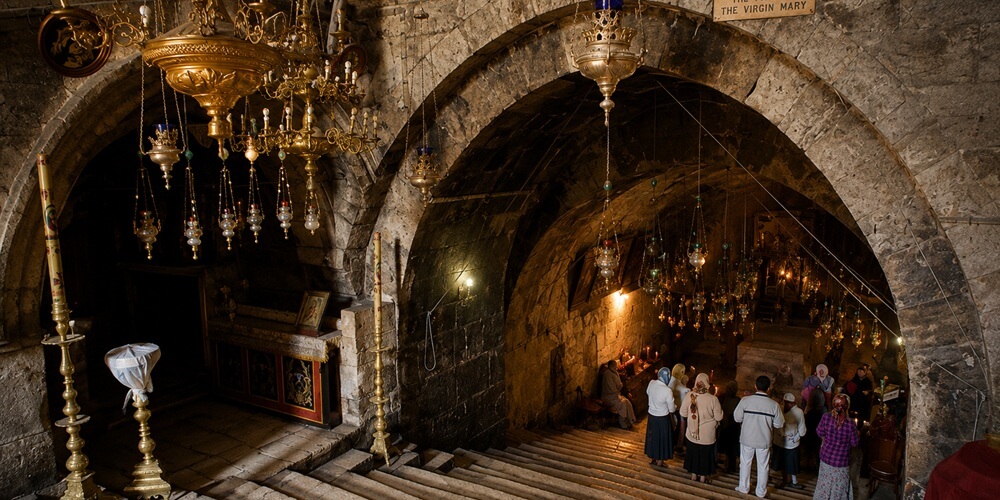
The tomb is located in a deep, carved burial cave that descends into the earth. In the cave, there is an inner room where Mary stays for three days, until Jesus arrives and awakens her from her dormition and takes her to heaven, body and soul. The Assumption of Mary is no small thing, and it is a preview of the resurrection of the dead that will first take place in this place. The Ascension of Jesus to heaven is a natural thing because he is the Son of God, but Mary is a human being, and the meaning of her assumption is that she becomes a divine being, the Queen of Heaven.
The Assumption of Mary is dated to August 15. On this day, magnificent processions of Catholics, Orthodox[7] and other Christian denominations are held from the place of Mary’s birth in the Church of St. Anne, which is inside the Old City behind the Lions’ Gate, to her burial place outside the walls at the bottom of the Valley of Jehoshaphat. It should be noted in this context that the Catholics have no rights in the tomb structure itself, but only in a nearby system of underground tombs, perhaps because of the belief of some of them that she is buried in Ephesus.
Byzantines built a church over Mary’s tomb, but it was destroyed by the Persians, and in its place the Crusaders built a magnificent and large church that was part of a Benedictine monastery. The place was a center of mystery rituals and worship, and the Templars also used it. The queens of Jerusalem, led by Melisende, were buried in the Josaphat Monastery (as it was called) inside Mary’s tomb, and it largely served as a royal monastery in the style of monasteries in France.
After the defeat of the Crusaders, the monastery was destroyed, and all that remained was the tomb structure itself, its crypt. Wide stairs descend to a cross-shaped underground space; one part of it houses the tomb and is in the possession of the Orthodox, and the other arm of the cross is in the possession of the Armenians. In both parts, there is a cycle of paintings depicting events in the life of Mary. In front of the Crusader entrance, a corridor leads to another underground space called the “Cave of Betrayal,” which is in the possession of the Franciscans. The place is associated with Judas’s betrayal of Jesus and the pangs of Sheol in the garden, but the Franciscans also celebrate the Assumption of Mary there.
Notes
[1] Besant, A. (1912). Esoteric Christianity: Or, The Lesser Mysteries. Theosophical Publishing House.
[2] John Paul II. (1994). Crossing the Threshold of Hope. Tel Aviv: Sifriat Ma’ariv. (Hebrew)
[3] Steiner, R. (1914). Christianity as Mystical Fact and the Mysteries of Antiquity (H. Collison, Trans., 3rd ed.). New York, NY & London, UK: G.P. Putnam’s Sons. (Original lectures delivered in 1902)
[4] Davidson, E. (2022). “‘And as they went up to the Mount of Olives’: A proposal for the identification of the ‘Ascension of the Shekhinah’ site in Jerusalem in medieval Jewish traditions.” In the Highland’s Depth (IHD), 12, p. 92. (Hebrew)
[5] John Paul II. (1994). Crossing the Threshold of Hope. Tel Aviv: Sifriat Ma’ariv. (Hebrew)
[6] Shoemaker, S. J. (2004). Ancient Traditions of the Virgin Mary’s Dormition and Assumption. Oxford, UK: Oxford University Press. (Includes discussion of early Transitus literature, including Pseudo-Melito)
[7] The Orthodox, who rely on the Julian calendar, celebrate the Assumption of Mary on August 25 in a procession that leaves the area of the Church of the Holy Sepulchre and arrives at the Tomb of Mary.