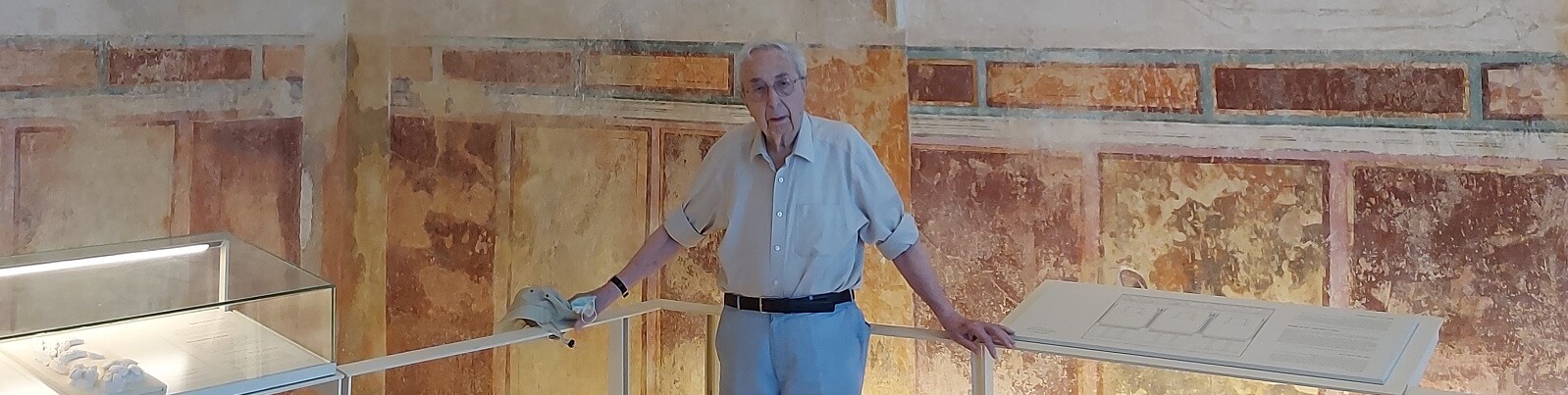
Professor Yehoshua Ben-Arieh began his research career in the History Branch of the Israel Defense Forces following the War of Independence and played a central role in the study and documentation of that epic conflict. He later joined the Department of Geography in Jerusalem. His master’s thesis focused on the caves of Beit Guvrin, while his doctoral dissertation examined settlement in the Jordan Valley. He also worked on other topics, including the water level of the Sea of Galilee, and upon completing his doctorate, published a book on The Middle Jordan Valley.
During the 1960s and 1970s, he met scholars of historical geography in Britain and the United States and decided to study the Land of Israel from this perspective, a field that had received little attention before. The idea behind historical geography is to examine a region from a geographical perspective during different historical periods, drawing upon historical sources. In other words, it seeks to reconstruct what a country or region looked like at a given time. The most significant studies in this field around the world have focused on the modern era, beginning with the Industrial Revolution and extending to the present day—a period of roughly two hundred years. This is partly because sufficient historical sources exist for such research and partly because of its relevance to contemporary realities.
My father decided to devote himself to the study of the Land of Israel in the modern era, and his first groundbreaking work was The Rediscovery of the Holy Land in the Nineteenth Century, published in 1970. From that point onward, and for more than fifty years, he focused on the study of the Land of Israel from the beginning of the nineteenth century to the middle of the twentieth century—the period culminating in the establishment of the State of Israel. In many ways, his final book, The Making of the Land of Israel, returned to and completed themes first explored in the early pioneering works.
Most of his books were translated to English, however his voluminous work on Jerusalem in Mandate Period, as well as a few other works, are only available in Hebrew, following are the Books one can find in the Internet in English
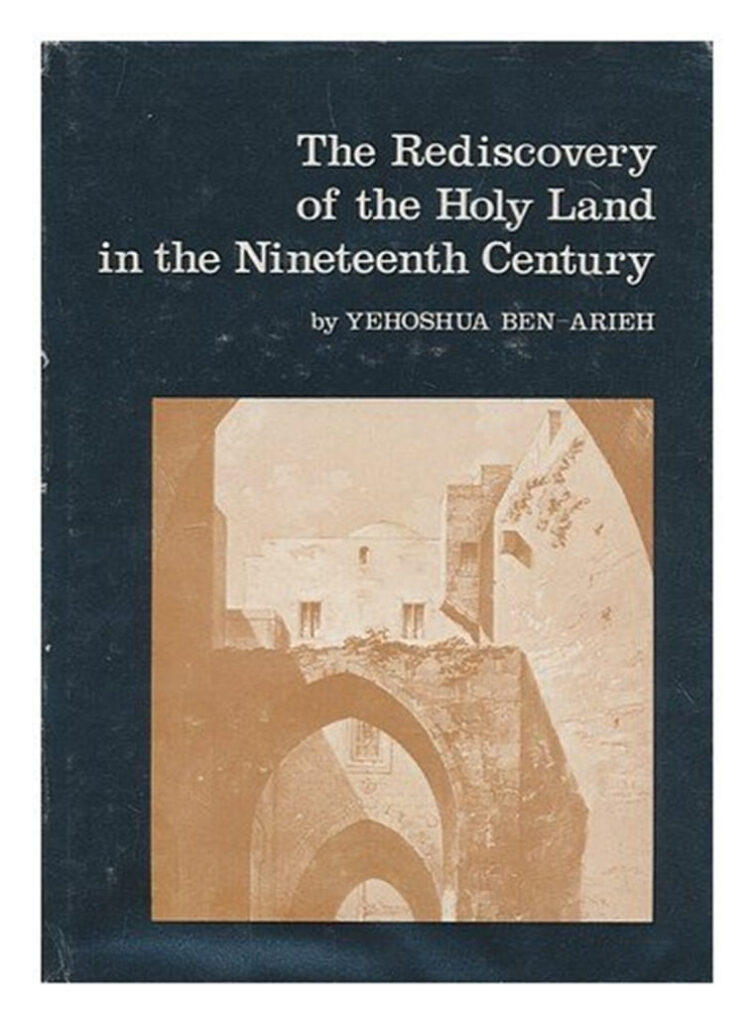
The Rediscovery of the Holy Land the Nineteenth Century
During our sabbatical year in England in 1966, my father discovered the archives of the Palestine Exploration Fund and, as he later recounted, “went crazy.” There he found a vast treasure trove of research and exploration relating to the Land of Israel, material that would serve him throughout his career and become one of the principal foundations of his books and studies. From that point onward, he traveled to England many times to continue his research in these archives. The first major result of this discovery was the publication, in 1970, of his first important book, a work that effectively opened an entirely new field of research, travel, and public interest: The Rediscovery of the Holy Land.
The central idea of this book—a theme to which my father would return at the end of his life in his final work, Yhe Making of Eraz Israel—is that at the beginning of the nineteenth century, the Land of Israel was a remote and underdeveloped province of the Ottoman Empire. Its population amounted to less than ten percent of what it had been during the Byzantine period, numbering only about 250,000 inhabitants. Jerusalem was a provincial town in which large areas within the Old City walls lay vacant and undeveloped. There were no paved roads and virtually no wheeled transportation in the country. Europeans were few in number, and much of the land’s historical heritage—and even its geographical reality—remained unknown.
At the same time of the great explorations of previously unknown areas in Africa, Asia, and South America, explorers and scholars began arriving in the Land of Israel and rediscovering it for the world. They mapped the country, identified its historical sites, told the story of this largely forgotten land, and rekindled international interest in it.
Yet these explorations were only one aspect of the dramatic changes taking place during the nineteenth century. With the advance of the Industrial Revolution, the appearance of steamships, the gradual opening of the Ottoman Empire to the West, its weakening in the aftermath of the Crimean War, and the granting of capitulatory privileges to the European powers, increasing numbers of people began arriving in the the land of Israel. Various communities settled in the land and started developing it, even before the rise of Zionist immigration. The great powers invested heavily in the Land of Israel, competing with one another for influence and presence. As a result, by the end of the nineteenth century, the country had become a developing and increasingly diverse land, with a population that had nearly doubled to some 430,000 inhabitants, a society whose gaze was increasingly directed toward the future.
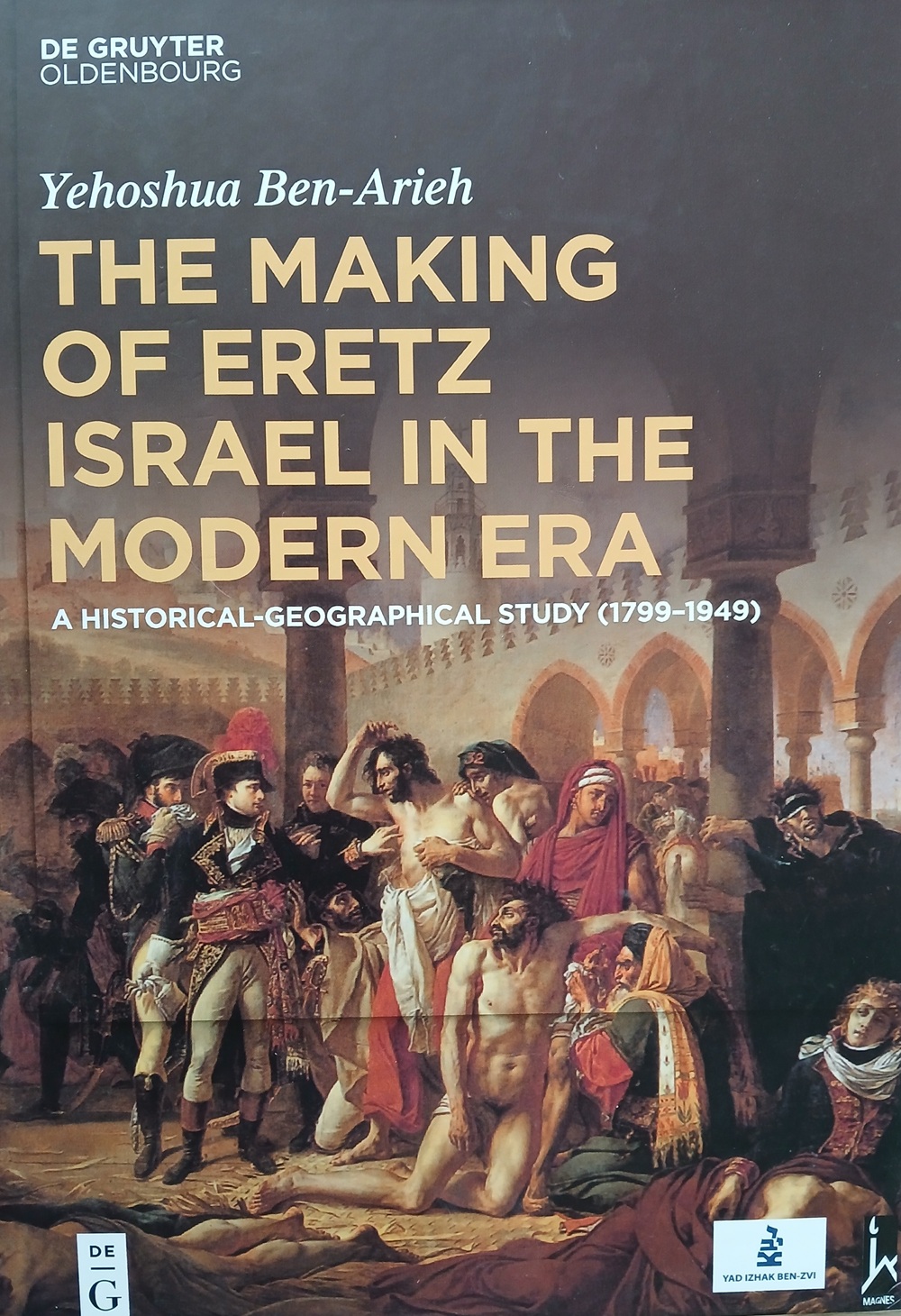
The Making of Erez Israel in the Modern Era, 1799–1949
A monumental work on which my father labored day and night for a decade, this book brings together and synthesizes the findings of his earlier studies and publications within a framework of twelve chapters corresponding to the twelve lectures he taught in an undergraduate course at the university throughout those years. My father continued teaching even after his retirement, despite having no obligation to do so and receiving no additional compensation. He taught until the age of ninety, and year after year he was chosen by his students as an outstanding lecturer. Among the students who attended his course was his grandson, Oren Ben-Arieh.
The book seeks to explain how the geographical, political, and even cultural entity known as the Land of Israel came into being. Yet beneath this explicit theme lies a deeper layer, one to which my father returns in both the introduction and the conclusion. His perspective on the emergence of the entity called the Land of Israel is fundamentally shaped by Zionism. Although the Jews were not the majority population in the country throughout most of the period under discussion, Yehoshua viewed Zionism as the principal force behind the consolidation of the Land of Israel as a distinct entity. While he does not devote extensive attention to the parallel developments within Arab society, it is possible to infer from his observations that he regarded the Palestinian national movement largely as a response to the Zionist enterprise. Prior to that period, the Arabs of the country tended to identify either with a broader Arab framework or with smaller regional districts (sanjaks), rather than with a clearly defined territorial entity comparable to countries such as Egypt or Iran.
Yehoshua Ben-Arieh on the Book
After completing ten years of voluntary teaching in the Department of Geography, while simultaneously working on The New Jewish Jerusalem during the British Mandate Period, I found myself debating whether to continue teaching or to take the full retirement that I had earned. After a short time, I decided to continue teaching, but this time I chose an entirely new subject that had begun to interest me: the creation and development of the Land of Israel up to the establishment of the State of Israel.
As is well known, the Land of Israel remained under Ottoman rule for many centuries. Only after the First World War, when Britain assumed control of the Middle East, did major changes occur in the status of the country. Yet many scholars trace the beginning of these transformations to Napoleon’s invasion of the Middle East. Although Napoleon’s stay in the country was brief, these scholars argue that his campaign marked the beginning of the modern era in the Land of Israel, for it was a decisive event that signaled the awakening of the Middle East—and of the Land of Israel in particular—from centuries of stagnation.
Therefore, when I decided to continue teaching in the Department of Geography during the second decade of my retirement, I chose to study and teach the subject of the creation and development of the Land of Israel up to the establishment of the State of Israel in a chronological manner. I divided the subject into two parts: the first dealing with the Ottoman period (six chapters), and the second with the British Mandate period (six chapters).
This course of study later became the foundation for my decision to publish the book How the Land of Israel Was Created, 1799–1949, which appeared in both Hebrew and English editions through Magnes Press and Yad Ben-Zvi in 2018. The chapters of the book, and indeed the book as a whole, are the product of decades of study and teaching in the Department of Geography at the Hebrew University of Jerusalem.
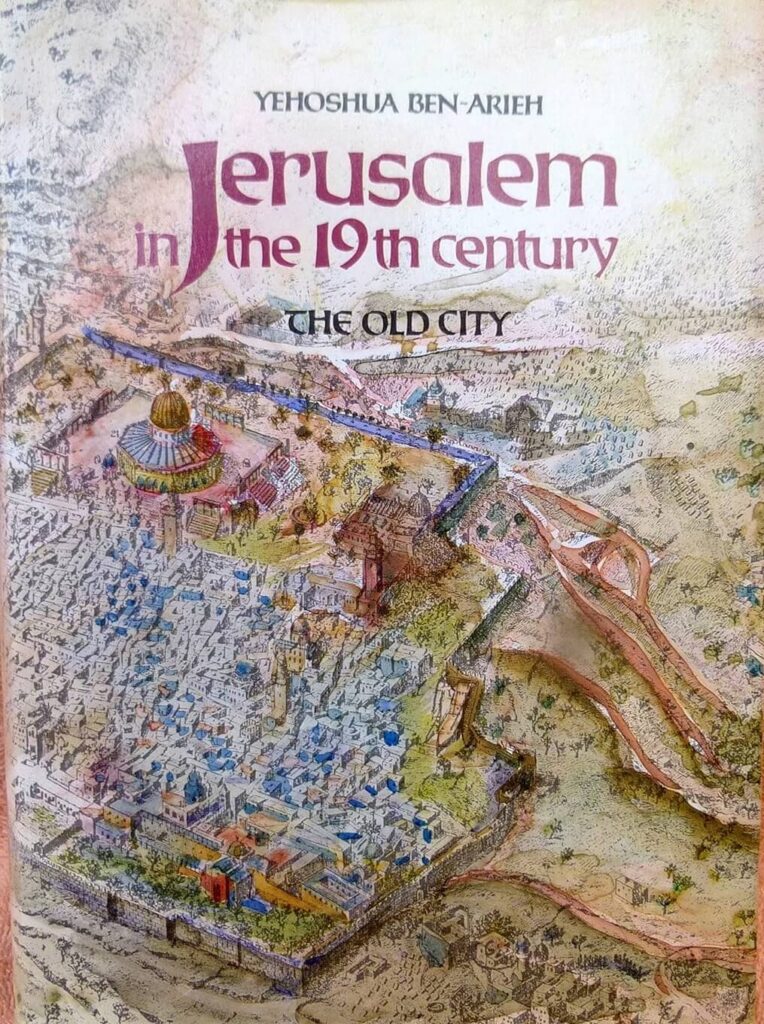
Two Volumes on Jerusalem in the 19th Century
In my humble opinion, the books on Jerusalem in the 19th Century represent my father’s most important achievement. They reveal the process by which Jerusalem became the microcosm of the Western world that it is today—a city belonging to all religions and nations. He wrote these books while he was still young and full of energy, and through them he effectively opened new horizons in the historical-geographical study of Jerusalem. No city is more suited to such an approach than Jerusalem, with its many faces, layers, and identities.
The books were written during a relatively peaceful period in Jerusalem, a time when one could wander through the Old City in tranquility and the future appeared bright. They attracted considerable attention and had a profound impact on the study of the city. After completing them, my father considered extending his historical-geographical research of the nineteenth century to other cities in the Land of Israel, including Acre, Tiberias, Hebron, and Safed. However, his election as Dean of the Faculty of Humanities in 1981 largely brought this phase of his research momentum to an end. The work was subsequently carried forward by his students, who continued to develop the field that he had helped establish.
See article on the two books on Jerusalem in the 19th Century