The Custodia de Terra Sancta
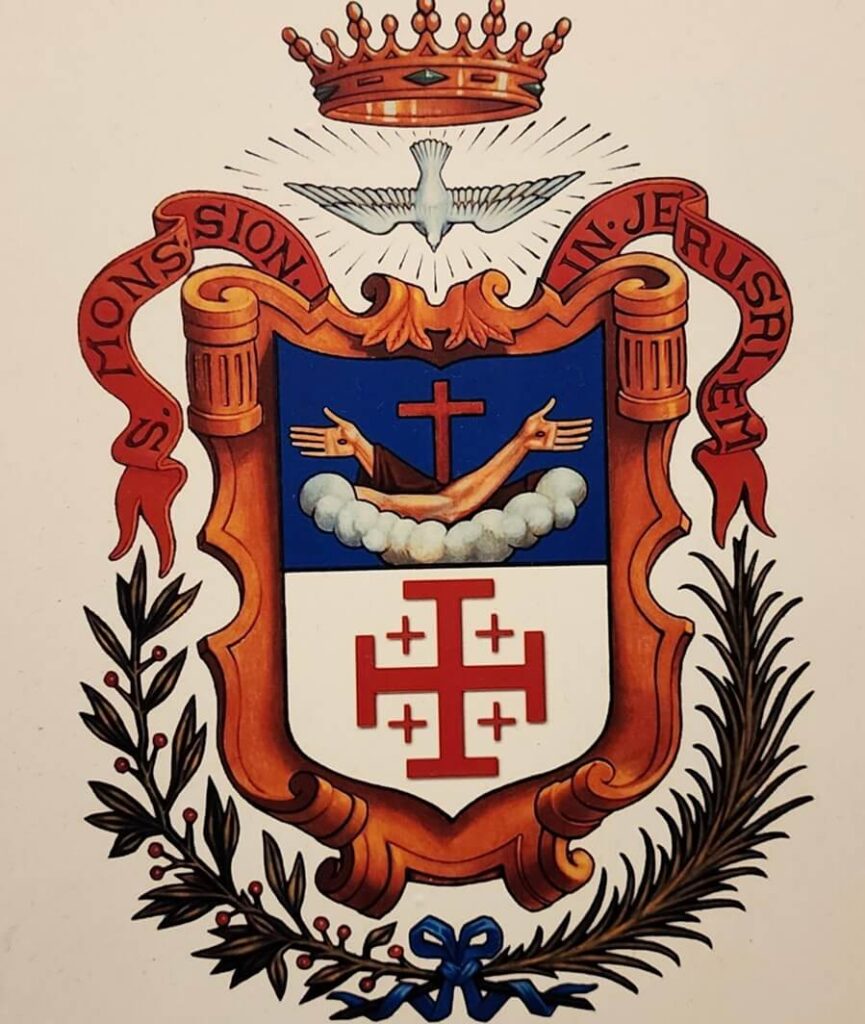
The Franciscan Order was founded in 1219, twenty years after Ṣalāḥ ad-Dīn (Saladin) conquered Jerusalem from the Crusaders. Already with the founding of the Order and while Saint Francis was still alive, the friars were encouraged to open more provinces, and so in 1219, Saint Francis came to visit Israel along with Brother Elias. Before that, Francis held a famous meeting with Sultan al-Kamil in Egypt, and following the encounter, the Sultan allowed the Franciscans to operate freely throughout his kingdom. In an interview with the current head of the Custodia de Terra Sancta, Father Francesco Patton, he recounts that the meeting with the Sultan changed Francis, and he instructed the friars not to stir up controversy and to represent Christianity with dignity [1].
In 1229, twenty years after the Order’s founding, as a result of the Sixth Crusade led by Frederick II, the Christians regained control of Jerusalem (except for the Dome of the Rock). According to Christian sources, Frederick brought the Franciscan friars with him to Jerusalem, and they established their center near the Fifth Station of the Via Dolorosa (the place where Simon of Cyrene helped Jesus carry the cross). During this time, Pope Gregory IX favored the Franciscans, declared Francis a saint in 1228, and built the cathedral in Assisi. In 1230, he issued a papal bull (an official holy letter) confirming the presence of the Franciscan Friars Minor in the Holy Land.
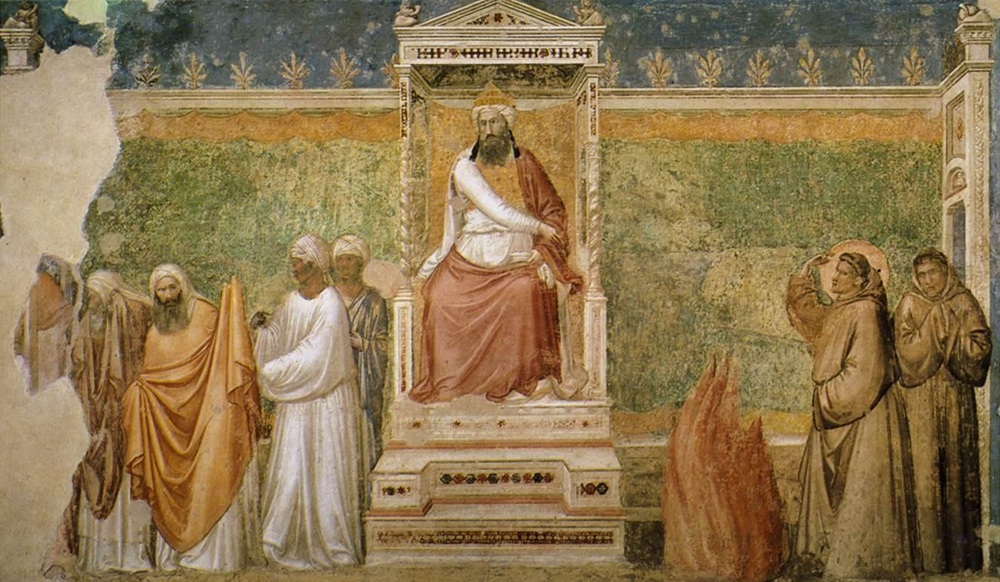
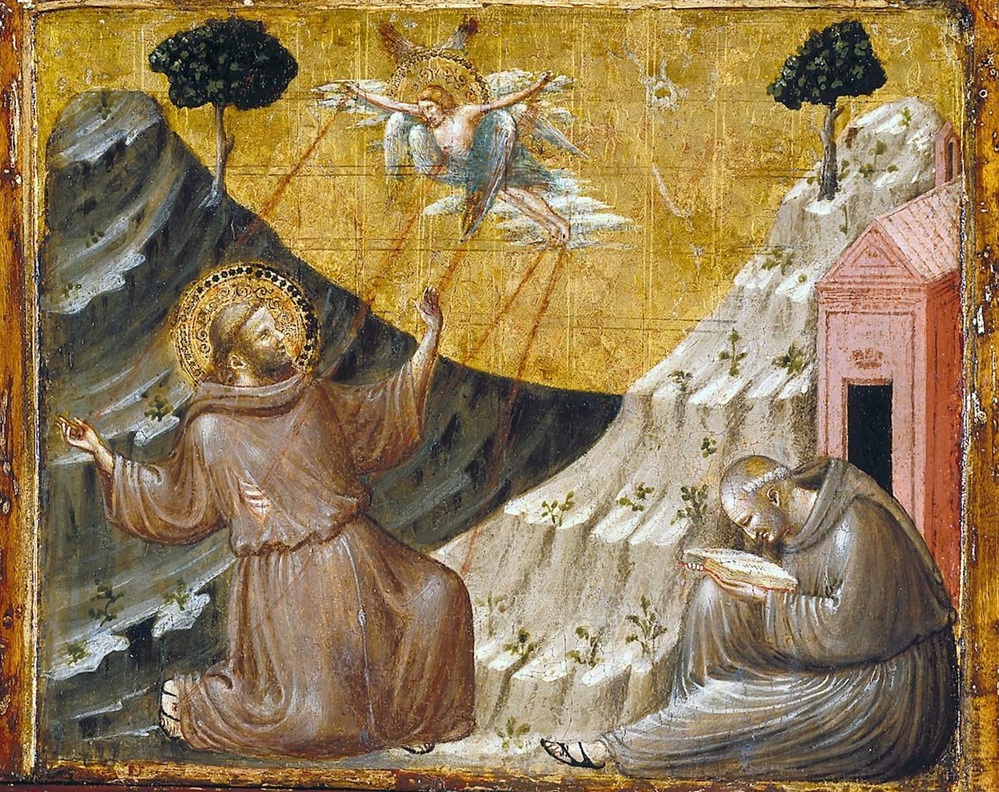
Gregory IX is considered one of the most important Popes, who strengthened the orders of the barefoot monks (Franciscans) and the preaching monks (Dominicans—he declared Dominicus a saint in 1234), strengthened the University of Paris, and permitted Christians to engageme in academic life (which is consistent with supporting the Dominican Order, from whose ranks came great scholars such as Thomas Aquinas). He also wrote a bull called “Mother of the Sciences,” which is considered the Magna Carta of the academy. But on the other hand, he fought earthly and political wars, especially a bitter war with Frederick II that devastated Italy, and with the Cathars in southern France. He was the man who founded the Inquisition to fight the Cathar heresy and allowed terrible deeds to be done in the name of Christianity.
Perhaps because of the sins of Christianity, the Christians were destined to lose Jerusalem, and so in 1244, the Khwarazmians (Turkish Muslim warriors from Central Asia who briefly conquered parts of the Middle East) invaded the Land of Israel, conquered Jerusalem, and killed the Franciscan and other monks there. From this time onward, there was no longer any official Christian presence in Jerusalem, and only from the 14th century did the Franciscan friars, who returned to the holy sites, fill the void.
In 1291, after the fall of Acre, the last Crusaders, including the Franciscan friars, were expelled from Israel. This did not prevent them from theoretically becoming the Custodians of the Holy Places, but in the 14th century, they returned and became the Guardians of the Holy Places. The Franciscans became responsible for the catholic presence in the eight holy sites that can be called “Sanctuaries of Redemption” (such as the Church of the Nativity in Bethlehem). The head of the Franciscans in the land replaced the Kings of Jerusalem and the Knights as the head of the Order of the Holy Sepulchre, and from this time onward, they established the “Custodia de Terra Sancta.”
In 1333, the Franciscans signed an agreement with the Mamluks, by which the Mamluks recognized the Franciscan friars’ custodianship of Christian holy sites. Concurrently, the Franciscan friars began to develop the tradition of the Via Dolorosa. The Mamluk rule enabled the activities of the Franciscan friars, who were supported by the Kings of Naples and the Italian maritime powers, foremost among them Venice. The Mamluks had important trade ties with Europe that they wished to develop, so it was important for them to maintain good relations with the Christians.
In 1342, Pope Clement VI (one of the Avignon Popes who became famous for defending the Jews during the Black Death) formally appointed the Franciscans as the Guardians of the Holy Land and instructed them to remain and lodge in the holy sites, meaning to found monasteries, and so it happened. We do not know much about this period, but it may be related to the fact that at the beginning of the 15th century, the Custodia de Terra Sancta established an external organization of representatives on its behalf in Christian communities around the world, whose role was to raise funds for the guardianship of the holy sites in the Land of Israel and the other functions of the Custody (for example, caring for the local Christians). They are called Commissaries, and are still active, numbering 84 people as of today.
Generally, the Franciscan friars around the world are organized into three orders: the largest among them is the Order of the Friars Minor (which numbers about 15,000 people), of which the Custodia de Terra Sancta is a branch. The other two Franciscan orders are the Capuchins and the Conventuals, and they number about 15,000 additional people. The Custodia de Terra Sancta has about 300 friars and 100 nuns serving in it, and in addition to maintaining and guarding the holy sites in the Holy Land, it is also responsible for religious services to the Catholics in Israel, Lebanon, Syria, Jordan, Egypt, Rhodes, and Cyprus, as well as educational services for local Christians. They have 11,000 students in dozens of schools they manage, which are considered the best in the Arab sector, with a large part of the students being Muslims or from other denominations.
The Development of the Via Dolorosa
Since the beginning of Christianity, people have tried to identify the places where Jesus passed his last days and moments, especially the route of the passion from the place of judgment to the place of crucifixion. Seemingly, this should have been simple, but since Jerusalem was destroyed in the Great Revolt, 37 years after Jesus’ crucifixion, and then again in the Bar Kokhba Revolt (135 CE), and the Roman city of Aelia Capitolina was built in its place where Christians were persecuted and not allowed to live, this became a difficult task.
With the Roman Empire’s conversion to Christianity in the 4th century CE, Helena, mother of Emperor Constantine, came to Jerusalem and identified the holy sites beginning a tradition of walking in the footsteps of Jesus’ Passion. The first processions set out from Gethsemane and first turned to Mount Zion, where the house of Caiaphas the High Priest was believed to be, where Jesus was brought after his arrest. From Mount Zion, the processions continued to the Tower of David, which was identified as the location of Herod’s palace and the Antonia Fortress, where Jesus was taken for judged and condemned to carry the cross on Friday morning. In other words, the area of the Tower of David was considered the place of conviction, scourging, crowning with thorns, and imposition of the cross, and from there the Passion began, the processions went to the place of crucifixion in the Church of the Holy Sepulchre.
During the Crusades, a palace of the Crusader kings was established north of the Tower of David, which was renovated and became the city’s citadel, and therefore in the popular imagination, these two places were associated with Pontius Pilate’s palace and the place of judgment, condemnation, scourging, crowning with thorns, and imposition of the cross, and it is likely that the processions with the cross following Jesus’ Passion took place from Mount Zion or the palace to the Church of the Holy Sepulchre and not on the current route.
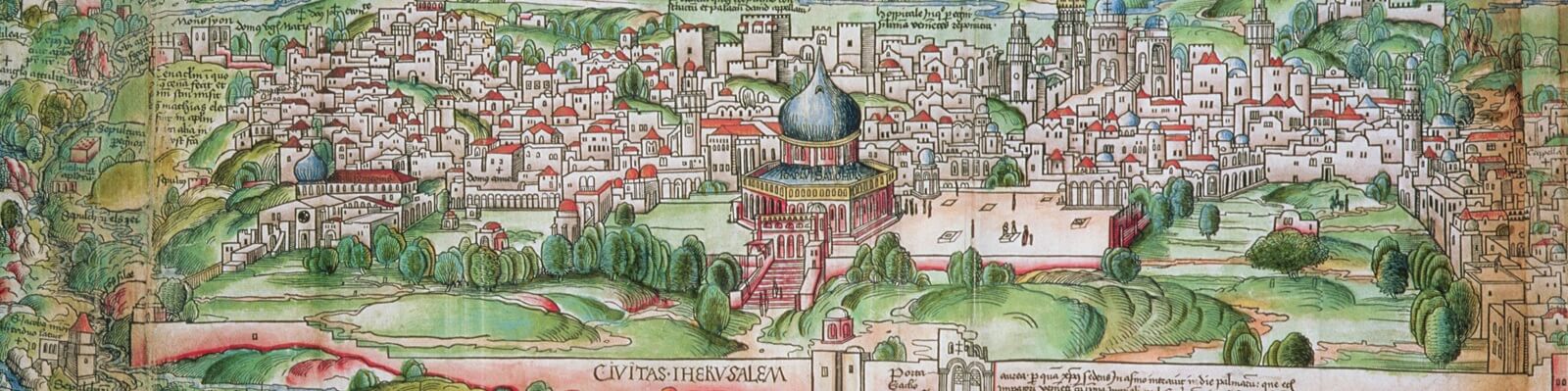
When the Crusaders came they turned the Dome of the Rock into a Christian church and called it the “Temple of the Lord.” This was the headquarters of the knights Templar during the first Kingdom of Jerusalem and their symbol, the second most important Christian site in Jerusalem after the Church of the Holy Sepulchre. In maps from the Crusader period, Jerusalem is seen in the shape of a circle with two identical circles inside, one being the Temple of the Lord (Dome of the Rock) and the other the Church of the Holy Sepulchre. It is likely that there were religious processions from the Dome of the Rock to the Church of the Holy Sepulchre, and it is possible that they were linked over time to the Passion of Jesus.
After the end of the Crusades, the Temple Mount returned to Muslim hands, but the idea of processions from east to west, from the Temple Mount area to the Church of the Holy Sepulchre, remained. The Tower of David also passed to Muslim hands and became the seat of the army, out of the two possibilities for the Passion route the east west one seemed favourable. And so, starting from the 14th century, the Franciscan friars shaped the passion route in the places where it is today. they identified the elevated area north of the Temple Mount as the location of Herod’s palace and the Antonia Fortress, consolidating the route of the Via Dolorosa that we know today.
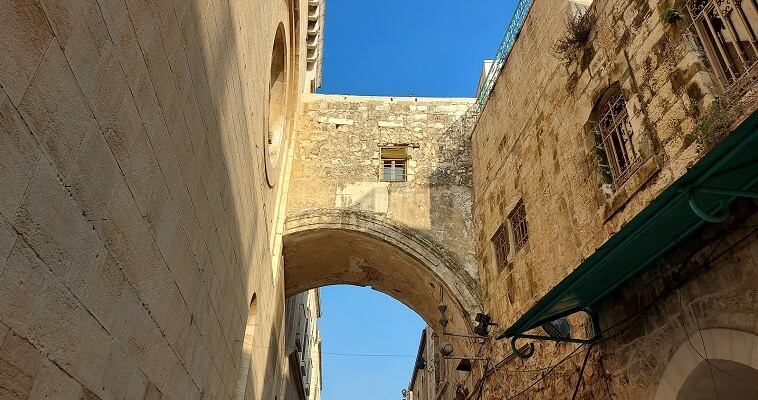
The Franciscans are the ones who developed the tradition of the Via Dolorosa, the identification and numbering of the different Stations, and the reference to them in processions, prayers, and though signs in the church, as well as sacred complexes built throughout Europe. The selection of the stations and the route was done partly out of a desire to create a sacred geography for pilgrims, and partly to gain a foothold in parts of Jerusalem where there was no pronounced Christian presence (most of the Via Dolorosa stations are in the Muslim Quarter). In addition to the accepted stations, some of which appear in the New Testament and apocryphal books, the Franciscans added three stations marking three falls of Jesus on the way -Stations Three, Seven, and Nine, and a station marking a supposed meeting between a woman named Veronica and Jesus -the Sixth Station—the meaning of the name veronica is the True Image, Vero—truth, Icon—image; according to legend, Veronica gave Jesus a cloth to wipe his face, and when she received it back, she saw his face imprinted on it; the cloth became one of the holy objects of Catholic Christianity.
In the 15th century, the route of the Via Dolorosa was finally formalized under the patronage of the Custodia de Terra Sancta. Not all the stations had yet been established, but a book of prayers for the various stations had already been compiled, and what is more important is that the Franciscans around the world began to replicate the Stations of the Via Dolorosa in Christian churches throughout the Catholic world.
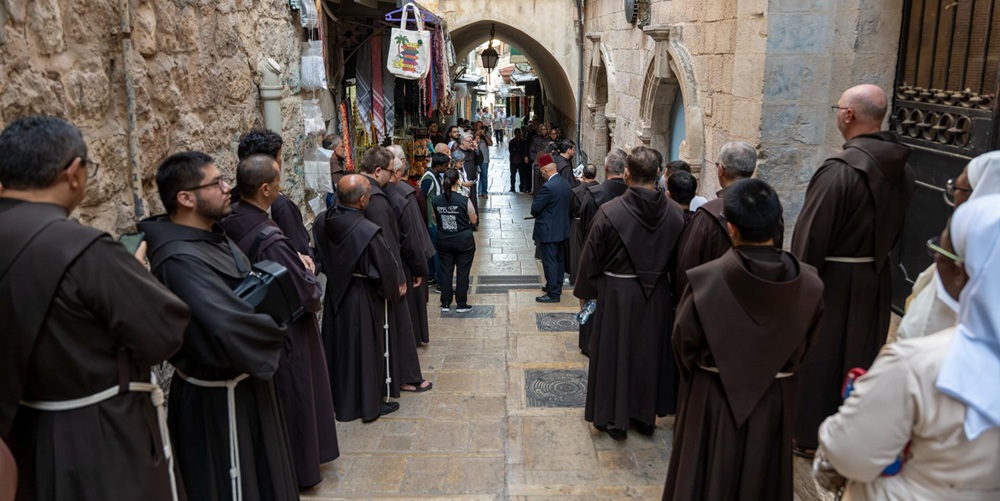
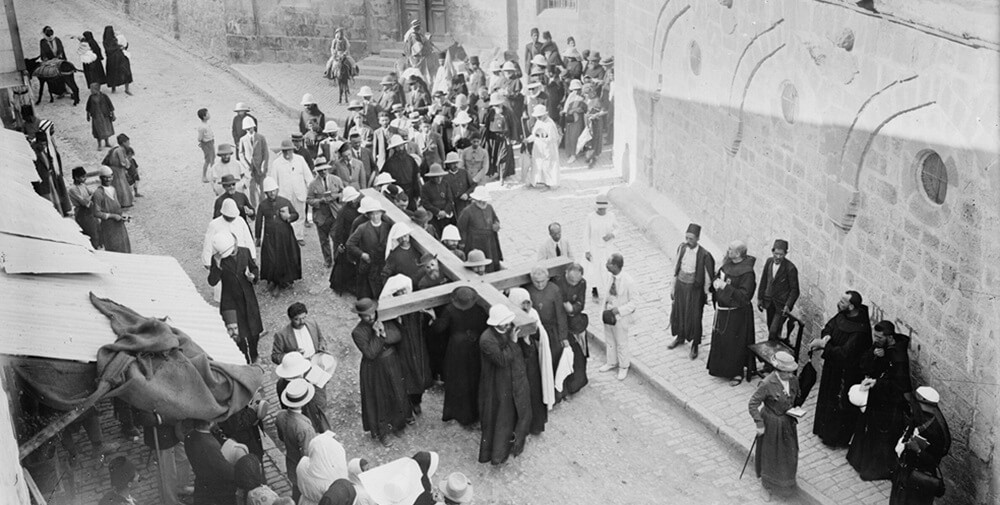
Since then, and until today, every Friday, which is the day of the Passion and Crucifixion of Jesus, the Franciscans hold a procession along the Via Dolorosa in Jerusalem, reliving the Passion of Jesus, carrying a large cross on their backs and saying prayers at the various stations. Throughout the rest of the week, processions of pilgrims carrying large wooden crosses also set out from the beautiful courtyard of the Franciscan complex at the Second Station toward the Church of the Holy Sepulchre.
Interesting Stations on the Via Dolorosa
There are several stations on the Via Dolorosa with deep mystical meaning:
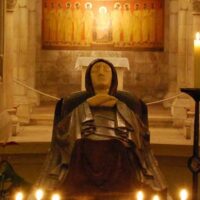
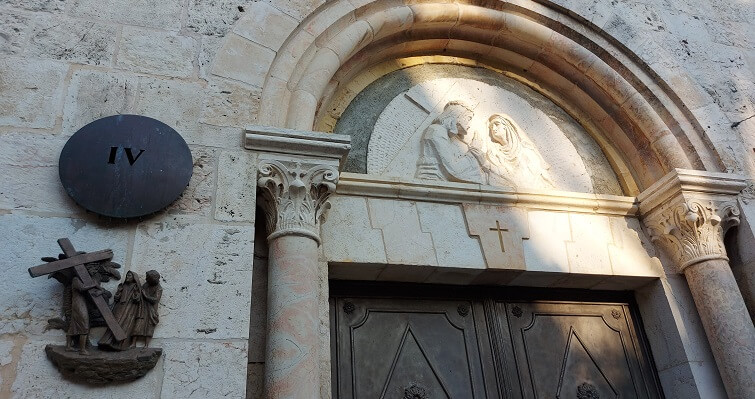
The Fourth Station is the place where Jesus met his mother, and it is located in the basement of an Armenian Catholic church called the “Church of Our Lady of Sorrows.” The tradition of Mary meeting Jesus carrying the cross is late, but the locals will show a mosaic with a pair of feet and claim that this is the place where Mary stood and that the mosaic is ancient. From here on, Jesus mainly meets women: Veronica at the Sixth Station, the Women of Jerusalem at the Eighth Station, and again his mother at the time of the crucifixion. It seems as if the feminine principle contains Jesus’ sacrifice and gives it a deep emotional meaning. It is interesting to consider, if Jesus indeed met his mother at the Fourth Station, what was the conversation between them?
The Fifth Station is the place where the street begins to ascend towards the Christian Quarter. It is marked by a small recess in the wall where the weary Jesus leaned, and it has a small chapel. Since Jesus struggled to carry the cross up hill, the Romans forced a man named Simon of Cyrene who was watching the scene to carry the cross in his place. According to some Gnostic sources (a Christian mystical movement from the 2nd–3rd centuries CE that had additional Gospels), Jesus took the opportunity, disappeared into the crowd, and even reached India and lived there happily ever after until the age of 120, and the one who was eventually crucified was Simon of Cyrene. The crrying of the cross by Simon of Cyrene teaches us that we need to help jesus carry the cross as well.
Catholics accept the story of Simon of Cyrene (an area in northern Libya, where there was a large and important Jewish community) literally and see him as a noble model for believers who are called to help Jesus carry the cross. And not only Jesus, but also others, everyone with their burden. Over time, a related concept developed called “Substitution” (see the chapter on Mariam Baouardy in the third book), and thus it is written: “As they were going out, they met a man from Cyrene, named Simon, and they forced him to carry his cross” (Matthew 27:32).
Further up the street is the Sixth Station, where a woman named Veronica watched Jesus carrying his cross and had compassion for him. She wiped his sweating face with her cloth. To her surprise, Jesus’ likeness was imprinted on the cloth, which, of course, became an important holy object in Christianity, documenting the true image of Jesus (the name Veronica means Vero Icon, the True Image). The miracle of the appearance of Jesus likeness on the cloth echoes the miracle of the Annunciation and Incarnation, and it happened as a result of the kindness and compassion that Veronica showed towards Jesus.
The miracle of the cloth is not mentioned in the New Testament and is a later tradition, but holy cloths bearing the image of Jesus appeared in Europe and Byzantium earlier and were part of the belief world of the pilgrims. Some identified Veronica with the woman who touched the fringe of Jesus’ cloak in the Sea of Galilee and was healed. The surprised Jesus felt that someone was there, turned to her, and said: “Take courage, daughter; your faith has made you well” (Matthew 9:22). The lesson of Veronica and that woman is that one must strive to touch Jesus; he is waiting for us, and if the desire is genuine, then wondrous things happen. At the beginning of the 13th century, Veronica’s veil began to be displayed in Rome.
At the location of Veronica’s Sixth Station, Barluzzi built a beautiful small chapel belonging to the Melkite Greeks. Next to it is a room that appropriately houses a workshop for icon painting occupied by several French catholic nuns. In their case, the faces of Jesus and the saints appear with a paint brush on wooden panels.
Further up the street is the Seventh Station—the Gate of Judgment—and a little further on is the Eighth Station, where Jesus meets some of the Daughters of Jerusalem who have compassion for him. Thus it is written: “A large number of people followed him, including women who mourned and wailed for him. Jesus turned and said to them, Jesus turned and said to them, “Daughters of Jerusalem, do not weep for me; weep for yourselves and for your children. For the time will come when you will say, ‘Blessed are the childless women, the wombs that never bore and the breasts that never nursed!’ Then they will say to the mountains, “Fall on us!” and to the hills, “Cover us!” For if people do these things when the tree is green, what will happen when it is dry?” (Luke 23:28–31).
This is the last contact of Jesus with the people (women) of Jerusalem, who have compassion for him and try to help him along the way, which is contrary to the image of a bloodthirsty crowd that only wants his death. Jesus is the green tree, the living one, while those who are not connected to the spiritual light are a dry tree that does not bear fruit and will eventually be burned. According to Christian thought, man has two choices: either to join in carrying Jesus’ cross and become part of the Tree of Life, or to deny him and remain a dry tree. Nevertheless, it must be noted that the Second Vatican Council (the last ecumenical council) determined that there is truth outside of Christianity, and Christians should cherish all faiths and religions, especially the Jewish religion.
It seems to me that both the recognition and the denial are not towards Jesus as a person, but towards the idea he represents. In the two thousand years since Jesus’ death, the Jewish people have undergone a journey of suffering at the hands of Christians and knew how to patiently accept all calamities, out of hope and faith in the coming of the Messiah and the rebuilding of Jerusalem, and it can be said that they carried the cross of the exile with great success. The Via Dolorosa in particular and Jerusalem in general are good places to reflect on the meaning of carrying the cross, whether it is the cross of Jesus 2,000 years ago or the cross of a people who went into exile and suffered atrocities and calamities for 2,000 years. In any case, reflection leads to a re-evaluation of human strength, and I would add: wonder at the strength and vitality of the Jewish people.
The Allegorical Meaning of the Via Dolorosa
Suffering brings man closer to himself. although the processions take place in public, the Via Dolorosa is essentially a private journey. The stations along the way evoke feelings; Jesus’ suffering connects us to our inner suffering, and yet within the pain, we can find meaning, and understanding that all this leads somewhere, and that at the end of the road there will be resurrection and the birth of something new. Like any birth, this one brings first suffering and pain. This understanding leads to patience in bearing calamities, and this does not mean passive patience but patience stemming from knowledge and love.
In recent years, attempts have been made to give the 14 Stations an additional meaning beyond the usual one, especially an allegorical and mystical meaning. There were even attempts to rearrange and redefine the stations, adding or removing stations, and the prominent figure in this context is Pope John Paul II, who suggested replacing some of the traditional stations that have no scriptural basis with other stations, so that the entire path would rely more on the text of the New Testament [2].
But one does not have to be a Pope to pour content into Jesus’ journey of suffering, or to allegorically interpret Jesus’ cross-bearing. We all carry our cross, and even people of other faiths can try to give meaning to the various stations (stages) along the way.
Bearing the cross is the essence of the Christian path. Each of us carries his own cross; for one, it is old parents who need care, for another, it is some physical limitation, and so on. But few of us carry the cross with love, and even fewer carry the cross for others. Jesus carries the cross from the place of condemnation to the place of crucifixion with love and for all mankind—this is his Passion—and yet he says: “Whoever does not carry his cross and come after me cannot be my disciple” (Luke 14:27).
It is important to understand that the believing Christian lives with a different emotional feeling than ordinary people. Most of us live with the feeling that the world constantly wants to take, and therefore we are busy defending and pushing back. The bank demands its due, the children, the work, the neighbors, and who else. But the believing Christian lives with the feeling that there is someone willing to do everything for him, who loves him, who suffered and sacrificed for him without asking for nothing in return, and this person embodies infinite giving and love is Jesus.
Jesus’ sacrifice is a good and unexpected possibility, a grace, a gift of life. The hidden secret in this sacrifice is that Jesus calls us to participate with him in carrying the cross and the crucifixion. And so, Saint Francis, the founder of the Franciscan Order responsible for the stations on the Via Dolorosa, asks God to give him the privilege of carryieng Jesus’ burden, to take upon himself the yoke of the cross and the crucifixion, but first that he be given Jesus’ love in his heart so that he can endure the suffering, and so it was: Francis was blessed with the miracle of the Stigmata—the wounds of Jesus appearing on his body as he was tied to the cross, but not before he himself walked a Via Dolorosa of asceticism and repentance.
The secret of bearing the cross is patience in bearing calamities, and some have said that patience is the highest quality of love. A complete person is capable of bearing the events of life with love, as many of the saints before us did, foremost among them Jesus. According to John Paul II, when they said “Behold the Man” (John 19:5), the meaning is that the source and fulfillment of man is found in the example of Jesus. Bearing the cross is not only necessary suffering but also an opportunity for love. Patience in bearing the cross stems from love and from the understanding that while troubles are happening, we have an opportunity to accumulate treasures in heaven. The Via Dolorosa eventually ends, and we will reap the fruits of our patience and love in another realm.
Jesus had to go through the Via Dolorosa to participate in the human fate, and to spread light and comfort even into the dark kingdoms of suffering. By sanctifying suffering, Christianity gave a door of hope to millions of suffering people, and instead of despair, it brought the possibility of redemption. It is worth mentioning in this context that Buddhism also addresses the question of suffering, but from another angle. Christianity injects love and sacrifice into suffering, gives it an emotional meaning, connects it to fate and destiny, and thereby resolves it.
A Proposal for a New Via Dolorosa
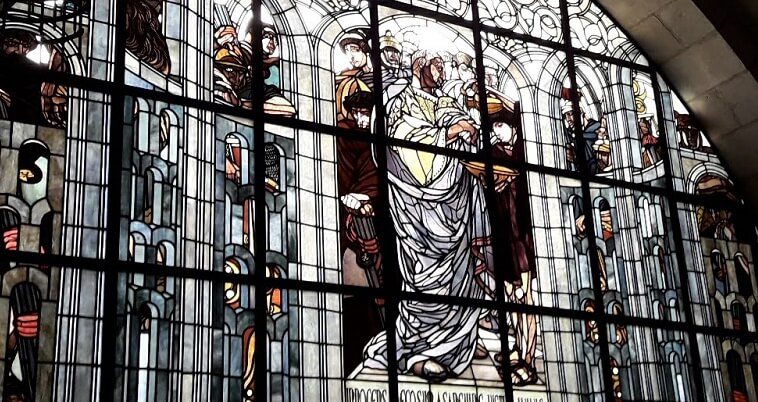
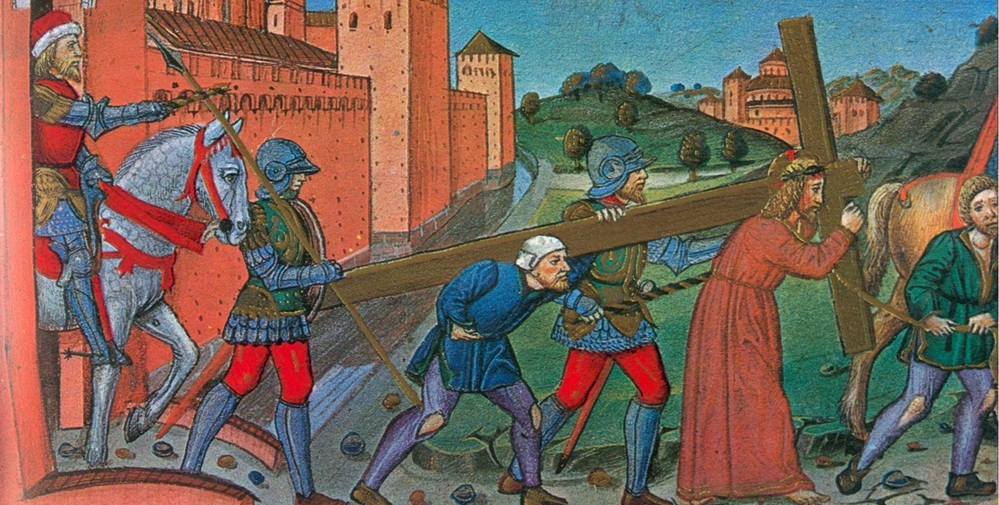
Pope John Paul II proposed renewing the tradition of the 14 Stations of the Cross and replacing some of the traditional stations that have no scriptural support with others, so that the entire path would refer more to the New Testament and less to later traditions, but there are other esoteric reasons behind his interesting suggestions as well.
Pope John Paul II suggested that the first station of the Via Dolorosa would not be the place of Jesus’ trial before Pontius Pilate, as is customary today, but the place of the anguish in Gethsemane. the first five stations of the new Way of the Cross are related to the denial of Jesus. The first is the anguish and the sleeping of the disciples in Gethsemane, the second is the betrayal of Judas Iscariot, the third is the trial by the Sanhedrin, the fourth is Peter’s denial, and the fifth is the trial by Pilate. Only when the cup of wrath is completely full does the Way of the Cross begin, when there is no choice, and even this is only after Jesus is scourged and the crown of thorns is placed on his head. The falls of Jesus along the way, on the other hand, John Paul proposed to remove.
Thus, the stations of the trial, the scourging at the pillar, and the crowning with thorns, which are the beginning of the Via Dolorosa today, become only the Fifth and Sixth Stations. The Fifth Station of Simon of Cyrene becomes the Eighth Station, and the Eleventh Station of the nailing to the cross becomes the Tenth Station [3].
Pope John Paul II suggested that Station 11 will be Jesus promising the good thief the kingdom of heaven, and Station 12 be the moment when Jesus dedicates (entrusts) Mary and John (the beloved disciple) to each other at the foot of the cross, saying “Behold your mother” (John 19:26), and thereby John Paul II who was a devote Marian worshiper, sanctifies Mary as the Mother of all Humanity and introduces an element of veneration of Mary into the Way of the Cross based on an event appearing in the New Testament.
In 2000, he proposed adding another station, the 15th, to the Way of the Cross, which is the Station of the Resurrection, thereby emphasizing the Via Dolorosa as a path leading to redemption and enlightenment. One can see sparks of genius in his innovations, a developed theatrical and religious sense, and in my opinion, there is justification for the desire to call him “the Great.”
procession of the new Way of the Cross proposed by John Paul II (called the “Biblical Way of the Cross”) took place for the first time on Good Friday in 1991, nine years before the millennium, and rather strangely, it was done around the Colosseum in Rome. In my humble opinion, this way adds a more spiritual dimension to the Passion of Jesus and presents it as a journey of sanctification and not just of suffering. The new Biblical Way of the Cross offers a solution to the Passion, as appears in Station 11, when Jesus promises the kingdom of heaven to the good thief who repents of his deeds, in Station 12 when Jesus sanctifies Mary as John’s mother and John as Mary’s son, and in Station 15—the Resurrection.
The big question is whether the Via Dolorosa is unnecessary suffering, or whether this suffering is intended to teach us something, to prepare us for a new life. The Christian mystic Peter Deunov offers a surprising answer: God wants to purify man’s inner being, but man constantly runs from place to place and from thing to thing, and it is impossible to act upon him. Therefore, God nails him to the cross, fixing him in place, so that He can act and change his interior. Hence, the crucifixion is not a bad thing but a necessary stage on the path, and the suffering associated with it should be accepted with love because it comes to teach and change us.
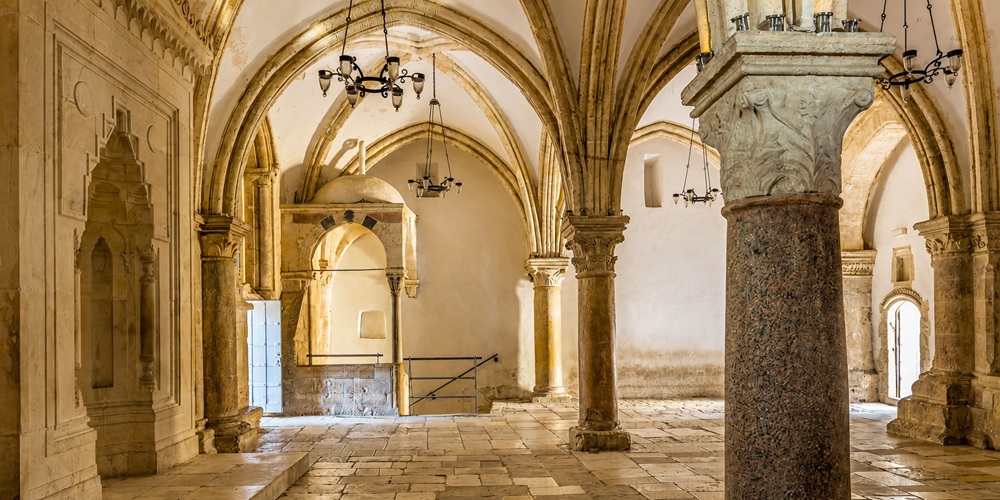
The Ordeal of the Custodia Terrae Sanctae
Since 1333 and to this day, there has been a continuous Franciscan presence in the Holy Land in their official role as the custodians of the holy places, though the journey was not always smooth. Over 130 Franciscan martyrs from the Custody sacrificed their lives in this sacred mission. The most famous among them is Nikola Tavelić (Švelić) of Croatia, who was executed in 1391—some say burned at the stake near Jaffa Gate—and the story went like this: Nikola and three other friars took Jesus’ directive to spread the light among the nations to heart, and, departing from the customary Franciscan practice of respecting local traditions, went to the Imam of the Dome of the Rock to persuade him to convert to Christianity.
This daring—and arguably audacious—attempt to preach the Gospel at the Dome of the Rock ended disastrously in worldly terms, yet triumphantly in the spiritual realm. Nikola and his companions were killed, canonized as saints, and a church was built in their honor in the city of Šibenik on Croatia’s Adriatic coast.
Footnotes:
[1] Custodia of the Holy Land. (2025, July 11). Being a Custos like a pilgrim: Interview with Br. Francesco Patton on his experience in the Holy Land. Retrieved from https://www.custodia.org/en/news/being-a-custos-like-a-pilgrim-interview-with-br-francesco-patton-on-his-experience-in-the-holy-land
[2] John Paul II. (1991). Via Crucis: Biblical Way of the Cross. Vatican: Libreria Editrice Vaticana.
[3] Ibid.