
England in Jerusalem: First Article
In the 19th century, England was the leading power in the world. The British Empire encompassed a quarter of the world’s population—an empire on which the sun never set. London was the largest city in the world, with six million people (Paris had three million at the end of the 19th century). The British Isles had over 40 million inhabitants. The Industrial Revolution began early in England and gave it an advantage over other nations. About 75% of the population lived in cities, and many yearned to travel to distant lands.
There are several synchronistic events regarding the English presence in Jerusalem in the 19th century. Firstly, one of the most important English politicians, the then-young and romantic Disraeli, arrived in Jerusalem during Muhammad Ali’s reign and drew inspiration there for his life’s work from this visit. Later in his life, as prime minister, he brought England into the Middle East. In the 1860s, the future King Edward VII came to Israel.
But it was not just politicians. In the 1850s, William Holman Hunt, the most important painter from the Pre-Raphaelite Brotherhood, arrived in Jerusalem. Here he had a fateful meeting with the visionary Henry Monk, which led to the development of a new style in painting. Richard Francis Burton, the famous explorer and expert on Islam, who served as consul in Damascus, collaborated with Edward Henry Palmer, visited Jerusalem, and was influenced by it. In the 1870s, Charles Warren, a Freemason, was active in Jerusalem, as was Walter Besant, who was connected to Annie Besant of Theosophy and was one of the leaders of the Palestine Exploration Fund (PEF), founded at that time.
The English presence in Jerusalem was manifested through secular orders such as the Freemasons and through Christian associations like the Church’s Ministry Among Jewish People (CMJ), the Young Men’s Christian Association (YMCA), the English branch of the Hospitallers of St John, and the Anglican Church. England’s presence in Jerusalem was linked to its vision of leading human civilization toward the modern age. The English believed in a mystical connection between the New Jerusalem—England—and the Old Jerusalem. A widespread belief in England at that time was that there existed a connection between the English and the Israelite peoples (see the next chapter on “British Israelism”).
The English have several large and beautiful compounds in Jerusalem: the St. George’s Compound in East Jerusalem, the Anglican School on Prophets Road, the Scottish Church in the Valley of Hinnom, and, to some extent, the YMCA building. However, the first and most unique site is the Christ Church compound near Jaffa Gate, established at the beginning of the 19th century as the first Protestant center in the city.
Ancient Connection
England and Israel are linked by mystical bonds. According to tradition, Joseph of Arimathea arrived in England after the destruction of the Second Temple with the Holy Grail, bringing the new Christian religion to the island. A thousand years later, Richard the Lionheart came from England to Israel to liberate the Holy Land from the Muslims. Two thousand years later, the English liberated Israel from the Ottomans, eventually enabling the establishment of the new Jewish state. According to legends that appeared in England during the Middle Ages [1], Jesus Himself came to England during His travels in the world and founded the first church there.
Jesus had a wealthy uncle named Joseph of Arimathea, who appears in the Holy Grail stories. According to legends that emerged in England, Joseph of Arimathea was the man who took Jesus’ body down from the cross, buried it in his family tomb, and brought the Holy Grail to England. Joseph was a wealthy merchant whose travels took him across the ancient world, including to England. Part of his business involved trading metals. Southern England was the ancient world’s main source of tin used in bronze alloys, so merchants from the Eastern Mediterranean frequented the area from the earliest periods of history. On one of his journeys, Joseph of Arimathea took the young Jesus with him and brought him to the Druid priests so that he could learn from them. Joseph and the young Jesus arrived at Glastonbury, then called the Isle of Avalon, which was a center of Druidic worship and a place of connection to other worlds, and there they built the first Christian church.
According to alternative theories, for Jesus to become the new teacher of humanity, He had to gather the scattered pieces of spiritual knowledge from around the world, including the sparks of light present in Celtic spirituality, and for this purpose, He came to Britain, which held the most important Druidic center of its time (following the fall of Gaul to the Romans).
According to the New Testament, Jesus began His preaching and teaching at the age of 30, and we do not know what He did or where He was from the age of 13 to 30—a long period of 17 years. Over the years, claims emerged that Jesus traveled to various places in search of knowledge, encountered the spiritual traditions prevalent in His time, such as the mystery cults in Greece and Persia, and underwent initiation in different locations, including Egypt. In this context, it is possible that He did come to England to undergo initiation with the Druid priests and receive spiritual knowledge there.
According to medieval legends that appeared in England, after the destruction of the Second Temple (70 CE), Joseph of Arimathea and twelve of his disciples left Jerusalem and sailed away to find a new home. Naturally, Joseph returned to Glastonbury in England and planted his staff on the Hill of the Weary Walker. He founded a kind of monastery made of wooden huts and created a brotherhood of twelve disciples. Joseph possessed the Holy Grail, from which Jesus drank at the Last Supper and in which the blood and water that flowed from His wounds on the cross were collected. The Grail absorbed its master’s qualities: healing, holiness, spiritual knowledge, and connection. After coming to the new land, the Holy Grail was guarded by Joseph’s descendants in a mysterious castle. The health and blessing of the land depended on the presence of the Grail guarded by the holy dynasty; this presence enabled the continuation of ancient wisdom teaching. However, in the 5th century CE, its power weakened, and so King Arthur and the great Druid priest Merlin fought to preserve and renew the power of the Grail and established, for this purpose, the brotherhood of the “Round Table.” The site of the Holy Grail was believed to be Glastonbury, and it became the most important pilgrimage destination in Britain until the Reformation.
Whether the legends are true or not (most likely not), the English believed in them for centuries, and they must be acknowledged in order to understand the background of English motivation, aspiration, and sentimentality toward the Holy Land. Knowing these legends is essential for understanding English architecture, art, and sacred geography.
In addition to the Grail, England has a special stone that links it to Jerusalem. Within the throne and coronation chair of the English monarchs is the “Stone of Destiny,” a miraculous stone that served as the pillow for Jacob, who dreamed at Bethel of angels ascending and descending. The stone reached Egypt and from there traveled to Spain and Ireland as early as the 5th century BCE. For a thousand years, the kings of Ireland were crowned over the stone. If the king was “true,” the stone sighed; if not, it remained silent. In the 5th century, the stone was taken to Scotland, where it was used in the coronation ceremonies of the Scottish kings for nearly another thousand years, until King Edward I brought it to England at the end of the 13th century, where it has been used in coronation ceremonies to this day. The stone links the ancient kings and prophets of Israel with the monarchs of the British kingdom (who, since the time of James I, have been kings of both England and Scotland together).
British Israelism
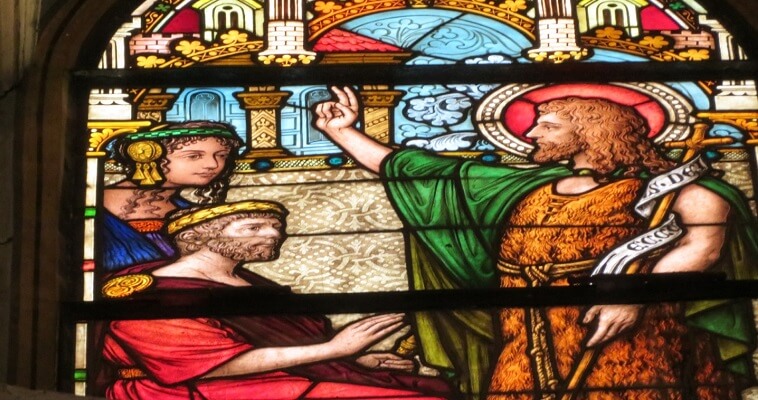
Behind much of Britain’s interest in the Middle East was a movement that claimed the British were descendants of the Lost Tribes of Israel (British Israelism) and that the British monarchy traced its lineage to the House of David. King James VI, who was inclined toward mysticism (and who initiated the witch hunts), saw himself as a descendant of the House of David and his subjects as the Chosen People.
In the 19th century, several thinkers in England developed the idea of British Israelism, such as John Wilson, who wrote the book Our Israelitish Origin [2]. Toward 1880, an organized movement developed, with branches and influence in the United States and in countries of the British Empire with populations of English descent, such as New Zealand, Australia, South Africa, Canada, and others.
The general idea was that the Ten Lost Tribes reached Europe and the plains of Russia, and that peoples such as the Goths, ancient Scythians, Celts, and Germans were actually their descendants. Thus, the Anglo-Saxon peoples were understood to be the Chosen People, descendants of the tribes of Judah, Ephraim, and Manasseh.
The Victorian Era
Queen Victoria reigned from 1837–1901, during a period when England was the world’s leading power, ruling over a quarter of its population. During her time, Parliament became more important, and the monarchy became more symbolic and an object of identification for the masses. Nevertheless, the ethos she developed had great power and was a central component in the British Empire’s path to success. This ethos held that the English had a leading role in bringing culture and progress to the world. Part of this ethos rested on a widespread pseudo-scientific belief that the English were descendants of the Lost Tribes. But even if we disregard this, the Empire’s ideal was to create a New Jerusalem in Britain.
During Queen Victoria’s time, London was the largest city in the world, with six million people, a cosmopolitan center of secret societies, mystics, magicians, and witches. In 1892, the Society for Psychical Research was founded in London, and many of the Empire’s leaders were associated with it. Lord Balfour can be mentioned in this context, as he served as the Society’s chairman.
Queen Victoria’s son, the future King Edward VII, visited Israel in 1862 as a prince. Queen Victoria’s granddaughter, Princess Alice, is buried in the Church of Gethsemane on the Mount of Olives. Her prime ministers for many years were Disraeli and Palmerston, who will be discussed below in the context of their spiritual beliefs, of course.
The scope of this book does not allow for a review of the spiritual renaissance that took place in London at the end of the 19th century. We will only note that England was sovereign over India, and this was the time when the spiritual doctrines of Buddhism and Hinduism, Yoga, and other Eastern traditions reached the West—and, of course, first and foremost, London. The encounter of the West with moral, theological, and spiritual doctrines that were no less, and perhaps even more, advanced than its own was somewhat like the discovery of classical culture by Renaissance figures. Christianity, viewed through the lens of Buddhism, acquired a different dimension, as did Hermeticism, alchemy, and magic. Following the encounter with the East, spiritual movements such as Theosophy emerged.
Western spirituality also experienced a revival during this period, developing movements such as Spiritualism and Mesmerism, Christian Kabbalah, Hermeticism, and Egyptian magic. The British Museum became a magnet for occultists of all kinds. There was a flourishing of various esoteric orders and of the sciences of magic, alchemy, spiritism, mesmerism, and more.
In Victorian England, there were no longer knights on horseback in armor charging onto the battlefield, but there were still orders of knighthood that preserved the ideal of chivalry, such as the prestigious Order of the Garter. There was also the concept of the English gentleman, who replaced the figure of the knight so that an empire could be built on his shoulders. A true gentleman is a self-driven person who does not have a job but has hobbies, is adventurous and courageous, idealistic, and has a sense of service and mission [10]. An English gentleman, for example, is someone who, even if he is alone at home and needs to wash dishes, will spread the butter with the special knife intended for it and not the general knife, because that is how a true gentleman should behave.
One of the acceptable hobbies of an English gentleman was membership in various esoteric societies, some of which also dealt with Spiritualism, the occult, and parapsychology. Contributing to this was England’s natural and traditional status as a land of spirits and supernatural mysteries, from the Celtic period through the Middle Ages. Furthermore, the British Empire discovered the world—including ancient cultures in Egypt, Mesopotamia, India, and beyond—and this stirred the imagination. The British Museum aroused not only an interest in history but also in the spiritual and supernatural, especially in the context of Egypt. England ruled the East, with an emphasis on India, and from there came advanced spiritual doctrines of Sufism, the Hindu Bhakti movement, Yoga, Buddhism, and more. Part of this English-imperial world found a home in Jerusalem.
Disraeli in Jerusalem
After the Egyptian conquest of Israel by Muhammad Ali, a young English gentleman aged 27 arrived in Jerusalem, spent two significant weeks there, and continued to other places in the Land of Israel for a three-month visit that was part of a British gentleman’s rite of passage known as the “Grand Tour.” This visit greatly influenced him. He later became prime minister from 1874–1880 and was instrumental in the purchase of the Suez Canal in 1875, the acquisition of Cyprus in 1878, and consequently, Britain’s entry into the Middle East.
In the Holy Land, Disraeli began writing a novel about David Alroy—a Jewish false messiah from 12th-century Iraq. Following this visit, Disraeli wrote a book called Tancred; or, The New Crusade [3], in which the hero is a young English nobleman seeking meaning in life, who travels to the Middle East to discover spiritual truths and uncover the Secret of Asia. The young Tancred is kidnapped and reaches Mount Sinai, where an angel reveals himself and tells him that he must be the prophet of sublime and comforting theocratic equality. He is later rescued from captivity by his Jewish beloved, Eva, who teaches him the secrets of the past cultures of the East and Christianity’s debt to Judaism.
In the story, Disraeli essentially unites Christianity and Judaism through Tancred and Eva’s desire to marry, the cultures of the past, and the need to establish a rectified society—and this is, in fact, what he attempted when he became prime minister. Some argue that Disraeli’s imperialism toward the Near East already appears in this book.
Disraeli’s Grand Tour also included a visit to Egypt, and while there, he met Clermont-Ganneau, a Frenchman of the same age who would later become one of the most prominent French figures in the Middle East (see Chapter on French Spirituality).
In addition to Disraeli, it is worth mentioning Lord Shaftesbury in the context of Jerusalem. He was a politician, social reformer, and philanthropist, the leader of the Evangelical stream in England, and a Millenarian who believed in the imminent return of Jesus. He worked with Prime Minister Palmerston (who was married to his mother-in-law) to promote the vision of the return of the Jews to Israel as a gateway to Redemption, and to advance this vision through the power of the British Empire. He was instrumental in establishing the British Consulate in Jerusalem (appointing James Finn), in creating the Protestant Bishopric, in supporting the London Society for Promoting Christianity Amongst the Jews, and he advocated all his life for the return of the Jews to their land.
As mentioned, Shaftesbury was close to Palmerston, the Prime Minister of Britain for most of the period between 1840–1865, who worked to strengthen the English presence in the Land of Israel and the Middle East. This was the zenith of the British Empire and the reign of Queen Victoria. He was succeeded by Disraeli, who practically realized the dream of a strong British presence in the Middle East, securing for the Empire a foothold in the Suez Canal (in Egypt, bordering the Land of Israel) and in Cyprus.
London Society for Promoting Christianity Amongst the Jews (LSPCJ)
The London Society for Promoting Christianity Amongst the Jews (LSPCJ) is another name for the Church’s Ministry Among Jewish People (CMJ), operating in Jerusalem from the 1840s. Joseph Wolff, a missionary on behalf of the LSPCJ, arrived in the city as early as the 1830s in his search for the Lost Tribes and in expectation of the Messiah’s coming in 1844. He was a charismatic personality whose writings and presence influenced several other figures connected to the Land, including Harriet Livermore (see chapter on The Indians are Coming), the convert Yohanan Meshulam, who founded the Artas Farm, Samuel Gobat, and others.
Joseph was a member of the LSPCJ. The ideology of this society was that the Messiah’s second coming was conditional on the Jews’ return to their land and their conversion to Christianity. They drew inspiration from Millenarian and other circles in England at that time. Generally, Millenarianism was a serious matter, and many were caught up in it in both America and Europe, leading various people to come to Jerusalem in this context.
The organization was established in 1809. In 1840, it joined forces with the Lutheran Protestants, and with the blessing of the Anglican Church, it worked to establish a base in Jerusalem. Thus, the first Protestant Bishopric was created, with Alexander as the first bishop in 1842. Three years later, he was replaced by Bishop Samuel Gobat, who held the position for 30 years. What is interesting, and connected to the synchronistic network, is that Gobat toured Ethiopia and Yemen with Joseph Wolff in 1836 in search of the Lost Tribes. During his search, Wolff reached Persia and was impressed by the Persians’ expectation of the Mahdi’s coming in 1844, which confirmed his own belief. It is noteworthy that this was the year the Báb (the harbinger of the Bahá’í Faith) declared himself the expected Messiah—and Joseph was likely in the vicinity.
The major changes of the Modern Era led various date-setters to proclaim that the Second Coming of Jesus would occur in 1840, and subsequently the dates shifted to 1844, 1860, and onward. Many people were caught up in this belief and saw it as a catalyst for personal development and religious life, resulting in new Protestant movements—especially in the United States—such as the Adventists. Lord Shaftesbury was a staunch Millenarian, as were Joseph Wolff, James Finn (the British–American consul), and other Christian figures who came to Jerusalem at this time.
The LSPCJ was a joint Protestant bishopric of English and German Lutherans. It was decided that the bishops would alternate—one term a German Lutheran, the next an Anglican. The first bishop, Alexander, was a Lutheran and a personal appointee of the King of Prussia. He was a convert and a language expert who knew Hebrew and Yiddish. Part of his role was to approach the Jews in the Jewish Quarter and try to convert them, making him perfectly suited for his mission. However, he died after a short three years and was replaced by the influential Anglican bishop Samuel Gobat, who shifted the emphasis to the Arab Christian population.
The center of the Protestant bishopric was the British Consulate and the small church next to it, which was established in 1839. It took another ten years for the construction of the large Christ Church beside it to be completed. In 1886, the German Lutherans stopped cooperating with the Anglican Church and went their own separate way.
Samuel Gobat – Anglican Bishop in Jerusalem
Samuel Gobat was born in Switzerland and educated in the Protestant Pietist tradition of Philipp Jakob Spener, which aimed at fostering a religious experience leading to a new spiritual birth. It is unknown what experience Gobat underwent, but following it, he came to England to study Arabic and Ge’ez (Ethiopian), joined the Anglican Church, and went out as its missionary to Ethiopia and Egypt.
Upon returning to England, he married Christina Regina Zeller, the daughter of a religious leader in the Pietist movement and a social reformer. He returned to Ethiopia, where he became renowned for his missionary work among the Falasha Jews and for his success among the Ethiopian Christians. It is possible that during that period he was exposed to the Ethiopian concept of the Gedl (man of merit), as well as to their Christian mysticism and religious devotion.
After sixteen years of missionary activity in Ethiopia and Malta, he arrived in the Holy Land in 1846 to lead the joint German–English Protestant bishopric. He served for thirty years and played a central role in bringing education to the Arab population and converting some of them to the Anglican Church, which still has followers and representation in cities like Ramla, Nazareth, and Jerusalem, of course.
Gobat was different from his predecessor Alexander in both education and orientation, and he turned toward the Arab Christian population rather than the Jewish population. When he arrived in the Holy Land, he saw that attempts to convert Jews were not only unsuccessful, but that the few who did convert often did so for the wrong reasons, making the entire process a great farce. Therefore, he decided to change course and try to convert the local Christians, mainly from the Orthodox Church, to Protestantism—not only externally, but also as true believers internally. The motto of the Pietist school to which he belonged was: “It is not enough to make the ignorant believers; we must also ensure that the believers are not ignorant.” The way to ensure this was through the establishment of educational and welfare institutions. He founded forty schools for the Arab Christian and Muslim population throughout the land, as well as hospitals and other welfare institutions.
The attempts to convert the local population to Protestantism through educational and welfare institutions met with resistance from the Greek Orthodox clergy, and they also heightened the sense of threat felt by the Catholics, leading to the establishment of parallel Catholic institutions. It can be said that this attempt ultimately failed to bring about a fundamental change in the demographic composition of Christians in the Land of Israel, but it succeeded in changing the nature and daily life of the Christian community as a whole. One can look at the half-full cup and note that there are still several thousand Anglican Christians in the Land today, and they hold significant influence within the Palestinian Christian community. Additionally, Gobat’s enterprises played an important role in the development of the Land of Israel and in its transformation from a remote province of the Ottoman Empire into a modern and vibrant land.
Gobat founded forty schools in the Arab sector. These were the first modern schools, and for a long time, the only ones. Through this effort, he created the foundations for the education of a young and educated elite within Arab society, who would later lead the national movement and the cultural struggle for the creation of the nation. This is similar to the establishment of Theosophy schools in India, which competed with those of the Christian missions and within which the new Indian nationalism and culture were born.
Gobat was fluent in the Arabic language and acquainted with Arabic culture, and he directed the local population toward productive work. During his time, a workshop was established at Christ Church, as well as the Gobat School on Mount Zion, where the best of the youth, including Jews, received various forms of vocational training and education.
Gobat led the Protestants in Israel from 1846 to 1879. He had ten children, some of whom died young, while others continued his missionary and educational work. Above all, he should be remembered as the person who brought modern education to the Land, moving the population from a period of backwardness and ignorance into the modern era and enabling a new Arab cultural renaissance toward the end of the Ottoman period and the arrival of Zionism.

Christ Church Anglican
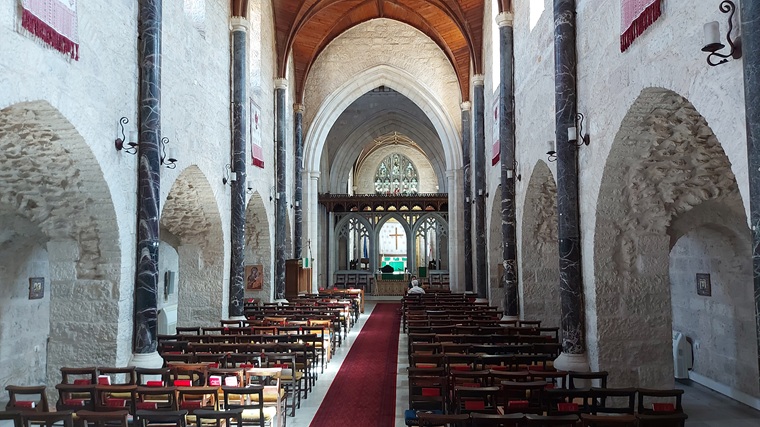
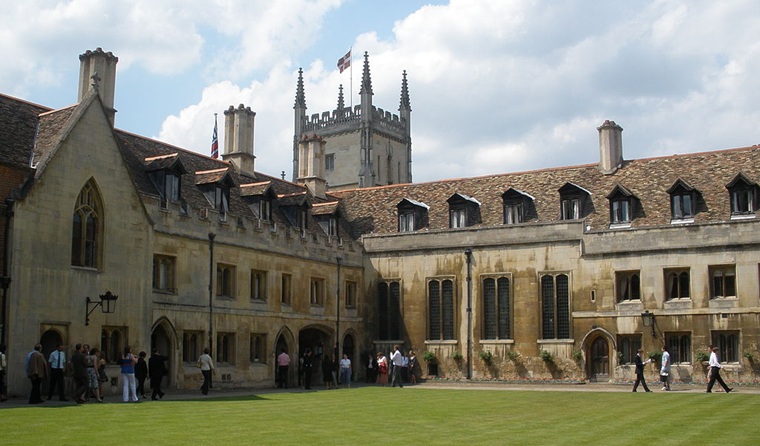
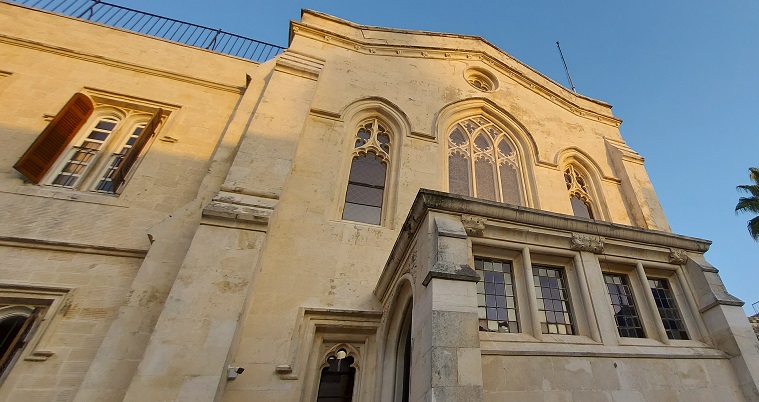
Christ Church is a good place to soak in a bit of English atmosphere. In a courtyard that looks as if it were taken from Oxford or Cambridge, one can drink English tea and try to connect with English history and the legends of the Holy Grail. The compound, located near Jaffa Gate, has an English stone courtyard, a garden, a hostel, a dining room, a small museum, and a church, and it is like a world unto itself within the Old City. The place has an important and interesting history in the context of Jerusalem’s development in the 19th century.
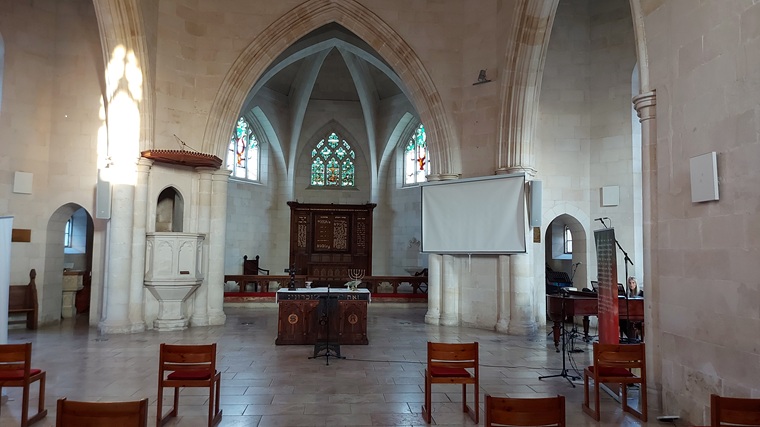
The church began construction in 1841 and was consecrated in 1849. For its construction, stonemasons were brought from Malta, as the Jerusalemites had forgotten how to cut stone skillfully, and workers had to be brought from outside to revive this craft. It was the first Protestant church in Jerusalem, but also the first modern stone structure. It was built near the residence of the British Consul as part of a complex that included services for the new Protestant community and especially for the nearby Jewish community. These services included workshops for vocational training (where Conrad Schick worked), a school, a hostel, and a soup kitchen, with the German Deaconess Hospital founded nearby.
Those were the days of Millenarianism, an expectation of an end-of-the-world transformation. The LSPCJ believed that the conversion of the Jews and their return to the Holy Land would hasten the Second Coming of Jesus. The person who consecrated the church was Samuel Gobat, and the final-stage architect (there were three) was Matthew Habershon, who was in contact with King Frederick William IV of Prussia (1840–1861), known as a romantic ruler and associated with Millenarian circles.
King Frederick William IV supported Germany’s unification and industrialization. He was sympathetic to Catholics and supported religious revival in Germany. He built castles and churches across the land and completed the cathedral in Cologne, the resting place of the relics of the Three Magi.
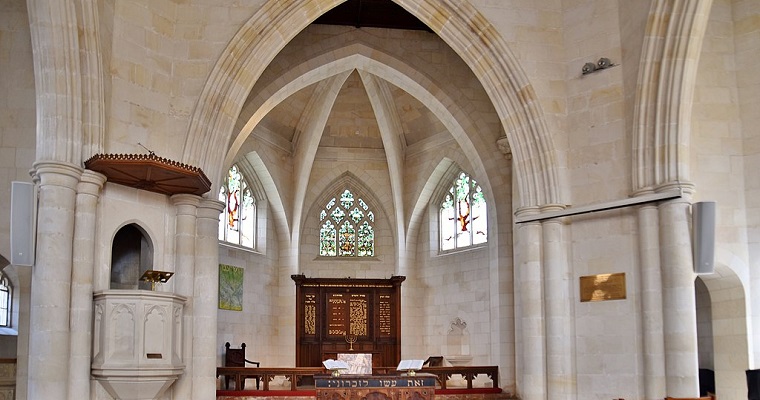
As mentioned before, the Millenarian circles believed that before the expected and imminent return of Jesus, the Jewish people needed to return to their land, settle there, and accept Christianity. Therefore, the church, which was intended to appeal to the Jewish population in the nearby Jewish Quarter, resembles a synagogue in its interior: it has no tower, statues, or images. Instead, it contains an Ark inscribed with the Ten Commandments and a painting of the Tree of Life.
This is one of the most beautiful Neo-Gothic structures in Jerusalem, reminiscent of similar buildings of the period in England, Oxford, and Cambridge. The beautiful and surprising stone courtyard also recalls England, and there is a hidden garden at the back of the building. Today, the site houses a museum that recounts the place’s history, with models of the Temple Mount and the Church of the Holy Sepulchre produced in Conrad Schick’s workshop. The site is a center of the Messianic community in Jerusalem and thus fulfills its original purpose as a Christian mission to the Jews.
The End of Days
The Millenarian conception of the End of Days (Eschatology) is based on verses in the Bible, the visions of Isaiah and Micah, and especially the Book of Daniel, as well as parts of the New Testament such as the Book of Revelation. It should be distinguished from the prophecies of the great prophets regarding the glorious future awaiting the people of Israel and the rule of justice that will be recognized by the nations.
John, one of the twelve apostles and the writer of the Gospel of John, had visions in his final days while on the island of Patmos in Greece, and these were put into writing. This vision reveals a complete worldview related to the process of Redemption: seven trumpets, seals, and bowls; a woman; four horsemen; and so on. The visions describe the divine Millennial Kingdom that will appear at the end of days, and they led to the establishment of various messianic movements that anticipated this kingdom, sought to advance it, and had a great influence on religious affairs—many of them supporting the Zionist movement and the Jewish state.
Toward the 1840s, there was an expectation of the End of Days shared by some Christians, Jews, and Muslims. Among Christians, it is worth mentioning Joseph Wolff, who was one of the first Protestant missionaries in the city in 1822; among Jews, Menachem Mendel of Shklov, a disciple of the Vilna Gaon; and among Muslims, the Shi‘ites who awaited the coming of the Mahdi in Persia. It is interesting to note that Wolff was on good terms with Shklov, accompanied Samuel Gobat on a journey to Yemen in search of the Lost Tribes in 1836, and was in Persia in 1844 when the Báb declared himself the Messiah, thus beginning the Bahá’í Faith.
Joseph Wolff converted the apostate Yohanan Meshulam, who moved to Jerusalem in 1840 and established the Artas Farm near Bethlehem, a center of Millenarianism. James Finn, the English consul, was also a Millenarian, which led him to establish the Kerem Avraham Farm north of Jerusalem. It seems that both individuals were preparing for the End of Days—a time when the existing social and economic order would collapse and every person would have to rely on the fruit of their own labor. Finn, who served as the representative of Britain and the U.S. in Jerusalem from 1846–1863, was a central figure in the city who supported the Jewish population and was connected with various religious and messianic groups.
There is a difference between prophecy—regarding the return of the people of Israel to their land and the magnificent rebuilding of the Temple—and eschatology: visions of fantastic and supernatural events whose meaning is partly obscure. This is the difference between the fantastic and the possible. It is the difference between a hope for a better future grounded in reality and fantasy—a kind of conspiracy theory about events that will occur, which is often used as a means of control by “those in the know” over the masses.
The apocalyptic fantasy appears more prominently in Christianity, becoming a mass movement with the beginning of the Modern Era and, toward the mid-19th century, developing into what was called Millenarianism. The new era that began with the Industrial Revolution in 18th-century England fundamentally changed people’s ways of life and was perceived, rightly so, as the birth pangs of the Messiah. Until then, there were different kingdoms and religions, but on a physical level life remained similar and limited—movement from place to place was slow, communication was limited, and the environment imposed itself on human beings. The Industrial Revolution, with the invention of electricity, machines, and the development of medicine, communication, and transportation, completely changed human life, enabling the creation of an artificial environment with light and air conditioning; exposure to knowledge previously unavailable; and comfortable, secure, and healthy living in which a person could dedicate themselves to “self-actualization” and become socially and personally independent.
It is difficult to exaggerate the magnitude of the change in lifestyle that has occurred since the Industrial Revolution—a change that continues to this day. Cellular phones, the internet, cars, international travel, computers—none of these existed before, nor did clubs, sports, television, and so on.
If we look at things from a spiritual perspective, and if we indeed believe that there are reasons for events and a guiding hand in the world, then what is happening certainly has meaning and direction, especially in the Jewish-Israeli context—the miraculous events of the return of the Jewish people to their land and the establishment of a glorious Start-Up Nation. There is no doubt that we are in the time of the “End of Days,” but the question is what its meaning is. Is it a time when far-fetched and imaginary stories about all kinds of monsters and miraculous events will come true exactly as written in books from thousands of years ago—or will what arrives be a new consciousness, a new stage in human development, as claimed by the New Age movements.
In the 19th century, people such as John Nelson Darby in England and William Miller [4] in the United States preached about the divine plan of Redemption and revealed its stages and signs according to their interpretation of the Scriptures. But one can also look at things differently, as suggested by the Catholic prehistorian and theologian Pierre Teilhard de Chardin. A look at history shows us that there are threads of love and synchronicity connecting all things. The historical development from ancient human types to the present day is so astonishing that it cannot be accidental—the product of random evolution.
According to de Chardin [5], what guides events is a point in the future that he called the “Omega Point”—a point of super-consciousness toward which humanity is advancing. Once we reach a new consciousness in which we see the connections between things, the ego, which currently serves as a defense mechanism against external chaos, can be shed, and human beings will transition to a new state of thought, consciousness, and existence. De Chardin’s vision is a Christian End of Days in a New Age style, and I tend to agree with it, because if there is indeed a God, a reason, and a meaning to human life—then they exist here today and are connected to the future, not the past.
See a lecture on the English presence in Jerusalem, spiritual movements, coincidences:
Footnotes
[1] Ashe, Geoffrey. King Arthur’s Avalon: The Story of Glastonbury. London: Collins, 1957.
[2] Wilson, John. (1876). Lectures on Our Israelitish Origin. London: James Nisbet & Co.
[3] Disraeli, B. (2007). Tancred; or, The new crusade. Mineola, NY: Dover Publications. (Original work published 1847).
[4] Miller, W. (1836). Evidence from Scripture and History of the Second Coming of Christ (Lectures). Boston: Joshua V. Himes.
[5] Teilhard de Chardin, P. (1959). The phenomenon of man. New York: Harper & Brothers.