William Henry Bartlett and the Sublime
William Henry Bartlett (1809–1854) is considered the most prominent landscape painter of biblical scenes in 19th-century England. He also painted landscapes of other countries and is especially known for his paintings of the United States and Canada [1]. His goal in painting was to show the Sublime, to activate the observer’s imagination, and to cause them to experience insights and a numinous affect (a sense of profound religious awe).
In general, there is a dialogue between man and place, and certain places are capable of arousing a heightened religious feeling—the Sublime within us. This is what happens to Bartlett in particular landscapes—and this he expresses in his painting. He cannot depict the Sublime without connecting to the Sublime himself, as he describes in the narratives accompanying the paintings, and through contemplation of the images, one can connect to what they are connected to. Even today, the goal of visiting Jerusalem can be a connection to the Sublime through physical elements found in the city as a whole and in specific places within it, as Bartlett shows us.
The school to which Bartlett belonged advocated presenting the symbolism in nature—glorifying and elevating it. To this end, Bartlett identifies archetypes and prominent features in the landscape, and, as in a caricature, he exaggerates them in order to convey the hidden reality present within them according to his perception of the holy places. Imagination is capable of filling and completing the world and bringing the wondrous and the sublime into it, because it exists within us. The purpose of painting is to lead to the Sublime—it arouses attention and a kind of aesthetic pleasure that can lead to a numinous religious experience.
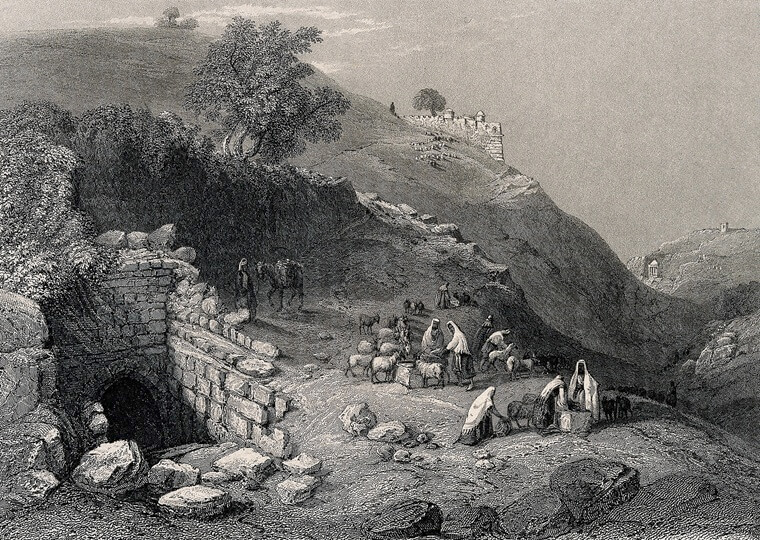
The school to which Bartlett belonged—picturesque topographical landscape painting leading to the Sublime—adopted models of landscape composition: in the foreground, figures or ruined monuments surrounded by trees or other objects; in the middle of the picture, its central element (for example, the Temple Mount plaza in Jerusalem); and in the background, a vague horizon, clouds, the meeting of heaven and earth, and so on. This was a fixed framework of ideal landscape painting emphasizing the existence of the Sublime (the Godhead) in the world. Common motifs in these paintings were high mountains, cliffs, deep ravines, rivers, wildernesses, and any other unusual features emphasizing the landscape and relating to history, especially ruins set against scenic backgrounds.
Bartlett leaned on the Romantic perception, which encourages emotion and melodrama. The ruins of the Land of Israel in general, and Jerusalem in particular, were suited to this approach—ruins were preferred over intact structures because they allow for the activation of the imagination, they call for the activation of the imagination, and thus an aesthetic experience is achieved—and, with the perception of the Sublime, an experience of the sacred can be achieved as well.
Bartlett came to the Land of Israel to improve his biblical paintings and to receive inspiration through the physical encounter with the places where the events of the Old and New Testaments occurred. He came here twice—in 1842 and 1853—and published several books with hundreds of sketches of the country’s landscapes. His visit to Israel brought his paintings to a new level in the sense of the Sublime they convey, especially the paintings of Jerusalem.
The Sublime
This was an aesthetic-spiritual ideal within the Romantic movement in painting and literature. While the word in this context translates as “The Sublime,” it can also be rendered as “Eminent,” which lends the concept an additional dimension. The defining characteristic of the sublime, as also seen in Bartlett’s paintings, is the insignificance of man in the presence of a power greater than himself—the very hallmark of the mystical experience described by William James in The Varieties of Religious Experience. Man is small before nature or a monumental structure, yet this does not diminish him (as those who do not look deeply into the matter might assume); on the contrary, it awakens something profound, vast, and immense within him—that religious sense of awe, wonder, and the “wholly other” (das ganz Andere), as described by Rudolf Otto in The Idea of the Holy.
In the late 18th century, the Anglo-Irish philosopher and statesman Edmund Burke authored A Philosophical Enquiry into the Origin of Our Ideas of the Sublime and Beautiful, which became a foundational text for the development of the 19th-century Romantic movement. Much like Mircea Eliade some two centuries later, Burke argued that man is inherently a religious creature (Homo Religiosus), and that religion and faith are natural human needs; like Pierre Teilhard de Chardin, he believed in a guiding hand throughout history. According to Burke, the essence of the sublime lies in the triumph of light over darkness (evident in Bartlett’s painting Jerusalem from the Mount of Evil Counsel). In contrast to the beautiful, which soothes the nervous system, the sublime induces tension arising from the contrast between man and a force vastly greater than himself—a contrast physically manifested in extraordinary scale and proportion.
The foremost painters associated with this aesthetic-spiritual ideal were J. M. W. Turner (1775–1851), John Martin (1789–1854), and William Blake (1757–1827). Blake was a mystic, prophet, and Gnostic whose paintings of God, Adam and Eve, Jacob’s Ladder, Newton as the divine geometer, and other subjects entered the global artistic pantheon. He depicted biblical themes alongside the Heavenly Jerusalem (Albion—the cosmic man), and penned the beloved English anthem “Jerusalem.” John Martin likewise painted biblical scenes, such as the destruction of Sodom. Turner boldly published paintings of sites in the Holy Land despite never having visited, basing his work on sketches by artists such as Bartlett. The works of these celebrated painters inspired many in Victorian England to seek and rediscover the physical Land of Israel as part of an inner journey toward the Heavenly Jerusalem—a desire that converged with British imperial ambitions and the exploratory vision of the Royal Geographical Society.
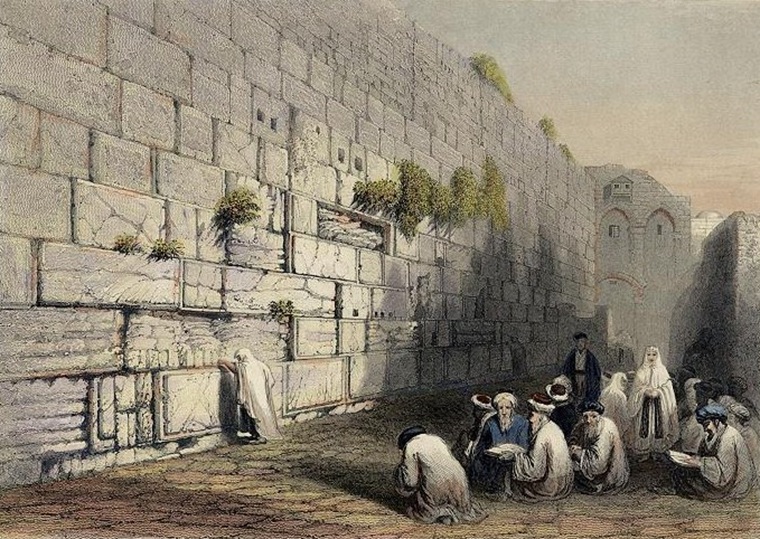
Bartlett produced thousands of paintings depicting various corners of the globe. Undoubtedly, much of this output stemmed from his duties as a documentary illustrator and the commercial demands of his patrons, who commissioned him to capture the landscapes of the regions he visited. In other words, much of it was straightforward “work.” Yet, particularly in his depictions of Jerusalem, one can discern his personal-religious interpretation and the mystical experience he underwent, which led him to select distinct visual motifs. For instance, in Jerusalem from the Mount of Evil Counsel (1842), the light illuminating the Old City rises above the darkness of the surrounding valleys (a mysticism of dark and light). In Tomb of the Virgin (1842), the entrance is centrally positioned, seemingly inviting the viewer inside; similarly, in The Jew’s Wailing Place—the Western Wall (1842)—the illuminated stones at the center and the lone, diminutive figure praying before them invite us into another dimension. In The Garden of Gethsemane (1838), the heavenly light radiating from the upper right resolves the oppressive mood evoked by the Van Gogh-esque trees in the valley and the harsh, enclosed wall in the background.
Although Bartlett documented his emotional impressions of these sites, he never explicitly offered mystical interpretations of his works; his intentions must be inferred directly from the paintings themselves. It is fascinating to note that Barluzzi, in his mosaics at Gethsemane, employed that same motif of stylized, expressive trees. Comparing Bartlett’s depictions of these sites with those of contemporaries like David Roberts illuminates the true essence of the sublime in art, particularly within the context of Jerusalem.
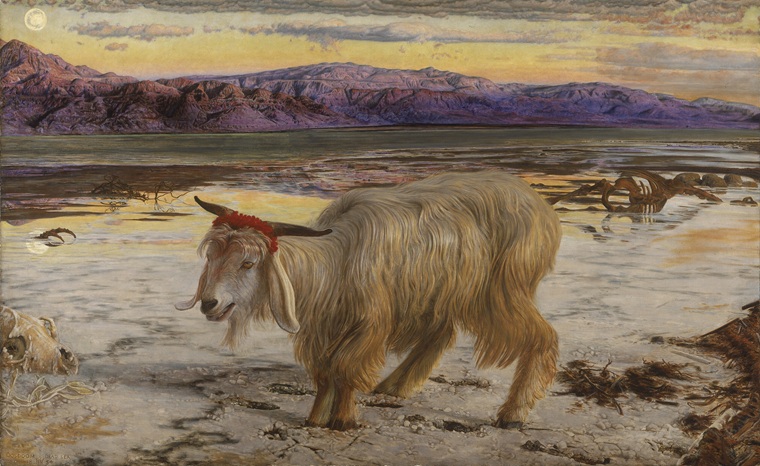
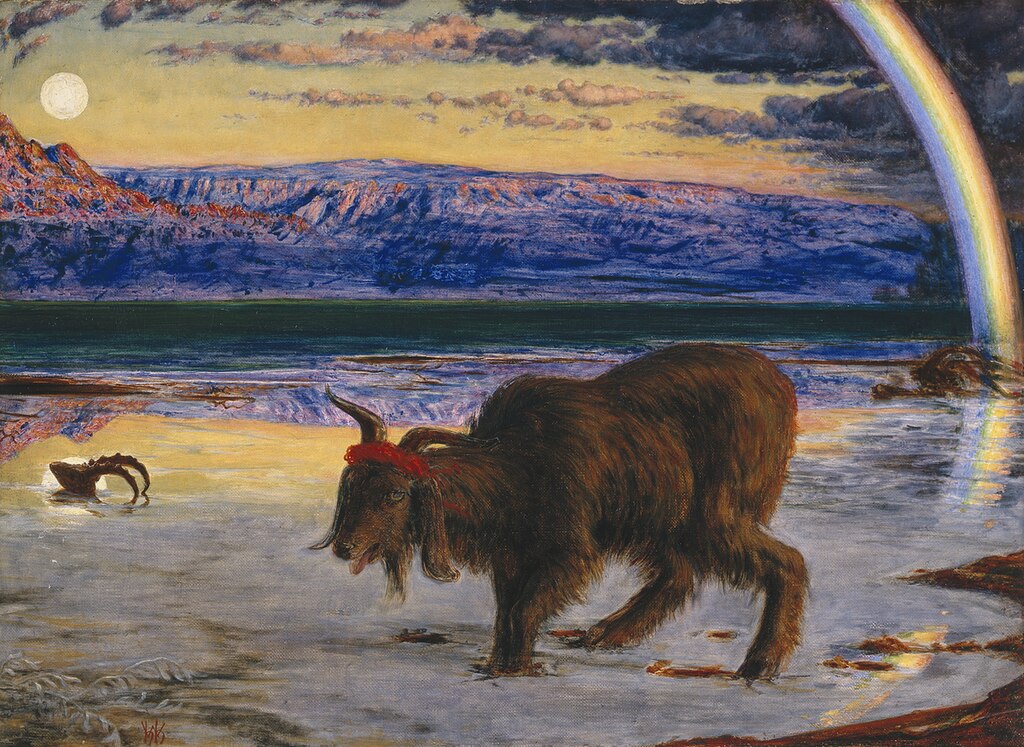
William Hunt and Henry Monk
In the spiritual path, there is a concept of a soulmate—a person whose encounter allows one to discover new realms within oneself that cannot be reached alone. Furthermore, there are certain encounters between people that seem destined to happen and bring something new into the world. This can be between partners, which is why it is said that behind every great man there is a great woman, and it can be between friends and not necessarily in a romantic context, but in the sense of a soulmate and spiritual love.
One of these special meetings that fate orchestrated is the encounter between the painter William Holman Hunt (1827–1910) and the visionary prophet Henry Wentworth Monk (1827–1896). Hunt was born on April 2, 1827, and Monk just four days later—on April 6, 1827. Both abandoned their entire known world because of an inner calling at the age of 27 and arrived in the Land of Israel in 1854. There they met by divine command (according to their perception) at Artas Farm. The two became soul friends, discovering a mystical connection between them, and one of the by-products of this fateful meeting was that Hunt’s painting succeeded in reaching a new level.
Henry Monk was a young Canadian with messianic visions, based on an original interpretation of the Book of Revelation in the New Testament. His conclusion from reading the Revelation was that the return of the Jews to their land should be encouraged, and, additionally, that an international center for conflict resolution and intercultural and interreligious dialogue should be established in Jerusalem. After discovering this secret, Monk decided to act. He took a vow of celibacy and left for Jerusalem, arriving in 1854 with nothing. He was adopted by Consul James Finn and the American Warder Cresson. After a short stay in Jerusalem, he moved to the Artas Farm of the convert John Meshullam, a millenarian stronghold. There he met the painter William Hunt, who saw him as a kind of ancient prophet. Together they delved into the interpretation of the Book of Revelation.
Hunt was one of the founders of the Pre-Raphaelite Brotherhood, an association whose goal was to return to the art of the Middle Ages before Raphael and Michelangelo—an art characterized by innocence, spirituality, a combination of romanticism and realism, abundant color, and symbols integrated with simplicity, beauty, and truth. Their source of inspiration was the stories of the Bible and nature [2]. By virtue of their opposition to the Neo-Classical style and their aspiration toward bare truth, nature, and the moral aspect, the Pre-Raphaelites were supported by the renowned art critic John Ruskin.
Hunt had a religious inclination and was fascinated by the stories of the Bible. In 1854, after completing his most important painting, The Light of the World (a work that became the most widespread image of Jesus in Victorian England), Hunt responded to an inner call he felt, abandoned everything, and left for Jerusalem.
After arriving in Jerusalem, and desiring to connect with biblical life, he moved to Meshullam’s Artas Farm, where he met Monk. The encounter changed both of them. Hunt and Monk held long nightly conversations and went on journeys together in the land. Through their dialogue, Hunt developed a new kind of religious painting—symbolic and realistic, yet possessing something else indefinable, bordering on the frightening and the bizarre. In his new paintings, Hunt successfully combines the landscapes of Israel with his developing concept of the divine; he manages to convey the hidden and immense aspects of the land and the mythical biblical events. The masterpiece of this painting style is his The Scapegoat—a work that offers no rest.
After two years, Hunt returned to England. Being wealthy, he could support his friend Henry Monk, whom he saw as a kind of ancient prophet. He invited him to London in 1857 to publish his original commentary on the Book of Revelation, and painted his portrait as an ancient prophet. Hunt introduced Monk to John Ruskin, who supported him and funded the publication of his books and his missions to establish peace in the world.
Monk’s commentary on the Book of Revelation predicted the destruction of the world in a massive war in the 1940s—which indeed happened—stemming from the sins of humanity. The rectification of the fall of society would come through a Jewish-Christian elite that would adopt the new true religion and settle in the Land of Israel. They would live their lives close to nature in rural villages, and when the war began, they would be the only ones to be spared, from whom a new, more enlightened human culture would begin.
Despite the strong friendship, life separated the two friends. In 1863, Monk returned to Jerusalem for a short, apparently unsuccessful, visit and subsequently returned—miraculously—to Canada. Eliezer Witztum wrote about him in the book Jerusalem of Sanctity and Madness [3], but he did not write what Monk’s interpretation of the Book of Revelation was—the same interpretation that tormented him all his life.
Six years after parting from his friend, Hunt traveled to Jerusalem alone in 1869 and stayed there for three years until 1872, and again for three years in 1875–1878, during which he built himself a house on Prophets Road. Towards the end of his life, he supported the Zionist movement, which he perceived as the fulfillment of his friend Monk’s prophecy.

The Palestine Exploration Fund and Theosophy
In the synchronistic network, events that move in one direction often lead to movement in another direction, somewhat like the butterfly effect, and so it was with the founding of the Palestine Exploration Fund (PEF) in England.
It all began with a man named James Fergusson [4], a well-known English architect and public figure. He claimed (and rightly so) that the Dome of the Rock is the peak of Muslim architecture, expressing cosmic principles. However, Fergusson also claimed that the Dome of the Rock was the burial place of Jesus and not the Church of the Holy Sepulchre, which caused a great uproar, leading his friend and colleague George Grove to found the PEF. Thus, in 1865, the first meeting of people who wanted to establish an association aimed at the true investigation of the Land of Israel took place in the “Jerusalem Room” at Westminster Abbey.
The Palestine Exploration Fund was supported by Lord Shaftesbury, the Geographical Society, the Anglican Church, many more dignitaries, and it had the official support of Queen Victoria. Some of the money for the expeditions was donated by the wealthiest woman in Britain, the banker and philanthropist Angela Burdett-Coutts.
The first expedition was led by Charles Wilson in 1865. In 1868, Charles Warren led another successful expedition. Edward Henry Palmer participated in a subsequent expedition to Mount Sinai. In 1882, Palmer was murdered by Bedouins in Sinai. Warren was sent to trace his footsteps and recover his body [5]. Another researcher associated with the Palestine Exploration Fund is Charles Frederick Tyrwhitt-Drake, who was the first secretary of the Freemasons in the land and founded the Royal Solomon Mother Lodge in Zedekiah’s Cave in 1873.
The founder and first head of the Palestine Exploration Fund was George Grove—a musician, engineer, and lexicographer. His partner in founding the Palestine Exploration Fund was Arthur Penrhyn Stanley. He was replaced by Walter Besant (1836–1901), who headed the PEF from 1868 to 1885. Besant was a Freemason and the brother-in-law of Annie Besant, a leader of Theosophy. As an author, he influenced Kipling.
Walter Besant was a founding member of the first Masonic research lodge (Quatuor Coronati Lodge) along with Charles Warren and William Wynn Westcott, a founder of the Hermetic Order of the Golden Dawn and an activist in the Theosophical Society. He wrote an article [6] for the lodge called The Religion of Freemasonry Illuminated by the Kabbalah. Besant was also a vicar in Lincolnshire. The tower in his church in Lincolnshire is very similar to the tower in the English Church of St. George on Nablus Road.
Annie Besant was a social reformer, a feminist, and an activist in the secular society. In 1890, she met Madame Blavatsky and became a student of Theosophical esotericism. She moved to India and became a social and political activist there, and later Madame Blavatsky’s successor in leading the movement. She is the one who chose Jiddu Krishnamurti (1895–1986) to be the World Teacher.
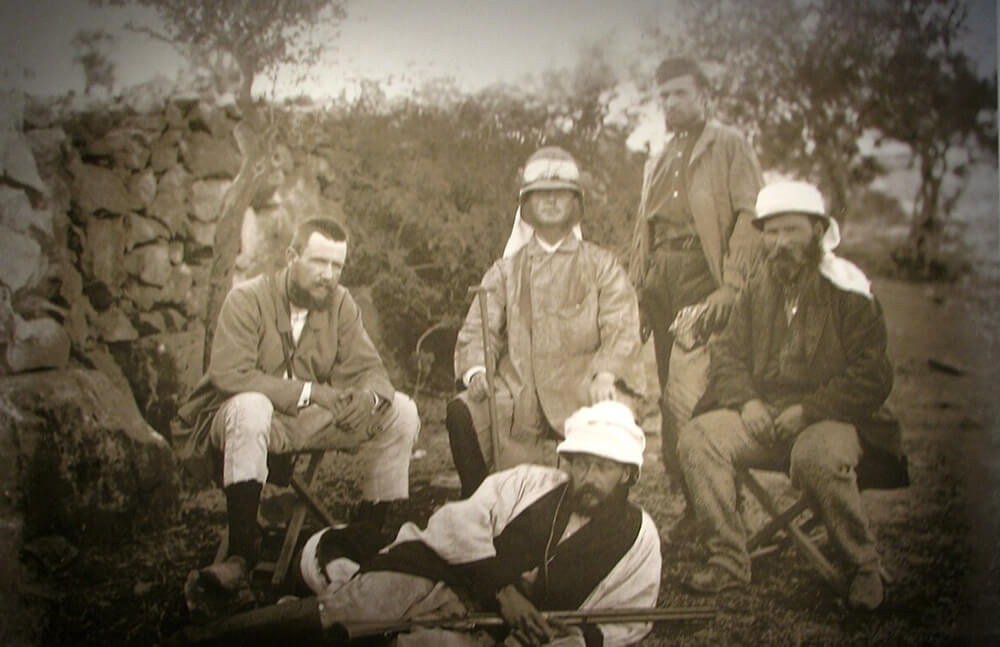
Charles Warren
The first expedition of the Palestine Exploration Fund was led by Charles Wilson, a British Army officer, geographer, and archaeologist. However, soon enough another Charles—also a British Army officer—took center stage in the activities of the PEF: Sir Charles Warren (1840–1927), a man with a solid reputation who later became the head of Scotland Yard. He was a prominent Freemason of high degrees who spent three years in the land (1867–1870), explored the Temple Mount, discovered “Warren’s Shaft,” and also traveled throughout the country, initiating a systematic mapping of the Land of Israel, which was later used by the British in World War I.
Warren excavated around the Temple Mount using shafts and tunnels and reached the bedrock and the western wall of the Temple Mount compound from various directions. The excavations, which took several years, aroused great excitement in Britain. In 1868, he discovered Phoenician letters and masons’ marks that were examined by the important Jewish scholar Emanuel Deutsch, and everyone was certain that these were remnants of Solomon’s Temple and proof of the participation of Phoenician builders, including Hiram Abiff, in the Temple’s construction.
Warren discovered “Warren’s Shaft” and published a book in 1876 called Underground Jerusalem. After returning to London, he maintained his connection with the PEF. In 1882, he went to Sinai to search for Edward Henry Palmer and found and recovered his body [5].
Warren was one of the founders of the first Masonic research lodge, Quatuor Coronati Lodge, and its first Grand Master. The lodge aimed to investigate the history of the Freemasons, and it is safe to assume that his excavations in Jerusalem played an important role in this. In the framework of his Masonic activity, he wrote an article [8] for the bulletin called On the Orientation of Temples. In the article, he argues that the origin of the Masons’ lodge structure is Phoenician and not Hebrew, and discusses three doors in the East, West, and South, symbolizing three stages in the sun’s journey across the heavens.
After retiring from his service, he helped his childhood friend, General Baden-Powell—a British war hero—to found the Scout Movement in 1908, which has a strong presence in Jerusalem.

Richard Francis Burton
If there is a figure who represents the ideal of the English gentleman and adventurer, and the world discoverer of the 19th century, it is Richard Francis Burton (1821–1890). He was a genius who knew 29 languages, an adventurer, and a mystic, employed by the Royal Geographical Society as an explorer of East Africa. Burton spent seven years in India, and in 1853, he made a pilgrimage to Mecca in disguise. He knew the Quran by heart and underwent initiation into the Shadhili Sufi path, as well as other religious experiences.
In 1868, Burton was appointed Consul in Damascus. While there, he connected with Abd el-Kader al-Jazairi, a legendary Muslim public reform figure who was also an important Sufi scholar, supporting the establishment of the Shadhili-Yashruti Sufi Order in Acre later on.
Burton recounts in his diaries [9] a connection he formed with a group of Shadhili Sufis, whom he calls “secret Christians longing for baptism.” His wife, Isabel, calls them “his ruin”—a hint that they may have become Sufis, because according to Sufi terminology, on the path toward union with God, a person must become a site of ruins (die to the self) in order to be reborn.
In 1870, Burton met Henry Palmer and Charles Frederick Tyrwhitt-Drake in Damascus. He connected with Tyrwhitt, and together they embarked on two years of discovery and travel throughout the land and the Levant. Burton’s wife, Isabel Burton, also participated in the journeys. Everywhere he visited, he supported the encounter between British culture and Islam, especially Sufism. Jane Digby, an Englishwoman married to a Bedouin Sheikh, was also part of their circle.
Burton devoted much of his time during the second stage of his life to literary work. He translated The Thousand and One Nights, wrote books, and also translated the Kama Sutra and The Perfumed Garden (a kind of 15th-century Arab Kama Sutra), both erotic works. He was generally known for his interest in sex in an anthropological, and perhaps also spiritual, context. Additionally, Burton wrote a book called The Kasîdah, a kind of Sufi doctrine, indicating his connection to the Bektashi Order [10].
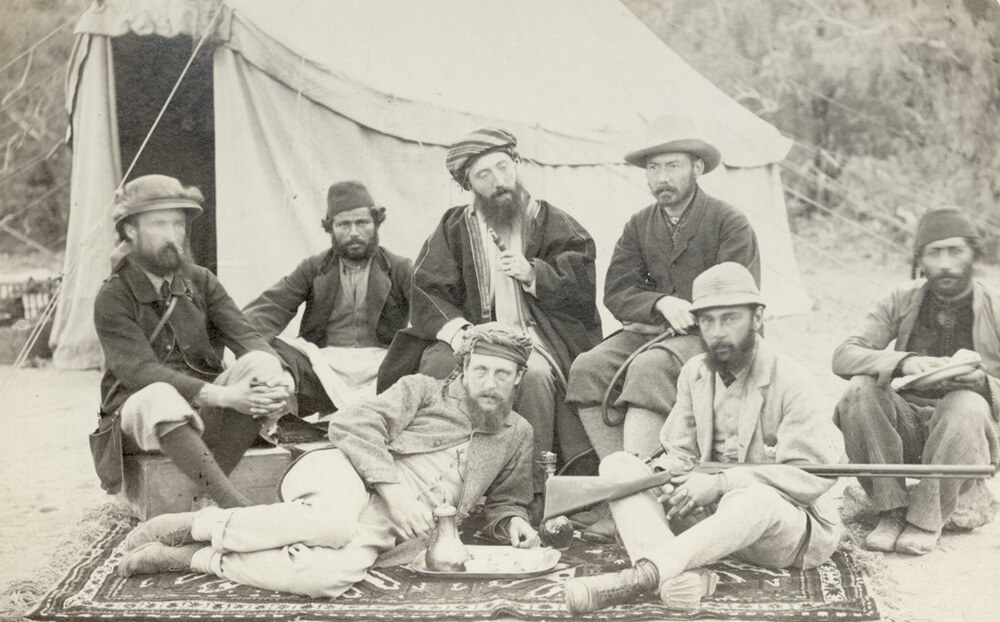
Edward Henry Palmer
Like Burton, Edward Henry Palmer (1840–1882) was interested in Sufi mysticism. He knew Arabic, Hindi, and Persian fluently, wrote a book on Islamic mysticism [11], and was one of the first to open up the topic. He met Burton in Damascus, and together they established a connection with the Sufi Orders.
Palmer found his place in the PEF and embarked on an expedition to Sinai in 1869 with Tyrwhitt-Drake. Palmer, who knew Arabic, was called “Abdullah Effendi” by the Bedouins. Upon completion of the successful journey, they continued to Damascus, where they connected with Richard Burton and his wife, and the four embarked on a journey together across the land.
In 1871, he returned to England and wrote a book about Jerusalem with Walter Besant [12], which expands on the Crusader kings, using techniques reminiscent of channeling. In 1882, he was called to embark on another mission to Sinai, aiming to influence the tribes to support the British. During this mission, he was murdered.
St. George’s Cathedral
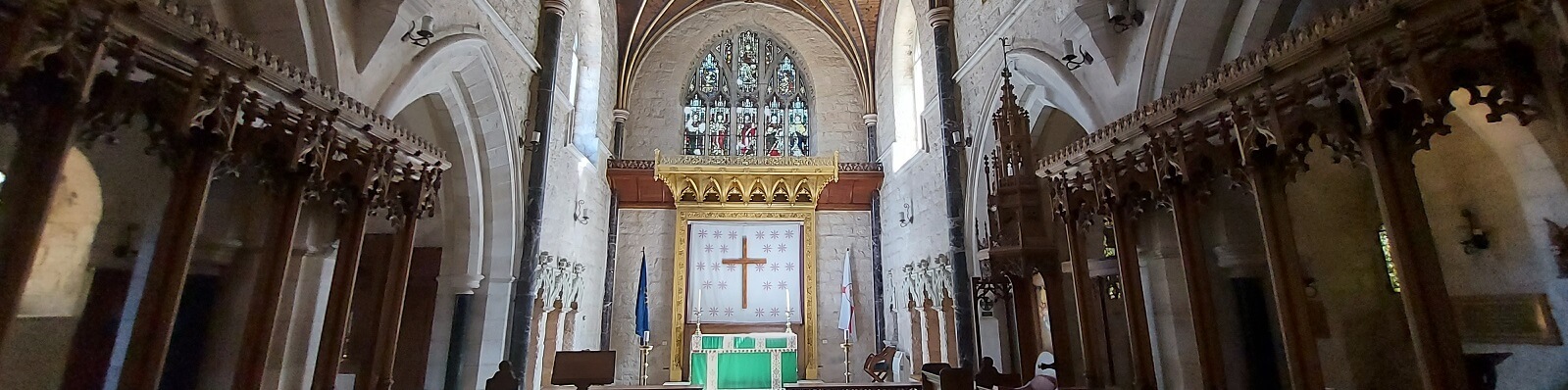
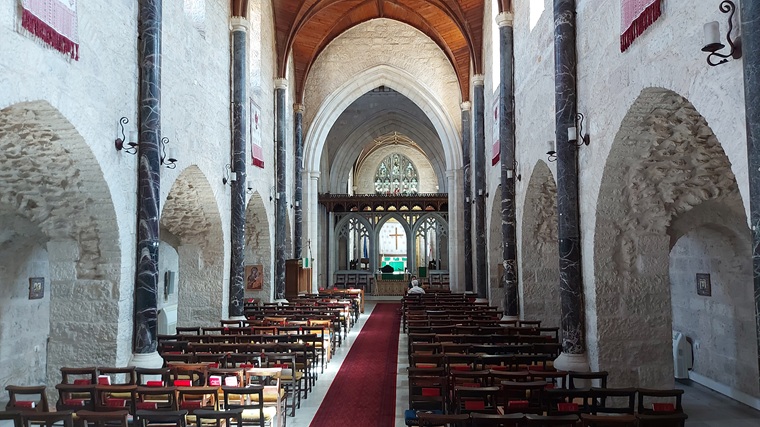
The St. George’s Cathedral and Compound are situated on Nablus Road north of the Old City. They were built in 1898 with the support of Crown Prince Edward VII and named after the patron saint of England.
The person who promoted the building of the cathedral was George Blyth, the Anglican Bishop of Jerusalem after Samuel Gobat (serving from 1887–1914). He founded the Jerusalem and the Middle East Church Association (JMECA) with an Arab orientation—as opposed to the Jewish orientation of Christ Church and the Church’s Ministry Among Jewish People (CMJ) society. Blyth was inclined toward the Catholic stream of the Anglican Church and was close to Orthodox Christianity. He directed his missionary efforts toward Christians and Muslims (instead of Jews) and maintained good relations with the local Arabs. To this day, the Anglican Church is a mediating and reconciling factor among the different Arab Christian denominations and a center of education.
The Cathedral became the seat of the Anglican Bishopric and includes St. George’s College within its territory. Professor Herbert Danby, who translated the Mishnah into English, was the librarian there and contributed to the study and understanding of Judaism within the Anglican Church.
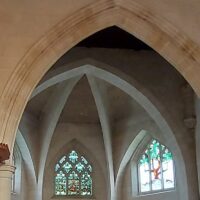
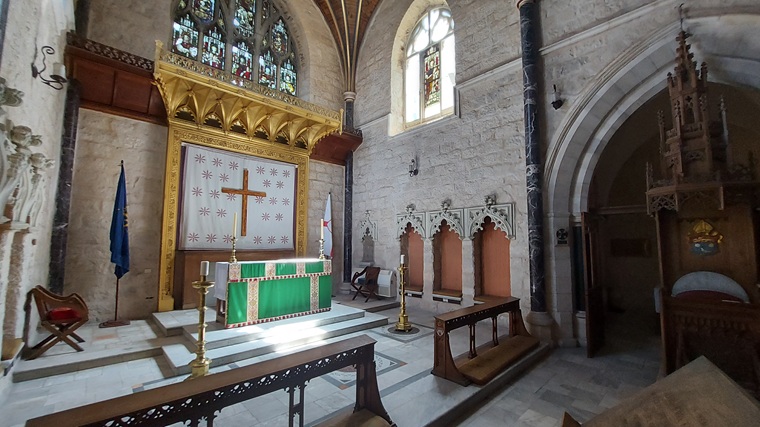
The tower at St. George’s Church is similar to that of St. Margaret’s Church in Sibsey, Lincolnshire (where Walter Besant was a vicar), or the tower of Magdalen College in Oxford. Inside the Cathedral are memorial plaques for English soldiers and police officers who fell during the Mandate period. The structure is in the shape of a cross with Neo-Gothic architecture.
The presence of heraldic shields on the cushions, on the walls, and in the stained-glass windows invites contemplation of the meaning of the colors and symbols. The source of the use of colors in Heraldry is linked to a spiritual belief connecting colors to astrology [13]. Color is a medium of transition between matter and energy, and therefore the spiritual worlds can be described through it.
Footnotes
[1] Ben-Arieh, Y. (1992). Painters and Paintings of the Land of Israel in the Nineteenth Century. Yad Izhak Ben-Zvi, Jerusalem.
[2] Mishory, A. (2010). The English Painter William Holman Hunt and the Holy Land: Orientalism in the 19th Century. Ariel, 191, 57–72.
[3] Witztum, E., & Lorberbaum, M. (2018). Jerusalem of Sanctity and Madness: A Journey Following Mystical and Psychotic Experiences in the Holy City. Jerusalem: Carmel Publishing.
[4] Fergusson, J. (1878). The Temples of the Jews and the Other Buildings in the Haram Area at Jerusalem. London: John Murray.
[5] Ben-Arieh, Y. (1970). The Land of Israel in the 19th Century: Its Rediscovery. Carta, Jerusalem.
[6] https://www.freemasonry.bcy.ca/aqc/kabbalah.html
[7] https://www.quatuorcoronati.com
[8] ttps://archive.org/details/arsquatuorcorona01free/page/56/mode/2up?view=theater
[9] Burton, R. F. (1872). Unexplored Syria: Visits to the Libanus, the Anti-Libanus, and the Northern Libanus, and the Jordan Valley (Vols. 1–2). London: Tinsley Brothers.
[10] Burton, R. F. (1880). The Kasîdah of Hâjî Abdû El-Yezdî (translator and commentator). London: Bernard Quaritch.
[11] Palmer, E. H. (1867). Oriental Mysticism: A Treatise on Sufiistic and Unitarian Theosophy of the Persians. Cambridge: Privately printed.
[12] Besant, W., & Palmer, E. H. (1871). Jerusalem, the City of Herod and Saladin. London: R. Bentley and Son.
[13] Neubecker, O. (1976). Heraldry: Sources, Symbols and Meaning. London: McGraw-Hill