Jewish Awakening in the 19th Century
At the beginning of the 19th century, Jerusalem was neglected and poor, with a population of 10,000 residents, of whom 2,000 were Jews. By the end of the 19th century, Jerusalem had 55,000 people, of whom 35,000 were Jews. The Old City alone was home to 20,000 Jews, filled to capacity. New neighborhoods began to be built outside the walls.
The main demographic change in the 19th century was the growth of the city’s Jewish population. They grew twentyfold and began settling in the Muslim Quarter and parts of the Protestant Christian Quarter. The housing shortage led the Jews to seek solutions outside the walls and begin the building of the New Jerusalem. According to Yehoshua Ben-Arieh, “The old Jewish Jerusalem is what built the new Jewish Jerusalem,” and paradoxically, this led to the emptying and decline of the Jewish presence in the Old City. In the 19th century, the Jewish Quarter overflowed, and as a result, New Jerusalem was established outside the walls.
The beginning of the Modern Era is marked by Napoleon’s campaign to Israel. Napoleon’s rise and his conquests in Europe led to messianic expectations among the Jews. The Vilna Gaon (Gra) annulled the prohibitions against hastening the Redemption. He was knowledgeable in the sciences and believed that action should be taken in the natural course of events to return the Jews to their homeland and to settle Jerusalem. He himself wished to come to Israel, but he was not granted permission from heaven (as with the Baal Shem Tov—the Tzaddik is not permitted to come to the Holy Land until the time is right).
There was a renewed expectation for the coming of the Messiah around the year 5600 from the creation of the world—1840 CE—and preparation for it. The Gra taught that it was necessary to strengthen the Jewish settlement in Israel and, at the same time, to create a new kind of Jew—“People of Faith,” wise and moral. According to the Zohar: “In the six-hundredth year of the sixth millennium, the gates of wisdom from above and the springs of wisdom from below will open, and the world will prepare itself to enter the seventh millennium, like a person preparing himself on Friday afternoon for the entry of the Sabbath” (Zohar, Part 1, 117a). The Gregorian date for the 600th year of the sixth millennium is 1840.
The Gra (1720–1799) saw the verse “the cooing of doves is heard in our land” (Song of Songs 2:12) as a hint to the time of the beginning of the Redemption (Atchalta de-Geula). The word “dove” in Hebrew—TR—contains the letters of the Hebrew calendar year T”R, which corresponds to the year 1840, implying that the Torah contains a prophecy about that year. Consequently, he annulled the prohibitions against hastening the Redemption and argued that man has a role—to integrate organically into the historical process.
The Gra suggested that the Redemption would come, as in the days of Cyrus, through the return of the Jews to the Land of Israel, settling it, and building Jerusalem, and that this was incumbent upon the Jews. He viewed historical events as an expression of a divine plan and a manifestation of a metaphysical reality. The destruction of the Temple occurred at the end of the fourth millennium, and the Modern Era is taking place toward the end of the sixth millennium—preceding the seventh millennium, the time of the Sabbath, the time of Redemption.
According to the Gra, the Torah contains everything that has happened and everything that will happen. Thus, the Book of Deuteronomy contains hints of the events of the sixth millennium. The sixth day is the time of man’s creation; therefore, the sixth millennium is the time of rectification (Tikkun). The Messiah will come during a generation that turns its back on God due to its wealth and success—which is what is happening in the Modern Era. First, there will be a Messiah from the line of Joseph who will herald the Redemption, but afterward there will be a decline, and then the Messiah from the line of David will come. Then the Temple will be built, and the secrets of the Torah will be revealed.
Consequently, a group of more than 500 disciples of the Gra, leaders of Lithuanian Jewry, led by Menachem Mendel of Shklov, immigrated to the Land of Israel in 1808. In 1816, Rabbi Menachem Mendel of Shklov led some of the new immigrants to Jerusalem, and they renewed the Ashkenazi settlement in the city (initially in disguise). They paid the “debts” of Rabbi Judah the Pious and sought to rebuild the ruins of the synagogue he had established, based on the Ottoman law allowing the restoration of ruins of destroyed synagogues and churches.
They established the Menachem Zion Synagogue, and at the end of the 1830s, they obtained permission to rebuild the Hurva Synagogue. However, almost 20 years passed before the magnificent building was constructed, and subsequently, in 1872, the Nissan Bek Synagogue of the Hasidim. Concurrently, the Sephardic Jewish community developed; the Sephardic synagogues were renovated, and new yeshivas and synagogues of both Sephardic and Ashkenazi Jews were established, and Jews flocked to Jerusalem from all over the world.
Moses Montefiore
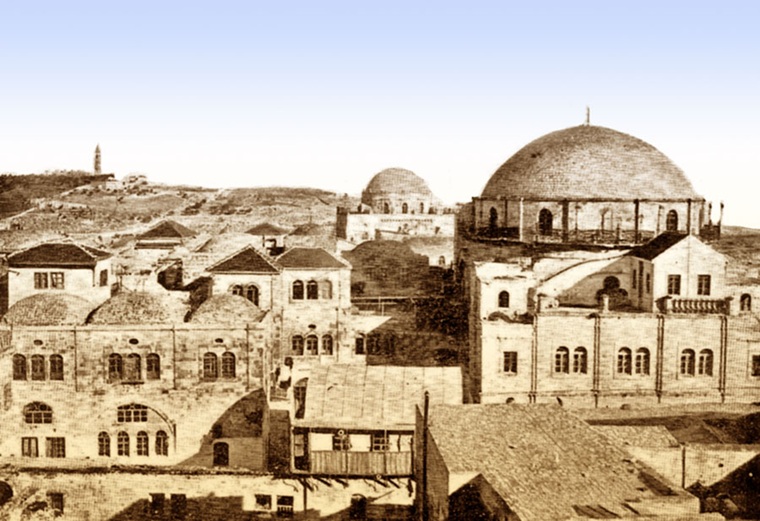
A key figure in the development of Jewish Jerusalem is Moses Montefiore (1784–1885), who visited Jerusalem seven times, beginning in 1827 and subsequently in 1839, 1849, 1855, 1857, 1865, and 1875. On his first visit, he was not religious, but after praying in the city all night, he became observant.
During his second visit in 1839, Montefiore had a vision of the building of Jerusalem, and he presented it to the English public upon his return. He was a very wealthy man, having made part of his fortune by lighting London’s streets with gas lamps. Montefiore was a public figure, philanthropist, English knight, President of the Board of Deputies of British Jews, and Sheriff of London. He was connected to the ruling elites and had great influence. At that time, London was the largest and most influential city in the world.
The Hurva Synagogue
The desire of the Gra’s disciples to rebuild the Hurva Synagogue was met with bureaucratic, religious, and political difficulties. But everything changed when Muhammad Ali conquered the Land of Israel in 1831 and granted rights to Jews and Christians. In 1834, an earthquake led to the authorities’ approval for the renovation of churches and synagogues, and the Sephardic synagogues underwent renovation. In 1836, the emissary (Shadar) of the Perushim community, Rabbi Shlomo Zalman Zoref, obtained permission to rebuild the Hurva Synagogue—an act that was perceived as the footsteps of the Messiah. So much so that some Jews stopped reciting Tikkun Chatzot (the Midnight Lament) and weeping over the destruction, and omitted the section “Shake yourself from the dust, arise…” from the Shabbat reception prayer.
According to the messianic interpretation of the Perushim, since the Redemption was expected to arrive in the year 1840, the rule of Muhammad Ali was seen as the beginning of the Redemption [1]. They found predictions in the Midrash and the Zohar that Israel would be subjugated to Ishmael for a fixed time, and then subjugated to Edom (Christians) before the coming of the Messiah. The rule of Muhammad Ali, supported by the European powers, was perceived by them as the rule of Edom.
The Jerusalem Perushim cleaned the Hurva area and initially established the Menachem Zion Beit Midrash (study hall) in 1837, named in memory of Menachem Mendel of Shklov and also to signify the comfort of the Redemption (menachem means “comfort” in Hebrew). That same year, a massive earthquake destroyed Safed, killing thousands, and the remaining Perushim moved to Jerusalem, led by their leader Israel of Shklov. They were reluctant to continue the ambitious building project of the Hurva Synagogue and instead established a competing Beit Midrash called Sukkat Shalom.
The planned construction of a central Ashkenazi synagogue at the Hurva faced difficulties after the Land of Israel reverted to Ottoman rule and the removal of Muhammad Ali—difficulties that were exacerbated by a crisis of faith following the non-fulfillment of the messianic prediction. Against the backdrop of the failed prophecy, we can understand the activity of the Protestant missionary institutions near the Jewish Quarter, led by Bishop Alexander, which aimed to convert the Jews. Indeed, two of the Perushim’s leaders, Rabbi Eliezer Luria and Rabbi Benjamin Goldberg, converted and became Christians.
The story of the messianic expectation of the year 1840 is a classic case of “When Prophecy Fails and Faith Remains.” [4] Most Jews continued to believe in eschatological visions; the Jewish settlement grew, and in 1841 the Etz Chaim Yeshiva was established in the Ashkenazi courtyard. In 1852, the Sha’arei Zion Beit Midrash was added, and eventually the Hurva Synagogue was indeed built magnificently. However, some of the Perushim retreated from their Zionist-messianic perception, renewed Tikkun Chatzot at the Western Wall, and awaited divine redemption instead of relying on man-made effort.
In 1849, Montefiore visited the city for the third time, and new efforts began to establish the synagogue. In 1855, he obtained a renewed firman (decree) from Sultan Abdülmecid I for the construction of a monumental synagogue in the Jewish Quarter. The Sultan supported reforms, especially after the empire’s reliance on foreign powers during the Crimean War. Abdülmecid I granted equal civil rights to all people within the great empire, and granted permission for Christians to build churches in Jerusalem and for the Jews to build synagogues.
The driving force behind the renewed synagogue project was Zeev Wolfsohn, a colorful figure who worked as a proofreader and manager of Nissan Bek’s printing house. He arrived in Jerusalem in 1834, defended the Jewish Quarter during the Peasants’ Revolt, led a delegation to assist the Jews of Safed after the earthquake, and was active in various causes of the Old Yishuv of Jerusalem. He knew several languages and was sent on numerous missions.
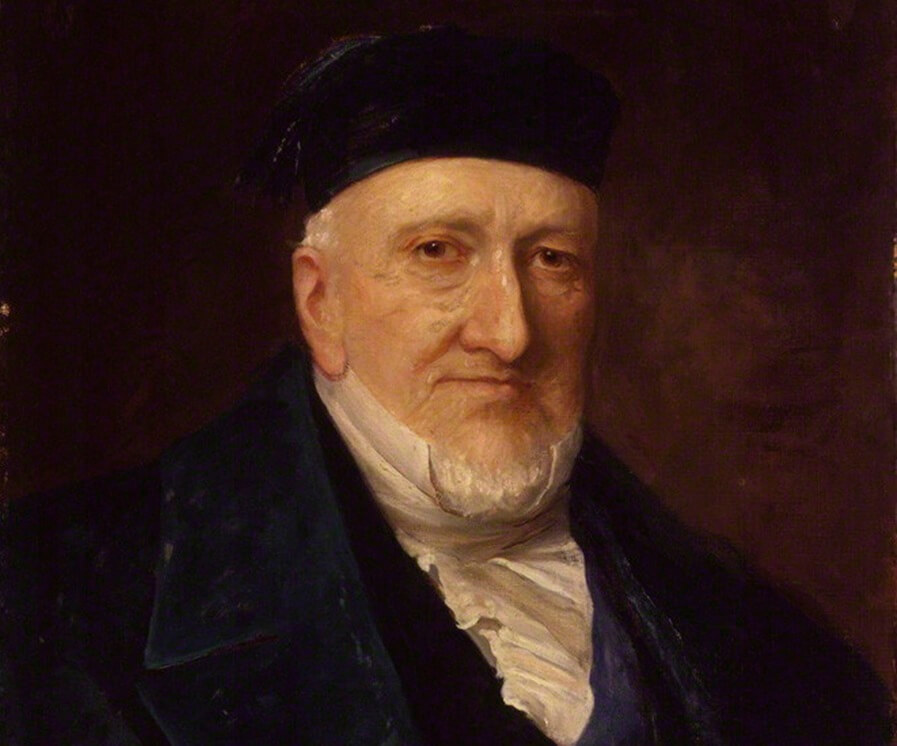
In 1856, he began the construction of the synagogue, concurrently with work being done on the Church of the Holy Sepulchre and the mosques on the Temple Mount. Sultan Abdülmecid I’s court architect, Assad Effendi, was sent to supervise renovation work on the Dome of the Rock, and he was recruited by Wolfsohn to design the synagogue as well—a wise move that contributed to obtaining building permissions. Architecture in the Ottoman Empire at that time was influenced by European styles, combining geometry, symmetry, and harmony. Assad Effendi’s design incorporated Byzantine elements (arches, dome) and reflected the nearby Dome of the Rock.
The Church of the Holy Sepulchre and the Dome of the Rock have large domes that stand out against the skyline of Jerusalem (both, incidentally, have the same diameter and lie on the same axis). However, the Jews, who at this stage constituted the majority in Jerusalem, did not have a prominent building of their own. Assad Effendi designed the new synagogue in the style of a Muslim mosque, with a large, prominent dome that would become the third great dome of Jerusalem, complementing the Christian and Muslim domes and creating a triangle of holiness—based on the perception that Jerusalem is a temple for all nations. It is said that Assad Effendi agreed to design the synagogue for financial gain, but he likely lacked nothing, and it is probable that his consent came with the Sultan’s approval and that he had other motivations as well. He was connected to Montefiore, the Rothschild family, and others, and may also have been a member of the Freemasons, along with the future Sultan Murad V, son of Sultan Abdülmecid.
In any case, the impressive building symbolized the beginning of the Return to Zion and the rebuilding of Jerusalem for the Jews, as well as the growing importance of the Jews in Jerusalem from that time on. Many fundraising campaigns throughout the Jewish world contributed to its establishment. It was consecrated in great splendor in 1864 and became the main Ashkenazi synagogue, a symbol of the Jewish presence and significance in Jerusalem.
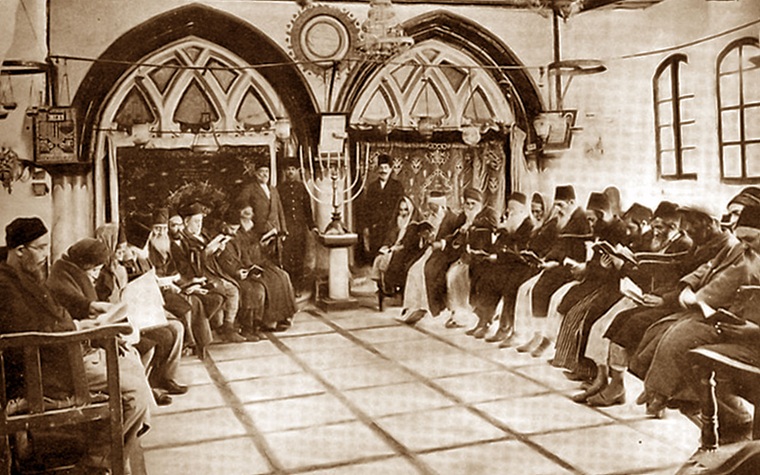
Two Domes
Rabbi Menachem Mendel of Vitebsk was a third-generation disciple of the Baal Shem Tov, a student of the Maggid of Mezritch, and an important figure in the history of the Hasidic movement for bringing it to, and planting it in, Israel. Rabbi Mendel immigrated to Safed in 1777 and later to Tiberias with 300 of his disciples.
The Baal Shem Tov, founder of the Hasidic movement, attempted to immigrate to the Land of Israel but did not succeed because the time was not ripe for the Tzaddik to connect with the Holy Land. His grandson, Rabbi Nachman of Breslov, came to Israel during Napoleon’s campaign—a synchronicity that heralded the beginning of a new era. Something happened during his stay here that enabled him to reach a higher spiritual level, and he continued to refer to this visit throughout his life. It is unclear whether he visited Jerusalem or not; officially, he did not reach the Holy City, but considering that he was in the country for six months, it is probable that he did, even in secret. His disciple and successor, Nathan of Breslov, also came to Israel in 1822, and he, too, officially did not visit Jerusalem, but I would suggest that he did reach the Holy City.
The Opponents (Mitnagdim), led by Menachem Mendel of Shklov, renewed the Ashkenazi settlement in Jerusalem in 1816, and subsequently Hasidim also began to arrive in Jerusalem. The first Hasidic synagogue in the city belonged to Tzemach Tzedek of the Chabad movement. It was established as early as 1845 and named after the third Rebbe of the movement. Initially, it was a rented building, but in 1856 it was purchased, and in 1879 it was built in its current form. It is interesting to note that Rabbi Shneur Zalman of Liadi, founder of the Chabad movement, wanted to come to the Land of Israel with Rabbi Mendel of Vitebsk but changed his mind at the request of the Russian Jews and founded Chabad.
Chabad—an acronym for Chochmah, Binah, and Da’at (Wisdom, Understanding, and Knowledge)—indicates the nature of the movement, which emphasizes reason as a path to God, the understanding that we are in a new age when the springs of knowledge will open, and an attempt to reconcile the paths of the Rabbinate and Hasidism.
In 1857, the Hasidim began building the Tiferet Yisrael Synagogue, which would become the central Hasidic synagogue and serve as a counterweight to the Hurva Synagogue of the Perushim. The person who promoted the construction of the Hasidic Tiferet Yisrael Synagogue was Nissan Bek (1815–1889). He likely learned from his printing-house manager, Zeev Wolfsohn, who was a Perush and the driving force behind the Hurva Synagogue, and decided to build a similar synagogue that would equal the height of the Hurva Synagogue and balance the status of the Hasidim against the Perushim and the Mitnagdim.
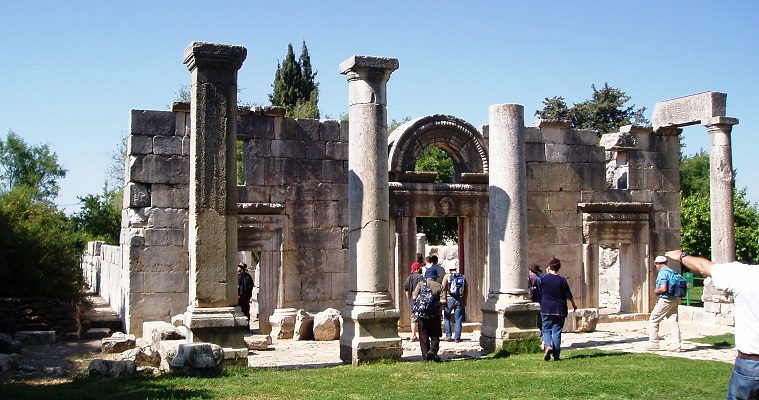
The façade of the lower part of the Tiferet Yisrael Synagogue is a copy of the ancient synagogue of Bar’am in the Galilee, the place from which Nissan Bek came. The construction encountered funding difficulties and was only completed in 1872, with the financial help of the Austrian Emperor Franz Joseph. Thus, two large and prominent domes, similar to each other and to the other domed structures of the Old City, were built over the course of a few years—beautiful and impressive domes that graced the skyline of the Jewish Quarter and of Jerusalem.
It is interesting to note that in 1860, the Batei Mahaseh Square complex was built, which included a synagogue for the Kollel HOD (Holland and Deutschland) and today houses a Breslov Hasidic synagogue featuring paintings by Yitzhak Bek (1896–1974), the grandson of Nissan Bek, the “Leonardo da Vinci” of Jerusalem. Yitzhak Bek painted frescoes in both the Hurva Synagogue and Tiferet Yisrael before the War of Independence, but they were destroyed during the war. After the war, he painted the frescoes and ceiling paintings in the Great Yeshiva in Mea Shearim, some of which reconstruct the paintings that had been in the synagogues of the Old City.
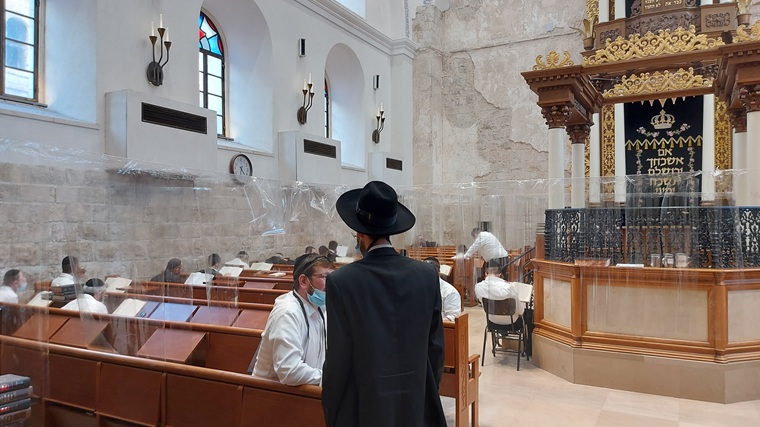
Hasidism
It is difficult to summarize the Hasidic movement in a few sentences. According to Yoram Jacobson [2], Hasidism emphasizes divine immanence. It highlights the premise according to which the Godhead dwells and reveals itself everywhere, and no place is void of it—“Leit Atar Panuy Minei.” This is the foundation of its worldview, derived from the Zohar.
The Godhead does not withdraw from the world but makes room, overlooks, and is clothed; it is covered and enveloped in its garments. It dwells everywhere as before, and no contraction (Tzimtzum) has occurred within it. It does not withdraw from a place, leaving it void, but is only clothed, covered, and concealed from the eyes of those who come into being within it.
The Kabbalistic Shattering (Shevirah) of the vessels is explained by the parable of a tailor who takes fabric and cuts it into pieces only to join and stitch them again into a worthy garment. In this parable, the catastrophic sting of the shattering is completely removed, and it is not perceived as destruction but rather as a deliberate act of rectification, joining, and building.
The Hasidic understanding of Tzimtzum is different from that of Lurianic Kabbalah. The concealment or clothing of the divine existence is due to the will of the Godhead—to reveal itself in the lower worlds, to be known, and to dwell among them. These worlds are but dim and faint lights, whose meager brilliance is nullified within the great light of the Godhead and is included in its essence as “Sheraga betihara”—like the light of a candle in the afternoon sun. Within the infinite flow of divine life, the boundaries of finite reality are erased and washed away, like a drop whose particular, distinct existence is no longer perceptible within the waters of the ocean.
Everything exists in the depths of man’s soul. The soul is the arena of cosmic and metaphysical events. Within its depths, the shattering and rectification occur, within which a profoundly deep psychological transformation takes place. Man can encounter the divine not by transcending himself or tearing himself away from this world, but by descending into the depths of his own being. Hasidism strives for the salvation of the individual. The way to salvation is through the annihilation of the self—its absolute nullification—which leads to cleaving to God (deveikut).
The self that dwells within the boundaries of self-consciousness is a dividing barrier between man and the divine existence. Rabbi Shneur Zalman of Liadi says: All creatures are originally eternal, and they come into being within the Ein (Nothingness) and are revealed within it in a state of yesh (Somethingness), metaphorically like the creation of light from the sun within the body of the sun itself.
Evil does not exist as an entity in itself, but is a kind of foreskin—a foreskin of the heart—a shell that surrounds the inner vitality and the divine point concealed in the depths of man’s soul. Evil arises from the attitude expressed in the words “I and nothingness”: from those who follow the stubbornness of their heart, consider only themselves, and are arrogant in their pride. The true path leads from the Ani (I/Self) to the Ein (Nothingness); it is a path of descent, in which a person is required to descend into the depths of the Ani. There, in the dormant, unknown depths of the human self, the divine Ein, from which no place is empty, is concealed—and only from these depths can the ascent toward God begin.
According to Aharon Zeitlin [3], there was a mystical tradition of telepathy in Hasidism, as in Lurianic Kabbalah. This was achieved by connecting “with the essence of the thinking soul.” This connection is granted by the level of holiness and not by wisdom. The true master of connection—i.e., the Tzaddik—is capable of linking his soul to a soul lower in rank than his, and thus, in classical Hasidism, special telepathic relations existed between the Tzaddik and his Hasidim.
The Hidden Tzaddik Rabbi Elyashar
An important leader of the Jews in the late 19th century was Rabbi Yaakov Shaul Elyashar (1817–1906), known by the acronym Yish’a. He was born in Safed, the grandson of a famous rabbi and a friend of the Chida. The family later moved to Jerusalem, and he became a disciple and stepson of Rabbi Benjamin Mordechai Navon, head of the Beit El Yeshiva.
Yaakov Shaul Elyashar was intensively engaged in Torah study from 1832–1856, during which time his stepfather, who greatly valued him, provided for his livelihood. The two were buried together in the same plot on the Mount of Olives. It is assumed that during this period he also delved into Kabbalah and became one of Jerusalem’s hidden Tzaddikim. The Beit El Yeshiva was the most important Kabbalistic yeshiva in the city, and Rabbi Mordechai Navon was an important Kabbalist and the head of the yeshiva.
Rabbi Yaakov Shaul Elyashar was close to Warder Cresson and influenced him to convert to Judaism in 1848. In 1872, he met Madame Blavatsky of the Theosophical Society at her request. In 1893, he became the Sephardic Chief Rabbi of the city. Accepted by all streams and communities in Judaism, and even by members of other religions, he was regarded as a wise elder and a father figure to the people. He knew several languages and sought to unite all the Jewish streams and factions in the city for the sake of progress and the common good. In 1898, he was one of the dignitaries who welcomed Kaiser Wilhelm II during his visit. The Givat Shaul neighborhood in Jerusalem is named after him.
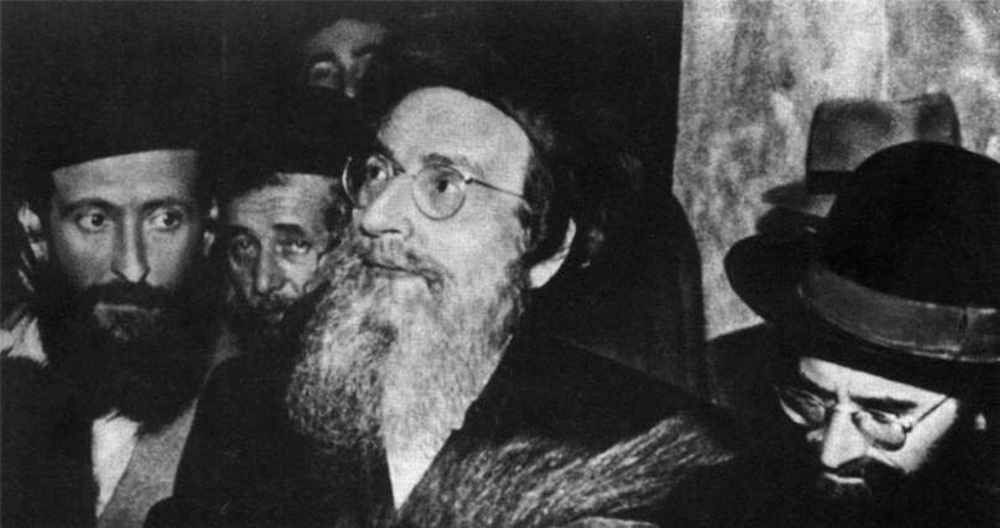
Baal HaSulam – Rabbi Ashlag
Rabbi Yehuda Ashlag (1884–1954) is the figure who brought the teachings of Kabbalah out of the closed circles of the Kabbalistic yeshivot in the Jewish Quarter—most notably Beit El Yeshiva—and into the wider Jewish world. Through his commentary on the writings of the Ari (Rabbi Isaac Luria) and the Zohar, published in the monumental work HaSulam (“The Ladder”), he shifted Kabbalah from an exclusive realm reserved for an elite of older men who dedicated their lives to it, to the broader public.
According to tradition, while a young man in Poland, he encountered a Kabbalist—a hidden righteous sage (tzaddik nistar)—who initiated him into the secrets of Kabbalah over a period of six months. In Kabbalistic tradition, knowledge of the spiritual worlds must be transmitted directly from person to person, originating with Moses; without a teacher to receive from, there is no Kabbalah (literally “reception”). Following this period, he continued his Kabbalistic studies on his own.
In 1921, Rabbi Ashlag arrived in Jerusalem. He studied at the Hasidic Kabbalistic yeshiva Chayei Olam, and likely at the traditional Beit El Kabbalist yeshiva as well. However, he grew disillusioned with their elitist approach and their stance that the esoteric secrets of Judaism should not be public knowledge, countering that they were engaging in superficial imaginings rather than the core essence of the wisdom. Three years later, in 1924, he left the Jewish Quarter and, with the support of Rabbi Abraham Isaac Kook (the Ra’ayah), was appointed rabbi of the Givat Shaul neighborhood, named after Rabbi Yaakov Shaul Elyashar.
Between 1926 and 1928, during the British Mandate, Rabbi Ashlag relocated to London for two years. There he began the rigorous task of writing a commentary on the Ari’s Etz Chaim (“Tree of Life”), a work he completed in 1936. In his view, Kabbalah had to be accessible and open to all because humanity had entered an era of redemption; the dissemination of Kabbalah would actively hasten this redemption. The central lesson of Kabbalah is the transition from self-absorption to altruism—a principle he noted was shared by the communist ideals gaining traction at the time, though he maintained that communism lacked the essential spiritual and faith-based foundation.
His most significant project, widely regarded as his life’s masterwork, was the first-ever translation of the Zohar from Aramaic into פםפוךשר Hebrew, accompanied by an extensive commentary. Spanning 21 volumes, this work—titled HaSulam—was written between 1943 and 1953. According to Rabbi Ashlag, HaSulam was merely an aid to access the Zohar itself, which he described as an inexhaustible spring and an ocean of wisdom from which anyone could draw according to their capacity and desire. He recounted that he was imbued with the soul of the Ari and received prophetic visions that assisted him in authoring this work. He passed away in Jerusalem in 1954, just one year after completing his monumental endeavor.
Footnotes
[1] Morgenstern, A, Friedman, M, Katz, Y., & Tishby, Y. (1981). Messianic expectations in the Land of Israel in the first half of the nineteenth century. Cathedra, 20, 5–25.
[2] From Lurianic Kabbalah to Hasidism. University on the Air, 1984.
[3] Zeitlin, A. (Year unknown). Parapsychology, p. 170.
[4] Festinger, L., Riecken, H. W., & Schachter, S. (1956). When prophecy fails: A social and psychological study of a modern group that predicted the destruction of the world. Minneapolis, MN: University of Minnesota Press.