Changes in the Ottoman Empire
Ottoman Empire, which ruled Jerusalem starting from 1517, weakened in the second half of the 19th century and was essentially dependent for its existence on the European powers. The British saved the Ottomans from defeat to Russia in the Crimean War, the French managed the Ottoman economy, and the Germans rehabilitated the Ottoman army. Thus, many of the aforementioned powers, in addition to Russia and the Austro-Hungarian Empire, had great influence in the late Ottoman Empire. As a result, they received rights that were expressed in renewed construction in Jerusalem.
Jerusalem in the 19th Century
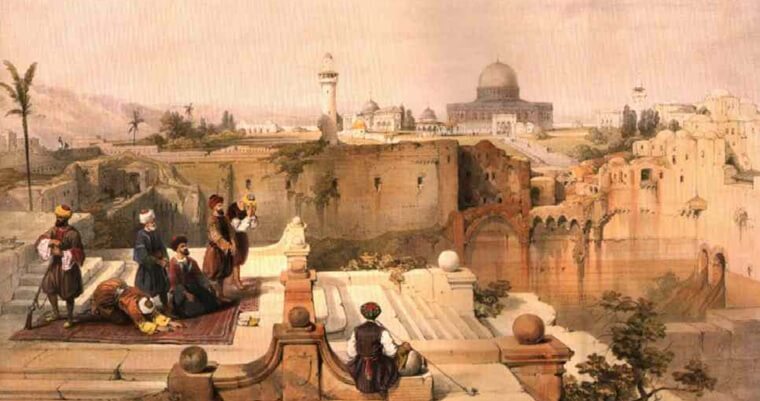
At the beginning of the 19th century, slightly more than 8,000 people lived within the walls of the Old City (today about 39,000 people), about a quarter of whom were Jews. The city was remote and neglected. Water came from cisterns, food arrived in donkey caravans from surrounding villages and from Transjordan (wheat from the Plains of Moab in camel caravans), and houses were small and crowded. Public buildings from past eras were partly neglected, as described by travelers. While the world began the Industrial Revolution, Jerusalem in particular—and the Land of Israel in general—seemed forgotten; the roads were unsafe, leading to a small number of pilgrims, and the local population was mostly poor and ignorant [1].
Jews were still considered protégés, discriminated against by Muslim law; their testimony was not accepted in court against a Muslim witness, and they had to pay a poll tax. They were forbidden to build synagogues, and there was also no money for it. The community was supported mainly by Halukka funds (charity collected abroad) and was concentrated in the four holy cities: Safed, Tiberias, Hebron, and Jerusalem. At the beginning of the 19th century, Ashkenazi Jews were not allowed to enter the gates of Jerusalem, and Christians also suffered hardship.
At the end of the 19th century, 70,000 people lived in Jerusalem, more than 40,000 of whom were Jews. It was a developing and flourishing city with an unusual building momentum of churches, synagogues, mosques, neighborhoods, and public institutions—led by the major European powers of the time: Britain, Austria, Russia, Germany, and France, followed by Spain, Italy, and Ethiopia. The Greek Orthodox and Armenian Churches played an important role, having many assets and people, but Protestants also took root in the land, including American groups. The Catholic Patriarchate returned to Jerusalem, building educational and charitable institutions, churches, and monasteries [2], and many Christian denominations and Catholic orders established their presence in the land.
Almost all Christian denominations and nations built in Jerusalem, and when they built, they copied important and historic structures from their homelands, telling the story of their country. The movement was two-way: their national heritage was influenced and linked in one way or another to events, people, and places in Jerusalem, and in turn influenced the new construction in the city. Muslim denominations and peoples from different parts of the world also built mosques, madrasas, and zawiyas (centers of Sufi mystics). But the greatest development was among the Jews, as will be detailed later.
What each of the Christian powers tried to do was to copy and relate to the most important sites and traditions in their country in their building projects in Jerusalem—to create a world of their own in the Holy City. Thus, two of the new Russian churches—the one in the Russian Compound and the one of Mary Magdalene—are replicas of two of the three churches in Red Square in Moscow; the German Dormition Church on Mount Zion is a replica of Charlemagne’s castle church in Aachen; the tower of the Anglican St. James Church is a replica of a similar Neo-Gothic tower in Oxford; the tower in the Italian Hospital is a replica of the tower in Siena, and so on.
The city expanded outside the walls with great momentum that eventually turned the new city outside the walls into the center, and the ancient heart of the city into a seemingly remote area. Carriages drove through the city streets and from there to Jaffa and back, and even a railway was built between the mountains. Security returned to the land, and with it the belief that everything was possible. The future was at the doorstep—Jerusalem was already part of the modern era.
Generally speaking, the city’s development in the 19th century can be divided into four stages [3]: The First Period is the time between Napoleon’s invasion of the Holy Land and the conquest of Jerusalem by Muhammad Ali in 1831. During this period, Jerusalem was a remote settlement that was not an important administrative center, and the Sharia laws that discriminated against Jews and Christians still prevailed.
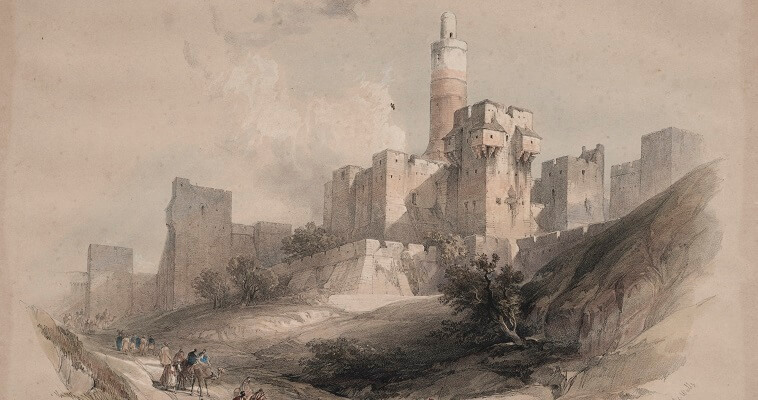
The Second Period is from the time of the Egyptian conquest by Muhammad Ali in 1831 until the return of the Ottomans in 1841. Jerusalem became an important administrative center, and rights were granted to Jews and Christians. Ashkenazi Jews were allowed to return to the city, founded the Menachem Zion Synagogue, and received a license to build the Hurva Synagogue. The Kishle building was erected as a police and military base, replacing the Janissary soldiers at the Tower of David. There was central rule and central tax collection, and the peasants and robbers were suppressed. Security returned to the roads, and with it the pilgrims, aided by the new steamships.
The Third Period is from the return of the Ottomans in 1841 on the bayonets of the French and British, until the accession of Sultan Abdul Hamid II in 1876. In 1839, Sultan Abdülmecid came to power, and a period of reforms began in the Empire. Following this, rights were granted to minorities, consulates opened in Jerusalem, and many Jews were brought under their protection according to the Capitulations Law. Protestants established the first institutions in the city, and the Catholic Patriarchate returned. The first modern buildings, hospitals, workshops, and schools were built. Jerusalem became a district city, and the Jews became the majority and established synagogues. In 1869, the Suez Canal was inaugurated, and the strategic importance of the Land of Israel increased.
The Fourth Period is from the accession of Abdul Hamid to power in 1876 until the Young Turk Revolution in 1908. This period is characterized by the Empire’s dependence on the European powers—first France and Britain, and later the rising Germany. German Templer settlements were established in Jerusalem and elsewhere in the Land of Israel, French officials and clergy arrived following the laws of the Third Republic, important figures such as Kaiser Wilhelm and Franz Joseph visited, and many churches were being built. But the most important development was the building of the new Jerusalem outside the walls, which had begun in 1860 but intensified during this period, with more than 70 new neighborhoods established within 40 years.
Muhammad Ali
Some argue that the modern period in the Land of Israel began after the Egyptian conquest in 1831. Napoleon’s episode in the land was short and insignificant, and the outdated Ottoman rule continued its ways, including treating Jews and Christians as protégés. In Egypt, however, there were great changes. The presence of Napoleon’s expedition and army for several years, and the reforms they introduced, began to be implemented on a large scale by a man of Albanian descent who rose to power and tried to create a European-style state in Egypt with industry, education, and an efficient central government system. The ruler Muhammad Ali turned Egypt into a power that could compete with the Ottoman Empire; he conquered the Land of Israel in 1831 and held it for ten years.
One of the people who encouraged Muhammad Ali in his early days was François-René de Chateaubriand, the French Foreign Minister. He was one of the founders of the Romantic movement in literature and made a pilgrimage to Jerusalem in 1806 on a journey that greatly influenced him and his work (including the book Itinéraire de Paris à Jérusalem [4]). He was a member of the Order of the Knights of the Holy Sepulchre, and after his return, he dedicated several years to writing a book about Christian martyrs during the Roman Empire. He was not afraid to call Napoleon “Nero Caesar,” thereby almost becoming a martyr himself (see below).
After the Egyptian conquest, taxes on Christian pilgrims were removed, government positions were opened to non-Muslims, the rights of minorities were equalized, and permission was granted to build churches and allow foreign institutions into the country. The status of Catholics was strengthened. Muhammad Ali mobilized the local population to his advantage by donating money to the Temple Mount structures. During his time, a British Consulate opened in the city, and a Protestant presence began.
According to Dorian Koçi [5], Muhammad Ali was a Bektashi Sufi (an Islamic mystical stream emphasizing values of humanity and tolerance), which explains his tolerant behavior toward other religions, even during wars. For example, during Muhammad Ali’s war against the Greeks in the Peloponnese, there was no discrimination or persecution of Greek Orthodox Christians (see chapter on the Bektashi Order and Jerusalem in the second book).
During his time, there was an important Tekke (a Sufi religious center, called zāwiya in Arabic) of one of the important Bektashi Sufi saints—Geyiklü Baba (Kayıgusuz Abdal)—in Cairo, a 14th-century saint who lived in a cave opposite the Cairo Citadel. In the late 19th century, there were 50,000 Albanians in Cairo, most of them Bektashi from southern Albania. Throughout the existence of Muhammad Ali’s dynasty, the Order and the Tekke were supported, and even after World War I, Egypt received Bektashi exiles from Kemal Atatürk’s Turkey, despite its Egyptian-Sunni orientation. The Tekke existed until the military revolution in the 1950s.
During Muhammad Ali’s time, the architect Frederick Catherwood, who was known for his research and discovery of Mayan cultures in Central America, arrived in Jerusalem and stayed for six weeks on the Temple Mount under the guise of a government employee. He studied the structure of the Dome of the Rock, other Temple Mount structures, and the subterranean spaces, and published detailed plans of them that were brought to the attention of the English public and aroused great interest [6]. Consequently, some even claimed that the structure was the actual burial place of Jesus and not the Church of the Holy Sepulchre, such as James Fergusson [7]. Later writers and researchers also relied on Catherwood’s work in reference to the Temple Mount.
The Development of Islam in Jerusalem
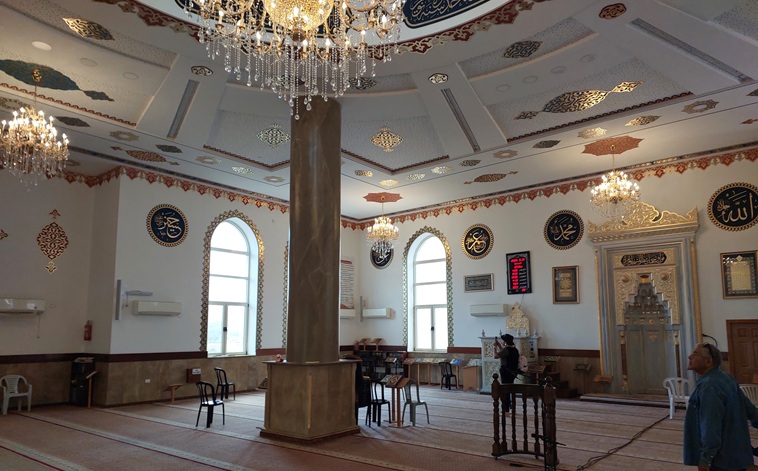
The 19th century was a period of reforms in the Ottoman Empire, and it should be remembered in this context that the Ottoman rulers were also the Caliphs of the Sunni Muslim world. They ruled the holy sites of Islam—Mecca, Medina, and Jerusalem—and the last great Ottoman ruler, Abdul Hamid II, tried to promote a Pan-Islamic identity in the territories under his control.
In the case of great (and even small) rulers, one must always look for the source of their power, inspiration, and guidance, which is often spiritual teachers, people with extrasensory abilities, and sometimes networks of spiritual movements. In the case of the Ottoman rulers, these were the Sufi Orders, which in the 19th century experienced a dual movement: on the one hand, a deterioration in their status and loss of their traditional place in society, and on the other hand, attempts at renewal and development to suit the modern era.
Sultan Mahmud II (1808–1839) began promoting reforms in the Empire. He dissolved the Janissary Corps and persecuted the followers of the Bektashi Order. The centers of the Bektashis and Janissaries were mostly given to Naqshbandi Order groups. The Ottoman Empire supported Naqshbandi-led revolts against the Russians in the Caucasus and Central Asia. Mahmud II was close to the Sufi Orders and built the “Dome of the Prophet’s Lovers” on the Temple Mount plaza—a meeting place for Sufi sheikhs and dhikr ceremonies.
The Naqshbandis are a leading force in Caucasian Islam to this day, and in other places in the world, from India to Tatar Russia. One of their leaders was Imam Shamil (1797–1871), who led the wars against the Russians in Dagestan and Chechnya between 1834–1856. In his youth (1828), he met Abd al-Qādir al-Jazā’irī (from Algeria; see chapter) and learned from him how to fight colonial invaders. He was the student and successor of the Sufi Sheikh Ghazi Muhammad (1790–1832), who started the war/revolt against the Russians. The Muslim forces were finally defeated in 1859, and Shamil was imprisoned for several years. During his imprisonment, he composed a melody called “Shamil’s Niggun,” which the Lubavitcher Rebbe later adopted and taught. The Niggun expresses Shamil’s longing for the mountains where he grew up, but it is actually the soul’s yearning for its origin and hope for future reunification [8].
When the Ottomans returned to power in the Land of Israel in 1841, the Sultan was Abdülmecid, an 18-year-old young man who had received a European education and was interested in literature and music. He ruled for the next 20 years, until 1861. He was the first sultan who used to travel around the kingdom and meet people directly to learn firsthand what was happening in his realm. He was a member of the British Order of the Garter. It is no coincidence that his architect received permission to design the Hurva Synagogue (see chapter), and that he was the man who published the Tanzimat (reform) regulations and later the Status Quo regulations at the religious sites in Jerusalem. He was close to the Naqshbandi Sufi Order, especially through his mother, who was of Circassian descent and close to the sheikhs of the Caucasus.
After Abdülmecid’s death in 1861, his brother, Abdülaziz, came to power and ruled for 16 years, continuing the path of reforms. He visited England and granted rights to minorities in his kingdom. In 1876, Abdülaziz was deposed by the Turkish Assembly due to his extravagant lifestyle, and Abdul Hamid II, Abdülmecid’s son, ascended to power. But as the proverb says: sometimes the apple falls far from the tree.
Abdul Hamid II was the last Ottoman Sultan, and one of the most important in the context of Jerusalem. His long reign (1876–1909) is characterized by a final attempt to save the Ottoman Empire from collapse, by turning it into a Pan-Islamic state on the one hand and encouraging its Westernization on the other. Spiritually, the Sultan was greatly influenced by a Sufi Sheikh named Muhammad Zafir al-Madani from the Shadhili Order in North Africa. In the study of rulers, one must always look for the spiritual-ideological influence from which they draw their strength and sometimes their wisdom, and in the case of Abdul Hamid, this is clear. The Sultan used to come to the Sheikh’s lessons in disguise, and when he ascended to power, he asked him to come to Istanbul and stay by his side as a kind of spiritual advisor and guide. He would meet him weekly in dhikr ceremonies and prayers. The Sultan established a tekke in honor of the Order in Istanbul and exempted it from taxes. The close relationship continued until the Sheikh’s death in 1903.
During that period, branches of the Shadhili Order established themselves in the Holy Land. The Shadhiliyya-Yashrutiyya Order was established in Acre. Muhammad Zafir al-Madani’s father was the Sheikh of the Order’s founder, Ali Nur al-Din, and it is likely that the two individuals knew each other. Either way, the Shadhiliyya-Yashrutiyya Order quickly gained many followers, including families in the Jerusalem area, and it had a presence in the city and especially in the village of Walaja, which existed until 1948 near Jerusalem. Concurrently, there were other branches of the Shadhili Order that took root in the city (see chapters on the Maghrebi Quarter and Abu al-Hasan al-Shadhili in the second book) [9].
The 19th century was the time when the annual celebration pilgrimage from Jerusalem to Nabi Musa in the Judean Desert (a day’s walk away) became institutionalized and developed. This became the central spontaneous religious event of Muslims in modern Jerusalem—an annual hilula (celebration) that took place during the Christian Easter holiday, during which the Sufi Orders played an important role, holding ceremonies, drumming, dancing, and performing extreme acts such as fire-eating and sword-stabbing (Rifa’iyya Order): “a noisy group of people calling ‘Allah! Allah!’ and beating drums, and Muslim fakirs dancing in front of them with swords and cheering loudly” [10]. Somewhat similar to the hilula of Rabbi Shimon bar Yochai in Meron, the green flag of Nabi Musa was taken from the Husayni family’s house in the Old City to the Temple Mount, and from there in a large crowd and celebration to Nabi Musa. The stay at the site lasted about a week. The Sheikh of the Naqshbandi Order in Jerusalem had an important role in this event.
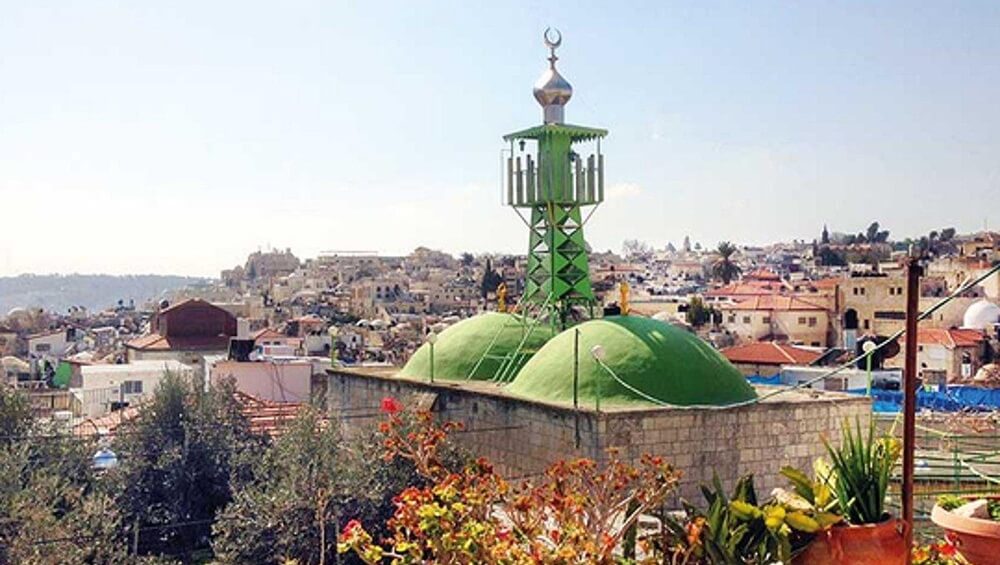
There were several active Zawiyas in Jerusalem. The first was the Naqshbandi Zawiya on the Via Dolorosa—this was a traditional Zawiya of the Order linked to a family that came from Central Asia as early as the 16th century, but towards the end of the 19th century, it became more important when Muslim refugees from the Caucasus arrived in the Ottoman Empire, and some of them were directed to the Land of Israel. Thus, the Zawiya became a guesthouse and a center for a growing community, a place of study (library) and practice.
Next to it was the Afghan Zawiya, which is currently linked to the Shadhili and Qadiri Orders and has a regular and well-attended presence and activity. We will elaborate on it later. The third Zawiya was the Indian Zawiya, which was also linked to the new Indian-Pakistani nationalism (see chapter on Muhammad Iqbal). And there were a few more.
Footnotes:
[1] Ben-Arieh, Y. (1977). A City Reflected in its Periods: Jerusalem in the Nineteenth Century. Jerusalem: Yad Izhak Ben-Zvi.
[2] Ibid.
[3] Ibid.
[4] Chateaubriand, F.-R. de. (2015). Itinéraire de Paris à Jérusalem (A. S. Kline, Trans.). CreateSpace Independent Publishing Platform.
[5] [Link to ResearchGate article by Dorian Koçi] (Dorian Koçi, Institute of History PhD in History Sciences).
[6] Catherwood, F. (1835). Plan of Jerusalem [Map]. London: F. Catherwood. The National Archives (UK), MPK 1/39. Engraved by S. Bellin.
[7] Fergusson, J. (1878). The temples of the Jews and the other buildings in the Haram area at Jerusalem. London: John Murray.
[8] [Link to YouTube video]
[9] Weismann, Itzchak, “Sufi Brotherhoods in Syria and Israel: A Contemporary Overview”, History of Religions 43 (2004), pp. 303-318.
[10] Ben-Arieh, Yehoshua, A City Reflected in its Periods, p. 163.