The Naqshbandi Order and the Silent Dhikr
In the 19th century, the importance of the Naqshbandi Order grew, serving as a central component in the new Ottoman Pan-Islamic vision of Sultans such as Abdul Hamid II. The Naqshbandi became a universal, highly orthodox order that advocated for political participation and enjoyed the support of the authorities.
The Naqshbandi Order traces its spiritual lineage through a chain of transmission known as the Golden Chain, which begins with Abu Bakr rather than Ali—unlike most other Sufi orders. It preserves ancient traditions from Central Asia that are connected to Eastern doctrines such as Yoga and Buddhism, and it influenced the teachings of G.I. Gurdjieff and other spiritual seekers. Unlike other Sufi orders, the Naqshbandi Order views political involvement as part of its ideology; consequently, it played a historically significant political role in Central Asia over the last few centuries, as well as in the Caucasus and the Balkans during the 19th and 20th centuries.
The Naqshbandi doctrine is based on the recognition of the human complex and the achievement of spiritual development through self-control and physical and mental exercises [1]. The name “Naqshband” implies a pattern, engraving, or weaving. A story is told of a Sufi who was unjustly imprisoned. Over time, he befriended the guards and made a humble request: to receive his prayer rug and weaving tools—a needle and thread—in his cell so he could pass the time pleasantly and pray. Seeing no harm in this, the guards granted the request. The Sufi’s wife sent a prayer rug featuring beautiful patterns, along with the weaving tools. For many days, the Sufi prayed devoutly, prostrating himself on the rug, bowing and touching his head to the floor. Then, one day, he vanished. The guards found the cell door open and the Sufi gone. They wondered how he could have disappeared as if the earth had swallowed him, especially knowing he had been imprisoned unjustly. Years later, one of the guards chanced upon the Sufi, who had long since been cleared of all charges and was living as a respected man.
“Tell me,” the guard asked, “now that everything is behind us, how did you manage to escape the prison cell? To this day, it remains a mystery to us…” “It is very simple,” the Sufi replied. “My wife inquired about the structure of my door’s lock from the blacksmith who built it. She sketched and embroidered the pattern of the lock mechanism into my prayer rug. When I prayed devoutly and prostrated myself on the rug, I was actually studying the pattern of the lock. All that remained was to create an improvised key using the tools I possessed—the weaving tools—and open the door.”
The prison represents the body in which we are confined. One must discover its key, be freed from the lower soul (Nafs), and connect to the Image of God (Tzelem Elohim); this is achieved through the activation of dormant energetic centers within us.
The Naqshbandi Order was officially established in Uzbekistan in the 14th century by Shaykh Baha-ud-Din Naqshband, hence its name. However, its roots were planted 200 years earlier by the Abdul Khaliq al-Ghijduwani, and some claim it existed as a mystical school even before Islam. Ghijduwani was a student on the Sufi path, trained in the technique of dhikr (remembrance)—the infinite repetition of God’s name to connect to His essence. However, during the practice, the student hears himself pronouncing God’s name, which can strengthen his pride in being a traveler on the path—a pride that distances him from God. So he sought to discover the secret of the verse in the Quran that says: “Call upon your Lord in humility and secretly in your hearts”—in other words: how to avoid the trap of pride.
Ghijduwani received divine guidance instructing him to perform prolonged immersions in water while attempting to utter God’s name to receive an answer. He submerged himself for many minutes, and then it was revealed to him that there was no need to speak the word of God aloud, because everything speaks it—the trees, the stones, the flowers, and above all, the beating of our hearts and our breath. All one needs to do is listen. The “Secret of the Hearts” (Silent Dhikr) is that with every heartbeat, one can hear God’s name, and similarly through the breath.
Baha-ud-Din Naqshband is considered the eponymous founder and spiritual father of the Order. He was born in 1317 AD (717 AH) in a village near Bukhara (in modern-day Uzbekistan). Very little is known about his life beyond stories and legends, as he forbade his followers from recording his deeds or sayings during his lifetime. He was trained in Sufism by the most renowned teachers of his era. His spiritual training included working for seven years as a shepherd and another seven years as a road mender. He lived in Bukhara and Samarkand but died and was buried in the village of his birth, Qasr al-Arifan. He was the one who finally formulated the 11 Principles of the Order (adding three to the original eight of the Ghijduwani) and institutionalized the practice of the Silent Dhikr (Dhikr al-Khafi), distinguishing his path from other Sufi brotherhoods who practiced vocal remembrance.
He was a student of Shaykh Shamsi and received the secret of the Order from Shaykh Kulal. One day in his youth, he prayed to God to give him the strength to bear the difficulties and pain of His love. The next day, the Shaykh looked at him, as if reading his thoughts, and admonished him: “My son, you must change the manner of your prayer. Say instead: ‘O God, grant Your pleasure to this weak servant.’ God does not wish for His servants to be in hardship and pain. Sometimes He tests them with hardships, but a servant should not ask for suffering—that is disrespect toward God.”
The Naqshbandi Order emphasizes “Sober Sufism” (Sahw) as the path to reach God, practicing meditative remembrance known as the Silent Dhikr.
Another story relates that Naqshband was asked by God: “Why are you entering this path?” He answered: “So that everything I say and everything I want will come true.” God replied: “That cannot be; everything We say and everything We want will come true.” Naqshband answered: “I cannot accept that. I must have the permission to say and do what I want, or I do not want this path.” Then he received an answer: “Everything We want must be said and done.” The presence of God withdrew, and Naqshband remained alone for 15 days until he was overcome by tremendous depression. Yet, he remained firm in his resolve. Finally, a Heavenly Voice was heard: “O Baha’uddin, everything you ask for, We shall grant you.” Filled with joy, he said: “I want a path to be granted to me that will lead everyone who follows it directly to the Divine Presence.” He then experienced a wondrous vision and heard a voice saying: “You have received what you asked for.” Thus, the Naqshbandi Order was created as a direct path to God.
Naqshband recounts his spiritual training: “At the beginning of my journey on the path, I met a ‘Lover of God.’ He said to me: ‘It seems you are one of us.’ I replied: ‘I hope I am one of you and wish to be your friend.’ One day he asked me: ‘How do you conduct yourself?’ I said: ‘If I find something, I thank God; and if not, I am patient.’ He smiled and said: ‘That is easy. The way is to burden your ego and test it. You must protect it from disobedience.’ I rejoiced in this answer and asked for his guidance. He commanded me to help the needy, serve the weak, and move the hearts of the broken hearted—to maintain humility, submission, and patience. I kept his commandments and spent many days of my life in this manner. Then, he commanded me to care for animals, heal their illnesses, clean their wounds, and help them find their needs. I maintained this practice until I reached a state where, if I saw an animal in the street, I would stop and make way for it. Finally, he commanded me to care for dogs with loyalty and humility and to ask them for support. He told me: ‘Through your service to one of them, you will attain great joy.’ I did as commanded, hoping to find the dog through whose service I would find joy. One day I was in the company of a dog and felt a state of joy overcoming me. I began to weep before him until he rolled onto his back and raised his paws to the heavens. I heard a very sorrowful sound coming from him, which moved me to raise my hands in prayer. I began to say ‘Amen,’ supporting his prayer until he fell silent. What opened before me was a vision that brought me to a state where I felt I was a part of every person and every creature.”
Naqshband further recounts: “One day, a surprising state overtook me. I heard a heavenly voice saying: ‘Ask whatever you want from Us.’ Then I said with humility: ‘O Allah, give me one drop from Your ocean of grace and blessing.’ The answer came: ‘You ask for only one drop from Our great generosity?'”
Shaykh Naqshband ate only from wheat he grew himself, harvested himself, milled himself, and baked himself. All the scholars of the time traveled to his home to partake of his bread. He said: “One of the best doors to the Presence of God is to eat with awareness. Food gives the body strength, and eating with awareness gives the body purity.”
According to the Naqshbandiyya, there are three primary ways to reach knowledge: Contemplation (Murāqabah), Vision (Kashf), and Accountability (Muhāsabah).
- In the state of Contemplation (Murāqabah): The seeker forgets creation and remembers only the Creator.
- In the state of Vision (Kashf): Inspiration from the Unseen reaches the heart, accompanied by two states—Contraction (Qabḍ) and Expansion (Basṭ). In the state of Contraction, the vision is of Majesty (Jalal); in the state of Expansion, the vision is of Beauty (Jamal).
- In the state of Accountability (Muhāsabah): The seeker evaluates every hour that has passed and examines whether it was spent in complete presence with God—or in complete presence with the world.

Eleven Principles of the Naqshbandi Way
Abdul Khaliq al-Ghijduwani and the first six masters of Central Asia formulated eight principles of the spiritual path, to which Baha-ud-Din Naqshband added three more, creating the Eleven Principles of the Naqshbandi Order. These principles and methods were later utilized by spiritual teachers who introduced the Sufi path to the West. I have summarized them based on Naqshbandi writings and insights developed through encounters with Sufi shaykhs and esoteric knowledge.
These are the principles of the Naqshbandiyya:
- Awareness During Breathing (Hosh dar dam): Conscious remembrance of God while breathing in and out; a technique for respiratory control. Every breath taken without attention is considered “dead,” while every breath taken with reverence and presence is considered “alive” and connected to the Divine Presence.
- Watching the Steps (Nazar bar qadam): Every step of the believer must be directed and organized toward the attainment of a heavenly goal. Physically, the gaze should be directed toward the feet; this filters out distracting sights and serves as a sign of modesty.
- Journey Homeward (Safar dar waṭan): Introspective study of oneself; “know thyself” and move from bad qualities to good qualities. The journey from the world of creation to the world of the Creator takes place in two stages: first, an external journey to find a teacher, and second, an internal journey to cleanse the heart.
- Solitude in the Crowd (Khalwat dar anjuman): The dervish must possess the ability to be alone with God even when occupied with the material world and other people. There are two types of solitude: external and internal. External solitude requires periods of retreat (khalwa) to fulfill certain tasks and advance on the spiritual path—a basic Sufi practice. However, the Naqshbandi Order emphasizes a deeper, internal solitude, expressed in the phrase: “Be in the world, but not of it.”
- Remembrance/Recollection (Yad kard): Both oral and mental remembrance (dhikr). The practice involves repeating the phrase “Lā ilāha illā Allāh” (There is no god but Allah) many times. The practitioner directs the resonance of the phrase to different parts of the body according to a specific order.
- Restraint/Return (Baz gasht): Restraint of thoughts. This includes the effort required to prevent thoughts from wandering during the repetition of the dhikr. The goal is to achieve union through awareness of the Oneness of God.
- Vigilance (Nigāh dāshat): Vigilance over the direction and flight of thought, preventing distraction during the repetition of the dhikr. The practice aims to protect the heart from negative thoughts; maintaining such vigilance for even 15 minutes is considered a great achievement.
- Recollection (Yād dāsht): Deep concentration on the Divine Presence; this is related to a state of continuous awareness or deep meditation.
- Time Pause (Wuqūf-i zamānī): Examining how one utilizes their time—giving thanks for performing good deeds and regretting time wasted on bad deeds or negligence.
- Number Pause (Wuqūf-i adadī): Checking that the heart dhikr has been repeated the required number of times, while taking wandering thoughts into account.
- Awareness of the Heart (Wuqūf-i qalbī): Building a mental image of the heart with the name of God engraved upon it. Keeping the heart in a state of readiness, alertness, and responsiveness to divine communication.
The central motif in all these principles is self-control oriented toward heavenly goals—control over the body, thoughts, and emotions. An additional dimension is knowledge: the soul must know itself before it tries to know the Heavenly. Although many of the principles are directed toward the performance of dhikr, together they provide a framework for life in which the dervish lives constantly conscious of the greater purpose.
The stream to which the Naqshbandi Order belongs, and against whose backdrop it grew, is the Malamatiyya (“People of Blame”)—a psychological Sufism that combats human sins, primarily the ego and hubris, often by concealing spiritual states.
The classical Naqshbandi approach to faith and the path is one of seriousness and humility. Contemporary Shaykh Nazim describes it:
“If a person expects a reward for his devotion, it means he views his actions as good enough and worthy of reward from Allah. Anyone who thinks their actions are appropriate for the Divine Presence has no concept of the Heavenly Truth and its hidden knowledge. Therefore, you can see them praying and worshiping Allah with devotion and enthusiasm, because they think: ‘I will receive my reward afterward,’ but they do not understand that these actions are inadequate for the Divine Presence… You must be careful not to misunderstand me… God is my witness, we do not want to distance anyone from faith; we are only teaching people the best manners with their God. That manner is not to be satisfied with the quantity of your prayer and worship while violating your rights with pride, thinking it is first-rate in the Divine Presence. It is better to present your work to God by saying: ‘O Lord, I am ashamed to send this to Your Divine Presence—forgive me for my shortcomings and my inability to worship or thank You as You deserve…'”
One of the distinguishing features of the Naqshbandi Order is the form of its dhikr. Among the Naqshbandis, the dhikr is performed silently, without words (Dhikr Khafi), to avoid the sin of pride. Instead, Naqshbandis use mental imagery linked to various places in the body; thus, the dhikr becomes an active, sober work requiring concentration and intention. “The Sufi must keep the tongue pressed against the roof of the mouth, his teeth and lips tightly closed. He holds his breath and then begins with the word Lā (from the phrase Lā ilāha illā Allāh). He causes it to ascend from the navel/throat to the brain. When it reaches the brain, he says ilāha to the right shoulder, and illā to the left shoulder, and forcefully pushes the words into the spiritual heart (Qalb), through which they circulate to all parts of the body along with the word Allāh. The phrase Muḥammad Rasūl Allāh causes him to lean from the left side to the right side, and then the person says: ‘My God, You are my goal, and Your satisfaction is my desire’ (Ilahi anta maqsudi wa ridhaka matlubi).”
If the dhikr is performed correctly, it activates a dormant spiritual organ within us called the Qalb—the mirror of the heart. The person concentrates the site of the dhikr within the heart because that is the center of power. All thoughts and aspirations, good and evil, are felt and appear one after the other, rotating and replacing each other, moving between light and darkness in perpetual motion within the heart. The dhikr is performed with the aim of controlling and reducing the turmoil within the heart.
The Naqshbandi Order, despite being orthodox, possesses a highly esoteric and mystical doctrine. According to the Naqshbandis, there are five points of spiritual connection (Lataif) within us that operate on different types of subtle energy.
The first is called the Qalb (Heart), located about two fingers below the physical heart (on the left side). It is not the physical organ, but the first spiritual connection point to the unseen worlds. Through the Qalb, the initial connection to God is made, and from it, via the bloodstream, energy disperses throughout the body.
In the first stage, the Naqshbandi Sufi learns to connect and activate his Qalb through the practice of the Silent Dhikr. After the spiritual organ of the Qalb is activated, the practitioner continues to activate it for the rest of his life but also proceeds to activate the additional spiritual organs.
On the right side of the chest, parallel to the Qalb, is the next spiritual point, called Rūḥ (Spirit). A hand’s length above the Qalb (left chest) is the Sirr (Secret) A hand’s length above the Rūḥ (right chest) is the Khafī (Hidden). Between the Secret and the Hidden, in the center of the chest (or slightly above/below the throat depending on the specific branch’s teaching), is the fifth point: the Akhfā (Most Hidden/Deeply Hidden), the highest point.
One of the figures who learned secrets from the Naqshbandis and stayed in Jerusalem at the beginning of the 20th century was G.I. Gurdjieff, about whom we will speak later.

Uwaysi Connection and Spiritual Transmission
Baha-ud-Din Naqshband received the Silent Dhikr from the spiritual presence of Abdul Khaliq al-Ghijduwani, whom he never met physically as five generations separated them. In this form of knowledge transfer, spirits meet in the “World of Spirits” (Alam al-Arwah), a realm beyond the material plane. This possibility of receiving guidance from a deceased master, or a living one whom the seeker has never met physically, is called the Uwaysi connection. It is named after Uwais al-Qarani, a contemporary of the Prophet Muhammad who received spiritual transmission from the Prophet without ever meeting him in person.
I recall a meeting with a prominent Shaykh in Jordan. For years, one aspect of the Sufi path had troubled me: the absolute necessity of a teacher. The Sufis say, “He who has no Shaykh, his Shaykh is the Devil.” This concept did not align with my worldview, nor, frankly, with the modern era and Western individualism.
“Is it possible to learn the Sufi path without a direct connection to a physical teacher?” I asked, alluding to the modern world with its freedom of information, social networks, and remote communication.
“In certain cases, it is possible,” was the answer. The implication was that modern remote communication—via phone, internet, WhatsApp, etc.—is effectively a trivialization of the high human capacity for spiritual connection, a distorted imitation of the real thing. It is indeed possible to learn through a form of spiritual communication, a connection within the spiritual world.
Rumi said, “There is an invisible thread connecting you to everything.” Indeed, it is possible to learn, understand, connect, and communicate through thought—a thread capable of linking us to all things. However, thought is merely the line of communication; the transmission itself, and the ability to communicate, stem from the spiritual world.
Naqshbandi Zawiya in Jerusalem
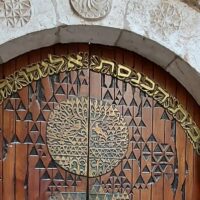
The Naqshbandi Zawiya (Sufi lodge) is located on the Via Dolorosa, opposite the Convent of the Sisters of Zion (Ecce Homo). Their small, intimate mosque opens directly onto the street. A flight of steps beside it leads into an enchanting courtyard, revealing one of the hidden worlds of the Old City of Jerusalem. Up and up we ascend into a courtyard from which a gate leads to another courtyard, a winding staircase, a passage through a room, yet another courtyard, and behold—we enter a spacious hall that seems to have been transported here on a magic carpet from Uzbekistan: adorned with carpets, furniture, pictures, and traditional Uzbek fabrics. On the second floor, there is a large room offering a breathtaking view of the Temple Mount and the Old City, housing a rare collection of old manuscripts and ancient books related to Sufi doctrine and community history. In the courtyard below lie the tombs of the family Shaykhs.
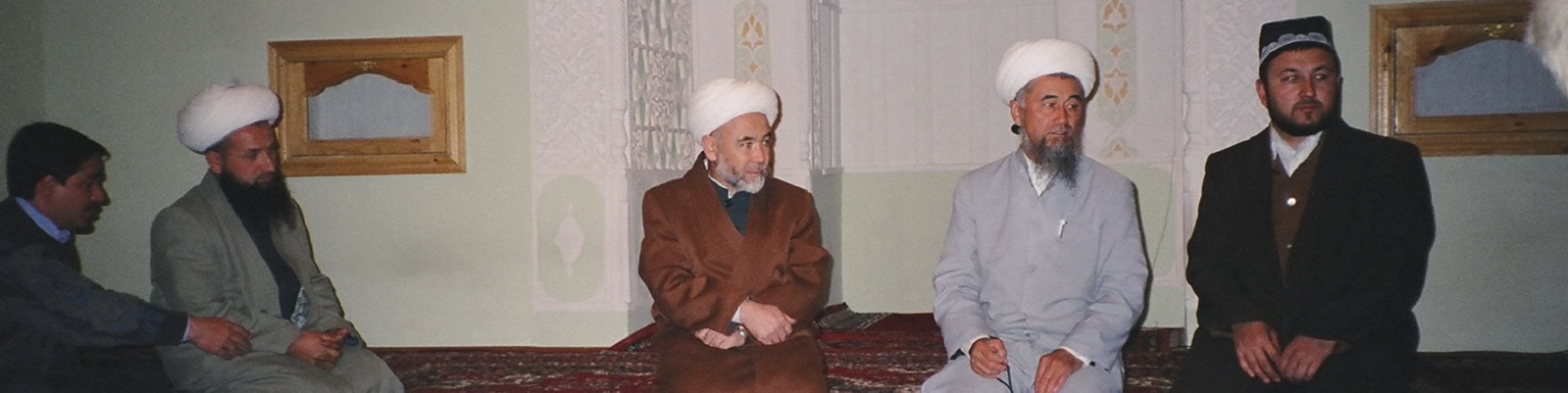
The Naqshbandi Center was established as early as the 17th century (formally in 1616) by the Bukhari family, who arrived from Bukhara. In the 19th century, the center grew and developed significantly. After World War I and the Soviet transition to communism, it embraced refugees fleeing Central Asia. During this period, the head of the Order in Jerusalem was Shaykh Ya’qub Bukhari. Following Uzbekistan’s liberation from the Soviet Union in the 1990s, the family became involved in efforts to revive Muslim culture and governance in Central Asia [2]. The last prominent Shaykh of the family, Abd al-Aziz Bukhari, (died in 2010). He was the head of the Uzbek community in the Holy Land (a community of about 300 people) and the head of the Naqshbandi Order in Israel.
The Naqshbandi Order has several branches worldwide. One of the most prominent, the Naqshbandi-Haqqani branch, was headed by Shaykh Nazim al-Haqqani (who lived in Northern Cyprus until his passing in 2014). In recent decades, this branch turned toward the West, opening many centers throughout Europe and the United States. They disseminate Sufism in a clear and accessible manner, utilizing publications and the internet; their website remains a rich source of information on Sufism.
Shaykh Nazim was considered by his followers to be the 40th Grand shaykh in the lineage of spiritual teachers stretching from the time of Prophet Muhammad to the present day. This lineage is called the Golden Chain. The transition from one link in the chain to the next is determined by the teacher’s choice, aided by divine guidance. It is somewhat similar to how the next Dalai Lama is identified in Tibetan Buddhism. A teacher might be walking down the street, see a person who appears unconnected to the Order or even irreligious, and simply know that this person is the next guide. A famous story tells of a Naqshbandi Shaykh walking with his students in Bukhara when he suddenly saw a wrestler; he immediately knew this man would be his successor, which indeed came to pass.
The number 40 holds great significance in Islamic mysticism, and the fact that Shaykh Nazim was the 40th link in the Golden Chain held profound meaning for his followers, driving their efforts to spread the doctrine worldwide. Shaykh Nazim’s successor was his son, Shaykh Mehmet Adil, while his deputy in the United States was Shaykh Hisham Kabbani (often confused with the title “Haqqani,” which was Nazim’s surname). Shaykh Abd al-Aziz Bukhari of Jerusalem was also a devoted student of Shaykh Nazim.
The Shaykhs and patriarchs of the Bukhari family are, as mentioned, buried in the courtyard of the Naqshbandi Zawiya in the Old City. According to Shaykh Bukhari, burial in Jerusalem holds immense value for the Sufi Muslim because the Day of Judgment will take place here. Jerusalem is a gate to Paradise and the higher worlds; this is why Muhammad came here on his Night Journey (Isra and Mi’raj)—to ascend to heaven from this specific point. In the past, Muslims would remove their shoes upon entering the city, just as they do when entering a mosque, because the entire city was considered holy ground where Divine Providence was omnipresent.
Today, Shaykh Bukhari lamented, few care what happens beyond their immediate surroundings. The city is often neglected, and tension reigns. His role, as he perceived it, was to replace hatred with love, to find what unifies and connects, and to cause the Shechinah (Divine Presence, a term he used to bridge traditions) to return and dwell in the place where it once was and to which it will return at the end of time.
The Naqshbandi path, according to Shaykh Bukhari, rejects violence. It believes in love, forgiveness, and understanding. When someone wrongs you, reciprocating with evil will not help. Only love can restore man and the world to their original state—a state of union with God.

The Afghan Zawiya
Adjacent to the Naqshbandi compound stands a building characterized by two green domes and a skeletal iron tower rising above them, serving as a minaret. Next to the building lies a verdant courtyard. This is the Afghan Zawiya, associated with the Qadiri Order and, currently, also with the Shadhili Order.
The Zawiya was founded as early as the 17th century, possibly encouraged and initiated by a great Sufi scholar of the period Abd al-Ghani al-Nabulusi who lived in Damascus but visited Jerusalem several times, and whose family was connected to the site. Abd al-Ghani al-Nabulusi belonged to both the Qadiri and Naqshbandi Orders but primarily adopted the doctrine of Ibn Arabi, and advocated for inter-religious tolerance.
The Zawiya is formally named after Abd al-Qadir al-Jilani, the founder of the Qadiri Order in Baghdad in the 12th century (11th–12th), as evidenced by the dedication inscription at the entrance (see the chapter on the Qadiriyya in Book Two). The complex includes rooms for initiates, a second floor for the Shaykh’s residence, and a mosque.
Remembering God
Once a week, usually on Thursday evenings, the Sufis gather in the Zawiyas (Sufi centers) and their meeting places to perform their central ceremony: the Dhikr, the remembrance of God’s name. The Sufis believe that all knowledge and all truth exist within us; we only need to remember it. The primary role of the Sufi is to awaken the remembrance of God. The Dhikr aids us in daily life; it heals us and grants us, for a singular moment, a sense of meaning and belonging that remains with us long afterward.
There are many ways to perform the Dhikr. One can recite the name “Allah” with a special emphasis that carries mystical power, or use other phrases and names. A key phrase is “Lā ilāha illā Allāh”—”There is no god but Allah”—which serves as a kind of Sufi mantra, as well as being the Shahada (the Muslim Testimony of Faith).
The Dhikr can be accompanied by movements of the body, the head, or rhythmic steps. Sometimes it is accompanied by breathing exercises or meditation. There are Silent Dhikr practices, similar to meditation, where one must also visualize images and concentrate on specific parts of the body, and there are Loud Dhikr practices performed in a group. In fact, almost every order has its own unique method of Dhikr, which serves as one of its distinguishing features.
Beyond the ritual itself, the entire essence of Sufism is Dhikr—the unceasing remembrance of Allah. The Sufi path is intended to awaken the memory of unity with God, the longing for home, and the love for the Divine. This awakening is accomplished in many ways: through song, prayer, dance, parable, and also through the world of the senses—beautiful sights, pleasant scents, and so on (hence the importance of well-maintained Sufi gardens). All of these reawaken the memory of the heavenly harmony of Paradise, the love, and the desire to return and become part of God. These are essentially the hidden motives in human life, or at least in the lives of some of humanity—those destined from the outset to be Sufis.
Love and the desire for union with the Divine are, by nature, universal and cross boundaries. If, in the end, everything is One, then the specific path and the narrow starting point of the individual do not matter. This is the message of Sufism as a religious path of true, essential, and internal Islam, distinct from what is known as social, political, or legalistic (Sharia-based) Islam. It is a message that transcends the narrow framework of religious dogma and pertains to every human being [3].
Footnotes
[1] https://naqshbandi.org/
[2] Zarcone, T. (2009). Sufi Pilgrims from Central Asia and India in Jerusalem (p. 168). Kyoto: Center for Islamic Area Studies at Kyoto University. P. 86.
[3] Trimingham, J. S. The Sufi Orders in Islam. Clarendon Press. Oxford. 1971.