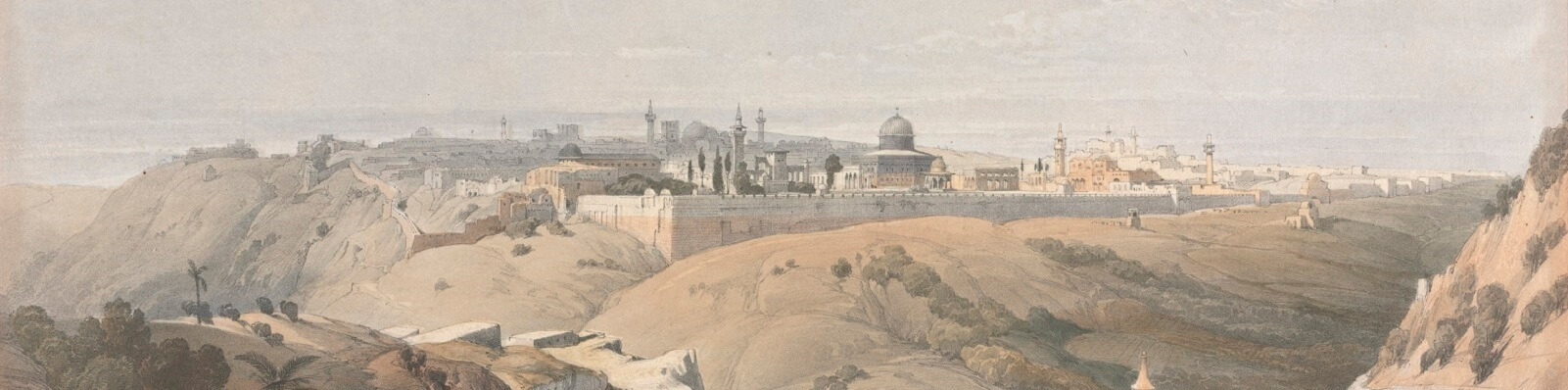
the two books on Jerusalem in the 19th century are a groundbreaking work by Professor Yehoshua Ben-Arieh, written in the late 1970s, in which he reconstructs the landscape of Jerusalem at the throughout the nineteenth century through with the use of historical sources, following the school of historical geography to which he was introduced during his sabbatical years in Canada—Ottawa—and in the United States—Washington D. C. As he wrote:
“It was then that some of the ideas began to take shape regarding the approach I would adopt, upon my return to Israel, in my plan to write a comprehensive book on the city of Jerusalem in the nineteenth century. I absorbed many of the ideas and perspectives that I encountered in my conversations and readings in the United States and Canada, and I decided that in writing about Jerusalem I would also pay close attention to the communities and ethnic groups, the outlooks and ideologies of the various population groups that lived in Jerusalem in the nineteenth century and that played an active role in shaping the city’s landscape during that period. Therefore, I devoted considerable attention to the Old Jewish Yishuv that lived in the city—its ideology, worldview, way of life, and means of existence; to the various Christian communities and denominations, their organizations and institutions that operated in the city; and also to the Muslim community, its different groups, customs, residential patterns, and way of life. I pursued these subjects to such an extent that at times my fellow geographers even accused me of abandoning geography altogether and producing nothing more than historical descriptions and reconstructions.”
Yet a deeper and more poetic reading of the book reveals Yehoshua’s vision of Jerusalem—a vision to which he returned many times during the tours he guided—as an evolving microcosm of the religious world of the West. It is a place where all the European powers, as well as non-European ones, sought a foothold. Thus, a person can walk through the streets of the city today, open a door that appears no different from any other, and suddenly enter another world. One moment he is in Victorian England; the next, in the squares of Moscow, the holy sites of Ethiopia, German castles, and countless other realms. Jerusalem becomes a city of worlds within worlds, where entire civilizations, cultures, and spiritual traditions coexist side by side within a remarkably small geographical space.
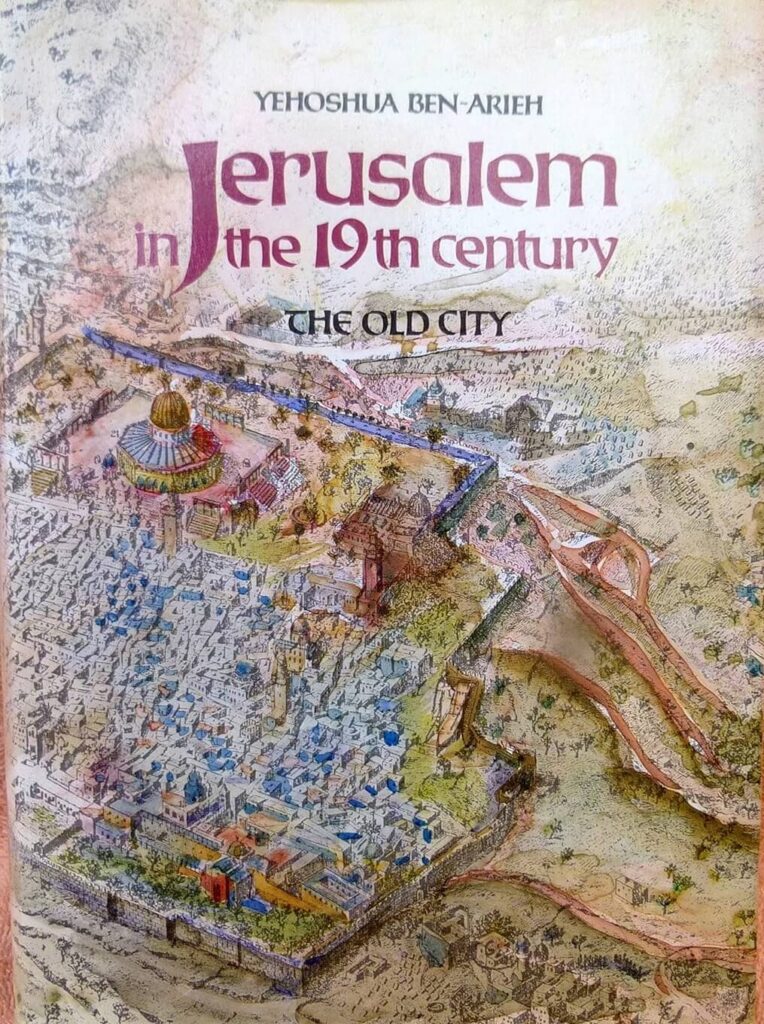
Book One: The Old City of Jerusalem
At the beginning of the nineteenth century, just over 8,000 people lived within the walls of Jerusalem’s Old City (compared to approximately 39,000 today), about a quarter of whom were Jews. The city was remote and neglected. Water was supplied from cisterns, while food arrived on donkey caravans from the surrounding villages and from beyond the Jordan River—wheat from the Plains of Moab, for example, was transported by camel caravans. Houses were small and overcrowded, and many of the magnificent public buildings from earlier periods had fallen into disrepair, as described by contemporary travelers. While the world was entering the Industrial Revolution, Jerusalem in particular, and the Land of Israel in general, seemed to have been forgotten. The roads were unsafe, resulting in a decline in pilgrimage, and the local population was, for the most part, poor and uneducated.
The Jews still lived as a protected but subordinate community under Ottoman rule, subject to discrimination under Islamic law. Their testimony was not accepted in court when opposed by that of a Muslim witness, and they were required to pay the poll tax. It was forbidden to build new synagogues, and in any case there was little money available for such projects. The Jewish community depended largely on halukkah funds—charitable donations from Jewish communities abroad—and was concentrated in the Four Holy Cities: Safed, Tiberias, Hebron, and Jerusalem. Ashkenazi Jews were not permitted to reside openly in Jerusalem, and the situation of the Christians was not much better.
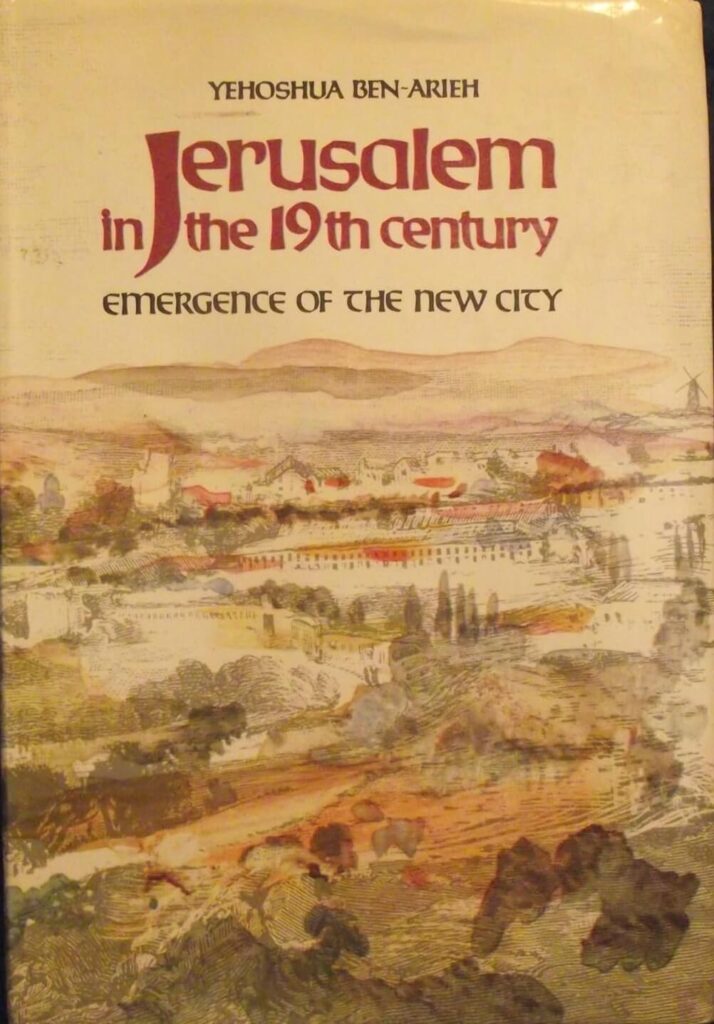
By the end of the nineteenth century, Jerusalem had grown to some 70,000 inhabitants, more than 40,000 of them Jews. It had become a thriving and rapidly developing city, experiencing an unprecedented wave of construction: churches, synagogues, mosques, neighborhoods, and public institutions were being built throughout the city. This transformation was led by the major European powers of the age—Britain, Austria, Russia, Germany, and France—with Spain, Italy, and Ethiopia also playing a role. The Greek Orthodox and Armenian Churches, as wealthy and influential local institutions, exerted considerable influence. At the same time, Protestant communities established firm roots in the country, while the Catholic Patriarchate was restored, bringing with it schools, charitable institutions, religious orders, and monasteries.
Critics
This book traces the remarkable evolution of Jerusalem during the 1800s, charting its growth from an isolated, secondary Ottoman town into a cosmopolitan metropolis that drawn global attention by the turn of the century.
For those fascinated by the history of the Holy Land or Eretz Yisrael, this work provides an exceptional overview. It documents the financial investments in the emerging urban center, the establishment of pioneering neighborhoods, the sacred landmarks, surrounding villages, and the heterogeneous population of Jerusalem between 1800 and 1900. The narrative is structured around specific communities, detailing the impact of international involvement with Muslim, Jewish, and Christian sectors. Throughout this era, Jerusalem underwent a radical metamorphosis: it shifted from a densely packed, disease-ridden city confined within the ancient walls of the Old City into a thriving urban expanse developing outside the walls. This new landscape was characterized by imposing architecture and a proliferation of internationally managed consulates and churches. This period was also defined by a demographic boom and significant immigration waves, which sparked the creation of new quarters that ultimately laid the foundation for modern Jerusalem’s contemporary geography.
Utilizing numerous historical travelogues to construct an engaging and informative narrative, the book is a captivating, highly informative read. Although the prose can occasionally feel slightly disjointed, it remains an essential and invaluable resource.
During the nineteenth century, Jerusalem’s population comprised three primary faith traditions: Islam, Christianity, and Judaism, each centered around its own sacred spaces. These broader categories were further fragmented by distinct theological interpretations—particularly among Christians—or by geographic origins and social structures, which was especially true for the Jewish community. The magnetic draw of various holy sites combined with this diverse demographic makeup deeply shaped the architecture and spatial distribution of the built environment. Ultimately, because of Jerusalem’s singular status as a sacred city, historical continuity remained the defining characteristic of its urban development leading up to the First World War.