

Abbasid Dynasty and Jerusalem
In the year 750 CE, the Abbasid dynasty ascended to power over the vast Muslim Empire, moving the capital from Damascus to Iraq and establishing Baghdad. This was the Golden Age of Muslim civilization. The dynasty continued to rule for more than 500 years until 1258, and for much of this time, they ruled over Jerusalem and the Land of Israel.
The Abbasid family originally came from Mecca and was related to the Prophet (Abbas was Muhammad’s uncle). However, the family had moved its seat from 700 CE to the ancient settlement of Humayma in southern Jordan, not far from Wadi Rum. Thus, the first three Abbasid Caliphs: al-Manṣūr, al-Mahdī, and al-Saffāḥ, were from southern Jordan, within the geographical sphere of the Land of Israel. At the time, there were many supporters of the Shi’ite and Abbasid cause in Jerusalem, and presumably, the first Abbasid Caliphs knew the city and had a sentiment for it.
The fifth in the lineage of Caliphs from the House of Abbas is Hārūn al-Rashīd, the greatest and most important ruler of the Islamic world (786–809). He visited Jerusalem as a boy, and when he became Caliph, he reportedly gave Charlemagne properties in the city. But the most famous Abbasid Caliph in the context of Jerusalem is al-Maʾmūn (ruled 813–833), who immortalized his name in an inscription on the Dome of the Rock.
In 831, Caliph al-Maʾmūn embarked on an expedition to the Great Pyramid, perhaps connected to the arrival of Dhū al-Nūn al-Miṣrī in Baghdad two years earlier—one of the greatest early Sufi scholars—who linked ancient Egyptian knowledge and hieroglyphs with Muslim spiritual wisdom. Al-Maʾmūn was the Caliph who established the House of Wisdom (Bayt al-Ḥikma). During his reign, Baghdad became the world’s center of learning, and the House of Wisdom was the most important university of its time, where disciplines such as algebra (by al-Khwārizmī), mathematics, astronomy, and philosophy flourished.
However, al-Maʾmūn was also interested in spirituality and dedicated a large part of his time to religious life and spiritual study. Therefore, he traveled to Egypt, which was regarded as the source of ancient wisdom, and even explored the Pyramids. On his way, he passed through Jerusalem and began restoration work on the Dome of the Rock, altering the building’s original dedication inscription. It can be assumed that while in Jerusalem, he studied the dimensions of the Dome of the Rock, delved into the secrets of the structure, and therefore wished to leave his name inscribed there as a memorial.
Al-Maʾmūn gathered knowledge from across the Muslim Empire, drawing on Jewish, Christian, and even pagan sources—and there was no place like Jerusalem as a center of wisdom. The idea al-Maʾmūn sought to promote was that human reason is a gift from God and should be used, cultivated, and employed to govern life, rather than relying on faith alone. In addition to founding the House of Wisdom, he championed the Muʿtazila movement (the rational theological school), sometimes by less wise means such as violent persecution.
Later, the Jewish scholar Saadia Gaon was exposed to the knowledge of the House of Wisdom and reflected it in his Book of Beliefs and Opinions in the 10th century. What exactly Caliph al-Maʾmūn brought from Jerusalem, what he learned in the Dome of the Rock, and why it was so important to him—since the building had been constructed by the Umayyads—and whether there existed a center of knowledge or a library in Ramla or Jerusalem at that time, remain open questions.
According to John Neal [1], there is a measure called the Black Cubit (Dhira’ Saudāʾ), equal to 54 cm (21.26 in), which al-Maʾmūn discovered during his journeys and which was used in sacred Arab architecture. This measure is close to the Egyptian Royal Cubit (approximately 52–53 cm), and it is possible that al-Maʾmūn learned it in Egypt. In addition, there was a measure that the Ottomans used as a module for their buildings, called the Builder’s (Sinan) Arşın, which is 72 cm (28.35 in). The Black Cubit is three-quarters of the Ottoman measure.
A regular cubit is 45 cm (17.7 in)—from the elbow to the tip of the finger—and was likely the measure used in the building of the Temple. The Egyptian Royal Cubit is 52–53 cm, obtained by adding four fingers—a handbreadth—to the regular cubit, which is divided into twenty-four fingers; thus, the Egyptian Royal Cubit is twenty-eight fingers or seven handbreadths. However, in Egypt, there was another cubit formed by adding an extra finger (perhaps a thumb), reaching 54 cm, and this is the Black Cubit. It was used for measuring the flooding of the Nile and the fields.
The cubit is related to the measurements of the human hand. Another common measure is the foot (approximately 30.48 cm). A stadium equals 600 feet (182 meters). A nautical mile (also called a geographical mile) equals 6,000 feet. One minute of arc on the Earth’s circumference corresponds to one nautical mile (1.852 km). In antiquity, the mile was calculated as 6,000 feet, and 60 nautical miles made up one degree of the Earth’s circumference. This forms a sexagesimal system related to the Earth’s dimensions. In addition, 12,000,000 Royal Cubits are approximately equal to the Earth’s polar radius.
The yard is the intermediate measure between the cubit and the foot; it equals two cubits, or twelve handbreadths, or three feet, thus connecting the measures of the hands and the feet. The land mile is related to walking measurements—one step was considered 2.5 feet, meaning that every 2,000 steps, or one thousand double steps, equaled a mile, equal to 5,000 feet (1.523 km). This was the measure used by the Romans and other ancient peoples. However, today the land mile is 1.609 km, due to changes in field measurements introduced by the English.

Charlemagne in Jerusalem
Charlemagne (768–814) saw himself as a messenger of God and as having the role of creating a just society. Unlike some kings before him, he ruled to serve society, not to be its master. In Christian tradition, he is regarded as a righteous king—one whose rule advanced the kingdom of heaven on earth. Indeed, the righteous rule of Charlemagne led to what is called the “Miracle of Europe.” The world’s cultural center shifted from the Mediterranean region—from Italy, Greece, and Constantinople—to the lands of Germany, France, and Britain, where it has remained to this day.
On December 25, 800, Charlemagne was crowned Emperor of the Holy Roman Empire by the Pope in Rome. The crown of the Christian Empire, which had previously been held by the Byzantine emperors, passed to another land and another ruler. Until then, the popes had recognized the Byzantine emperors as successors to the tradition of the Roman emperors—meaning the leaders of the Christian world—and from then on, they recognized the rulers of Europe. This change had great significance, and to emphasize it, at the coronation ceremony Charlemagne was presented with the keys to the Church of the Holy Sepulchre, which had been brought to Rome two days earlier by an envoy sent from Jerusalem.
The coronation of Charlemagne was perceived as part of a network of events that heralded a new era of redemption—events that had begun with the rise to power and consolidation of the Abbasid dynasty in Baghdad fifty years earlier. The Abbasids and Charlemagne shared common enemies—the Umayyads in Spain. Apocalyptic and eschatological expectations drew renewed attention to Jerusalem, where the events of the Day of Judgment were believed to take place. Charlemagne sent a delegation to survey the Christian presence, institutions, and buildings in the city.
The local Christian community sought the protection of the new empire that had arisen in the West, either in place of or in addition to that of the weakened Byzantium. The Abbasid Caliphate was then at the height of its power and influence, and it seemed that the new rising star of Europe held sway with it. The Abbasids were also apparently interested in maintaining good relations with the “king” of the Christians and allowed him to act in the Holy City.
Charlemagne was a learned man who promoted a cultural renaissance that came to bear his name. He knew Latin, studied the traditional Roman subjects of rhetoric, dialectic, and astronomy, and took great interest in Germanic writing and poetry. During his reign, the Latin script as we know it today was developed. His secretary, Einhard, was one of the leading scholars of the time, and together they established a network of monasteries that became centers of learning. The creation of this monastic network throughout Europe inspired the desire to build similar monasteries in the Land of Israel.
Thus, Carolingian sources report that Charlemagne built many structures in Jerusalem—monasteries, a guesthouse, a library, and a market—and also acquired estates in the Kidron Valley intended to finance these institutions. There is also a legend that he made a pilgrimage to Jerusalem himself. Nevertheless, no remnants of these institutions have been found, and among them, the most intriguing is the library. This period was marked by a cultural renaissance both in Europe and in the Abbasid Caliphate, expressed through the establishment of libraries and educational institutions, the most notable of which was the House of Wisdom in Baghdad.
One of Charlemagne’s most significant actions was the establishment of a permanent capital in Aachen, Germany—a kind of new Rome or Jerusalem. This move was of immense importance, as until then the court of the Frankish kings had been itinerant, and suddenly, by virtue of Charlemagne’s personality and authority, it became a permanent court. This effectively brought an end to ancient traditions. The step that legitimized this change was his becoming Emperor and leader of the Christian world, an idea expressed physically in the construction of a large church dedicated to the Mother of God, along with an adjacent governmental complex. The importance of the Church of the Mother of God in Aachen cannot be overstated; it was the first permanent Christian governmental structure of the Franks and embodied the greatness of Charlemagne and his deeds. In time, he was buried in the church itself.
1,100 years later, when the Germans, led by Kaiser Wilhelm II, built the Dormition Church on Mount Zion, they modeled it after the church in Aachen. The Church of the Ascension in Augusta Victoria likewise resembles it in its interior architecture. The inspiration for the design of the church in Aachen came from the churches in Ravenna, as well as from the Rotunda of the Church of the Holy Sepulchre and the Dome of the Rock. Following the completion of the church in Aachen in 805, Charlemagne identified himself with King David and King Solomon, while the church’s architect, Odo of Metz, was seen as a new Hiram or Bezalel. This may hint at a possible connection between Charlemagne and the later Freemasonic tradition.
Charlemagne developed the figure of the knight and was the first to articulate the ideal of chivalry (see chapter below), basing it on the legends of the warriors who had stopped the Muslims fifty years before his time, foremost among them Roland. During his reign, the foundations of the feudal society of the Middle Ages were laid. According to legend, one night a mysterious figure appeared to him in a dream, bearing a wondrous sword. The figure said: “Receive this sword from God to defend yourself, and read and remember what is written upon it, for these things will be fulfilled when the time comes.”
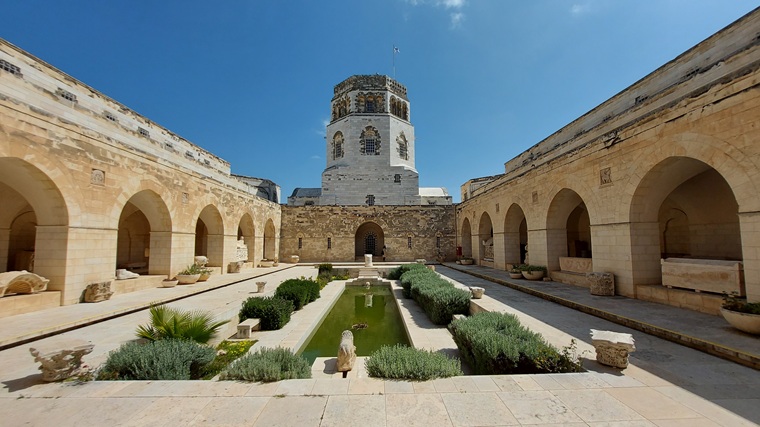
Hundred Years of changes
In 868, the Abbasid governor of Egypt, Aḥmad ibn Ṭūlūn, established a new but short-lived dynasty that ruled Egypt—and at times the Land of Israel—independently. Ibn Ṭūlūn was known for his religious devotion. He also took control of Jerusalem, and today there is a street in Wadi Joz named after him. During the Ṭūlūnid rule, the rights of Jews and Christians in the city were protected, and some sources claim that Ibn Ṭūlūn even appointed a Christian governor for Jerusalem. At that time, much of the land’s population was Shiʿite—half of Jerusalem’s population, according to the Arab geographer al-Hamdānī. During this same period, ʿUbayd Allāh al-Mahdī, the first caliph of the Fatimids, found refuge and concealment in the Land of Israel, residing in Ramla for two years.
Other heretical sects also found a home in Jerusalem. Aḥmad ibn Karrām (806–868), the founder of the Karrāmiyya sect, moved with some of his followers to Jerusalem even before Ibn Ṭūlūn’s rise to power, following the persecutions he had suffered in his homeland of Khorasan. He taught a literal interpretation of the Qurʾānic descriptions of God, claiming that God possesses a body—albeit one unlike any other—and that the divine Presence descends to the heavens during the final part of every night. He also taught that two guardian angels, Munkar and Nakīr, stand on either side of each person. The Karrāmiyya encouraged asceticism and seclusion, and it is possible that they were connected to the monastic traditions of the Judean Desert. Ibn Karrām died in Jerusalem and was buried near the Lions’ Gate in the same year that Ibn Ṭūlūn declared his independence.
However, the Abbasids did not give up, and in 905 they regained control of Jerusalem. Within the loose framework of their empire, the Ikhshīdid dynasty rose to power in Egypt, effectively establishing an independent rule over the Levant and Egypt—including Jerusalem—between 935 and 969. The founder of the dynasty, Muḥammad ibn Tughj al-Ikhshīd, had served as governor of Palestine in 920 and later as governor of Damascus and Egypt. The title Ikhshīd and the authority for hereditary rule were granted to him in recognition of his service to the caliph. The title itself originated from that of the rulers of the Fergana Valley in present-day Uzbekistan, the birthplace of Ibn Tughj’s family. He died in Damascus in 946 and was brought to Jerusalem for burial near the Golden Gate (Bāb al-Raḥma). He also adopted a tolerant policy toward Christians and Jews, even appointing a Jewish governor of Damascus.
In 969, Ikhshīdid Egypt was conquered by the expanding Fatimid Empire from its center in North Africa, marking the beginning of a new period in the city’s history. It is interesting to note that the leaders of dynasties such as the Ikhshīdids and of sects such as the Karrāmiyya sought, during the 10th century, to be buried in the city’s eastern part—the place from which the Messiah was believed to come and where the resurrection of the dead would take place.
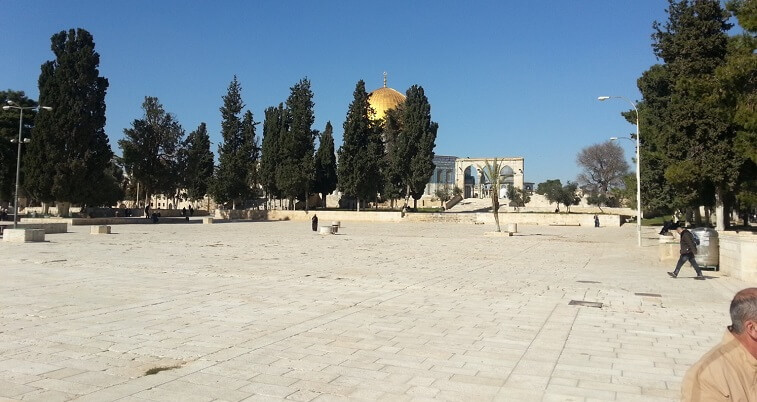
The New Muslim State
The Fatimid Empire competed with the Abbasid Caliphate of Baghdad for supremacy in the Muslim world and control of the Levant, at a time when the Abbasids were in continual crisis. However, toward the end of the 11th century, new and vigorous forces emerged in Baghdad—the Turkic peoples—who revived the Sunni current in Islam. The man who best embodied this trend and became the most influential figure of the period was the vizier of the revitalized caliphate, Nizām al-Mulk (1018–1092). The meaning of his name is “Order of the Realm,” and indeed, he established a new administrative order that endured for generations and, among other things, profoundly influenced Jerusalem.
Nizām was a learned and visionary man who had studied at the leading madrasa in Baghdad and had witnessed the weakening of Abbasid rule and the Shiʿite ascendancy in the Muslim world at that time. Following the Seljuk conquest of Baghdad in 1063, he became vizier of the empire and head of the Great Dīwān—overseeing finances, religious affairs, and effectively serving as the most powerful man in the realm.
In his youth, Nizām cherished an ideal of a “State of Justice,” which he articulated in his book Siyāsatnāma (The Book of Government). This work is a direct continuation of the classical ideal of the state as expressed by great philosophers throughout history, such as Plato, Seneca, and others.
An essential part of Nizām’s policy concerned religion. He regarded religion as a central means of achieving governmental legitimacy and of establishing a centralized and efficient state, while viewing the government itself as a tool for realizing the religious ideal. With his keen insight, Nizām recognized the potential of mobilizing the Sufi orders for the benefit of the new Islamic Sunni state. He was deeply attuned in spirit and belief to the Sufi understanding of Islam—a man who had grown up and been educated alongside some of the greatest Sufis of his time, the most renowned among them being the Persian poet Omar Khayyam.
The Sufi orders in Nizām’s time were centered in khānqāhs. The word khānqāh derives from khān—meaning guesthouse or inn. In its early days, the Sufi movement was a popular movement of individuals who withdrew from worldly vanities and gathered in inns along the roads; hence, the first Sufi centers were called khānqāhs. With the consolidation of the Sufi orders in the Middle Ages, the khānqāhs became social centers—places of learning and hospitality, of mystical practice, and also of charity, serving as soup kitchens for the poor and hostels for travelers and pilgrims. In each khānqāh there was usually a holy shaykh and his disciples, who lived a communal economic and social life. Muslim charitable endowments (awqāf) were often channeled through the khānqāhs, which were also known as zāwiya in Arabic and tekke in Turkish.
Nizām regarded the Sufi orders and their form of organization—social groups gathered around a shaykh—as ideal foundational units for a new society from which a state based on social and religious justice could emerge. He viewed them as ideal candidates to populate the madrasas—the schools dedicated to the study of Islamic law and the sciences—and to infuse them with spiritual vitality, believing that the two institutions could coexist and complement one another. He therefore mobilized government funding and official positions to establish Sufi khānqāhs throughout the Islamic world, linking the khānqāhs with the madrasas. This organizational model of Muslim society persisted for nearly nine centuries and continued to thrive under both the Mamluk and Ottoman Empires.
Nizām created a kind of renewed Islamic religious state, founded upon the institutions of the madrasa and the khānqāh, where it was taught that the state possesses an ethical and legal foundation, and that the Muslim state and government themselves are what matter—not any individual ruler, even if he be the caliph. The heavenly legitimacy once vested in the caliph as leader of the Muslims was replaced by the ideal of the Muslim state, which enables the realization of justice and provides the proper conditions for spiritual endeavor. The same students who studied during the day in the madrasas would, in the afternoons and evenings, sleep and engage in Sufi mystical practices in the khānqāhs, where they also served the public.
The madrasas and khānqāhs became not only schools for Islamic law and Qurʾānic interpretation but also universities for judges and selected officials. They offered instruction in theology, law, languages, literature, the natural sciences, and even politics—what we would now call political science. These institutions linked religion with the state and served as a foundation for propaganda against the Shiʿites. Students were required to obtain state approval for their studies and received monthly stipends; they had private rooms and attended lectures by the finest scholars.
The graduates of the madrasas and khānqāhs formed the backbone of the new Muslim state. They filled the ranks of the governmental and economic bureaucracy, as well as the military command. The extensive network of madrasas and khānqāhs established throughout the realm was named after Nizām—the Nizāmiyya.
In 1091, Nizām al-Mulk invited the most eminent scholar of the period, al-Ghazālī, to join him. Al-Ghazālī became the head of the most prominent Nizāmiyya in Baghdad. A few years later, however, he resigned from his post and set out on a personal spiritual quest along the Sufi path, engaging in its practices and spending periods of seclusion in Jerusalem—then still under Muslim rule—including retreats in its towers. In 1105, he returned to public life and collaborated with Nizām al-Mulk’s son to integrate the Sufi brotherhoods into the concept of the emerging Muslim state and to encourage their cooperation with the government. He was a religious thinker of a stature comparable to that of Maimonides and Nachmanides combined.
The creation of the new Muslim state, founded on righteous rule and the ideal of a religious state, marked the swan song of the early Muslim era and of Baghdad as a pan-Islamic cultural center. The nomadic Turkic tribes that conquered much of the Muslim world ushered in a new age of culture and prosperity. The Sufi orders became the mainstream expression of Sunni Islam—a situation that endured for more than six centuries. The establishment of this new Muslim state brought with it governmental support for the Sufi orders, leading to a golden age of the formation of orders, doctrines, methods, the writing of books and music, and the development of mystical practices.
When the Muslims, led by Ṣalāḥ ad-Dīn (Saladin), reconquered Jerusalem from the Crusaders in 1187, they brought with them the new order established by Nizām and founded dozens of khānqāhs and madrasas in the city. Some of these institutions were interconnected, and almost all received government support, serving as training grounds for the state’s bureaucracy, officials, and military personnel. Khānqāh Street in the Old City of Jerusalem is named after the great khānqāh established by Saladin near the Church of the Holy Sepulchre.
Footnotes:
[1] Neal, J. (2000). All done with mirrors: An exploration of measure, proportion, ratio and number. Secret Academy Press.
[2] The more precise measure is 6,076 feet (1,852 meters).

