The Romans Are Coming
The last great Hasmonean king was Alexander Jannaeus. He made an alliance with the Sadducees and killed Pharisees who tried to rebel against him. Alexander crucified 800 of his opponents in Jerusalem after slaughtering their families before their eyes—most of them Pharisees—no doubt an example of Jewish compassion. Thus began an eternal enmity between the monarchy—which also held the office of the High Priest—and the Pharisee sect supported by many of the people. It is possible that during this time some of the priests in the Temple left and moved to live in the Judean Desert, forming the Essene community.
After his death, his wife Salome Alexandra came to power and ruled for nine happy years (76–67 BCE). She tried to appease the injured parties and, true to her name, bring peace to the land. She drew closer to the Pharisees, restored their laws and rights, and at the same time protected the loyalists of Alexander. She had two sons—Hyrcanus and Aristobulus—and already during her lifetime the differences between them and their approaches to kingship became apparent.
Aristobulus made an alliance with the Pharisees, and upon the death of his mother, he seized Jerusalem and forced his brother, the official heir, to renounce the throne and be content with the title of High Priest. But the struggle continued: Hyrcanus, with the help of his advisor Antipater the Idumean and a Nabataean army, attacked Jerusalem, and in the end both sides turned to the Romans—who at that time had reached Damascus—asking for help and support for their claims. Pompey, the great general who had conquered the East, took advantage of the opportunity, conquered Jerusalem, and turned Hyrcanus into a puppet ruler, while the one who actually governed the country on his behalf was Antipater the Idumean.
For twenty years Antipater was the dominant figure in the politics of the Land of Israel, which continued to suffer from fraternal struggles and military campaigns. During this time, he appointed his sons as governors of provinces, with Herod appointed as governor of Galilee. In 43 BCE Antipater was assassinated, and a struggle for control of the Land of Israel began, involving foreign powers as well as the remnants of the Hasmonean family.
It is important to understand that the Romans were not necessarily evil, as described in Jewish sources, but brought to Israel a new culture of governance, law and order, security, and prosperity. The Roman period was the first in history in which an international money economy was established, and it was characterized by the development of cities, roads, and shipping, which connected the empire into a single global entity. Peace and technological progress brought social advancement.
Contrary to common belief, the Romans actually reduced taxes when they took control of the land and gave opportunities for those who wished to integrate into the new world order—and many Jews, especially among the upper classes, sought exactly that. In some respects, the Roman conquest of the Land of Israel benefitted the masses of the people.
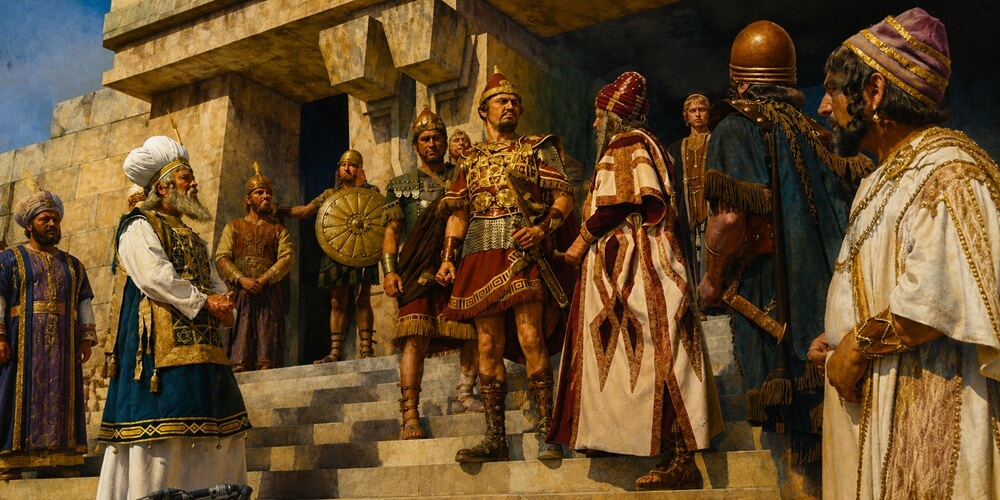
Rome was a state of law, and in cases where rulers were not corrupt—or in the case of a puppet ruler—there were significant advantages to belonging to the empire, such as military security. However, Rome at the time was in the throes of civil war, and Israel was a frontier state, and so the Parthians succeeded in conquering the land for several years. Only in 37 BCE, six years after his father’s death, did Herod take control of Jerusalem with the help of Roman spears, becoming King of Judea for 33 years (37–4 BCE).
The Rise of Herod
The young Herod received a Hellenistic education in Ashkelon and Maresha, as well as Roman citizenship and education, and he fully identified himself with the empire. He was one of the main supporters of integrating the Jewish people into the new Roman order. In addition to being King of Judea, he had many international connections, was an entrepreneur, the richest man in the land, and one of the wealthiest in the empire. Herod was involved in economics, politics, and international relations. He supported Julius Caesar, and afterward was received as an ally by Augustus, in whose honor he established the city of Caesarea in 25 BCE. In it he built a temple to the emperor, with a statue of Augustus in the style of the Olympian Zeus.
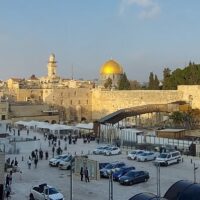
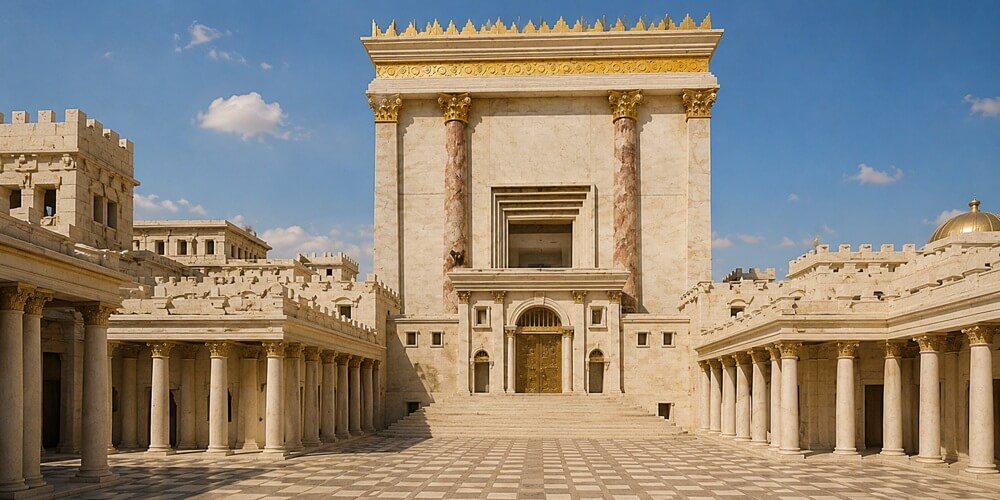
Some say that during Herod’s reign the Jewish population numbered close to four million, most of them within the borders of the Roman Empire, with a large diaspora in Babylonia under Parthian rule, and about one and a half million lived in Israel. The Jews comprised 5–10% of the population of the Roman Empire, with important Jewish centers in Alexandria in Egypt and Cyrene in Libya. About 50,000–100,000 Jews lived in Jerusalem, but during the festivals, and especially Passover, more than a quarter of a million Jews gathered there from all over the world. The city covered an area two to three times larger than today’s Old City, including the City of David and Mount Zion. The Temple was the social-religious center and the national symbol of Jews everywhere, but despite that, it was small compared with the First Temple, and poor in comparison with other temples of the ancient world.
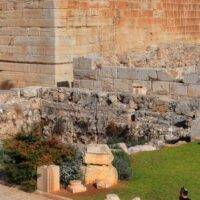
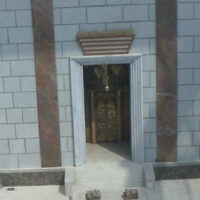
Herod began enormous building projects throughout the land immediately upon his rise to power, projects that reached their peak with the rebuilding of the Temple and the expansion around it beginning in 19 BCE. Herod’s aspiration was to build a temple that would amaze all who saw it, a world wonder that would stand alongside the other wonders of the ancient world, a structure that would symbolize the greatness and significance of the Jewish people. He wanted to build a structure of scale and dimensions never before seen in Israel, using the latest Roman innovations in architecture and construction. It was to be a building that placed Israel at the forefront of global architectural achievements and would serve as a source of national and religious pride and identity, while at the same time granting him legitimacy for his rule from the masses and the Jewish religious leadership.
The Temple Mount project was the pinnacle of Herod’s achievements, the source of his pride, and what he boasted of until his dying day—and not without reason. It was said of it: “He who has not seen Herod’s building has never seen a beautiful building in his life” (Babylonian Talmud, Bava Batra 3:2). The rebuilding of the new Temple carried religious and messianic aspects, as well as cultural and period-specific ones. Much has been said and written about Herod’s Temple. Josephus writes: “It was the work worthy of description above all that is under the sun. Those who had not seen the building could not believe it, and those who were fortunate enough to see it looked upon it with wonder” (Antiquities of the Jews XV, 411–416). Yet seventy years after Herod’s death and the completion of the project, in 70 CE, the magnificent Temple was destroyed during the Great Revolt. This, perhaps, teaches us that the true temple resides within man, not in splendid buildings.
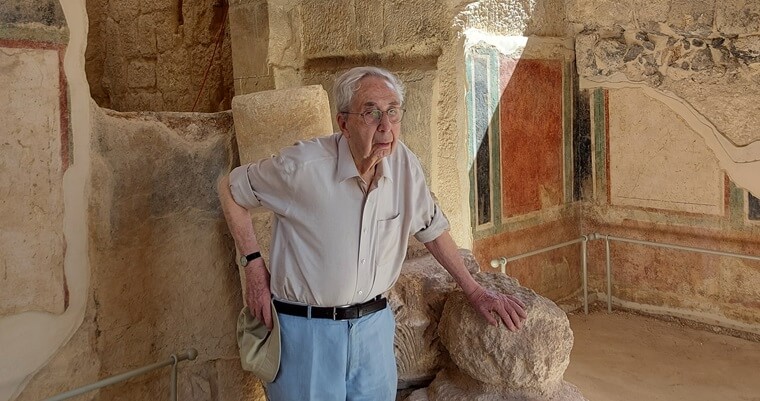
Professor Jodi Magness argues that Herod saw himself as a messianic king, and therefore his tomb was located opposite Bethlehem (the city of David)[1]. But she is not alone in this view: according to Abraham Schalit[2], Herod saw himself as a messenger of God, destined to renew the kingdom of David and Solomon, and thus he invested so much in the building of the Temple in Jerusalem and took pride in it. According to Schalit, Herod claimed Babylonian Jewish ancestry, thereby creating a possible link between his family and the House of David; this claim was extended by presenting himself as a descendant of Hillel the Elder.
Jacob Neusner argues[3] that Herod claimed Babylonian origins in order to establish a connection with the Davidic line. Magness further suggests that the appointment of Hananel—a Babylonian Jew—as priest in the Temple instead of a Hasmonean priest may have been part of Herod’s attempt at a religious revolution toward his own coronation as the anointed messiah.
Herod rebuilt the Tomb of King David in Jerusalem, perhaps because he saw himself as the heir and successor of David’s line (the messiah was to come from the House of David). He had an official biographer named Nicolaus of Damascus, upon whom Josephus relied for his descriptions[4]. From Josephus, one can reconstruct Herod’s biography according to Nicolaus, and it indeed resembles David’s biography in many of its features. According to Tal Ilan, Herod dictated to Nicolaus a biography that would highlight both men as kings chosen by God.
Furthermore, after Herod’s death, there was a sect called the Herodians, who apparently continued to believe in his divinity and perhaps in that of his descendants as well. The sect of the Herodians even appears in the New Testament. Writers from the 2nd–4th centuries CE, such as Epiphanius, mention the Herodians, who believed Herod was the messiah.
Herods Temple
The Golden Age
There is an interesting synchronicity between the reign of Augustus—the most important Roman ruler of the greatest empire, the reign of Herod—the greatest builder in the Land of Israel, when it reached its peak of expansion in the Second Temple period, and the appearance of Jesus a few years after Herod’s death—the most significant religious figure in the world until our own day. All three operated during the same period.
According to Mircea Eliade[5], the rule of Augustus was perceived by the Romans as the “second birth” of the empire, a change in the cosmic structure, a new point of origin, a rebirth. Therefore, time began to be counted from the 25th year of Augustus’ reign (17 BCE), when the beginning of the long-awaited harmonious Golden Age was proclaimed—the Age of Saturn—celebrated with great festivities (the Secular Games of 17 BCE).
Following this rebirth, Rome was to exist forever, world peace would come, a golden race would appear across the world, and Apollo would rule it. So it was written in the Aeneid, composed by Virgil, the court poet of Augustus. There was a renewal of rituals and ceremonies everywhere. Augustus rebuilt ruined temples and erected new ones, restored prophetic centers and priestly functions, such as the Sibyl’s sanctuary at Cumae. The declaration of the Roman Golden Age under Augustus became prominent in 19 BCE, with the publication of Virgil’s Aeneid. It is not by chance that in precisely that same year, Herod decided to begin the construction of the Temple Mount complex and the Temple itself. According to Josephus, one of the reasons Herod gave was his friendship with the Romans.
Augustus saw himself as a divinely favored king who became a god after his death through the process of apotheosis. Therefore, he built an impressive tomb structure that expressed this idea in Rome. It was an enormous mausoleum composed of several concentric circular buildings, one within the other, rising to a height of 42 meters with a diameter of 90 meters. At first, a round palace-like building was constructed; later, in the second stage of construction, the entire complex was covered with earth, forming a giant mound (somewhat like a pyramid) within which stood the circular tomb structure.
The tradition on which Augustus relied originated in Egypt and was found in many cultures, including the Hellenistic one. Thus the tomb of Philip, father of Alexander the Great, in Vergina, Greece, looked similar, and it may be that the lost tomb of Alexander himself also had this form. Augustus saw himself as the successor of Alexander—and Herod, in turn, seems to have seen himself as the embodiment of the Jewish messianic king, contemporary of Augustus.
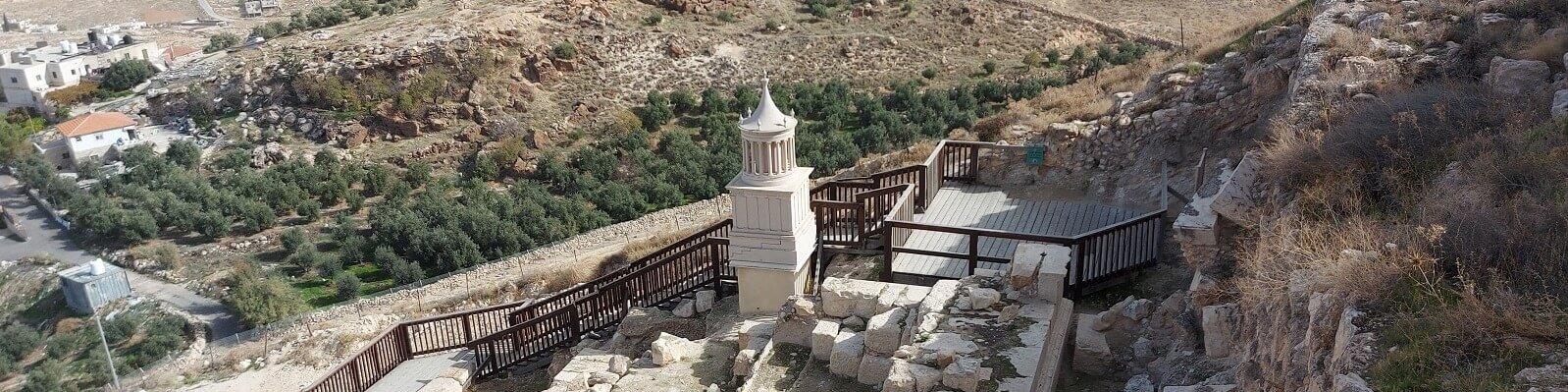
In 17 BCE, two years after beginning the Temple’s reconstruction, Herod came to participate in the Saturnian Games—the Golden Age—in Rome. On the way, he passed through Olympia and contributed to the Olympic Games, which symbolized international sacred time. There is no doubt that this event was deeply significant in Herod’s life and worldview. For him, Augustus was equal to the biblical Cyrus—the anointed of God—and he, Herod, was the messianic king of the House of David. Herod contributed to the festivities and built his own tomb at Herodium as a copy of Augustus’ tomb in Rome—a massive radial structure reflecting the tradition of imperial Roman burial monuments.
According to Jodi Magness[6], Augustus’ tomb gave Herod the inspiration for the design of his magnificent tomb at Herodium, expressing the conception of apotheosis—the transformation of a man, especially a king, into a god. Scholar Ehud Netzer and others have likewise argued that there are similarities between the mausoleum of Augustus and that of Herod, and that the tomb structure—and indeed the entire mountain—was a kind of monumental nefesh (soul-anchor, tomb monument)[7].
Augustus built around his burial place an artificial mound, like the tumuli in Macedonia, Greece, Etruria, and Anatolia. Many other ancient-world structures associated with the idea of apotheosis were likewise mound-shaped. This is why Herod built a round palace at the summit of his mountain, covering it with earth and leaving only the tomb building itself exposed, oriented toward Jerusalem. Thus the appearance of Herodium recalled the other tumuli of the ancient world.
After the Battle of Actium (30 BCE), Herod accompanied Augustus on a visit to Egypt, during which they visited the tomb of Alexander. According to Magness, Alexander’s now-lost tomb influenced the design of Augustus’ tomb in Rome and Herod’s tomb at Herodium. Alexander’s tomb, which has disappeared, was built as a giant mound, expressing the conception of Alexander as a god (reborn from the cosmic egg). It seems that Augustus went to the same sacred places where Alexander had gone in order to receive confirmation of his rule—Samothrace, Perperikon in Thrace—and like Alexander, he also became Pharaoh, king of Egypt. In addition to Augustus’ tomb, Magness argues that the design of Herodium may also have been based on the tomb of Antiochus I Theos of Commagene on Mount Nemrut, where a massive artificial mound, 50 meters high, was erected on the mountain’s summit a few decades before Herod’s death—and which he may well have known of.
One must understand that Roman emperors engaged, some more and some less, in the mystery religions, and some even underwent the initiation rites (mysteria) of antiquity. This explains, in another light, the “madness” of certain emperors such as Nero, who was intended to be a philosopher-king and was initiated by the great Stoic sage Seneca. Being exposed to the spiritual light too early made him lose his mind. It is possible that Herod, too, was exposed to such spiritual teachings.
The concept of apotheosis (the transformation of man into god) began in Egypt and passed to Rome through Greek culture. Thus the Argead dynasty of Philip and Alexander saw itself as ruling by divine grace, with its founder, Heracles, as a man who became a god. Magness relates that during Herod’s visit to the Olympic Games in Olympia he was appointed honorary president of the games and became acquainted with the Philippeion—the building erected by Philip of Macedon at Olympia to commemorate his family. This provided yet another source of inspiration for Herod’s tomb.
In the end, however, the one who became divine was not Herod, nor even Augustus, but a strange and world-renouncing man named Jesus of Galilee, who was crucified in Jerusalem as one of the criminals a few years after these two great kings. The soldiers mockingly called him “King of the Jews,” yet he proved to the world that true kingship is the kingship of heaven, dwelling within the inner life of man, and not measured by earthly power. As Zosimos the hermit, discoverer of Alexander’s lost tomb, is said to have declared: “Thus passes the glory of the world.”
Footnotes
[1] Magness, J. (2019). Herod the Great’s Self-Representation Through His Tomb at Herodium. Journal of Ancient Judaism, 10(3), 258-287.
[2] Schalit, A. (1960). Herod the King – The Man and His Work [Hebrew]. Jerusalem: Bialik Institute
[3] Neusner, J. (1965). Herod the Great: A Rabbinic Perspective. In The Glory of God Is Intelligence: Four Lectures on the Role of Intelligence in the World of God (pp. 45–63).
[4] Ilan, T. (1998). King David, King Herod and Nicolaus of Damascus. Jewish Studies Quarterly, 5(3), 195-240.
[5] Eliade, M. (1978). A History of Religious Ideas, Volume 1: From the Stone Age to the Eleusinian Mysteries. Chicago: University of Chicago Press.
[6] Magness, J. (2019). Herod the Great’s Self-Representation Through His Tomb at Herodium. Journal of Ancient Judaism, 10(3), 258-287.
[7] Segal, A. (1973). Herodium. Israel Exploration Journal, 27-29