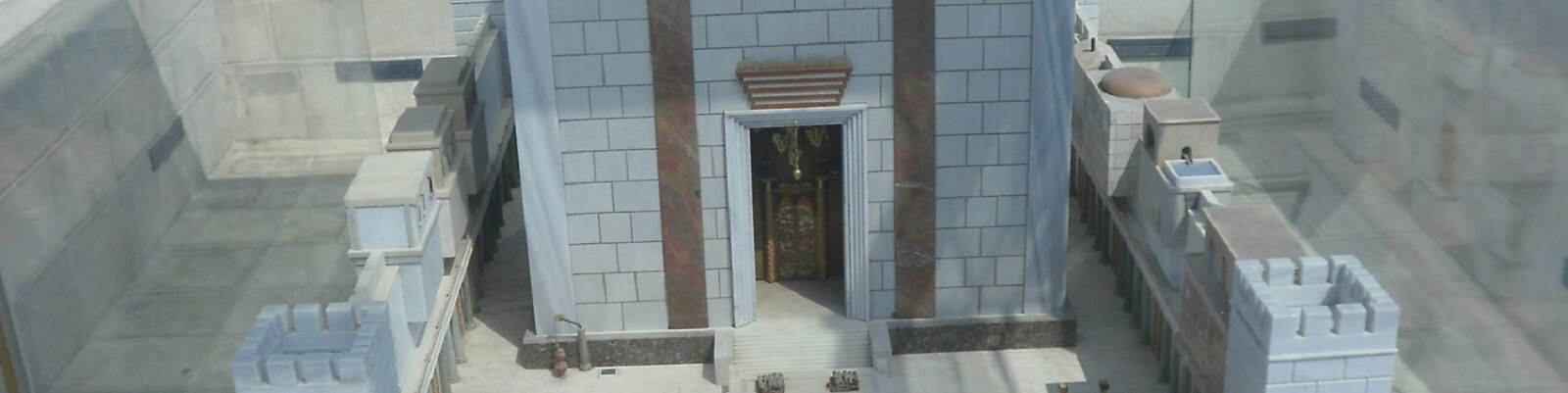
The Building of the Second Temple
In 586 BCE the First Temple was destroyed by Nebuchadnezzar of Babylon, and the Jewish people went into exile in Babylon. Forty-seven years later, in 539 BCE, the Persians defeated the Babylonians and established a mighty empire that stretched from India to Africa. King Cyrus II (the Great), who is called in the Bible “the Lord’s anointed,” gave the Jews permission to return to their homeland and rebuild their Temple. At that time there were 150,000 Jews living in Babylon (far more than those who had arrived there), of whom 42,000 decided to move to Israel. The returnees were led by two princes of the House of David, Sheshbazzar and Zerubbabel, and a high Zadokite priest named Joshua.
The economic situation of the settlers was difficult, and they delayed the building of the Temple out of fear that they would not be able to complete the project and build a temple as magnificent as that of Solomon. But the prophets encouraged them and reminded them that splendor was not important, but the act itself. They claimed that the building of the Temple would bring about many blessings and healing. The perception was still a magical one, claiming that the very sacred act would change the energies of the land and the people and bring a solution to all their problems.
The prophet Haggai who prophesized in 520 BCE told the Israelites that the glory of the Second Temple would be greater than that of the first: “The glory of this latter house shall be greater than of the former, saith the Lord of Hosts” (Haggai 2:9). Zechariah prophesied in that same year and in the same spirit, and together with them was Malachi, whom some say was the literary hidden name of Ezra the Scribe. Thus, the prince Zerubbabel lead the rebuilding of the second Temple, which was inaugurated in 516 BCE, exactly seventy years after the destruction of the first one. Who Zerubbabel was is not entirely clear; some say he was the grandson of Jehoiachin, and thus from the line of David.
In the new Temple there was no Ark of the Covenant, for it had been lost, and the Holy of Holies remained empty, but the spirit of prophecy had not yet departed from the land at the time of its establishment. It can be said that the Second Temple was in some respects more important than the First Temple, since alongside it institutions encouraging the study of Torah operated. The light that went out from the Temple illuminated the religion that existed afterwards. Thus, there were interpretive streams in Judaism that claimed that the Divine Presence of the Second Temple surpassed that of the First. However, a little after the time of Haggai the prophetic chapter in the history of the Second Temple and the people of Israel came to an end, and there were no more prophets, only sages.
Judah was a province in the Persian Empire, but many Jews continued to live in other places in the empire, especially in Mesopotamia and Persia. Thus it happens that during the reign of King Ahasuerus, who was most likely Xerxes at the beginning of the 5th century BCE, the event of the Scroll of Esther takes place in the royal court, an event that shows the important role of the Jews in the empire. After the days of Ahasuerus, Artaxerxes I rose to power, ruling for 40 years. Some say he was the son of Queen Esther. He supported the immigration of Ezra to Israel and later in his reign appointed Nehemiah as the ruler of Judea, for a long period there was Persian rule friendly to Judaism.
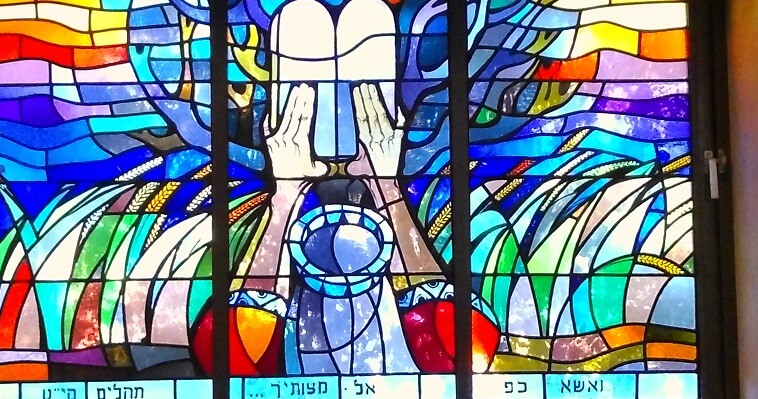
great Synagogue Jerusalem mosaic windows
Ezra and Nehemiah
In the days of Artaxerxes there was a cultural and religious Persian renaissance, and Zoroastrianism became a kind of state religion. The empire adopted a solar calendar as the national calendar (which means a kind of religious uniformity centered on the sun as the representative of good), and the period was characterized by peace and prosperity. Artaxerxes is mentioned in the Book of Ezra as the one who appointed Ezra to be responsible for the civil and religious affairs of the Jews in the province of Judah. In 458 BCE he sent Ezra with learned men and priests to Judah, and some say he even financed the expedition. Ezra went up to Jerusalem as a royal representative with a budget from the king and authority to judge the people, together with 1,800 Jews from Mesopotamia and Persia.
Ezra was a man of spirit and a scribe in the king’s court who took upon himself the great mission of compiling the Torah and reviving the laws of Moses, and therefore he is called “Ezra the Scribe” and also “the second Moses.” Ezra committed the Torah books to writing, and afterwards sent messengers throughout the Jewish world to announce that on the eve of Rosh Hashanah the Torah written by Moses would be read in the Temple in the presence of the people. Since most Jews no longer spoke Hebrew, he arranged for the presence of interpreters at the Torah reading, and from this the first school, the first institution of Torah translation, called “Midrash,” was later founded. Ezra established decrees and safeguards for the Torah and the Jewish religion, instituted Torah reading every Monday and Thursday, and began the tradition of the Oral Torah. Thus the Temple became a place of study and wisdom, and not only of sacrifices. Ezra changed the Hebrew script to square Assyrian letters and added the cantillation marks.
In 445 BCE Artaxerxes appointed his Jewish cupbearer Nehemiah to be governor (Satrap) of Judah on behalf of the Persian administration. Nehemiah was the actual ruler of the land, collecting taxes and enforcing law and order. Nehemiah became governor of Judah on behalf of the Persian Empire three years after Ezra’s arrival in the land and remained in his position for 12 years. This gave the growing Jewish community the power to promote social reforms, rule of law and develop economy, it contributed to the independent status of Judaism and the Jews.
Nehemiah’s most important enterprise was the building of the walls of Jerusalem, which symbolically separated the Jews from their Samaritan and other neighbors. Together with Ezra he signed a new covenant between the people and God at the conclusion of the Feast of Tabernacles, in which the Israelites committed to observe all the commandments of the Torah and to support the Temple and the priesthood. As part of the religious reform, the tradition of Torah reading began. Two years after he officially finished his post, in 431 BCE, Nehemiah came to Judah with soldiers to support the Temple and the Jewish population.
Ezra and Nehemiah were actively supported by King Artaxerxes, but even before him and after him one can see active Persian support for the Jewish settlement in the Land of Israel, and it did not stop there. The Persians settled Jewish soldiers on the island of Elephantine in southern Egypt (near Aswan) and allowed them to build their own temple. The closeness between the Persians and the Jews, the designation of Cyrus as “Messiah,” testifies not only to common political interests but also to philosophical influences and spiritual closeness between the two peoples.
Persian Rule in Jerusalem
We do not know much about the period after Ezra and Nehemiah, and in general about the time of Persian rule in Israel, which lasted over 200 years. Persia was a magical culture and a vast empire that controlled enormous territories from India to Kush, and allowed autonomy and cultural independence to the peoples within it, on the basis of cooperation and trade. The Persians replaced Egypt as the center of magic in the world, and an expression of this is the word “magic,” which originates in the Persian Magi cult (the priests). However, it can be said that in this period “the generation was diminishing”, and this was expressed in the gradual disappearance of prophecy.
Judah was a Persian province and enjoyed the developed road system, peace, and trade of the empire. From the days of Ezra and Nehemiah until the time of Simeon the Righteous, the Jewish people were led by the Men of the Great Assembly who gathered in the courtyards of the Temple—sages, elders, and apparently also high priests and prophets. Among them were Haggai, Zechariah, Malachi, Ezra, Nehemiah, and Zerubbabel. It can be said that the Great Assembly was a kind of spiritual school whose role, among other things, was to seal the Bible and edit its books. The Men of the Great Assembly, from their religious authority, composed prayers such as the Amidah prayer and established festivals such as Purim. In Tractate Avot it is written that the prophets handed the Torah over to the Men of the Great Assembly; the meaning here is undoubtedly its hidden and essential significance.
At first this institution had 120 members, and it served as the political and religious leadership of the Jews. The authority of the Great Assembly derived from the Temple service, which in part still had magical characteristics. The last and greatest of the Men of the Great Assembly was Simeon the Righteous, in whose time miracles occurred and it seemed that the Temple would return for a moment to its former greatness. After Simeon the Righteous, the Sanhedrin appears as the body that led the people, with 71 members.
It is interesting to note that the Knesset of the State of Israel is composed of 120 members, similar to the Great Assembly, and not of 71 or 70 representatives like the Sanhedrin. The word Sanhedrin is of Greek origin, and the activity of the Sanhedrin was like that of a Greek civic council or body of wisdom, whereas the Great Assembly was of Persian background and its activity was connected to religious ritual and the summoning of the spirit of prophecy. The founders of the state chose to echo the Persian magical-spiritual orientation in their choice of the name of the Israeli parliament and its number of members, and thus to differentiate themselves from the Greek Western culture.
The number 70 is connected to the planetary system of seven planets seen moving in the sky, while the number 120 is connected to the fixed stars, the zodiac circle, and the annual cycle. The spirituality of the Persian period continued to some extent the ancient astral theology that related to the number 12 and the fixed stars, while the astrology of the Hellenistic period is planetary astrology, that is, on a somewhat lower level in terms of influences. The transition from spirituality connected to the number 12—which appears in the time of the wandering in the desert, the building of the Temple (the celestial diagram), and in the time of Abraham—to a lower spirituality symbolizes the spiritual decline (the generation diminishing) that occurred with the years, which took place in parallel with the act of tikkun and the approach of redemption, in the sense of contraction and revelation.
They say that everything reaches its peak before its end, like the darkest part of the night before the sunrise. So it was also in the time of Simeon the Righteous. A new culture appeared in the world and changed human culture, thought, and religious life, constituting a challenge to Judaism and bringing about its development and adaptation to the new world. Alexander the Great conquered the Land of Israel and the Persian Empire and brought about the beginning of Hellenistic culture and period. When he came to Israel in 332 BCE he met Simeon the Righteous and received his blessing.
Simeon the Righteous
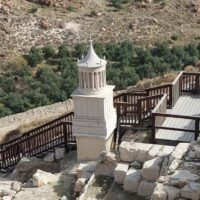
North of the Old City there are several important Jewish sites from the Second Temple period, including the large tombs of the Sanhedrin, the small tombs of the Sanhedrin, the Tombs of the Kings, and others. One of the important sites is the Tomb of Simeon the Righteous, whose uniqueness is that it relates to the greatest and last Jewish sage and high priest of the Persian period, just before Hellenism broke onto the stage of the history of Jerusalem and the world.
Simeon the Righteous was a high priest, leader of the people, sage and preacher, and also a kind of prophet. In the Talmud it is told: “For the forty years that Simeon the Righteous served, the lot always came up in the right hand (testimony that the Holy One accepted the people’s repentance on Yom Kippur). From then on sometimes it came up in the right, sometimes in the left… and the western lamp (the eternal flame in the Temple) kept burning; from then on sometimes it burned, sometimes it was extinguished. And the fire of the altar (for sacrifices) grew stronger and the priests did not need to bring wood to the altar except for two logs to fulfill the commandment of wood. From then on the power of the altar fire weakened, sometimes growing stronger, sometimes not… and a blessing was sent in the omer and in the two loaves and in the showbread, so that every priest who received an olive’s bulk ate and was satisfied, some ate and were satisfied, and some even had leftover. From then on a curse was sent in the omer” (Jerusalem Talmud, Yoma 33:2).
According to legend, the one who led Alexander the Great in his conquests, the figure that appeared before his spirit, was Simeon the Righteous. The story goes: Simeon the Righteous and priests dressed in priestly garments stood before Alexander at dawn in Antipatris (the Yarkon springs). Alexander descended from his chariot and bowed before him. The people present asked Alexander: “A great king like you bows to this Jew?” He said to them: “The image of this man’s face triumphs before me in battle.”
The Jewish Priests asked Alexander: “Why have you come?” and added: “Is it possible that the house in which prayers are offered for you and your kingdom not to be destroyed should be destroyed by gentiles?” Thus the plot of the Samaritans to destroy the Temple was thwarted.
According to historians, the one who met Alexander was not Simeon but his grandfather Jaddua, who was the last high priest of the Persian period and is mentioned in the Bible. Jaddua supported Darius III, and he in turn supported Judaism and the Jews and enabled the growth and strengthening of the Jewish community. Of all the peoples of the region the Jews were those with the greatest natural increase. Because of his support for Darius, Alexander came up to Jerusalem; Jaddua went out to meet him, and the important encounter took place in this context. The son of Jaddua was Onias I, his grandson Simeon I, and some say Jaddua brought him with him to the meeting.
In any case, Simeon the Righteous symbolizes a transition in Judaism from prophecy to wisdom —he was the last priest connected to the spirit of prophecy, from then on, whilst still having some magical elements, Judaism would focus on study, wisdom and interpretation.
Simeon the Righteous acted at a time of world transition from the magical theocratic cultures of Persia and Egypt to cultures of thought, universality, and civic society in the cities of Hellenism. Persia was a magical culture, and the Persians were considered the magi of the ancient world. They had a priestly cult called magi who practiced magic, and the Jews also had a tendency toward it. The Hellenistic age heralded the rise of reason, the revelation of truth before the sun, and the world of logic and study, in which the priesthood no longer had an important role. Precisely at this time, towards the end of an era, appeared the greatest high priest of all, to leave his mark and memory for future generations.
The Tomb of Simeon the Righteous is located in the Sheikh Jarrah neighborhood of East Jerusalem. It is possible that this tomb was actually the tomb of a Roman matron named Julia Sabina. Some claim that there were two high priests named Simeon the Righteous, and that the tomb is of a priest from a later period, but the identification of the place as the tomb of the first Simeon the Righteous is ancient, and as it is said, what is important is the faith. The burial cave serves as a place of prayer and study; next to it there is another burial cave called the Cave of the Small Sanhedrin, a mikveh, and a yeshiva where Torah is studied. Simeon the Righteous used to say: “On three things the world stands: on the Torah, on the service, and on acts of loving-kindness”—and for the wise that is sufficient hint.
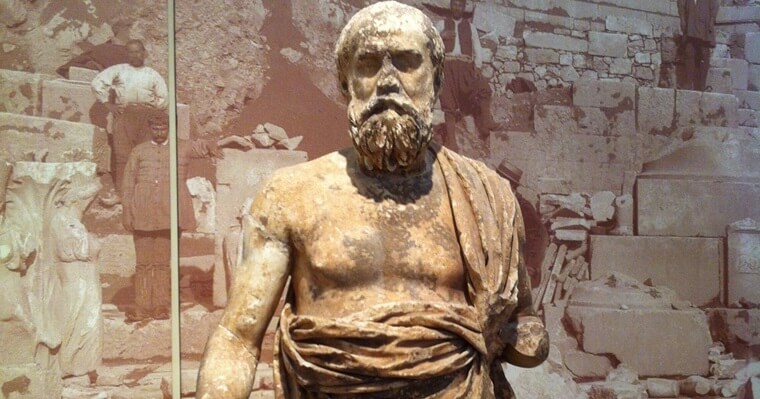
Simeon II and the High Priests
The important people in Jerusalem at the end of the Persian period and the beginning of the Hellenistic period were the high priests. Jerusalem was under the rule of the high priest, who was also a political leader and sometimes also military, as well as a religious leader. The city was considered a city of priests: more than 10% of the population in the early Persian period, and perhaps also in the early Hellenistic, were priests. Unlike the First Temple, there were many more priests than Levites, whose number was only a few hundred and who engaged mainly in singing. It can be assumed that between one and two thousand priests lived in Jerusalem, and the domain of this kingdom of priests extended from Modi’in to the Dead Sea, from south of Bethlehem to Ramallah. In other words, Jerusalem was a temple-city, similar to Thebes in Egypt, and in addition to sacrifices there were other activities in the Temple such as study and the writing of books.
The high priests were from the family of Zadok; sometimes when one of them died his brother inherited him, and sometimes the son, and thus there were sometimes inheritance struggles. The priestly-royal family was also called the House of Onias and belonged to Jedaiah’s priestly division, originating from the high priest of the Return to Zion, Jeshua son of Jehozadak. A priestly division that competed with Jedaiah for primacy was the priestly division of Jehoiarib, to which the Hasmoneans belonged, and the two other main priestly divisions were Bilgah, many of whose members tended toward Hellenization, and Pashhur.
The high priests were considered men of wonder, and they played an important role in the events of the time. Until the end of the Persian period they are mentioned in the Bible (Book of Nehemiah) by name, with the last priest in 350 BCE being Jaddua. Afterwards we know Onias I, who was probably the one who met Alexander the Great. He “reigned” for 20 years at the beginning of the Hellenistic period, and after him Simeon I, whom Josephus identifies as Simeon the Righteous (instead od his great grandfather).
The high priests were very learned men; they were part of the council (gerousia) that later became known as the Sanhedrin, that included besides priests also sages, scribes, and secular leaders such as those of the House of Tobiah. The high priests had contact with the outside world, as heads of state, and it can be assumed that they also knew languages, especially Greek. Onias I corresponded with Sparta, and after Simeon I, Eleazar became high priest, in whose time the Septuagint translation of the Bible into Greek was written. According to the Letter of Aristeas, Ptolemy sent one of his officials (Aristeas) to Eleazar with gifts asking him to send men to translate the Torah for the library in Alexandria. Eleazar sent 72 elders who in 72 days translated the Torah and discussed with the king and his courtiers matters of philosophy. Eleazar is presented as a wise philosopher who explains, for example, in an allegorical way the prohibition of eating certain foods in Judaism.
After Eleazar there was a short term of a family member (an uncle) named Manasseh, after him Onias II, and then came the turn of one of the most important and holy high priests, Simon II. The author of the Book of Ben Sira notes that Simon left a deep impression on everyone who met him. “How glorious he was when he looked out from the tent of the Holy of Holies in the Temple and when he came out from behind the curtain. Like a shining star among clouds, like a full moon on the festival days, like the sun shining on the King’s Temple, and like the rainbow appearing in the cloud.” The unique appearance of Simon II the Righteous reflected his unique qualities, and these were expressed in his service in the Temple and in the heavenly response to his sacred acts. He stood out not only in his title and sacred service, but also in his deeds. In his time the Temple was strengthened and a large water reservoir was dug beside it.
Simon II served for a long time during the transitional period between the rule of the Ptolemies in the land and the rule of the Seleucids. He supported Antiochus III (the father of Antiochus the Wicked, who was considered favorable to the Jews), and promoted settlement in the land[1]. During the Persian and Hellenistic periods, the Jewish population in Judea grew both in absolute numbers and relatively, becoming the most significant factor in the region. The Hellenistic period brought prosperity and growth, trade expanded despite wars, and agriculture flourished.
Simon II had two sons. One became High Priest after him, Onias III, but his other son Jason coveted the priesthood and managed to obtain it thanks to his Hellenistic inclinations and his support of the new ruler who rose to power in Antioch, Antiochus IV (the Wicked). Thus the high priesthood passed from men of righteousness who preserved the Jewish religion to men who adopted Greek culture. However, Simon II also raised during his life a spiritual son, Antigonus of Socho, one of the earliest sages and the teacher of the first pair of Tannaim (the period of the Pairs), who became the president of the Sanhedrin and head of the court, namely – Jose ben Joezer and Jose ben Johanan. From this time onward, two tendencies, two streams, began to take shape in Judaism: one connected to the priestly tradition of the House of Zadok and called Sadducees, and the other connected to the tradition of the sages, who were not priests but led the people and society, and they were the Pharisees.
When Jason took control of the high priesthood, the sages, who were not necessarily priests, became more important and led the Jewish people instead of the Hellenized priests. The problem with Jason was that he relied on a priest from a less important division named Menelaus, who eventually deposed him and became a kind of collaborator, an agent of Antiochus the wicked, introducing idolatry into Jerusalem and the Temple. The ongoing struggle between Jason and Menelaus led to religious decrees against Judaism and to a direct clash between the Greek authorities and the Maccabees and their supporters (more on that later).
notes
[1] With the withdrawal of the Ptolemies from the Land of Israel, some of their supporters moved to Egypt.