The Essenes on Mount Zion
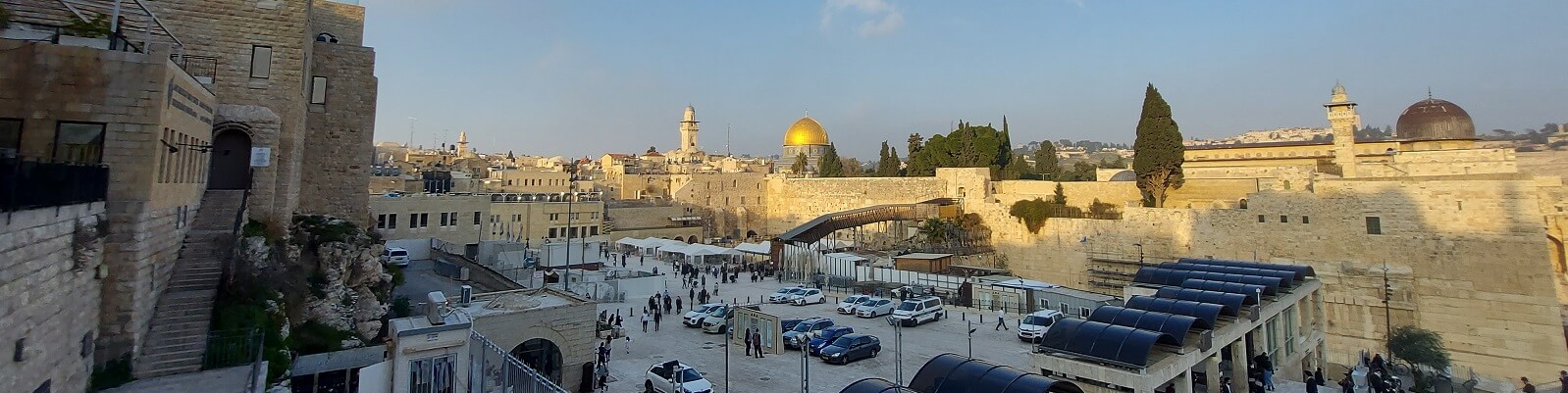
In the 2nd century BCE a crisis erupted among the priestly circles in the Temple, with the termination of the high-priestly line of the sons of Zadok and the transfer of the office to the Hasmoneans. This crisis involved the Essenes, who came from priestly circles close to the Zadokites, and therefore regarded the Temple from that time onward as defiled. Some of them moved to the Judean Desert to establish another kind of sanctuary, a community-temple—the Camp of the Children of Israel, as in the time of the wilderness of Sinai—all in expectation of the End of Days, when a new divine Temple would come down from heaven to Jerusalem. They saw themselves as the “sons of light,” and the world, including the priesthood in the Temple, as the “sons of darkness,” and yearned for the End of Days when light would triumph. Yet apparently some of them nevertheless remained in the holy city, or later returned to it, and established a living neighborhood on Mount Zion.
The Essenes lived in sacred spiritual communities and claimed to preserve the original Judaism of Moses. They had their own solar calendar and their own books, such as the Book of Jubilees. They are described by writers of the period such as Philo of Alexandria and Josephus Flavius. Most scholars identify them with the Qumran community and the Dead Sea Scrolls[1], but maintain that there were other Essene communities throughout the land, and a particularly important one in Jerusalem, since Jerusalem was regarded as the Camp of the Shekhinah, like the encampment of the tribes of Israel in the wilderness.
According to Josephus[2], the Essenes lived lives of morality and purity, practiced medicine, and knew the secrets of stones and plants. They knew the names of the angels, kept them secret, attained longevity, believed in the eternity of the soul and the temporality of the body, and practiced prophecy. One who attained the rank of “the Maskil” (the enlightened one) was obliged to teach others. They believed that the resurrection of the dead would not be in the body but only in the soul, contrary to the vision of the dry bones and the mainstream Jewish belief in the resurrection of the body. In Essene terminology, the Messiah was a man who had attained a high spiritual level and came from the priestly class. Levi was anointed with oil as a symbol of knowledge, integrity, truth, faith, and prophecy.
Josephus also claims that among the Essenes there were groups of married men, and that in Jerusalem there was a place called the Gate of the Essenes. Indeed, archaeologist Pixner found outside the gate in the wall of Mount Zion a ritual bath (mikveh) with a double descent separated by a partition, in accordance with Essene custom. According to Essene law, one who experienced a nocturnal emission had to leave the camp, purify himself outside, and not re-enter until morning. This fits the existence of the mikveh at the spot, from which Pixner concluded that the gate was the Essenes’ Gate and that their neighborhood was on Mount Zion.
According to Philo of Alexandria (20 BCE–40 CE)[3], the Essenes were righteous and upright, devoted to moral teaching and spiritual exercises which they had received from Moses; their way led to inner freedom. Philo describes the practices of the Therapeutae, who were similar to the Essenes and lived in Egypt. According to him, their practice included intellectual study, poetry, discipline, and self-control; this was done in a special room in a house called a monastery. There they engaged in allegorical interpretation of the Torah, using ancient books containing the secrets of the spiritual path (perhaps apocryphal books such as Enoch). If so, there may have been an Essene monastery on Mount Zion in the 1st century BCE.
According to Rachel Elior[4], the number seven, which underlies the Book of Jubilees, was important both to the Essenes and to the priests in the Temple. The Book of Jubilees presents a solar calendar which, apparently, some of the priests in the Temple and the sectarians of the Judean Desert followed. The calendar consisted of 52 weeks, that is 364 days—four seasons of 13 weeks each. In each season two months had 30 days and the last month had 31 days. The transitions between the seasons fell on the solstices and equinoxes. Thus each of the three months in the four seasons began on a fixed day: the first, the fourth, and the sixth days of the week. The source of this solar calendar was divine, and its dates appear in the story of the Flood and the recession of the waters. The solar calendar and the jubilee cycle created sacred time.
Enoch, the seventh generation from Adam, studied the books of wisdom, ascended to heaven, and became Metatron. He established the septenary calendar. The Essene spiritual experience was one of encounters with angels and luminous beings, seeing visions and revelations in heaven. Likewise, Levi the son of Jacob was of high spiritual rank. Levi’s revelation is described in the Testament of the Twelve Patriarchs, a 2nd-century BCE book that emphasizes the important role of the tribes of Levi and Judah. Levi was granted a revelation, and like Enoch he was charged with disclosing the secrets to mankind, removing the veil separating the spiritual from the physical worlds. In another revelation he received the office and garments of the priesthood from seven angels. The task of the holy priests, then, was to purify themselves and connect with angels of the heavenly host, and together with them to determine the destinies of men. It was possible for enlightened individuals to ascend on high—and this was later reflected in the twenty-four elders of the vision of John.
Josephus Flavius tells of a prophet in Jerusalem named Menahem the Essene, who prophesied to Herod about his kingship and his destiny, and that Herod honored him and the Essenes because of this. According to Israel Knohl, Menahem was apparently the partner of Hillel the Elder, who left him, and in his place came Shammai (hence the schools of Hillel and Shammai). Menahem the Essene left Jerusalem amidst disagreements with the rabbis, taking with him eighty pairs of disciples. The reason was his involvement with the Work of the Chariot (Ma‘aseh Merkavah), and therefore the Mishnah forbade engagement with the Work of the Chariot by a single individual.
According to Knohl[5], the Hodayot Scroll (Thanksgiving Hymns) found at Qumran, which contains a psalm in which a man likens himself to God, was written by Menahem. It reads: “Who among the gods is like me, who can stand against the openings of my mouth and the flow of my lips? Who can match me in tongue and resemble my judgments? For I am the beloved of the King and a companion of the holy ones.” These are words of heresy and ecstasy, reminiscent of the shathiyyāt—ecstatic hymns of the early Muslim mystics such as Bistami (see below)—who said things like “How exalted am I” or “I am You for all time.” Its discovery at Qumran suggests that Menahem and his companions reached there, though at some point some of them returned to Jerusalem.
The “Jerusalem above” is the heavenly pattern of the Temple that was shown to Moses on Mount Sinai. According to Jewish thought in the Second Temple period, this was not necessarily a city that would descend ready-made from heaven, but rather something meant to be constructed by human beings. Therefore, when Herod rebuilt the Temple, he was performing an act of redemption; and once it was built, it could not be destroyed. Herod was merely an instrument in the hand of God. The belief in divine decree apparently enabled some of the Essenes to accept Herod’s deeds, especially in light of the fact that his predecessors, the Hasmoneans, had—according to the Essenes—taken the wrong path, usurping the high priesthood, and particularly Alexander Jannaeus, whom they regarded as a false priest and a son of Belial. Herod’s extermination of the Hasmonean dynasty could have been perceived as a divine decree, a justified punishment, and might explain a renewed Essene settlement in Jerusalem.
In any case, on Mount Zion there was apparently an Essene quarter. This was traditionally the residential area of the priests, part of the Upper City. This can be seen in the abundance and type of ritual baths (mikva’ot) uncovered in archaeological excavations on the hill. It is therefore reasonable to assume that the dwelling place of the Essenes—who were of priestly origin—was on Mount Zion. This also emerges from a story in the New Testament, in which Jesus instructs his disciples to look for a man carrying a jar of water in order to prepare the Passover meal in his house. At that time only women carried water jars on their heads, and the unusual case was that of the Essenes (since the water jar symbolized purity). The disciples found a man carrying a water jar (Mark), and the Last Supper was held in his house. Since the house was in the Mount Zion area, we may infer that distinguished Essene families lived in the Upper City of the Second Temple period.
According to the Testament of the Twelve Patriarchs, found at Qumran, the Essenes believed in a Teacher of Righteousness—a messiah from the house of Levi and Aaron who was their Teacher of Righteousness—after whom was to come a messiah from the house of David. Therefore, the two most important tribes for them were Levi and Judah. Hence they attached great importance to King David, in whose dynasty they saw the legitimate heirs to kingship, in contrast to the despised Hasmoneans. Interestingly, in the area of the Essene quarter on Mount Zion, the Tomb of David was later identified. The identification is late, but the structure itself dates from the end of the Second Temple period, and it may have been built by Herod, given the large stones employed in its construction.
Mysteries in the Tomb of David
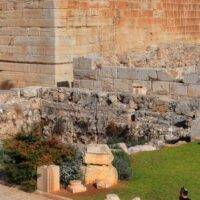
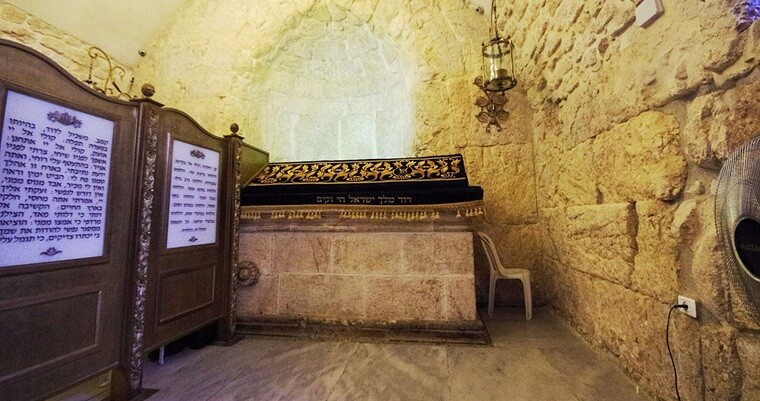
The Tomb of David is a large complex located on Mount Zion, and in its lower part stands an ancient structure of large (Herodian) stones containing the burial place of King David. Above the burial chamber is the Christian Room of the Last Supper (Cenaculum), and above that an inactive mosque. This was the holiest place for Jews until the Six-Day War, and even today it is under the authority of the Ministry of Religious Affairs. Around the tomb there are study halls, spaces for prayer, charity, ritual, and pilgrimage. Some believe that the place was an ancient synagogue, one of the seven synagogues of Jerusalem at the end of the Second Temple period. Yet it should be understood that in the Second Temple era, a synagogue did not serve for prayer as it does today.
In 1913, the archaeologist Raymond Weill discovered a Greek inscription (the Theodotus Inscription) in the City of David, which had been at the entrance of a synagogue. In it, the function of the synagogue is described: a place for the reading of the Torah and the study of commandments, an inn, and ritual purification baths (mikva’ot). A synagogue was the spiritual and social center of a community, and it is possible that the Tomb of David was a synagogue of a similar spirit belonging to the Essenes—a place where they studied the sacred books together in a closed circle at night, as was done in Qumran and elsewhere, a kind of monastery.
Between 1854–1861, an Italian named Ermete Pierotti served as city architect of Jerusalem, employed by the Ottoman authorities. This gave him access to all the holy places, including their hidden underground parts. He discovered a large space beneath the Tomb of David, explored subterranean areas under the Temple Mount complex, and in 1864 published a book entitled Jerusalem Explored[6], in which he described what he had discovered. He later left the city following a scandal connected with his past.
One of Pierotti’s most important discoveries was a large space beneath the Tomb of David. He entered twice beneath the tomb into a huge cave, 65 meters long, 15 meters wide, and 4 meters high, from which rooms branched off. The cave has not been rediscovered since, but his description matches those of elaborate Jewish burial caves from the First Temple period. It is therefore quite possible that this was a burial cave for kings of the Davidic dynasty from the 8th–9th centuries BCE, after the original tomb in the City of David had filled, or that it was the place to which bones connected with the House of David—and perhaps even David himself—were transferred, hence its sanctity.
This astonishing fact corresponds with Jewish belief in the existence of tunnels and caves beneath Mount Zion in which King David resides. Jewish legend tells that David did not die but lives on, concealed within the caves inside the mountain until the time when Israel will need him, at which point he will return. Various people who supposedly descended into this cave system are said to have encountered a venerable elder. Indeed, in the open area near the Tomb of David at the summit of Mount Zion there is an entrance to an impressive cave system.
According to the Kabbalistic interpretation of the letters, the name Zion hints at a spiritual ideal connected through the transmission of energy: a proper earthly kingdom that will enable the Kingdom of Heaven upon the earth. The letter Tsade (צ) is linked to idealism, hidden qualities, justice. The letter Yod (י) to spiritual energy. The letter Vav (ו) to connection between things. And the letter Nun (נ) to the transmission of energy from place to place. Jerusalem is the physical place, while Zion is the spiritual quality, and therefore people labor to call it Jerusalem, the City of Zion. Thus, it is fitting that the Tomb of David, or the kings of the House of David, be located on Mount Zion.
King David represents the Sefirah of Malkhut (Kingship), through which the worlds are created, the dwelling place of the Shekhinah. His role was to establish a righteous kingdom on earth, by virtue of which the Kingdom of Heaven could manifest. The Tomb of David is a place where Psalms are recited. King David is connected with tikkunim (spiritual rectifications), especially the Tikkun Hatzot (Midnight Rectification), because he is called “the one who awakens the dawn”: he would rise before dawn to pray to God. The dawn signifies not only the day but also the dawn of humanity. The place is important to the Breslov Hasidim, who customarily visit it annually. They make pilgrimage to a triangle of sites during the Tishrei festivals: on Rosh Hashanah to the tomb of Rabbi Nachman in Breslov, on Yom Kippur to the tomb of Rabbi Shimon bar Yochai, and on Shemini Atzeret to the Tomb of David on Mount Zion.
It should also be noted that King David is holy to Muslims as well, and he is the one who will weigh the deeds of the faithful on the scales of Judgment Day. In the stained-glass window of the Cenaculum hall (the Last Supper) there is a verse from the Qur’an that says: “O David! Indeed, We have made you a vicegerent upon the earth, so judge between people in truth and do not follow desire, lest it lead you away from the way of the Lord” (Qur’an, Sura 38:25).
At the same time, scholars argue that David is not actually buried in the Tomb of David on Mount Zion, since according to the Bible he was buried inside the city, which in his time had not extended to Mount Zion. The tradition of the Tomb of David on Mount Zion developed only in the last thousand years, initially among Christians, and was later accepted by Jews and Muslims. This is connected with the existence of the Room of the Last Supper above the tomb (see the chapter on the Last Supper). In any case, my father, Professor Yehoshua Ben-Arieh, argued that the fact that so many people have believed for more than a thousand years that this is the Tomb of David is enough to make it so.
The Old City as a Temple
John Michell (1933–2009) was one of the leading figures of the New Age movement in Britain beginning in the 1960s. He was a friend of the Rolling Stones and wrote books on energy lines and earth mysteries in England. Michell studied the sacred architecture of the Temple in Jerusalem and argued that it is the key to the secret knowledge concerning man and the world. The Temple is a kind of philosopher’s stone revealed in a heavenly vision to David, as appears in I Chronicles 28:12: “the pattern of all that he had by the Spirit, for the courts of the house of the Lord and for all the chambers round about.” Likewise, it contains sacred proportions and mysteries, as appears in Revelation 11:1: “And there was given me a reed like unto a rod; and the angel stood, saying, Rise, and measure the temple of God, and the altar.” Newton attempted to decipher the meaning and secrets of the Temple’s structure, as the Templars had before him, followed by the Freemasons and others—and John Michell continued in their path.
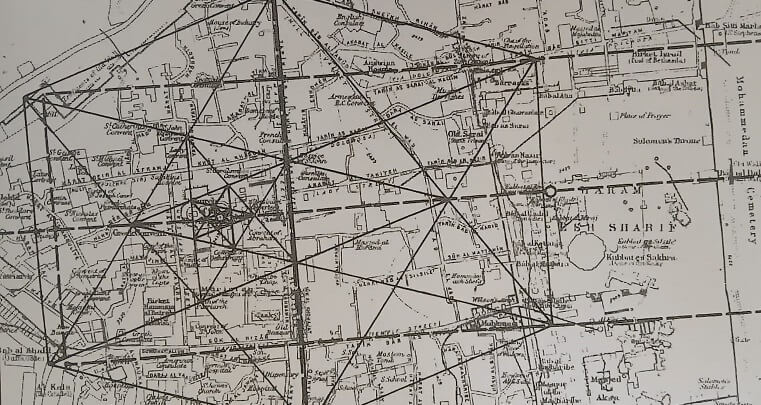
In 1999, Michell visited Israel as the guest of Dr. Yizhak Hayut-Man, and there he had a revelation. He discovered that in addition to the sacred proportions of the Temple itself, the entire Old City had been designed and built as a kind of super-temple[7]. This appears in the layout of the streets and in the placement of the main walls and buildings. Michell identified two patterns in the street grid of Jerusalem: the first is a network of rectangles oriented on an east–west axis (many of the streets of the Christian Quarter are arranged according to this grid), and the second is a network of rectangles arranged on a north–south axis, parallel to the Western Wall (many of the streets of the Muslim Quarter are arranged according to this grid). In addition, there are two focal points of the city’s urban design. One is the presumed site of the Temple, at the Dome of the Spirits on the Temple Mount, and the other is the Rock of Golgotha. These two points relate to each other, are situated on an east–west axis, and the two street-grid patterns of Jerusalem and the other sites align according to them.
According to Michell, the original planning of Jerusalem’s street grid was carried out by the architects of Herod, who, at the king’s request, incorporated into the city’s design two perspectives expressed in two different grid patterns. Herod wished to unite, through the city’s architecture, the pagan and the Jewish perspectives. About 150 years later, Emperor Hadrian completed the urban design along these same guiding lines. The opportunity came to him after the Great Revolt and the destruction of the city. From the old city, Hadrian preserved only what suited Herod’s master plan and completed it. The result was a city named Aelia Capitolina, an exemplar of sacred architecture.
Michell’s proposal is not far-fetched, since one of the characteristics of sacred sites and capital cities in the ancient world is that they were often built according to two axes, two perspectives, two orders, and sometimes even two systems of measurement, as Lubicz showed in his book The Temple of Man[8]. In the urban design of Rome, too, one can discern two axes and directions that govern the arrangement of the streets and the distances between the different sites[9].
The sacred planning of the city of Jerusalem began from the Temple. Michell accepts the proposal of Professor Asher Kaufman[10] regarding the location of the Temple—north of the Dome of the Rock, at today’s Dome of the Spirits, on the east–west axis connecting the Mount of Olives, the Golden Gate, and the Church of the Holy Sepulchre—and begins to measure the distances and arrangement of the streets from there. There are currently three proposals for its location: the first, by the architect Tuvia Sagiv, claims that it was between the Dome of the Rock and the al-Aqsa Mosque, at the spot where the present-day water installation—the Tankiz Cup—is located, on the axis of the Tower of David (Jaffa Gate) and Absalom’s Tomb[11]. The second holds that it was at the site of the current Dome of the Rock, and the third is that of Professor Kaufman, which John Michell accepts.
Herod’s planning of the Temple Mount esplanade was apparently influenced by the sacred complex at Baalbek and/or the temple courtyard at Cyrene in Libya, and likewise the urban design of Jerusalem was influenced by the urban design of Rome. This, of course, recalls Masonic theories about secret knowledge embedded in architecture at that time and transmitted from generation to generation in builders’ guilds and architectural schools.
The Temple had to be built according to the proportions written in the Torah, and Herod expanded upon them, constructing a super-structure over the existing building. Yet he was limited in his interpretation there. This was not the case with the esplanade and auxiliary structures within it, and the other buildings of the Old City, where he gave free rein to his imagination—or rather, to the principles of sacred architecture. He built an esplanade that was not a necessity (slopes or terraces could have sufficed for visitors), but into which he invested great resources, creating what would become the foundation for the sacred urban planning of the city.
Examining the street grid of Jerusalem reveals that the two points from which one can begin to measure and place the city’s streets and sites are Golgotha Hill in the Church of the Holy Sepulchre and the Temple site on the Temple Mount. These two points are the primary fulcrums of the urban street design of Roman Jerusalem—Aelia Capitolina—a city that partly relied on Herodian Jerusalem and forms the basis of today’s street system. The problem with this theory is that Golgotha Rock lay outside the city walls in Herod’s time (and that is why Jesus was crucified upon it), and it is appropriate to mention here that my mother, Sarah Ben-Arieh, an archaeologist who excavated the Third Wall in the eastern part of the city, contributed to this determination.
However, this problem is resolved when we measure the distances between the Mount of Olives and the Temple site, and between the Temple site and Golgotha Rock. It turns out that the distance between the Mount of Olives and the Temple site—960 meters—is an exact multiple of the distance from the Temple to Golgotha Rock—480 meters. This leads to the hypothesis that Golgotha Rock, a prominent stone outcrop, was intentionally hewn and left outside the walls of Jerusalem as part of Herod’s design. The builders of the Temple may have carved out a rock column to the west, half the distance between the Temple and the Mount of Olives, to serve as a kind of energetic support for the Temple (similar to the principles of Feng Shui). For this reason, this area remained outside the city walls and was made a place of executions, just as the place of purification (the burning of the red heifer) was to the east outside the city walls. And perhaps for this reason, Jesus “chose” to be crucified there. In any case, the redesign of Jerusalem’s walls, sites, and streets in the time of Herod and Hadrian made the entire Old City a kind of temple.
Footnotes
[1] Flusser, D. (1985). The Dead Sea Scrolls and the Essenes [Hebrew]. Tel Aviv: Ministry of Defense Publishing.
[2] Josephus Flavius, & Schalit, A. (Trans.) (1955). Antiquities of the Jews [Hebrew translation]. Jerusalem: Bialik Institute.
[3] Philo, D., S. Daniel-Nataf, & Niehoff, M. (1986). Writings [Hebrew]. Jerusalem: Bialik Institute.
[4] Elior, R. (2002). Temple and Chariot, Priests and Angels, Sanctuary and Heavenly Sanctuary in Early Jewish Mysticism [Hebrew]. Jerusalem: Magnes Press, The Hebrew University.
[5] Knohl, I. (1993). The Sanctuary of Silence: The Priestly Torah and the Holiness School [Hebrew]. Jerusalem: Magnes Press.
[6] Re’em, A. (2013). “Pierotti’s Cave”: On the Subterranean Space beneath the Tomb of David on Mount Zion. City of David and Ancient Jerusalem Studies, 8, 101–129 [Hebrew].
[7] Michell, J. (2000). The Temple at Jerusalem: A Revelation. Boston: Weiser Books.
[8] De Lubicz, R. S., & Lawlor, D. (1998). The Temple of Man. Inner Traditions.
[9] Ben-Arieh, Z. (2021). Sacred Italy [Hebrew]. Jerusalem: Prague Publishing.
[10] Kaufman, A. S. (1983). Where the Ancient Temple of Jerusalem Stood. Biblical Archaeology Review, 9(2).
[11] Shkarka, T. S. (2008). Rocks and Water for Identifying the Place of the Temple on the Temple Mount: “His Rock Is Perfect, His Waters Are Faithful.” Techumin – Torah, Society and State; A Halakhic Collection, 28, 471–501 [Hebrew].